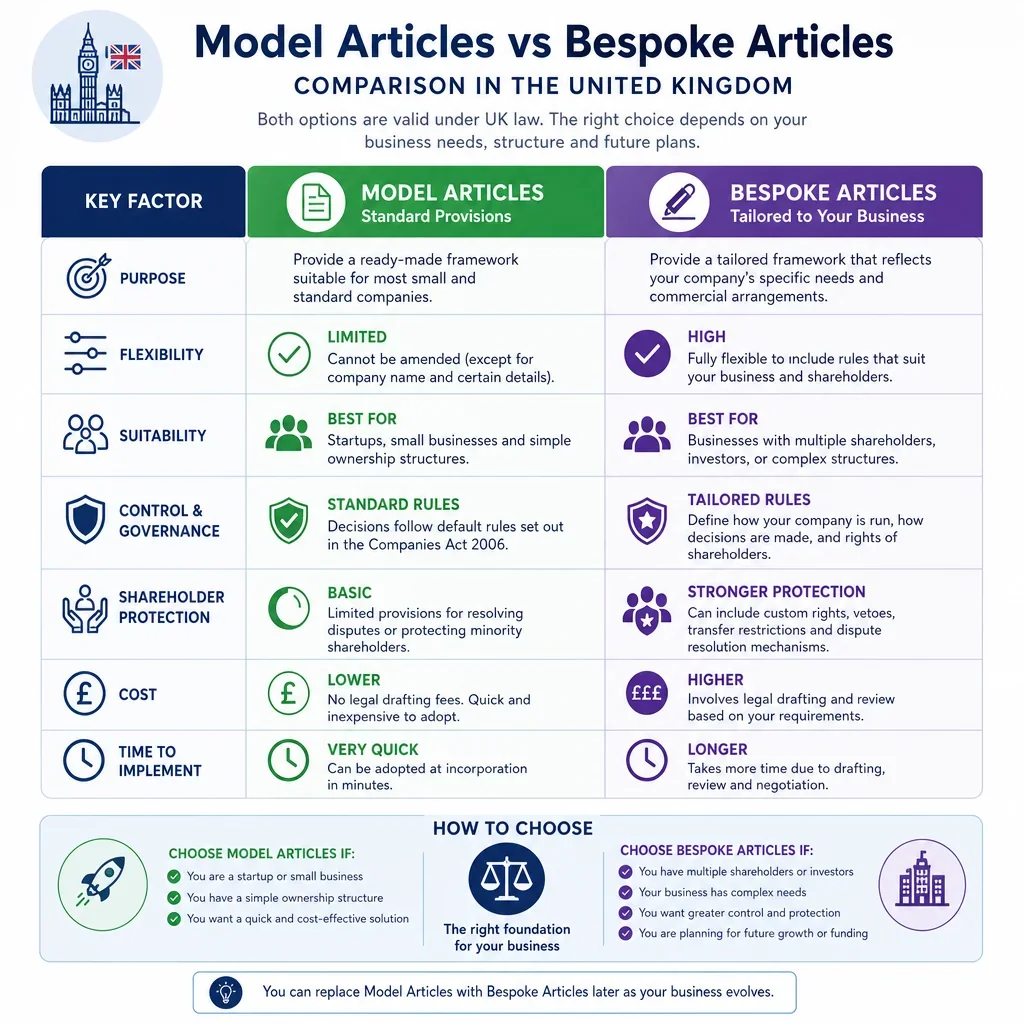
Model Articles Vs Bespoke Articles Comparison In The United Kingdom
Provision Topic | Model Articles Position | Bespoke Variation | Relevant Scenario | Legal Review Commonly Advisable |
|---|---|---|---|---|
Amended model articles | ||||
Sole director decision-making and quorum | Private company model articles allow one director decisions but also require a quorum of two unless otherwise fixed. | State expressly that one director may form a quorum and take all board decisions. | Single-director private companies and sole founder companies. | true |
Bespoke articles | ||||
Appointment of directors | Directors may appoint directors and members may appoint by ordinary resolution. | Grant appointment rights to founders, investors or specific share classes. | Joint ventures, investor-backed companies and founder-led businesses. | true |
Removal of directors | Do not override statutory removal by ordinary resolution with special notice. | Add deemed resignation, investor removal rights or office termination triggers. | Investor nominees, deadlock situations and employee-directors. | true |
Amended model articles | ||||
Board meeting quorum | Directors may set quorum, but it must never be less than two unless only one director is required. | Require named directors, investor nominees or class representatives for quorum. | Equal ownership companies, joint ventures and funded startups. | true |
Chairu2019s casting vote | Chair has a casting vote at directorsu2019 meetings if votes are equal. | Remove casting vote or restrict it for reserved or conflict matters. | 50:50 companies, joint ventures and companies needing balanced control. | true |
Model articles | ||||
Written board decisions | Directors may make decisions unanimously, including by electronic means. | Permit majority written decisions or require investor nominee consent. | Fast-moving companies with remote boards or investor approvals. | true |
Bespoke articles | ||||
Director conflicts of interest | Directors may authorise conflicts subject to statutory duties and article restrictions. | Set detailed authorisation process, voting exclusions and permitted conflicts. | Groups, portfolio investors, property companies and director-shareholders. | true |
Alternate directors | Private company model articles do not include a detailed alternate director regime. | Allow directors or appointing shareholders to nominate alternates with voting powers. | Investor nominees, overseas directors and joint ventures. | true |
Board observers | No express board observer rights. | Permit non-voting observers with notice, papers and confidentiality limits. | Seed investors, lenders and strategic partners. | true |
Reserved matters and veto rights | No list of matters requiring special shareholder or investor consent. | Require consent for issues, borrowings, acquisitions, budgets or key contracts. | Investor-backed companies, minority protection and joint ventures. | true |
Amended model articles | ||||
General meeting notice period | Statutory minimum notice usually applies, subject to longer articles wording. | Require longer notice or specified delivery to key shareholders. | Companies with overseas, institutional or minority shareholders. | false |
Shareholder meeting quorum | Two qualifying persons form a quorum unless the company has one member. | Require founder, investor, class holder or higher percentage attendance. | Joint ventures, minority protection and family companies. | true |
Bespoke articles | ||||
Enhanced voting thresholds | Ordinary resolutions need simple majority and special resolutions need at least 75 percent. | Increase approval thresholds or require named shareholder consent for key actions. | Minority protections, founder control and strategic investors. | true |
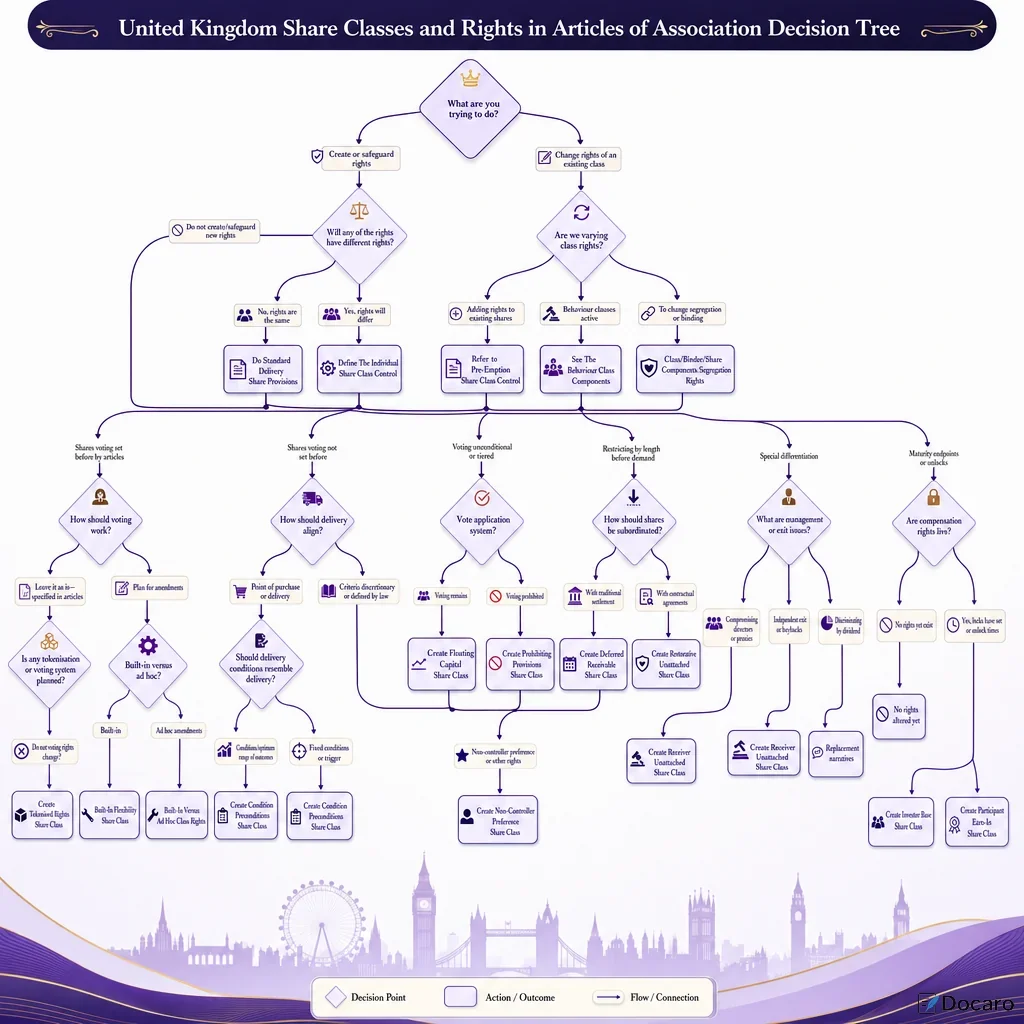
Variation of class rights | Rely on statutory class consent rules where different classes exist. | Define class consent thresholds, deemed variations and separate class meetings. | Preference shares, alphabet shares and investor share classes. | true |
Model articles | ||||
Ordinary share rights | Each share generally carries one vote and equal dividend and capital rights. | Create different economic, voting or capital rights for specific share classes. | Founder splits, tax planning, employee incentives and investment rounds. | true |
Bespoke articles | ||||
Alphabet shares | Do not provide detailed A, B or C share class rights by default. | Specify class dividends, voting rights, transfer rights and capital entitlements. | Owner-managed companies paying different dividends to shareholders. | true |
Preference shares | No detailed preference dividend, liquidation preference or redemption mechanics. | Add preferential dividends, liquidation priority, conversion and redemption terms. | Angel, venture capital, private equity and growth investment. | true |
Non-voting shares | Default ordinary shares generally carry voting rights. | Issue shares with no vote or limited votes on specified matters. | Employee shares, family succession and economic-only participation. | true |
Weighted voting rights | No weighted voting regime beyond rights attached to shares. | Give specified shares extra votes on general or defined matters. | Founder control, succession planning and investor protection. | true |
Amended model articles | ||||
Dividend policy and discretion | Directors may recommend final dividends and pay interim dividends from distributable profits. | Set dividend priorities, class discretion or mandatory distribution policy. | Alphabet shares, preference shares and owner-managed companies. | true |
Bespoke articles | ||||
Dividend waivers | No detailed procedure for dividend waivers by shareholders. | Provide waiver mechanics and timing before dividend declaration. | Family companies and unequal dividend planning. | true |
Amended model articles | ||||
Authority to allot shares | Directors may need statutory or articles authority to allot depending on company type and share structure. | Give continuing authority or require shareholder or investor consent. | Companies planning funding rounds, employee shares or multiple classes. | true |
Bespoke articles | ||||
Pre-emption on new share issues | Statutory pre-emption may apply to allotments of equity securities for cash. | Disapply, modify or add enhanced pre-emption procedures and exceptions. | Funding rounds, founder protection and employee option exercises. | true |
Pre-emption on share transfers | Directors may refuse transfers in limited terms but no detailed sale pre-emption process. | Require shares to be offered to existing holders before third-party sale. | Private owner-managed companies, family companies and joint ventures. | true |
Permitted transfers | No detailed exceptions for transfers to family, trusts, group companies or affiliates. | Allow transfers to defined permitted transferees without pre-emption. | Family ownership, group reorganisations and investor fund structures. | true |
Amended model articles | ||||
Refusal to register share transfers | Directors may refuse registration and must notify transferee under statutory rules. | Set precise refusal grounds, required evidence and board process. | Regulated businesses and companies with ownership restrictions. | true |
Bespoke articles | ||||
Drag-along rights | No right for majority shareholders to force minority shareholders to sell. | Allow specified majority to compel sale on same terms to a buyer. | Investment exits, acquisitions and companies with many minority holders. | true |
Tag-along rights | No right for minority shareholders to join a majority sale. | Require buyer to offer same terms to protected minority shareholders. | Minority investors, founder exits and strategic investors. | true |
Good leaver and bad leaver transfers | No compulsory transfer rules when a shareholder leaves employment or office. | Require sale at fair value or discount depending on leaver status. | Employee shareholders, founders and management equity plans. | true |
Death of shareholder | Transmission provisions recognise personal representatives but do not force buyback or sale. | Add compulsory sale, option rights or family succession mechanisms. | Family companies and owner-managed businesses. | true |
Shareholder bankruptcy or insolvency | Basic transmission rules do not provide a full compulsory transfer regime. | Trigger compulsory transfer before control passes to trustee or liquidator. | Closely held companies and joint ventures. | true |
Share valuation on compulsory transfer | No detailed valuation mechanism for compulsory transfers. | Set expert valuation, fair value, minority discount or formula pricing. | Leaver events, deadlock exits and family succession. | true |
Amended model articles | ||||
Company share buybacks | Buybacks must comply with statutory procedures and any articles restrictions. | Permit buybacks and align with leaver, option or exit provisions. | Employee share exits, founder departures and capital reorganisations. | true |
Bespoke articles | ||||
Redeemable shares | No full redemption terms unless shares are created with redemption rights. | Specify redemption date, price, trigger events and payment mechanics. | Preference shares, employee shares and structured investments. | true |
Share conversion rights | No detailed conversion mechanics between share classes. | Set automatic or optional conversion ratios, triggers and filing steps. | Convertible preference shares and founder vesting structures. | true |
Anti-dilution protection | No price-based anti-dilution adjustment for future share issues. | Add weighted average or full ratchet adjustment to conversion rights. | Venture capital and down-round investment protection. | true |
Employee option shares | No EMI or employee option plan share terms included. | Create option share class, leaver rules and transfer restrictions. | Startups and SMEs using employee share incentives. | true |
Investor information rights | No enhanced management accounts, budget or inspection rights for investors. | Require periodic accounts, board packs, budgets and inspection access. | Angel, VC, private equity and lender-monitored companies. | false |
Confidentiality obligations | No detailed confidentiality regime articles filed at Companies House are public. | Keep sensitive obligations in shareholdersu2019 agreement rather than public articles. | Companies with trade secrets, pricing terms or sensitive investor terms. | false |
Deadlock resolution | No detailed deadlock escalation, buy-sell or winding-up trigger. | Add escalation, mediation, put-call, Russian roulette or Texas shoot-out clauses. | 50:50 companies and joint ventures. | true |
Minority shareholder protection | Rely mainly on statutory remedies and ordinary constitutional rights. | Add veto rights, information rights, exit rights and fair treatment rules. | Minority investors and quasi-partnership companies. | true |
Model articles | ||||
Company secretary requirement | Private companies are not required to have a secretary unless articles require one. | Require a secretary or allocate governance functions to a named role. | Larger private groups and regulated businesses. | false |
Amended model articles | ||||
Electronic notices and communications | Allow notices and documents subject to statutory communication rules and member agreement. | Specify email, portal delivery, deemed receipt and backup methods. | Remote-first companies and overseas shareholders. | false |
Virtual and hybrid meetings | Model articles allow flexible participation but may not fully specify virtual meeting mechanics. | Set platform, attendance, voting, adjournment and technical failure rules. | Companies with dispersed shareholders or remote governance. | false |
Model articles | ||||
Proxy voting | Members have statutory rights to appoint proxies, with article procedures for delivery and voting. | Clarify proxy form, deadline, electronic appointment and corporate representatives. | Companies with passive investors or overseas shareholders. | false |
Amended model articles | ||||
Poll voting at general meetings | Polls may be demanded under statutory and article rules. | Allow poll demands by specified shareholders or automatic polls for key votes. | Companies where shareholding percentages should control voting outcomes. | false |
Model articles | ||||
Written shareholder resolutions | Private companies may use statutory written resolutions, except for certain decisions. | Add circulation process, consent thresholds and investor notification steps. | Small private companies using paperless approvals. | false |
Bespoke articles | ||||
Amending the articles | Articles can generally be amended by special resolution. | Add entrenched provisions or require class or investor consent. | Investor protections, founder rights and mission-locked companies. | true |
Entrenched provisions | No entrenched provisions by default. | Require stricter conditions than special resolution for specified changes. | Investor veto rights, founder rights and purpose protections. | true |
Objects and business restrictions | A companyu2019s objects are unrestricted unless articles specifically restrict them. | Limit company activities to defined business, charitable or mission purposes. | Charities, community businesses, SPVs and regulated structures. | true |
Purpose or mission lock | No social purpose, impact objective or mission lock. | Embed mission, stakeholder factors and restricted amendment rules. | B Corps, social enterprises and impact investment companies. | true |
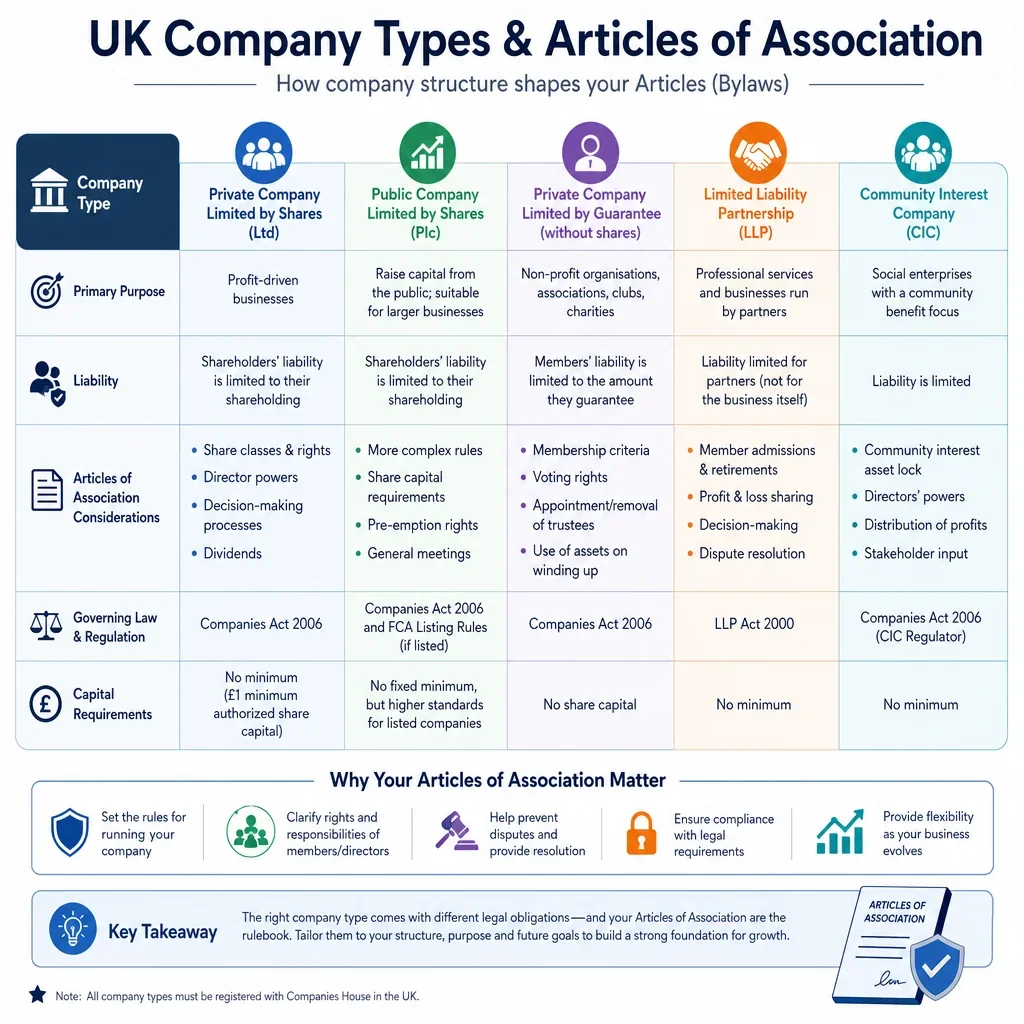
Community interest company requirements | Standard model articles are not sufficient for CIC statutory requirements. | Include asset lock, dividend cap and community interest provisions. | Companies registering as community interest companies. | true |
Model articles | ||||
Guarantee company member liability | Guarantee company model articles use membersu2019 guarantee rather than share capital. | Tailor membership admission, expulsion, subscriptions and non-profit distribution rules. | Clubs, associations, charities and not-for-profit companies. | true |
Bespoke articles | ||||
Charitable company provisions | Standard trading company model articles do not include charity-specific clauses. | Add charitable objects, trustee rules, asset lock and Charity Commission wording. | Companies seeking charitable registration in England and Wales. | true |
Public company governance | Public company model articles differ from private company model articles. | Add PLC-specific meeting, capital, secretary and market governance provisions. | Public limited companies and companies planning re-registration as PLC. | true |
Amended model articles | ||||
Director indemnities | May include indemnity wording subject to statutory restrictions on exempting liability. | Add qualifying third-party indemnity and advancement of defence costs. | Companies with external directors, investor nominees or higher litigation risk. | true |
Directorsu2019 insurance | Companies may purchase directorsu2019 liability insurance subject to statutory rules. | Require D&O insurance for directors or investor nominees. | Investor-backed companies and companies with non-executive directors. | false |
Model articles | ||||
Execution of documents | Statutory rules allow execution by authorised signatory methods, with optional seal use. | Set internal signing authorities, seal rules and approval requirements. | Property companies, groups and companies with delegated authorities. | false |
Bespoke articles | ||||
Borrowing powers | No detailed borrowing limits or lender consent mechanics. | Cap borrowings or require shareholder, board or investor approval. | Property SPVs, leveraged businesses and investor-backed companies. | true |
Related party transactions | Rely on statutory director duties, conflict rules and substantial property transaction rules. | Require independent approval for connected transactions and director interests. | Family companies, groups and founder-controlled businesses. | true |
Model articles | ||||
Substantial property transactions | Statutory member approval rules apply to substantial non-cash assets involving directors. | Add lower thresholds or broader approval requirements for connected assets. | Property companies and director-owned asset transfers. | true |
Loans to directors | Statutory approval and exception rules apply to director loans and similar transactions. | Prohibit director loans or require enhanced shareholder approval. | Owner-managed companies and closely held groups. | true |
Amended model articles | ||||
Inspection of company records | Statutory registers and records have prescribed inspection rights. | Add contractual access to management records, accounts or board materials. | Minority investors and absentee shareholders. | false |
Model articles | ||||
Share certificates and register of members | Companies must keep a register of members and issue share certificates under statutory rules. | Set certificate replacement, joint holder and uncertificated process details. | Companies with many shareholders or frequent transfers. | false |
PSC transparency obligations | PSC disclosure duties apply by statute and are not usually article-based. | Add cooperation obligations for shareholders to provide ownership information. | Complex ownership structures, trusts and offshore shareholders. | false |
Amended model articles | ||||
Overseas shareholder practicalities | No detailed time zone, address, tax or local law mechanics. | Require service address, electronic notices and tax residency cooperation. | UK companies with non-UK investors or founders. | false |
Bespoke articles | ||||
Regulatory ownership restrictions | No detailed restriction for regulated, sanctioned or ineligible owners. | Allow refusal, suspension or compulsory transfer for prohibited ownership. | Regulated sectors, defence, finance and licensed businesses. | true |
Group company governance | No group-wide approval matrix or parent consent mechanism. | Require parent approvals, group policies and delegated authority limits. | Subsidiaries, SPVs and corporate groups. | true |
Special purpose vehicle restrictions | No built-in restriction to a single asset, project or transaction. | Limit activities, indebtedness, asset disposals and constitutional changes. | Property SPVs, securitisations and project companies. | true |
Exit transaction approval | No specific investor consent process for sale, IPO or asset exit. | Require class consent, drag thresholds and proceeds waterfall rules. | Venture-backed and private equity portfolio companies. | true |
Capital return and liquidation waterfall | Ordinary shares generally share surplus capital equally by shareholding. | Set preference return, participation rights and priority waterfall. | Preference shares, venture investment and structured equity. | true |
Voluntary winding up approval | Statutory insolvency and member resolution rules apply. | Require investor, class or supermajority consent before voluntary winding up. | Investor-backed companies and companies with preference shares. | true |
Default transfer enforcement | No detailed power for directors to execute transfers for defaulting shareholders. | Authorise directors to sign transfer forms and hold proceeds on default. | Drag-along, leaver, deadlock and compulsory sale provisions. | true |
Interaction with shareholdersu2019 agreement | No coordination with private shareholdersu2019 agreement terms. | Align transfer, voting and governance mechanics with private agreement. | Any company with both articles and a shareholdersu2019 agreement. | true |
Public filing and privacy | Articles and amendments are filed and available publicly at Companies House. | Keep sensitive commercial terms in private side agreements where possible. | Investment terms, family arrangements and commercial confidentiality. | false |
Model articles | ||||
Binding effect of articles | Articles bind the company and its members as a statutory contract. | Use articles for rights intended to bind future members automatically. | Transfer restrictions, class rights and compulsory sale obligations. | true |
When Should A UK Company Use Bespoke Articles Instead Of Model Articles?
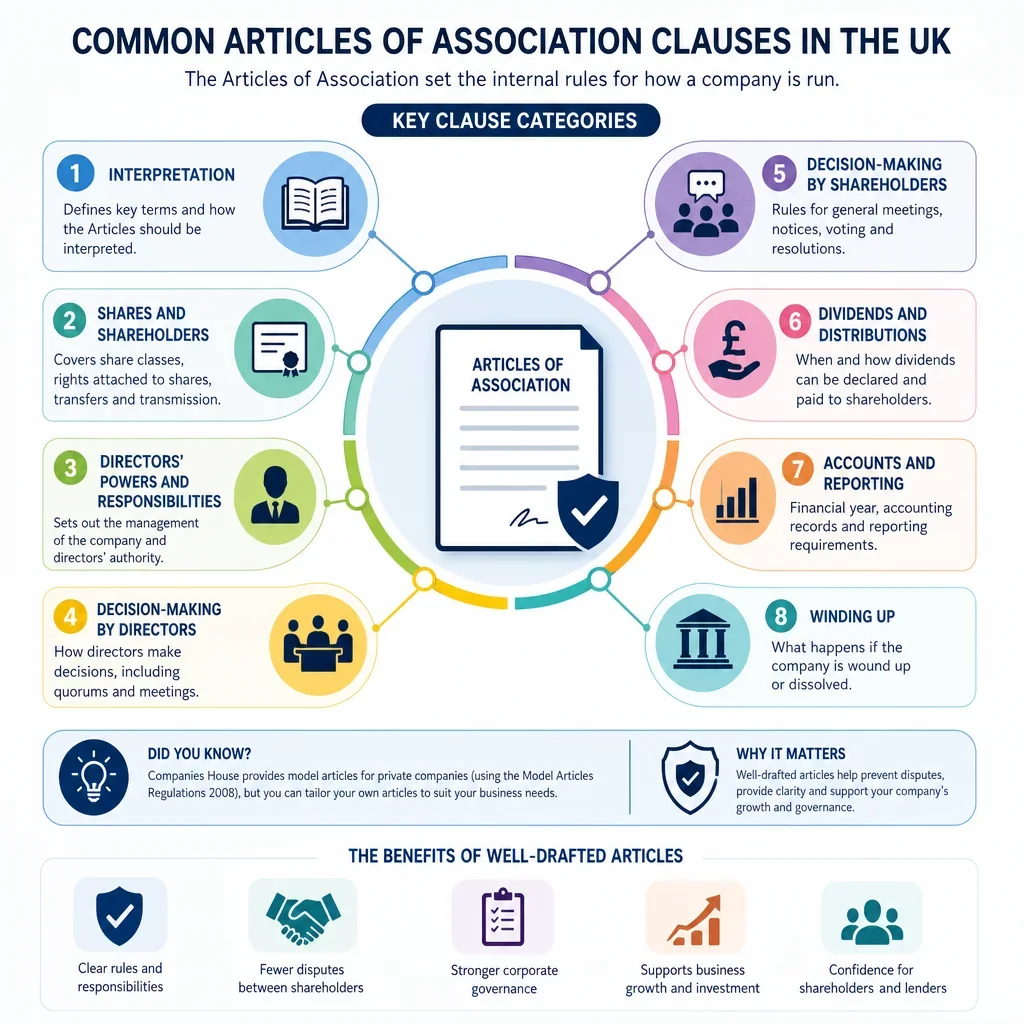
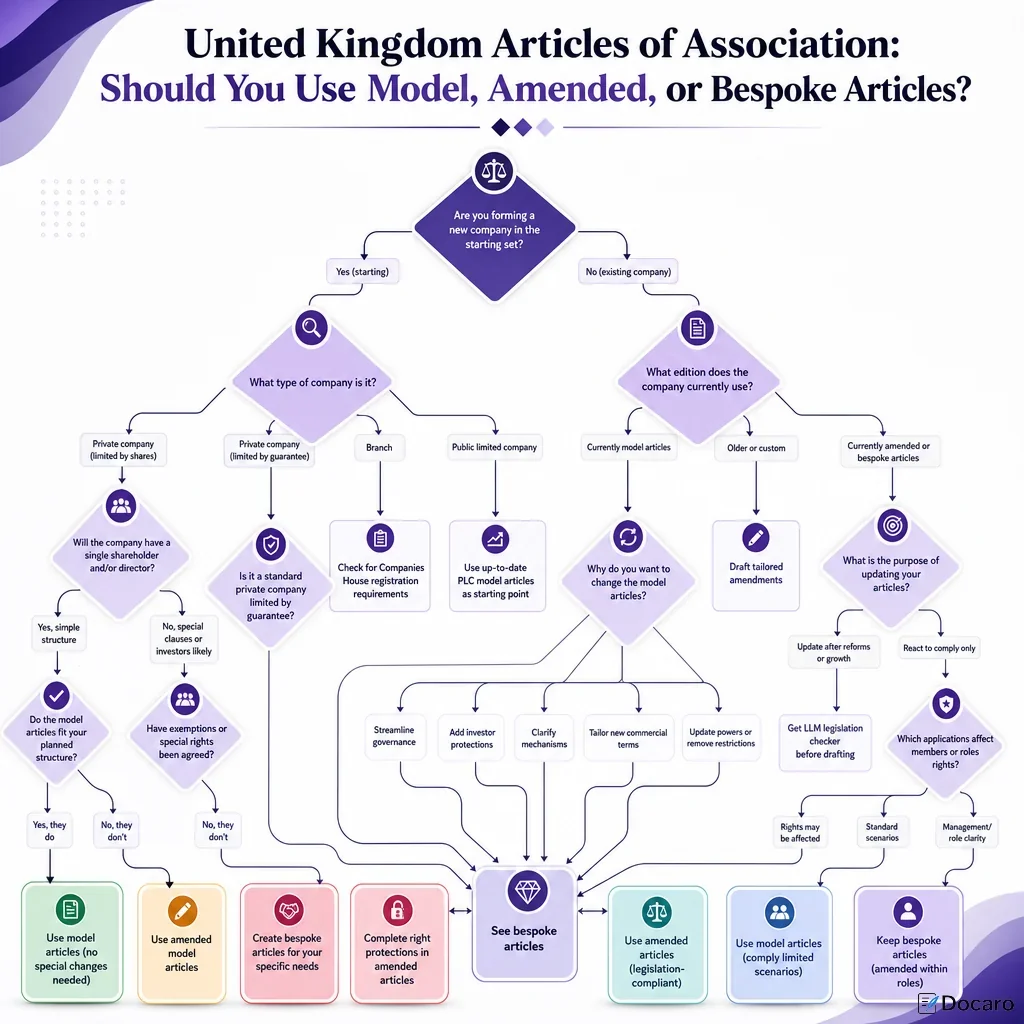
Model articles are a useful default for many simple private companies, but they are often too limited where ownership, control, investment rights, share classes or transfer restrictions need to be tailored. Bespoke or amended model articles are commonly used to document governance rules that must bind the company and future shareholders through the constitution.
What Are The Main Risks Of Relying Only On Model Articles?
- Sole director companies should check quorum wording: case law has created uncertainty where unamended model articles are used by a company with only one director, so bespoke wording is often used to confirm decision-making authority.
- Shareholder control is limited: model articles do not usually provide detailed veto rights, reserved matters, drag-along rights, tag-along rights or compulsory transfer rules.
- Investment terms usually need bespoke drafting: preference shares, anti-dilution rights, investor consent rights and enhanced information rights generally require tailored articles alongside any shareholders\u2019 agreement.
- Family and owner-managed companies often need transfer controls: pre-emption, permitted transfers, leaver provisions and death or incapacity rules are usually more detailed than the default model articles.
Which Article Changes Commonly Need Legal Review?
Legal review is commonly advisable where provisions affect share rights, director authority, member voting, compulsory transfers, conflicts of interest, class rights, drag or tag rights, or anything that must interact with the Companies Act 2006. Articles are public constitutional documents and inconsistent drafting can create disputes, invalid decisions or filing problems.
How Do Articles And Shareholders\u2019 Agreements Fit Together?
Articles are filed at Companies House and bind the company and its members as a statutory contract. A shareholders\u2019 agreement is private and can include commercial obligations, confidentiality and funding terms. For important governance controls, companies often use both documents so that constitutional mechanics appear in the articles while sensitive commercial terms remain private.
FAQs
You Might Also Be Interested In