United Kingdom Independent Contractor Agreement Clause Library
Clause Name | Clause Purpose | Risk Relevance | UK Drafting Notes |
|---|---|---|---|
Core | |||
Services | Defines the work the contractor must perform and expected deliverables. | High | Use clear deliverables avoid employee-style duties unless intended. |
Recommended | |||
Timetable And Milestones | Sets deadlines, stages and target completion dates. | Medium | State whether dates are binding, estimated or dependent on client input. |
Acceptance Of Deliverables | Creates a process for review, rejection and deemed acceptance. | Medium | Include objective criteria and short review periods to reduce payment disputes. |
Change Control | Controls changes to scope, fees, timing or specifications. | Medium | Require written approval for extra work to avoid scope creep. |
Core | |||
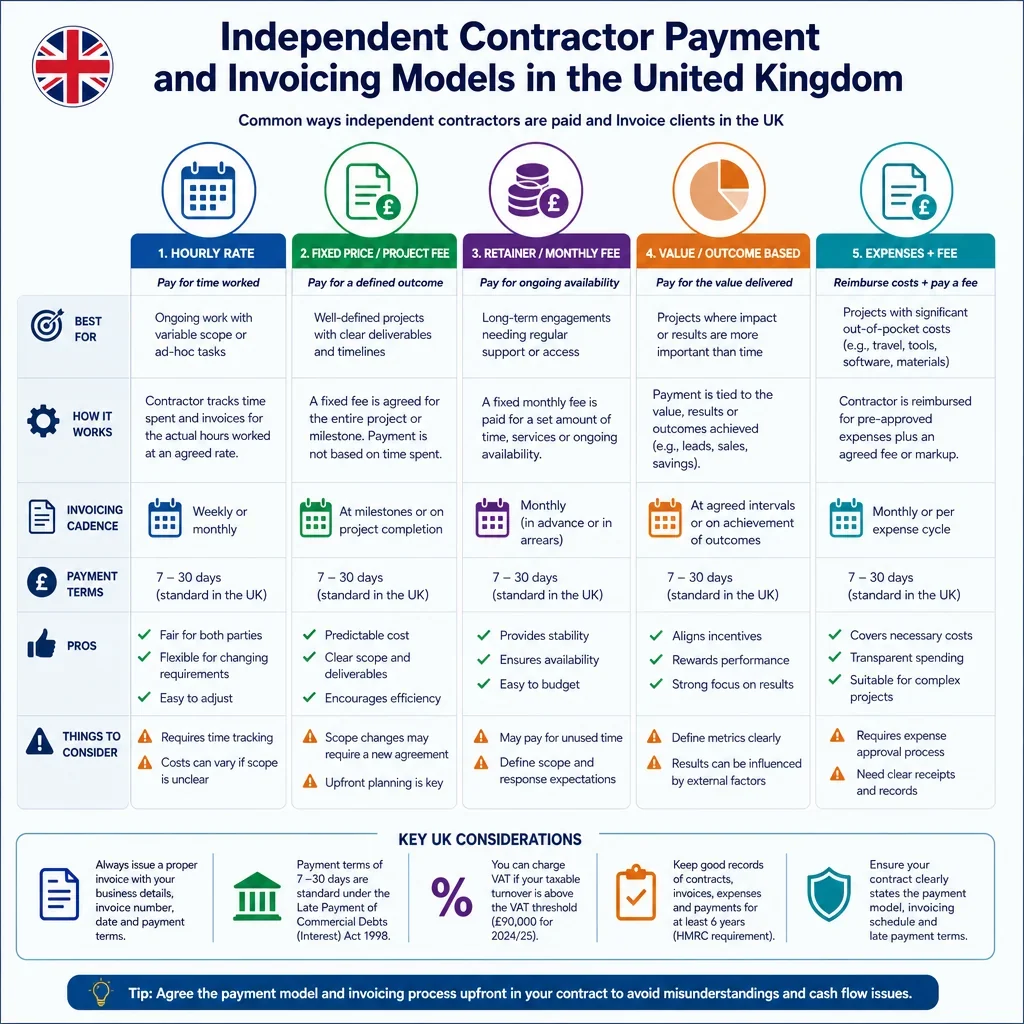
Fees | States the contractoru0027s charges, rates or fixed price. | High | Clarify VAT, expenses, day rates, fixed fees and any caps. |
Payment Terms | Sets invoicing, payment due dates and payment method. | High | Commercial debts may attract statutory interest if paid late. |
Recommended | |||
Late Payment Interest | Discourages late payment and allocates delay costs. | Medium | Refer to statutory interest unless a substantial contractual remedy is used. |
Expenses | States whether expenses are reimbursable and approval requirements. | Medium | Require receipts and prior written approval for travel or unusual costs. |
VAT | Clarifies whether fees are inclusive or exclusive of VAT. | Medium | State that VAT is payable only against a valid VAT invoice. |
Core | |||
Tax Responsibility | Makes the contractor responsible for their own tax and National Insurance. | High | Wording must reflect reality cannot override PAYE or IR35 rules. |
Recommended | |||
Tax Indemnity | Protects the client from contractor tax claims or liabilities. | High | Use carefully where IR35 responsibility may sit with the client or fee-payer. |
Core | |||
Independent Contractor Status | Confirms the contractor is not an employee, worker, agent or partner. | High | Must align with control, substitution, mutuality and actual working practice. |
Recommended | |||
No Employment Rights | States that employee benefits and employment protections are not intended. | High | Cannot exclude statutory rights if employment or worker status exists. |
Right Of Substitution | Allows the contractor to send a suitably qualified substitute. | High | A genuine, practical substitution right supports self-employed status. |
Core | |||
Control And Autonomy | Shows the contractor controls how, when and where work is done. | High | Avoid detailed supervision wording inconsistent with independent status. |
Recommended | |||
No Mutuality Of Obligation | States there is no ongoing duty to offer or accept work. | High | Important for status analysis but ineffective if conduct suggests continuing employment. |
Non-Exclusivity | Allows the contractor to work for other clients. | Medium | Supports contractor status protect conflicts with tailored restrictions. |
Contractor Equipment | States who provides tools, equipment, software and materials. | Medium | Using own equipment can support self-employment but must match reality. |
Location Of Services | Identifies whether work is remote, on-site or at specified locations. | Medium | On-site work should include access, safety and security requirements. |
Optional | |||
Working Hours | Clarifies any availability, access windows or time recording needs. | Medium | Avoid fixed employee-style hours unless commercially necessary. |
Reporting | Requires progress updates, records or project reports. | Low | Keep reporting focused on deliverables, not employee-style supervision. |
Situation-specific | |||
Key Personnel | Identifies named individuals important to service delivery. | Medium | Balance named personnel with any genuine substitution right. |
IR35 And Off-Payroll Working | Allocates responsibilities for employment tax status assessments. | High | Essential where a personal service company or intermediary is used. |
Status Determination Statement | Requires the client to issue or handle an IR35 status determination. | High | Relevant for medium and large clients under off-payroll rules. |
Core | |||
Confidentiality | Protects non-public business, technical and commercial information. | High | Include permitted disclosures and survival after termination. |
Situation-specific | |||
Trade Secrets | Adds protection for valuable secret business information. | High | Define trade secrets and require reasonable protective measures. |
Optional | |||
Publicity | Controls use of names, logos, case studies and announcements. | Medium | Obtain consent before using client branding or project details. |
Core | |||
Intellectual Property Assignment | Transfers ownership of work product IP to the client. | High | Copyright assignment must be in writing and signed by the assignor. |
Recommended | |||
Background IP | Preserves pre-existing IP and defines permitted client use. | High | List excluded tools, templates, libraries and pre-existing materials. |
Optional | |||
Licence Back To Contractor | Allows contractor to reuse specified know-how or materials. | Medium | Exclude confidential information and client-specific assets unless agreed. |
Recommended | |||
Moral Rights Waiver | Waives personal rights to attribution and objection to derogatory treatment. | Medium | Waiver should be express and in writing for relevant copyright works. |
Further Assurance For IP | Requires signing documents needed to perfect IP transfers. | Medium | Useful for patent, design or software assignments after completion. |
Situation-specific | |||
Open Source Software | Controls use of open source components in deliverables. | High | Require disclosure and approval of copyleft or restrictive licences. |
Recommended | |||
Third-Party Materials | Ensures third-party content is properly licensed for client use. | High | Require warranties that licences cover intended territory and duration. |
Situation-specific | |||
Data Protection Compliance | Requires compliance with UK data protection law. | High | Use UK GDPR roles: controller, processor or independent controller. |
Data Processing Terms | Sets mandatory processor duties when processing personal data for the client. | High | Article 28 UK GDPR terms are required for processors. |
International Data Transfers | Controls transfers of personal data outside the UK. | High | Consider adequacy, IDTA or UK addendum safeguards. |
Recommended | |||
Information Security | Requires technical and organisational security measures. | High | Specify access controls, encryption, backups and incident reporting. |
Situation-specific | |||
Personal Data Breach Notification | Requires prompt reporting of suspected personal data breaches. | High | Controllers often need enough time to assess ICO notification duties. |
Recommended | |||
Client Property | Protects equipment, documents, systems and materials supplied by the client. | Medium | Include return, deletion and access revocation on termination. |
Return Or Deletion Of Materials | Requires return or secure deletion of client data and materials. | High | Include certification of deletion and lawful retention exceptions. |
Situation-specific | |||
Records And Audit | Allows verification of compliance, billing or regulatory obligations. | Medium | Limit audit scope, notice, confidentiality and frequency. |
Core | |||
Contractor Warranties | Confirms quality, authority, skill and non-infringement assurances. | High | Tailor warranties to services avoid unrealistic absolute guarantees. |
Skill And Care | Requires work to be performed with reasonable skill and care. | Medium | Reasonable skill and care is common for UK service contracts. |
Compliance With Laws | Requires lawful performance of services and regulatory compliance. | High | Reference sector-specific UK rules where relevant. |
Situation-specific | |||
Permits And Licences | Requires the contractor to hold needed professional approvals. | Medium | Check regulated roles such as legal, financial, medical or construction work. |
Recommended | |||
Insurance | Requires relevant cover for professional, public or employer liabilities. | High | Specify cover types, limits, evidence and run-off requirements. |
Situation-specific | |||
Professional Indemnity Insurance | Covers negligence, errors or omissions in professional services. | High | Often essential for consultants, designers, engineers and advisers. |
Core | |||
Limitation Of Liability | Caps or excludes certain liabilities between the parties. | High | Exclusions must satisfy UCTA reasonableness where applicable. |
Recommended | |||
Unlimited Liability Carve-Outs | Identifies liabilities not subject to the contractual cap. | High | Common carve-outs include fraud, death, personal injury and IP misuse. |
Indemnities | Allocates specified losses to the party best placed to control them. | High | Define covered losses, procedure, mitigation and cap interaction. |
IP Infringement Indemnity | Protects the client if deliverables infringe third-party IP rights. | High | Include exclusions for client-supplied materials and required modifications. |
Optional | |||
Insurance Not Limiting Liability | Clarifies insurance cover does not itself cap legal liability. | Medium | Coordinate with liability caps and required insurance limits. |
Core | |||
Term | States when the agreement starts and ends. | Medium | Use fixed term, project completion or rolling arrangements clearly. |
Termination On Notice | Allows either party to end the agreement with notice. | High | Set notice periods consistent with project commitments and payment rights. |
Termination For Cause | Allows termination for serious breach, insolvency or misconduct. | High | Define material breach and any cure period precisely. |
Consequences Of Termination | Sets final payments, handover, return of property and survival terms. | High | Preserve accrued rights and key surviving clauses expressly. |
Optional | |||
Suspension Of Services | Allows services to pause for non-payment, risk or client delay. | Medium | Give notice and link suspension to payment or safety triggers. |
Recommended | |||
Handover Assistance | Requires transition support at project end or termination. | Medium | Specify duration, rates and deliverables for post-termination support. |
Situation-specific | |||
Restrictive Covenants | Restricts harmful post-contract competition, solicitation or dealing. | High | Must protect legitimate interests and be no wider than reasonable. |
Optional | |||
Non-Solicitation Of Staff | Prevents poaching of employees, contractors or key personnel. | Medium | Limit duration, covered people and prohibited conduct. |
Situation-specific | |||
Non-Solicitation Of Clients | Prevents targeting client customers introduced through the engagement. | High | Restrict only relevant customers and use reasonable time limits. |
Recommended | |||
Conflicts Of Interest | Requires disclosure and management of competing interests. | Medium | Use with non-exclusivity so contractor status is not undermined. |
Anti-Bribery And Corruption | Prohibits bribery, improper payments and corrupt conduct. | High | Include compliance with the Bribery Act 2010 and reporting duties. |
Situation-specific | |||
Criminal Finances Compliance | Prevents facilitation of UK or foreign tax evasion. | High | Relevant where contractors act for businesses in finance or tax-sensitive roles. |
Modern Slavery Compliance | Requires ethical labour practices and supply chain cooperation. | Medium | Important for larger businesses and supply-chain contractors. |
Health And Safety | Requires safe working and compliance with site safety rules. | High | Crucial for on-site, construction, manual or hazardous work. |
Recommended | |||
Equality And Harassment | Requires non-discrimination and respectful workplace conduct. | Medium | Useful where contractors interact with staff, customers or service users. |
Situation-specific | |||
Safeguarding | Protects children or vulnerable adults during service delivery. | High | Include DBS checks, reporting and sector safeguarding policies where needed. |
Right To Work | Requires lawful immigration status for individuals performing services. | High | Relevant if the client relies on named individuals or on-site access. |
Sanctions Compliance | Prevents dealings with sanctioned persons, countries or entities. | High | Important for cross-border work, finance, trade and sensitive sectors. |
Export Controls | Controls export or transfer of restricted goods, technology or data. | High | Relevant for defence, dual-use, encryption and international technical work. |
Recommended | |||
Sub-Contracting | Controls whether the contractor may delegate work to others. | Medium | Coordinate with substitution, data protection and confidentiality obligations. |
Core | |||
No Authority To Bind Client | Prevents the contractor from creating obligations for the client. | High | Essential if contractor contacts customers, suppliers or public bodies. |
Recommended | |||
Client Cooperation | Requires the client to provide access, information and approvals. | Medium | Link contractor deadlines to timely client inputs. |
Optional | |||
Client Delay | Protects the contractor from delay caused by missing client input. | Medium | Allow timetable extension and additional fees for material delay. |
Recommended | |||
Force Majeure | Excuses delay or non-performance caused by events beyond control. | Medium | English law has no general force majeure doctrine draft expressly. |
Dispute Resolution | Sets escalation, negotiation, mediation or expert determination steps. | Medium | Use clear pre-action steps without blocking urgent court remedies. |
Core | |||
Governing Law | Identifies which countryu0027s law governs the agreement. | High | Specify England and Wales, Scotland or Northern Ireland as appropriate. |
Jurisdiction | Identifies which courts will hear disputes. | High | Align with governing law and cross-border enforcement needs. |
Notices | Sets how formal notices must be served and when received. | Medium | Include addresses, email use and deemed delivery timings. |
Entire Agreement | Prevents reliance on earlier statements not included in the contract. | Medium | Do not attempt to exclude liability for fraud. |
Variation | Requires agreed changes to be documented properly. | Medium | Require written agreement signed or clearly approved by both parties. |
Recommended | |||
Assignment | Controls transfer of contractual rights or obligations. | Medium | Consider corporate group transfers and business sale scenarios. |
Severance | Keeps the rest of the agreement effective if one term fails. | Low | May help with overbroad restrictions but cannot rewrite poor drafting entirely. |
Waiver | Prevents delay or inaction from waiving rights unintentionally. | Low | State that waivers must be express and limited to the relevant breach. |
Third Party Rights | Controls whether non-parties can enforce contract terms. | Medium | Exclude or define rights under the Contracts Act 1999. |
Optional | |||
Counterparts And Electronic Signatures | Allows separate signature copies and electronic signing. | Low | Check deed formalities if the agreement is executed as a deed. |
Situation-specific | |||
Execution As A Deed | Uses deed formalities for assignments, longer limitation or no consideration. | Medium | English deeds require valid execution, delivery and witnessing where applicable. |
Core | |||
Survival | Keeps key obligations effective after termination or expiry. | Medium | List confidentiality, IP, payment, liability and dispute clauses expressly. |
Recommended | |||
Schedules And Statements Of Work | Allows project-specific details to sit in attached documents. | Medium | Set order of precedence if terms conflict. |
Order Of Precedence | Determines which document prevails if terms conflict. | Medium | Useful where proposals, purchase orders and SOWs are used. |
Optional | |||
Purchase Orders | Controls whether purchase orders are administrative or contractual. | Medium | Avoid unintended incorporation of conflicting client procurement terms. |
Situation-specific | |||
Business Continuity | Requires continuity planning for critical services. | Medium | Important for outsourced IT, operations or regulated services. |
Disaster Recovery | Sets recovery obligations after system failure or disruption. | Medium | Define recovery time, recovery point and testing obligations. |
Service Levels | Sets measurable performance standards for ongoing services. | Medium | Use objective metrics, exclusions, service credits and reporting. |
Service Credits | Provides financial credits for service level failures. | Medium | State whether credits are sole remedy or additional remedy. |
Software Escrow | Protects access to source code if the contractor fails or exits. | High | Consider for critical bespoke software or long-term support. |
Use Of AI Tools | Controls contractor use of generative AI and automated tools. | High | Address confidentiality, personal data, IP ownership and output verification. |
AI Output Verification | Requires human review and validation of AI-assisted work. | Medium | Useful for legal, technical, regulated or high-risk deliverables. |
Cyber Incident Response | Requires action and cooperation after security incidents. | High | Coordinate with UK GDPR breach reporting and client incident plans. |
Recommended | |||
System Access | Controls contractor access to client networks, accounts and premises. | High | Include least privilege, MFA, account return and monitoring notices. |
Optional | |||
Monitoring Of Systems | Allows monitoring of client systems used by the contractor. | Medium | Give fair notice and align with privacy and data protection duties. |
Situation-specific | |||
Background Checks | Requires checks before access to sensitive systems or people. | Medium | Ensure checks are proportionate and data protection compliant. |
Environmental Compliance | Requires environmentally responsible performance of services. | Medium | Relevant for waste, construction, manufacturing and site services. |
Optional | |||
Sustainability Reporting | Requires information on emissions, sourcing or sustainability metrics. | Low | Useful for clients with ESG reporting or public procurement obligations. |
Situation-specific | |||
Consumer Law Compliance | Requires compliance where services affect consumers or marketing. | Medium | Important where contractor designs customer terms, ads or e-commerce flows. |
Marketing Compliance | Controls email, SMS, cookies and direct marketing work. | High | PECR and UK GDPR are key for direct marketing and cookies. |
Financial Services Compliance | Requires compliance with FCA rules where services are regulated. | High | Check authorisation, appointed representative status and financial promotions. |
Construction Industry Scheme | Allocates CIS deduction and verification obligations for construction work. | High | Relevant to construction operations and contractor-subcontractor chains. |
CDM Regulations Compliance | Allocates construction design and management health and safety duties. | High | Relevant for construction clients, designers, principal contractors and contractors. |
TUPE | Allocates risk if employees transfer on outsourcing or service change. | High | Consider where services are outsourced, insourced or re-tendered. |
Agency Workers Regulations | Addresses agency worker protections where labour is supplied via agencies. | Medium | Relevant when contractors are supplied by temporary work agencies. |
Recommended | |||
Whistleblowing And Protected Disclosures | Preserves rights to make protected disclosures. | Medium | Confidentiality clauses should not prevent protected disclosures. |
Optional | |||
Complaints Handling | Sets process for handling complaints about services or conduct. | Low | Useful for customer-facing, public sector or regulated services. |
Recommended | |||
Quality Assurance | Requires checks, testing or review before delivery. | Medium | Define testing standards and responsibility for correcting defects. |
Defect Correction | Requires correction of defective deliverables within agreed periods. | Medium | State remedy periods, exclusions and whether rework is free. |
Optional | |||
Training And Knowledge Transfer | Requires training, documentation or transfer of know-how. | Low | Specify audience, format, materials and recording rights. |
Recommended | |||
Documentation | Requires manuals, notes, specifications or user guidance. | Medium | Define format, language, update obligations and ownership. |
Optional | |||
Time Records | Requires records supporting time-based billing. | Low | Use for billing verification without imposing employee-style timesheets unnecessarily. |
Situation-specific | |||
Retainer | Sets reserved availability or recurring service fees. | Medium | Avoid wording that creates ongoing obligation to accept all work. |
Optional | |||
Deposit Or Advance Payment | Requires payment before work starts or at agreed stages. | Medium | State refundability and treatment on cancellation or termination. |
Set-Off | Controls deductions from amounts owed between the parties. | Medium | Clients may want set-off contractors may require undisputed payment. |
Currency | Specifies the currency for fees, expenses and payments. | Low | Use GBP unless cross-border pricing requires another currency. |
Situation-specific | |||
Withholding Tax | Allocates risk of tax withheld from cross-border payments. | Medium | Consider gross-up wording and double tax treaty relief. |
Recommended | |||
Confidentiality Exceptions | Defines information not covered by confidentiality restrictions. | Medium | Common exceptions include public domain, prior knowledge and legal compulsion. |
Compelled Disclosure | Allows disclosure required by law, regulator or court order. | Medium | Require notice where lawful and disclosure limited to what is required. |
Optional | |||
Equitable Remedies | Recognises damages may be inadequate for confidentiality or IP breaches. | Medium | Do not assume injunctions are automatic court discretion remains. |
Situation-specific | |||
Data Retention | Sets how long personal data and records may be kept. | Medium | Retention must reflect storage limitation and lawful business needs. |
Optional | |||
Anonymised And Aggregated Data | Controls reuse of anonymised statistics or performance data. | Medium | Ensure data is genuinely anonymised under ICO guidance. |
Non-Disparagement | Discourages damaging public statements about the other party. | Low | Carve out truthful, required and protected disclosures. |
Recommended | |||
Compliance With Client Policies | Requires compliance with relevant site, security or conduct policies. | Medium | Do not impose HR policies that undermine contractor status unnecessarily. |
Situation-specific | |||
Public Sector Requirements | Adds obligations required for public sector engagements. | Medium | Consider transparency, FOIA, security, audit and procurement obligations. |
Freedom Of Information | Supports public authority responses to information requests. | Medium | Confidentiality may be subject to FOIA disclosure obligations. |
Official Secrets And Security | Protects classified or government-sensitive information. | High | Relevant for government, defence or security-cleared work. |
Optional | |||
Materials Escrow | Holds important project materials with a third party for release triggers. | Medium | Use where continuity depends on contractor-controlled assets. |
Trial Period | Allows early termination or review after an initial period. | Low | Avoid employment-style probation language use project review wording. |
Minimum Commitment | Sets any minimum fees, hours or project volume. | Medium | May affect status analysis if it resembles ongoing employment obligation. |
Situation-specific | |||
Limited Exclusivity | Restricts work for competitors during a defined engagement. | Medium | Keep narrow broad exclusivity can undermine independent status. |
Introduction Or Recruitment Fees | Protects an introducer or agency if the contractor is hired directly. | Medium | Relevant in agency or consultancy supply chains. |
Employment Agency Regulations | Addresses rules for agencies supplying work-seekers or contractors. | Medium | Relevant where an employment business or agency is involved. |
Optional | |||
Non-Circumvention | Prevents bypassing the contracting party to deal directly with contacts. | Medium | Use reasonable scope and duration to support enforceability. |
Situation-specific | |||
Liquidated Damages | Pre-agrees damages for specified breach or delay. | High | Avoid penalties amount should protect a legitimate interest proportionately. |
Optional | |||
Cancellation Fees | Compensates the contractor for late cancellation or reserved capacity. | Medium | Set fair, proportionate fees tied to likely loss or reserved time. |
Situation-specific | |||
Client Money | Controls handling of client funds or monies held on account. | High | Check sector rules for solicitors, estate agents, finance or regulated advisers. |
Recommended | |||
Confidentiality Duration | Sets how long confidentiality obligations continue. | Medium | Trade secrets may need protection while they remain secret. |
What Clauses Matter Most In A UK Independent Contractor Agreement?
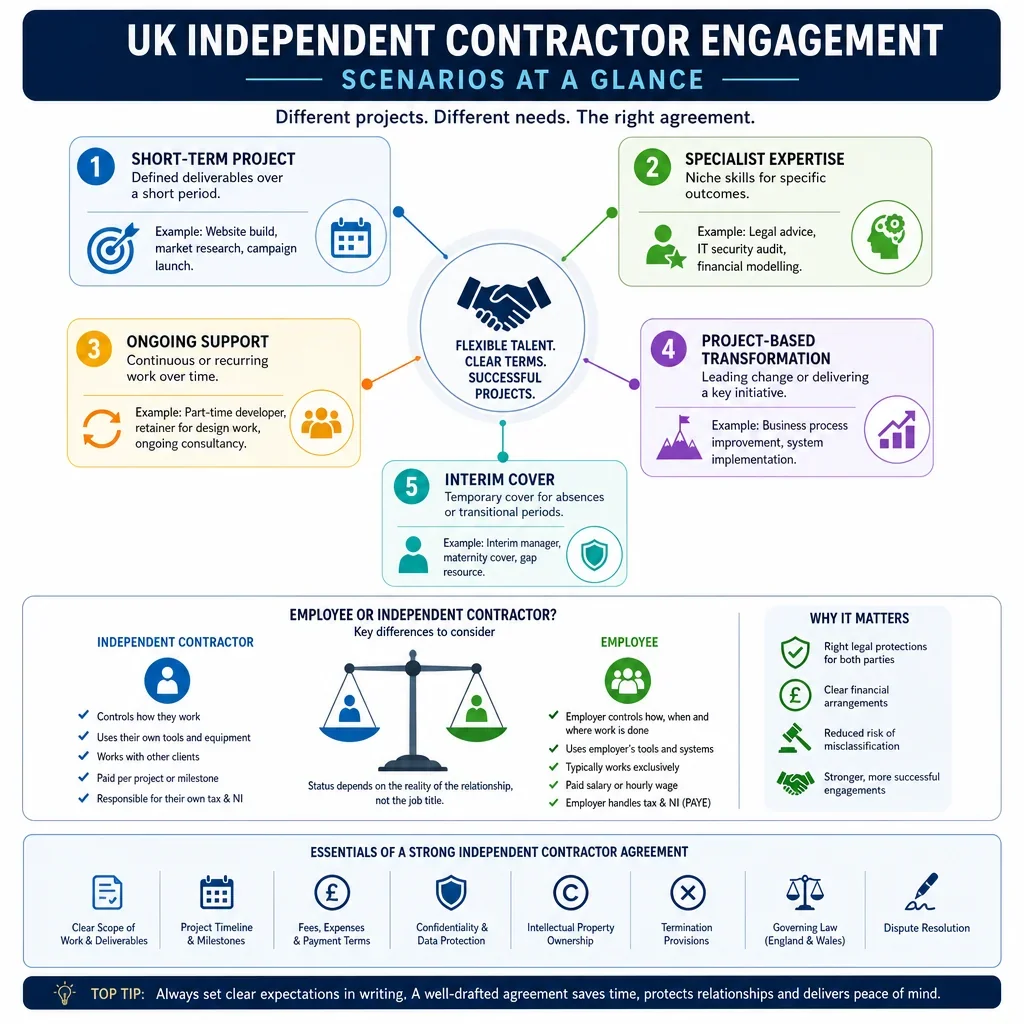
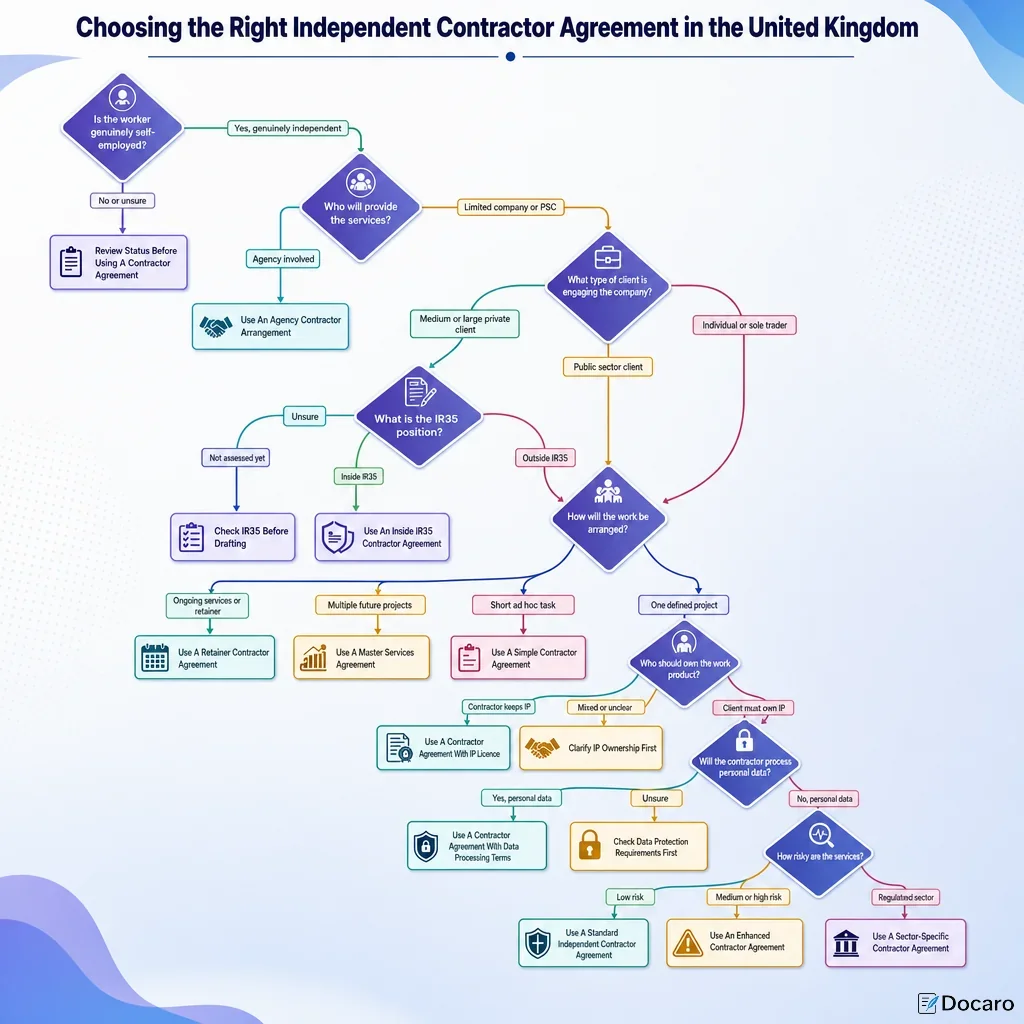
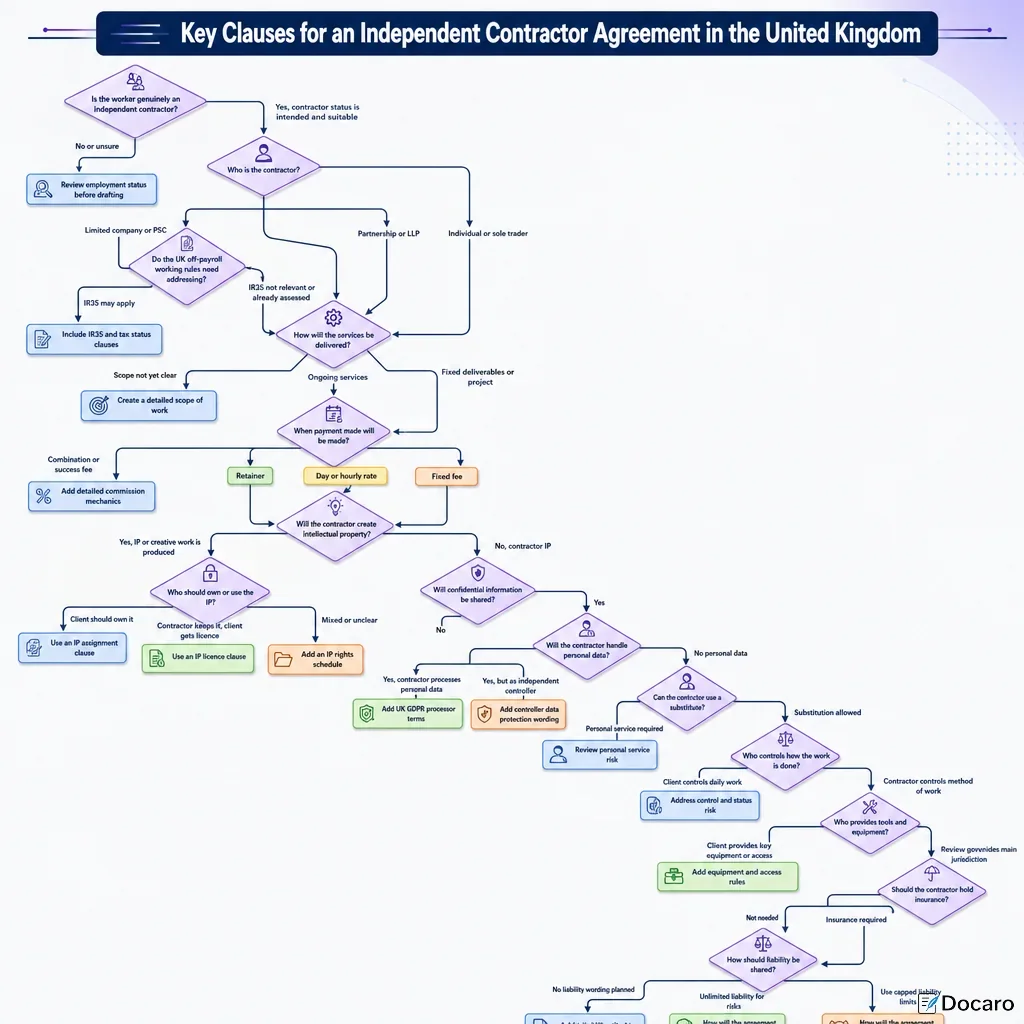
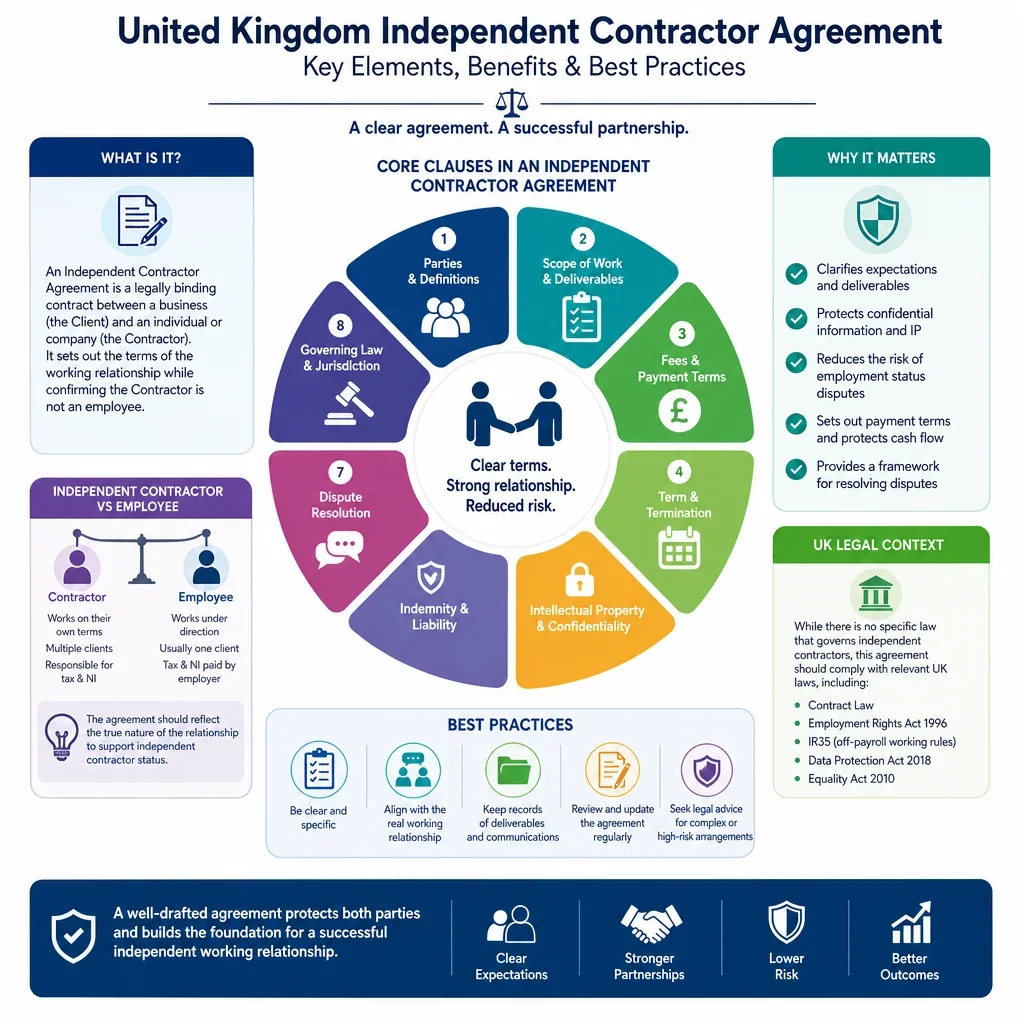
A strong UK independent contractor agreement should do more than describe the work. The highest-risk clauses usually concern employment status, IR35, intellectual property, confidentiality, data protection, tax, payment, liability and termination. These clauses help show that the contractor is genuinely independent, allocate ownership of work product, protect confidential information and reduce disputes about fees or deliverables.
How Can The Agreement Help Protect Contractor Status?
Clauses on independent status, control, substitution, mutuality of obligation, non-exclusivity and equipment should be drafted consistently with the real working arrangements. UK courts and HMRC look at substance as well as wording, so the contract should not promise independence while the client manages the contractor like an employee.
Which Clauses Are Especially Important For IR35 And Tax?
Where the contractor works through a personal service company or other intermediary, an IR35 status clause, substitution rights, control provisions and tax indemnities are particularly important. For medium and large private-sector clients, off-payroll working rules may require a status determination statement. See HMRC guidance on off-payroll working.
Who Owns The Work Created By The Contractor?
Under UK copyright law, contractors do not automatically transfer copyright to the client merely because they are paid. The agreement should contain a clear intellectual property assignment, moral rights waiver where appropriate, licence-back terms if needed and obligations to sign further documents. See section 90 of the Copyright, Designs and Patents Act 1988.
What UK Compliance Clauses Should Not Be Missed?
Many contractor agreements need UK-specific clauses on UK GDPR, anti-bribery, modern slavery, health and safety, equality, sanctions, export controls and right to work. These may be situation-specific, but they become important where the contractor handles personal data, works on-site, deals with public bodies, manages supply chains or operates in regulated sectors.
FAQs
You Might Also Be Interested In