UK EULA Licence Models And Drafting Considerations
Model description | Licence grant considerations | Common conditions | Commercial terms relevance | UK drafting notes |
|---|---|---|---|---|
Perpetual licence | ||||
A licence with no fixed end date, usually granted after a one-off fee. | State that rights are licensed, not sold define scope, permitted use, territory and version. | No copying except permitted backup, no resale, no reverse engineering except where law allows, updates excluded unless stated. | Medium | Avoid suggesting software ownership transfers check digital content quality rights for consumers under the Consumer Rights Act 2015. |
Permanent use rights are sold separately from time-limited maintenance, updates or support. | Separate the perpetual use licence from optional maintenance and update entitlements. | Support may expire, updates may require active maintenance, and unsupported versions may be excluded from service levels. | High | Make renewal charges and service exclusions clear before contract formation, especially for consumers and small businesses. |
Subscription licence | ||||
Access or use is licensed for recurring periods while fees are paid. | Tie the grant to the subscription term, paid plan, authorised users and active account status. | Non-payment may suspend access renewals, upgrades, downgrades and cancellation rules usually apply. | High | For online consumer sales, provide pre-contract information and cancellation details under the Consumer Contracts Regulations 2013. |
The licence renews automatically unless cancelled before the renewal date. | Define renewal periods, cancellation route, renewal notice, price changes and termination effects. | Continued payment authorisation, account cancellation deadlines and loss of access after expiry. | High | Auto-renewal terms should be prominent, transparent and not unfair under the Consumer Rights Act 2015. |
Use is licensed month to month, commonly cancellable at the end of a billing period. | State start date, monthly term, billing cycle, access period and cancellation cut-off. | No refund for partial months, subject to consumer rights suspension for failed payment. | High | Refund limits must not override statutory remedies for faulty digital content supplied to consumers. |
Use is licensed for yearly periods, often discounted against monthly pricing. | Define annual term, renewal, mid-term seat changes, payment timing and early termination. | Annual fees may be non-cancellable, with pro-rata charges for added seats. | High | Long notice periods, price rises and renewal lock-ins should be assessed for fairness and transparency. |
Trial licence | ||||
Software is made available free or discounted for a short evaluation period. | Limit use to evaluation, define trial term, features, data use and conversion to paid plan. | No production use, limited support, no SLA, usage caps and automatic expiry. | High | If payment details are collected, clearly explain any paid conversion and cancellation process before sign-up. |
A free trial changes into a paid subscription unless the user cancels in time. | State trial length, conversion date, paid plan, billing amount and cancellation method. | Payment method required, reminders may be needed, access continues after conversion until cancelled. | High | Avoid misleading omissions about post-trial charges under the Consumer Protection from Unfair Trading Regulations 2008. |
Pre-release software is provided for testing, feedback or limited preview use. | Limit to testing, reserve right to change or withdraw features, and address feedback ownership. | Confidentiality, no production use, limited warranties, telemetry and bug reporting obligations. | Medium | Liability exclusions must be reasonable in B2B contracts under UCTA and cannot exclude death or personal injury from negligence. |
Freemium licence | ||||
A free base version is licensed, with paid upgrades for extra features or capacity. | Separate free and paid rights, feature access, usage caps and upgrade terms. | Feature limits, storage caps, advertising, no guaranteed availability for free tier and upgrade restrictions. | High | Describe paid add-ons clearly and avoid burying material limits in non-prominent terms. |
Free use is funded by advertising, tracking or sponsored content. | Reserve rights to display ads and define any restrictions on ad blocking or misuse. | Users may not remove ads, interfere with tracking or use automated extraction tools. | Medium | If personal data or cookies support advertising, align the EULA with UK GDPR, Data Protection Act 2018 and PECR notices. |
Single-user licence | ||||
One identified person is permitted to install or use the software. | Define the named user, permitted devices, reassignment rules and personal or business use. | No sharing credentials, no use by colleagues, contractors or family unless expressly allowed. | Medium | If user monitoring enforces seat limits, explain personal data processing in a compliant privacy notice. |
One user may install or access the software on several devices they control. | State device limit, simultaneous use rules, activation controls and deactivation rights. | No use by other users, no shared devices beyond the named user, activation may be limited. | Medium | Activation and deactivation mechanisms should not deprive consumers of paid digital content unfairly. |
Multi-user licence | ||||
A set number of users or seats may access the software under one account or contract. | Define seat count, named or concurrent use, administrators and seat reassignment. | No credential sharing, no exceeding seats, audit rights and extra fees for overuse. | High | Audit, suspension and overage fee clauses should be proportionate and clearly incorporated into B2B terms. |
A maximum number of users may use the software at the same time. | Define concurrent user measurement, session rules, timeout and technical enforcement. | No bypassing access controls, pooled access limits and server monitoring may apply. | High | If usage logs identify individuals, provide lawful basis and transparency under UK data protection law. |
Use is permitted for multiple users at a specified site or location. | Define the site, remote access, home working, contractors and permitted networks. | No use outside the site, no affiliate access and no unmanaged remote installations unless permitted. | Medium | Hybrid working makes site definitions important specify whether UK remote workers are within scope. |
Enterprise licence | ||||
A whole organisation or defined group receives broad internal use rights. | Define customer group, affiliates, internal business use, user classes and territory. | No external service bureau use, no sublicensing, affiliate limits, audit and usage reporting. | High | Clarify whether UK subsidiaries, contractors and outsourced service providers are covered. |
The licence extends beyond the contracting entity to defined group companies. | Define affiliate by control test, included entities, divestments and new acquisitions. | Affiliate use only while affiliated, customer remains responsible, no unauthorised third-party access. | High | Ensure group-company wording aligns with the contracting structure and any UK Companies Act control concepts if used. |
Enterprise use rights include selected contractors acting for the customer. | Permit contractor access only for customer benefit and require compliance with the EULA. | No independent contractor use, no competitor access, customer liable for contractor breaches. | Medium | For regulated UK sectors, consider confidentiality, audit and data processing controls for outsourced access. |
Device-based licence | ||||
Use is authorised on a specified device rather than for a specified user. | Define device, installation count, virtual machines, replacement hardware and activation transfer. | No cloning, no use on extra devices, no circumvention of activation or hardware checks. | Medium | If technical protection measures are used, do not restrict lawful statutory exceptions such as permitted decompilation. |
Software is licensed for use on a kiosk, terminal, till or shared workstation. | State permitted device type, location, users, operational purpose and access controls. | No general-purpose use, no extra terminals, no remote access unless expressly allowed. | Medium | For retail or workplace terminals, address security, personal data logging and employee monitoring transparency. |
The licence may move between devices, subject to activation or transfer rules. | Define transfer frequency, old-device deactivation and hardware failure exceptions. | No simultaneous use on multiple devices, no transfer outside the licensed organisation. | Medium | Consumer-facing transfer restrictions should be transparent and not remove expected functionality unfairly. |
Perpetual licence, Single-user licence | ||||
One user receives ongoing rights to use a specified software version. | Combine perpetual duration with named-user, version, installation and transfer limits. | No shared use, no unsupported updates unless bought, and no transfer without consent if restricted. | Medium | If sold to consumers, ensure restrictions are prominent because buyers may assume permanent broad use. |
Subscription licence, Single-user licence | ||||
One named user may use the software only during an active subscription. | Tie access to the individual account, subscription term, authentication and paid plan. | No account sharing, recurring payment required, access ends on cancellation or non-payment. | High | Make cancellation and renewal wording clear at sign-up, not only inside the EULA. |
Subscription licence, Multi-user licence | ||||
A customer pays recurring fees for a defined number of seats or users. | State seat metrics, admin controls, user provisioning, overage fees and renewal quantities. | Seat sharing prohibited, added seats co-terminate, exceeding usage may trigger extra charges. | High | In B2B deals, overage and audit fees should be certain enough to avoid later disputes. |
Subscription licence, Enterprise licence | ||||
An organisation receives broad access for a recurring enterprise fee. | Define enterprise scope, usage bands, affiliates, term, renewal and true-up process. | Annual true-ups, internal-use restriction, audit rights, no service bureau use and termination on non-payment. | High | Large UK B2B deployments should align the EULA with order forms, DPAs, SLAs and procurement terms. |
Perpetual licence, Enterprise licence | ||||
An enterprise obtains permanent internal use rights, often for a defined software version. | Define organisation, affiliates, version, deployment cap, territory and post-support rights. | No external commercial hosting, no sublicensing, audit rights and separate maintenance contract. | High | Ensure termination clauses do not accidentally destroy paid perpetual rights except for material breach. |
Subscription licence, Device-based licence | ||||
Recurring fees authorise use on specified devices during the subscription term. | Define licensed devices, activation, replacement, remote wipe and subscription expiry effects. | No extra devices, no cloned images, no use after expiry and remote disablement may apply. | High | Remote disabling should be disclosed and should not affect unrelated user data without clear rights. |
Perpetual licence, Device-based licence | ||||
A permanent licence is locked to a device and may work without continuous internet access. | Address activation files, hardware replacement, offline validation and disaster recovery. | No hardware fingerprint tampering, no copying licence keys and limited transfer after replacement. | Medium | For business-critical software, consider express obligations for replacement keys and continuity after vendor insolvency. |
Trial licence, Single-user licence | ||||
A discounted or free individual licence is granted for study, teaching or evaluation. | Restrict use to education, define eligible users, verification and non-commercial purposes. | No commercial use, proof of status required, expiry when eligibility ends. | Medium | Eligibility checks should collect only necessary personal data and provide clear privacy information. |
Trial licence, Enterprise licence | ||||
A business receives limited enterprise access to assess suitability before purchase. | Define evaluation team, duration, permitted test data and restrictions on benchmarking disclosure. | No live production use, no public benchmarking, confidentiality and return or deletion after trial. | Medium | If customer test data includes personal data, put controller-processor terms in place before access. |
Freemium licence, Single-user licence | ||||
An individual may use a free version indefinitely, usually with limited features. | Specify personal use, feature limits, account requirements and rights to change the free tier. | No business use, limited storage, no premium support and account suspension for misuse. | Medium | If the user provides personal data as counter-performance, consumer digital content rights may still be relevant. |
Freemium licence, Multi-user licence | ||||
A team can use a limited free plan and pay for more users or features. | Define free seat cap, workspace ownership, admin rights and upgrade triggers. | Limited users, storage or exports disabled features conversion to paid plan for excess use. | High | Clarify who owns the team account and data if an employee creates it before paid conversion. |
Enterprise licence | ||||
The customer receives broad or uncapped internal use within defined enterprise boundaries. | Avoid vague unlimited wording define enterprise, products, environments and excluded uses. | Internal use only, no external hosting, no access by acquired entities unless agreed. | High | If priced by employee count or revenue band, include objective true-up and verification wording. |
A public body licenses software for a department, authority or defined public-sector estate. | Define permitted public bodies, shared services, contractors and framework call-off documents. | No use outside named authority, security requirements, audit, accessibility and data handling obligations. | High | Check compatibility with UK public procurement documents, FOIA disclosure risk and government security policies. |
Trial licence | ||||
The trial offers only selected functions or capped output before purchase. | Identify disabled features, output restrictions, watermarking and upgrade process. | No removing watermarks, limited exports, usage caps and no reliance for production decisions. | Medium | Marketing claims should not overstate trial functionality compared with the actual licensed feature set. |
Trial licence, Multi-user licence | ||||
A small group tests software for a defined proof-of-concept period. | Define POC objectives, users, environments, test data, end date and deletion obligations. | No production rollout, no third-party access, limited support and confidentiality of results. | Medium | If POC data includes personal data, ensure data minimisation, security and processor terms are documented. |
Subscription licence | ||||
Recurring access includes usage allowances such as API calls, storage or transactions. | Define metered units, measurement method, overage charges and throttling or suspension rights. | Usage caps, fair use limits, extra fees, no automated abuse and rate limiting. | High | Usage-based charges should be transparent and calculable before the customer incurs material costs. |
Device-based licence, Multi-user licence | ||||
Software is accessed through virtual desktops or shared hosted environments. | Define virtual machines, host servers, thin clients, concurrent sessions and remote access. | No unlicensed virtual copies, no public cloud deployment unless allowed, session caps. | High | Cloud hosting and remote access should be expressly covered because traditional device wording may be inadequate. |
Subscription licence, Enterprise licence | ||||
Software rights are bundled with hosted services, updates and online functionality. | Distinguish installed software rights from SaaS access, APIs, updates and service availability. | Acceptable use, uptime exclusions, data processing terms, suspension and service changes. | High | Include UK GDPR controller-processor terms where the provider processes customer personal data. |
Perpetual licence | ||||
The user obtains permanent rights plus defined entitlement to major or minor upgrades. | Specify whether upgrades replace, supplement or terminate rights in earlier versions. | Upgrade eligibility, no parallel use of old and new versions unless permitted, maintenance required. | Medium | Avoid ambiguous lifetime updates claims define support lifetime and excluded new products. |
Perpetual licence, Single-user licence | ||||
A paid licence cannot be transferred to another person or entity except as stated. | Expressly state non-transferability, exceptions for device replacement and assignment rules. | No resale, lending, sublicensing, assignment or transfer of licence keys. | Medium | Draft transfer limits carefully where software is downloaded and exhaustion or resale issues may arise under retained UK/EU principles. |
Enterprise licence | ||||
Enterprise rights may transfer on restructuring, merger or asset sale subject to conditions. | Define permitted assignment, change of control, acquirer restrictions and notice requirements. | Consent needed for competitors, no splitting licences, transfer may trigger fee adjustment. | High | Assignment and novation wording should match English contract law mechanics and group restructuring needs. |
Enterprise licence, Single-user licence | ||||
Employees may install or access the software at home for work-related purposes. | Define eligible employees, home devices, work-only use and end-of-employment removal. | No family use, no personal commercial use, removal when employment or enterprise licence ends. | Medium | Check BYOD security, monitoring notices and employer obligations for UK worker personal data. |
Enterprise licence | ||||
The software may be used only for the customer’s own internal business operations. | Define internal business purposes and expressly exclude service bureau or managed service use. | No outsourcing services to third parties, no commercial hosting and no customer-facing platform use. | Medium | For UK service providers, decide whether client work using the software is permitted or needs a separate licence. |
Enterprise licence, Subscription licence | ||||
The licence allows internal use but not hosting the software for third-party customers. | State whether managed services, outsourcing, bureau use or white-label access are allowed. | No SaaS resale, no third-party platform use, no sublicensing and no external user access. | High | UK IT suppliers should confirm whether client-facing use is outside the licence before relying on internal-use wording. |
What Should A UK EULA Say About The Licence Model?
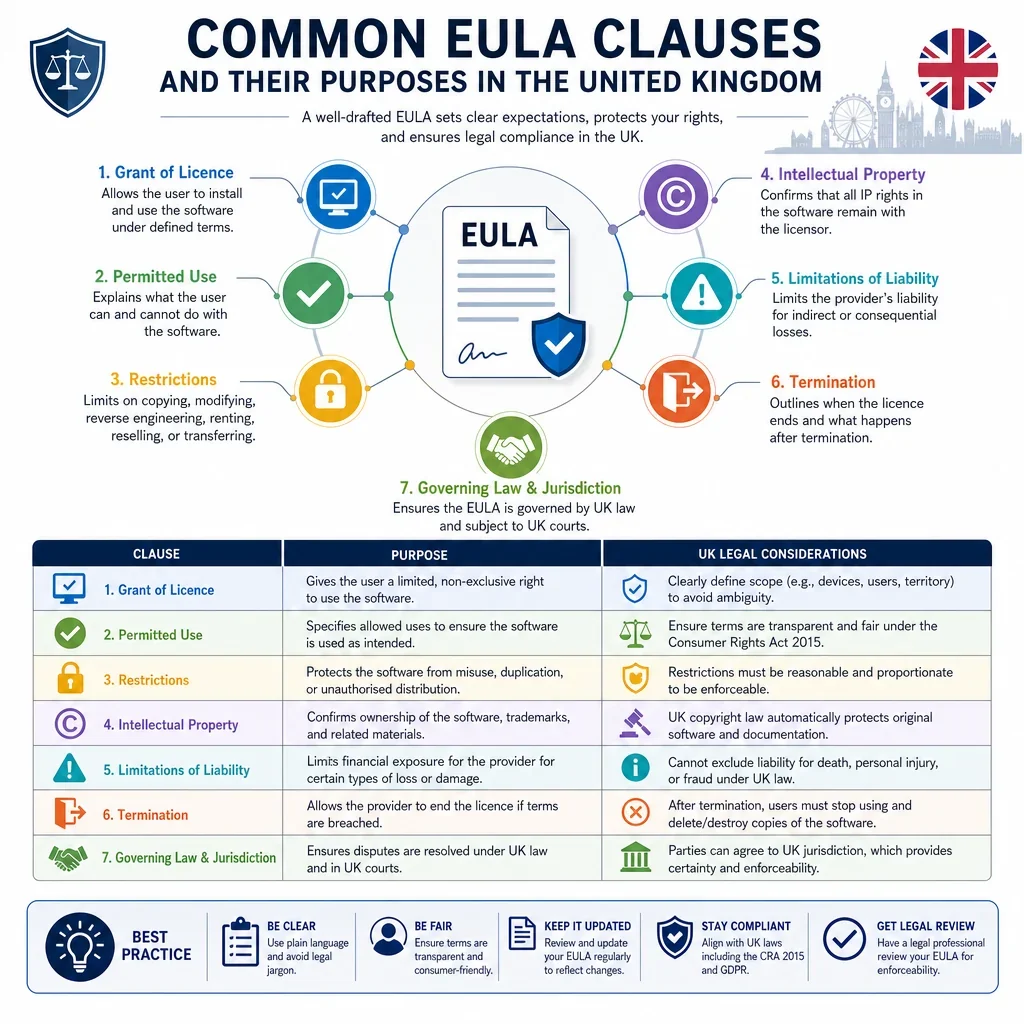
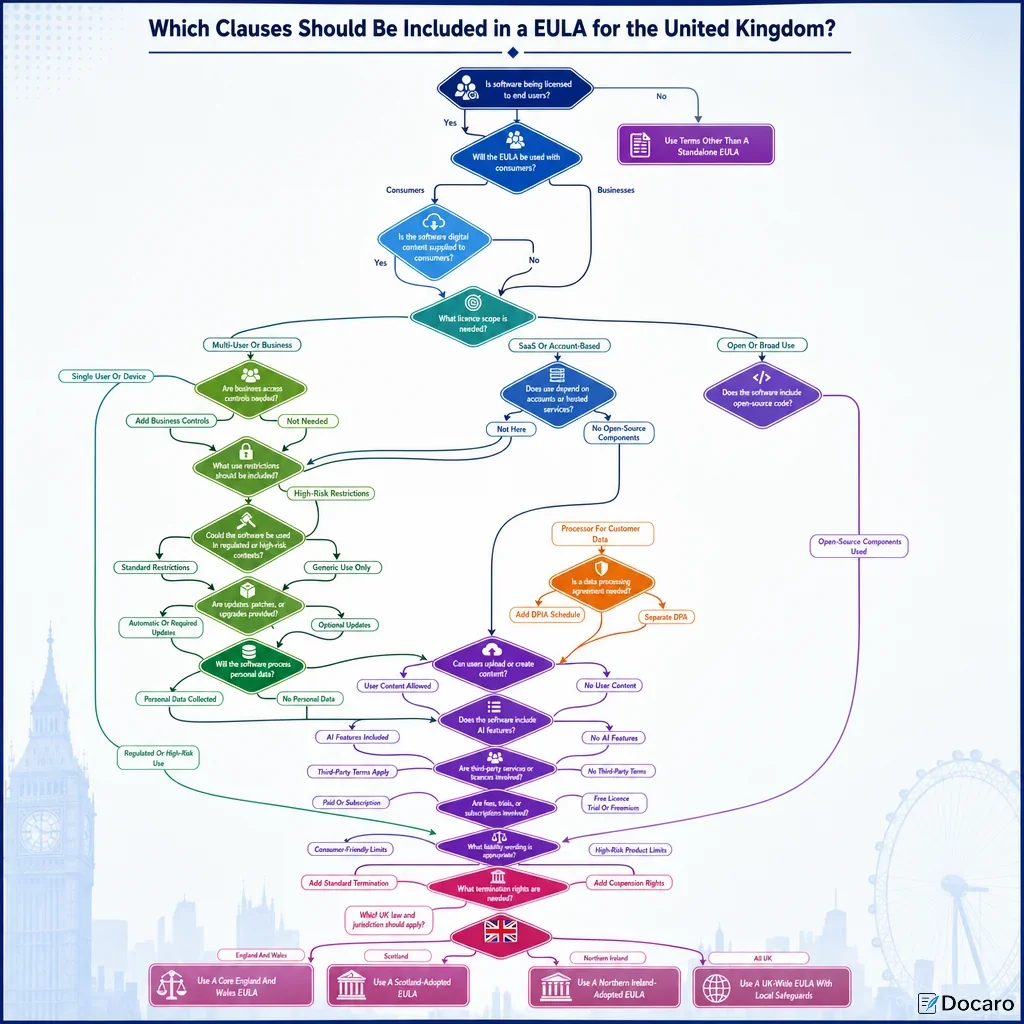
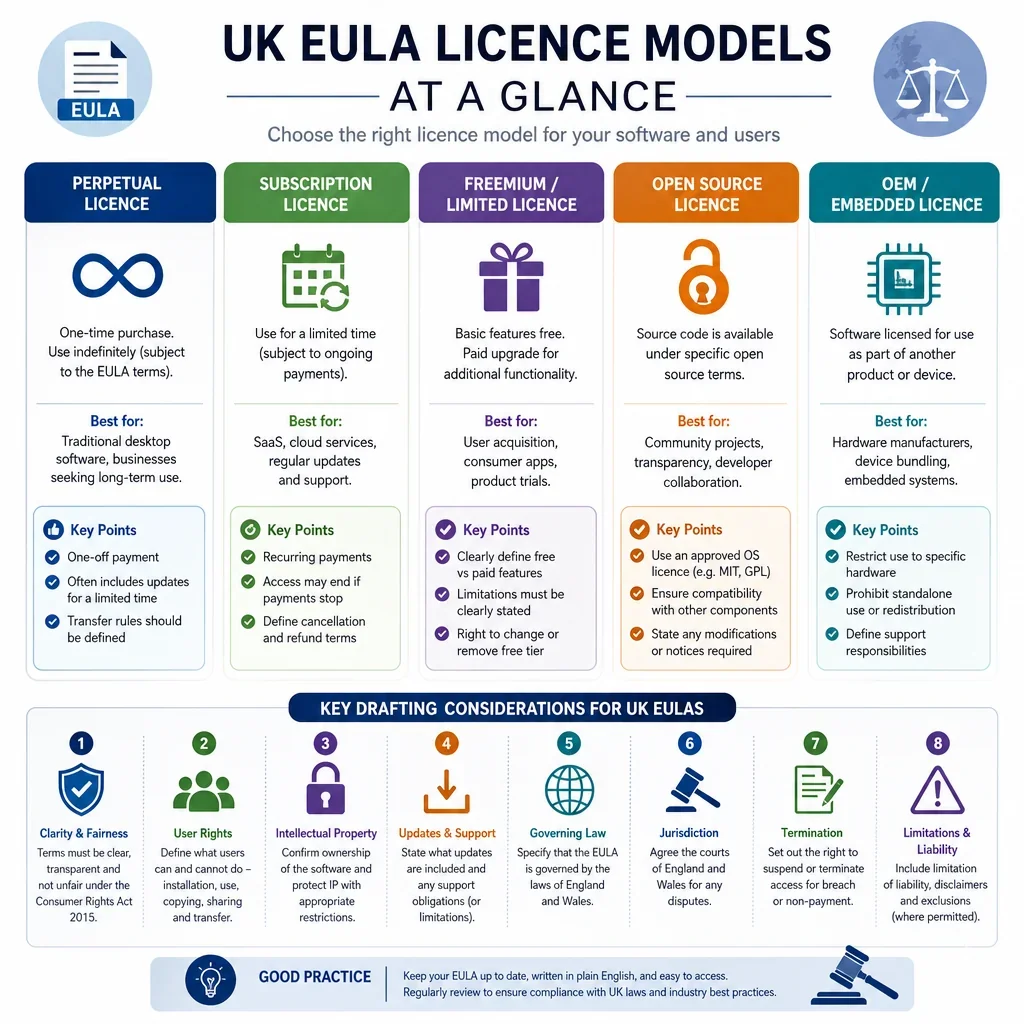
A UK EULA should match the commercial model actually used. Subscription, trial and freemium models need especially clear wording on duration, renewal, cancellation, feature limits and what happens when access ends. Perpetual licences still need limits on scope, transfer, updates and support, because perpetual does not usually mean ownership of the software.
Which EULA Terms Are Most Important For UK Consumers?
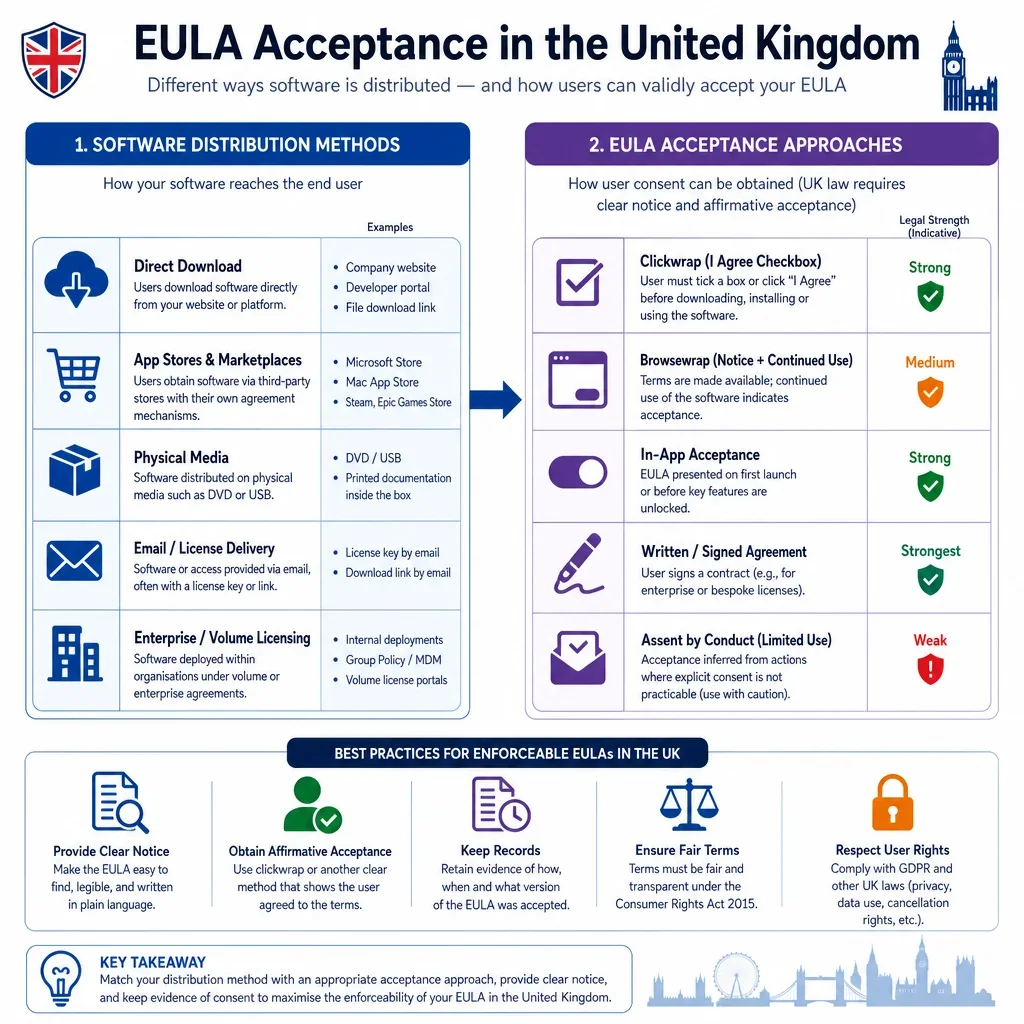
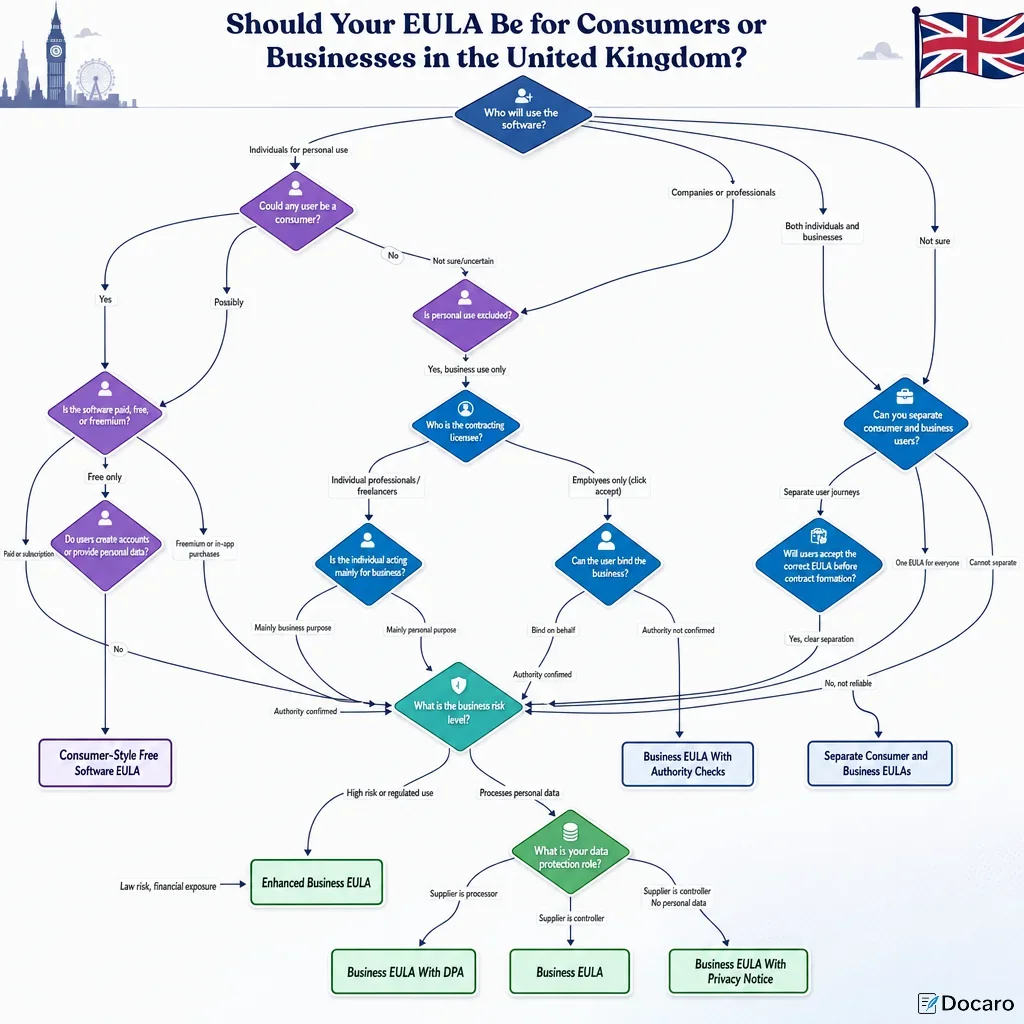
For consumer-facing software, the EULA should be consistent with UK consumer law. Key points include pre-contract information, transparent pricing, cancellation rights for distance contracts, conformity of digital content and limits on excluding liability. Terms that create a significant imbalance or are not transparent may be vulnerable under the Consumer Rights Act 2015.
How Should Subscription And Auto-Renewal EULAs Be Drafted?
Subscription and enterprise models should define billing periods, renewal mechanics, notice periods, price changes, suspension, termination and post-termination access. If supplied to UK consumers online, cancellation and pre-contract information rules under the Consumer Contracts Regulations 2013 should be checked carefully.
Why Do User, Device And Enterprise Limits Matter?
Single-user, multi-user, device-based and enterprise licences rely on measurable scope limits. The EULA should state whether use is limited by named users, concurrent users, seats, devices, affiliates, territory, internal business purposes or permitted contractors. Without clear metrics, enforcement and audit rights can be difficult and commercial leakage is more likely.
FAQs
You Might Also Be Interested In