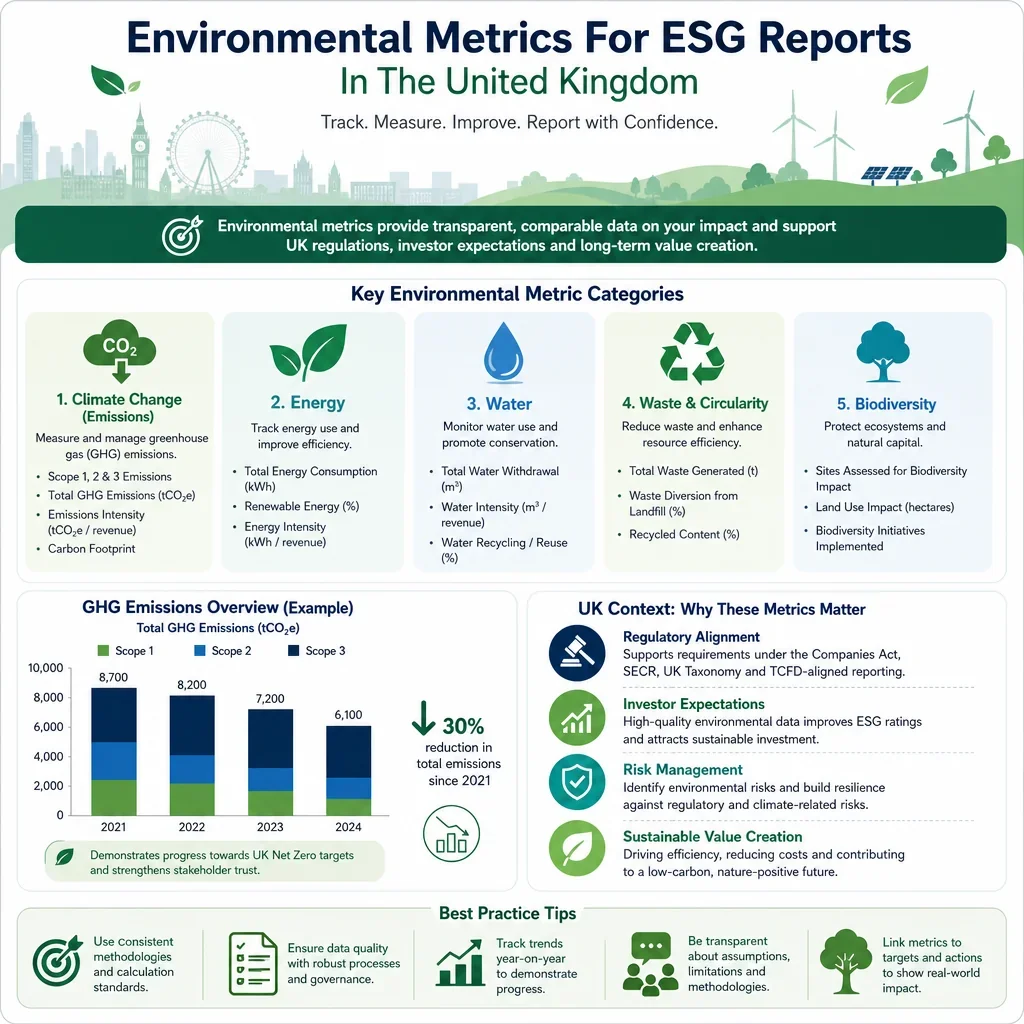
Environmental Metrics For ESG Reports In The United Kingdom
Metric Name | Metric Description | Common Unit | Metric Format | Typical Data Sources | Collection Frequency | Calculation Notes |
|---|---|---|---|---|---|---|
Greenhouse Gas Emissions | ||||||
Scope 1 GHG Emissions | Direct emissions from owned or controlled sources. | tonnes CO2e | Absolute | Gas bills, fuel cards, fleet records, refrigerant logs. | Monthly | Apply current UK conversion factors define operational boundary. |
Scope 2 GHG Emissions | Indirect emissions from purchased electricity, heat, steam or cooling. | tonnes CO2e | Absolute | Electricity bills, landlord recharges, meter data, PPAs. | Monthly | Report location-based and, where relevant, market-based emissions. |
Scope 3 GHG Emissions | Other indirect value chain emissions. | tonnes CO2e | Absolute | Supplier data, spend ledgers, travel systems, logistics data. | Quarterly | Screen all 15 categories disclose exclusions and methods. |
Total GHG Emissions | Combined emissions across reported scopes. | tonnes CO2e | Absolute | GHG inventory, utility data, fuel and supplier records. | Annually | Avoid double counting state included scopes and gases. |
GHG Emissions Intensity | Emissions normalised by business activity. | tCO2e per £m revenue, FTE or unit | Intensity | GHG inventory, finance data, HR data, production data. | Annually | Use a consistent denominator and explain business changes. |
Energy | ||||||
UK Energy Use For SECR | UK energy consumed for electricity, gas and transport. | kWh | Absolute | Utility invoices, meter reads, fuel cards, mileage claims. | Monthly | Large UK companies and LLPs may need directors' report disclosure. |
Purchased Electricity Consumption | Electricity bought and consumed by the organisation. | kWh | Absolute | Supplier bills, smart meters, landlord service charges. | Monthly | Estimate gaps from meter averages separate landlord-procured energy. |
Natural Gas Consumption | Gas used for heating, processes or catering. | kWh or therms | Absolute | Gas invoices, meter reads, building management systems. | Monthly | Convert volume to kWh using supplier calorific value where needed. |
Renewable Electricity Percentage | Share of electricity sourced from renewable generation. | % of electricity consumption | Percentage | Energy contracts, REGOs, PPAs, supplier certificates. | Annually | Check certificate quality and avoid double counting claims. |
On-Site Renewable Energy Generated | Renewable energy generated at company sites. | kWh | Absolute | Solar inverter data, export meters, maintenance logs. | Monthly | Separate self-consumed and exported energy. |
Energy Intensity | Energy use normalised by activity or size. | kWh per m2, FTE or unit output | Intensity | Energy data, floor area, HR or production records. | Quarterly | Weather-normalise buildings where heating demand is material. |
Energy Efficiency Actions Implemented | Narrative of measures taken to improve energy efficiency. | Narrative or kWh saved | Qualitative | Project records, audits, capex approvals, M&V reports. | Annually | SECR requires disclosure of principal energy efficiency actions where applicable. |
Fleet Fuel Consumption | Fuel consumed by owned or leased vehicles. | litres, kWh or miles | Absolute | Fuel cards, telematics, EV charging records, mileage logs. | Monthly | Separate petrol, diesel, hybrid and electric vehicles. |
Electric Vehicle Charging Electricity | Electricity used to charge company EVs. | kWh | Absolute | Charge point systems, reimbursement claims, telematics. | Monthly | Distinguish depot, workplace, public and home charging. |
Water | ||||||
Total Water Withdrawal | Water taken from all sources for use. | cubic metres | Absolute | Water bills, meters, abstraction records, landlord data. | Monthly | Report by source where material, including mains and groundwater. |
Mains Water Consumption | Potable water supplied by utilities and consumed. | cubic metres | Absolute | Water invoices, meter readings, landlord recharge statements. | Monthly | Estimate shared premises from floor area or occupancy if needed. |
Water Intensity | Water use normalised by activity. | m3 per FTE, £m revenue or unit output | Intensity | Water data, HR records, revenue or production volumes. | Quarterly | Choose denominator matching water drivers. |
Water Recycled Or Reused | Water treated and used again on site. | cubic metres or % of use | Absolute Percentage | Process meters, treatment plant logs, engineering records. | Monthly | Do not double count recirculated process water. |
Wastewater Discharged | Effluent or wastewater released to sewer or environment. | cubic metres | Absolute | Trade effluent bills, discharge consents, flow meters. | Monthly | Separate sewer, surface water and direct environmental discharge. |
Operations In Water-Stressed Areas | Sites located in areas with high water stress. | number of sites or % of withdrawals | Percentage | Site register, water data, Aqueduct or local risk maps. | Annually | Use current geolocation and recognised basin-level risk tools. |
Waste | ||||||
Total Waste Generated | Total waste produced by operations. | tonnes | Absolute | Waste transfer notes, contractor reports, weighbridge tickets. | Monthly | Separate hazardous, non-hazardous and construction waste. |
Waste Diverted From Disposal | Waste reused, recycled, composted or recovered. | tonnes or % of waste | Absolute Percentage | Waste contractor reports, transfer notes, recycling certificates. | Monthly | Define whether energy recovery counts as diversion. |
Waste Sent To Landfill | Waste disposed of in landfill. | tonnes or % of waste | Absolute Percentage | Waste contractor reports, landfill tickets, transfer notes. | Monthly | Track separately from incineration and energy recovery. |
Hazardous Waste Generated | Waste classified as hazardous under UK waste rules. | tonnes | Absolute | Consignment notes, waste codes, contractor reports. | Monthly | Use correct EWC codes and retain consignment evidence. |
Recycling Rate | Share of waste sent for recycling. | % of total waste | Percentage | Waste contractor reports, transfer notes, recycling statements. | Monthly | Exclude contamination rejected by recyclers where known. |
Waste Intensity | Waste generation normalised by activity. | tonnes per £m revenue, FTE or unit output | Intensity | Waste data, finance, HR or production records. | Quarterly | Use consistent output measure across reporting periods. |
Food Waste Generated | Edible and inedible food waste from operations. | tonnes | Absolute | Kitchen audits, waste contractor weights, production losses. | Monthly | Separate edible surplus, unavoidable waste and animal by-products. |
Electronic Waste Generated | Waste electrical and electronic equipment disposed or reused. | tonnes or units | Absolute | IT asset registers, WEEE notes, recycler certificates. | Quarterly | Track reuse, refurbishment, recycling and secure destruction. |
Materials | ||||||
Packaging Placed On The UK Market | Packaging supplied in the UK by material type. | tonnes | Absolute | Packaging specs, sales data, supplier declarations, ERP data. | Quarterly | Classify by producer role, material and household packaging status. |
Recycled Content In Materials | Share of input materials from recycled sources. | % by weight | Percentage | Supplier specifications, certificates, bills of materials. | Quarterly | Distinguish post-consumer and pre-consumer recycled content. |
Plastic Packaging Recycled Content | Recycled content in plastic packaging components. | % recycled content or tonnes | Percentage | Packaging specs, supplier evidence, import records, tax returns. | Quarterly | UK Plastic Packaging Tax applies below 30% recycled plastic content. |
Total Materials Used | Total weight or volume of materials consumed. | tonnes or cubic metres | Absolute | Procurement records, bills of materials, inventory systems. | Quarterly | Separate renewable, non-renewable and critical materials. |
Certified Timber Or Paper Percentage | Wood or paper sourced from certified responsible forestry. | % of spend, volume or weight | Percentage | Supplier certificates, invoices, chain-of-custody documents. | Annually | Verify certificate scope and expiry date. |
Sustainable Materials Spend | Spend on materials meeting defined sustainability criteria. | £ or % of materials spend | Monetary | Procurement systems, supplier declarations, certifications. | Quarterly | Define eligible standards before comparing suppliers. |
Biodiversity | ||||||
Sites Near Biodiversity-Sensitive Areas | Operations located in or near protected habitats. | number of sites or hectares | Absolute | GIS data, site register, ecological surveys, MAGIC maps. | Annually | Include SSSIs, SACs, SPAs, Ramsar sites and local designations. |
Land Occupied Or Disturbed | Land area occupied, disturbed or restored by operations. | hectares | Absolute | Site plans, leases, GIS, construction records, restoration plans. | Project Based | Separate sealed, vegetated, disturbed and restored areas. |
Biodiversity Net Gain | Change in biodiversity value from development projects. | biodiversity units or % gain | Percentage | Statutory metric, ecological surveys, planning documents. | Project Based | Many English planning permissions require at least 10% net gain. |
Habitat Restored Or Created | Area of habitat improved, restored or newly created. | hectares | Absolute | Ecology reports, land management plans, GIS monitoring. | Annually | Record habitat type, condition and duration of management. |
Protected Species Incidents | Incidents affecting legally protected species or habitats. | number of incidents | Absolute | Incident logs, ecological surveys, regulator correspondence. | As Required | Escalate potential offences and mitigation licence breaches promptly. |
Sites With Biodiversity Management Plans | Sites covered by active biodiversity management plans. | % of relevant sites | Percentage | Site audits, environmental management systems, ecology plans. | Annually | Define relevant sites based on landholding and ecological risk. |
Pollution | ||||||
Air Pollutant Emissions | Emissions of NOx, SOx, particulates and VOCs. | tonnes or mg/m3 | Absolute | Stack tests, CEMS, fuel data, permit returns. | Quarterly | Align substances and limits with environmental permits. |
Environmental Permit Exceedances | Breaches of permit limits or conditions. | number of exceedances | Absolute | Monitoring results, permit returns, regulator notices, incident logs. | As Required | Include air, water, waste and installation permit non-compliance. |
Spills And Pollution Incidents | Unplanned releases causing or risking environmental harm. | number of incidents or litres released | Absolute | Incident reports, spill logs, regulator notifications, insurance claims. | As Required | Record severity, substance, volume, location and remediation action. |
Volatile Organic Compound Emissions | VOC emissions from solvents, paints, fuels or processes. | tonnes or mg/m3 | Absolute | Solvent usage, mass balance, stack tests, SDS data. | Quarterly | Use mass balance where direct monitoring is unavailable. |
Greenhouse Gas Emissions | ||||||
Refrigerant Leakage | F-gases released from cooling or refrigeration equipment. | kg refrigerant or tonnes CO2e | Absolute | F-gas logs, maintenance records, top-up invoices. | Quarterly | Convert refrigerant mass using GWP values include leak checks. |
Pollution | ||||||
Noise Complaints | Complaints received about operational noise. | number of complaints | Absolute | Complaints logs, local authority correspondence, monitoring data. | As Required | Track substantiated complaints separately from all complaints. |
Contaminated Land Provisions | Estimated cost of soil or groundwater remediation obligations. | £ | Monetary | Site investigations, legal reviews, remediation plans, accounts. | Annually | Use probability-weighted estimates where obligations are uncertain. |
Environmental Fines And Penalties | Financial penalties for environmental non-compliance. | £ | Monetary | Legal records, regulator notices, finance ledgers. | As Required | Separate fines, undertakings, remediation costs and legal fees. |
Climate Risk | ||||||
Physical Climate Risk Exposure | Assets exposed to floods, heat, drought or storms. | £ asset value or % assets exposed | Monetary | Asset register, flood maps, climate models, insurance data. | Annually | Assess acute and chronic hazards over relevant time horizons. |
Transition Climate Risk Exposure | Financial exposure to policy, market or technology transition risks. | £ revenue, cost or asset value exposed | Monetary | Scenario analysis, product data, carbon prices, strategy models. | Annually | Use credible scenarios and disclose assumptions and time horizons. |
Climate-Related Financial Disclosure Coverage | Coverage of governance, strategy, risk and metrics disclosures. | narrative or disclosure checklist | Qualitative | Annual report, risk registers, board papers, scenario analysis. | Annually | Certain UK companies and LLPs must include climate disclosures. |
Internal Carbon Price | Carbon cost used in decisions and investment appraisal. | £ per tonne CO2e | Monetary | Finance policies, capex models, shadow price assumptions. | Annually | State whether shadow price, fee or implicit carbon price. |
Climate-Aligned Capital Expenditure | Capex supporting emissions reduction or climate resilience. | £ or % of capex | Monetary | Capex budgets, project appraisals, transition plans. | Annually | Define qualifying criteria and link to transition plan actions. |
Net Zero Target Progress | Progress against stated emissions reduction pathway. | % reduction from base year | Percentage | GHG inventory, target baseline, reduction project tracking. | Annually | Restate baseline for acquisitions, disposals and methodology changes. |
Greenhouse Gas Emissions | ||||||
Carbon Credits Retired | Verified credits retired to support climate claims. | tonnes CO2e | Absolute | Registry retirement statements, supplier certificates, invoices. | Annually | Report separately from gross emissions specify standard and vintage. |
Avoided Emissions | Emissions avoided by products or projects versus a baseline. | tonnes CO2e | Absolute | LCA models, project baselines, customer use data. | Project Based | Do not deduct from inventory emissions disclose baseline assumptions. |
Purchased Goods And Services Emissions | Emissions from goods and services bought by the business. | tonnes CO2e | Absolute | Procurement spend, supplier PCFs, LCA databases, invoices. | Quarterly | Prefer supplier-specific data use spend factors for screening. |
Capital Goods Emissions | Embodied emissions from purchased capital assets. | tonnes CO2e | Absolute | Fixed asset register, capex spend, supplier data, EPDs. | Quarterly | Account in year acquired unless using disclosed alternative method. |
Business Travel Emissions | Emissions from employee travel for business purposes. | tonnes CO2e | Absolute | Travel booking systems, expense claims, mileage records. | Monthly | Use distance, class and transport mode where available. |
Employee Commuting Emissions | Emissions from staff travel between home and work. | tonnes CO2e | Absolute | Employee surveys, HR locations, working pattern data. | Annually | Reflect hybrid working assumptions and transport mode splits. |
Upstream Transport And Distribution Emissions | Emissions from inbound freight and third-party transport. | tonnes CO2e | Absolute | Logistics invoices, shipment weights, distances, carrier reports. | Monthly | Use tonne-km or supplier-specific carrier emissions where available. |
Downstream Transport And Distribution Emissions | Emissions from distribution of sold products to customers. | tonnes CO2e | Absolute | Carrier reports, sales shipments, distances, freight invoices. | Monthly | Define whether customer-paid transport is included. |
Use Of Sold Products Emissions | Lifetime emissions from customer use of sold products. | tonnes CO2e | Absolute | Product energy ratings, sales volumes, usage assumptions. | Annually | Model expected lifetime use and disclose key assumptions. |
End-Of-Life Treatment Emissions | Emissions from disposal of sold products and packaging. | tonnes CO2e | Absolute | Sales volumes, material composition, waste scenario assumptions. | Annually | Use market-specific disposal routes where material. |
Climate Risk | ||||||
Suppliers With Science-Based Targets | Share of supplier spend covered by validated climate targets. | % of spend or suppliers | Percentage | Supplier questionnaires, SBTi database, procurement spend. | Annually | Weight by emissions or spend for relevance. |
Climate Scenario Analysis Completed | Assessment of resilience under different climate scenarios. | narrative or number of scenarios | Qualitative | Risk workshops, models, board papers, external scenarios. | Annually | Include at least one low-carbon transition scenario if relevant. |
Pollution | ||||||
Sites Certified To ISO 14001 | Operational sites with certified environmental management systems. | number or % of sites | Percentage | Certification records, site register, audit reports. | Annually | Verify certificate scope, sites covered and expiry date. |
Environmental Complaints | Complaints about odour, dust, noise, waste or pollution. | number of complaints | Absolute | Complaints register, CRM, regulator correspondence. | As Required | Classify by theme, site, severity and resolution status. |
Which Environmental Metrics Should A UK ESG Report Include?
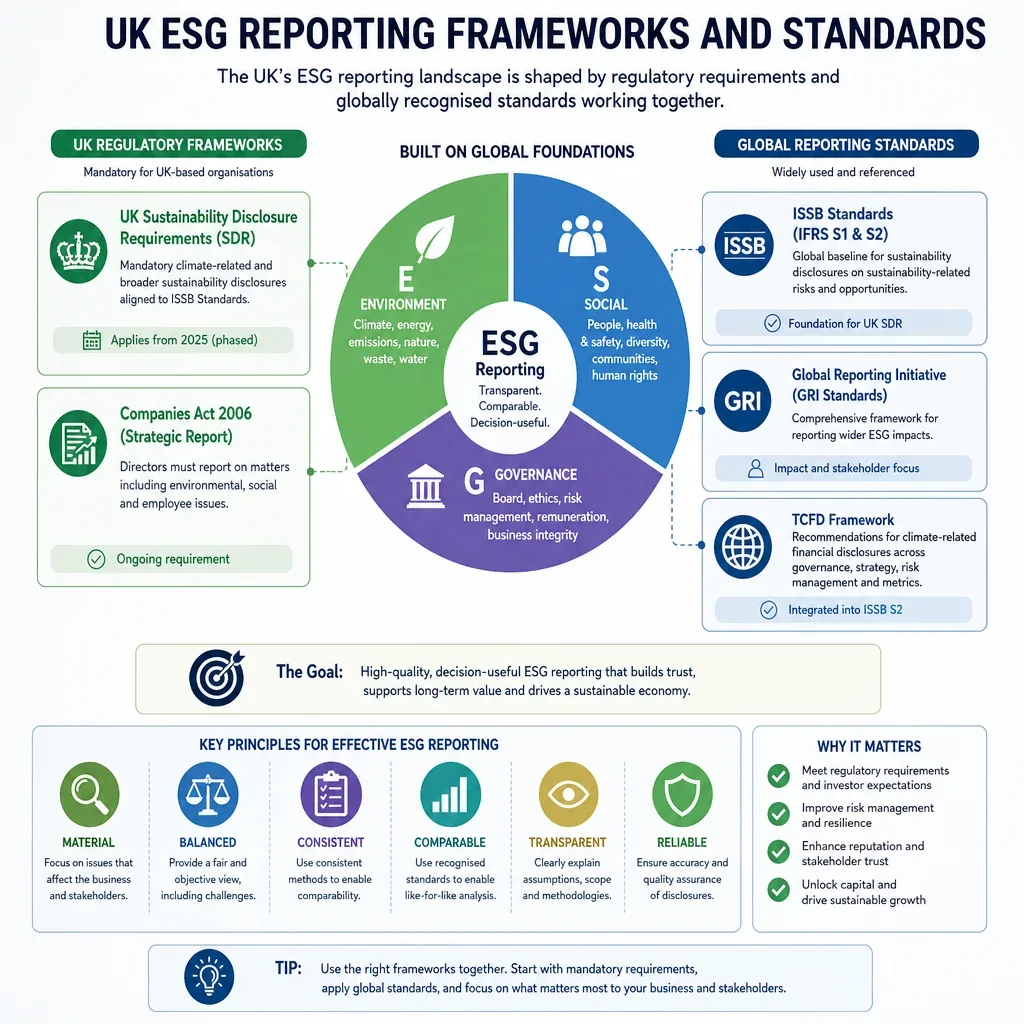
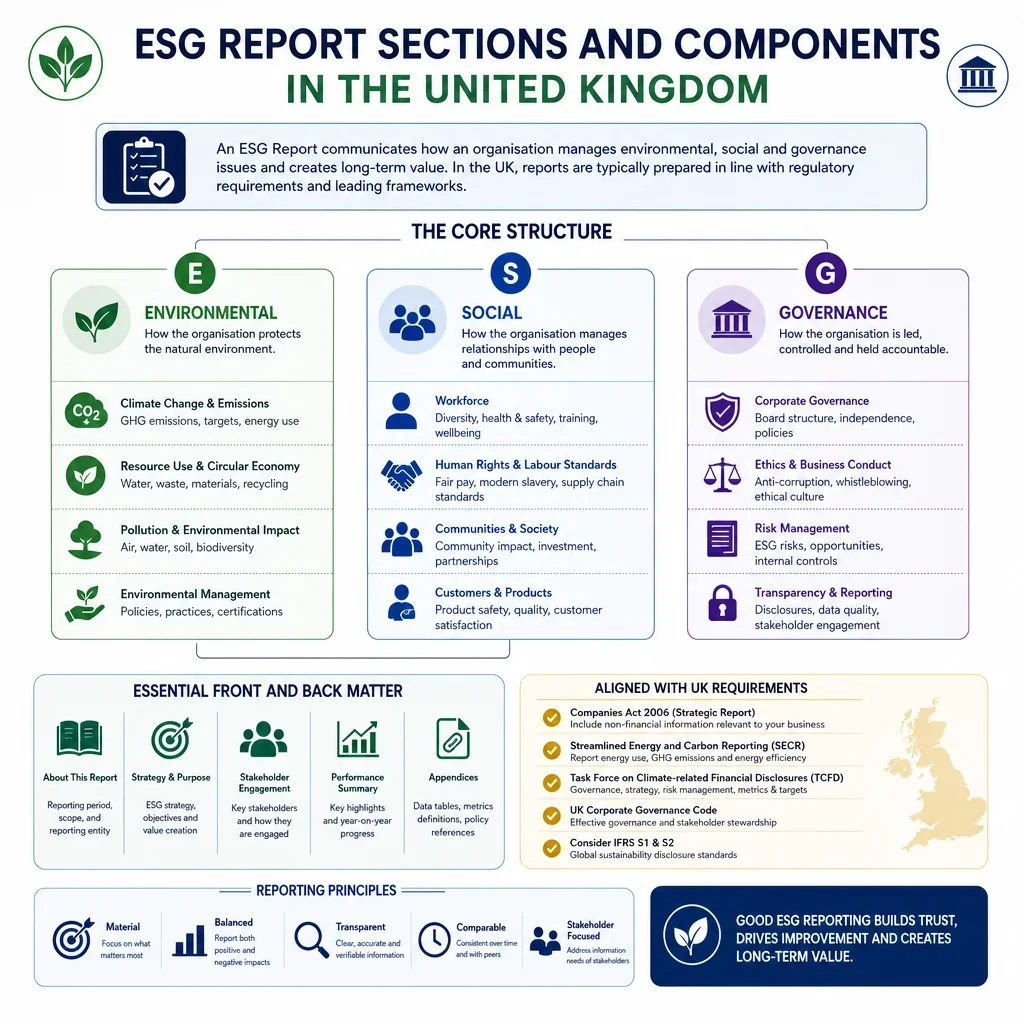
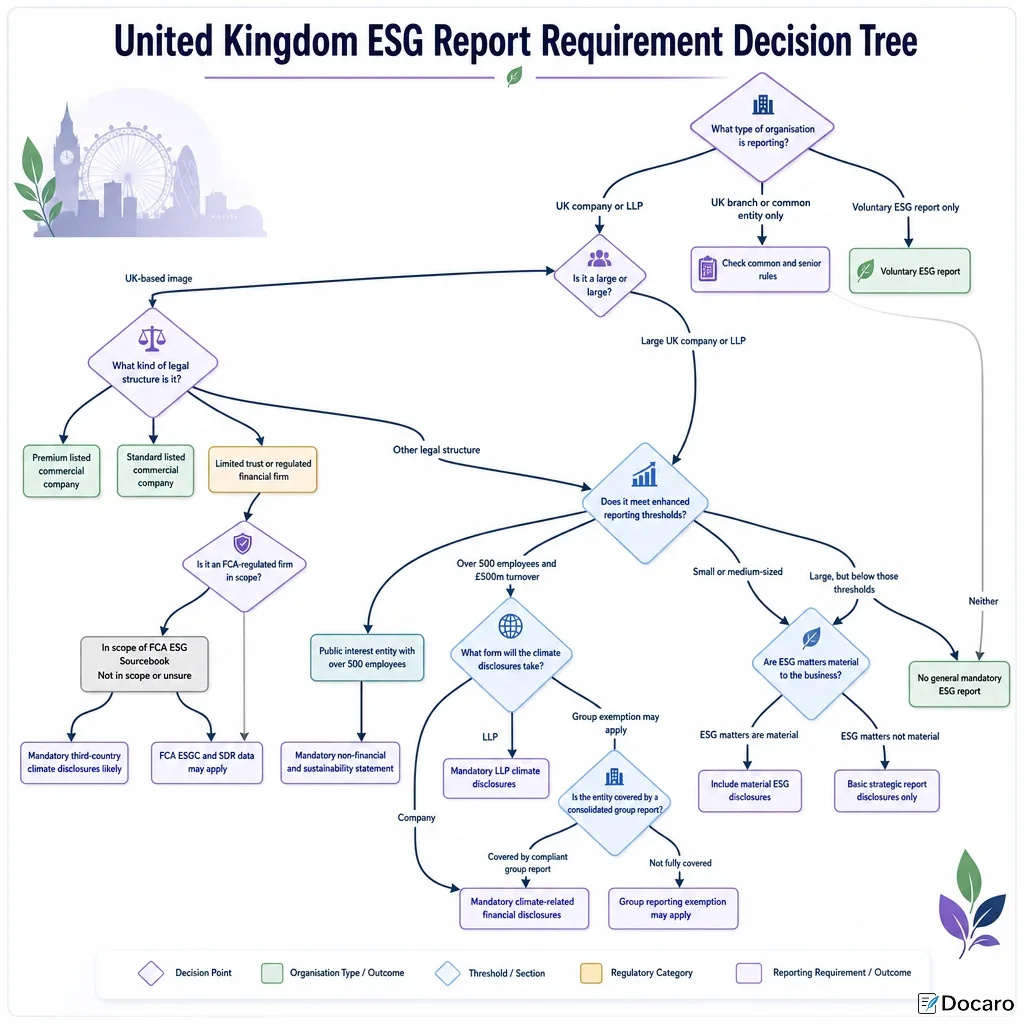
A UK-focused ESG report should normally include absolute greenhouse gas emissions, energy use, water, waste and key intensity ratios. Larger UK companies and LLPs may also need to consider Streamlined Energy and Carbon Reporting requirements, including UK energy use, associated greenhouse gas emissions, at least one intensity ratio, and energy efficiency action. Climate-related metrics are also important where the organisation is subject to UK climate-related financial disclosure requirements.
How Should Environmental Data Be Collected For ESG Reporting?
The dataset shows that most core ESG environmental metrics are best collected monthly or quarterly from primary evidence such as utility bills, meter readings, fuel cards, waste transfer notes, travel systems and supplier data. Annual reporting is usually more reliable when source data is collected throughout the year rather than reconstructed at year end.
What Are The Main Calculation Issues For UK ESG Reports?
- Boundary setting matters: emissions, energy, water and waste should be aligned to clear organisational and operational boundaries, such as sites under operational control.
- Scope 3 data is often estimated: purchased goods, transport, commuting, waste and business travel commonly require spend-based, distance-based or supplier-specific estimates.
- Intensity metrics need context: ratios such as tCO2e per £m revenue, kWh per square metre or water per unit produced help users compare performance but should not replace absolute figures.
- UK evidence retention is practical: waste records, energy invoices, refrigerant logs and environmental permit data can support auditability and reduce greenwashing risk.
Which UK Legal And Reporting Sources Are Most Relevant?
Useful reference points include the UK Government environmental reporting guidance, Environmental Reporting Guidelines, the Companies (Directors' Report) and Limited Liability Partnerships (Energy and Carbon Report) Regulations 2018, and the UK greenhouse gas conversion factors. For climate risk metrics, the TCFD framework and UK climate-related financial disclosure rules are especially relevant.
FAQs
You Might Also Be Interested In