What is the Memorandum of Association in UK Company Law?
The Memorandum of Association is a foundational document in UK company law, serving as the initial agreement among a company's subscribers to form the entity and become its members. Its primary purpose is to outline the company's formation details and the subscribers' commitment to take at least one share each, ensuring legal clarity from inception. Under the Companies Act 2006, it establishes the company's existence and basic structure, distinct from the more detailed Articles of Association.
Key contents of the Memorandum of Association include the company's name, registered office address in the UK, objects (if applicable for certain companies), liability type (limited by shares, guarantee, or unlimited), and the subscribers' names with their share commitments. For modern companies incorporated after 1 October 2009, the memorandum is a simpler document stating that subscribers wish to form a company and agree to its articles. This streamlined version focuses on formation intent, with detailed governance moved to the Articles of Association, as per the Companies Act 2006 reforms.
Since the Companies Act 2006, the Memorandum of Association has evolved from a comprehensive charter defining a company's objects and powers—often limiting activities—to a concise statement of formation, abolishing the ultra vires doctrine for third parties. This shift promotes flexibility for businesses, allowing companies to pursue any lawful activity without rigid object clauses. For deeper insights into key requirements, explore our guide on Understanding Memorandum of Association: Key Requirements in the UK, and refer to the official Companies Act 2006 on the UK Legislation website.
"The Memorandum of Association serves as the foundational charter of a company under UK law, defining its name, registered office, objects, and initial shareholders, thereby establishing its legal identity from incorporation."
Recommendation: Consult the Memorandum when forming or reviewing a company's core structure to ensure compliance with the Companies Act 2006.
What are the Articles of Association in UK Company Law?
The Articles of Association under UK company law serve as the primary constitutional document that governs the internal operations of a company, outlining rules for management, shareholder rights, and decision-making processes. Registered with Companies House upon incorporation, these articles provide a framework for how directors and members interact, ensuring compliance with the Companies Act 2006. For detailed guidance on customization, refer to our Drafting Articles of Association for Your UK Company: A Step-by-Step Guide.
Key provisions in the Articles of Association typically include details on share issuance, board meetings, voting rights, dividend policies, and procedures for altering the articles themselves, allowing companies to tailor governance to their specific needs. Unlike rigid statutes, these provisions offer flexibility while maintaining statutory safeguards against unfair prejudice to minority shareholders. Essential clauses often cover director appointments, quorum requirements for meetings, and conflict of interest protocols to promote transparent UK company governance.
The Articles of Association closely relate to the model articles prescribed by the Companies Act 2006, which act as default rules for private limited companies (Table A), public companies, and community interest companies, automatically applying if no custom articles are filed. Companies can adopt, amend, or exclude parts of the model articles to suit their structure, but any changes must not contravene overriding statutory requirements. For authoritative reference, consult the official Companies Act 2006 on the UK Legislation website.
How Do the Memorandum and Articles of Association Differ in Purpose?
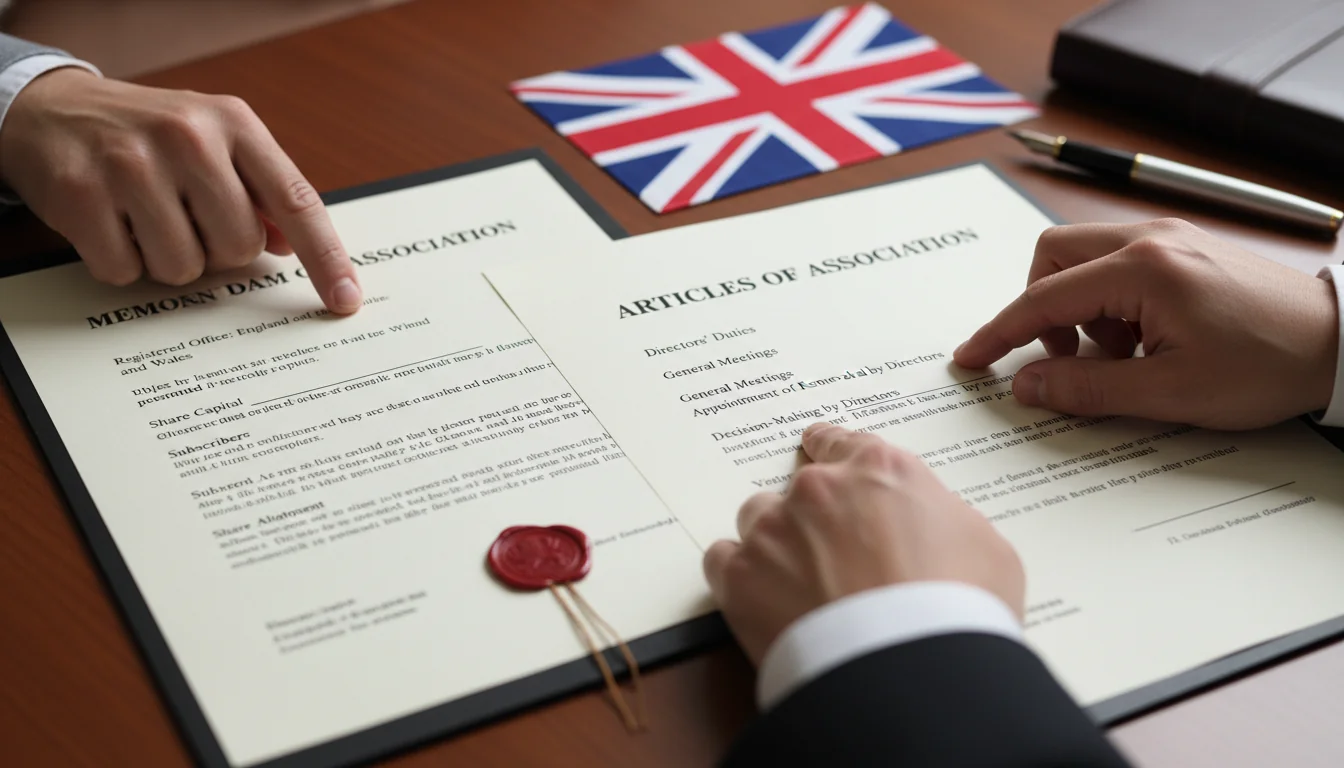
Under UK company law, the Memorandum of Association serves as the foundational document that outlines a company's external commitments, primarily defining its name, registered office, objects (or purposes), and initial shareholders' liabilities. This document acts as a charter binding the company to the outside world, ensuring transparency about its scope of activities and structure. For more details on Memorandum and Articles of Association, refer to the general guide.
In contrast, the Articles of Association focus on internal rules governing the company's day-to-day operations, such as directors' powers, shareholders' meetings, and decision-making processes. These rules provide a framework for internal management and can be altered more flexibly than the Memorandum. This distinction emphasizes how the Memorandum protects external stakeholders while the Articles ensure smooth internal governance, as outlined in the Companies Act 2006.
To summarize key differences using bullet points for clarity:
- Memorandum of Association: Establishes external commitments, like company objects and liability; historically unchangeable post-incorporation.
- Articles of Association: Detail internal rules, such as voting rights and board procedures; amendable by special resolution.
For authoritative insights, see the UK Government guidance on model articles.
What Key Elements Define Their Distinct Roles?
The Memorandum of Association primarily outlines the foundational aspects of a company, such as its name, objectives, registered office, and liability of members, serving as the company's charter under company law. In contrast, the Articles of Association govern the internal management and operations, detailing rules for director powers, board meetings, and shareholder rights like voting and dividend entitlements. This distinction ensures the Memorandum sets broad boundaries while the Articles provide operational flexibility, as explained in the Companies Act 2006.
Regarding subscriber commitments, the Memorandum requires initial subscribers to declare their intent to form the company and specify the number of shares they agree to take, binding them legally from incorporation. The Articles, however, do not cover such commitments but instead regulate post-formation aspects like the appointment of directors and resolution of disputes among shareholders. For deeper insights into these corporate governance documents, refer to authoritative resources like the UK Legislation on company formation.

What Are the Main Structural and Content Differences?
The Memorandum of Association underwent significant simplification after the Companies Act 2006 in the UK, transforming it from a detailed foundational document into a concise declaration of basic company intentions. Prior to 2006, it often included extensive clauses on the company's name, objects, and liabilities, but post-reform, it primarily states the company's name, registered office, liability type, and share capital if applicable. This shift emphasizes brevity, allowing companies to focus on essential legal requirements without unnecessary elaboration.
In contrast, the Articles of Association retain their detailed nature, serving as the internal rulebook governing operational aspects like directors' powers, shareholder meetings, and dividend policies. While the Memorandum outlines the company's core identity and purpose, the Articles delve into day-to-day governance, such as voting rights and share transfers, providing a comprehensive framework for management. This division ensures the Memorandum remains a high-level overview, whereas the Articles handle procedural intricacies, as detailed in authoritative sources like the UK Companies Act 2006.
Key content variances include the Memorandum's focus on static elements like the company name and objects clause, which define the scope of activities, versus the Articles' dynamic rules on operations and internal relations. For instance, the objects in the Memorandum limit the company's pursuits to avoid ultra vires actions, while Articles enforce practical rules like board resolutions. These differences enhance corporate governance efficiency, with resources like the UK Government model articles offering templates for customization.
How Has Legislation Shaped These Differences?
The Companies Act 2006 introduced significant reforms to the structure of company documents in the UK, transforming the Memorandum of Association into a largely historical document. Prior to the Act, the Memorandum contained essential details such as the company's name, objectives, and liability provisions, serving as a foundational charter. Under the new legislation, for companies incorporated after 1 October 2009, the Memorandum is simplified to merely state the intent to form a company and its initial shareholders, rendering it a historical record rather than an operative document, as outlined in Section 8 of the Act.
This reform elevated the importance of the Articles of Association, which now encompass all key provisions governing the company's internal management, operations, and shareholder rights. The Articles became the primary constitutional document, allowing for greater flexibility and customization while ensuring compliance with statutory defaults. This shift streamlined company formation, reducing administrative burdens and focusing on practical governance, as detailed in resources from the UK Government.
For new companies under the Companies Act 2006, the implications are profound, emphasizing the need to carefully draft comprehensive Articles from inception to avoid future amendments. Existing companies had to re-register or amend their documents, but new entities benefit from model Articles that can be adopted or tailored, promoting efficiency and legal certainty.
In What Ways Do Formation and Amendment Processes Differ?
In UK company law, the formation process involving the Memorandum of Association is distinct as it is filed at incorporation and serves as the initial charter defining the company's fundamental objectives and powers. Unlike other documents, the Memorandum is not amendable post-incorporation, ensuring a stable foundation that cannot be easily altered. This rigidity protects stakeholders by locking in core elements from the outset, streamlining the company formation process under the Companies Act 2006.
Conversely, the Articles of Association outline internal governance rules and are filed alongside the Memorandum during incorporation, but they offer flexibility as they can be altered by special resolution passed by shareholders. This amendability allows companies to adapt their operational rules to changing circumstances, such as updating management procedures or voting rights. The contrast highlights how the Articles support ongoing corporate governance evolution while the Memorandum remains fixed.
For a deeper dive into these differences between Memorandum and Articles of Association, explore our guide Differences Between Memorandum and Articles of Association Under UK Company Law. Additional authoritative insights are available from the UK Government's Companies Act 2006 source.
What Are the Legal Requirements for Each?
In the United Kingdom, creating a Memorandum of Association for a company involves outlining the initial subscribers' intent to form the company and their agreement to become members, as required under the Companies Act 2006. This document must be signed by at least one subscriber and filed with Companies House upon incorporation. Any amendments to the articles must be approved by a special resolution of members and filed with Companies House within 15 days of passage to keep records updated. Bullet points for clarity on common requirements include:
- Memorandum must state the company name, registered office, and liability type.
- Articles govern internal management and can be altered by special resolution.
- All filings must be electronic where possible for efficiency.
How Do Legal Implications and Enforcement Vary Between Them?
The Memorandum of Association serves as a foundational document for companies, outlining the scope of activities and powers, but it is not directly binding on individual subscribers in the same way as a personal contract. Instead, subscribers are bound through their agreement to form the company, making the memorandum enforceable indirectly via corporate law principles. For instance, courts have ruled in cases like Ashbury Railway Carriage v Riche (1875) that actions ultra vires the memorandum are void, protecting subscribers from unauthorized company ventures.
The Articles of Association, on the other hand, function as an internal contract binding on the company and its members, enforceable through courts under statutory provisions like Section 14 of the UK Companies Act 2006. Disputes often arise over shareholder rights, such as dividend policies or director appointments, where courts intervene to uphold the articles' terms.
What Happens in Case of Conflicts?
In company law, the Memorandum of Association and Articles of Association form the foundational documents governing a corporation's structure and operations. Historically, the Memorandum held superior precedence, serving as the company's charter that outlined its core objectives and powers, while the Articles dealt with internal management details. Any conflict between the two would typically be resolved in favor of the Memorandum, as it represented the subscribers' agreement on the company's fundamental purpose.
Under modern legal frameworks, such as the UK's Companies Act 2006, this historical precedence has been overridden, allowing the Articles to take priority in case of inconsistencies. This shift emphasizes flexibility in corporate governance, enabling companies to amend the Articles more readily without altering the Memorandum's scope. For detailed insights, refer to authoritative sources like the Companies Act 2006, which outlines these resolutions for conflict resolution in company documents.