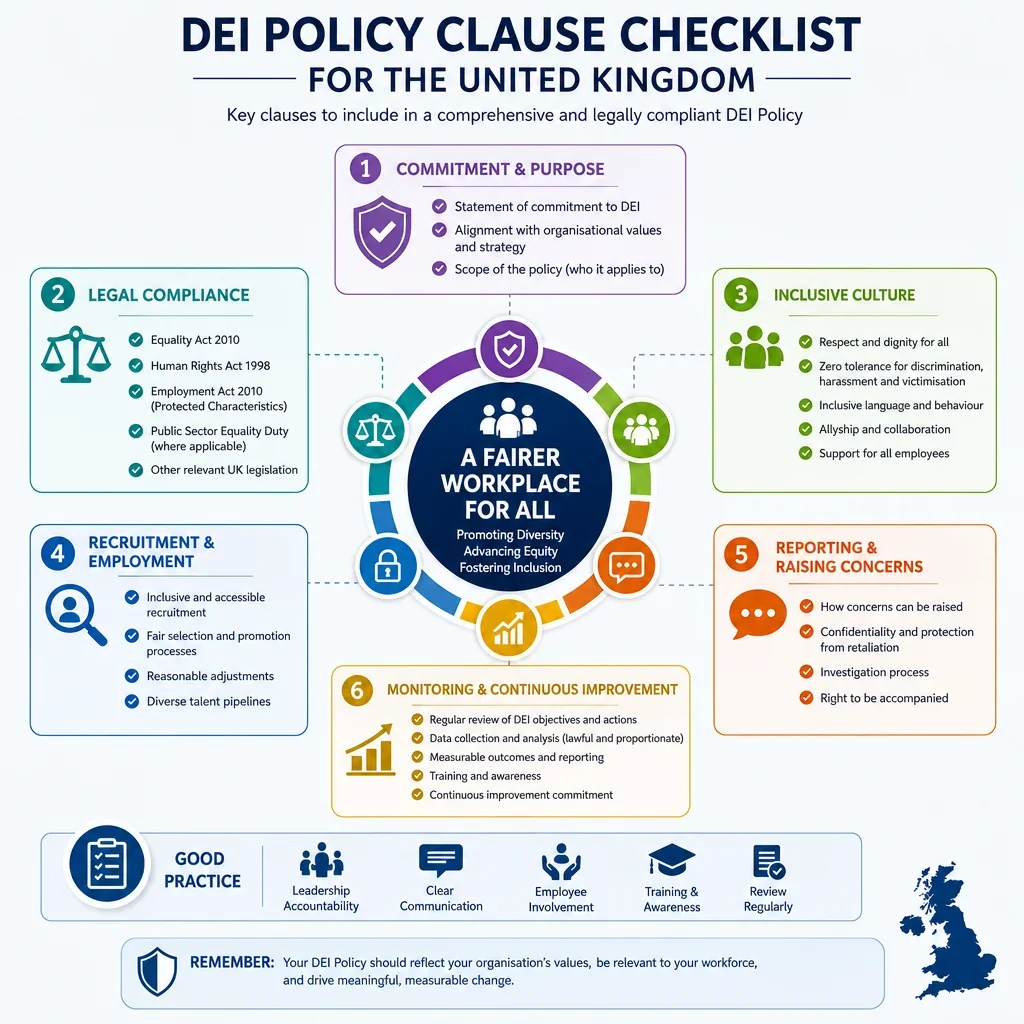
DEI Policy Clause Checklist For The United Kingdom
Clause Name | Purpose | Essential Clause | Example Content Summary |
|---|---|---|---|
Introductory | |||
Purpose And Scope | Explains why the policy exists and who it applies to. | true | States commitment to an inclusive workplace covering employees, workers, contractors, applicants and visitors. |
DEI Commitment Statement | Sets the organisation's overall DEI principles. | true | Confirms commitment to fairness, dignity, respect, inclusion, equity and equal opportunity. |
Key Definitions | Clarifies important terms used in the policy. | true | Defines diversity, equity, inclusion, equality, discrimination, harassment, victimisation and reasonable adjustment. |
Legal compliance | |||
Protected Characteristics | Identifies the characteristics protected by UK equality law. | true | Lists age, disability, gender reassignment, marriage and civil partnership, pregnancy and maternity, race, religion or belief, sex and sexual orientation. |
Equality Act 2010 Compliance | Links the policy to the main UK anti-discrimination statute. | true | States that the organisation will comply with the Equality Act 2010 and related employment obligations. |
Direct Discrimination | Prohibits less favourable treatment because of a protected characteristic. | true | Gives examples such as refusing promotion because of age, race, sex or sexual orientation. |
Indirect Discrimination | Addresses rules or practices that disadvantage protected groups. | true | Requires policies, criteria and practices to be justified, proportionate and reviewed for unequal impact. |
Workplace conduct | |||
Harassment | Prohibits unwanted conduct linked to protected characteristics. | true | Explains that jokes, comments, exclusion, images or conduct creating a hostile environment may breach policy. |
Sexual Harassment | Specifically prohibits unwanted conduct of a sexual nature. | true | Covers sexual comments, touching, messages, images, coercion and other unwanted sexual conduct. |
Legal compliance, Workplace conduct | |||
Preventing Sexual Harassment | Reflects the employer duty to take reasonable steps to prevent sexual harassment. | true | Commits to risk assessments, training, reporting routes, manager action and proportionate preventative measures. |
Victimisation | Protects people who raise or support equality concerns. | true | States no one will suffer detriment for complaining, giving evidence or supporting a discrimination complaint. |
Workplace conduct | |||
Bullying And Unacceptable Conduct | Addresses harmful behaviour beyond strict discrimination law. | true | Covers intimidation, ridicule, exclusion, misuse of power and repeated undermining behaviour. |
Dignity And Respect At Work | Sets expected standards of respectful workplace behaviour. | true | Requires colleagues to communicate professionally, avoid stereotyping and respect personal boundaries. |
Workplace conduct, Training and implementation | |||
Inclusive Language And Communications | Promotes respectful, accessible and non-exclusionary communication. | false | Encourages plain language, respectful terminology, correct names and pronouns, and accessible formats. |
Recruitment and employment | |||
Inclusive Recruitment | Ensures hiring processes support equal opportunity. | true | Covers fair job adverts, objective criteria, diverse shortlisting and avoiding discriminatory questions. |
Non-Discriminatory Job Advertising | Reduces bias and unlawful exclusion at attraction stage. | true | Requires inclusive wording, essential criteria only and accessible application information. |
Fair Selection And Interviews | Promotes objective and consistent candidate assessment. | true | Uses role-related questions, structured scoring, trained interviewers and reasonable adjustments. |
Recruitment and employment, Legal compliance | |||
Right To Work Checks And Fair Treatment | Ensures immigration checks are completed without discriminatory treatment. | false | Applies checks consistently to all candidates at the correct stage and avoids assumptions based on nationality or ethnicity. |
Recruitment and employment, Training and implementation | |||
Inclusive Onboarding | Helps new starters feel informed, supported and included. | false | Covers accessible induction, buddy support, policy signposting and early adjustment discussions. |
Recruitment and employment | |||
Promotion And Career Progression | Supports fair access to advancement opportunities. | true | Requires transparent criteria, open opportunities, fair assessment and monitoring of progression patterns. |
Recruitment and employment, Training and implementation | |||
Learning And Development Access | Ensures training opportunities are available fairly. | false | States that access to training, mentoring and development should not be affected by protected characteristics or working pattern. |
Recruitment and employment | |||
Fair Performance Management | Reduces bias in appraisal and capability decisions. | true | Requires objective standards, documented feedback, adjustment consideration and consistent manager decisions. |
Recruitment and employment, Workplace conduct | |||
Fair Disciplinary Action | Promotes consistent and non-discriminatory conduct management. | false | States disciplinary issues will be handled fairly, consistently and in line with the disciplinary procedure. |
Reporting and governance | |||
Grievance Procedure Link | Directs employees to the route for formal workplace concerns. | true | Explains when and how DEI concerns may be raised under the grievance procedure. |
Informal Resolution Options | Encourages early resolution where appropriate and safe. | false | Allows a concern to be raised with a manager, HR or another contact before a formal complaint. |
Reporting Discrimination Or Harassment | Provides clear channels for raising DEI concerns. | true | Lists reporting contacts, escalation options, expected information and emergency safeguarding routes if relevant. |
Confidentiality In Complaints | Protects privacy while allowing fair investigation. | true | Explains information will be shared only with those who need it, subject to legal and investigation requirements. |
Investigation And Case Handling | Sets expectations for fair handling of DEI complaints. | true | Covers prompt action, impartial investigators, evidence gathering, support and outcome communication. |
Reporting and governance, Workplace conduct | |||
No Retaliation | Reinforces protection from retaliation after raising concerns. | true | States retaliation against complainants, witnesses or supporters may result in disciplinary action. |
Legal compliance, Recruitment and employment | |||
Reasonable Adjustments For Disability | Explains the duty to remove disability-related barriers. | true | Covers adjustments to working arrangements, premises, equipment, communication, recruitment and performance processes. |
Workplace conduct, Training and implementation | |||
Disability Inclusion And Accessibility | Promotes accessible systems, communications and workplaces. | false | Commits to accessible meetings, documents, technology, premises and reasonable support discussions. |
Neurodiversity Inclusion | Supports workers with different cognitive profiles. | false | Encourages clear communication, sensory awareness, flexible processes and individual adjustment discussions. |
Legal compliance, Recruitment and employment | |||
Pregnancy And Maternity Protection | Prevents unfavourable treatment because of pregnancy or maternity. | true | Covers recruitment, absence, health and safety, maternity leave, return to work and career progression. |
Recruitment and employment, Training and implementation | |||
Menopause Support | Supports affected workers and reduces related workplace disadvantage. | false | Signposts support, adjustments, manager conversations and confidentiality for menopause-related symptoms. |
Legal compliance, Workplace conduct | |||
Gender Reassignment And Trans Inclusion | Protects and supports trans people and those undergoing gender reassignment. | true | Covers names, pronouns, privacy, facilities, records, dress codes and protection from harassment. |
Race Equality And Anti-Racism | Addresses race, colour, nationality and ethnic or national origins. | true | Prohibits racist conduct and supports fair recruitment, progression, disciplinary and workplace treatment. |
Religion Or Belief Inclusion | Supports fair treatment related to religion, philosophical belief or lack of belief. | true | Covers respectful conduct, scheduling, dress, facilities and handling belief-related requests proportionately. |
Sex Equality | Prevents unfair treatment because someone is a woman or a man. | true | Commits to fair treatment in recruitment, work allocation, pay, promotion, conduct and facilities. |
Sexual Orientation Inclusion | Protects lesbian, gay, bisexual and heterosexual people from unfair treatment. | true | Covers inclusive language, partner recognition, anti-harassment standards and equal access to benefits. |
Legal compliance, Recruitment and employment | |||
Age Inclusion | Prevents unjustified age-related treatment. | true | Addresses age-neutral hiring, training, promotion, redundancy and retirement-related practices. |
Legal compliance | |||
Marriage And Civil Partnership Protection | Prevents unfair treatment because of marriage or civil partnership status. | false | Confirms workplace decisions should not disadvantage people because they are married or in a civil partnership. |
Legal compliance, Recruitment and employment | |||
Equal Pay | Supports equality of contractual terms between women and men doing equal work. | true | Commits to fair pay practices, objective pay decisions and review of unexplained pay disparities. |
Legal compliance, Reporting and governance | |||
Gender Pay Gap Reporting | Addresses reporting obligations for eligible UK employers. | false | States that employers meeting the threshold will publish required gender pay gap figures and consider action plans. |
Recruitment and employment | |||
Flexible Working And Inclusion | Supports fair access to flexible working arrangements. | false | Confirms requests will be considered fairly and consistently, with attention to equality impacts. |
Legal compliance, Recruitment and employment | |||
Part-Time Worker Fairness | Prevents less favourable treatment of part-time workers. | false | Covers fair access to benefits, training, promotion, communication and pro-rated terms where appropriate. |
Fixed-Term Employee Fairness | Prevents unjustified less favourable treatment of fixed-term employees. | false | Commits to fair access to benefits, vacancies, training and employment information for fixed-term employees. |
Agency Worker Inclusion | Recognises fair treatment principles for agency workers. | false | Covers workplace access, vacancy information and relevant equal treatment rights for agency workers. |
Recruitment and employment, Legal compliance | |||
Carer Inclusion | Supports workers with caring responsibilities. | false | Signposts carer leave, flexible working and support for avoiding caregiver-related disadvantage. |
Recruitment and employment | |||
Parents And Family Leave Inclusion | Supports fair treatment around family-related leave and responsibilities. | false | Refers to maternity, paternity, adoption, shared parental, parental bereavement and unpaid parental leave policies. |
Legal compliance, Recruitment and employment | |||
Positive Action | Allows lawful steps to address disadvantage or under-representation. | false | Explains proportionate initiatives such as outreach, mentoring or targeted development for under-represented groups. |
Positive Action In Recruitment Tie-Breaks | Clarifies the narrow conditions for lawful tie-break decisions. | false | States tie-break positive action may be considered only where candidates are genuinely as qualified and action is proportionate. |
Legal compliance | |||
Avoiding Unlawful Positive Discrimination | Distinguishes lawful positive action from unlawful preferential treatment. | true | Explains that selection or promotion must not be automatic or based solely on protected characteristics. |
Reporting and governance | |||
Equality Monitoring | Supports evidence-based DEI review while respecting privacy. | false | Explains voluntary data collection, anonymised reporting, limited access and lawful use of workforce diversity data. |
Legal compliance, Reporting and governance | |||
Diversity Data And UK GDPR | Addresses special category data risks in DEI monitoring. | true | States equality data will be collected lawfully, transparently, securely and only where necessary. |
Data Protection Act 2018 Compliance | Links DEI data handling to UK data protection law. | false | Refers employees to the privacy notice and data protection safeguards for equality monitoring data. |
Public Sector Equality Duty | Addresses the equality duty for public authorities and relevant functions. | false | For applicable bodies, confirms due regard to equality, eliminating discrimination and advancing equality of opportunity. |
Reporting and governance | |||
Roles And Responsibilities | Allocates accountability for policy delivery. | true | Sets responsibilities for directors, senior leaders, managers, HR, employees and contractors. |
Leadership Accountability | Ensures senior leaders own DEI outcomes and conduct standards. | true | Requires leaders to model inclusive behaviour, allocate resources and review progress. |
Reporting and governance, Training and implementation | |||
Manager Responsibilities | Clarifies frontline duties for fair treatment and escalation. | true | Managers must apply procedures fairly, address inappropriate conduct and support adjustments and reporting. |
Workplace conduct, Reporting and governance | |||
Employee Responsibilities | Sets individual expectations for inclusive conduct. | true | Employees must treat others respectfully, follow the policy, report concerns and cooperate with investigations. |
Reporting and governance | |||
Senior Review And Reporting | Creates oversight of DEI risks, actions and progress. | false | Provides for periodic reporting to senior leadership on complaints, training, monitoring and improvement actions. |
Workplace conduct, Reporting and governance | |||
Breach Of Policy | Explains consequences of non-compliance. | true | States serious breaches may lead to disciplinary action, up to and including dismissal where appropriate. |
Reporting and governance | |||
Malicious Or Bad Faith Complaints | Balances reporting protection with misuse prevention. | false | States genuinely raised concerns are protected, but knowingly false complaints may be handled under disciplinary procedures. |
Reporting and governance, Legal compliance | |||
Whistleblowing Link | Signposts protected disclosure routes where DEI concerns raise public interest issues. | false | Refers to whistleblowing procedures for serious wrongdoing, legal breaches or public interest concerns. |
Training and implementation | |||
DEI Training | Builds awareness and practical capability across the workforce. | true | Covers equality law basics, respectful conduct, bias, reporting, reasonable adjustments and manager responsibilities. |
Training and implementation, Workplace conduct | |||
Anti-Harassment Training | Helps prevent harassment and improve responses to complaints. | true | Includes examples, bystander action, reporting routes, manager duties and sexual harassment prevention. |
Training and implementation | |||
Bias Awareness | Helps decision-makers recognise and reduce biased judgments. | false | Covers bias risks in hiring, appraisal, work allocation, feedback, promotion and disciplinary decisions. |
Workplace conduct, Training and implementation | |||
Bystander Intervention | Encourages safe action when inappropriate conduct is witnessed. | false | Provides options to challenge, distract, support, document or report depending on safety and circumstances. |
Inclusive Meetings And Events | Makes participation fairer and more accessible. | false | Covers accessible venues, hybrid access, agendas, speaking opportunities, dietary needs and religious considerations. |
Workplace conduct, Legal compliance | |||
Inclusive Dress Code | Ensures appearance rules are fair, proportionate and inclusive. | false | Requires dress standards to consider religion, disability, gender expression, health and safety and business need. |
Workplace conduct, Recruitment and employment | |||
Inclusive Facilities | Supports fair and dignified access to workplace facilities. | false | Addresses toilets, changing spaces, prayer or quiet rooms, breastfeeding facilities and accessibility needs. |
Recruitment and employment, Training and implementation | |||
Hybrid And Remote Inclusion | Prevents exclusion of remote or hybrid workers. | false | Covers meeting access, communication norms, fair visibility, equipment, adjustments and inclusion in opportunities. |
Workplace conduct, Reporting and governance | |||
Third Parties, Clients And Suppliers | Extends conduct expectations to external interactions. | false | States staff should not face discriminatory or harassing conduct from clients, customers, suppliers or visitors. |
Workplace conduct | |||
Work Social Events | Clarifies standards apply outside normal working settings. | false | Applies respectful conduct standards to work-related events, travel, online spaces and informal gatherings. |
Digital And Online Conduct | Applies DEI standards to electronic communications. | false | Covers email, messaging, video calls, collaboration tools and work-related social media behaviour. |
Workplace conduct, Training and implementation | |||
Microaggressions And Exclusionary Behaviour | Identifies subtle behaviours that undermine inclusion. | false | Gives examples such as repeated stereotypes, assumptions, interruptions, mispronunciation or dismissive comments. |
Introductory, Training and implementation | |||
Intersectional Inclusion | Recognises that people may experience overlapping forms of disadvantage. | false | Encourages consideration of combined impacts across characteristics, roles, locations and working patterns. |
Recruitment and employment, Training and implementation | |||
Socioeconomic Inclusion | Promotes opportunity for people from different social backgrounds. | false | Addresses unpaid internships, educational requirements, networking access, expenses and progression barriers. |
Reporting and governance, Training and implementation | |||
Employee Networks And Resource Groups | Supports community, feedback and inclusion initiatives. | false | Explains governance, participation, sponsorship, budget, confidentiality and relationship with HR or leadership. |
Reporting and governance | |||
Employee Consultation And Voice | Enables staff input into DEI priorities and policy review. | false | Uses surveys, forums, representatives, networks or feedback channels to inform DEI actions. |
Training and implementation, Reporting and governance | |||
DEI Action Plan | Turns policy commitments into measurable activity. | false | Sets priorities, owners, timelines, measures and review points for DEI improvements. |
Reporting and governance | |||
Targets, Metrics And Reporting | Provides a framework for monitoring DEI progress. | false | May track recruitment, retention, promotion, pay, complaints, training completion and survey data. |
Reporting and governance, Legal compliance | |||
Equality Impact Review | Identifies potential unequal effects of policies or decisions. | false | Requires major workforce policies or changes to be reviewed for equality risks before implementation. |
Reporting and governance | |||
Policy Review Cycle | Keeps the policy current and effective. | true | States review frequency, responsible owner and triggers such as legal changes, complaints or workforce data. |
Introductory, Reporting and governance | |||
Related Policies | Connects the DEI policy to wider HR documentation. | true | Links to grievance, disciplinary, anti-harassment, whistleblowing, flexible working, data protection and recruitment policies. |
Introductory | |||
Policy Status | Clarifies whether the policy forms part of employment contracts. | false | States the policy is non-contractual unless the employer intends otherwise and may be amended after review. |
Training and implementation | |||
Policy Accessibility | Ensures staff can read and use the policy. | false | Provides accessible formats, translations where appropriate, intranet access and manager explanation if needed. |
Communication And Rollout | Ensures workers know the policy and how to use it. | true | Covers launch communications, induction, reminders, manager briefings and where the policy is stored. |
Reporting and governance | |||
Record Keeping | Supports accountability while limiting unnecessary personal data retention. | false | Covers records of complaints, investigations, training, monitoring and reviews, with retention limits. |
Reporting and governance, Workplace conduct | |||
Inclusive Procurement And Supply Chain | Extends DEI expectations to supplier engagement where relevant. | false | Encourages fair supplier practices, accessible services and appropriate conduct standards in contracts. |
Workplace conduct, Training and implementation | |||
Customer And Service User Inclusion | Applies inclusion principles to service delivery where relevant. | false | Sets expectations for respectful, accessible and non-discriminatory treatment of customers and service users. |
Recruitment and employment, Training and implementation | |||
Occupational Health And Support Referrals | Supports evidence-based adjustments and wellbeing support. | false | Explains when occupational health, employee assistance or specialist support may be offered with consent. |
Legal compliance, Recruitment and employment | |||
Health And Safety Equality Considerations | Aligns inclusion with workplace health and safety duties. | false | Requires risk assessments to consider pregnancy, disability, equipment, working environment and safe systems of work. |
Recruitment and employment, Legal compliance | |||
Redundancy And Restructuring Fairness | Reduces discrimination risk during workforce change. | false | Requires objective criteria, consultation, adjustment consideration and review for unequal impact. |
Absence Management And Equality | Ensures absence procedures consider equality obligations. | false | Covers disability-related absence, pregnancy-related absence, adjustments and consistent application of triggers. |
Recruitment and employment, Reporting and governance | |||
Adjustment Request Process | Provides a practical route for requesting and reviewing adjustments. | true | Sets out who to contact, information needed, review timing, trial adjustments and escalation if refused. |
Recruitment and employment, Training and implementation | |||
Mental Health Inclusion | Supports fair and sensitive handling of mental health at work. | false | Signposts support, adjustments, confidentiality, manager conversations and crisis escalation where relevant. |
Recruitment and employment | |||
Inclusive Benefits And Rewards | Ensures benefits are applied fairly and inclusively. | false | Reviews benefits for equal access across family status, sexual orientation, disability, working pattern and location. |
Training and implementation, Recruitment and employment | |||
Mentoring And Sponsorship | Supports fair development and progression opportunities. | false | Provides structured support, transparent access criteria and monitoring of participation and outcomes. |
Recruitment and employment | |||
Apprenticeships And Internships | Promotes fair early-career access. | false | Covers paid opportunities, objective criteria, accessible applications and outreach to under-represented groups. |
Workplace conduct | |||
Accent And Language Respect | Reduces exclusion linked to accent, language or nationality stereotypes. | false | Prohibits mocking accents or language ability and supports clear communication across teams. |
Workplace conduct, Legal compliance | |||
Religious And Ethnic Hostility | Addresses hostility that may overlap race, religion or belief. | false | Gives examples of anti-Semitism, Islamophobia and other hostility linked to religion, ethnicity or nationality. |
Workplace conduct, Reporting and governance | |||
Caste-Related Concerns | Allows reporting of caste-related exclusion or harassment where relevant. | false | States caste-related conduct will be treated seriously and assessed under relevant equality and conduct rules. |
Legal compliance, Recruitment and employment | |||
Nationality And Immigration Status Fairness | Prevents unfair assumptions linked to nationality or immigration status. | false | Confirms legal checks will be applied consistently and workplace treatment will not be based on nationality stereotypes. |
Legal compliance | |||
Human Rights Awareness | Relevant for public bodies and organisations performing public functions. | false | Notes that applicable organisations should consider rights such as privacy, expression, religion and non-discrimination. |
Legal compliance, Reporting and governance | |||
Modern Slavery And Exploitation Awareness | Supports ethical treatment and escalation of exploitation concerns. | false | Signposts reporting of forced labour, coercion or exploitation concerns, especially in supply chains or vulnerable roles. |
Recruitment and employment, Training and implementation | |||
International Worker Inclusion | Supports workers relocating from or working across different countries. | false | Covers cultural orientation, time zones, language support, relocation fairness and consistent employment treatment. |
Recruitment and employment, Workplace conduct | |||
Religious Holidays And Observance | Supports fair handling of religious or belief-related requests. | false | Explains requests for leave, prayer time, fasting or dress will be considered reasonably and consistently. |
Recruitment and employment | |||
Breastfeeding And Expressing Milk Support | Supports workers returning from maternity leave. | false | Provides for rest, suitable facilities, privacy and health and safety consideration where practicable. |
Workplace conduct | |||
Workplace Banter Boundaries | Clarifies that humour is not a defence to harmful conduct. | false | States comments framed as jokes may still be harassment or bullying if unwanted or offensive. |
Workplace conduct, Introductory | |||
Zero Tolerance Statement | Signals serious treatment of discrimination, harassment and bullying. | false | States prohibited conduct will not be tolerated and will be addressed under relevant procedures. |
Legal compliance, Reporting and governance | |||
Objective Justification And Proportionality | Guides review of policies that may indirectly disadvantage protected groups. | false | Requires potentially disadvantageous rules to pursue a legitimate aim and be proportionate. |
Training and implementation, Reporting and governance | |||
Training Records And Refreshers | Supports evidence of implementation and ongoing awareness. | false | Tracks completion, refresher timing, manager training and updates after legal or policy changes. |
Reporting and governance, Introductory | |||
Policy Owner And Contact | Identifies who maintains the policy and answers questions. | true | Names HR, a senior leader or responsible team as the policy owner and provides contact details. |
What Should A UK DEI Policy Include?
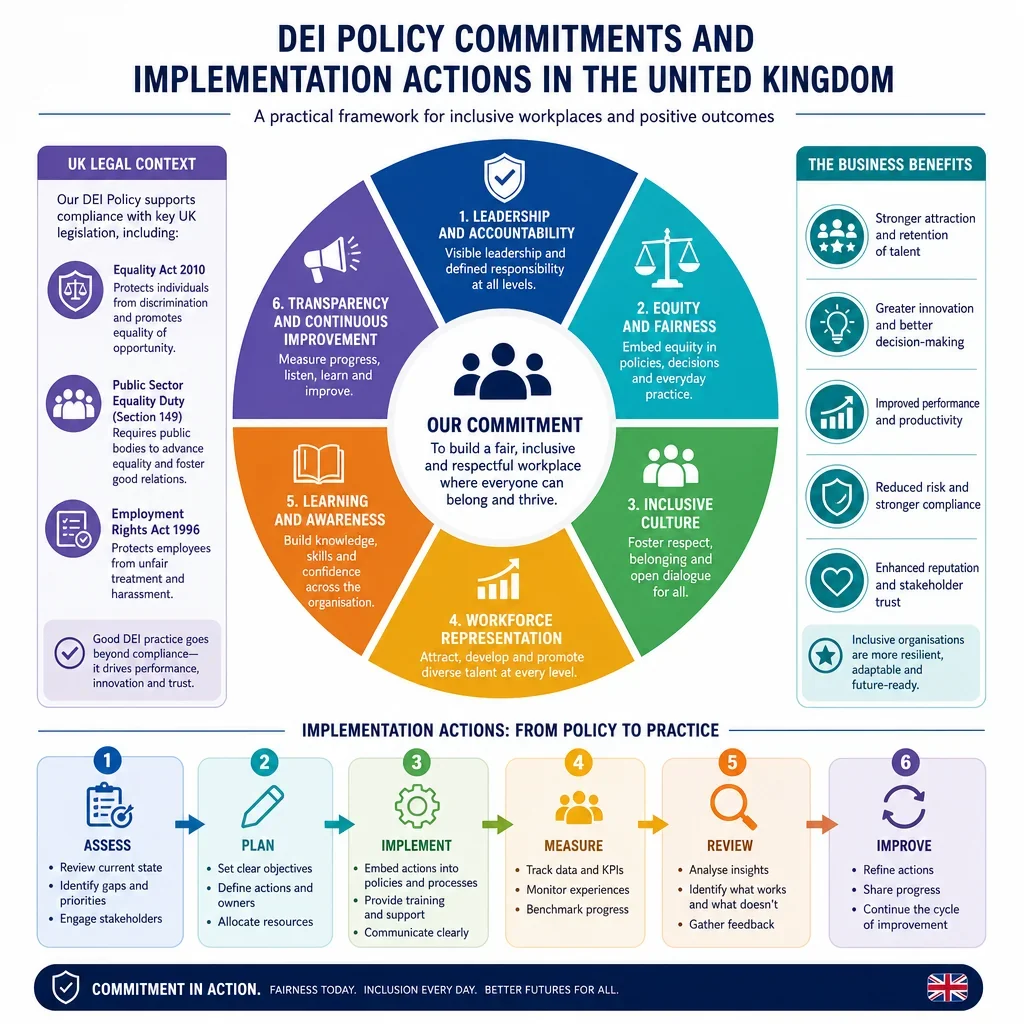
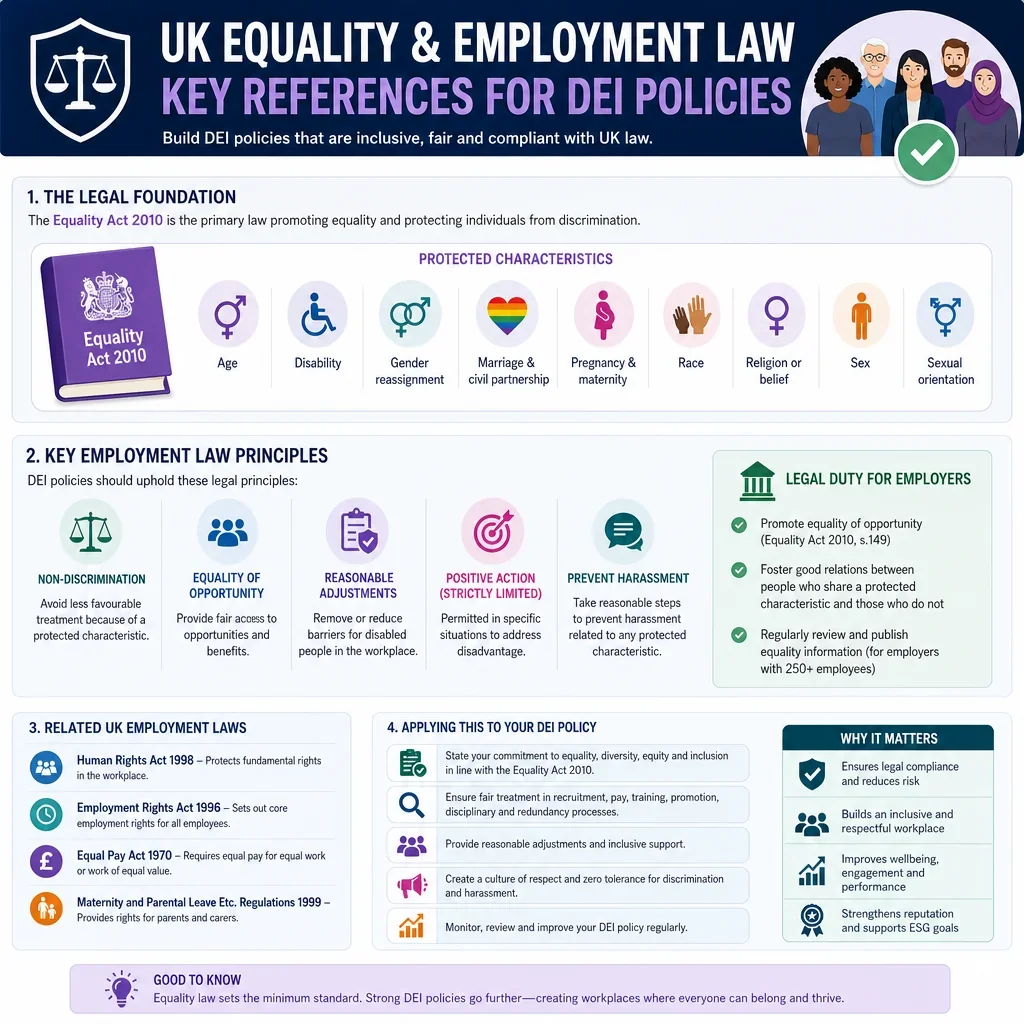
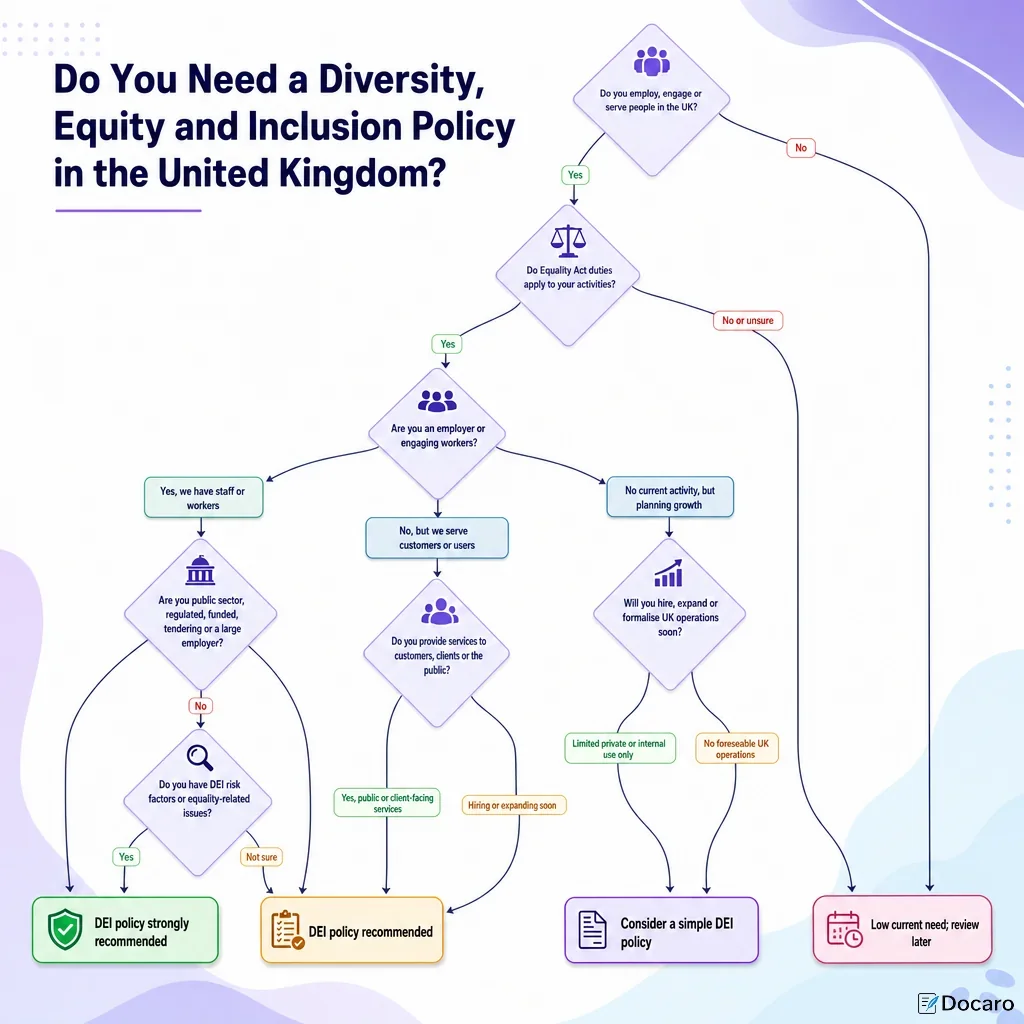
A comprehensive UK DEI policy should combine legal compliance clauses with practical workplace commitments. The most important clauses cover the Equality Act 2010 protected characteristics, anti-discrimination, harassment and victimisation, reasonable adjustments for disabled workers, recruitment and promotion, pay equity, reporting routes, investigation handling, governance ownership and training.
Which Clauses Are Most Important For Legal Risk?
The clauses most closely linked to UK legal risk are those dealing with discrimination, harassment, victimisation, disability adjustments, pregnancy and maternity, equal pay, part-time and fixed-term worker fairness, whistleblowing and data protection. These areas connect directly to statutory obligations and should be drafted clearly, consistently and realistically.
How Should Employers Make A DEI Policy Practical?
- Assign ownership: name the role or team responsible for implementation, monitoring and review.
- Create safe reporting channels: explain how concerns can be raised, including links to grievance, whistleblowing and harassment procedures.
- Link DEI to employment decisions: cover recruitment, promotion, pay, training, performance management and flexible working.
- Use measurable actions carefully: monitoring should respect UK GDPR and equality data rules and avoid unlawful positive discrimination.
- Review regularly: policies should be updated when the law, workforce data or organisational risks change.
Can A DEI Policy Use Positive Action In The UK?
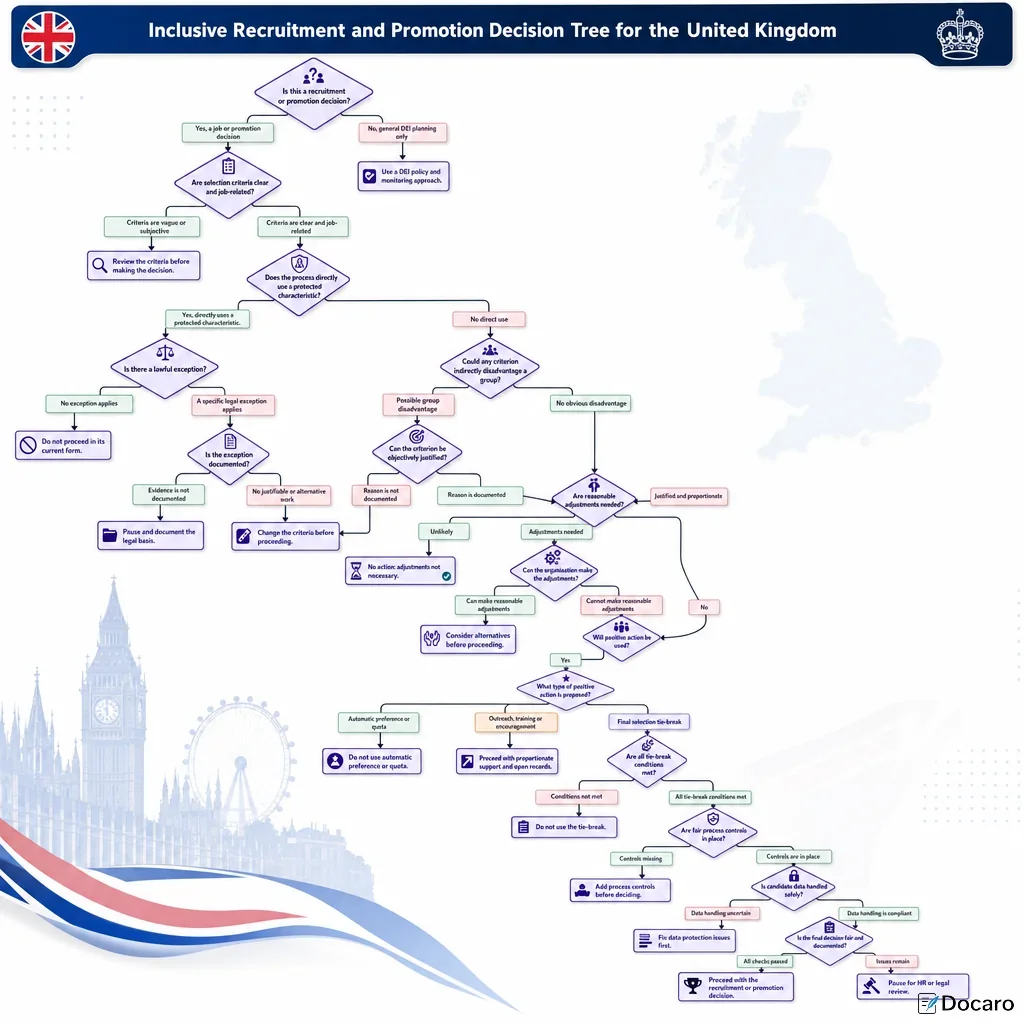
Yes, but only within the limits of the Equality Act 2010. UK employers may take proportionate positive action to address disadvantage, under-representation or different needs, but the policy should distinguish this from unlawful positive discrimination. Any tie-break approach in recruitment or promotion should be used cautiously and only where candidates are genuinely as qualified as each other.
FAQs
You Might Also Be Interested In