Common LLP Agreement Clauses In The UK
Clause name | Purpose | Agreement section | Typical use case | Risk if omitted |
|---|---|---|---|---|
Core | ||||
Parties and LLP Details | Identifies the LLP, its registered number, members and agreement date. | Formation and governance | All LLPs signing a written membersu0027 agreement. | Uncertainty over who is bound and which LLP is covered. |
Nature of LLP and Membersu0027 Relationship | Confirms the LLP is a separate legal person and not a general partnership. | Formation and governance | Any LLP where members want limited liability and clear capacity. | Confusion over authority, liability and member obligations. |
Recommended | ||||
Business Purpose and Scope | Describes the LLPu0027s permitted business activities and strategic scope. | Formation and governance | Professional, investment, property or project LLPs with defined objectives. | Members may pursue unauthorised activities or dispute business direction. |
Core | ||||
Name, Registered Office and Statutory Registers | Sets rules for the LLP name, registered office and statutory record keeping. | Administration | All LLPs needing Companies House compliance and reliable notices. | Missed notices, filing errors and administrative disputes. |
Commencement and Duration | States when the agreement starts and whether it continues indefinitely. | Formation and governance | Start-ups, joint ventures and project-specific LLPs. | Unclear start date, term and rights before signing. |
Designated Members | Identifies designated members responsible for statutory filing and compliance tasks. | Administration | All LLPs, especially where only some members handle compliance. | Missed filings, penalties and unclear compliance accountability. |
Initial Capital Contributions | Records each memberu0027s initial cash, asset or non-cash contribution. | Capital and contributions | Any LLP where members contribute unequal capital or assets. | Disputes over ownership, repayment and profit expectations. |
Recommended | ||||
Further Capital Calls | Sets when and how members must provide extra funding. | Capital and contributions | Growth businesses, property LLPs and cash-intensive ventures. | Funding deadlock or unfair pressure on solvent members. |
Member Loan Accounts | Separates repayable member loans from capital and profit balances. | Capital and contributions | LLPs funded by director-style loans or temporary member advances. | Arguments over whether funds are repayable debt or permanent capital. |
Non-Cash Contributions and Valuation | Values assets, equipment, goodwill or IP contributed by members. | Capital and contributions | Members contribute software, property, equipment or client goodwill. | Inflated valuations and later ownership disputes. |
Capital Accounts | Requires accurate tracking of each memberu0027s capital balance. | Capital and contributions | LLPs with unequal contributions, drawings or buyout rights. | Unclear entitlements on retirement, sale or winding up. |
Optional | ||||
Interest on Capital | States whether members receive interest on capital balances. | Capital and contributions | Capital-heavy LLPs or members contributing different cash amounts. | Disputes where one member funds more than others. |
Core | ||||
Profit Sharing | Sets each memberu0027s share of profits and allocation method. | Profits and losses | Any LLP not intending equal profit sharing. | Default equal sharing may apply despite unequal contributions or roles. |
Loss Sharing | Allocates trading losses and deficits between members. | Profits and losses | Start-ups, property ventures and LLPs with uneven risk exposure. | Members may dispute deficits and equal loss allocation. |
Drawings and Advances | Controls interim payments to members before final profit calculation. | Profits and losses | Trading LLPs where members take monthly income. | Overdrawn accounts, cash shortfalls and repayment disputes. |
Recommended | ||||
Tax Reserves and Withholding | Allows the LLP to retain funds for tax-related liabilities and payments. | Profits and losses | LLPs with self-employed members and large annual tax liabilities. | Insufficient cash for tax obligations or member indemnities. |
Retention of Profits | Permits profits to be retained for working capital or investment. | Profits and losses | Growing LLPs needing cash for staff, premises or expansion. | Members may demand distribution of cash needed by the business. |
Optional | ||||
Fixed Remuneration or Priority Profit Shares | Sets fixed member payments before residual profit allocation. | Profits and losses | Founder members, salaried partners or managing members. | Unclear priority between fixed rewards and profit shares. |
Core | ||||
Management Structure | Defines who manages the LLP and how management roles operate. | Management and decisions | LLPs with managing partners, committees or delegated teams. | Confusion over control, accountability and day-to-day authority. |
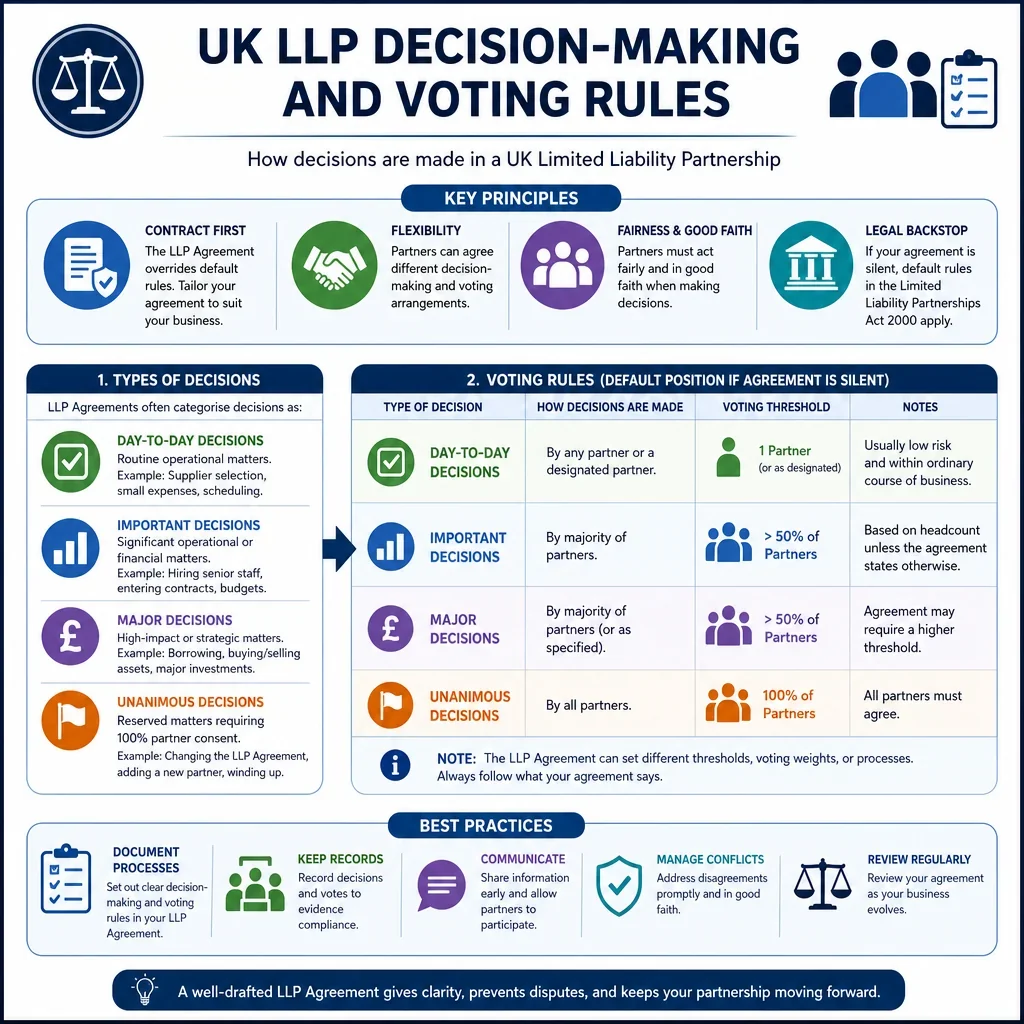
Ordinary Decisions and Voting | Sets voting rights, thresholds and procedures for routine decisions. | Management and decisions | LLPs wanting majority, weighted or class voting. | Default rules may cause unsuitable equal voting or unanimity requirements. |
Reserved Matters | Lists major decisions needing special approval or unanimity. | Management and decisions | Borrowing, new members, asset sales, litigation or business changes. | Major commitments may be made without proper member consent. |
Recommended | ||||
Membersu0027 Meetings | Sets notice, quorum, agenda and minutes for member meetings. | Management and decisions | LLPs with several members or formal governance expectations. | Challenges to decisions and poor governance records. |
Written Resolutions | Allows decisions to be approved in writing without a meeting. | Management and decisions | Remote, small or fast-moving LLPs. | Unnecessary delays or disputed informal approvals. |
Core | ||||
Authority to Bind the LLP | Limits or defines when members can contract on behalf of the LLP. | Management and decisions | LLPs where members negotiate with clients, lenders or suppliers. | Unauthorised contracts may bind the LLP or cause internal disputes. |
Bank Accounts and Payment Authority | Controls bank accounts, signatories, payment limits and approvals. | Administration | All LLPs handling client money, payroll or supplier payments. | Fraud risk, unauthorised spending and cash control failures. |
Recommended | ||||
Budgets and Business Plans | Requires annual budgets or plans and approval procedures. | Management and decisions | LLPs with employees, premises, financing or growth targets. | Overspending and disagreement about business priorities. |
Core | ||||
Member Duties and Time Commitment | Sets expected services, roles, standards and working commitment. | Management and decisions | Professional practices and owner-managed trading LLPs. | Free-riding, performance disputes and unclear service obligations. |
Recommended | ||||
Good Faith and Loyalty | Requires members to act honestly and in the LLPu0027s interests. | Formation and governance | Closely held LLPs relying on mutual trust between members. | Harder to challenge self-interested conduct or misuse of opportunities. |
Core | ||||
Conflicts of Interest | Requires disclosure and approval of conflicting interests or transactions. | Management and decisions | Members with outside businesses, family interests or client referrals. | Secret profits, divided loyalty and reputational damage. |
Recommended | ||||
Outside Activities | Controls other work, investments or directorships held by members. | Management and decisions | Part-time members, consultants and portfolio entrepreneurs. | Competing priorities, conflicts and loss of business opportunities. |
Core | ||||
Confidentiality | Protects business plans, financial data, know-how and client information. | Formation and governance | Professional services, technology, finance and client-led LLPs. | Loss of sensitive information and weak remedies after departure. |
Intellectual Property Ownership | Allocates ownership of IP created or used by members. | Capital and contributions | Software, design, consultancy, media or research LLPs. | Members may personally own key IP needed by the LLP. |
Recommended | ||||
Data Protection | Requires members to handle personal data lawfully and securely. | Administration | LLPs processing client, employee, patient or customer data. | Data breaches, regulatory complaints and unclear responsibility. |
Core | ||||
Compliance With Law and Regulation | Requires the LLP and members to follow applicable legal and regulatory duties. | Administration | Regulated professions, financial services and licensed businesses. | Regulatory breach, fines and disputes over compliance failures. |
Recommended | ||||
Anti-Bribery and Corruption | Prohibits bribery and requires adequate anti-corruption controls. | Administration | LLPs dealing with public bodies, agents or overseas clients. | Criminal exposure, loss of contracts and reputational harm. |
Anti-Money Laundering | Requires AML checks, reporting and client due diligence where applicable. | Administration | Legal, accountancy, property, tax and finance-sector LLPs. | Regulatory penalties and unclear responsibility for AML failures. |
Insurance | Requires appropriate professional indemnity, liability and asset insurance. | Administration | Professional practices, employers and businesses with client risk. | Uninsured claims and disputes over premium costs. |
Core | ||||
Accounts and Financial Records | Requires proper accounting records, annual accounts and member access. | Administration | All LLPs required to prepare and file accounts. | Poor financial control, missed filings and profit disputes. |
Recommended | ||||
Financial Year and Accounting Policies | Sets the financial year end and accounting principles for the LLP. | Administration | LLPs aligning accounts with tax, group or project cycles. | Timing disputes over accounts, profit allocation and tax planning. |
Accountants and Audit | Sets who appoints accountants and whether an audit is required. | Administration | Growing LLPs, regulated practices or externally financed businesses. | Disputes over accountant independence, audit costs and financial assurance. |
Core | ||||
Member Information Rights | Gives members access to accounts, records, contracts and management information. | Administration | Passive, minority or investor members. | Information asymmetry, mistrust and minority member disputes. |
Recommended | ||||
Expenses and Reimbursement | Sets which business expenses are reimbursable and approval limits. | Administration | Members incur travel, marketing, equipment or client entertainment costs. | Unauthorised claims, tax issues and member resentment. |
Core | ||||
Admission of New Members | Sets consent, contribution and documentation requirements for new members. | Member changes | Growing LLPs promoting employees or bringing in investors. | Default unanimity may apply and entry terms may be disputed. |
Retirement or Voluntary Withdrawal | Sets notice, effective date and consequences of member retirement. | Member changes | Professional practices where partners retire or move firms. | Sudden departures, client disruption and unclear settlement terms. |
Expulsion of a Member | Allows removal for serious breach, misconduct, insolvency or incapacity. | Member changes | LLPs needing protection against dishonest or non-performing members. | A harmful member may be impossible to remove without wider dispute. |
Recommended | ||||
Compulsory Transfer Events | Triggers exit on bankruptcy, misconduct, loss of licence or prohibited transfer. | Member changes | Regulated, owner-managed or reputation-sensitive LLPs. | Problem events may not produce a clear exit route. |
Death of a Member | Sets rights of the estate and payment terms after death. | Member changes | Family LLPs, investment LLPs and long-term professional practices. | Executors and surviving members may dispute control and valuation. |
Incapacity of a Member | Deals with long-term illness or inability to perform duties. | Member changes | Small LLPs dependent on active member services. | Unclear cover, pay and exit rights during prolonged absence. |
Core | ||||
Restrictions on Transfer of Interest | Prevents members transferring economic or governance rights without consent. | Member changes | Closely held LLPs protecting control and member identity. | Unwanted third parties may obtain interests or economic claims. |
Recommended | ||||
Pre-Emption Rights on Transfer | Gives existing members first refusal before an interest is sold. | Member changes | LLPs where members want to keep ownership internal. | Members may lose the chance to buy out a departing member. |
Core | ||||
Valuation of Member Interest | Sets valuation method for buyouts, exits and compulsory transfers. | Member changes | Any LLP where a departing member may be bought out. | Expensive disputes over goodwill, discounts and accounting basis. |
Buyout Payment Terms | Sets timing, instalments, interest and set-off for exit payments. | Member changes | LLPs needing cashflow protection when buying out leavers. | Immediate payment demands may damage cashflow or trigger disputes. |
Optional | ||||
Good Leaver and Bad Leaver | Adjusts exit price and rights depending on departure circumstances. | Member changes | Founder LLPs and incentive structures for senior members. | Misconduct and ordinary retirement may receive the same treatment. |
Recommended | ||||
Post-Termination Restrictive Covenants | Restricts competition, solicitation and poaching after a member leaves. | Disputes and exit | Client-facing LLPs with goodwill, staff or referral networks. | Departing members may take clients, staff and business opportunities. |
Client Non-Solicitation | Prevents leavers actively soliciting LLP clients for a set period. | Disputes and exit | Accountants, solicitors, consultants and financial advisers. | Client relationships may be diverted immediately after exit. |
Staff Non-Poaching | Prevents leavers recruiting key employees, consultants or members. | Disputes and exit | LLPs with specialist teams or valuable employee relationships. | Team lift-outs and operational disruption. |
Exit Handover and Return of Property | Requires return of records, devices, documents and orderly client handover. | Disputes and exit | Any LLP with confidential files, client work or physical assets. | Lost records, service disruption and confidentiality breaches. |
Core | ||||
Deadlock Resolution | Provides escalation, mediation, casting vote or buy-sell process. | Disputes and exit | Two-member or 50:50 LLPs. | Business paralysis and costly court proceedings. |
Recommended | ||||
Internal Dispute Escalation | Requires disputes to be escalated to senior members before formal action. | Disputes and exit | Multi-member LLPs wanting to preserve working relationships. | Minor issues may become formal litigation too quickly. |
Mediation | Requires parties to attempt confidential mediation before litigation. | Disputes and exit | Member disputes where ongoing relationships or confidentiality matter. | Higher costs and fewer structured settlement opportunities. |
Optional | ||||
Arbitration | Refers disputes to private arbitration instead of court proceedings. | Disputes and exit | High-value or confidential LLP disputes. | Disputes may proceed in public court unless settled. |
Recommended | ||||
Expert Determination | Uses an independent expert for valuation or accounting disputes. | Disputes and exit | Profit, valuation, accountancy or technical disputes. | Technical disputes may become slow and expensive litigation. |
Core | ||||
Internal Liability and Indemnities | Allocates responsibility for losses caused by breach, negligence or misconduct. | Disputes and exit | LLPs where members act independently for clients or projects. | Innocent members may bear losses caused by another member. |
Recommended | ||||
Sanctions for Breach of Authority | Sets remedies if a member exceeds spending or contracting authority. | Management and decisions | LLPs with delegated sales, procurement or borrowing powers. | Unauthorised commitments may have no clear internal consequence. |
Core | ||||
Dissolution and Winding Up | Sets when the LLP may be wound up and how assets are applied. | Disputes and exit | Any LLP planning for insolvency, sale, deadlock or end of project. | Unclear order of payments and dispute over final distributions. |
Surplus Assets on Winding Up | Allocates remaining assets after debts and liabilities are paid. | Disputes and exit | LLPs with capital accounts, property, investments or valuable IP. | Members may dispute priority between capital, loans and profits. |
Recommended | ||||
Insolvency Cooperation | Requires members to assist office holders and provide records if insolvent. | Administration | LLPs with borrowing, creditors or financial distress risk. | Poor cooperation may increase costs and creditor conflict. |
Core | ||||
Notices | Sets valid methods, addresses and timing for formal notices. | Administration | Retirement, breach, meetings, transfers and dispute notices. | Notices may be disputed as invalid or not received. |
Recommended | ||||
Entire Agreement | Confirms the written agreement supersedes prior discussions and drafts. | Administration | Negotiated LLP agreements with prior heads of terms or emails. | Members may rely on inconsistent pre-contract statements. |
Core | ||||
Amendments to Agreement | Sets approval threshold and process for changing the LLP agreement. | Formation and governance | All LLPs expecting future changes to rights or governance. | Default unanimity or uncertainty may block necessary updates. |
Recommended | ||||
Severance | Preserves the agreement if one clause is invalid or unenforceable. | Administration | Agreements containing restrictive covenants or complex exit terms. | An invalid clause may threaten wider contractual certainty. |
No Waiver | Prevents delay or tolerance being treated as permanent waiver of rights. | Administration | Repeated breaches, late payments or informal governance practices. | Members may argue rights were waived by past inaction. |
Core | ||||
Governing Law and Jurisdiction | Chooses applicable law and courts for agreement disputes. | Disputes and exit | LLPs with cross-border members, assets or clients. | Forum disputes and uncertainty over applicable law. |
Recommended | ||||
Tax Status and Salaried Member Rules | Addresses membersu0027 tax treatment and salaried member risk. | Profits and losses | LLPs with fixed-pay members or employee-like arrangements. | Unexpected PAYE and NIC treatment or tax disputes. |
PSC and Transparency Information | Requires members to provide information for PSC and transparency filings. | Administration | LLPs with complex ownership, corporate members or control rights. | Late, inaccurate or incomplete Companies House transparency filings. |
Optional | ||||
Corporate Members | Sets rules for member companies, representatives and authority evidence. | Member changes | Group structures, investment LLPs and joint ventures. | Unclear representative authority and control of corporate member decisions. |
Recommended | ||||
Employees and Consultants | Controls hiring, pay, dismissal and approval of staff or contractors. | Management and decisions | LLPs with employees, associates, contractors or support teams. | Unauthorised hires, payroll disputes and unclear management responsibility. |
Optional | ||||
Classes of Members | Creates different rights for equity, fixed-share or non-voting members. | Formation and governance | Professional firms with equity partners and junior members. | All members may be assumed to have similar rights and expectations. |
Probationary or Junior Members | Sets limited rights and progression rules for new or junior members. | Member changes | Professional firms promoting employees into membership gradually. | Junior members may claim rights not intended commercially. |
Sale of the LLP Business | Sets approval and cooperation rules for selling the LLPu0027s business. | Management and decisions | Investment, consultancy or property LLPs with planned exit value. | Minority members may block or disrupt a commercially sensible sale. |
Core | ||||
Borrowing and Security | Controls loans, overdrafts, guarantees and security over LLP assets. | Management and decisions | LLPs using bank finance, leases or asset-backed borrowing. | Members may create excessive debt or pledge assets without consent. |
Recommended | ||||
Member Guarantees | Sets when members may give personal guarantees and contribution rights. | Capital and contributions | Bank lending, leases or supplier credit requiring guarantees. | Unequal guarantee exposure and no clear reimbursement mechanism. |
Client Money and Trust Funds | Controls segregation and handling of client or third-party money. | Administration | Legal, property, accountancy and regulated advisory LLPs. | Misuse of funds, regulatory breach and client claims. |
Document Retention | Sets retention periods and responsibility for business and legal records. | Administration | LLPs with client files, regulated records or tax documentation. | Lost evidence, compliance failures and poor audit trail. |
Optional | ||||
Electronic Communications and Signatures | Permits email notices, electronic approvals and electronic signing where valid. | Administration | Remote members and paperless LLP administration. | Uncertainty over electronic approvals or signed counterparts. |
Counterparts | Allows members to sign separate copies of the same agreement. | Administration | Members signing remotely or at different times. | Practical signing uncertainty for remote parties. |
Force Majeure | Excuses or adjusts performance affected by events beyond control. | Administration | Project LLPs dependent on supply chains, travel or premises. | No clear relief for exceptional disruption to member obligations. |
Recommended | ||||
Professional Regulation and Licences | Requires members to maintain licences, practising certificates and approvals. | Administration | Solicitors, accountants, architects, surveyors and healthcare professionals. | Loss of regulatory permission and uncertainty over suspended members. |
Workplace Conduct and Equality | Sets conduct standards and prohibits discrimination or harassment. | Management and decisions | LLPs with staff, junior members or shared workplaces. | Misconduct may be harder to manage and may create legal exposure. |
Health and Safety | Requires safe systems of work and compliance with health and safety duties. | Administration | LLPs with premises, employees, site visits or physical operations. | Unclear responsibility for safety controls and incident response. |
Which Clauses Matter Most In A UK LLP Agreement?
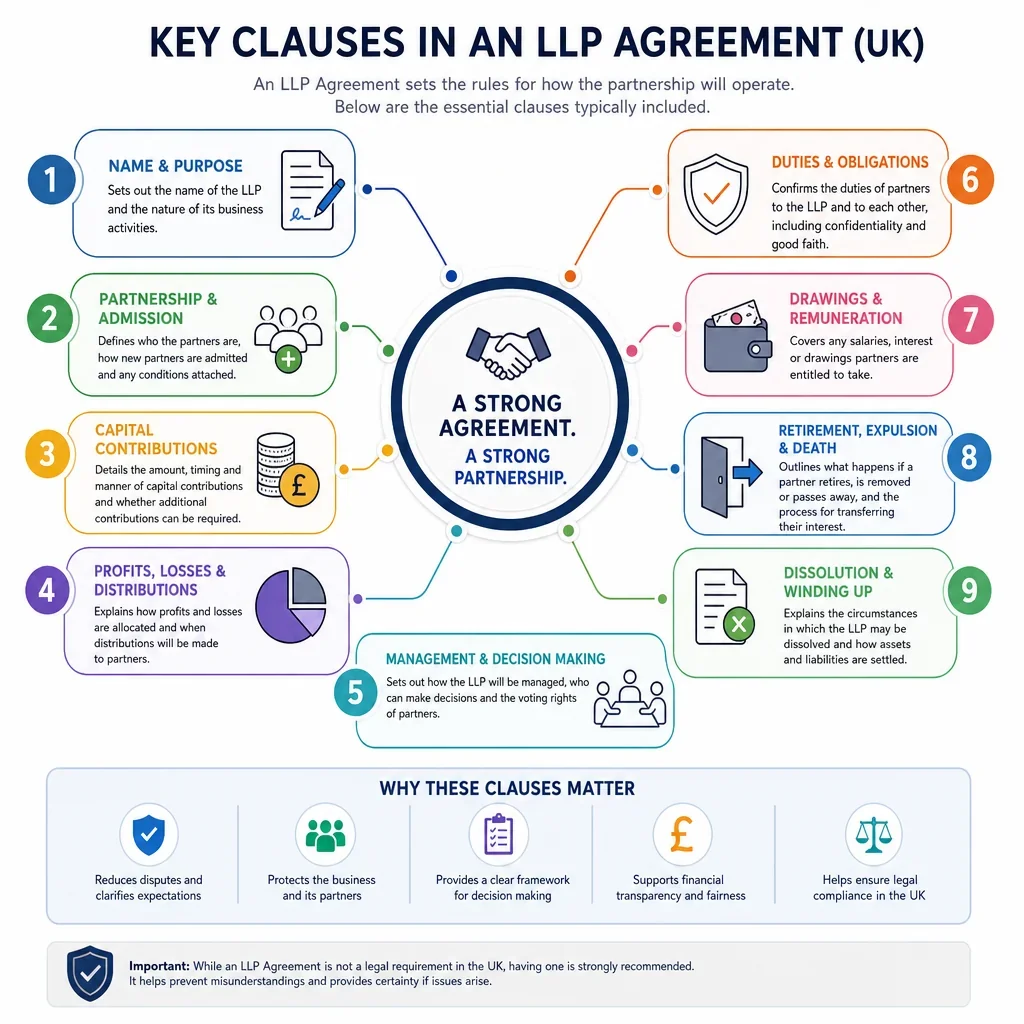
The most important LLP agreement clauses are those that replace uncertainty with clear rules on member contributions, profit shares, decision-making, authority, exits, disputes and winding up. In the UK, an LLP has separate legal personality and must have at least two members, but many internal rights and obligations are left to agreement. If the LLP agreement is silent, default rules under the Limited Liability Partnerships Regulations 2001 may apply, which can produce unsuitable results such as equal profit sharing or unanimity for some decisions.
Why Should Profit, Management And Exit Clauses Be Written Carefully?
- Profit and loss clauses should state whether allocations are equal, fixed, performance-based or linked to capital, because the statutory default may not match the commercial bargain.
- Management and reserved matter clauses should separate day-to-day authority from major decisions such as borrowing, admitting members, changing the business or selling assets.
- Retirement, expulsion, death and buyout clauses are especially important because without agreed procedures the LLP may face deadlock, valuation disputes or ongoing liabilities when a member leaves.
- Confidentiality, restrictive covenant and IP clauses are particularly relevant for professional services, consultancy, technology and client-led businesses where goodwill, know-how and client relationships are key assets.
What UK-Specific Issues Should Members Check Before Signing?
Members should check that the agreement aligns with UK filing, accounting, tax and transparency obligations, including Companies House requirements for members and persons with significant control. They should also ensure employment-status, tax treatment and restrictive covenant wording are reviewed for their specific circumstances, as poorly drafted clauses may create practical, tax or enforceability problems.
FAQs
You Might Also Be Interested In