Advance Decision Glossary In The United Kingdom
Term | Plain English Definition | Example Context |
|---|---|---|
Legal concept, Document feature | ||
Advance Decision | A legally binding decision to refuse specified medical treatment in future if you lack capacity. | A person records that they refuse ventilation if they are permanently unconscious. |
Legal concept | ||
Living Will | An informal name for an Advance Decision to refuse treatment. | A user searches for a living will but needs an Advance Decision in England and Wales. |
Advance Directive | Another term sometimes used for an Advance Decision. | Older medical notes may refer to an advance directive rather than an Advance Decision. |
Legal concept, Document feature | ||
Advance Decision to Refuse Treatment | The Mental Capacity Act term for a future refusal of treatment. | The document title may state "Advance Decision to Refuse Treatment" to avoid confusion. |
Legal concept | ||
Mental Capacity Act 2005 | The main law in England and Wales on capacity, best interests, and Advance Decisions. | An Advance Decision is assessed under sections 24 to 26 of the Act. |
Section 24 Mental Capacity Act 2005 | Defines what counts as an Advance Decision. | A drafter checks section 24 when describing the treatment being refused. |
Section 25 Mental Capacity Act 2005 | Sets rules on validity, applicability, and life-sustaining treatment refusals. | A life-sustaining treatment refusal must meet section 25 formalities. |
Section 26 Mental Capacity Act 2005 | Explains the legal effect of a valid and applicable Advance Decision. | Clinicians must treat a valid applicable refusal as if made with capacity. |
Process, Legal concept | ||
Mental Capacity Act Code of Practice | Official guidance on applying the Mental Capacity Act in practice. | Healthcare staff may consult the Code when deciding if a refusal applies. |
Legal concept, Medical concept | ||
Capacity | The ability to make a specific decision at the time it needs to be made. | The person must have capacity when making the Advance Decision. |
Lacking Capacity | Being unable to make a specific decision because of an impairment of mind or brain. | The Advance Decision is used only when the person lacks capacity to decide about treatment. |
Process, Medical concept | ||
Capacity Assessment | A check of whether a person can make a particular decision. | A doctor assesses capacity before deciding whether to rely on the Advance Decision. |
Legal concept, Process | ||
Understand, Retain, Use And Weigh, Communicate | The four abilities used to test whether someone can make a decision. | A person must understand and weigh treatment risks before refusing them in advance. |
Legal concept | ||
Presumption Of Capacity | Adults are assumed to have capacity unless shown otherwise. | A diagnosis of dementia does not automatically mean the person cannot make an Advance Decision. |
Unwise Decision | A decision others think is risky or wrong does not prove lack of capacity. | Refusing blood products for religious reasons is not evidence of incapacity by itself. |
Best Interests | The standard used for decisions when someone lacks capacity and no valid refusal applies. | If the Advance Decision is not applicable, treatment may be decided in best interests. |
Validity | Whether the Advance Decision is legally still in force. | A later inconsistent action may make an Advance Decision invalid. |
Applicability | Whether the refusal covers the treatment and circumstances now faced. | A refusal of ventilation in permanent coma may not apply to short-term ventilation after surgery. |
Document feature, Legal concept | ||
Specified Treatment | Treatment named clearly enough for clinicians to identify what is refused. | The document names CPR, ventilation, and artificial nutrition and hydration. |
Circumstances | The situation in which the refusal is meant to apply. | The refusal applies only if two doctors agree recovery is highly unlikely. |
Medical concept, Legal concept | ||
Life-Sustaining Treatment | Treatment a healthcare professional regards as necessary to keep someone alive. | A refusal of ventilation may be a refusal of life-sustaining treatment. |
Document feature, Legal concept | ||
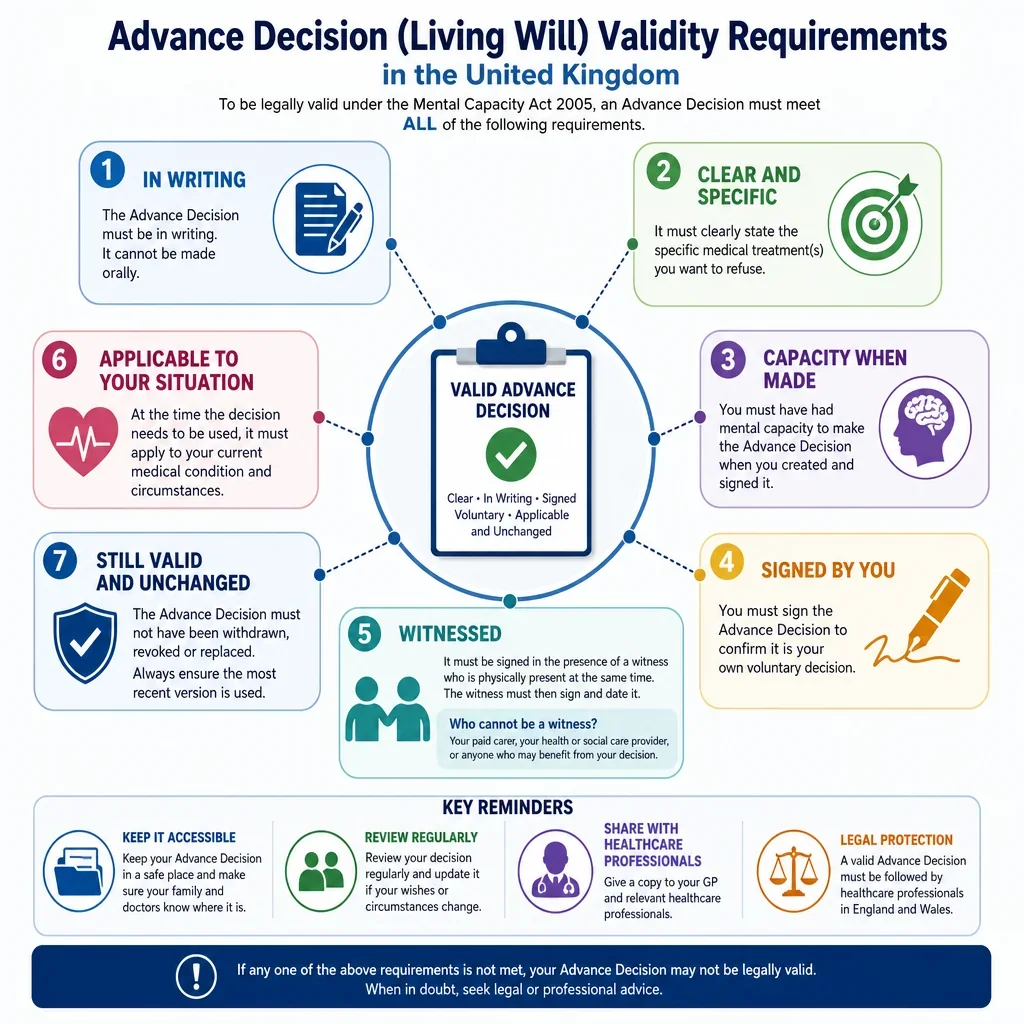
Life Is At Risk Statement | Required wording that a life-sustaining treatment refusal applies even if life is at risk. | The document says the refusal applies even if my life is at risk. |
Written Requirement | A life-sustaining treatment refusal must be recorded in writing. | A verbal refusal of life-sustaining treatment is not enough under the Act. |
Document feature, Process | ||
Signature | The person's signed confirmation of the Advance Decision. | The maker signs the document before a witness. |
Person or role, Document feature | ||
Witness | A person who observes the signature for certain Advance Decisions. | A witness signs to confirm they saw the maker sign the refusal. |
Process, Document feature | ||
Signed On Behalf | Someone else may sign if directed by the person making the decision. | A person with paralysis directs another adult to sign in their presence. |
Process, Legal concept | ||
Revocation | Cancelling an Advance Decision while you have capacity. | The person tells their GP they no longer refuse CPR. |
Process | ||
Withdrawal | Removing or cancelling a previous refusal of treatment. | A person destroys old copies and tells family the decision is withdrawn. |
Legal concept, Process | ||
Inconsistent Behaviour | Later actions that suggest the person no longer wants the refusal to apply. | The person later accepts the same treatment in similar circumstances. |
Reasonable Grounds | A genuine evidence-based reason to doubt whether the refusal is valid or applies. | Doctors treat temporarily while checking whether a newer LPA changed the position. |
Medical concept, Process | ||
Emergency Treatment | Urgent care given while checking if an Advance Decision exists or applies. | Paramedics start resuscitation because the document is not available at the scene. |
Person or role | ||
Clinician | A healthcare professional involved in treatment decisions. | A clinician checks whether the refusal covers the proposed treatment. |
Doctor | A registered medical practitioner responsible for clinical decisions. | A hospital doctor reviews the Advance Decision before offering ventilation. |
GP | A general practitioner who may keep a copy on the patient record. | The maker gives their GP a signed copy for their medical notes. |
Healthcare Team | The professionals caring for the person. | The healthcare team reviews the document during an admission. |
Family Member | A relative who may help locate or explain the document, but cannot override it. | A daughter brings the signed Advance Decision to hospital. |
Person or role, Legal concept | ||
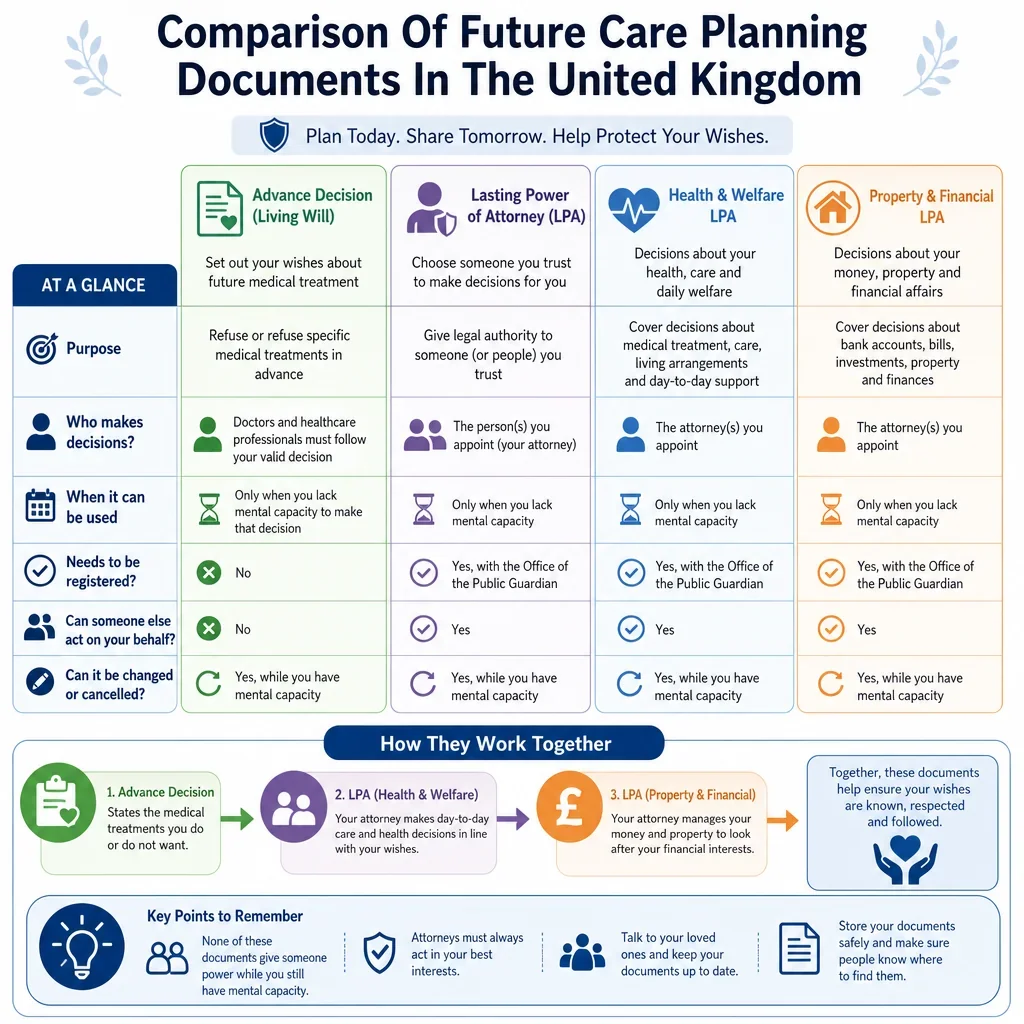
Attorney | A person appointed under a Lasting Power of Attorney to make decisions. | An attorney may make health decisions if the LPA gives that authority. |
Legal concept, Document feature | ||
Health And Welfare Lasting Power Of Attorney | A document appointing attorneys to make health and care decisions if capacity is lost. | A later Health and Welfare LPA may affect an earlier Advance Decision. |
Document feature, Legal concept | ||
Life-Sustaining Treatment Authority In LPA | An LPA choice allowing attorneys to decide on life-sustaining treatment. | The LPA gives attorneys authority over life-sustaining treatment after the Advance Decision date. |
Person or role, Process | ||
Court Of Protection | The court that decides disputes about capacity and serious medical treatment. | The hospital applies to court where family and doctors dispute applicability. |
Office Of The Public Guardian | Government body that registers LPAs in England and Wales. | A person registers a Health and Welfare LPA with the OPG. |
Person or role | ||
Independent Mental Capacity Advocate | An advocate for some people who lack capacity and have no suitable family or friends. | An IMCA may be involved in serious medical treatment decisions. |
Patient | The person whose treatment is being considered. | The patient's Advance Decision is checked before treatment is given. |
Maker | The person who creates the Advance Decision. | The maker signs and dates the refusal while they have capacity. |
Legal concept, Medical concept | ||
Treatment Refusal | A decision not to receive a named medical treatment. | The document refuses CPR if the person has advanced terminal cancer. |
Legal concept, Document feature | ||
Treatment Request | A wish to receive treatment not legally binding as an Advance Decision. | A request for all possible treatment may be included as a preference, not a refusal. |
Document feature, Legal concept | ||
Advance Statement | A non-binding statement of wishes, values, and care preferences. | The person says they prefer to be cared for at home if possible. |
Document feature | ||
Preferences And Wishes | Personal choices that guide care but do not legally refuse treatment. | The document notes religious needs and preferred place of care. |
Medical concept | ||
CPR | Emergency chest compressions and rescue treatment to restart breathing or circulation. | An Advance Decision may refuse CPR in advanced irreversible illness. |
Medical concept, Document feature | ||
DNACPR | A clinical decision or form saying CPR should not be attempted. | A DNACPR form may sit alongside an Advance Decision refusing CPR. |
Document feature, Medical concept | ||
ReSPECT Form | A recommended emergency care plan used by many UK healthcare services. | The ReSPECT form notes that an Advance Decision exists. |
Medical concept | ||
Artificial Nutrition And Hydration | Food or fluids given by tube, drip, or other medical method. | A person refuses tube feeding if they are in a permanent vegetative state. |
Clinically Assisted Nutrition And Hydration | Nutrition or fluids provided by clinical means, such as tube or drip. | CANH is specifically addressed in a refusal for prolonged disorders of consciousness. |
Ventilation | Machine support to help or take over breathing. | A refusal applies if ventilation would only prolong dying. |
Mechanical Ventilation | Breathing support from a ventilator in intensive care. | The document refuses mechanical ventilation after irreversible brain injury. |
Intubation | Placing a tube into the airway to support breathing. | An Advance Decision may refuse intubation in specified end-stage illness. |
Antibiotics | Medicines used to treat bacterial infections. | A refusal may cover intravenous antibiotics during terminal illness. |
Dialysis | Treatment that filters waste and fluid when kidneys fail. | A person refuses dialysis if they develop advanced dementia. |
Blood Transfusion | Receiving donated blood through a drip. | A person refuses blood transfusion for religious reasons. |
Surgery | An operation or invasive medical procedure. | The refusal excludes routine surgery where recovery is expected. |
Intensive Care | Specialist hospital care for life-threatening illness or injury. | An Advance Decision may refuse intensive care in irreversible coma. |
Palliative Care | Care focused on comfort, symptoms, and quality of life. | The person refuses ventilation but wants full palliative care. |
Medical concept, Process | ||
End Of Life Care | Support and treatment for people nearing the end of life. | An Advance Decision is discussed during end of life care planning. |
Medical concept | ||
Terminal Illness | An illness expected to lead to death, often within a limited time. | The refusal applies if cancer becomes terminal and treatment would only prolong dying. |
Permanent Unconsciousness | A lasting state with no awareness where recovery is not expected. | The document refuses CANH if permanent unconsciousness is diagnosed. |
Prolonged Disorder Of Consciousness | A long-term state of impaired or absent awareness after brain injury. | The refusal addresses treatment if the person enters a prolonged disorder of consciousness. |
Vegetative State | A condition with wakefulness but no signs of awareness. | A refusal of tube feeding may apply in a permanent vegetative state. |
Minimally Conscious State | A condition with minimal but definite signs of awareness. | The document may distinguish vegetative state from minimally conscious state. |
Dementia | A group of symptoms affecting memory, thinking, and daily functioning. | A person makes an Advance Decision after an early dementia diagnosis while capacity remains. |
Stroke | A serious condition where blood supply to part of the brain is cut off. | The refusal may apply after a severe stroke causing permanent loss of capacity. |
Brain Injury | Damage to the brain from trauma, illness, or lack of oxygen. | The refusal applies after catastrophic brain injury with no meaningful recovery expected. |
Medical concept, Document feature | ||
Irreversible Condition | A medical condition not expected to improve or be cured. | The refusal applies only where doctors agree the condition is irreversible. |
Medical concept, Process | ||
Diagnosis | A medical identification of an illness or condition. | A new diagnosis prompts review of the Advance Decision. |
Medical concept | ||
Prognosis | The likely course and outcome of a medical condition. | The refusal depends on a prognosis of no meaningful recovery. |
Legal concept, Medical concept | ||
Consent | Agreement to medical treatment after receiving relevant information. | A valid Advance Decision works as a refusal of consent to treatment. |
Informed Refusal | Refusing treatment after understanding relevant risks and consequences. | The maker discusses the effects of refusing ventilation with a doctor. |
Medical concept, Legal concept | ||
Mental Disorder | Any disorder or disability of the mind under the Mental Health Act. | Mental Health Act treatment rules may affect psychiatric treatment refusals. |
Legal concept | ||
Mental Health Act 1983 | Law allowing compulsory assessment and treatment for mental disorder in certain cases. | Some treatment for mental disorder may be given despite an Advance Decision. |
Person or role, Legal concept | ||
Detained Patient | A person held in hospital under the Mental Health Act. | A detained patient's refusal may not prevent authorised psychiatric treatment. |
Legal concept, Medical concept | ||
Assisted Dying | Helping someone end their life not something an Advance Decision can request. | A clause asking for a lethal injection would not be valid. |
Euthanasia | Deliberately ending a person's life to relieve suffering illegal in the UK. | An Advance Decision cannot require euthanasia. |
Legal concept | ||
Assisted Suicide | Encouraging or assisting another person's suicide a criminal offence. | A living will cannot authorise assisted suicide. |
Medical concept | ||
Pain Relief | Medication or care to reduce pain and distress. | The person refuses CPR but wants pain relief and comfort care. |
Medical concept, Document feature | ||
Comfort Care | Care aimed at comfort rather than cure or life prolongation. | The Advance Decision refuses ventilation but requests comfort care. |
Medical concept | ||
Hydration By Mouth | Drinking normally or being helped to drink if safe. | A refusal of tube fluids does not necessarily refuse sips of water if safe. |
Basic Care | Ordinary care such as warmth, hygiene, comfort, and offered food or drink. | The refusal of treatment does not mean refusing basic nursing care. |
Document feature | ||
Date Of Signature | The date the Advance Decision is signed. | The date helps compare the document with a later LPA or review note. |
Document feature, Process | ||
Review Date | A date showing the maker has reconsidered the document. | The maker signs an annual review note saying the refusal still stands. |
Medical Record | The healthcare record holding clinical information and documents. | The GP scans the Advance Decision into the medical record. |
Emergency Care Plan | A plan recording urgent care recommendations and key decisions. | The plan tells ambulance staff that an Advance Decision exists. |
Copy | A duplicate of the signed Advance Decision shared with others. | Copies are given to the GP, attorney, and next of kin. |
Document feature | ||
Original Document | The signed paper version kept for reference. | The original is stored where family can find it quickly. |
Contact Details | Names and phone numbers for people who should be contacted. | The document lists the attorney, GP, and emergency family contact. |
Witness Details | The witness name, address, signature, and date. | Witness details help prove the life-sustaining refusal was properly signed. |
Personal Details | Identifying information such as full name, date of birth, and address. | Hospital staff use personal details to match the document to the patient. |
Medical Conditions Section | Part of the document describing diagnoses or health situations. | The section names advanced dementia and irreversible coma. |
Treatment Refusals Section | Part of the document listing treatments refused and when. | The section refuses CPR, ventilation, and CANH in specified circumstances. |
Statement Of Values | A short explanation of beliefs and priorities behind the decisions. | The maker explains that independence and awareness are central to them. |
Document feature, Legal concept | ||
Religious Beliefs | Faith-based views that may affect treatment choices. | A refusal of blood transfusion is based on religious beliefs. |
Document feature, Medical concept | ||
Jehovah's Witness Advance Decision | A refusal document often used to decline blood or blood products. | The document refuses whole blood, red cells, white cells, platelets, and plasma. |
Medical concept | ||
Blood Products | Medical products made from or containing parts of blood. | The refusal distinguishes blood products the person accepts and refuses. |
Medical concept, Document feature | ||
Organ Donation | Giving organs or tissue for transplant after death or during life. | The maker notes organ donation wishes separately from treatment refusals. |
Legal concept, Medical concept | ||
Organ Donation Deemed Consent | The opt-out system for organ donation in England, subject to exceptions. | Organ donation wishes should be recorded separately because they are not treatment refusals. |
Legal concept | ||
Human Tissue Act 2004 | Law governing consent and use of human tissue, including donation issues. | Donation wishes may be considered under organ donation law, not the Advance Decision rules. |
Legal concept, Process | ||
Confidentiality | The duty to protect private medical and personal information. | The maker authorises sharing copies with relatives and clinicians. |
Process | ||
Data Sharing | Allowing relevant people or services to access the document or information. | The maker asks the GP to share the Advance Decision with hospital services. |
Document feature, Process | ||
NHS Summary Care Record | An electronic NHS record with key patient information in England. | A note may be added that an Advance Decision exists. |
Process | ||
Hospital Admission | Being taken into hospital for assessment or treatment. | The patient brings a copy during planned admission. |
Person or role, Process | ||
Ambulance Service | Emergency service responding to urgent medical incidents. | Paramedics may need immediate access to the Advance Decision or care plan. |
Process, Person or role | ||
Care Home | Residential setting providing care and support. | The care home keeps a copy in the resident's care plan. |
Document feature, Process | ||
Care Plan | A written plan for care needs, preferences, and risks. | The care plan records where the Advance Decision is stored. |
Person or role | ||
Next Of Kin | A nominated contact not automatically a legal decision-maker. | The next of kin is told where the Advance Decision is kept. |
Person or role, Legal concept | ||
Nearest Relative | A specific legal role under the Mental Health Act, not the same as next of kin. | Mental Health Act decisions may involve the nearest relative rather than the Advance Decision. |
Deputy | A person appointed by the Court of Protection to make decisions for someone lacking capacity. | A deputy may be involved if no attorney exists and ongoing decisions are needed. |
Medical concept, Legal concept | ||
Serious Medical Treatment | Treatment with serious consequences, risks, or major choices. | Withdrawal of ventilation may be treated as serious medical treatment. |
Legal concept, Process | ||
Deprivation Of Liberty Safeguards | Legal safeguards for some people deprived of liberty in care settings. | DoLS may apply in a care home but does not replace an Advance Decision. |
Legal concept | ||
Protection From Liability | Legal protection for clinicians who act reasonably about an Advance Decision. | A doctor is protected if unaware of a valid refusal despite reasonable checks. |
Negligence Risk | Risk of legal or professional consequences for ignoring a valid refusal. | A hospital should not give refused treatment if the Advance Decision is valid and applicable. |
Battery | Unlawful touching, which may include treatment without valid consent or authority. | Giving refused treatment may risk a battery claim. |
Process, Legal concept | ||
Safeguarding | Protecting adults from abuse, neglect, or undue pressure. | Staff investigate if relatives pressured the person to refuse treatment. |
Legal concept, Process | ||
Undue Influence | Improper pressure that may undermine a person's free decision. | A doctor asks privately whether the maker was pressured to sign. |
Coercion | Forcing or threatening someone into making a decision. | Evidence of coercion may lead clinicians to doubt the document. |
Legal concept | ||
Fraud | Dishonest conduct, such as forging or altering a document. | A forged signature may mean the Advance Decision is not valid. |
Document feature, Process | ||
Mental Capacity Evidence | Notes or opinions showing the person had capacity when signing. | A GP note confirms the maker understood the refusal and its consequences. |
Process, Medical concept | ||
Medical Advice | Information from a clinician about treatments, risks, and outcomes. | The maker discusses likely consequences of refusing dialysis. |
Process | ||
Legal Advice | Advice from a qualified legal professional about legal effect and wording. | A solicitor checks interaction with a Health and Welfare LPA. |
Legal concept, Process | ||
Applicability Doubt | Uncertainty about whether the document covers the current treatment decision. | Doctors question whether the refusal covers a reversible infection. |
Later Decision | A newer decision or act that may change or override an earlier one. | A later LPA gives an attorney authority over the same treatment. |
Legal concept, Medical concept | ||
Material Change In Circumstances | A significant change not anticipated when the refusal was made. | A new treatment with good recovery prospects may affect applicability. |
Medical concept, Process | ||
New Treatment Options | Medical treatments available after the document was made. | A new low-burden treatment may make an old broad refusal unclear. |
Medical concept | ||
Treatment Burden | The pain, risk, discomfort, or disruption caused by treatment. | The maker refuses treatment they consider too burdensome in terminal illness. |
Benefit Of Treatment | The expected medical advantage or improvement from treatment. | The refusal applies where treatment offers no meaningful benefit. |
Futile Treatment | Treatment unlikely to provide meaningful clinical benefit. | The document refuses treatments that would only prolong dying. |
Medical concept, Legal concept | ||
Clinically Inappropriate Treatment | Treatment a clinician should not provide because it is not medically suitable. | An Advance Decision cannot force doctors to give inappropriate treatment. |
Legal concept, Document feature | ||
Positive Demand | A request for treatment rather than a refusal not binding as an Advance Decision. | A statement demanding antibiotics in all cases is not an Advance Decision refusal. |
Document feature, Medical concept | ||
Partial Refusal | Refusing some treatments while accepting others. | The person refuses CPR but accepts antibiotics for comfort. |
Document feature, Legal concept | ||
Conditional Refusal | A refusal that applies only in stated circumstances. | The refusal applies only if recovery of awareness is highly unlikely. |
Broad Refusal | A general refusal that may be unclear if not linked to specific treatments and situations. | "No heroic measures" is too vague unless explained. |
Document feature | ||
Vague Wording | Unclear language that may make a refusal hard to apply. | The phrase "if I am very ill" is replaced with defined medical circumstances. |
Clear Wording | Specific language that identifies treatments and circumstances. | The document states "I refuse CPR if I have end-stage heart failure". |
Document feature, Process | ||
Witnessed Signature | A signature observed and confirmed by a witness. | The witness signs after seeing the maker sign the life-sustaining refusal. |
Document feature | ||
Electronic Copy | A digital scan or file version of the signed document. | A PDF copy is stored with the GP record and shared with the attorney. |
Wallet Card | A small card stating that an Advance Decision exists and where to find it. | Paramedics find a card naming the GP and attorney contact. |
Person or role, Document feature | ||
Emergency Contact | Someone who can be contacted quickly in a medical emergency. | The emergency contact knows where the signed document is stored. |
Document feature | ||
Storage Location | Where the original or copies are kept. | The wallet card says the original is in the bedside folder. |
Process | ||
Review Process | Checking and confirming the document still reflects current wishes. | The person reviews the document after hospital treatment options change. |
Document feature, Process | ||
Replacement Document | A newer Advance Decision intended to replace an earlier one. | The maker signs a new version after changing views on ventilation. |
Old Copies | Superseded versions that should be withdrawn or marked cancelled. | The maker asks family to destroy old copies after signing a replacement. |
Legal concept, Process | ||
Oral Advance Decision | A spoken future refusal, possible only where life-sustaining treatment formalities are not required. | A person orally refuses a non-life-sustaining treatment before losing capacity. |
Document feature, Legal concept | ||
Written Advance Decision | A documented refusal, required for life-sustaining treatment refusals. | The maker signs a written refusal of CPR and ventilation. |
Legal concept, Person or role | ||
Under 18 | A person below 18 cannot make an Advance Decision under the Mental Capacity Act. | A 17-year-old's treatment refusal is handled under different legal principles. |
Legal concept | ||
England And Wales | The jurisdiction where the Mental Capacity Act Advance Decision rules apply. | The website prepares documents for use in England and Wales. |
Scotland | UK jurisdiction with different rules and terminology for advance directives. | A Scottish user should check Scots law before relying on an England and Wales form. |
Northern Ireland | UK jurisdiction with separate healthcare and capacity law. | A Northern Ireland resident should use local advance care planning guidance. |
Person or role, Process | ||
NHS | The UK's publicly funded health service. | The NHS record may note that an Advance Decision exists. |
Document feature, Medical concept | ||
Refusal Of CPR Form | A document recording that CPR is not wanted or clinically appropriate. | The Advance Decision refuses CPR and the clinical team completes DNACPR paperwork. |
Process | ||
Advance Care Planning | Planning future care, treatment preferences, and decisions before a crisis. | The person discusses an Advance Decision during advance care planning. |
Process, Medical concept | ||
Shared Decision Making | Clinicians and patients discussing options, risks, and preferences together. | The maker uses shared decision making to understand likely outcomes before refusing treatment. |
Medical concept, Process | ||
NICE Guidance | Evidence-based guidance for health and care in England. | Clinicians may follow NICE guidance when discussing treatment options. |
Process, Legal concept | ||
GMC Guidance | Professional standards and guidance for UK doctors. | Doctors use GMC guidance when handling consent and end of life decisions. |
Person or role, Process | ||
Resuscitation Council UK | UK body producing resuscitation guidance and ReSPECT resources. | A ReSPECT form may record CPR recommendations and note an Advance Decision. |
Legal concept, Person or role | ||
Enduring Power Of Attorney | Older power of attorney covering property and finances, not health decisions. | An EPA attorney cannot consent to medical treatment for the person. |
Legal concept, Document feature | ||
Property And Financial Affairs LPA | An LPA for money and property decisions, not medical treatment decisions. | A finance attorney cannot override an Advance Decision about CPR. |
Document feature, Process | ||
Registered LPA | An LPA registered with the Office of the Public Guardian before use. | Clinicians check whether the Health and Welfare LPA is registered and later than the Advance Decision. |
Document feature, Legal concept | ||
Attorney Instructions | Binding directions written into an LPA for attorneys to follow. | The LPA instructs attorneys to follow the Advance Decision where it applies. |
Document feature | ||
Attorney Preferences | Non-binding guidance written into an LPA for attorneys. | The LPA preference says the person values comfort over life extension. |
Medical concept, Process | ||
Clinician Conscience | A clinician's personal beliefs, which must not obstruct lawful patient care. | A doctor with concerns should seek advice while respecting a valid refusal. |
Process, Medical concept | ||
Second Medical Opinion | Another clinician's view on diagnosis, prognosis, or treatment. | The document requires two doctors to agree there is no recovery prospect. |
Specialist Opinion | Advice from a doctor expert in the relevant condition or treatment. | A neurologist advises whether brain injury recovery is possible. |
Process, Legal concept | ||
Dispute | A disagreement about validity, applicability, or treatment decisions. | Family members disagree about whether the Advance Decision should be followed. |
Process | ||
Mediation | A structured attempt to resolve disagreement without a contested court hearing. | The hospital arranges a meeting to resolve family disagreement about treatment. |
Legal concept, Process | ||
Declaratory Relief | A court declaration about what is lawful in a treatment dispute. | The Court of Protection declares whether CANH may lawfully be withheld. |
Process, Legal concept | ||
Serious Medical Treatment Application | An application to court about major treatment for someone lacking capacity. | The NHS trust applies where the Advance Decision is disputed. |
Person or role | ||
NHS Trust | An NHS organisation providing hospital or community healthcare services. | The NHS Trust seeks legal advice about a disputed refusal. |
Person or role, Process | ||
Integrated Care Board | NHS body planning and commissioning local health services in England. | Local systems may set processes for recording advance care planning information. |
Legal concept, Document feature | ||
Lasting Power Of Attorney | A legal document appointing attorneys to make decisions if capacity is lost. | The person makes both an Advance Decision and a Health and Welfare LPA. |
Person or role, Legal concept | ||
Donor | The person who makes an LPA. | The donor appoints an attorney after signing an Advance Decision. |
Person or role, Process | ||
Certificate Provider | Person who confirms an LPA donor understands and is not pressured. | The certificate provider is relevant to an LPA, not the Advance Decision itself. |
Person To Notify | A person told about an LPA application before registration. | The person to notify may also hold a copy of the Advance Decision. |
Medical concept | ||
Life-Prolonging Treatment | Treatment that may extend life even if it does not cure the condition. | The maker refuses life-prolonging treatment if permanently unconscious. |
Symptom Control | Treatment to reduce symptoms such as pain, breathlessness, or nausea. | The Advance Decision refuses CPR but accepts medicines for symptom control. |
Sedation | Medication that makes a person calm, sleepy, or less aware. | Sedation may be accepted for comfort even where ventilation is refused. |
Anaesthesia | Medication used to prevent pain during surgery or procedures. | The refusal clarifies it does not apply to anaesthesia for beneficial surgery. |
Reversible Condition | A condition likely to improve with treatment. | The maker says the refusal does not apply to temporary reversible illness. |
Medical concept, Legal concept | ||
Temporary Loss Of Capacity | A short-term inability to decide, such as during unconsciousness or delirium. | The refusal may not apply if capacity is expected to return quickly. |
Medical concept | ||
Delirium | Sudden confusion that can affect attention, awareness, and decision-making. | A patient with delirium may temporarily lack capacity to accept or refuse treatment. |
Coma | A state of unconsciousness where a person cannot be woken. | The refusal applies if coma is irreversible after brain injury. |
Medical concept, Legal concept | ||
Capacity Fluctuation | Capacity changing over time or from one moment to another. | A person with fluctuating capacity reviews the document during a lucid period. |
Process, Legal concept | ||
Communication Support | Help to communicate a decision before treating someone as lacking capacity. | The maker uses a communication aid to confirm they understand the refusal. |
Medical concept, Process | ||
Communication Aid | A tool that helps someone express choices, such as a board or device. | A speech device is used to confirm the person refuses treatment. |
Process | ||
Translation | Converting the document or discussion into another language. | An interpreter helps ensure the maker understands the refusal before signing. |
Person or role, Process | ||
Interpreter | A person who helps communication between different languages. | An interpreter is used when discussing complex treatment refusals. |
Medical concept | ||
Learning Disability | A reduced ability to understand new information and manage independently. | Extra support is provided before deciding whether the person can make the refusal. |
Cognitive Impairment | Problems with memory, thinking, understanding, or reasoning. | Cognitive impairment triggers a careful capacity assessment before signing. |
Medical concept, Legal concept | ||
Psychiatric Treatment | Treatment for mental disorder, sometimes governed by Mental Health Act powers. | A refusal of psychiatric medication may be overridden under Mental Health Act rules. |
Physical Health Treatment | Treatment for bodily illness or injury rather than mental disorder. | A detained patient's refusal of cancer treatment may still need MCA analysis. |
Document feature | ||
Refusal Of Treatment Certificate | A signed document evidencing a person's treatment refusal. | The certificate is kept with hospital admission papers. |
Document feature, Process | ||
Clinical Notes | Written healthcare notes about consultations, decisions, and care. | The GP records that the maker discussed and understood the refusal. |
Advance Decision Register | A local or private system recording that an Advance Decision exists. | The GP system flags the existence of the document for out-of-hours clinicians. |
Process, Person or role | ||
Out-Of-Hours Care | Medical care outside normal GP or clinic hours. | Out-of-hours clinicians need access to the Advance Decision in an emergency. |
Document feature, Process | ||
Ambulance Electronic Record | Digital information available to ambulance clinicians, depending on local systems. | A record flag helps paramedics identify a DNACPR or Advance Decision. |
Document feature | ||
Emergency Folder | A visible folder holding urgent medical documents at home or in a care setting. | The folder contains the Advance Decision, DNACPR, and medicines list. |
Document feature, Medical concept | ||
Medicines List | A current list of prescribed and other medicines. | The emergency folder includes a medicines list alongside the Advance Decision. |
Medical concept, Document feature | ||
Allergies | Reactions to substances such as medicines, foods, or materials. | Allergy information is included so refusal is not confused with drug safety risks. |
Person or role, Process | ||
Clinical Ethics Committee | A hospital group that advises on difficult ethical treatment issues. | The team seeks ethics advice about a disputed refusal of CANH. |
Multidisciplinary Team | Professionals from different disciplines working together on care decisions. | Doctors, nurses, therapists, and palliative care staff review the document. |
Process | ||
Best Interests Meeting | A meeting to decide what is best where a person lacks capacity. | A meeting is held because the Advance Decision does not cover the proposed treatment. |
Legal concept, Document feature | ||
Wishes And Feelings | The person's past and present views considered in best interests decisions. | If no valid refusal applies, clinicians consider written wishes and feelings. |
Beliefs And Values | Personal principles considered in best interests decisions. | The Advance Statement explains values if the Advance Decision is not applicable. |
Legal concept, Process | ||
Least Restrictive Option | Choose the option that interferes least with rights and freedom. | Care decisions should not restrict the person more than necessary. |
Process, Legal concept | ||
Supported Decision-Making | Helping a person decide before concluding they lack capacity. | Information is given in simple language before the person signs. |
What Should You Know Before Making An Advance Decision In England And Wales?
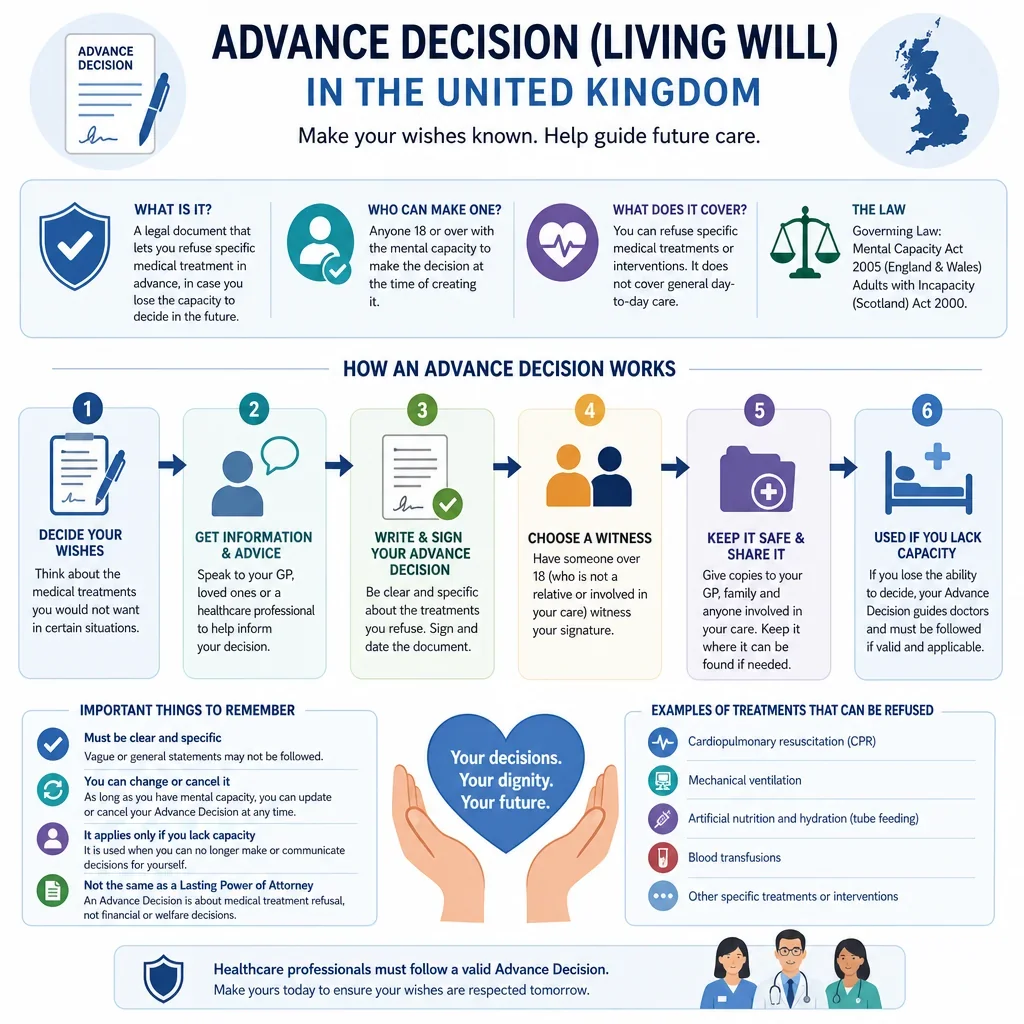
An Advance Decision can refuse specified medical treatment in future, but it must be clear, applicable to the situation, and made by a person aged 18 or over who has capacity at the time. If it refuses life-sustaining treatment, it must be in writing, signed, witnessed, and include a statement that it applies even if life is at risk.
Can An Advance Decision Refuse Any Treatment?
An Advance Decision can refuse treatment such as CPR, ventilation, artificial nutrition and hydration, dialysis, antibiotics, or blood transfusion, but it cannot demand a particular treatment, request assisted dying, or require clinicians to provide treatment they consider clinically inappropriate.
Who Needs To Know About An Advance Decision?
To be useful in an emergency, the document should be shared with the GP, hospital team, family, attorneys under any Health and Welfare LPA, and care providers. It should be easy to find, because clinicians must know about it before they can follow it.
How Does An Advance Decision Work With A Health And Welfare LPA?
If there is both an Advance Decision and a Health and Welfare Lasting Power of Attorney, timing and wording matter. A later valid Advance Decision can limit an attorney\'s authority. A later LPA may override an earlier Advance Decision if it gives the attorney power to decide about the same treatment.
Why Is Review Important?
Reviewing an Advance Decision after a diagnosis, change in treatment options, hospital admission, or major life event helps show that the decision remains current and applicable. Keeping dated review notes can reduce disputes about whether the person changed their mind.
FAQs
You Might Also Be Interested In