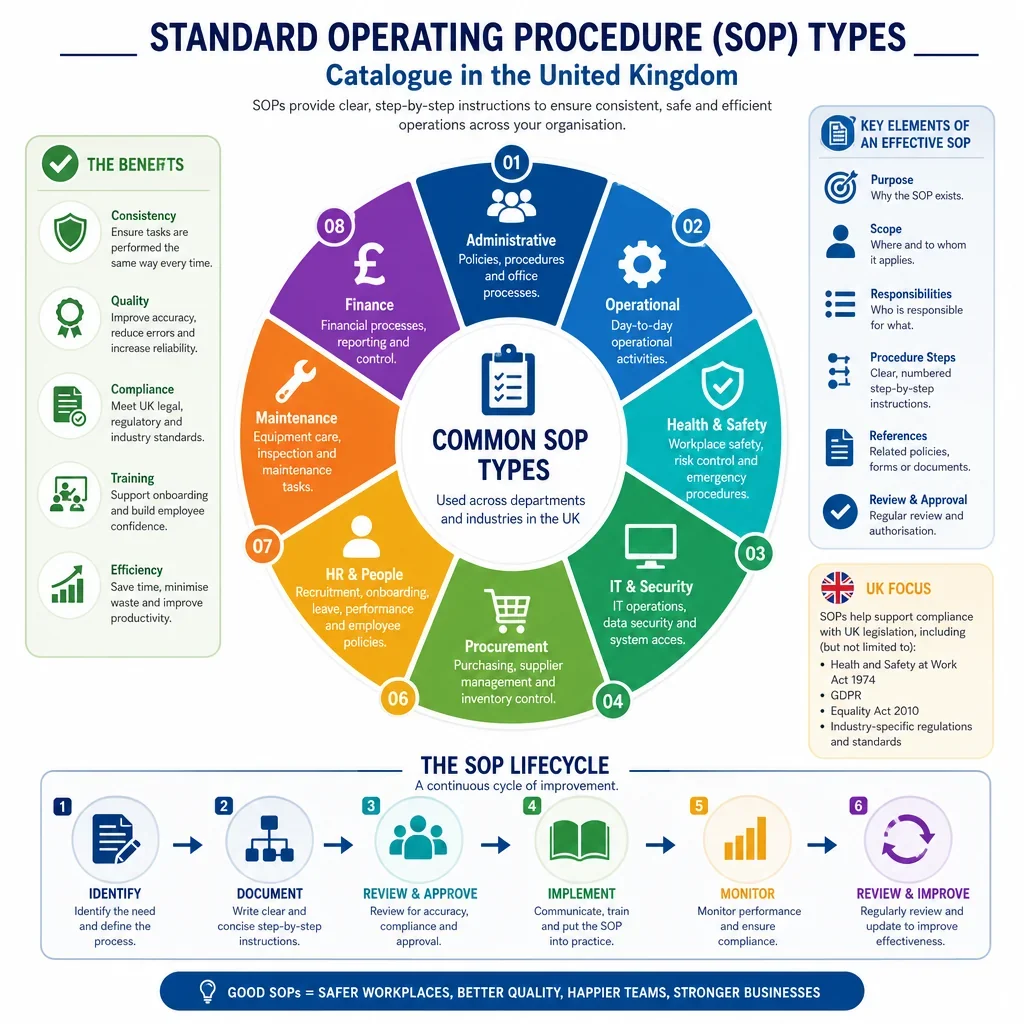
SOP Document Section Guide In The United Kingdom
Section name | Section purpose | Inclusion level | Drafting guidance | Common drafting pitfalls | Typical content owner |
|---|---|---|---|---|---|
Introductory | |||||
Document Title | Identifies the SOP by clear, specific name. | Essential | Use a concise title describing the process, location or business function. | Using vague titles that cannot be distinguished from related procedures. | Procedure owner |
Control and assurance | |||||
Document Reference Number | Provides a unique identifier for tracking and retrieval. | Recommended | Use a consistent numbering convention linked to department or process area. | Changing identifiers between versions or reusing numbers for different SOPs. | Quality manager |
Review and maintenance | |||||
Version Control | Records version number, date, author and change history. | Essential | Include version, effective date, summary of changes and superseded version. | Failing to remove obsolete versions from circulation. | Procedure owner |
Control and assurance | |||||
Approval Record | Shows who authorised the SOP and when. | Essential | List approver role, name, signature method, approval date and effective date. | Approving without involvement from risk, quality or compliance specialists. | Senior management |
Introductory | |||||
Purpose | Explains why the SOP exists and the outcome it controls. | Essential | State the business, safety, quality or compliance objective in one short paragraph. | Restating the title without explaining the required result. | Procedure owner |
Scope and responsibility | |||||
Scope | Defines where, when and to whom the SOP applies. | Essential | Specify covered teams, sites, systems, transactions, products and exclusions. | Leaving uncertainty about edge cases or excluding outsourced activities. | Procedure owner |
Out Of Scope | Clarifies activities, sites or roles not covered by the SOP. | Recommended | Use where boundaries may be misunderstood or another SOP applies. | Creating gaps by excluding work without identifying the alternative control. | Procedure owner |
Introductory | |||||
Definitions | Explains technical terms, acronyms and role labels used in the SOP. | Recommended | Define only terms needed to perform or audit the procedure. | Adding generic glossary terms that do not affect interpretation. | Procedure owner |
Scope and responsibility | |||||
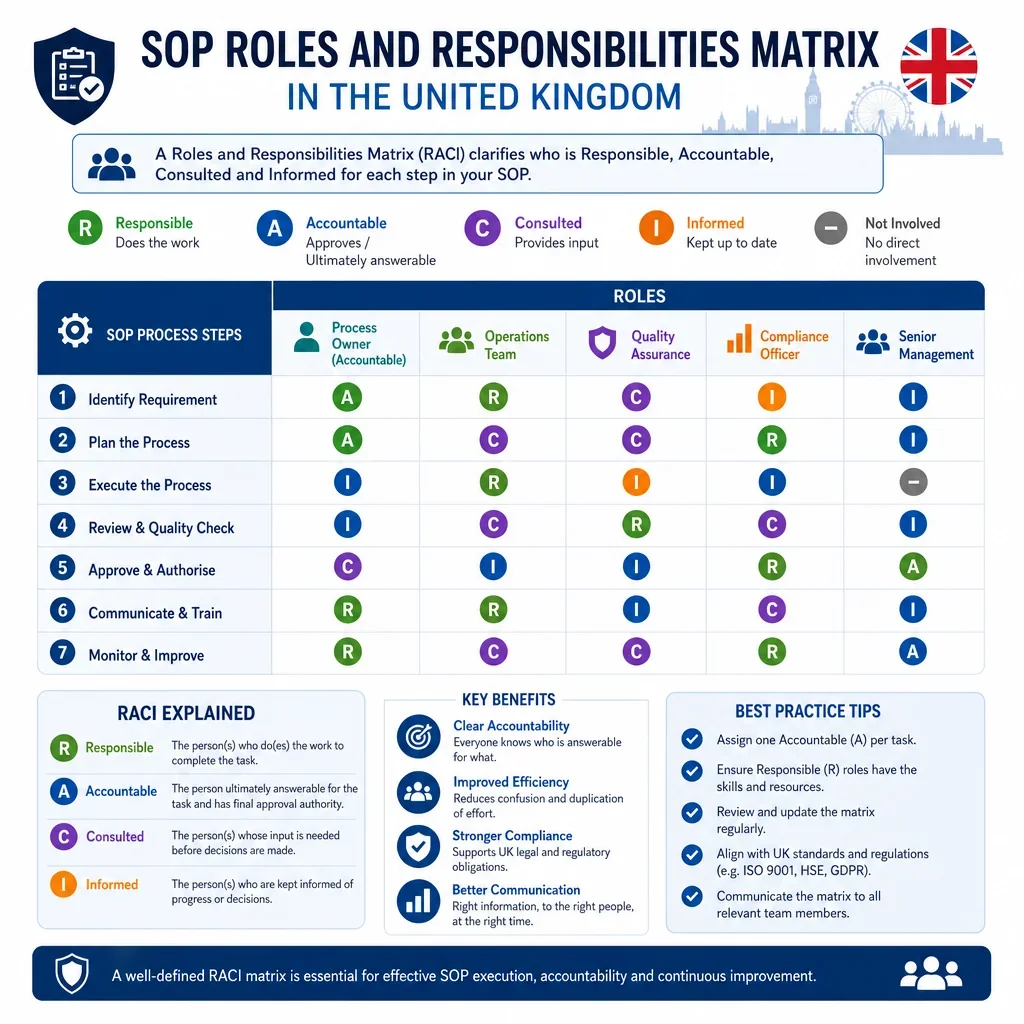
Roles And Responsibilities | Assigns duties for performing, supervising and approving the procedure. | Essential | Use job roles, not named individuals, and distinguish doer, checker and approver. | Making everyone responsible, which leaves no clear accountability. | Line manager |
Competence And Training Requirements | States required training, competence checks or authorisations before work begins. | Recommended | Identify mandatory induction, refresher training, supervision and training records. | Assuming experience is enough without evidence of competence. | Human resources lead |
Control and assurance | |||||
Health And Safety Requirements | Identifies hazards, precautions and safe working requirements. | Essential | Summarise key risks, controls, PPE, permits and links to risk assessments. | Copying a risk assessment without stating operational controls. | Health and safety lead |
Risk Assessment Link | Links the SOP to relevant workplace risk assessments. | Recommended | Reference assessment title, owner, location and review date. | Referring to outdated assessments or not translating controls into steps. | Health and safety lead |
Procedure steps | |||||
Required Equipment And Materials | Lists equipment, tools, forms, systems and materials needed. | Recommended | Include specifications, access requirements and approved alternatives where relevant. | Omitting system access, calibrated equipment or current template versions. | Procedure owner |
Prerequisites | States conditions that must be met before starting. | Recommended | Cover approvals, inputs, checks, permissions, stock, access and handover requirements. | Burying start conditions inside later procedural steps. | Line manager |
Introductory | |||||
Process Overview | Summarises the workflow before detailed instructions. | Recommended | Use a short narrative or flow summary showing major stages. | Repeating every detailed step instead of giving orientation. | Procedure owner |
Procedure steps | |||||
Step-By-Step Procedure | Sets out the ordered actions needed to complete the process. | Essential | Use numbered steps with actor, action, timing, system and expected result. | Writing broad policy statements rather than executable instructions. | Procedure owner |
Decision Points | Explains what to do when outcomes differ or thresholds are met. | Recommended | Use if, then wording and objective criteria for each route. | Leaving decisions to judgement without limits or escalation criteria. | Line manager |
Escalation Procedure | States when and how issues must be escalated. | Recommended | Define triggers, timeframes, escalation route and minimum information required. | Using vague wording such as escalate where appropriate. | Line manager |
Exception Handling | Explains authorised handling of unusual cases or deviations. | Recommended | Define permitted exceptions, approval requirements and evidence to retain. | Allowing informal workarounds that undermine standardisation. | Compliance officer |
Control and assurance | |||||
Quality Checks | Specifies inspections, validations or checks confirming acceptable output. | Recommended | State check method, sample size, acceptance criteria and checker role. | Saying check quality without measurable criteria. | Quality manager |
Acceptance Criteria | Defines pass, fail or completion standards for the procedure. | Recommended | Use measurable tolerances, document requirements, approvals or service levels. | Using subjective terms such as satisfactory or adequate alone. | Quality manager |
Data Protection Requirements | Controls processing of personal data within the procedure. | Essential | State data collected, access limits, lawful handling, retention and disposal route. | Ignoring personal data in logs, emails, CCTV, HR records or customer files. | Compliance officer |
Confidentiality Requirements | Explains how confidential information must be protected. | Recommended | Cover access, sharing, secure storage, clean desk and authorised disclosure. | Not distinguishing internal, confidential and restricted information. | Compliance officer |
Information Security Controls | States required cyber and access controls for the process. | Recommended | Cover authentication, permissions, secure transfer, device use and incident reporting. | Assuming system controls exist without naming required user actions. | Compliance officer |
Environmental Controls | Sets controls for waste, emissions, spills or environmental impacts. | Optional | Include segregation, storage, permits, spill response and disposal evidence. | Treating waste disposal as an informal housekeeping matter. | Compliance officer |
Incident Reporting | Explains reporting of accidents, near misses, defects or breaches. | Recommended | Specify reportable events, immediate actions, forms, contacts and deadlines. | Not distinguishing internal reporting from statutory reporting duties. | Health and safety lead |
Procedure steps | |||||
Business Continuity Arrangements | Describes alternative steps during system, staff or site disruption. | Optional | State triggers, manual workarounds, recovery records and return-to-normal checks. | Creating workarounds that bypass approval, security or evidence controls. | Senior management |
Records and evidence | |||||
Records To Be Created | Lists forms, logs, screenshots, approvals or files generated. | Essential | State record name, format, owner, storage location and completion point. | Not identifying evidence needed to prove the procedure was followed. | Procedure owner |
Record Retention | States how long records are kept and when they are disposed of. | Essential | Link to retention schedule and note legal, contractual or audit requirements. | Keeping personal data indefinitely without a retention basis. | Compliance officer |
Document Storage Location | Identifies where current SOPs and generated records are stored. | Recommended | Name controlled repository, folder path, access restrictions and backup location. | Allowing uncontrolled copies on desktops, email or shared drives. | Quality manager |
Forms And Templates | Lists approved forms, templates and checklists used with the SOP. | Recommended | Include title, version, location and when each form must be used. | Linking to obsolete or editable uncontrolled templates. | Procedure owner |
Control and assurance | |||||
Monitoring And Audit | Explains how compliance with the SOP will be checked. | Recommended | State audit frequency, sample method, reviewer role and reporting route. | Requiring audits without naming who performs them or how often. | Compliance officer |
Key Performance Indicators | Defines measures used to track process performance. | Optional | Use measurable indicators with target, data source, owner and review frequency. | Selecting vanity metrics that do not reveal process failure. | Senior management |
Non-Conformance And Corrective Action | Explains handling of failures, deviations and corrective actions. | Recommended | Define reporting, containment, root cause, action owner and closure evidence. | Fixing immediate errors without addressing root cause or recurrence. | Quality manager |
Review and maintenance | |||||
Review Frequency | States when the SOP must be reviewed. | Essential | Set a fixed review cycle and event-triggered reviews after major changes. | Relying only on annual review despite process, law or system changes. | Procedure owner |
Change Control | Controls how SOP amendments are requested, assessed and approved. | Essential | Specify request route, impact assessment, approval level and communication method. | Allowing undocumented edits after approval. | Quality manager |
Communication And Roll-Out | Explains how staff are informed of new or revised SOPs. | Recommended | State audience, communication channel, effective date and acknowledgement method. | Publishing an SOP without confirming affected staff know it applies. | Line manager |
Records and evidence | |||||
Training Record Requirements | States evidence needed to show staff were trained on the SOP. | Recommended | Record trainee, trainer, date, version, assessment result and refresher due date. | Recording attendance only when competence assessment is required. | Human resources lead |
Introductory | |||||
Related Documents | Lists policies, SOPs, manuals and standards that support the procedure. | Recommended | Include document title, reference, version or controlled location. | Referencing documents that conflict with or duplicate this SOP. | Procedure owner |
Legal And Regulatory References | Identifies laws, regulations, guidance or standards relevant to the procedure. | Recommended | Cite only directly relevant obligations and allocate responsibility for updates. | Listing legislation without explaining which part affects the procedure. | Compliance officer |
Control and assurance | |||||
Equality And Accessibility Considerations | Identifies reasonable adjustments or accessibility needs in the procedure. | Optional | Include adjustments for training, forms, communication, access and working methods. | Designing one process that excludes disabled staff or service users. | Human resources lead |
Safeguarding Or Vulnerable Persons Controls | Sets controls where the procedure involves children or vulnerable adults. | Optional | State reporting routes, supervision, confidentiality limits and immediate safety steps. | Treating safeguarding concerns as ordinary complaints or HR issues. | Compliance officer |
Procedure steps | |||||
Customer Communication Requirements | States when and how customers or external parties are contacted. | Optional | Define approved wording, timing, channel, authority and record of contact. | Allowing inconsistent messages or unauthorised commitments to customers. | Line manager |
Scope and responsibility | |||||
Supplier Or Contractor Interface | Defines responsibilities where third parties perform or affect the process. | Recommended | State handoffs, permits, information sharing, supervision and acceptance checks. | Assuming contractors follow internal SOPs without onboarding or monitoring. | Procedure owner |
Procedure steps | |||||
Service Level Or Time Limits | Sets required response, completion or escalation times. | Recommended | Use clear time units, start points, stop points and exception rules. | Using promptly or timely without measurable deadlines. | Senior management |
Control and assurance | |||||
Segregation Of Duties | Prevents one person controlling incompatible parts of a process. | Recommended | Separate request, approval, execution, payment, reconciliation and review roles. | Ignoring small-team conflicts without compensating checks. | Compliance officer |
Authorisation Limits | Defines approval thresholds and permitted decision makers. | Recommended | List monetary, risk, operational or HR thresholds by role. | Referencing approval by management without role or threshold clarity. | Senior management |
Personal Protective Equipment | States PPE required for safe completion of the task. | Essential | Specify PPE type, standard, inspection, replacement and when it must be worn. | Listing PPE without explaining when higher-level controls also apply. | Health and safety lead |
Manual Handling Controls | Sets controls for lifting, carrying, pushing or pulling tasks. | Optional | Include load limits, aids, team lifts, route checks and stop criteria. | Providing generic lifting advice instead of task-specific controls. | Health and safety lead |
COSHH Controls | Controls use, storage and disposal of hazardous substances. | Optional | Reference safety data, exposure controls, PPE, ventilation and spill response. | Relying on supplier labels without a task-based COSHH assessment. | Health and safety lead |
Work Equipment Controls | Sets safe use, inspection and maintenance controls for work equipment. | Optional | Include pre-use checks, guarding, isolation, defects and authorised operators. | Omitting defect reporting and isolation steps for unsafe equipment. | Health and safety lead |
Display Screen Equipment Controls | Controls DSE risks for screen-based procedures. | Optional | Cover workstation assessment, breaks, eye tests and home-working equipment. | Ignoring prolonged screen use in administrative SOPs. | Health and safety lead |
Procedure steps | |||||
Complaints Handling | Explains how complaints are received, recorded, investigated and closed. | Optional | State acknowledgement, investigation owner, response times and escalation route. | Treating complaints as informal feedback without evidence or closure criteria. | Compliance officer |
Control and assurance | |||||
Financial Controls | Controls financial accuracy, fraud risk and payment authorisation. | Optional | Include approval thresholds, reconciliation, evidence, exceptions and audit trail. | Combining requester, approver and payment processor roles. | Senior management |
HR And Employee Relations Controls | Ensures people management procedures follow fair and consistent controls. | Optional | Cover notice, evidence, confidentiality, right to be accompanied and records. | Creating informal routes that conflict with HR policies or Acas guidance. | Human resources lead |
Records and evidence | |||||
Appendices | Holds supporting diagrams, checklists, examples or reference tables. | Optional | Use for helpful detail that would interrupt the main procedure. | Putting mandatory steps in appendices where users may miss them. | Procedure owner |
Procedure steps | |||||
Process Flowchart | Visualises the workflow, roles and decision points. | Optional | Keep symbols simple and ensure the flowchart matches numbered steps. | Creating a diagram that conflicts with written instructions. | Procedure owner |
Introductory | |||||
Frequently Asked Questions | Answers recurring operational questions about the procedure. | Optional | Include only questions that reduce mistakes or support consistent application. | Using FAQs to introduce rules not stated in the main procedure. | Line manager |
Review and maintenance | |||||
Document Withdrawal And Archiving | Explains how obsolete SOPs are withdrawn and retained. | Recommended | State archive location, access limits, retention period and withdrawal notice. | Deleting historic SOPs needed to evidence past practice. | Quality manager |
What Sections Should A UK SOP Usually Include?
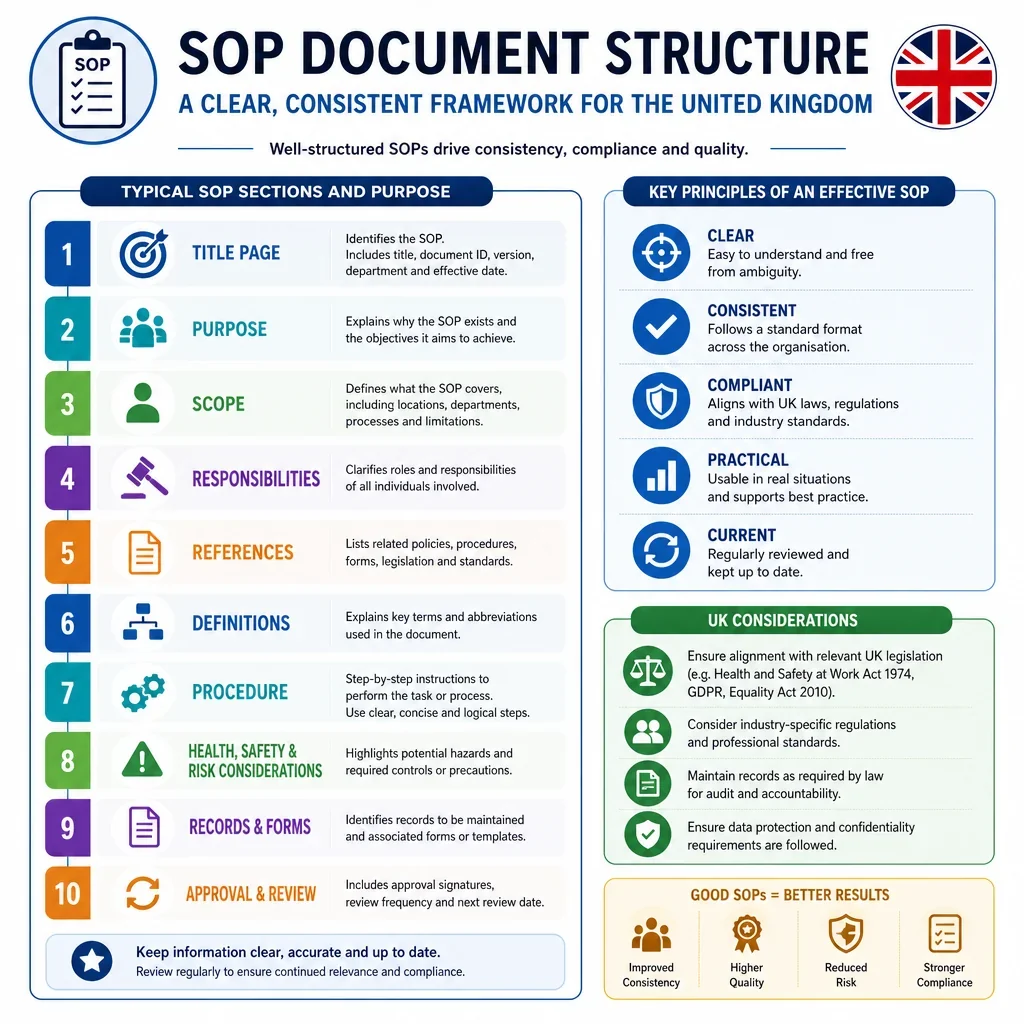
A formal UK SOP should normally include a clear purpose, scope, responsibilities, defined procedure steps, required records, version control, approval and review arrangements. Where the SOP affects safety, data protection, quality or employment processes, the control and evidence sections become especially important.
Which SOP Sections Carry The Most Legal And Compliance Risk?
- Health and safety controls should align with UK risk assessment duties and safe systems of work expectations, especially where manual handling, hazardous substances, equipment or workplace hazards are involved.
- Records and evidence sections should identify what must be retained, by whom and for how long, particularly for training, incidents, inspections, complaints and quality checks.
- Data protection sections are important where an SOP involves personal data, customer records, employee files or monitoring. They should reference privacy, access control and retention requirements.
- Approval, review and change control help prove that the SOP is current, authorised and consistently managed.
Who Should Own SOP Content In A UK Organisation?
The procedure owner should usually draft and maintain the SOP, but approval should involve the relevant specialist where risk is involved: the health and safety lead for safety controls, the compliance officer for regulated processes, the quality manager for quality-critical procedures, and the human resources lead for people management procedures.
How Detailed Should SOP Procedure Steps Be?
Steps should be specific enough for a trained person to perform the task consistently without relying on informal knowledge. Use numbered actions, decision points, required forms, escalation routes, acceptance criteria and evidence requirements. Avoid vague wording such as as soon as possible unless a measurable timeframe is also given.
FAQs
You Might Also Be Interested In