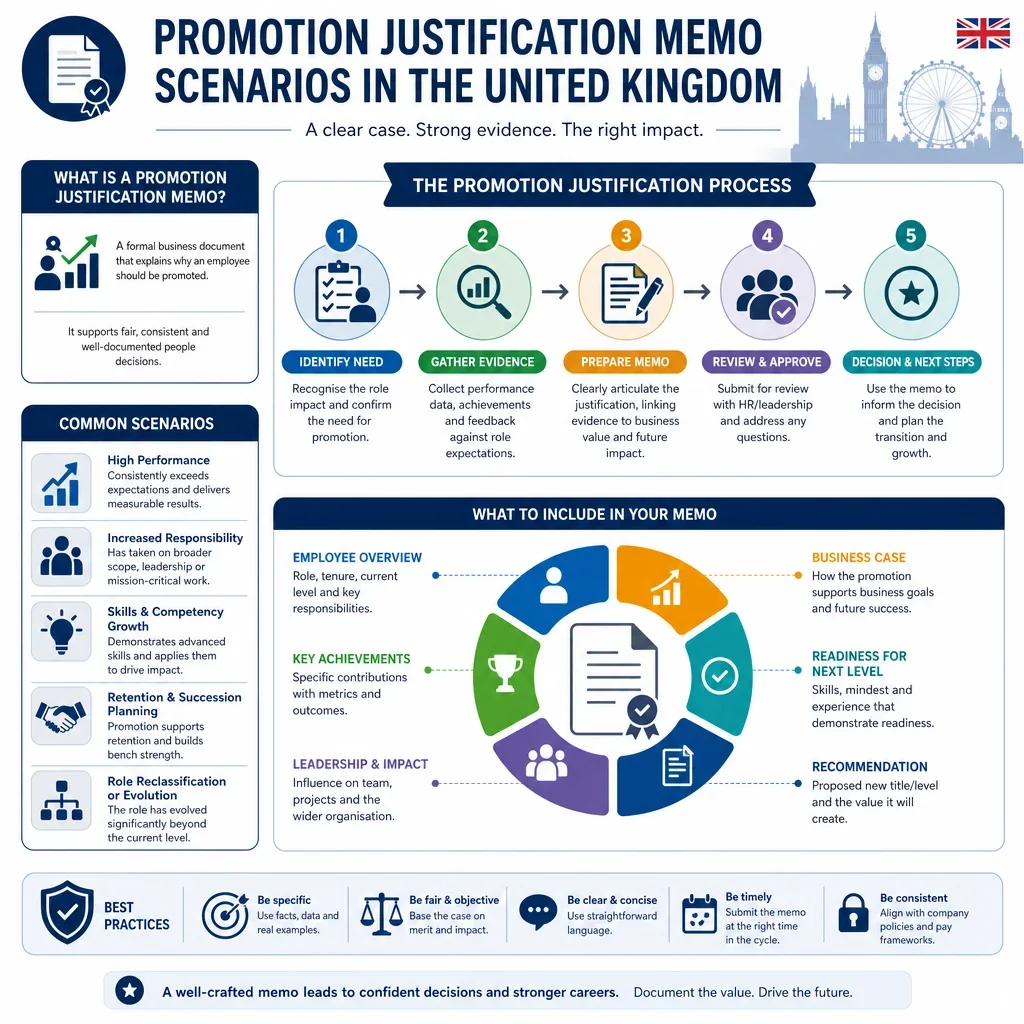
Promotion Justification Memo Section Guide In The United Kingdom
Memo Section | Section Purpose | Content Requirements | Suitable Memo Format | Common Pitfalls |
|---|---|---|---|---|
Essential | ||||
Executive summary | Summarises the promotion request, rationale and decision sought. | Employee name, current role, proposed role, effective date, headline reasons and requested approval. | Short memo, Standard memo, Detailed business case | Being vague, omitting the requested decision, or repeating the full business case. |
Promotion recommendation | States the specific promotion outcome being recommended. | Recommended title, grade, reporting line, employment basis, start date and approver action. | Short memo, Standard memo, Detailed business case | Using unclear wording such as "consider for progression" without a firm recommendation. |
Employee details | Identifies the employee and relevant employment context. | Name, department, location, current manager, start date, current job title and current grade. | Short memo, Standard memo, Detailed business case | Including irrelevant personal data or inconsistent HR system details. |
Current role overview | Explains the employee’s existing duties and scope. | Main responsibilities, grade, team size, budget scope, key stakeholders and current objectives. | Standard memo, Detailed business case | Describing the current role so broadly that the promotion step is unclear. |
Proposed role overview | Defines the role or grade the employee would move into. | Proposed title, grade, responsibilities, authority level, reporting line and expected outcomes. | Short memo, Standard memo, Detailed business case | Failing to distinguish a promotion from a title change or routine duty growth. |
Role comparison | Shows the material difference between current and proposed roles. | Side-by-side comparison of scope, accountability, autonomy, complexity, leadership and impact. | Standard memo, Detailed business case | Listing duties without explaining increased responsibility or seniority. |
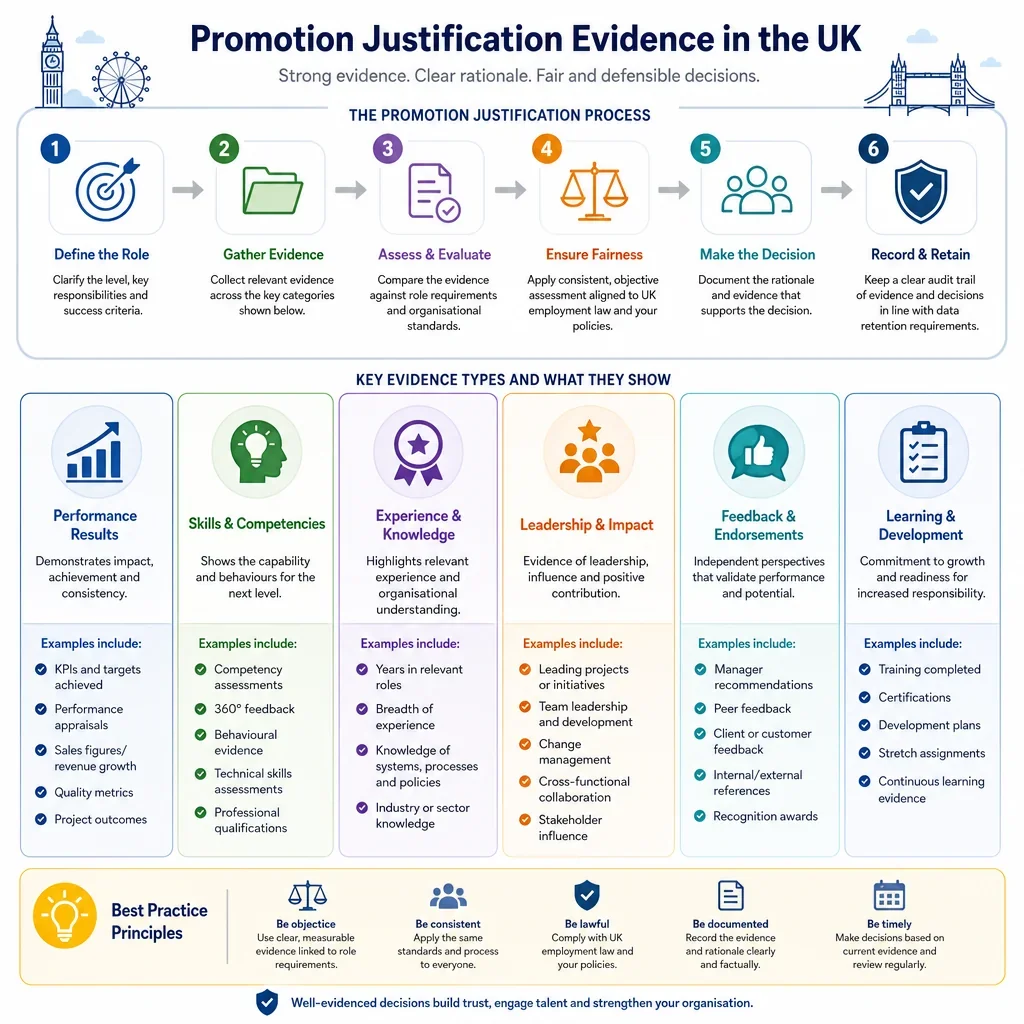
Performance evidence | Demonstrates that promotion is justified by proven performance. | Recent ratings, objectives achieved, KPIs, measurable outputs, quality indicators and manager observations. | Short memo, Standard memo, Detailed business case | Using praise without evidence, relying only on recent success, or ignoring missed objectives. |
Achievements and impact | Connects the employee’s achievements to organisational value. | Projects delivered, revenue, savings, risk reduction, service improvement, client outcomes or productivity gains. | Short memo, Standard memo, Detailed business case | Claiming impact without figures, dates, baselines or clear business relevance. |
Higher-level working evidence | Shows the employee is already performing duties of the proposed level. | Examples of senior tasks, delegated authority, independent decisions, cross-functional leadership and sustained delivery. | Standard memo, Detailed business case | Relying on one-off acting-up duties rather than sustained higher-level contribution. |
Recommended | ||||
Competency assessment | Maps the employee’s skills to the proposed role requirements. | Required competencies, evidence against each, capability gaps and readiness rating. | Standard memo, Detailed business case | Using generic strengths without linking them to the role profile or promotion criteria. |
Leadership evidence | Supports promotion into roles with supervisory or leadership duties. | Team leadership, coaching, delegation, conflict resolution, inclusion, performance management and engagement results. | Standard memo, Detailed business case | Equating technical excellence with leadership readiness without evidence. |
Technical expertise | Shows the employee has the technical depth required for the next level. | Specialist skills, qualifications, certifications, professional judgement, quality standards and knowledge sharing. | Standard memo, Detailed business case | Overstating credentials or omitting whether qualifications are required for the role. |
Essential | ||||
Business need | Explains why the organisation needs the promoted role now. | Workload, growth, client demand, operational risk, strategic priorities and gaps in current structure. | Standard memo, Detailed business case | Presenting promotion only as a reward without proving organisational need. |
Recommended | ||||
Strategic alignment | Links the promotion to wider organisational objectives. | Relevant strategy, department plan, transformation goal, market opportunity or risk priority. | Detailed business case | Using high-level strategy language without explaining the employee’s contribution. |
Organisational structure impact | Shows how the promotion fits the team structure. | Reporting changes, team chart impact, spans of control, replacement needs and dependency changes. | Detailed business case | Creating unclear reporting lines or hidden headcount increases. |
Essential | ||||
Salary and reward impact | Sets out the financial effect of the promotion on pay and benefits. | Current salary, proposed salary, grade range, bonus, allowances, pension impact and effective date. | Short memo, Standard memo, Detailed business case | Omitting total reward impact or giving figures inconsistent with payroll and HR records. |
Budget approval | Confirms the promotion is affordable and funded. | Budget holder, cost centre, annualised cost, funding source and finance approval status. | Standard memo, Detailed business case | Approving the role before confirming budget or recurring cost ownership. |
Recommended | ||||
Market pay benchmark | Supports salary positioning with internal or external pay evidence. | Pay range, market data source, internal peers, grade midpoint and rationale for proposed placement. | Standard memo, Detailed business case | Cherry-picking market data or ignoring internal equity and pay range rules. |
Essential | ||||
Internal equity review | Checks that the promotion and pay outcome are consistent with comparable employees. | Comparison group, grade norms, pay position, similar promotions and reasons for any differences. | Standard memo, Detailed business case | Ignoring comparable colleagues or creating unexplained pay disparities. |
Equality and fairness check | Reduces discrimination risk in the promotion decision. | Objective criteria, selection pool if relevant, protected characteristic risk, consistency and mitigation steps. | Standard memo, Detailed business case | Using subjective labels, informal sponsorship or criteria that may indirectly disadvantage groups. |
Promotion policy compliance | Confirms the recommendation follows internal HR rules. | Applicable policy, eligibility, required panel, documents, manager approval and HR review. | Short memo, Standard memo, Detailed business case | Bypassing published criteria or applying different standards to similar cases. |
Recommended | ||||
Selection process | Explains how the employee was identified for promotion. | Nomination route, assessment method, interview or panel outcome, and whether role was advertised. | Standard memo, Detailed business case | Leaving unexplained why other eligible employees were not considered. |
Risk of non-promotion | Explains the business risks if the promotion is not approved. | Retention risk, delivery risk, recruitment cost, morale impact, client impact and knowledge loss. | Detailed business case | Overstating resignation risk without evidence or making emotional arguments. |
Retention rationale | Shows whether promotion helps retain key capability. | Critical skills, replacement difficulty, market demand, succession role and retention indicators. | Detailed business case | Using retention as the only reason when performance or role need is weak. |
Succession planning | Shows how the promotion supports future leadership or capability continuity. | Talent pipeline, successor readiness, backfill plan, knowledge transfer and development pathway. | Detailed business case | Treating succession planning as a promise rather than a business planning factor. |
Post-promotion development plan | Identifies support needed for success in the new role. | Training, coaching, mentoring, probationary milestones, capability gaps and review dates. | Standard memo, Detailed business case | Presenting the employee as fully ready while ignoring known development needs. |
New role objectives | Sets expectations for performance after promotion. | First 90-day goals, annual objectives, KPIs, deliverables and success measures. | Standard memo, Detailed business case | Approving promotion without defining how success will be measured. |
Optional | ||||
Stakeholder endorsements | Adds independent support for the promotion recommendation. | Brief comments from senior stakeholders, clients, project leads or cross-functional partners. | Detailed business case | Including generic testimonials that repeat praise without evidence. |
Essential | ||||
Manager assessment | Records the line manager’s reasoned view of readiness. | Assessment of performance, behaviour, readiness, risks, support needs and recommendation strength. | Short memo, Standard memo, Detailed business case | Providing an unsupported opinion or ignoring contrary performance evidence. |
HR review | Confirms HR has checked process, grading, reward and fairness issues. | HR reviewer, policy compliance, grade fit, pay check, equality review and conditions. | Standard memo, Detailed business case | Treating HR review as a formality after the decision is already communicated. |
Recommended | ||||
Finance review | Verifies the affordability and accounting treatment of the promotion. | Annualised salary cost, employer costs, bonus impact, cost centre and budget holder confirmation. | Standard memo, Detailed business case | Ignoring employer National Insurance, pension or bonus cost implications. |
Contractual implications | Identifies employment contract changes caused by the promotion. | Title, duties, pay, hours, location, notice, benefits, restrictive covenants and written statement updates. | Standard memo, Detailed business case | Assuming promotion can be implemented without contract variation or written confirmation. |
Written particulars update | Flags required written confirmation of changed employment particulars. | Changed particulars, date of change, employee communication owner and document issue date. | Standard memo, Detailed business case | Failing to update written terms after changes to pay, role, location or hours. |
Data protection considerations | Ensures the memo uses employment data lawfully and proportionately. | Relevant data only, access controls, retention period, sensitive data check and sharing limits. | Standard memo, Detailed business case | Including health, family, grievance or absence details unrelated to the promotion decision. |
Essential | ||||
Objective promotion criteria | Shows the decision is based on transparent and relevant standards. | Criteria used, evidence for each criterion, weighting if relevant and threshold for promotion. | Standard memo, Detailed business case | Using subjective traits such as "fit", "attitude" or "potential" without evidence. |
Recommended | ||||
Appraisal history | Provides a balanced record of sustained performance over time. | Recent appraisal ratings, objectives, development actions, progression trend and notable feedback. | Standard memo, Detailed business case | Selecting only favourable history or ignoring recent performance concerns. |
Optional | ||||
Conduct and disciplinary status | Confirms there are no relevant unresolved conduct issues. | Only relevant live warnings, investigations, conduct risks and HR guidance, if applicable. | Detailed business case | Including expired, irrelevant or excessive disciplinary information. |
Recommended | ||||
Training and qualifications | Shows the employee meets qualification or learning expectations for the new role. | Completed training, required qualifications, licences, CPD, gaps and planned completion dates. | Standard memo, Detailed business case | Failing to distinguish mandatory qualifications from desirable development. |
Optional | ||||
Client or customer impact | Explains how the promotion improves external or internal service outcomes. | Client feedback, service levels, account growth, issue resolution, delivery quality and relationship ownership. | Detailed business case | Using anecdotal client praise without measurable service or commercial impact. |
Recommended | ||||
Commercial impact | Quantifies revenue, margin, savings or financial contribution. | Revenue generated, margin protected, costs saved, efficiency gains and assumptions used. | Detailed business case | Double-counting benefits or presenting estimated savings as verified results. |
Operational impact | Shows how the promotion improves delivery, control or efficiency. | Process improvements, capacity gains, quality outcomes, error reduction and delivery resilience. | Standard memo, Detailed business case | Describing activity rather than measurable operational improvement. |
Optional | ||||
Risk and compliance impact | Explains how the promotion supports governance, assurance or regulatory control. | Controls improved, incidents reduced, audit points closed, compliance duties and risk ownership. | Detailed business case | Making broad compliance claims without linking them to duties or evidence. |
Recommended | ||||
DEI considerations | Checks whether promotion practice supports fair and inclusive progression. | Fair access, reasonable adjustments if relevant, criteria consistency and adverse impact considerations. | Detailed business case | Treating DEI as a slogan rather than checking the fairness of the actual decision process. |
Optional | ||||
Reasonable adjustments | Records any disability-related adjustments relevant to assessment or role transition. | Adjustment need, assessment process changes, role support, confidentiality limits and implementation owner. | Standard memo, Detailed business case | Disclosing medical details unnecessarily or ignoring adjustments in promotion assessment. |
Location and working pattern implications | Identifies changes to workplace, travel, hours or hybrid arrangements. | Work location, travel expectations, hours, hybrid terms, allowances and contract update needs. | Standard memo, Detailed business case | Changing working pattern expectations without confirming contractual or policy implications. |
Recommended | ||||
Implementation plan | Explains how the promotion will be put into effect. | Effective date, HRIS update, payroll instruction, announcement plan, handover and review milestones. | Standard memo, Detailed business case | Approving promotion without assigning operational tasks to HR, payroll and managers. |
Optional | ||||
Communication plan | Manages how the promotion is communicated internally or externally. | Employee notification, team announcement, client communication, timing, confidentiality and message owner. | Standard memo, Detailed business case | Announcing the promotion before formal approvals or contract terms are confirmed. |
Essential | ||||
Approval route | Identifies who must approve the promotion and in what order. | Line manager, department head, HR, finance, reward, executive sponsor and panel requirements. | Short memo, Standard memo, Detailed business case | Missing a required approver or obtaining approvals after communication to the employee. |
Decision requested | Makes the required approval action clear to decision-makers. | Approve, reject, defer or request further information, with any conditions stated clearly. | Short memo, Standard memo, Detailed business case | Ending with background information but no explicit decision point. |
Sign-off record | Creates an audit trail of approval for the promotion. | Approver names, roles, dates, approval conditions and final decision status. | Short memo, Standard memo, Detailed business case | Relying on informal verbal agreement without a dated record. |
Recommended | ||||
Supporting documents | Lists evidence relied on for the promotion case. | Job descriptions, appraisal records, org chart, pay range, business case data and endorsement notes. | Standard memo, Detailed business case | Attaching excessive documents or omitting key evidence cited in the memo. |
Optional | ||||
Assumptions and dependencies | Clarifies conditions that affect the promotion business case. | Budget assumptions, workload forecasts, client demand, backfill dependency and timing constraints. | Detailed business case | Presenting forecasts as certain or hiding dependencies from approvers. |
Alternatives considered | Shows why promotion is the preferred option. | Recruitment, temporary allowance, acting-up arrangement, role redesign, development plan or no-change option. | Detailed business case | Ignoring lower-cost or fairer alternatives without explanation. |
Acting-up or interim history | Records prior temporary performance in the higher role. | Dates, duties, allowance, outcomes, feedback and difference from permanent promotion. | Standard memo, Detailed business case | Assuming temporary cover automatically proves readiness for permanent promotion. |
Promotion trial period | Defines any trial, review or confirmation arrangement after promotion. | Trial duration, objectives, review date, support, confirmation criteria and fallback position. | Standard memo, Detailed business case | Using a trial period without clear contractual terms or objective review criteria. |
Recommended | ||||
Job evaluation or grading | Confirms the proposed role sits at the correct organisational level. | Evaluation method, grade factors, comparator roles, outcome date and reward approval. | Standard memo, Detailed business case | Promoting into an unevaluated role or matching grade to person rather than job scope. |
Equal pay considerations | Checks whether pay outcome could raise equal pay concerns. | Like work comparators, grade consistency, pay differences, material factor rationale and records. | Detailed business case | Approving unexplained pay differences for comparable work. |
Optional | ||||
Minimum wage check | Confirms pay remains compliant where hours or duties change. | New salary, working hours, unpaid time risks, deductions and applicable minimum wage rate. | Standard memo, Detailed business case | Ignoring increased hours or deductions that may affect hourly compliance. |
Recommended | ||||
Confidentiality controls | Limits access to sensitive promotion and salary information. | Audience, document classification, salary confidentiality, storage location and sharing restrictions. | Standard memo, Detailed business case | Circulating pay details wider than necessary or using unsecured channels. |
Record retention | Ensures promotion records are kept only as long as needed. | Retention period, HR file location, deletion owner and reason for retaining decision evidence. | Detailed business case | Keeping duplicate drafts indefinitely or failing to retain final approval evidence. |
Optional | ||||
Review or appeal route | Identifies how promotion concerns or disputes may be handled. | Relevant grievance or review process, contact point, timing and escalation route. | Detailed business case | Suggesting an informal route that conflicts with the employer’s grievance procedure. |
Recommended | ||||
Promotion timeline | Sets out key dates for decision and implementation. | Submission date, panel date, approval date, employee notice, payroll cut-off and effective date. | Short memo, Standard memo, Detailed business case | Choosing an effective date that misses payroll or policy deadlines. |
Backfill plan | Explains how the employee’s current duties will be covered. | Replacement need, recruitment plan, redistribution of duties, interim cover and cost impact. | Detailed business case | Creating a capability gap in the current role by promoting without cover. |
Essential | ||||
Role description update | Ensures the proposed role is documented accurately. | Updated job description, duties, reporting line, grade, person specification and review date. | Standard memo, Detailed business case | Approving a promotion where the job description is outdated or inconsistent with grade. |
Pay effective date | Confirms when salary and reward changes take effect. | Effective date, payroll month, arrears position, bonus eligibility date and approval condition. | Short memo, Standard memo, Detailed business case | Leaving ambiguity about back pay, arrears or bonus eligibility. |
Recommended | ||||
Benefits impact | Identifies benefit changes triggered by grade or role change. | Car allowance, private medical cover, holiday, pension, bonus, share plan and other grade benefits. | Standard memo, Detailed business case | Focusing only on salary and overlooking benefit eligibility costs. |
Optional | ||||
Pension impact | Notes employer pension cost changes resulting from higher pay. | Employer contribution rate, pensionable salary, salary sacrifice impact and payroll treatment. | Detailed business case | Understating total employment cost by excluding pension contributions. |
Employer National Insurance impact | Notes additional employer payroll tax cost from increased earnings. | Annual salary uplift, employer NIC estimate, payroll period and finance treatment. | Detailed business case | Calculating salary uplift only and omitting employer on-costs. |
Recommended | ||||
Bonus and incentive eligibility | Clarifies whether promotion changes incentive opportunity. | Bonus plan, target percentage, pro-rating, commission rules, share awards and performance conditions. | Standard memo, Detailed business case | Failing to state whether new bonus terms apply immediately or from the next cycle. |
Optional | ||||
Conflict of interest check | Confirms decision-makers are independent and appropriate. | Relationships, reporting conflicts, personal interests, recusal needs and alternative approver. | Detailed business case | Allowing a conflicted sponsor to be the sole evidence source or approver. |
Jurisdiction and location issues | Flags issues where the employee works outside or across UK locations. | Work jurisdiction, local employment terms, tax, immigration, remote working approval and payroll entity. | Detailed business case | Assuming UK promotion terms apply unchanged to cross-border working arrangements. |
Immigration and right to work implications | Checks whether the new role affects sponsorship or right to work duties. | Visa status if relevant, sponsor reporting, SOC code, salary threshold, work location and HR immigration review. | Detailed business case | Changing duties, salary or location for a sponsored worker without immigration review. |
Regulatory approval requirements | Identifies whether the promotion needs external or internal regulatory approval. | Regulated function, fit and proper checks, certification, training, approval body and timing. | Detailed business case | Letting the employee perform regulated duties before required approval or certification. |
What Should A UK Promotion Justification Memo Include?
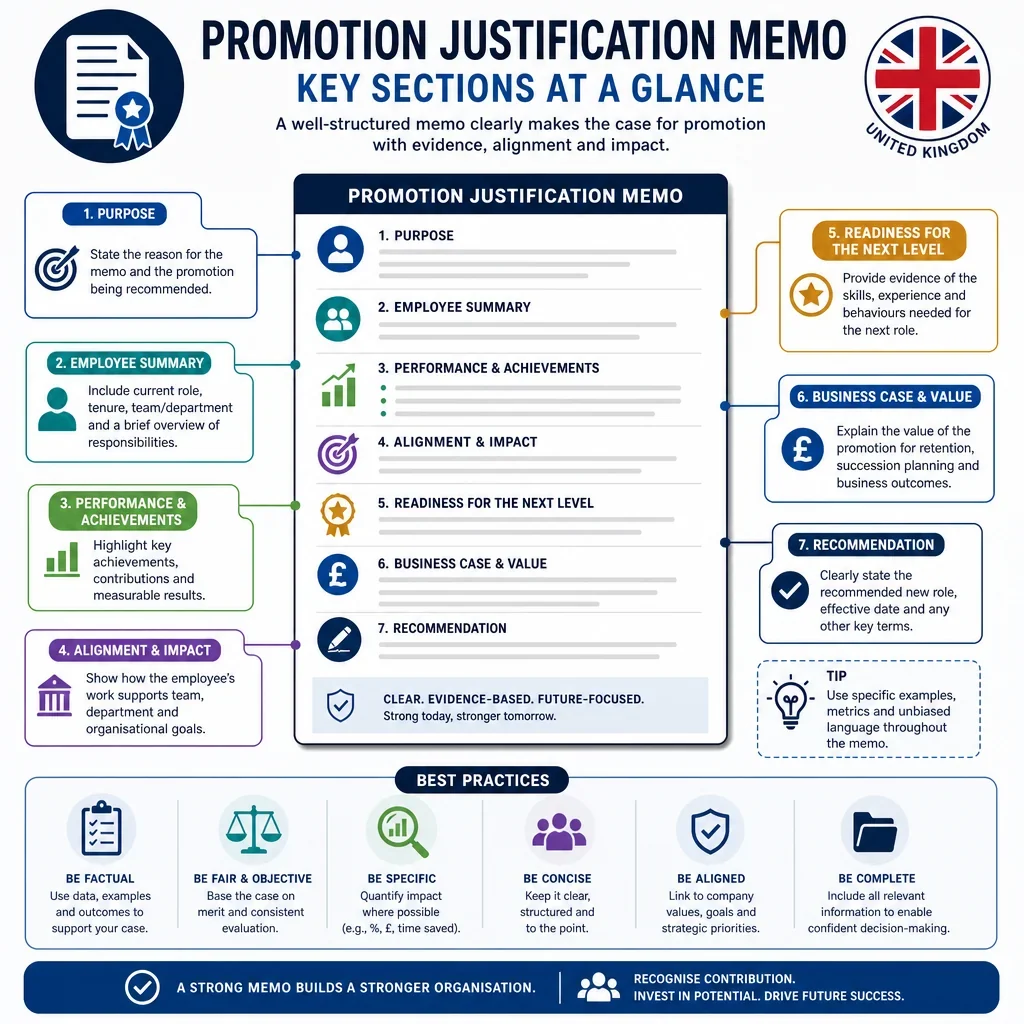
A strong UK promotion justification memo should combine a clear recommendation, evidence of sustained performance, comparison with the proposed role, pay impact, and approval route. The most persuasive sections are those that connect the employee’s achievements to business need, internal role expectations, budget approval, and fair treatment of comparable employees.
How Can Employers Reduce Legal And HR Risk?
- Use evidence-led criteria: Promotion decisions should be based on documented performance, responsibilities, capability, and business need rather than subjective praise.
- Check equality and consistency: In the UK, promotion processes can create discrimination risk if decisions disadvantage protected groups under the Equality Act 2010. Include a short fairness and consistency check where appropriate.
- Record pay rationale: If promotion changes salary, grade, bonus, or benefits, explain the basis for the change and confirm budget approval to reduce later disputes.
- Avoid unnecessary personal data: Keep the memo limited to relevant employment information and avoid sensitive personal data unless genuinely necessary, consistent with UK GDPR principles explained by the ICO.
Which Sections Are Essential For Most Promotion Cases?
Most standard memos should include an executive summary, promotion recommendation, current and proposed role details, performance evidence, business need, compensation impact, fairness review, effective date, and approval sign-off. Detailed business cases should add succession planning, organisational structure, risk of non-promotion, stakeholder endorsements, and implementation arrangements.
FAQs
You Might Also Be Interested In