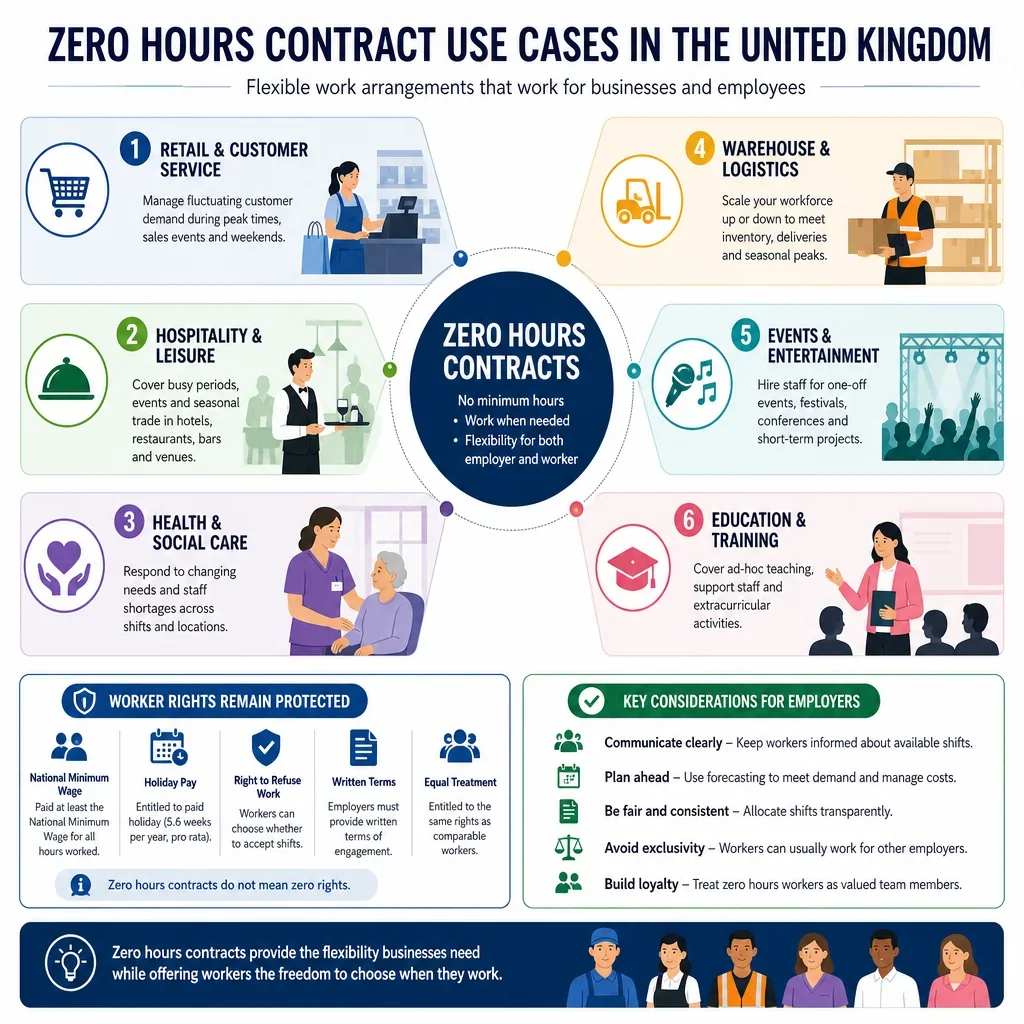
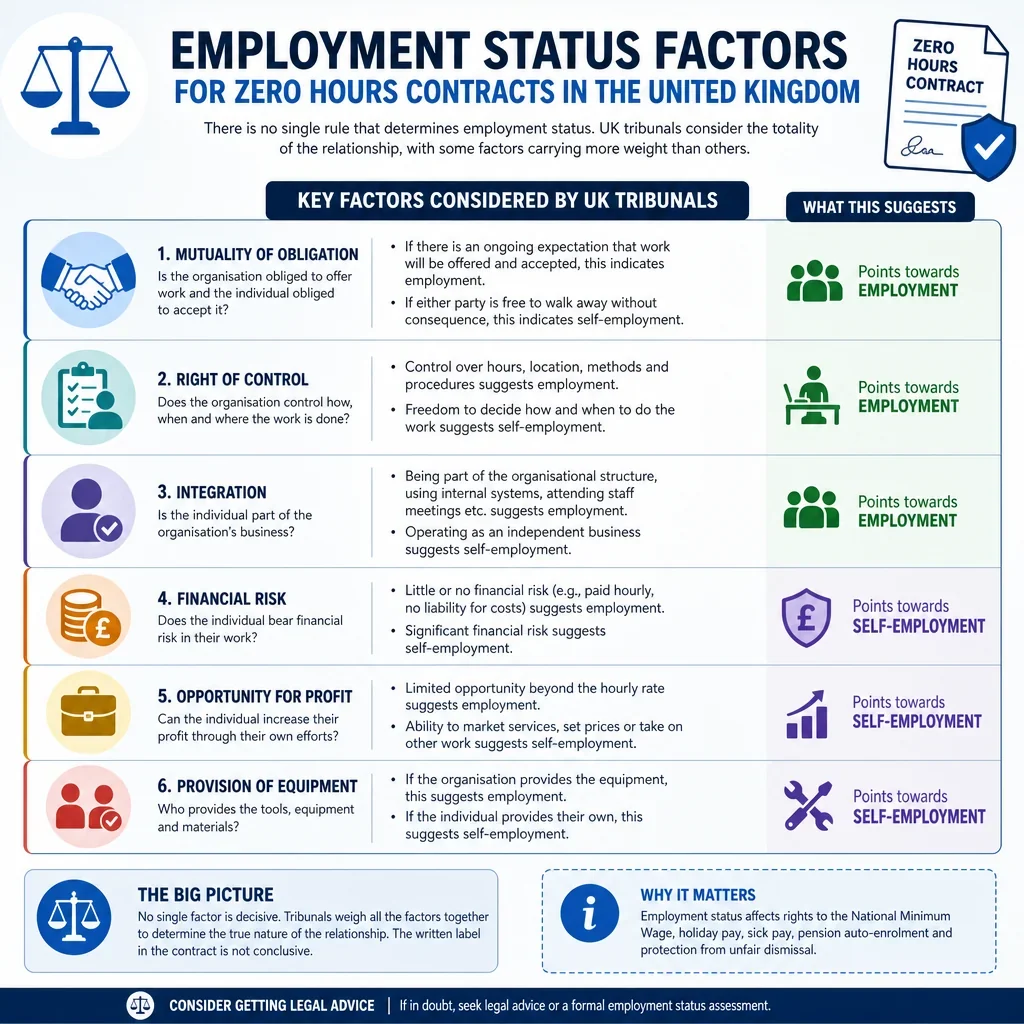
United Kingdom Zero Hours Contract Clause Checklist
Clause name | Purpose | Typical importance | Drafting notes |
|---|---|---|---|
Engagement and status | |||
Employment Status | States whether the individual is engaged as a worker, employee or self-employed contractor. | Usually essential | Status wording must reflect reality courts and tribunals look beyond labels. |
No Guaranteed Hours | Confirms the organisation is not obliged to offer a minimum amount of work. | Usually essential | Avoid wording inconsistent with regular guaranteed shifts or fixed hours. |
No Obligation To Accept Work | Makes clear the worker may refuse offered assignments without automatic sanction. | Usually essential | Important for avoiding implied mutuality of obligation do not undermine with penalties. |
Working arrangements | |||
Offer Of Assignments | Explains how shifts or assignments will be offered to the worker. | Usually essential | Specify practical method, such as rota, app, email or phone, without promising work. |
Acceptance Of Assignments | Sets how and when the worker accepts a proposed shift or assignment. | Commonly included | Include acceptance deadlines and clarify that only accepted work becomes binding. |
Refusal Of Assignments | Confirms refusal of offered work is permitted under the casual arrangement. | Usually essential | Avoid disciplinary consequences merely for declining work, especially if no obligation exists. |
Cancellation Of Assignments | Sets rules for cancelling accepted shifts by either party. | Commonly included | Consider reasonable notice, late cancellation pay and fairness in rota management. |
Place Of Work | Identifies where work may be carried out. | Commonly included | Use flexible location wording only where reasonable and operationally justified. |
Duties And Role Description | Describes the type of work the worker may be asked to perform. | Commonly included | Keep duties broad enough for casual work but clear enough for expectations and training. |
Reporting Line And Supervision | Identifies who manages the worker during accepted assignments. | Commonly included | Supervision wording should reflect operational control without overstating ongoing obligation. |
Engagement and status | |||
Personal Service | States whether the individual must perform accepted work personally. | Commonly included | Personal service supports worker status substitution wording must be genuine if included. |
Substitution Rights | Allows, limits or excludes the ability to send someone else to do the work. | Situation dependent | Do not include artificial substitution rights that will not be honoured in practice. |
No Exclusivity Restriction | Confirms the worker is not prevented from working for others. | Usually essential | Exclusivity clauses in zero hours contracts are generally unenforceable. |
Conduct and compliance | |||
Conflicts Of Interest | Requires disclosure of work or interests that may conflict with the organisation. | Commonly included | Do not use conflict wording as a disguised unlawful exclusivity clause. |
Engagement and status | |||
Commencement Date | Records when the casual engagement begins. | Usually essential | Useful for holiday, length of engagement and document control. |
Continuity Of Employment | Addresses whether gaps between assignments count towards continuity. | Situation dependent | Continuity is statutory and fact-sensitive avoid overconfident exclusion wording. |
Written Particulars | Provides the required core terms of engagement in writing. | Usually essential | Employees and workers are entitled to written particulars from day one. |
Trial Or Probationary Period | Allows performance and suitability to be assessed at the start of engagement. | Optional | May be less useful where work is genuinely intermittent. |
Pay and benefits | |||
Rate Of Pay | States the hourly or other applicable pay rate. | Usually essential | Pay must meet National Minimum Wage or National Living Wage for working time. |
Pay Dates And Payroll | Explains when wages are paid and how payslips are issued. | Usually essential | Include payroll cut-off dates and itemised payslip arrangements. |
Deductions From Wages | Allows lawful deductions where permitted by statute, contract or consent. | Commonly included | Deductions need clear contractual authority or another lawful basis. |
Timesheets And Time Recording | Requires accurate recording of hours worked for pay and compliance. | Usually essential | Vital for minimum wage, working time and holiday pay calculations. |
Overtime Or Enhanced Rates | States whether any premium rates apply for extra, night, weekend or holiday work. | Situation dependent | No general statutory right to overtime premium, but pay must not fall below minimum wage. |
Expenses | Sets rules for reimbursing authorised business expenses. | Situation dependent | Require prior approval, receipts and compliance with tax treatment. |
Time off and absence | |||
Annual Leave Entitlement | Sets paid holiday entitlement for zero hours workers. | Usually essential | Workers are generally entitled to 5.6 weeks paid annual leave. |
Holiday Accrual For Irregular Hours | Explains how holiday builds up where hours vary. | Usually essential | Irregular hours and part-year rules changed for leave years from 1 April 2024. |
Pay and benefits | |||
Holiday Pay Calculation | States how pay during annual leave will be calculated. | Usually essential | Use the correct statutory calculation avoid unclear rolled-up holiday pay wording. |
Rolled-Up Holiday Pay | Provides for lawful rolled-up holiday pay where permitted for eligible workers. | Situation dependent | Only use where legally permitted and show holiday pay separately on payslips. |
Time off and absence | |||
Holiday Booking Procedure | Explains how the worker requests and takes annual leave. | Commonly included | Set notice requirements and employer approval process consistently with working time rules. |
Sickness Reporting | Requires prompt notice if the worker cannot attend accepted work due to sickness. | Commonly included | Tie obligations to accepted assignments rather than periods with no scheduled work. |
Pay and benefits | |||
Statutory Sick Pay | Explains entitlement to SSP where statutory qualifying conditions are met. | Commonly included | Eligibility depends on earnings, incapacity and other SSP rules. |
Time off and absence | |||
Family Leave And Pay | Refers to maternity, paternity, adoption, parental bereavement and related rights. | Commonly included | Entitlements vary by status, earnings and service cross-refer to policy if needed. |
Time Off For Dependants | Recognises statutory time off for certain dependant emergencies. | Situation dependent | Applies to employees avoid deterring statutory emergency absence rights. |
Working arrangements | |||
48-Hour Weekly Working Limit | Addresses the average 48-hour weekly working time limit. | Commonly included | Use a separate opt-out only if genuinely voluntary and revocable. |
Working Time Opt-Out | Records any voluntary agreement to work over the 48-hour average limit. | Situation dependent | Must be voluntary include right to withdraw on notice. |
Rest Breaks And Rest Periods | Confirms rights to rest breaks, daily rest and weekly rest where applicable. | Commonly included | Account for shift length, age, sector exceptions and compensatory rest. |
Night Work | Sets rules for night shifts and health assessment requirements. | Situation dependent | Include health assessment and night work limits where night work is expected. |
Young Worker Restrictions | Applies additional working time protections for workers under 18. | Situation dependent | Add age-specific limits where engaging 16 or 17 year olds. |
Pay and benefits | |||
Pension Auto-Enrolment | Explains pension auto-enrolment where eligibility criteria are met. | Commonly included | Eligibility depends on age, earnings and worker status avoid blanket exclusions. |
Benefits And Non-Contractual Perks | Clarifies whether any benefits apply and whether they are discretionary. | Optional | Distinguish contractual benefits from discretionary or assignment-specific perks. |
Conduct and compliance | |||
Training Requirements | Requires completion of mandatory training before or during assignments. | Commonly included | Clarify whether training time is paid and required before work is offered. |
Health And Safety | Requires compliance with health and safety duties, instructions and procedures. | Usually essential | Apply to all workers, including casual staff and site-specific assignments. |
Equality, Diversity And Anti-Harassment | Requires compliance with equality standards and anti-harassment rules. | Usually essential | Cover conduct towards colleagues, customers, service users and third parties. |
Confidentiality | Protects confidential business, client and operational information. | Usually essential | Should survive termination and be proportionate to actual information access. |
Data Protection | Requires personal data to be handled lawfully and securely. | Usually essential | Cross-refer to privacy notice and data protection policy cover breach reporting. |
Intellectual Property | Allocates ownership of work product created during assignments. | Situation dependent | Important for creative, software, design, marketing and consultancy assignments. |
Company Property And Equipment | Sets rules for use, care and return of equipment, keys, uniforms and devices. | Commonly included | If deductions for loss are intended, include a lawful deductions clause. |
IT And Communications Use | Controls use of systems, email, internet, devices and monitoring. | Situation dependent | Monitoring must be transparent, proportionate and covered by privacy information. |
Social Media And Public Statements | Restricts damaging, unauthorised or confidential public communications. | Optional | Balance reputational protection with lawful whistleblowing and personal expression. |
Right To Work Checks | Makes engagement conditional on legal right to work in the UK. | Usually essential | Checks must be completed before work starts and repeated where required. |
Background And DBS Checks | Allows checks where appropriate for the role or sector. | Situation dependent | Only request checks that are lawful, necessary and proportionate to the work. |
Safeguarding | Requires compliance with safeguarding rules for vulnerable people or children. | Situation dependent | Essential in care, education, health, charity and youth-facing roles. |
Dress Code Or Uniform | Sets appearance, PPE or uniform expectations for assignments. | Situation dependent | Consider equality, religious dress, PPE duties and minimum wage impact of required items. |
Conduct Standards And Disciplinary Rules | Sets behavioural standards and consequences for misconduct during engagement. | Commonly included | Avoid using discipline to penalise refusal of work where refusal is permitted. |
Grievance Procedure | Explains how the worker can raise workplace concerns or complaints. | Commonly included | Cross-refer to procedure and keep route accessible for casual workers. |
Whistleblowing | Preserves rights to make protected disclosures about wrongdoing. | Commonly included | Confidentiality terms must not prevent protected disclosures. |
Anti-Bribery And Corruption | Prohibits bribes, facilitation payments and improper gifts or hospitality. | Situation dependent | Useful where workers handle procurement, sales, customers or public contracts. |
Modern Slavery Compliance | Requires reporting and compliance with anti-slavery standards. | Situation dependent | Relevant in supply chains, labour providers, hospitality, agriculture and logistics. |
Policies And Procedures | Requires compliance with workplace policies that may change over time. | Commonly included | State whether policies are contractual or non-contractual. |
Termination and variation | |||
Notice Of Termination | Sets notice required to end the engagement or accepted assignments. | Usually essential | Employee statutory minimum notice may apply distinguish engagement from individual shifts. |
Immediate Termination For Misconduct | Allows termination without notice for serious misconduct or fundamental breach. | Commonly included | Use examples but avoid limiting gross misconduct to a closed list. |
Ending An Individual Assignment | Explains how a particular accepted shift or assignment can end early. | Commonly included | Keep separate from ending the overall engagement or worker relationship. |
No Right To Future Work | Confirms completion of an assignment does not guarantee further offers of work. | Usually essential | Must be consistent with actual practice and any regular work patterns. |
Final Pay And Accrued Holiday On Termination | Provides for final wages and payment for untaken statutory holiday. | Usually essential | Calculate accrued holiday correctly for irregular hours and the relevant leave year. |
Return Of Property On Termination | Requires return of property, documents, equipment and access credentials. | Commonly included | Include timing and consequences, supported by lawful deductions wording if needed. |
Post-Termination Confidentiality | Keeps confidentiality obligations in force after work ends. | Commonly included | Limit to genuine confidential information and preserve whistleblowing rights. |
Restrictive Covenants | Restricts certain competitive activity after the engagement ends. | Optional | Rarely suitable for zero hours roles must protect legitimate interests and be reasonable. |
Variation Of Terms | Explains how contract terms may be changed. | Commonly included | Unilateral variation wording should be narrow seek agreement for material changes. |
Entire Agreement | States that the written contract contains the agreed terms. | Optional | Should not attempt to exclude statutory rights or mandatory written particulars. |
Governing Law And Jurisdiction | States that the contract is governed by UK jurisdiction-specific law. | Commonly included | Use England and Wales, Scotland, or Northern Ireland as appropriate UK is not one legal system. |
Notices And Contact Details | Sets how formal notices are given and contact details are updated. | Commonly included | Permit practical notice methods while preserving proof of delivery. |
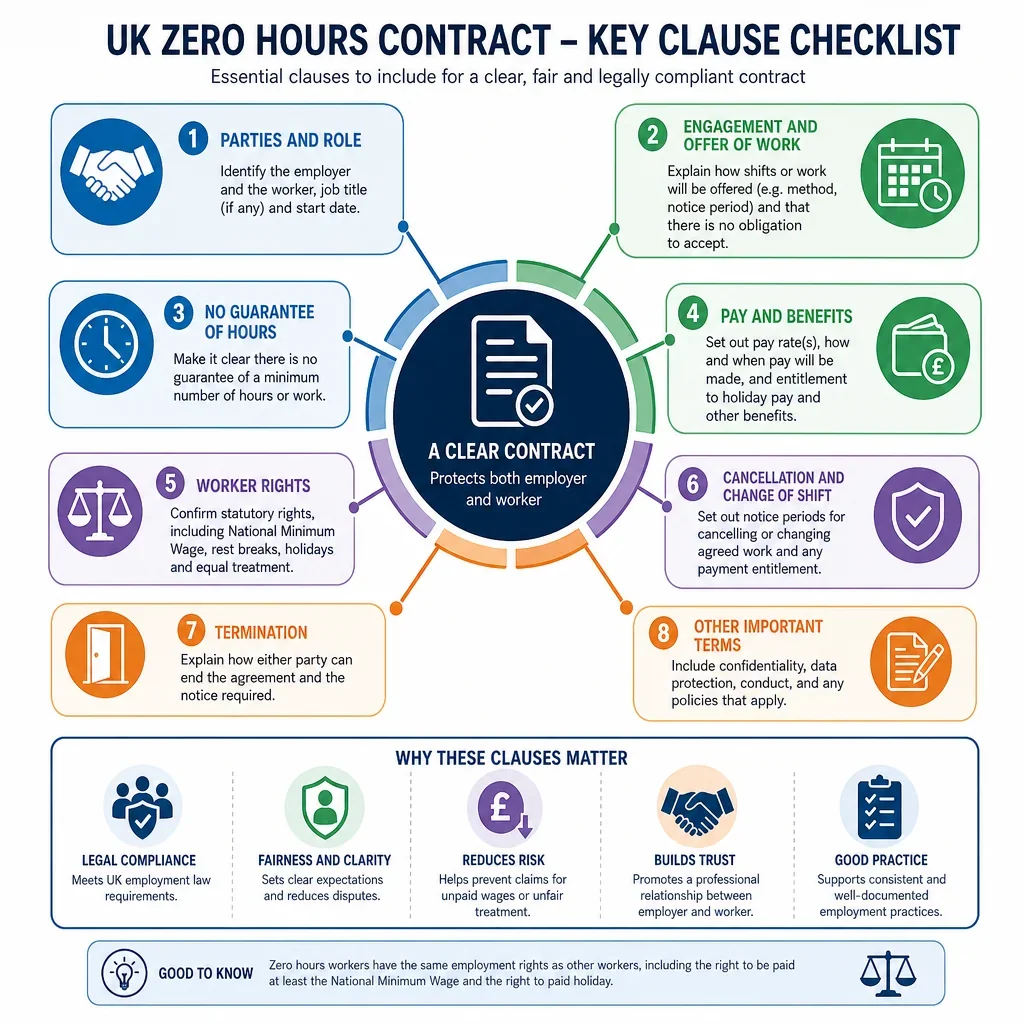
What Clauses Should A UK Zero Hours Contract Usually Include?
A UK zero hours contract should usually deal clearly with employment status, no guaranteed work, pay, holiday entitlement, working time, absence, conduct, data protection and termination. The drafting must match the real working relationship: labelling someone as a casual worker will not prevent employee rights arising if the practical arrangements show employment.
Can A Zero Hours Worker Be Stopped From Working Elsewhere?
In most cases, no. Clauses that stop a zero hours worker from doing work or services for another business, or penalise them for doing so, are generally unenforceable under UK rules on exclusivity clauses. Contracts should therefore avoid broad exclusivity wording and focus instead on genuine conflicts of interest, confidentiality and health and safety risks.
What Pay And Holiday Terms Need Particular Care?
Zero hours workers are entitled to at least the National Minimum Wage or National Living Wage for hours worked and to paid annual leave if they are workers. Holiday pay for irregular hours and part-year workers should be drafted carefully, including the holiday year, accrual method and pay calculation approach.
Why Are Working Time And Availability Clauses Important?
Because zero hours arrangements involve fluctuating work, the contract should explain how work is offered, how the worker may accept or refuse assignments, cancellation arrangements, rest breaks, weekly working time limits and record keeping. This helps reduce disputes about whether there is any obligation to provide or accept work.
Which Clauses Reduce Compliance Risk For Employers?
The most risk-sensitive provisions are those covering worker status, mutuality of obligation, right to refuse work, wage compliance, holiday pay, sickness reporting, confidentiality, data protection, equality, health and safety, disciplinary standards and termination. These clauses should be consistent with UK employment law and with how shifts are actually managed in practice.
FAQs
You Might Also Be Interested In