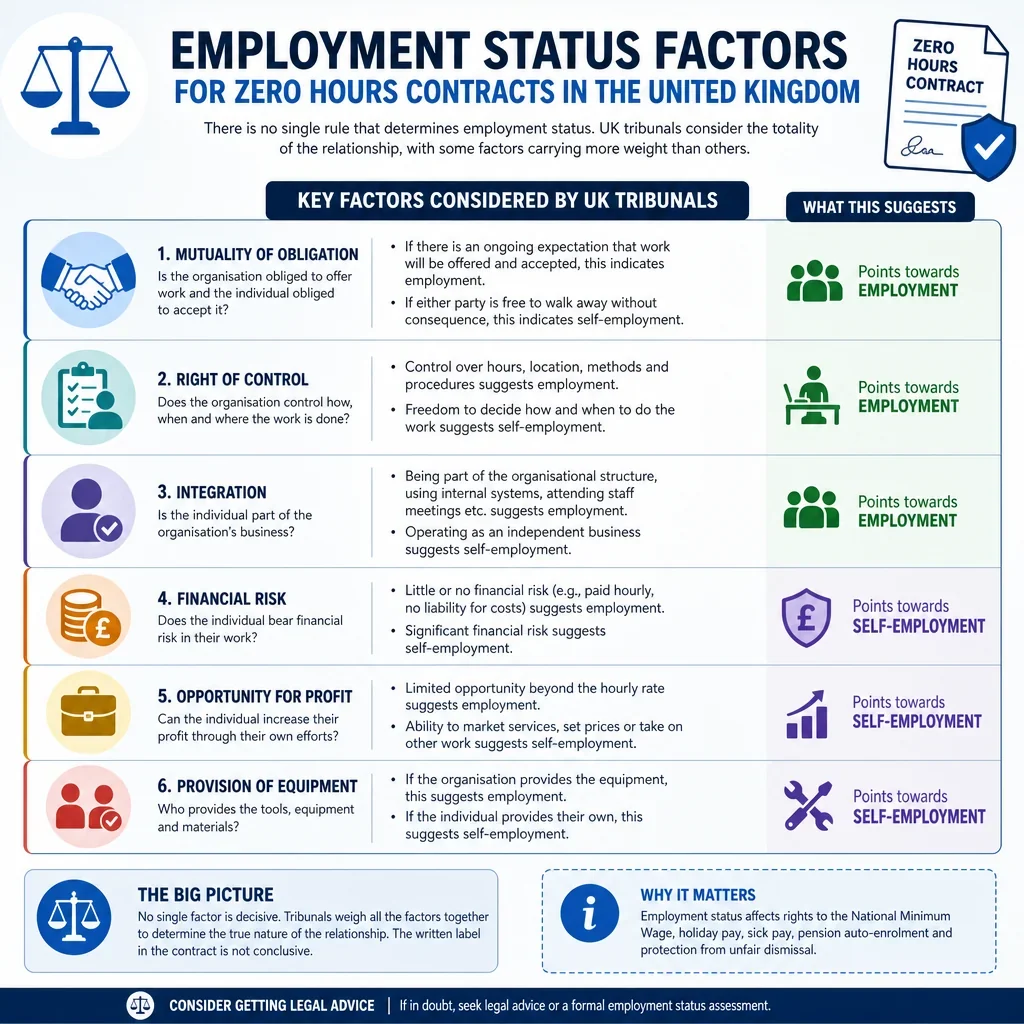
Employment Status Factors For Zero Hours Contracts In The United Kingdom
Status factor | Why it matters | Typical evidence | Legal significance |
|---|---|---|---|
Worker status, Self-employed status, General status assessment | |||
Personal service requirement | Worker status usually requires the individual to perform work personally rather than as a business supplying labour. | Clause requiring the individual to attend personally and barring others from doing the work. | High |
Worker status, Self-employed status | |||
Genuine right of substitution | An unrestricted and genuine substitution right may defeat personal service and support self-employed status. | Substitute may be sent without approval and is paid by the individual, not the engager. | High |
Worker status, General status assessment | |||
Fettered substitution right | A substitution clause limited by approval, narrow conditions or rare use may not prevent worker status. | Substitution only allowed if the individual is unable to work and the manager approves the replacement. | High |
Employee status, General status assessment | |||
Obligation to offer work | A continuing obligation on the business to provide work can point towards employment rather than a casual arrangement. | Regular rota issued in advance with an expectation that shifts will be allocated each week. | High |
Employee status, Worker status, General status assessment | |||
Obligation to accept work | If the individual must accept shifts, the arrangement may be less consistent with casual self-employed work. | Refusal of offered shifts leads to sanctions, fewer future shifts or disciplinary action. | High |
Employee status | |||
Mutuality between assignments | Employment may require obligations continuing beyond each individual shift or assignment. | Ongoing relationship, staff handbook duties and expectation of availability between shifts. | High |
Worker status, Employee status | |||
Mutuality during accepted shifts | Even without ongoing obligations, worker rights may arise once a shift is accepted and performed personally. | Individual accepts a shift, attends at the required time and is paid for the hours worked. | High |
Employee status, Worker status, Self-employed status | |||
Control over how work is done | High control over method, standards and process points away from independent contractor status. | Detailed instructions, scripts, standard operating procedures and close task supervision. | High |
Employee status, Worker status, General status assessment | |||
Control over working time | Required start times, shift lengths and breaks can show subordination and integration into the workforce. | Fixed shift times, clocking-in rules and approval needed to leave early. | High |
Control over place of work | A requirement to work at specified premises or routes suggests the engager controls performance. | Work must be done at named sites, depots, stores or client locations chosen by the business. | Medium |
Employee status, Worker status | |||
Managerial supervision | Supervision by managers can show the individual is working within the employer's organisation. | Team leader allocates tasks, monitors performance and corrects work during shifts. | Medium |
Employee status, General status assessment | |||
Disciplinary procedures | Formal discipline is consistent with an employment relationship rather than a client-contractor relationship. | Warnings, suspension, conduct rules or dismissal-style processes applied to zero hours staff. | Medium |
Appraisal and performance management | Employee-style monitoring and targets can support integration and control. | Annual reviews, KPIs, performance improvement plans and ratings used for future shifts. | Medium |
Employee status, Worker status, Self-employed status | |||
Integration into the business | Being presented as part of the workforce points away from operating an independent business. | Company email, staff badge, internal systems access and inclusion on staff rotas. | Medium |
Self-employed status, General status assessment | |||
Business on own account | A genuine independent business is less likely to be worker or employee status. | Own clients, business name, insurance, website, marketing and ability to profit from management. | High |
Worker status, Self-employed status, General status assessment | |||
Economic dependence | Dependence on one engager can support worker status where the person is not an independent business. | Most income comes from the same business and outside work is rare or discouraged. | Medium |
Self-employed status, Worker status | |||
Ability to work for others | Freedom to take competing work supports independence, although it is not conclusive by itself. | No restriction on other clients and the person in fact works for multiple businesses. | Medium |
Worker status, General status assessment | |||
Exclusivity clause | Exclusivity terms in zero hours contracts are generally unenforceable under the Employment Rights Act 1996. | Clause preventing the person from working for anyone else without consent. | High |
Protection against detriment for breaching exclusivity | Zero hours workers have protection from detriment for working elsewhere despite an exclusivity clause. | Reduced shifts after the individual accepts work with another employer. | High |
Low-income exclusivity protection | Exclusivity restrictions are also limited for certain low-income workers whose earnings fall below the statutory threshold. | Part-time low-paid worker barred from secondary work although weekly earnings are below the threshold. | Medium |
Worker status, Employee status | |||
Holiday pay entitlement | Workers, including many zero hours workers, are entitled to paid annual leave. | Contract says holiday accrues or payroll adds holiday pay for hours worked. | High |
National Minimum Wage entitlement | Worker status brings National Minimum Wage rights for qualifying work time. | Hourly rate, timesheets, clock-in records and deductions reducing pay below minimum wage. | High |
Working time protection | Workers have rights on rest breaks, weekly rest and working time limits. | Rotas, shift lengths, break records and opt-out forms for the 48-hour weekly limit. | Medium |
Unlawful deductions protection | Workers can challenge unauthorised deductions from wages, including underpaid shift pay or holiday pay. | Payslips, rota records, deduction clauses and payroll adjustments after cancelled shifts. | Medium |
Employee status | |||
Unfair dismissal qualifying status | Ordinary unfair dismissal protection generally requires employee status and sufficient continuity of employment. | Dismissal letter, disciplinary process and continuous service records. | High |
Employee status, Worker status, General status assessment | |||
Statutory sick pay treatment | SSP depends on employee earner status and earnings conditions, which may include some zero hours arrangements. | PAYE records, average weekly earnings and sickness absence reports. | Medium |
Worker status, Employee status, General status assessment | |||
Pension auto-enrolment treatment | Eligible workers may need to be assessed for workplace pension auto-enrolment duties. | Age, earnings, PAYE status and postponement or enrolment notices. | Medium |
Employee status, Self-employed status, General status assessment | |||
Tax and PAYE treatment | PAYE treatment can evidence employment-like arrangements, although tax status is not decisive for employment rights. | PAYE payroll, payslips, tax code, employee NI deductions or self-employed invoices. | Medium |
Self-employed status, General status assessment | |||
Use of invoices | Invoicing may support self-employment but is weak if other factors show personal service and control. | Individual submits numbered invoices and is paid gross without PAYE deductions. | Low |
Financial risk | Bearing real risk of loss supports independent business status. | Unpaid correction of defects, liability for losses, bad debts or unrecovered expenses. | Medium |
Opportunity to profit | Ability to increase profit through pricing, efficiency or delegation supports self-employment. | Fixed project fee, ability to hire helpers and retain margin after expenses. | Medium |
Self-employed status, Employee status, General status assessment | |||
Provision of tools and equipment | Providing substantial own equipment can support self-employment using employer equipment can support worker or employee status. | Business supplies uniform, devices, vehicles, stock systems or specialist tools. | Medium |
Employee status, Worker status, General status assessment | |||
Uniform or branding requirement | Mandatory branding may show integration and control over how services are presented. | Requirement to wear company uniform, lanyard or branded delivery kit during shifts. | Low |
Training requirements | Compulsory induction and recurring training can show organisational control and integration. | Mandatory induction, compliance modules and training before shifts are offered. | Medium |
Employee status, General status assessment | |||
Employee handbook application | Application of employee policies may show the individual is treated as staff. | Handbook rules on conduct, grievance, absence and social media apply to zero hours staff. | Medium |
Worker status, Employee status, General status assessment | |||
Right to refuse shifts in practice | A contractual right to refuse matters less if refusal causes penalties or loss of future work. | Messages showing workers can decline shifts without punishment or are penalised for doing so. | High |
Employee status, General status assessment | |||
Regularity of work pattern | Regular hours over time may support an argument for ongoing employment obligations. | Same weekly shifts for months despite a document stating no guaranteed hours. | Medium |
Length of engagement | Long-term continuous arrangements may support employment status where other obligations exist. | Several years of ongoing rotas, appraisals and repeated work allocations. | Medium |
Employee status | |||
Continuity of employment | Continuity affects employee rights such as unfair dismissal and redundancy pay. | Start date, gaps between assignments, temporary cessation of work and written contract terms. | High |
Breaks between assignments | Some gaps may preserve continuity if they fall within statutory rules or temporary cessation principles. | Calendar of worked weeks, absences, lay-offs and reasons for non-working periods. | Medium |
General status assessment | |||
Written contract label | Labels such as self-employed or casual are not decisive if they conflict with statutory purpose and reality. | Contract calls the person self-employed but management controls shifts and personal performance. | Medium |
Reality of the relationship | Tribunals consider the practical reality, not only the written wording, especially where statutory rights are involved. | Witness evidence, rotas, messages, payroll records and how the arrangement actually operated. | High |
Worker status, General status assessment | |||
Bargaining power imbalance | Employment statutes often protect vulnerable workers, so contractual labels may carry limited weight. | Standard-form contract imposed on individuals with no negotiation of key terms. | Medium |
Worker status, Self-employed status | |||
Client or customer relationship | A person is less likely to be a worker if the engager is a client or customer of their business. | Individual markets specialist services to many clients and negotiates commercial terms. | High |
Worker status | |||
Worker definition under ERA 1996 | The statutory worker definition is central to many zero hours rights claims. | Contract to perform work personally where the engager is not a client or customer. | High |
Employee status | |||
Employee definition under ERA 1996 | Employee status depends on a contract of employment and unlocks rights beyond worker status. | Contract of service, ongoing obligations, control and employee-style policies. | High |
Worker status, General status assessment | |||
Cancellation of shifts by business | Frequent short-notice cancellations may show lack of guaranteed hours but can raise pay and fairness issues. | Shift cancelled by text shortly before start time with no payment or compensation. | Low |
General status assessment | |||
Notice to attend shifts | Very short notice may suggest casuality, while fixed advance rosters may suggest organisation and control. | Same-day shift offers versus monthly published rotas. | Low |
Employee status, General status assessment | |||
Guaranteed minimum hours | Guaranteed hours may move the arrangement away from a true zero hours model and support mutual obligation. | Contract promises at least 8 hours per week or a fixed core shift. | High |
Worker status, Employee status | |||
Payment by the hour | Hourly pay is common for workers and employees and may be less consistent with project-based business risk. | Set hourly rate for each shift with payroll processing after timesheet approval. | Low |
Self-employed status, Worker status, General status assessment | |||
Piece-rate or task pay | Task pay may indicate business independence but can still be worker status where personal service and control exist. | Payment per delivery, booking, call or completed assignment. | Low |
Employee status, Self-employed status, General status assessment | |||
Expenses reimbursement | Routine reimbursement can look employment-like absorbing own costs can support self-employment. | Mileage, travel, phone or equipment expenses paid under company expenses policy. | Low |
Self-employed status, General status assessment | |||
Provision of insurance | Holding own business insurance can support self-employment, especially with client-facing services. | Public liability, professional indemnity or courier insurance held by the individual. | Low |
Employee status, Worker status, General status assessment | |||
Requirement to follow company policies | Extensive policy control can show the person is subordinate to the business. | Rules on absence reporting, uniform, conduct, health and safety, and customer interaction. | Medium |
General status assessment | |||
Health and safety control | Health and safety duties may require controls, but extensive operational control can also be relevant to status. | Mandatory risk assessments, PPE, site rules and incident reporting procedures. | Low |
Worker status, General status assessment | |||
Agency worker involvement | If an agency supplies the worker, agency worker rights and responsibility allocation may be relevant. | Agency contract, assignment details, hirer supervision and agency payroll. | Medium |
Employee status, Worker status, General status assessment | |||
Umbrella company arrangement | An umbrella company may be the employer for pay and tax, while the hirer controls daily work. | Umbrella employment contract, payslips, assignment schedule and hirer timesheets. | Medium |
Worker status, Self-employed status, General status assessment | |||
Platform or app control | Algorithmic control over allocation, pricing and performance can support worker status. | App sets fares, controls access to jobs, monitors ratings and restricts customer contact. | High |
Self-employed status, Worker status | |||
Customer ownership | If the business owns the customer relationship, the individual is less likely to be trading independently. | Business sets customer terms, handles complaints and prevents direct customer contact. | Medium |
Self-employed status, General status assessment | |||
Ability to negotiate pay | Commercial negotiation supports independent business status fixed rates imposed by the engager suggest subordination. | Individual can set rates or reject work unless a higher rate is agreed. | Medium |
Employee status, Worker status, General status assessment | |||
Absence reporting requirements | Employee-style absence rules can indicate control and continuing obligations. | Requirement to call a manager by a set time and provide medical evidence for sickness. | Low |
Grievance procedure access | Access to internal grievance processes may indicate staff-like treatment, although it is not decisive. | Zero hours staff can raise grievances under the same procedure as employees. | Low |
Employee status, General status assessment | |||
Company benefits | Employee-style benefits can suggest integration into the workforce. | Staff discount, bonus, sick pay scheme or access to employee assistance programme. | Low |
Notice period for ending relationship | A contractual notice period can indicate an ongoing contract rather than separate casual engagements. | Either party must give one month's notice to terminate the zero hours arrangement. | Medium |
Right to dismiss or terminate summarily | Dismissal-style termination powers can be consistent with employment control. | Business may dismiss for misconduct, poor performance or breach of company rules. | Medium |
Employee status, Worker status, General status assessment | |||
No obligation clause | No-obligation wording is important but may be outweighed by a contrary practical relationship. | Clause stating the business need not offer work and the individual may refuse it. | Medium |
Separate contracts for each assignment | Separate engagements may reduce employee continuity but can still create worker rights for each assignment. | Each accepted shift forms a separate contract ending when the shift is completed. | Medium |
Rota allocation discretion | Management discretion over who gets shifts may show dependence and control, especially if used as a sanction. | Manager removes worker from rota after refusing shifts or raising complaints. | Medium |
Employee status, General status assessment | |||
Employee-style recruitment process | Recruitment resembling employment can support staff integration but is rarely decisive alone. | Job advert, interview, references, right to work checks and onboarding as staff. | Low |
General status assessment | |||
Right to work checks | Checks are legally required for employers but do not by themselves decide employment status. | Passport, share code or immigration status check before work starts. | Low |
Worker status, Employee status, General status assessment | |||
Equality Act protection | Equality law uses a broad employment concept and can protect many zero hours workers from discrimination. | Personal work contract and discrimination linked to shift allocation, dismissal or treatment at work. | High |
Worker status, Employee status | |||
Whistleblowing protection | Workers are protected from detriment for protected disclosures, including loss of shifts. | Worker raises safety or legal concerns and is then removed from the rota. | Medium |
Employee status | |||
Family leave rights | Many statutory family leave rights require employee status, making status critical for zero hours staff. | Request for maternity, paternity, adoption or parental leave under the staff policy. | Medium |
Redundancy pay eligibility | Statutory redundancy pay generally requires employee status and qualifying continuous service. | Role disappears, business reduces headcount, and the worker has long continuous service. | Medium |
Employee status, Worker status | |||
Statement of employment particulars | Employees and workers are entitled to a written statement of key particulars from day one. | Written particulars covering pay, hours, holiday, place of work and notice. | Medium |
Worker status, Employee status | |||
Holiday pay for irregular hours workers | Irregular hours and part-year worker rules can affect holiday accrual and rolled-up holiday pay calculations. | Variable hours records, leave year dates and payslips showing holiday pay separately. | High |
Rolled-up holiday pay presentation | For qualifying irregular hours or part-year workers, rolled-up holiday pay must be calculated and shown correctly. | Payslip separately identifies holiday pay at the applicable percentage of total pay. | Medium |
General status assessment | |||
Sector-specific regulatory control | Some control is imposed by regulation, so tribunals may distinguish legal compliance from employment control. | Care, transport, security or childcare rules requiring checks, training and standards. | Low |
What Determines Employment Status In A Zero Hours Contract?
In the UK, the label zero hours contract does not decide employment status. Tribunals look at the real working relationship, especially personal service, control and mutuality of obligation. A document that says there is no obligation to offer or accept work may still create worker or employee rights if the day-to-day arrangements show regular work, management control, and integration into the business.
When Can A Zero Hours Worker Still Be An Employee Or Worker?
A person on a zero hours arrangement is more likely to be a worker if they must personally do the work, cannot send a genuine substitute, and are not operating an independent business. They may be closer to employee status where there is continuing obligation between assignments, disciplinary control, fixed procedures, regular rosters, and dependence on the engager.
What Contract Terms Need Special Care?
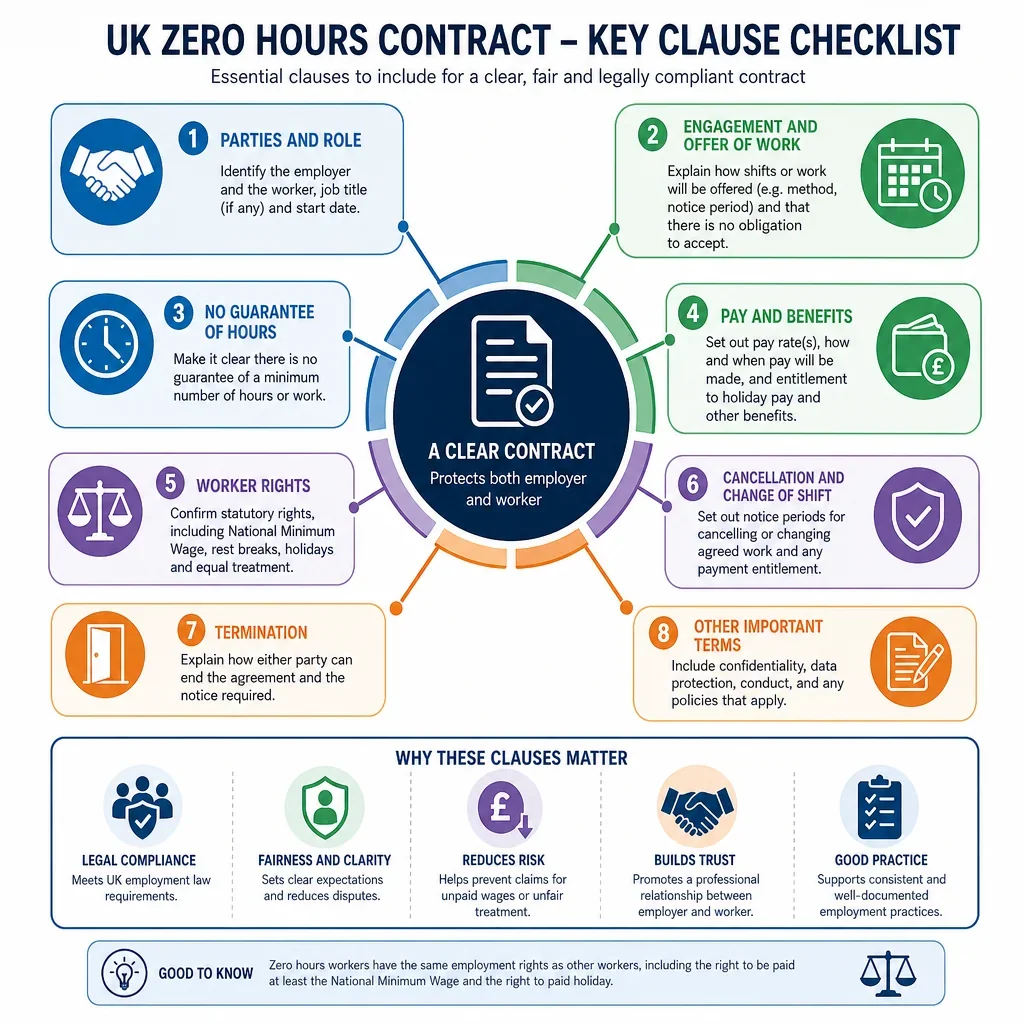
- Exclusivity clauses are generally unenforceable in zero hours contracts, and protection also extends to certain low-income workers.
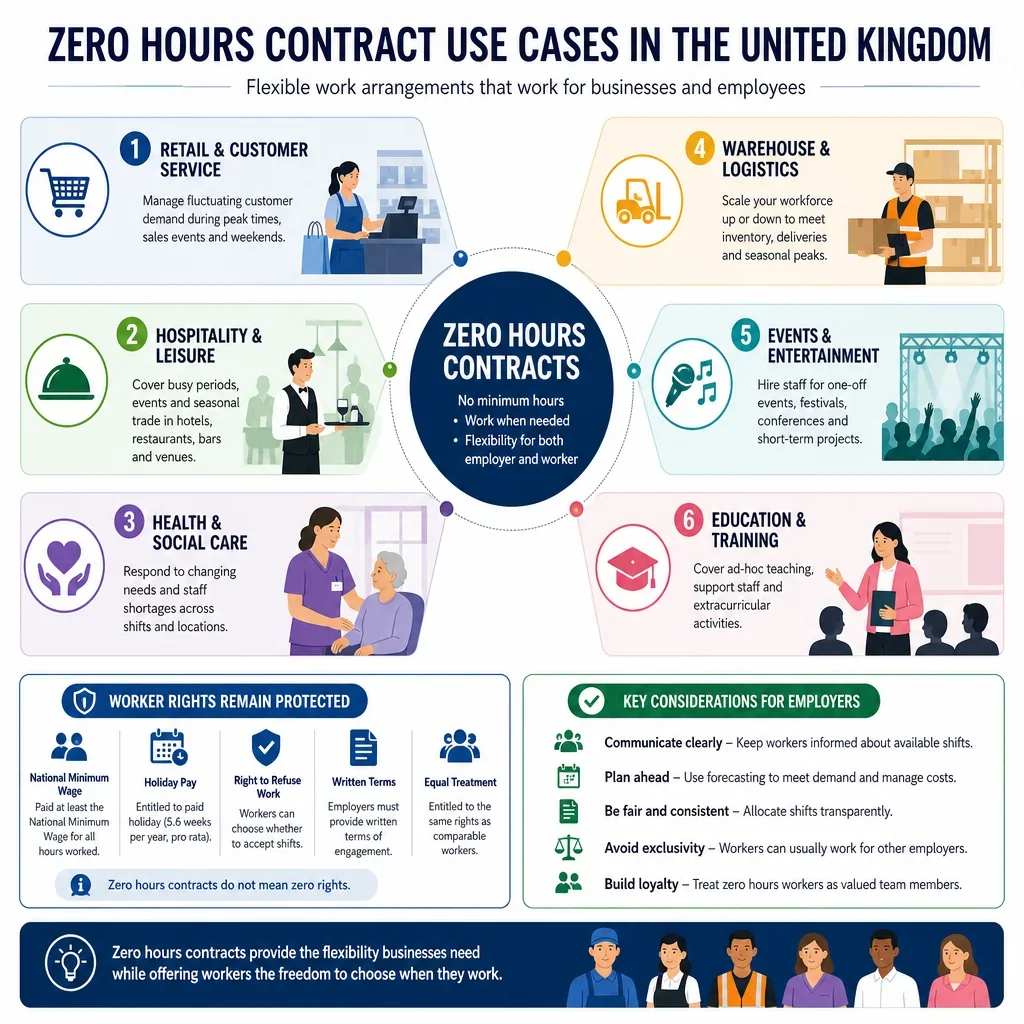
- Holiday pay, National Minimum Wage and unlawful deduction rights may apply to workers even if they are not employees.
- Substitution wording only helps self-employed status if it is genuine and practical, not just a paper clause.
- Payroll, uniforms, training, supervision and disciplinary rules can all point away from self-employment.
How Should Businesses Reduce Status Risk?
Businesses should ensure the written zero hours contract matches the reality of the arrangement. If the business controls when, where and how work is done, expects personal service, and treats individuals as part of the workforce, it should assume that statutory worker rights may arise and take advice before relying on self-employed wording.
FAQs
You Might Also Be Interested In