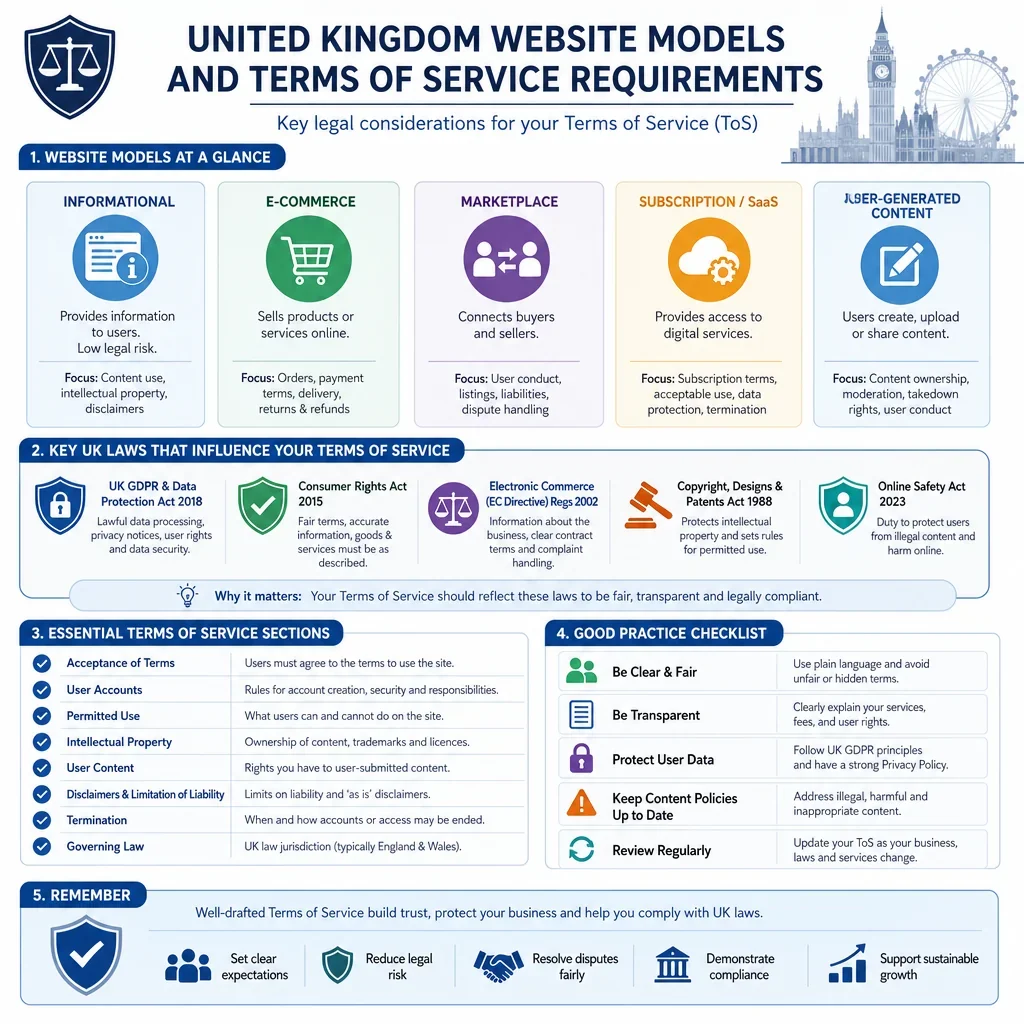
United Kingdom Website Models And Terms Of Service Requirements
Model Description | Key Terms Needed | Account Requirement | Payment Structure | UK Terms Note |
|---|---|---|---|---|
Informational website | ||||
Publishes business, professional or organisational information with no user transactions. | Website use rules, IP ownership, content accuracy disclaimer, external links, liability limits, acceptable use. | No user account | No payments | Avoid excluding liability for death, personal injury or fraud unfair exclusions may be unenforceable. |
Provides content and collects enquiries for later sales or professional services. | Enquiry disclaimers, no professional advice wording, acceptable use, content ownership, response-time limitations. | No user account | No payments | Terms should avoid accidentally forming a contract for services when a user only submits an enquiry. |
Publishes free content funded by advertising, sponsorships or affiliate links. | Advertising disclosure, affiliate disclaimer, editorial control, external-link disclaimer, IP and reuse restrictions. | No user account | Third-party payments | Affiliate and sponsored content should be identifiable as advertising where required by UK advertising rules. |
Provides legal, financial, health, technical or other specialist information. | No advice disclaimer, reliance limits, professional engagement boundary, content update caveat, liability exclusions. | No user account | No payments | Terms should distinguish general information from regulated or client-specific advice. |
Membership website | ||||
Users register to access restricted content, tools, newsletters or community features. | Account rules, password security, eligibility, suspension, acceptable use, content access changes. | Mandatory user account | No payments | Account suspension and termination clauses should be transparent and not unfair to consumers. |
Users pay recurring fees for members-only content, resources or benefits. | Subscription fees, renewal, cancellation, refunds, access restrictions, price changes, failed payments. | Mandatory user account | Recurring payments | Pre-contract information, cancellation rights and ongoing payment terms should be clear for consumer subscribers. |
Users join free but can upgrade for premium features or content. | Free and paid tier differences, upgrade terms, billing, downgrades, cancellation, feature changes. | Mandatory user account | Mixed payments | Premium feature claims should match the actual service and avoid misleading commercial practices. |
Users access course materials, lessons, certificates or learning communities after registration. | Course access, licence to materials, completion rules, certificates, refunds, tutor support limits. | Mandatory user account | Mixed payments | Digital course access may affect cancellation rights if supply begins with consumer consent. |
E-commerce website | ||||
Sells physical goods directly to customers through checkout and delivery. | Order process, pricing, delivery, title and risk, returns, cancellation, refunds, product descriptions. | Optional user account | One-off payments | Consumer buyers usually need statutory pre-contract information, cancellation rights and refund terms. |
Sells made-to-order, personalised or bespoke physical products. | Customisation approval, customer-supplied content, production times, cancellation exceptions, errors in proofs. | Optional user account | One-off payments | Personalised goods may be exempt from ordinary distance-selling cancellation rights. |
Sells goods subject to age checks, such as alcohol, knives or vaping products. | Age eligibility, verification, refused delivery, compliance duties, order cancellation, misuse restrictions. | Optional user account | One-off payments | Terms should support statutory age restrictions and explain verification and refusal processes. |
Ships recurring boxes or products under a subscription plan. | Subscription frequency, renewal, cancellation deadline, substitutions, delivery, price changes, failed payments. | Mandatory user account | Recurring payments | Auto-renewal, minimum terms and cancellation routes should be prominent and fair to consumers. |
Sells goods or supplies to business customers through online ordering. | Business-only eligibility, credit terms, delivery, retention of title, warranties, liability caps, VAT. | Optional user account | Mixed payments | Business terms can be tougher than consumer terms but statutory controls on reasonableness still matter. |
Online marketplace | ||||
Third-party sellers list goods and buyers purchase through the platform. | Seller onboarding, listing rules, commission, buyer contract party, disputes, refunds, prohibited products. | Mandatory user account | Third-party payments | Terms should state whether the operator is agent, seller of record or platform provider. |
Connects customers with independent service providers, freelancers or professionals. | Provider status, customer-provider contract, platform fees, reviews, disputes, cancellations, vetting limits. | Mandatory user account | Third-party payments | Terms should avoid implying employment, partnership or guaranteed provider quality unless intended. |
Allows users to rent assets, property, equipment or spaces from other users. | Owner and renter duties, deposits, damage, insurance, cancellations, late returns, platform liability. | Mandatory user account | Third-party payments | Terms should allocate responsibility for damage, safety checks, insurance and statutory obligations. |
Users post listings and negotiate transactions outside or partly outside the platform. | Listing rules, prohibited items, scam warnings, no transaction responsibility, moderation, reporting abuse. | Optional user account | Third-party payments | Terms should make clear the operator is not responsible for off-platform user transactions. |
SaaS platform | ||||
Provides hosted software tools accessed online through user accounts. | Software licence, user seats, uptime, support, acceptable use, data handling, suspension, liability caps. | Mandatory user account | Recurring payments | Business SaaS terms often need clear service levels, data processing roles and liability allocation. |
Offers subscription-based online software or app functionality to consumers. | Subscription terms, cancellation, digital service access, usage limits, support, account closure, refunds. | Mandatory user account | Recurring payments | Consumer SaaS terms should address digital content rights, conformity and cancellation rules. |
Provides API access for developers, integrations or automated data services. | API licence, rate limits, keys, security, prohibited scraping, uptime, changes, developer obligations. | Mandatory user account | Mixed payments | Terms should reserve rights to throttle, suspend or change APIs to protect service integrity. |
Uses AI to generate, analyse or transform user prompts, files or data. | AI output disclaimer, user input rights, prohibited use, accuracy limits, human review, IP allocation. | Mandatory user account | Mixed payments | Terms should warn that AI outputs may be inaccurate and may require professional review. |
Digital download website | ||||
Sells downloadable templates, documents, spreadsheets, graphics or other files. | Digital licence, permitted use, download access, refunds, cancellation consent, IP restrictions. | Optional user account | One-off payments | Immediate digital download can remove cancellation rights only if statutory consent and acknowledgment are obtained. |
Licences stock photos, video, music, fonts or design assets for download. | Licence scope, prohibited uses, attribution, sublicensing, model releases, copyright infringement process. | Optional user account | Mixed payments | Licence terms should clearly define commercial use, redistribution and copyright ownership. |
Sells ebooks, reports, guides or other digital publications. | Personal-use licence, access period, no sharing, refunds, device limits, content disclaimer. | Optional user account | One-off payments | Terms should cover digital content conformity and cancellation consent before instant access. |
Provides downloadable software, plugins, extensions or mobile app files. | End-user licence, installation limits, updates, compatibility, security, prohibited reverse engineering, support. | Optional user account | Mixed payments | Software terms should state licence restrictions and any limits on updates, maintenance and compatibility. |
Booking platform | ||||
Allows users to book appointments with a business or professional. | Booking confirmation, rescheduling, cancellation fees, no-shows, provider obligations, payment timing. | Optional user account | Mixed payments | Cancellation charges should reflect genuine loss and be fair under consumer law. |
Sells or reserves tickets for events, classes, webinars or workshops. | Ticket terms, event changes, cancellations, refunds, transfer restrictions, venue rules, attendee conduct. | Optional user account | One-off payments | Leisure events for a specific date may be exempt from the standard cancellation right. |
Enables reservations for accommodation, travel, tours or related services. | Booking party, supplier terms, deposits, cancellation, changes, check-in rules, traveller responsibilities. | Optional user account | Third-party payments | Package travel arrangements may trigger additional organiser obligations if services are combined. |
Lets users reserve tables, hospitality spaces or time slots. | Reservation rules, deposits, no-show fees, late arrivals, cancellation windows, special requests. | No user account | Mixed payments | Deposit and no-show terms should be shown before booking and drafted as fair consumer terms. |
Forum or community website | ||||
Users create accounts to post discussions, replies, messages or community content. | User content licence, conduct rules, moderation, reporting, suspension, prohibited content, repeat infringers. | Mandatory user account | No payments | Platforms hosting user content should define moderation powers and unlawful-content reporting routes. |
Members pay to access a private community, group, forum or networking space. | Membership fees, community rules, moderation, cancellation, refunds, access removal, confidentiality. | Mandatory user account | Recurring payments | Terms should balance moderation rights with fair treatment of paying consumer members. |
Users publish reviews, ratings, recommendations or feedback about products or services. | Review authenticity, prohibited reviews, moderation, takedown requests, user content licence, defamation risks. | Optional user account | No payments | Sites showing consumer reviews should not present fake or misleading reviews as genuine. |
Users follow creators, post content, join groups or access community features. | Creator rules, user content rights, paid access, moderation, reporting, community safety, IP complaints. | Mandatory user account | Mixed payments | Terms should address user content, creator payments, harmful content and account enforcement. |
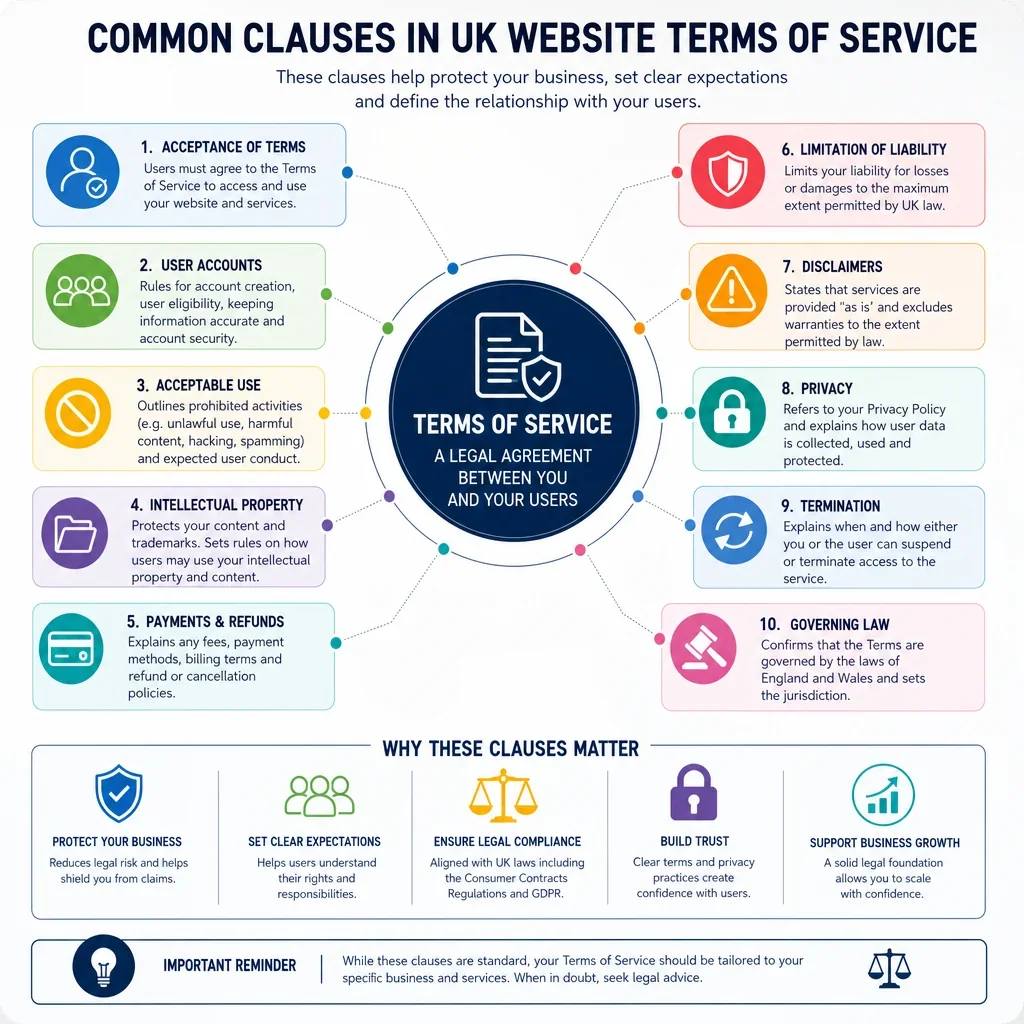
What Terms Of Service Does A UK Website Need?
Different website models need different Terms of Service. UK operators should focus on the clauses that match how users interact with the site: accounts, payments, user content, online selling, subscriptions, marketplace transactions, bookings, or software access.
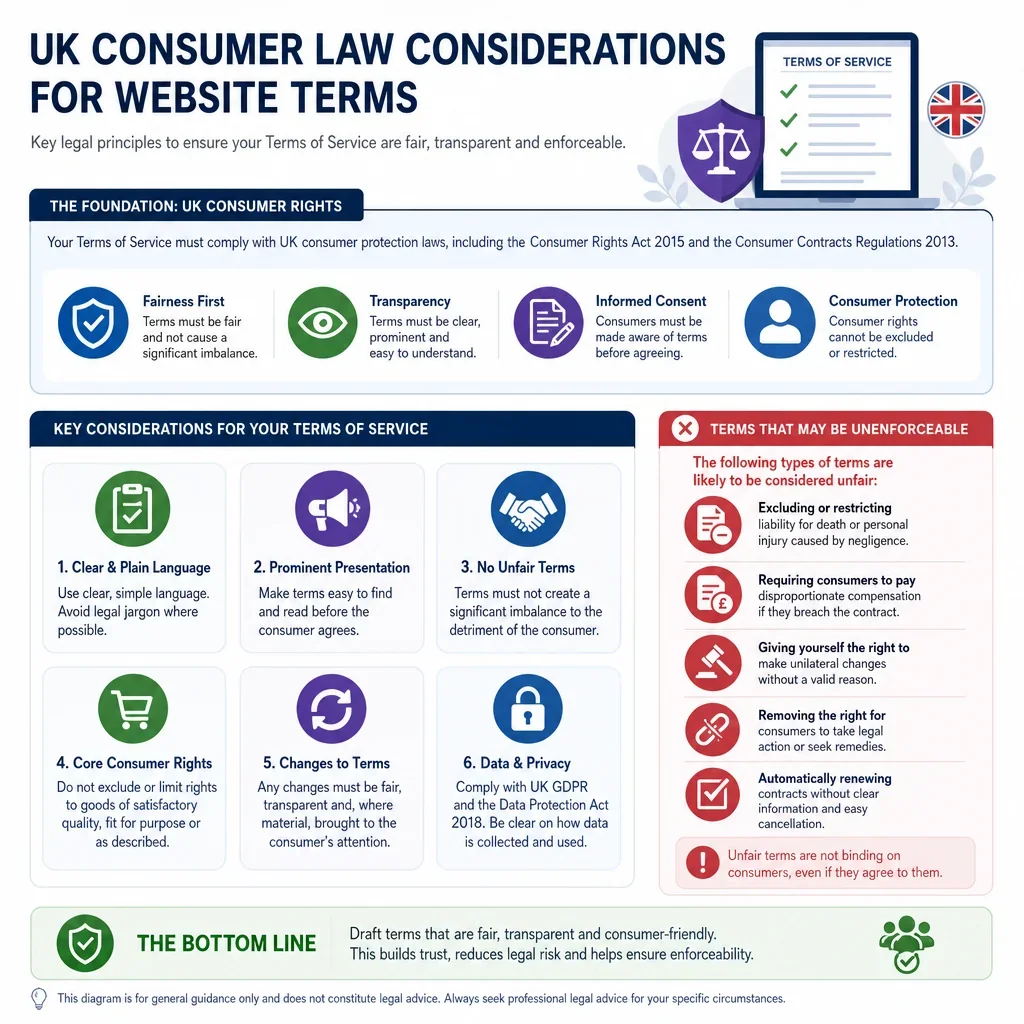
When Do Consumer Cancellation Rights Matter?
E-commerce, digital download, SaaS, booking and membership models often need clear cancellation, renewal, refund and service-start wording. UK consumer rules can require pre-contract information and cancellation rights, while digital content and booked services may need specific consent wording before supply starts.
When Are Platform Rules Especially Important?
Marketplaces, forums and community websites usually need stronger rules on user-generated content, acceptable use, moderation, account suspension, illegal content reporting and disputes between users. These sites are also more likely to need transparent policies on rankings, reviews and trader status.
When Are Payment Terms A Priority?
Recurring payment models should explain billing cycles, auto-renewal, price changes and cancellation routes. Third-party payment models should clarify whether the site operator, seller, payment processor or booking provider is responsible for the transaction.
Why Should UK Terms Match The Website Model?
A simple informational site may only need basic website-use rules, IP protection and disclaimers. By contrast, a SaaS platform or online marketplace may need detailed service availability, licence, liability, account, data, payment and user-content provisions. Using the wrong model can leave major operational and consumer-law risks uncovered.
FAQs
You Might Also Be Interested In