UK Resignation Letter Scenario Guide
Scenario Name | Recommended Tone | When To Use | Notice Consideration | Handover Requirement |
|---|---|---|---|---|
Standard notice resignation | ||||
Standard Resignation With Contractual Notice | Formal, Grateful | Use when leaving on normal terms and giving the notice required by the contract. | State the notice period and proposed final working day clearly. | true |
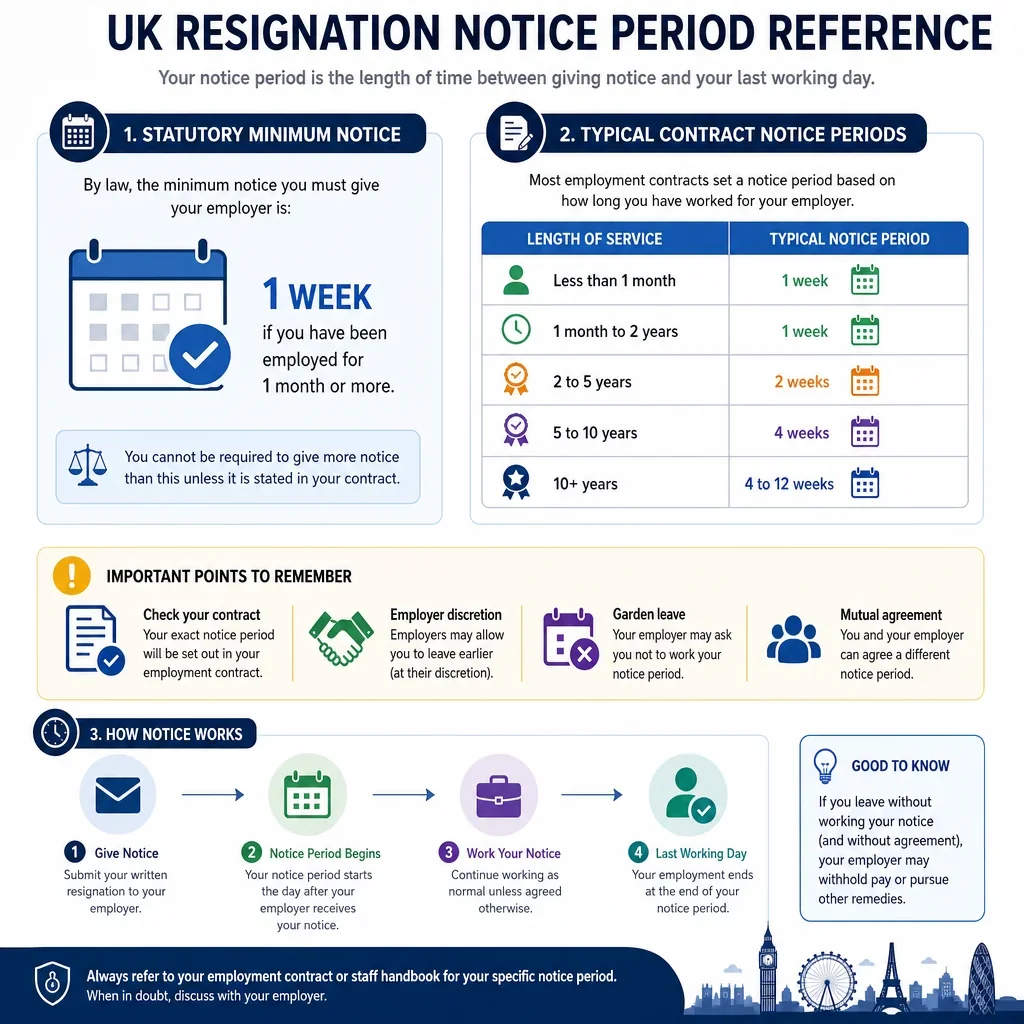
Standard Resignation With Statutory Minimum Notice | Formal, Neutral | Use where no longer contractual notice applies and the employee has worked for at least one month. | Employees normally give at least one week after one month of employment. | true |
Professional Resignation With Long Notice Period | Formal, Grateful | Use for professional, management or specialist roles with extended contractual notice. | Confirm the contractual notice period and invite agreement on transition arrangements. | true |
Resignation Before Fixed-Term Contract Ends | Formal, Neutral | Use when leaving a fixed-term role before the agreed end date. | Check whether the fixed-term contract allows early termination by notice. | true |
Part-Time Employee Resignation | Formal, Concise | Use when a part-time employee resigns under ordinary notice arrangements. | Notice usually follows the contract and should not be assumed lower because hours are part-time. | true |
Remote Worker Resignation | Formal, Concise | Use when resigning from a home-based or hybrid role. | Include practical arrangements for returning equipment and closing access. | true |
Client-Facing Role Resignation | Formal, Grateful | Use when the role involves customers, clients, accounts or external stakeholders. | Allow time for client communication, subject to employer instructions. | true |
Senior Manager Or Director Resignation | Formal, Neutral | Use for senior employees with strategic, financial or people-management responsibilities. | Check long notice, restrictive covenants, garden leave and board reporting requirements. | true |
Short notice resignation | ||||
Short Notice Resignation By Agreement | Formal, Concise | Use when asking the employer to accept less notice than the contract requires. | Request written agreement to the shorter final working day. | true |
Short Notice Resignation For Personal Reasons | Concise, Neutral | Use where urgent personal circumstances make full notice difficult. | Briefly explain the request without oversharing personal details. | true |
Short Notice Resignation Due To Caring Responsibilities | Formal, Neutral | Use where new caring responsibilities prevent working the full notice period. | Ask for early release and propose a realistic handover. | true |
Short notice resignation, Resignation due to relocation | ||||
Short Notice Resignation Due To Urgent Relocation | Formal, Concise | Use when relocation must happen before the normal notice period ends. | Request a shortened notice period and give the latest workable final date. | true |
Short notice resignation, Resignation following job offer | ||||
Short Notice Resignation After New Job Offer | Formal, Grateful | Use when a new employer wants an earlier start date. | Avoid assuming release ask the employer to agree the earlier leaving date. | true |
Immediate resignation | ||||
Immediate Resignation By Mutual Agreement | Formal, Concise | Use when both parties agree employment should end immediately. | Confirm the employer has agreed to waive or shorten notice. | true |
Immediate Resignation After Serious Workplace Issue | Formal, Neutral | Use where the employee believes serious employer conduct makes continued work impossible. | Take advice before resigning without notice because legal risks can be significant. | false |
Immediate resignation, Resignation due to health reasons | ||||
Immediate Resignation Due To Health Emergency | Concise, Neutral | Use where health circumstances prevent further attendance or notice working. | Mention inability to work notice and provide only necessary health detail. | false |
Immediate resignation | ||||
Immediate Resignation For Safety Concerns | Formal, Neutral | Use where serious safety concerns mean the employee will not continue working. | Keep the letter factual and consider separate reporting of safety issues. | false |
Retirement resignation | ||||
Planned Retirement Resignation | Warm, Grateful | Use when leaving employment to retire on a planned date. | Give enough notice for succession and pension-related administration. | true |
Retirement After Phased Working Arrangement | Warm, Grateful | Use after reducing hours or duties before full retirement. | Confirm the final date after any agreed phased arrangement. | true |
Early Retirement Resignation | Formal, Grateful | Use when retiring earlier than originally expected. | Check pension, benefits and contractual notice timing before confirming the date. | true |
Retirement resignation, Resignation due to health reasons | ||||
Ill-Health Retirement Resignation | Formal, Neutral | Use when health leads to retirement rather than a standard job move. | Coordinate the leaving date with medical, pension and employer procedures. | false |
Resignation during probation | ||||
Resignation During Probation With Notice | Concise, Neutral | Use when leaving during a probationary period and giving required notice. | Check the probation clause because notice may be shorter than after confirmation. | true |
Probation Resignation Because Role Is Not A Fit | Concise, Grateful | Use when the employee decides early that the role or culture is unsuitable. | Keep reasons brief and offer to help during the short notice period. | true |
Immediate resignation, Resignation during probation | ||||
Immediate Resignation During Probation | Concise, Neutral | Use only where immediate departure is agreed or unavoidable during probation. | Ask the employer to confirm waiver of any probation notice. | false |
Resignation after maternity or parental leave | ||||
Resignation After Maternity Leave | Formal, Grateful | Use when deciding not to return after maternity leave. | Give contractual notice and check any enhanced maternity pay repayment terms. | false |
Resignation During Maternity Leave | Formal, Concise | Use when resigning before maternity leave has ended. | Confirm whether notice will run during maternity leave and the final employment date. | false |
Resignation After Shared Parental Leave | Formal, Neutral | Use when not returning after shared parental leave. | Check contractual notice and any employer family leave repayment policy. | false |
Resignation After Adoption Leave | Formal, Neutral | Use when deciding not to return after adoption leave. | Give required notice and check any enhanced adoption pay conditions. | false |
Resignation due to relocation | ||||
Resignation Due To UK Relocation | Warm, Grateful | Use when moving to another UK area makes the role impractical. | Give normal notice and state relocation as the reason if comfortable. | true |
Resignation Due To Moving Abroad | Formal, Grateful | Use when emigrating or taking an overseas move that ends UK employment. | Allow time for payroll, equipment return and final UK employment administration. | true |
Resignation After Remote Work Request Declined | Formal, Neutral | Use when relocation is possible only if remote work is agreed and it is declined. | Refer neutrally to the agreed or declined working arrangement if needed. | true |
Resignation Due To Partner Or Family Relocation | Warm, Grateful | Use when family relocation makes continued employment impractical. | Give standard notice unless family timing requires an early release request. | true |
Resignation for career change | ||||
Resignation For Career Change | Warm, Grateful | Use when leaving to move into a different profession, sector or career path. | Normal notice is usually appropriate unless retraining dates require discussion. | true |
Resignation To Start Full-Time Study | Formal, Grateful | Use when leaving employment to begin full-time education or professional training. | Set the final date around course start dates and contractual notice. | true |
Resignation To Start Apprenticeship Or Training | Formal, Grateful | Use when leaving to start structured training, an apprenticeship or a trainee role. | Align the final working day with the new training start date where possible. | true |
Resignation To Become Self-Employed | Formal, Grateful | Use when leaving employment to freelance, consult or start a business. | Check restrictive covenants, confidentiality and conflict rules before leaving. | true |
Resignation due to health reasons | ||||
Resignation Due To Health Reasons With Notice | Formal, Neutral | Use when health affects the ability to continue but notice can still be given. | State the final date and keep medical details limited. | false |
Resignation During Long-Term Sickness Absence | Formal, Neutral | Use when resigning while signed off or absent long term for health reasons. | Clarify whether notice is worked, covered by sickness absence, or otherwise agreed. | false |
Resignation After Reasonable Adjustments Not Enough | Formal, Neutral | Use when adjustments have been explored but the role remains unsuitable for health reasons. | Avoid detailed allegations in the resignation letter unless advice has been taken. | false |
Resignation Due To Mental Health Reasons | Concise, Neutral | Use when mental health makes continuing in the role unsuitable. | Share only necessary information and request practical arrangements in writing. | false |
Resignation following job offer | ||||
Resignation After Accepting New Job Offer | Formal, Grateful | Use after accepting a new role and needing to give notice to the current employer. | Align the leaving date with contractual notice and the new start date. | true |
Resignation After Conditional Job Offer | Formal, Concise | Use only when ready to resign despite the new offer being subject to checks. | Consider waiting until conditions are satisfied before giving notice. | true |
Resignation To Join A Competitor | Formal, Neutral | Use when leaving for a competing business or similar client market. | Check confidentiality, garden leave and restrictive covenant clauses. | true |
Resignation From One Group Company After Internal Offer | Formal, Warm | Use when moving to a separate employing entity within a group or associated organisation. | Confirm whether employment is ending or transferring before resigning. | true |
Resignation following job offer, Resignation for career change | ||||
Resignation For Promotion With Another Employer | Warm, Grateful | Use when leaving for a more senior or better aligned role elsewhere. | Give full notice unless the new employer and current employer agree otherwise. | true |
What Should A UK Resignation Letter Usually Include?
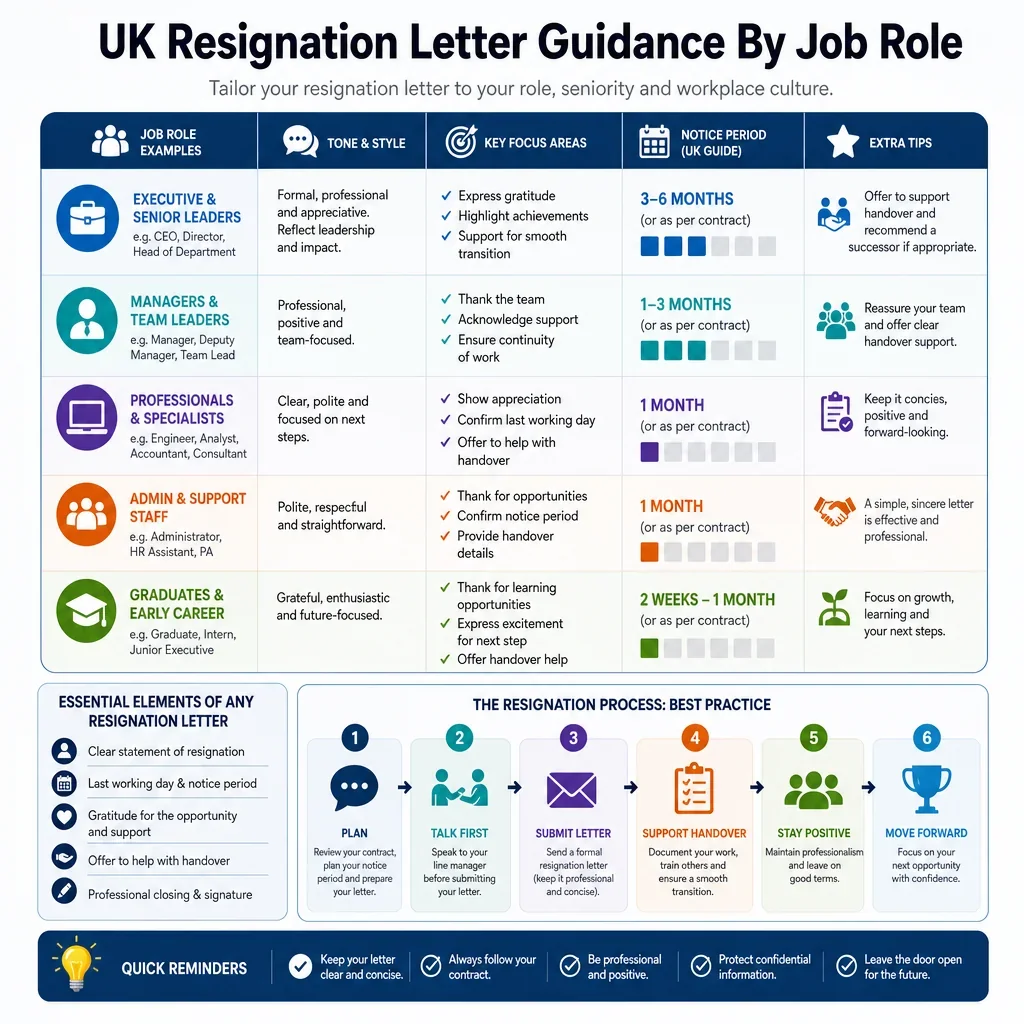
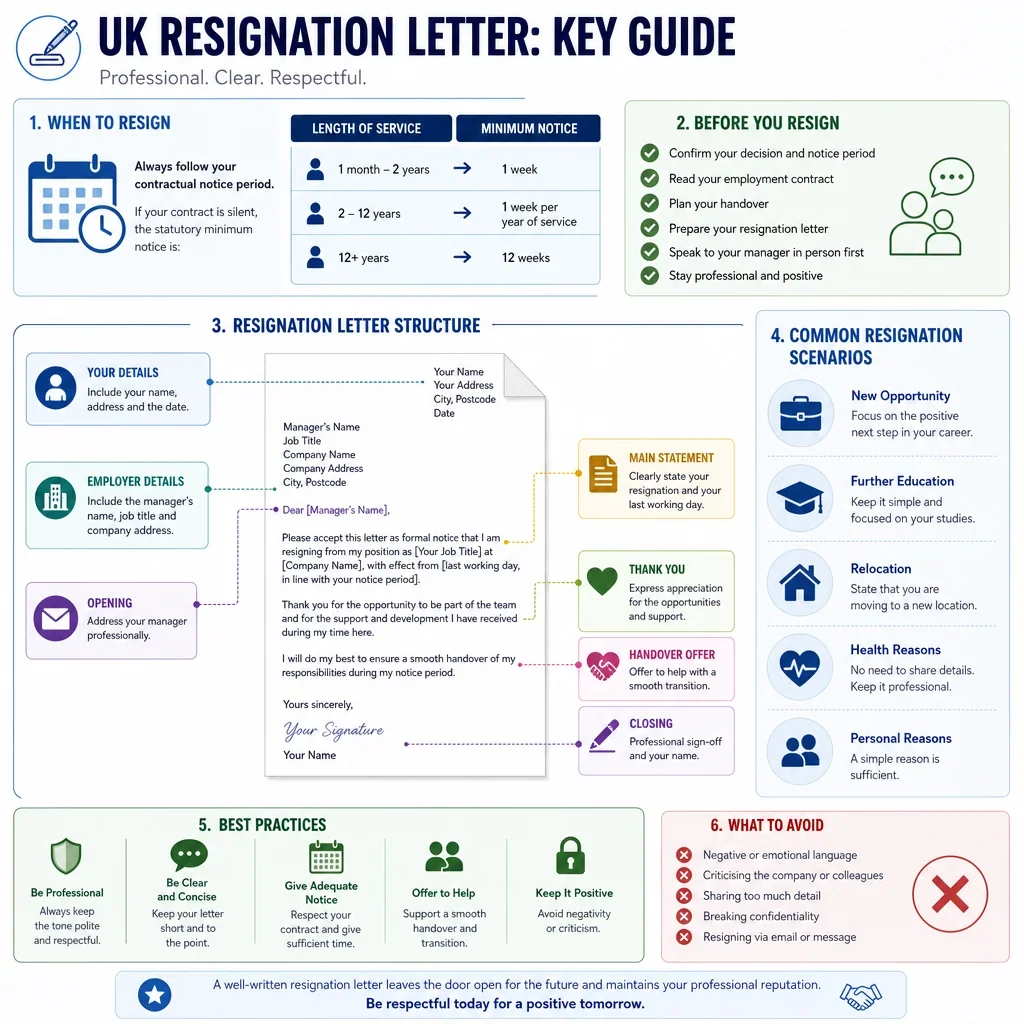
A UK resignation letter should normally state that the employee is resigning, give the intended final working day, refer to the contractual notice period where relevant, and offer a proportionate handover. For standard, career-change, relocation and new-job scenarios, the safest tone is usually formal, concise and grateful.
When Is Short Notice Or Immediate Resignation Riskier?
Short notice and immediate resignation scenarios should be used carefully because the employee may have a contractual or statutory notice obligation. UK guidance explains that employees must usually give at least one week of notice after one month of employment unless the contract requires more. Where less than contractual notice is proposed, the letter should briefly request agreement and explain the reason.
Why Does The Final Working Day Matter?
The final working day affects pay, accrued holiday, handover planning and access to systems. Stating the date clearly reduces disputes, especially where the resignation follows maternity or parental leave, probation, sickness absence, or a negotiated early release.
Which Resignation Letters Need A Handover Plan?
A handover note is especially useful for senior roles, client-facing jobs, regulated work, live projects, IT access, finance duties, healthcare, education and any role involving confidential records. Immediate or health-related resignations may require a shorter transition note instead of a full handover.
Where Can UK Employees Check Notice Rules?
Employees should check their employment contract, staff handbook and reputable UK guidance such as GOV.UK guidance on giving notice and Acas guidance on notice periods before sending a resignation letter.
FAQs
You Might Also Be Interested In