UK Freelancer Contract Clause Library
Clause name | Clause purpose | Main party affected | Typical drafting points | Risk if omitted | UK considerations |
|---|---|---|---|---|---|
Core clause | |||||
Scope Of Services | Defines exactly what the freelancer must deliver and avoids assumptions about extra work. | Both parties | Services, deliverables, exclusions, assumptions, dependencies, location, standards, and project documents. | High | Clear scope helps avoid disputes over whether extra work is chargeable. |
Deliverables | Identifies the specific outputs the client will receive from the freelancer. | Both parties | Format, quantity, file types, drafts, final versions, documentation, source files, and handover items. | High | Useful evidence if there is a later dispute about substantial performance or payment entitlement. |
Project Timetable And Milestones | Sets deadlines and key stages for delivery, review, and approval. | Both parties | Start date, milestones, delivery dates, dependencies, client review periods, and consequences of delay. | Medium | If time is critical, state whether time is of the essence to reduce uncertainty. |
Fees And Rates | States how the freelancer will be paid for the work. | Both parties | Fixed fee, day rate, hourly rate, retainer, minimum charges, rate changes, and included work. | High | Rates should state whether VAT is included or added if the freelancer is VAT registered. |
Invoicing Procedure | Explains when and how invoices are issued and what information they must contain. | Freelancer | Invoice timing, PO numbers, billing contact, supporting records, electronic invoices, and approval process. | Medium | VAT invoices must contain required details where VAT is charged. |
Payment Terms | Sets the deadline for payment and the method by which payment must be made. | Both parties | Due date, bank transfer details, currency, payment in cleared funds, disputed invoices, and set-off restrictions. | High | B2B late payment rights may apply if payment is late and no adequate contractual remedy exists. |
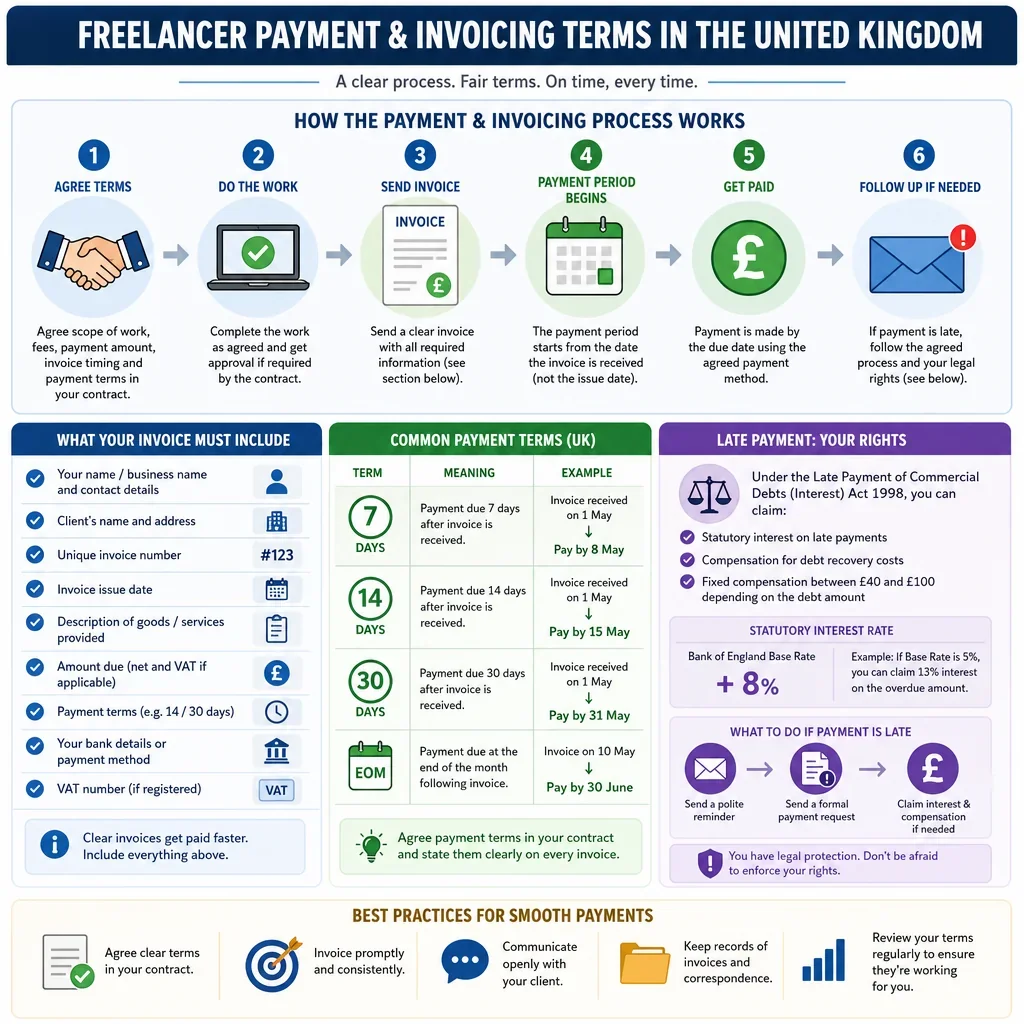
Late Payment Interest And Recovery Costs | Deters late payment and compensates the freelancer for overdue invoices. | Freelancer | Interest rate, accrual date, statutory interest, fixed compensation, reasonable recovery costs, and debt collection. | Medium | The Late Payment of Commercial Debts (Interest) Act 1998 allows statutory interest and compensation in many B2B contracts. |
Common optional clause | |||||
Deposit Or Upfront Payment | Requires money before work begins to reduce non-payment risk. | Freelancer | Deposit amount, due date, whether refundable, credit against fees, and work start condition. | Medium | For consumer clients, non-refundable payments may be scrutinised for fairness. |
Core clause | |||||
Expenses And Disbursements | States whether the client reimburses project costs incurred by the freelancer. | Both parties | Pre-approval, travel, materials, software, subcontractors, receipts, caps, mileage, and recharge timing. | Medium | VAT treatment may differ depending on whether costs are disbursements or recharged expenses. |
VAT Treatment | Clarifies whether VAT is included in or added to the freelancer's fees. | Both parties | VAT registration status, VAT-exclusive pricing, valid VAT invoices, reverse charge issues, and rate changes. | Medium | UK businesses must register for VAT if taxable turnover exceeds the registration threshold. |
Change Control | Creates a process for agreeing changes to scope, fees, or deadlines. | Both parties | Change requests, quotes, written approval, impact on fees, impact on timetable, and urgent changes. | High | Helps evidence contract variations and avoid unpaid scope creep. |
Client Responsibilities | Lists the inputs and cooperation the client must provide so the freelancer can perform. | Client | Briefs, access, approvals, materials, feedback, staff availability, legal clearances, and timely decisions. | Medium | Important where client delay affects delivery dates or the freelancer's ability to invoice. |
Freelancer Responsibilities | Sets performance obligations and basic service standards for the freelancer. | Freelancer | Skill and care, lawful performance, availability, progress updates, record keeping, and compliance with agreed policies. | Medium | Avoid wording that gives the client employee-like control unless that reflects the arrangement. |
Acceptance And Approval | Explains how deliverables are reviewed and deemed accepted. | Both parties | Review period, acceptance criteria, deemed acceptance, rejection reasons, resubmission, and minor defects. | High | Acceptance mechanics can affect when fees become payable and whether work is treated as complete. |
Common optional clause | |||||
Revisions And Amendments | Controls how many rounds of changes are included in the agreed price. | Both parties | Included revision rounds, response times, out-of-scope changes, extra fees, and final sign-off. | Medium | Commonly useful for design, copywriting, marketing, development, and creative services. |
Core clause | |||||
Intellectual Property Ownership | States who owns copyright and other rights in the work produced. | Both parties | Background IP, project IP, assignment, licence, timing of transfer, excluded materials, and further assurances. | High | Copyright assignments must generally be in writing and signed by or for the assignor. |
Common optional clause | |||||
Intellectual Property Licence | Gives permission to use IP without transferring ownership. | Both parties | Licensed materials, scope, territory, duration, exclusivity, sublicensing, modifications, and payment condition. | High | A licence can preserve freelancer ownership while giving the client operational use rights. |
Core clause | |||||
Background Materials | Protects pre-existing materials, tools, templates, code, or know-how used by either party. | Both parties | Pre-existing IP, client materials, freelancer tools, retained rights, licence back, and restrictions on reuse. | Medium | Useful because ownership of existing IP is not automatically altered by a services contract. |
Common optional clause | |||||
Moral Rights | Addresses rights such as attribution and objection to derogatory treatment of copyright works. | Freelancer | Assertion, waiver, consent to editing, credit requirements, portfolio use, and third-party publication. | Medium | UK moral rights are separate from economic copyright and may need express treatment. |
Portfolio And Publicity Use | States whether the freelancer may show the work or name the client in marketing. | Freelancer | Portfolio display, case studies, logos, social media, consent, embargoes, and confidential work. | Low | Must align with confidentiality, trade mark permissions, and data protection where personal data appears. |
Core clause | |||||
Confidentiality | Protects non-public business, technical, financial, and project information. | Both parties | Definition, permitted use, exclusions, disclosure to advisers, security, return, destruction, and survival. | High | Contractual confidentiality sits alongside equitable duties of confidence and trade secret protection. |
Data Protection | Allocates responsibilities where the freelancer handles personal data. | Both parties | Controller or processor role, processing instructions, security, breach notice, sub-processors, deletion, and audits. | High | UK GDPR requires specific processor terms where a processor processes personal data for a controller. |
Specialist clause | |||||
Data Processing Schedule | Records the detailed processing description required for personal data work. | Both parties | Subject matter, duration, nature, purpose, data types, data subjects, security measures, and deletion. | High | Usually needed if the freelancer acts as a processor under UK GDPR Article 28. |
Common optional clause | |||||
Information Security | Sets minimum security standards for systems, accounts, devices, and client data. | Freelancer | Passwords, MFA, encryption, backups, access control, malware protection, incident reporting, and device loss. | Medium | Security expectations may support UK GDPR security obligations where personal data is involved. |
Core clause | |||||
Compliance With Laws | Requires the parties to follow laws relevant to the services and project. | Both parties | Applicable laws, permits, professional rules, sanctions, anti-bribery, tax, employment, and data protection. | Medium | May need sector-specific wording for regulated UK industries or public sector clients. |
Common optional clause | |||||
Anti-Bribery And Corruption | Prevents improper payments, facilitation payments, and corrupt conduct connected with the project. | Both parties | Prohibited conduct, gifts, hospitality, reporting, audit, policies, training, and termination rights. | Medium | The Bribery Act 2010 creates UK bribery offences and corporate failure-to-prevent liability. |
Specialist clause | |||||
Modern Slavery | Requires ethical labour practices in the freelancer's supply chain where relevant. | Freelancer | No forced labour, subcontractor checks, policy compliance, audit, reporting, and termination for breach. | Low | Often requested by larger clients subject to Modern Slavery Act transparency obligations. |
Core clause | |||||
Independent Contractor Status | Confirms the freelancer is engaged as an independent business, not as an employee. | Both parties | No employment relationship, no benefits, responsibility for tax, autonomy, non-exclusivity, and own business risk. | High | Status depends on the real arrangement, including control, substitution, and mutuality of obligation. |
Common optional clause | |||||
Right Of Substitution | Allows the freelancer to provide a suitably qualified substitute where appropriate. | Freelancer | Substitute approval, qualifications, cost responsibility, supervision, liability, and genuine ability to substitute. | Medium | A genuine substitution right can be relevant to employment status and IR35 analysis. |
Control And Autonomy | Clarifies that the freelancer controls how the services are performed, subject to agreed outputs. | Freelancer | Method of work, working hours, location, client policies, supervision limits, reporting, and quality standards. | Medium | High client control may point away from genuine self-employment in UK status assessments. |
Specialist clause | |||||
IR35 And Off-Payroll Working | Allocates practical responsibilities for UK tax status where a personal service company is used. | Both parties | Status determination, information sharing, tax indemnities, substitution, working practices, and challenge process. | High | Off-payroll rules can shift status determination and PAYE responsibilities to certain clients. |
Core clause | |||||
Tax And National Insurance Responsibility | States who is responsible for income tax, National Insurance, VAT, and related filings. | Freelancer | Self-assessment, corporation tax, PAYE exclusion, VAT, indemnity, and cooperation with HMRC enquiries. | Medium | Self-employed individuals usually report income through Self Assessment, subject to their circumstances. |
Common optional clause | |||||
Equipment And Tools | Allocates responsibility for providing equipment, software, licences, and workspace. | Both parties | Own equipment, client equipment, software licences, loss, damage, return, and security requirements. | Medium | Use of own equipment can support independent contractor character, but facts remain decisive. |
Non-Exclusivity | Allows the freelancer to work for other clients during the engagement. | Freelancer | Other clients, conflicts, priority commitments, confidentiality, availability, and non-exclusive appointment. | Low | Non-exclusivity may support self-employed status if consistent with actual working practices. |
Conflicts Of Interest | Requires disclosure and management of competing duties or client conflicts. | Freelancer | Conflict disclosure, restricted competing work, consent, confidentiality separation, and termination rights. | Medium | Professional freelancers may also be subject to regulator or professional body conflict rules. |
Non-Solicitation | Restricts poaching of staff, contractors, customers, or suppliers for a limited period. | Both parties | Protected persons, restricted approaches, time limit, territory, exclusions, and remedies. | Medium | Restrictive covenants must protect a legitimate interest and go no further than reasonable. |
Specialist clause | |||||
Non-Compete Restriction | Limits competing work for a defined period where necessary to protect the client. | Freelancer | Restricted business, duration, territory, client accounts, legitimate interest, exclusions, and reasonableness. | Low | UK courts scrutinise restraint of trade clauses narrow non-solicitation is often more defensible. |
Core clause | |||||
Limitation Of Liability | Caps or excludes certain losses if something goes wrong. | Both parties | Financial cap, excluded losses, unlimited liabilities, indirect loss, insurance link, and aggregate limit. | High | Liability exclusions and caps may be subject to UCTA reasonableness rules in business contracts. |
Excluded Losses | Identifies types of loss that are not recoverable between the parties. | Both parties | Loss of profit, revenue, goodwill, data, anticipated savings, indirect loss, and consequential loss. | High | Exclusions should be clear and cannot exclude liability for death or personal injury caused by negligence. |
Common optional clause | |||||
Indemnities | Requires one party to cover specified losses suffered by the other party. | Both parties | IP infringement, data breach, tax, third-party claims, client materials, mitigation, conduct of claims, and caps. | Medium | Indemnities should be narrow, insurable, and consistent with liability caps and UCTA controls. |
Insurance | Requires the freelancer to maintain relevant insurance cover. | Freelancer | Professional indemnity, public liability, cyber cover, employer's liability, policy limits, evidence, and exclusions. | Medium | Employer's liability insurance may be legally required if the freelancer employs staff. |
Core clause | |||||
Warranties | Sets promises about quality, authority, originality, and compliance. | Both parties | Skill and care, non-infringement, authority to contract, lawful materials, no malware, and reliance limits. | Medium | Express warranties should align with any statutory implied terms that cannot be excluded unfairly. |
Reasonable Skill And Care | Sets the standard of care expected from the freelancer when performing services. | Freelancer | Professional standard, industry practice, deliverable quality, no guaranteed outcome, and client dependencies. | Medium | The Supply of Goods and Services Act 1982 implies reasonable care and skill in many B2B service contracts. |
Specialist clause | |||||
Consumer Client Rights | Addresses mandatory rights where the client is an individual consumer. | Client | Pre-contract information, cancellation rights, service standard, repeat performance, price reduction, and fair terms. | High | Consumer Rights Act 2015 and distance selling rules may apply to B2C freelancer services. |
Consumer Cancellation Rights | Explains cancellation rights for consumer contracts made online, by phone, or away from premises. | Client | Cooling-off period, start of services consent, cancellation form, payment for work done, and exceptions. | High | The Consumer Contracts Regulations 2013 can require a 14-day cancellation period for many distance contracts. |
Core clause | |||||
Termination For Convenience | Allows either or one party to end the contract without proving breach. | Both parties | Notice period, minimum term, payment for completed work, committed costs, handover, and refund rules. | Medium | If omitted, early exit may depend on breach, frustration, or implied notice arguments. |
Termination For Breach | Allows termination if a party materially breaches the contract. | Both parties | Material breach, non-payment, cure period, immediate termination, repeated breach, and notice method. | High | Express termination rights reduce uncertainty over whether breach is repudiatory at common law. |
Common optional clause | |||||
Termination For Insolvency | Allows action if a party becomes insolvent or enters formal insolvency procedures. | Both parties | Administration, liquidation, winding up, bankruptcy, moratorium, payment default, suspension, and mandatory restrictions. | Medium | Termination on insolvency may be affected by statutory restrictions for suppliers of goods or services. |
Core clause | |||||
Effects Of Termination | Sets what happens after the contract ends. | Both parties | Final invoice, work in progress, return of property, deletion of data, survival clauses, licences, and handover. | High | Important for preserving accrued payment rights and continuing confidentiality or IP obligations. |
Common optional clause | |||||
Suspension Of Services | Allows the freelancer to pause work in defined circumstances, especially non-payment. | Freelancer | Overdue invoices, notice, suspension period, reactivation fees, deadline extensions, and access withdrawal. | Medium | Should be drafted carefully to avoid the freelancer itself being in breach for stopping work. |
Force Majeure | Excuses or adjusts obligations when events beyond control prevent performance. | Both parties | Events covered, notice, mitigation, payment obligations, deadline extension, prolonged disruption, and termination. | Medium | English law does not imply a general force majeure doctrine wording matters. |
Core clause | |||||
Dispute Resolution | Sets a process for resolving disagreements before or instead of court action. | Both parties | Escalation, negotiation, mediation, expert determination, arbitration, court proceedings, and urgent relief. | Medium | English courts increasingly expect parties to consider ADR where suitable. |
Governing Law | States which legal system governs the contract. | Both parties | England and Wales, Scotland, Northern Ireland, mandatory rules, and consistency with jurisdiction clause. | High | The UK has separate legal jurisdictions specify the intended one, not just "UK law". |
Jurisdiction | States which courts can hear disputes under the contract. | Both parties | Exclusive or non-exclusive courts, England and Wales, Scotland, Northern Ireland, interim relief, and service of proceedings. | High | Match the clause to the chosen UK legal jurisdiction and any overseas party issues. |
Notices | Sets how formal notices such as termination or breach notices must be sent. | Both parties | Addresses, email notices, deemed delivery, business days, notice recipients, and proof of service. | Medium | Precise notice wording reduces arguments about whether termination or breach notices were valid. |
Entire Agreement | States that the written contract contains the full bargain between the parties. | Both parties | Superseding prior statements, reliance exclusions, fraud carve-out, schedules, order forms, and incorporated documents. | Medium | Cannot exclude liability for fraudulent misrepresentation reasonableness may matter in some contexts. |
Variation | Controls how the contract can be changed after signing. | Both parties | Written variations, authorised signatories, email approval, change orders, oral changes, and no waiver. | Medium | No oral modification clauses are generally effective but drafting should reflect practical approval methods. |
Assignment And Transfer | Controls whether rights or obligations can be transferred to another person. | Both parties | Consent, group transfers, business sale, subcontracting distinction, novation, and notice. | Medium | Obligations usually require novation rather than simple assignment if transferred to a new contracting party. |
Common optional clause | |||||
Subcontracting | States whether the freelancer may use assistants or subcontractors. | Freelancer | Client consent, responsibility for subcontractors, confidentiality, IP assignment, data processing, and payment. | Medium | If personal data is processed, sub-processor controls may be required under UK GDPR. |
Core clause | |||||
Third Party Rights | States whether people who are not parties can enforce contract terms. | Neither party specifically | Exclusion or inclusion of third-party rights, group companies, affiliates, indemnified persons, and variation without consent. | Low | The Contracts (Rights of Third Parties) Act 1999 may allow enforcement by named or described third parties. |
Severance | Preserves the rest of the contract if one provision is invalid or unenforceable. | Both parties | Invalid terms, deletion, modification, continued effect, and commercial intention. | Low | Particularly useful where restrictive covenants or liability exclusions might be challenged. |
Waiver | Prevents a delay or failure to enforce rights from automatically giving them up. | Both parties | No waiver by delay, single waiver not continuing, written waiver, and cumulative rights. | Low | Helps avoid arguments that repeated tolerance of late payment changed the parties' rights. |
Specialist clause | |||||
Audit Rights | Allows verification of compliance with defined obligations. | Freelancer | Scope, notice, frequency, records, confidentiality, costs, remediation, and regulator access. | Low | Often requested for data protection, financial services, public sector, or supply-chain compliance. |
Common optional clause | |||||
Records And Timesheets | Requires evidence of time spent, expenses, or project activity where billing depends on records. | Freelancer | Timesheet format, submission deadlines, approval, audit, retention period, and invoice matching. | Medium | Useful for day-rate engagements but should not create employee-like supervision if status is sensitive. |
Health And Safety | Allocates safety responsibilities where work occurs on site or involves physical risk. | Both parties | Site rules, risk assessments, PPE, reporting incidents, training, access, and refusal of unsafe work. | Medium | UK health and safety duties can apply to self-employed persons and clients controlling premises. |
Site Access And Client Premises | Sets conditions for working at the client's premises or controlled locations. | Both parties | Access times, security passes, conduct rules, equipment, parking, induction, removal rights, and safety rules. | Low | Site rules should be limited to necessary safety and security controls to preserve contractor autonomy. |
Remote Working | Sets expectations where the freelancer works away from client premises. | Freelancer | Location, availability windows, secure workspace, communications, equipment, data security, and travel expectations. | Low | Avoid fixed hours and management controls unless needed, as these may affect status analysis. |
Communications And Reporting | Sets practical expectations for updates and contact during the project. | Both parties | Main contacts, meeting frequency, progress reports, communication channels, response times, and escalation. | Low | Helpful for project control, but excessive supervision wording may conflict with independent contractor status. |
Specialist clause | |||||
Source Code And Development Materials | States whether the client receives source code, repositories, credentials, and build materials. | Both parties | Repository access, source files, object code, build scripts, documentation, handover, escrow, and retained tools. | High | Copyright ownership and licence terms should align with any code handover obligations. |
Open Source Software | Controls use of open-source components and licence compliance in software work. | Both parties | Permitted licences, copyleft restrictions, disclosure, approval, notices, source obligations, and software bill of materials. | Medium | Open-source terms are contractual licence conditions and can affect client commercialisation rights. |
AI Tools And Generated Content | Manages use of generative AI tools in producing freelance work. | Both parties | Permitted tools, disclosure, prompts, training use, confidentiality, personal data, ownership, human review, and infringement risk. | Medium | UK copyright, confidentiality, and data protection issues may arise when client inputs are used in AI systems. |
Marketing And Advertising Compliance | Requires marketing work to follow applicable advertising and promotion rules. | Both parties | Claims substantiation, approvals, regulated sectors, influencer disclosures, ASA codes, client responsibility, and takedowns. | Medium | UK advertising is commonly assessed against CAP and BCAP Codes enforced through ASA processes. |
Website Accessibility | Allocates responsibility for accessibility standards in digital deliverables. | Both parties | WCAG level, testing scope, client content, remediation, exclusions, public sector rules, and acceptance criteria. | Medium | Equality Act duties and public sector accessibility regulations may be relevant to UK digital projects. |
Financial Promotion Compliance | Controls work that could invite or induce investment or financial activity. | Both parties | Authorised approval, FCA rules, client sign-off, prohibited claims, records, risk warnings, and takedown. | High | FSMA section 21 restricts unauthorised financial promotions unless an exemption applies. |
Regulated Professional Services | Addresses professional rules where the freelancer provides regulated services. | Freelancer | Qualifications, authorisation, scope limits, professional standards, client responsibilities, filings, and conflicts. | High | Legal, accountancy, financial, medical, architectural, and engineering services may require regulator-specific terms. |
Export Controls And Sanctions | Prevents unlawful dealings with restricted countries, persons, software, technology, or services. | Both parties | Sanctions compliance, restricted parties, export licences, controlled technology, client warranties, reporting, and termination. | Medium | UK sanctions and export control rules can affect software, technical data, and international service delivery. |
International Data Transfers | Controls transfers of personal data outside the UK. | Both parties | Transfer countries, adequacy, IDTA, UK addendum, transfer risk assessment, sub-processors, and cloud tools. | High | UK GDPR restricts restricted transfers unless an adequacy decision or appropriate safeguard applies. |
Personal Data Breach Notification | Sets reporting duties if personal data is lost, accessed, or disclosed improperly. | Both parties | Immediate notice, details required, cooperation, ICO notification, affected individuals, remediation, and records. | High | Controllers may have to notify the ICO within 72 hours of becoming aware of certain breaches. |
Common optional clause | |||||
Data Retention And Deletion | Controls how long project data is kept and when it must be returned or deleted. | Both parties | Retention period, deletion triggers, legal hold, backups, certificates, client materials, and personal data. | Medium | UK GDPR storage limitation requires personal data not be kept longer than necessary. |
Specialist clause | |||||
Source Code Escrow | Protects the client if the freelancer cannot support critical software in future. | Client | Escrow agent, deposit materials, update frequency, release events, verification, fees, and licence on release. | Low | Most relevant for business-critical bespoke software where source code is not otherwise delivered. |
Service Levels | Sets measurable performance standards for ongoing freelance services. | Freelancer | Response times, resolution times, uptime, reporting, exclusions, service credits, and planned maintenance. | Medium | Ensure service credits are proportionate and consistent with liability caps and termination rights. |
Common optional clause | |||||
Maintenance And Support | Defines post-delivery assistance, bug fixes, updates, or support obligations. | Both parties | Support term, included fixes, paid enhancements, response times, channels, exclusions, and end-of-support. | Medium | Distinguish warranty corrections from paid ongoing support to avoid open-ended obligations. |
Training And Knowledge Transfer | Covers training sessions or handover needed for the client to use deliverables. | Both parties | Training hours, materials, attendees, recording, location, fees, documentation, and follow-up questions. | Low | If sessions are recorded, privacy notices and consent may be needed where personal data is captured. |
Core clause | |||||
Handover | Ensures an orderly transfer of materials, knowledge, and access at completion or exit. | Both parties | Handover items, timing, access credentials, documentation, transition assistance, charges, and deletion of copies. | Medium | Handover should align with IP, confidentiality, and data deletion obligations. |
Client Materials | Covers materials the client provides for the freelancer to use in the project. | Client | Licence to use, accuracy, legality, third-party rights, warranties, return, deletion, and responsibility for claims. | Medium | The client should warrant it has rights to supply logos, images, copy, data, and brand materials. |
Common optional clause | |||||
Third Party Materials | Controls use of stock assets, plugins, fonts, libraries, datasets, and external services. | Both parties | Approval, licence terms, licence holder, fees, usage limits, attribution, renewals, and replacement if withdrawn. | Medium | Third-party licences may restrict commercial use, modification, sublicensing, or client transfer. |
Specialist clause | |||||
Domain Names And Accounts | Clarifies ownership and control of domains, hosting, social accounts, and platform accounts. | Both parties | Registrant name, admin access, account ownership, credentials, payment responsibility, transfer, and recovery. | Medium | For .uk domains, Nominet rules and registrar processes may affect transfers and disputes. |
Payment Escrow | Uses a third-party escrow arrangement to reduce payment and delivery risk. | Both parties | Escrow provider, release triggers, dispute process, fees, chargebacks, milestones, and currency. | Low | Useful for new client relationships, cross-border work, or high-value deliverables. |
Common optional clause | |||||
Retainer Arrangement | Defines ongoing availability or recurring work for a periodic fee. | Both parties | Monthly fee, included hours, rollover, minimum term, availability, out-of-scope work, and termination notice. | Medium | Availability commitments should not unintentionally create mutuality of obligation inconsistent with freelance status. |
Minimum Commitment | Sets a minimum spend, hours, or project volume during the engagement. | Client | Minimum fees, unused hours, rollover, cancellation, exclusivity link, and invoicing. | Low | Consider whether guaranteed ongoing work affects employment status indicators in the real arrangement. |
Currency And Exchange Rate | States the payment currency and handles foreign exchange issues. | Both parties | GBP, foreign currency, exchange rate source, bank charges, withholding taxes, and payment shortfalls. | Low | GBP is usually appropriate for UK clients unless cross-border terms require otherwise. |
Set-Off And Deductions | Controls whether the client can deduct alleged claims from amounts owed to the freelancer. | Freelancer | No set-off, undisputed sums, lawful deductions, withholding tax, disputed invoices, and final reconciliation. | Medium | Clear wording helps prevent payment delays caused by unrelated disputes. |
IP Infringement Claims | Allocates responsibility if a deliverable allegedly infringes third-party rights. | Both parties | Indemnity, exclusions for client materials, mitigation, replacement, modification, licence procurement, and claim control. | High | Copyright, trade mark, design, database, and patent rights may be relevant depending on the work. |
Specialist clause | |||||
Database Rights | Addresses ownership and use of databases or datasets created during the project. | Both parties | Database maker, extraction rights, reuse rights, source data, licences, personal data, and assignment. | Medium | UK database rights can exist separately from copyright and should be expressly allocated. |
Core clause | |||||
Client Approvals And Sign-Off Authority | Identifies who can approve work, changes, spending, and final delivery. | Both parties | Named approvers, delegated authority, approval deadlines, deemed approval, conflicting feedback, and final sign-off. | Medium | Useful evidence that variations or deliverables were authorised by someone with apparent authority. |
Common optional clause | |||||
Performance Metrics | Defines measurable success criteria for outcome-based freelance work. | Both parties | KPIs, baseline data, measurement period, dependencies, exclusions, analytics access, and no guaranteed results. | Medium | Important for SEO, marketing, sales, consultancy, and performance-based fee arrangements. |
No Guaranteed Outcome | Clarifies that the freelancer promises services, not a specific commercial result, unless agreed. | Freelancer | No guaranteed rankings, sales, investment, approvals, traffic, profit, or legal outcome dependency carve-outs. | Medium | Should not conflict with express service standards or consumer law where the client is a consumer. |
Electronic Signatures | Allows the contract to be signed electronically and in counterparts. | Both parties | E-signing platform, counterparts, PDF signatures, authority, evidential records, and execution date. | Low | Electronic signatures are generally capable of being valid in the UK if legal formalities are met. |
Core clause | |||||
Authority To Contract | Confirms each party has power and authority to enter the agreement. | Both parties | Corporate authority, signatory authority, capacity, no conflicting obligations, and valid execution. | Low | Useful where the client is a company, charity, public body, or agent signing for another person. |
Order Of Precedence | Resolves conflicts between the contract, schedules, statements of work, proposals, and purchase orders. | Both parties | Priority ranking, exclusion of client PO terms, special terms, schedules, and statement of work hierarchy. | Medium | Important where UK clients issue purchase orders containing standard terms that may conflict. |
Common optional clause | |||||
Purchase Orders | Clarifies whether client purchase orders are administrative only or part of the contract. | Client | PO requirement, no PO no pay risk, administrative status, conflicting terms excluded, and invoice references. | Medium | Helps avoid battle-of-forms disputes over whose standard terms apply. |
Specialist clause | |||||
TUPE | Addresses employment transfer risks when services move between providers or in-house. | Both parties | Employee information, indemnities, service provision change, consultation, affected staff, and exit cooperation. | Low | TUPE can apply to service provision changes, but is less common for solo freelancer engagements. |
Common optional clause | |||||
Equality And Non-Discrimination | Requires respectful, lawful treatment and prevents discriminatory project conduct. | Both parties | Non-discrimination, harassment, reasonable adjustments, inclusive materials, reporting, and termination. | Low | The Equality Act 2010 can apply to services, employment-like relationships, and public-facing outputs. |
Specialist clause | |||||
Illegal Or Harmful Content | Allows refusal to create, host, or distribute unlawful or harmful materials. | Both parties | Unlawful content, defamatory material, hate content, IP infringement, platform rules, takedown, and termination. | Medium | Relevant for content, publishing, moderation, social media, web hosting, and advertising projects. |
Defamation And Reputation Risk | Allocates responsibility for statements that may damage reputation. | Both parties | Client factual approvals, legal review, takedown, indemnity, edits, sources, and publication responsibility. | Medium | UK defamation risk is important for copywriters, PR consultants, journalists, and social media freelancers. |
Personal Service Company Engagement | Identifies the contracting company and the individual who may perform the services. | Both parties | Supplier company, named consultant, substitution, IR35, insurance, tax, authority, and service continuity. | Medium | PSC use may bring off-payroll working rules into focus depending on client size and circumstances. |
Independent Controller Obligations | Clarifies duties where each party decides how and why it uses personal data. | Both parties | Separate controller roles, privacy notices, lawful basis, data subject rights, sharing, security, and breach cooperation. | Medium | Controller-to-controller sharing differs from processor terms and needs clear allocation of UK GDPR duties. |
Joint Controller Arrangement | Sets duties where both parties jointly determine purposes and means of processing personal data. | Both parties | Joint roles, transparency, data subject contact point, lawful basis, breach handling, records, and liability split. | High | UK GDPR Article 26 requires joint controllers to determine their respective responsibilities transparently. |
Special Category Data | Controls handling of sensitive personal data such as health, biometric, ethnicity, or political data. | Both parties | Permitted categories, lawful basis, Article 9 condition, minimisation, security, DPIA, and deletion. | High | UK GDPR imposes stricter conditions for special category data and criminal offence data. |
Subcontractor IP Assignment | Ensures IP created by assistants or subcontractors can be passed to the client or licensed properly. | Freelancer | Written assignments, moral rights waivers, confidentiality, warranties, further assurance, and chain of title. | High | Copyright assignments need signed writing, so freelancer should secure rights from contributors before transfer. |
Common optional clause | |||||
Priority And Availability | Defines agreed availability without creating excessive control over the freelancer. | Freelancer | Availability windows, response expectations, blackout dates, holidays, urgent work, and capacity reservations. | Low | Avoid employee-like fixed working patterns unless the commercial arrangement truly requires them. |
Specialist clause | |||||
Business Continuity | Sets expectations for continuity of critical freelance services during disruption. | Freelancer | Continuity plan, backups, alternate contacts, incident response, disaster recovery, and critical service priorities. | Low | Most relevant for IT, security, managed services, and operationally critical retainers. |
Common optional clause | |||||
Professional Advice Limitations | Clarifies the scope and limitations of consultancy advice. | Freelancer | Reliance limits, assumptions, no legal or tax advice unless qualified, third-party reliance, and implementation responsibility. | Medium | Important where consultancy output may be mistaken for regulated legal, financial, or tax advice. |
Core clause | |||||
No Agency Or Partnership | Confirms neither party can bind the other or create a partnership. | Both parties | No agency, no partnership, no employment, no authority to bind, and no representations on behalf of the other party. | Medium | Useful where the freelancer deals with the client's customers, suppliers, or platforms. |
Survival Of Clauses | Identifies obligations that continue after the contract ends. | Both parties | Confidentiality, IP, payment, liability, indemnities, data deletion, dispute resolution, and governing law. | Medium | Ensures post-termination obligations remain enforceable where intended. |
Common optional clause | |||||
Counterparts | Allows the parties to sign separate copies of the same contract. | Neither party specifically | Separate counterparts, single instrument, electronic copies, and execution date. | Low | Helpful for remote signing but usually procedural rather than substantive. |
What Clauses Should A UK Freelance Contract Usually Include?
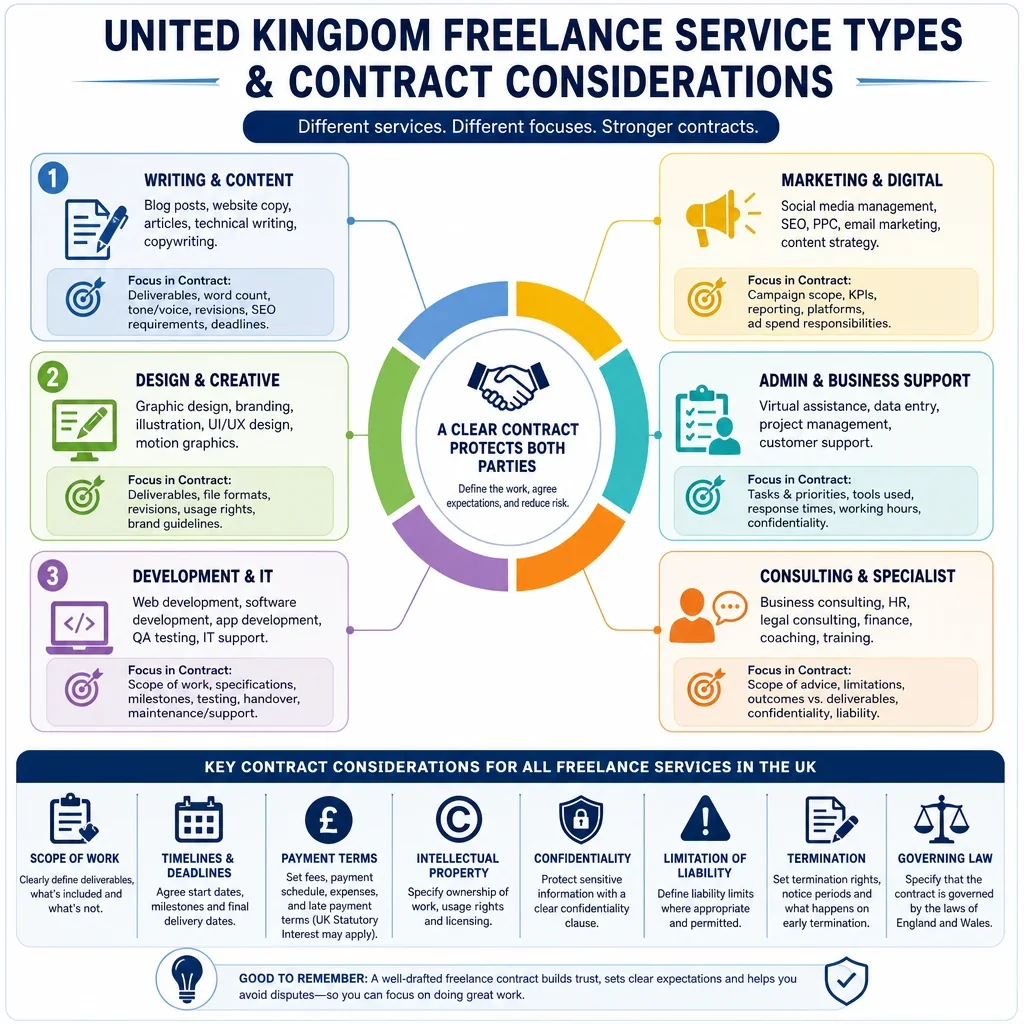
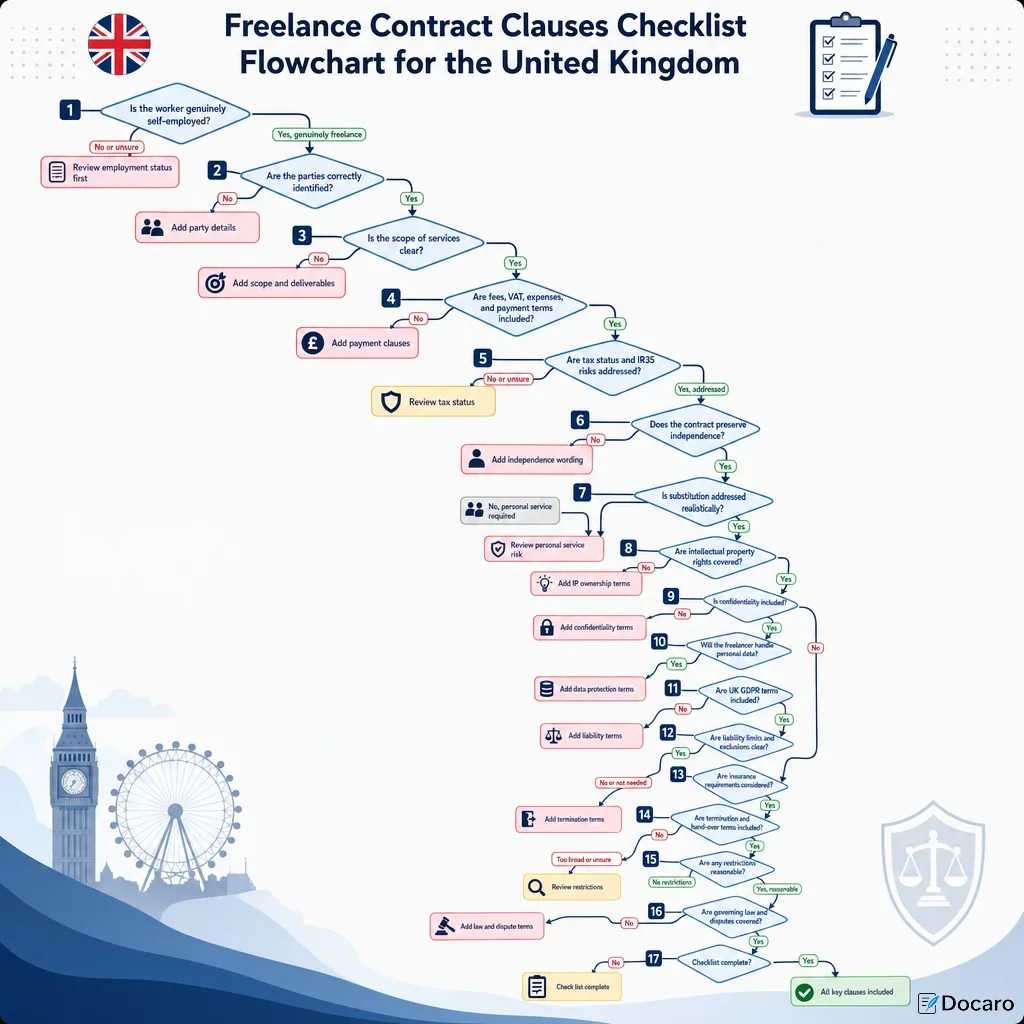
A strong UK freelance contract should normally cover scope of work, fees, payment timing, expenses, intellectual property, confidentiality, liability, termination, status, data protection, and dispute resolution. These clauses reduce the main risks in freelance arrangements: unpaid invoices, unclear deliverables, disputed ownership of work, accidental employment indicators, and exposure to uncapped claims.
Why Are Intellectual Property Clauses Especially Important For Freelancers?
Under UK law, copyright will not automatically transfer from a freelancer to a client just because the client paid for the work. A written assignment is normally needed for a legal transfer of copyright. If the contract is silent, the client may receive only an implied licence, which can be narrower than expected.
What UK Payment Rules Matter In Freelancer Contracts?
Freelancers should specify invoice dates, payment deadlines, VAT treatment, late payment interest, and debt recovery costs. For business-to-business contracts, the Late Payment of Commercial Debts (Interest) Act 1998 may apply if payment is late and no adequate contractual remedy is agreed.
How Can A Contract Help Avoid Employment Status Problems?
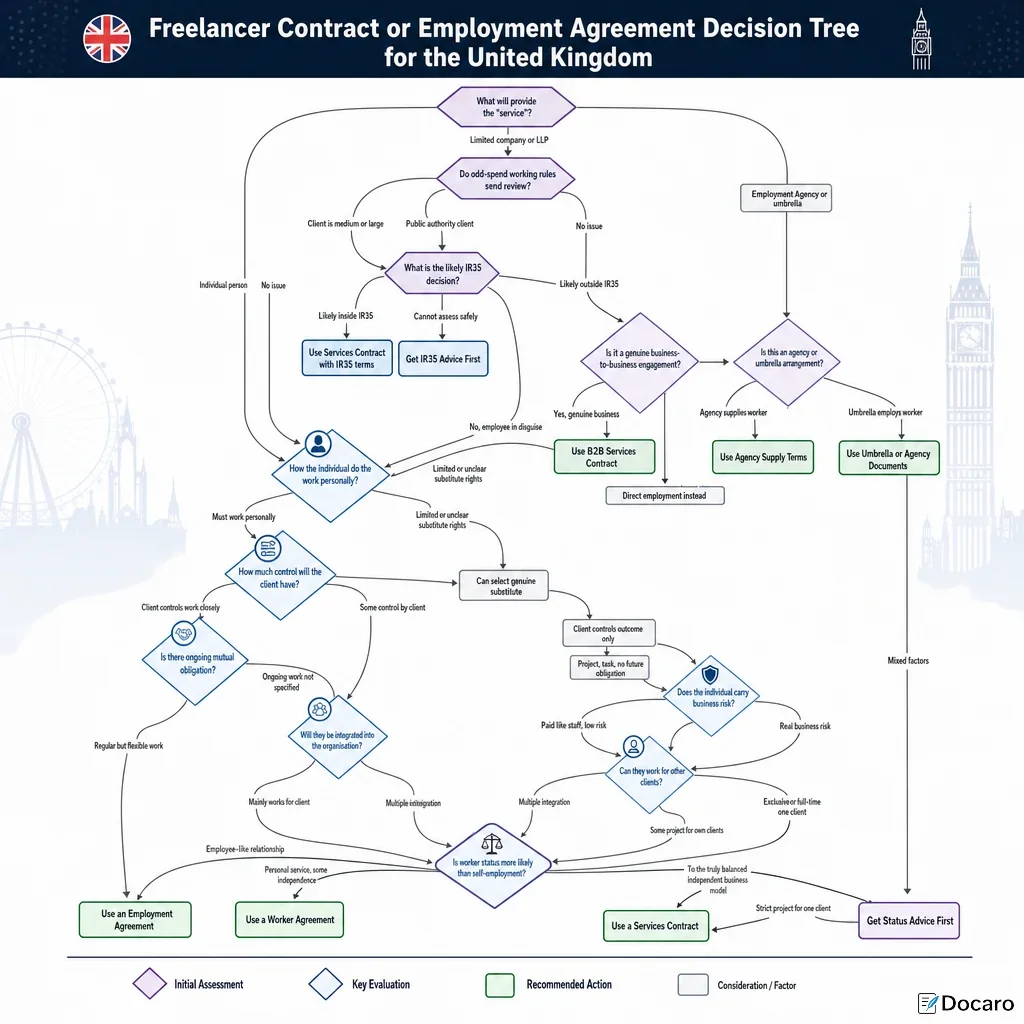
Freelance contracts should reflect the real working arrangement, not just the label used by the parties. Clauses on substitution, control, mutuality of obligation, own equipment, financial risk, and non-exclusivity can be relevant to UK employment status and tax status, including IR35 considerations for personal service companies.
When Are Specialist Clauses Needed?
Specialist clauses are useful where the project involves regulated work, personal data, AI-generated outputs, open-source software, overseas transfers, consumer end users, financial promotion, escrow, TUPE, or security-sensitive systems. These clauses should be added only where the factual arrangement justifies them.

FAQs
You Might Also Be Interested In