UK Employment Types For Offer Letters
Description | Key Offer Letter Terms | Pre-Issue Checks | Drafting Complexity | Common Pitfalls |
|---|---|---|---|---|
Permanent employee | ||||
Open-ended employment with continuing mutual obligations until terminated by notice, dismissal, resignation or agreement. | Job title, start date, salary, hours, place of work, probation, notice, holiday, benefits, conditions and governing policies. | Confirm right to work, salary approval, role details, reporting line, references, checks and any conditions of offer. | Low | Using vague conditional wording, omitting probation or notice, or promising benefits not yet approved. |
Fixed-term employee | ||||
Employee engaged for a defined period, project or event, with employment ending on the agreed trigger unless renewed. | End date or event, reason for fixed term, renewal process, early termination, notice, benefits and continuity of service. | Confirm objective reason, budget period, renewal expectations and whether the role may become permanent. | Medium | Failing to include early termination rights or implying automatic renewal without approval. |
A fixed-term employee has statutory protection against less favourable treatment because of fixed-term status. | Pro-rated benefits, comparable terms, access to vacancies, training and any justified exclusions. | Compare terms with permanent comparators and document objective justification for any difference. | Medium | Offering lower benefits solely because the contract is fixed-term without objective justification. |
Part-time employee | ||||
Employee working fewer hours than a comparable full-time worker, usually with employee rights on a pro-rated basis. | Weekly hours, work pattern, pro-rated salary, holiday, benefits, overtime, flexibility and changes to working days. | Confirm actual working pattern, pay calculation, holiday pro-rating and comparable full-time benefits. | Medium | Stating annual full-time salary without pro-rating or giving fewer benefits without justification. |
Part-time workers must not be treated less favourably than comparable full-time workers unless justified. | Equal access to pay rates, training, pension, leave, promotion and benefits, usually pro-rated where appropriate. | Check proportional treatment and record any objective justification for different terms. | Medium | Using fewer hours as a reason to deny training, pension or promotion opportunities. |
Temporary employee | ||||
Employee hired for short-term cover, seasonal demand or a limited assignment, often with an expected end point. | Expected duration, assignment purpose, notice, pay, hours, holiday, extension rights and conditions for early termination. | Confirm whether engagement is direct employment, agency work or casual work and who pays wages and holiday. | Medium | Labelling the role temporary but drafting an open-ended offer with no end mechanism. |
A temporary role may overlap with agency worker rules if supplied by an employment business to a hirer. | Identify employer, hirer, assignment, pay arrangements, holiday pay, supervision and any agency-specific documentation. | Check whether the worker is supplied through an agency and whether equal treatment rights may apply after 12 weeks. | High | Issuing a direct employee offer where the business is only the hirer, not the employer. |
Casual worker | ||||
Ad hoc work offered as needed, usually without an obligation to provide or accept future work. | No guarantee of work, right to refuse shifts, hourly pay, holiday pay, cancellation, status and assignment-by-assignment terms. | Confirm intended status, shift allocation process, holiday pay method and whether regular work creates continuity. | High | Describing the role as casual while requiring ongoing availability or acceptance of every shift. |
Casual workers may still have worker rights, including paid holiday and minimum wage protection. | Worker status, hourly rate, holiday entitlement, payment timing, deductions, rest breaks and no employment guarantee. | Confirm pay meets minimum wage and holiday entitlement is calculated using current holiday pay rules. | High | Assuming casual status removes holiday pay, minimum wage or written particulars obligations. |
Zero-hours worker | ||||
Worker or employee with no guaranteed minimum hours, offered work when available. | No guaranteed hours, shift offer process, right to decline, hourly pay, holiday, notice for shifts and status. | Confirm whether the person will be a worker or employee and whether business needs truly require no guaranteed hours. | High | Including guaranteed hours, mandatory availability or inconsistent scheduling obligations that undermine zero-hours wording. |
Zero-hours contracts cannot generally stop the worker working for another employer. | Avoid exclusivity restrictions and sanctions for taking other work, unless a lawful exception clearly applies. | Review restrictive covenants, availability clauses and conflict wording for prohibited exclusivity effects. | High | Adding a blanket ban on other jobs to a zero-hours offer letter. |
Apprentice | ||||
Employee undertaking paid work and structured training under an approved apprenticeship arrangement. | Apprenticeship standard, training provider, duration, off-the-job training, pay rate, working hours and supervision. | Confirm eligibility, funding, training plan, minimum wage rate, apprenticeship agreement and provider documents. | High | Using an ordinary employee offer without apprenticeship training obligations or agreement details. |
Certain apprenticeships require a compliant apprenticeship agreement or approved English apprenticeship agreement. | Skill, trade or occupation, apprenticeship framework or standard, training period and employment terms. | Ensure the offer aligns with the apprenticeship agreement, training plan and statutory apprenticeship requirements. | High | Failing to distinguish an apprenticeship agreement from a traditional contract of apprenticeship. |
Apprentices have specific minimum wage rules depending on age and apprenticeship year. | Hourly rate, annual salary equivalent, training hours, paid study time and rate increases when eligibility changes. | Check age, apprenticeship year, working time, training time and current National Minimum Wage rate. | High | Forgetting to increase pay when the apprentice becomes entitled to a higher minimum wage rate. |
Intern | ||||
Short-term work experience or trainee role legal status depends on the reality of work and obligations. | Status, duration, duties, supervision, pay or expenses, hours, learning aims and whether work is required. | Assess whether the intern is a worker entitled to minimum wage and paid holiday. | High | Calling the role unpaid work experience while requiring productive work and fixed hours. |
Interns who count as workers are generally entitled to National Minimum Wage. | Pay rate, expenses, hours, voluntary status, learning objectives and whether there is an obligation to perform work. | Check whether any exemption applies, such as genuine volunteering, student placement or work shadowing. | High | Relying on the label intern to avoid minimum wage where the person is doing required work. |
Permanent employee | ||||
Permanent employees must receive key written employment particulars from day one of employment. | Main terms should align with written particulars covering pay, hours, place, holiday, notice and job title. | Ensure the offer letter and employment contract do not conflict on core terms. | Low | Issuing an offer with salary, hours or location that differs from the contract particulars. |
Part-time employee | ||||
Part-time employees are entitled to statutory paid holiday calculated according to their working pattern. | Holiday entitlement in days or hours, bank holiday treatment, accrual and pro-rated annual leave. | Use a holiday calculation that fits the agreed days, hours or irregular pattern. | Medium | Giving full-time bank holiday wording that disadvantages staff who do not work Mondays. |
Zero-hours worker | ||||
Zero-hours workers are generally entitled to statutory holiday based on work done. | Holiday accrual, holiday pay calculation, request process and whether rolled-up holiday pay is used lawfully. | Check current holiday pay rules for irregular hours or part-year workers before drafting pay wording. | High | Stating that holiday is included in the hourly rate without lawful rolled-up holiday pay wording. |
Temporary employee | ||||
Seasonal temporary employment supports peak trading periods, events or holiday cover. | Season dates, expected end date, shift pattern, overtime, holiday, uniform, training and early finish rights. | Confirm peak period dates, staffing budget, minimum age requirements and right to work evidence. | Medium | Omitting what happens if the season ends early or demand falls unexpectedly. |
Intern | ||||
A student placement may be exempt from minimum wage if it is required by a UK-based course and lasts under one year. | Placement purpose, course requirement, duration, learning outcomes, supervision, expenses and no employment guarantee. | Verify course requirement, placement length and university or college documentation. | High | Assuming all students can be unpaid regardless of placement structure or duration. |
Permanent employee | ||||
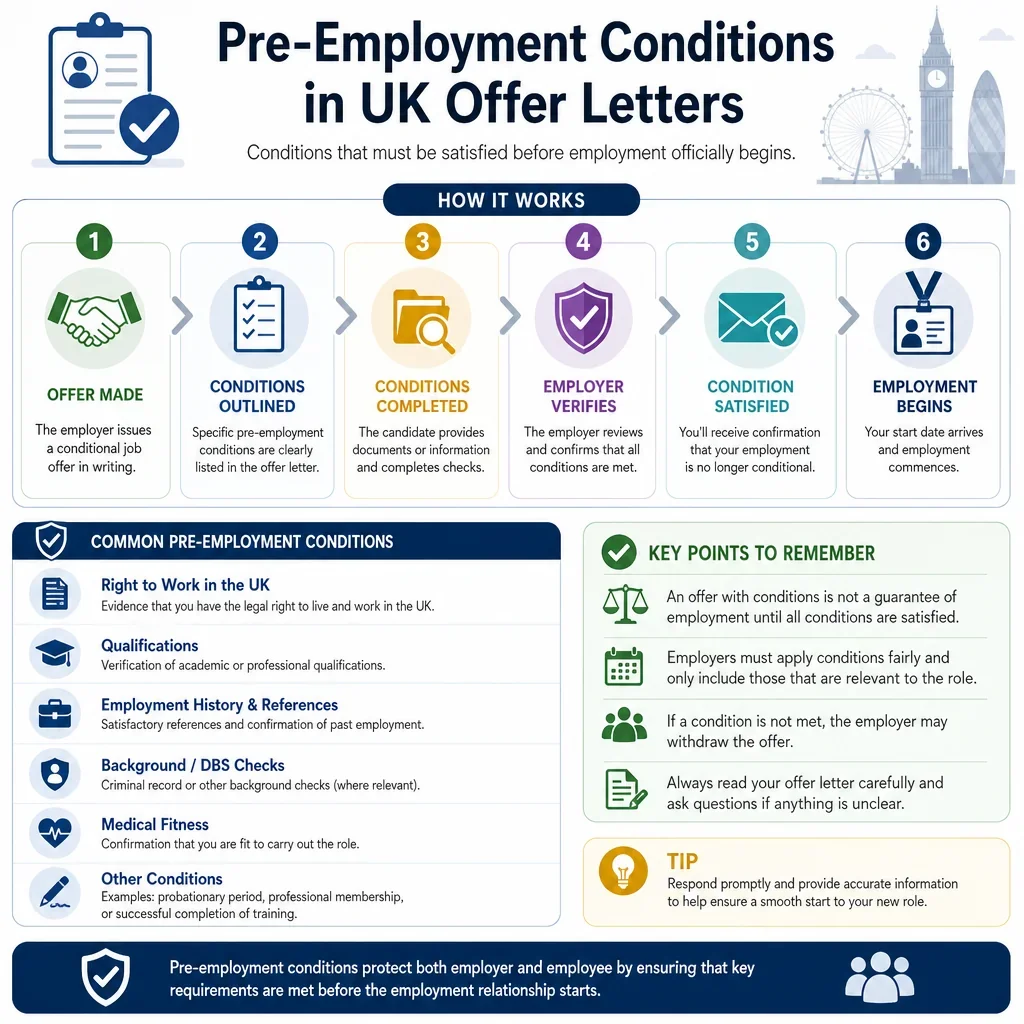
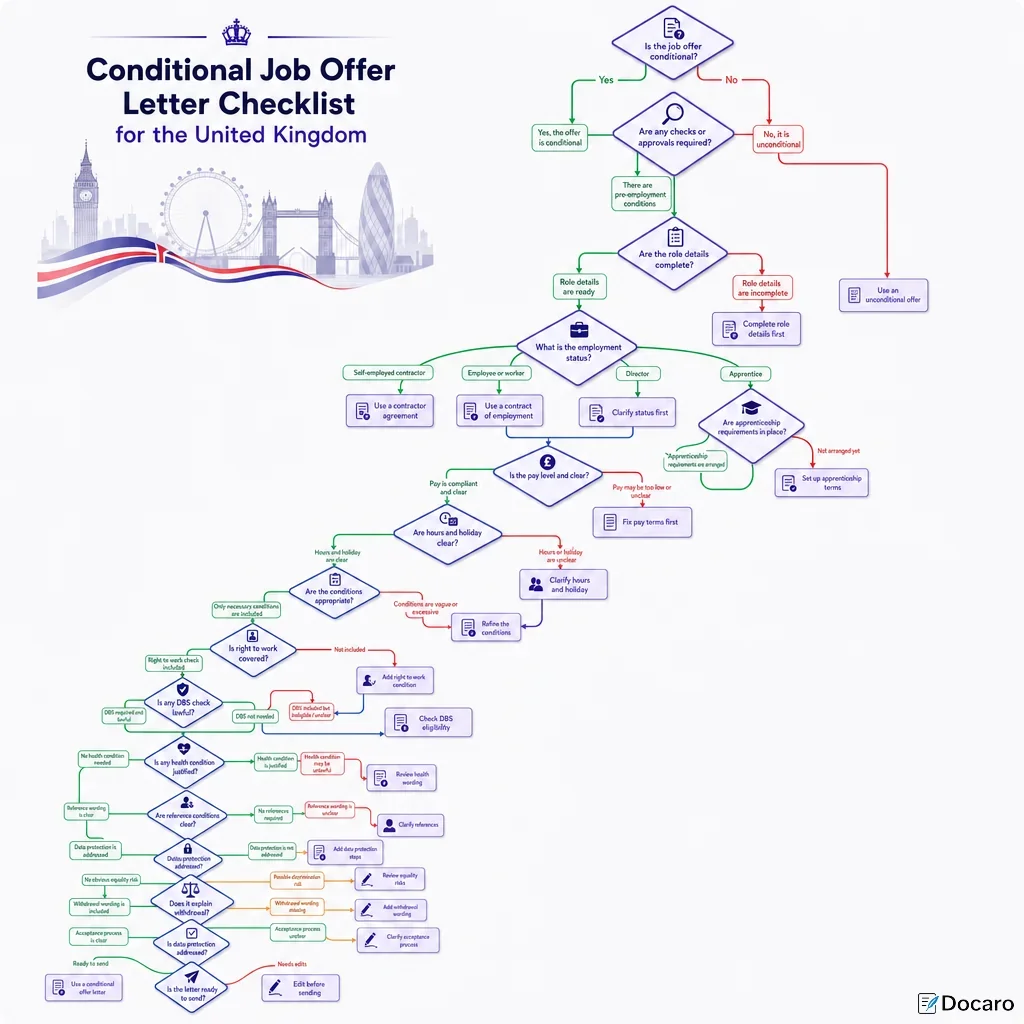
A permanent offer may be conditional on checks such as references, right to work, qualifications or screening. | Clear conditions, deadline for satisfaction, withdrawal rights and start date dependency. | Decide which checks are mandatory before employment starts and which can follow acceptance. | Low | Making the offer sound unconditional before required screening has been completed. |
Fixed-term employee | ||||
Fixed-term employment is often used for maternity, parental leave, sickness or secondment cover. | Cover reason, anticipated end date, return-of-employee trigger, notice and possibility of extension. | Confirm whether the end is date-based, event-based or whichever occurs first. | Medium | Stating a fixed end date only when the real trigger is the absent employee returning. |
Casual worker | ||||
Casual engagement suits event, hospitality or relief staffing where work is intermittent and optional. | Separate shift engagements, acceptance process, cancellation, pay after each assignment and conduct rules. | Confirm rota process, cancellation payment rules and whether repeat work creates a regular pattern. | High | Using permanent employee wording such as normal working hours and continuous employment. |
Zero-hours worker | ||||
A zero-hours arrangement can still create employee status depending on control, obligations and working reality. | Status label, no guaranteed hours, acceptance rights, control, substitution if applicable and continuity wording. | Assess actual control, personal service and mutual obligations before selecting worker or employee wording. | High | Assuming zero-hours automatically means self-employed or removes employment rights. |
Part-time employee | ||||
Part-time employment may involve fixed days, compressed hours or other flexible working arrangements. | Working days, start and finish times, flexibility limits, rota notice and process for changing hours. | Confirm operational cover, manager approval and whether the pattern results from a flexible working request. | Medium | Saying hours are flexible without defining who can vary them and on what notice. |
Apprentice | ||||
Apprenticeship arrangements can carry higher termination risk if training rights are not properly addressed. | Termination rights, misconduct, capability, redundancy, training obligations and effect on apprenticeship completion. | Confirm the contract type and whether a standard employment termination clause is suitable. | High | Assuming an apprentice can be dismissed on the same basis as any probationary employee. |
What Employment Type Should A UK Offer Letter State?
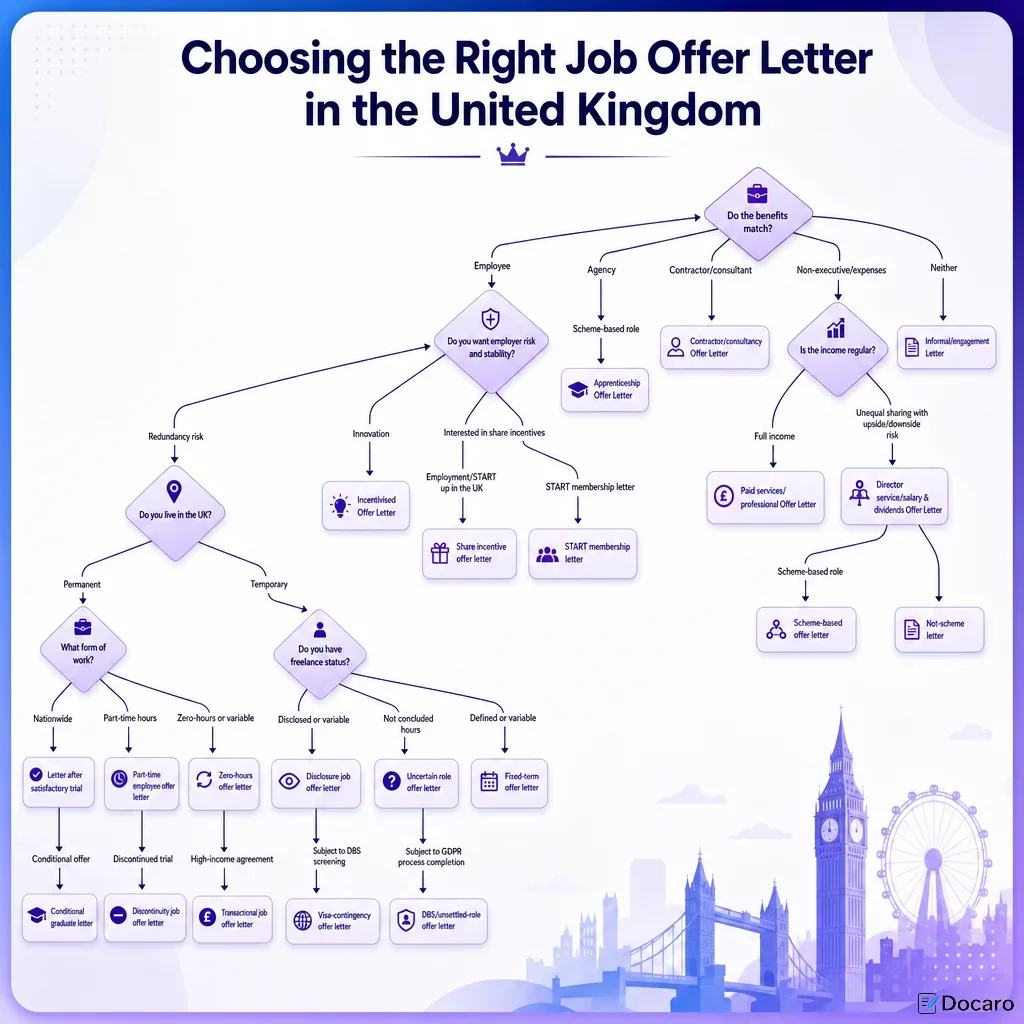
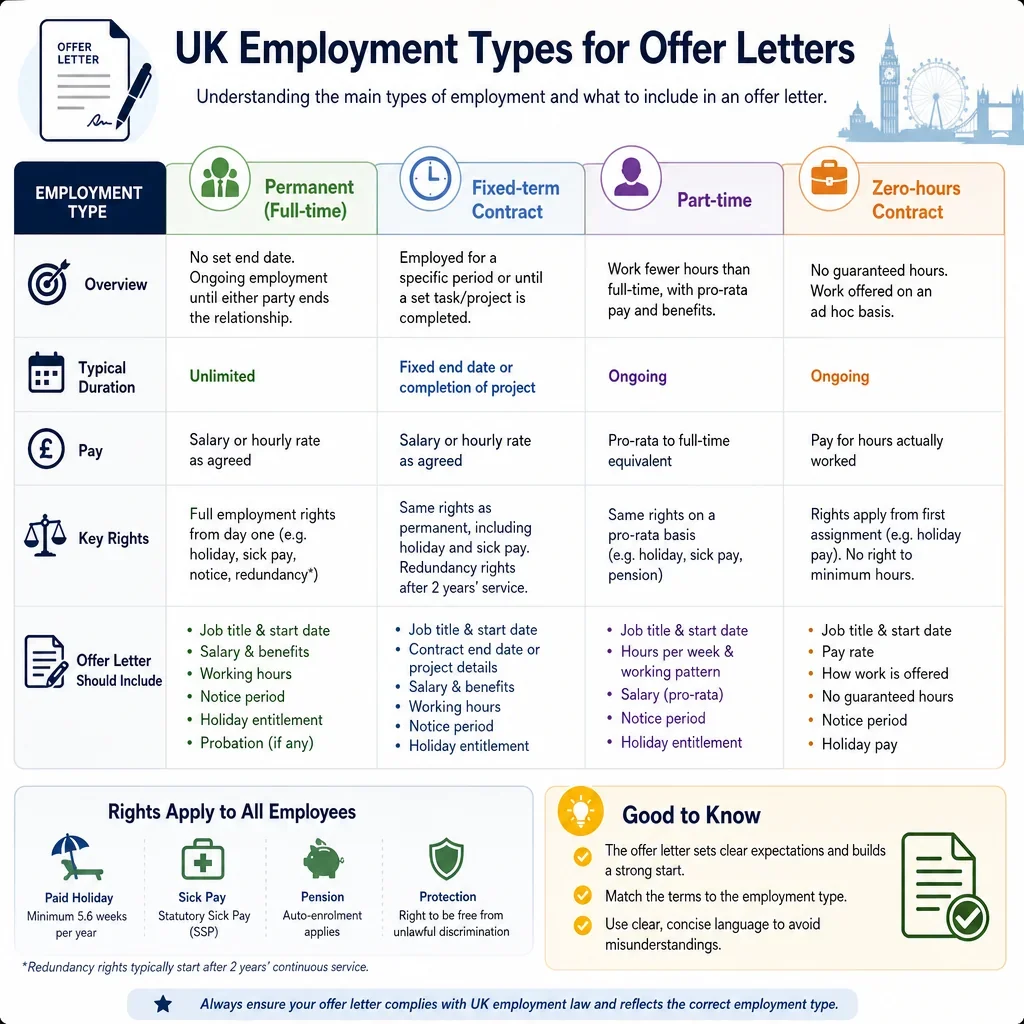
A UK offer letter should match the real working arrangement. Permanent, fixed-term, part-time and temporary employees usually need clear employee terms, while casual and zero-hours arrangements need careful wording so the letter does not accidentally promise guaranteed work. Apprentices and interns require extra checks because pay, training structure, supervision and employment status can change the legal risk.
Which Offer Letter Terms Need The Most Care?
- Fixed-term offers: state the end date, renewal position and early termination rights, and avoid treating fixed-term staff less favourably without objective justification.
- Part-time offers: state hours, work pattern and pro-rated pay and benefits, because part-time workers are protected from less favourable treatment.
- Zero-hours and casual offers: avoid exclusivity clauses that restrict other work and avoid wording that guarantees shifts if the business does not intend to do so.
- Apprentice offers: confirm the apprenticeship standard, training provider, off-the-job training and pay rules before issue.
- Intern offers: check whether the intern is a worker or employee for minimum wage and holiday purposes; calling the role an internship is not decisive.
What Checks Should Be Completed Before Issuing A UK Offer Letter?
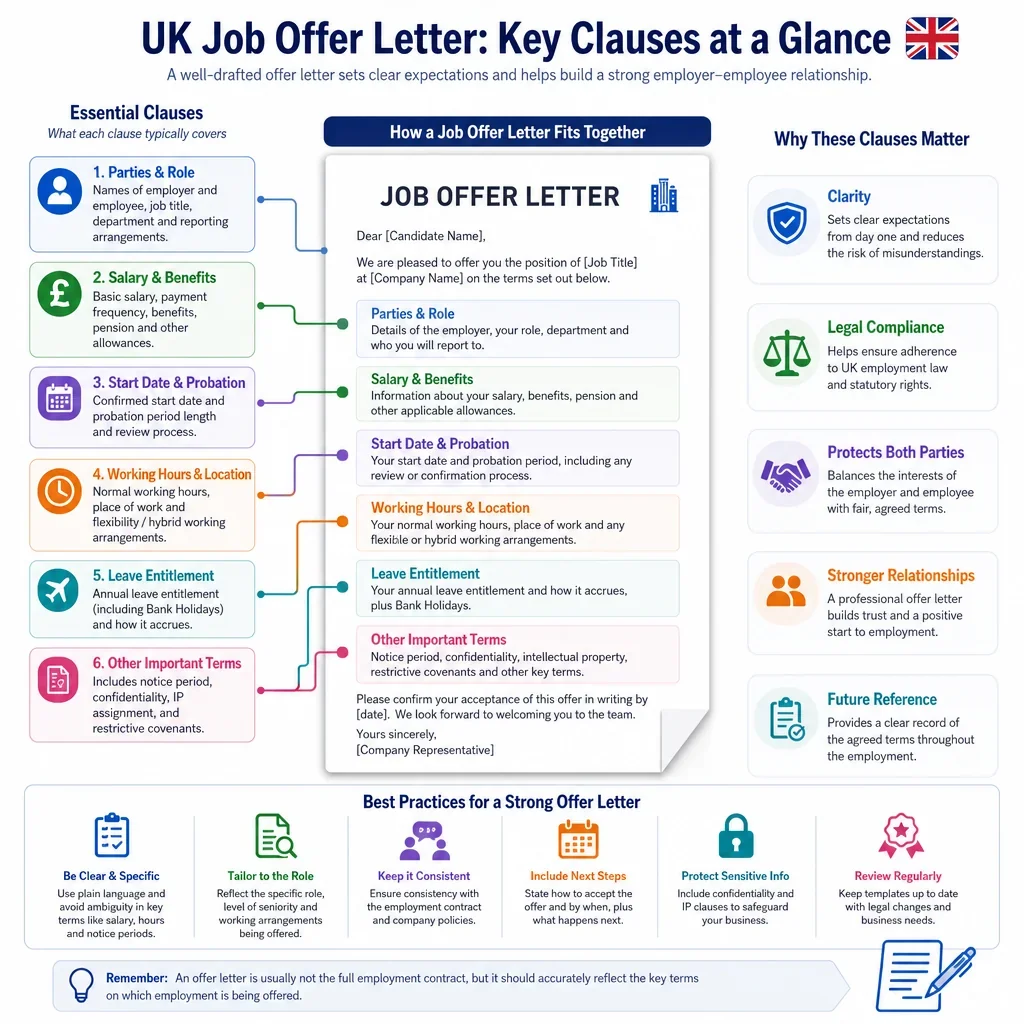
Employers should confirm right to work, salary and National Minimum Wage compliance, probation, hours, notice, holiday entitlement and any conditions such as references, qualifications, DBS checks or professional registration. Where the role has a non-standard structure, the offer letter should be adapted rather than reused from a permanent full-time template.
FAQs
You Might Also Be Interested In