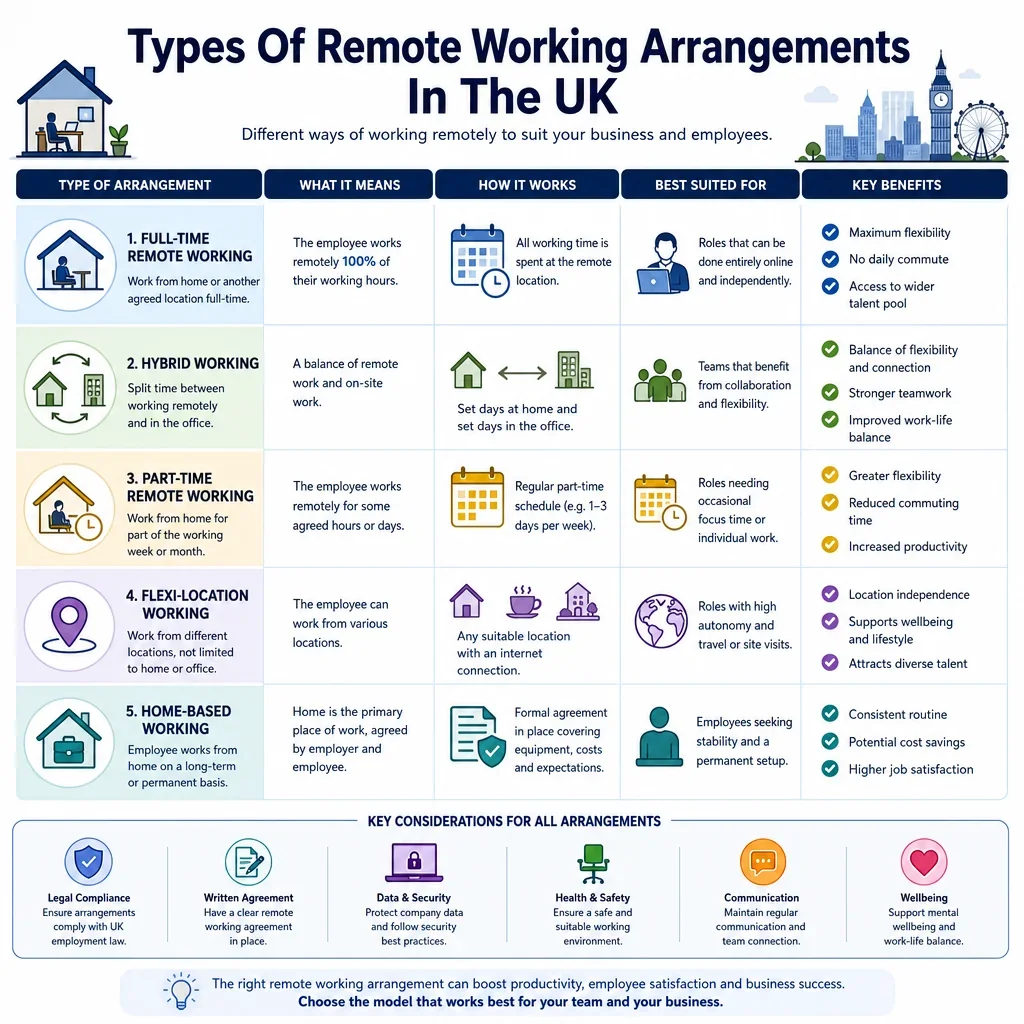
Types Of Remote Working Arrangements In The UK
Arrangement type | Description | Management oversight level | Relevant agreement provisions | Practical considerations |
|---|---|---|---|---|
Fully remote | ||||
Fully Remote Employment | The employee works away from the employer's premises on a regular or permanent basis, usually from home. | Medium | Work location, hours, availability, equipment, expenses, confidentiality, data security, health and safety, review rights. | Best suited to roles with measurable outputs, secure systems and limited need for in-person collaboration. |
Home-based | ||||
Home-Based Employment | Home is the employee's normal contractual workplace, with office attendance only when required. | Medium | Home workplace address, HSE compliance, equipment ownership, insurance, visits, expenses, confidentiality, change process. | Requires clear home workstation checks and rules on moving house or working from another address. |
Fully remote | ||||
Remote-First Working | Remote work is the default, but meetings or events may take place in person when justified. | Low | Remote default, required attendance, notice for meetings, travel expenses, communications, performance measures. | Works best where teams use asynchronous communication and attendance expectations are not arbitrary. |
Distributed Team Working | Employees work from different locations with no single shared workplace for the whole team. | Medium | Core hours, collaboration tools, time zones, information security, meeting norms, travel for team events. | Requires deliberate communication practices to avoid isolation and inconsistent access to managers. |
Hybrid | ||||
Fixed-Day Hybrid Working | The employee works remotely on set days and attends the workplace on set days each week. | High | Office days, remote days, changes to rota, attendance requirements, desk booking, commuting costs. | Useful for coordinating teams, but may require fairness checks across roles and caring responsibilities. |
Employer-Led Hybrid Rota | The employer allocates remote and workplace days to ensure cover, supervision or customer service. | High | Rota setting, notice of changes, minimum office attendance, supervision, service coverage, equal treatment. | Needs transparent criteria to reduce disputes and discrimination risks over who can work remotely. |
Employee-Choice Hybrid Working | The employee chooses remote or workplace days within agreed business limits. | Medium | Choice parameters, team days, minimum attendance, booking systems, availability, withdrawal rights. | Gives flexibility but needs rules on collaboration, supervision and avoiding empty-office inefficiency. |
Anchor-Day Hybrid Working | All team members attend the workplace on specified anchor days and work remotely on other days. | High | Anchor days, meeting attendance, remote days, exceptions, notice, equality adjustments. | Improves collaboration but may disadvantage workers with caring, disability or travel constraints. |
Minimum Office Days Hybrid Working | The employee must attend the workplace for a minimum number of days per week or month. | Medium | Minimum attendance, counting rules, approval exceptions, monitoring, consequences of non-attendance. | Avoids rigid fixed days but needs clarity on whether client visits count as office attendance. |
Alternating-Week Hybrid Working | The employee alternates between remote weeks and workplace weeks, or uses a repeating multi-week cycle. | High | Cycle pattern, notice of changes, travel, handovers, supervision, equipment portability. | Useful for project cycles but may complicate desk planning and childcare arrangements. |
Team-Based Hybrid Scheduling | Remote and office days are agreed at team level rather than individually. | High | Team rota authority, consultation, conflict resolution, minimum cover, individual exceptions. | Supports coordination but should not override individual flexible working rights without proper process. |
Hot-Desking Hybrid Working | Employees work remotely part of the time and use shared desks when attending the workplace. | Medium | Desk booking, office capacity, equipment storage, display screen assessments, hygiene, accessibility. | Requires safe workstation arrangements at both home and office, especially for DSE users. |
Occasional remote | ||||
Occasional Working From Home | The employee works from home occasionally, usually with manager approval for specific days. | Low | Approval process, permitted tasks, availability, equipment, confidentiality, expenses, refusal grounds. | Often suitable for focused tasks, appointments or disruption days, but not a substitute for childcare. |
Ad Hoc Remote Working | Remote work is permitted case by case for short-term needs rather than a regular pattern. | Medium | Request route, approval authority, notice, suitability factors, data security, review. | Clear approval criteria help avoid inconsistent treatment and informal privilege. |
Temporary remote | ||||
Emergency Remote Working | The employee works remotely temporarily because the workplace or commute is disrupted. | High | Trigger events, communication chain, expected duties, temporary duration, equipment, security, return process. | Useful for severe weather, transport disruption, building closure or public health events. |
Trial Remote Working | A remote or hybrid pattern is tested for a defined period before any permanent decision. | Medium | Trial length, success criteria, review date, reversibility, performance data, consultation. | Can help assess whether a flexible working request is workable before changing the contract permanently. |
Temporary Reasonable-Adjustment Homeworking | A disabled employee works remotely temporarily to remove or reduce workplace disadvantage. | Medium | Adjustment purpose, duration, review, equipment, occupational health input, confidentiality, return plan. | Employers must consider reasonable adjustments where disability places a worker at substantial disadvantage. |
Home-based | ||||
Permanent Reasonable-Adjustment Homeworking | Remote work becomes a long-term adjustment for a disabled employee where appropriate and reasonable. | Medium | Adjustment terms, review, equipment, communications, office attendance exceptions, confidentiality, health and safety. | A blanket return-to-office policy may create disability discrimination risk if adjustments are not assessed individually. |
Temporary remote | ||||
Phased Return Remote Working | Remote work is used during a gradual return after sickness absence or other long absence. | Medium | Return timetable, duties, reduced hours, review points, medical advice, pay position, support. | Should be aligned with fit notes, occupational health advice and any disability-related adjustments. |
Pregnancy Or Maternity Risk Homeworking | Homeworking is used where workplace risks for a pregnant worker or new mother need to be controlled. | Medium | Risk assessment, duration, duties, equipment, communication, review, return or alternative work. | If risks cannot be avoided, employers may need to alter conditions, offer suitable alternative work or suspend on pay. |
Hybrid | ||||
Carer-Friendly Hybrid Working | Hybrid work is arranged to help an employee balance work with caring responsibilities. | Medium | Home days, core hours, emergency contactability, meeting times, review, dependency leave interaction. | May be requested as flexible working employers should handle requests reasonably and avoid indirect discrimination. |
School-Run Hybrid Working | Remote or office days are arranged around school drop-off or pick-up constraints. | Medium | Core hours, availability gaps, meeting scheduling, output expectations, review, childcare boundaries. | Needs explicit availability rules so flexibility does not create uncertainty over working time. |
Flexible location | ||||
Compressed-Hours Remote Working | The employee works full-time hours over fewer days, with some or all work done remotely. | High | Daily hours, non-working day, breaks, overtime, availability, workload, review, wellbeing safeguards. | Must account for working time limits, rest breaks and fatigue risk during longer remote days. |
Flexitime Remote Working | The employee works remotely with variable start and finish times around agreed core hours. | Medium | Core hours, bandwidth, time recording, carry-over rules, breaks, contactability, approval. | Requires reliable time recording and boundaries to avoid hidden overtime or missed rest periods. |
Hybrid | ||||
Staggered-Hours Hybrid Working | The employee has different start, finish or break times and works remotely on some days. | Medium | Start and finish times, remote days, cover requirements, handovers, breaks, review. | Useful for commuting peaks and caring duties, but needs handover rules for customer-facing teams. |
Flexible location | ||||
Annualised-Hours Remote Working | The employee works a set annual total, with remote work used during agreed periods or peaks. | High | Annual hours, scheduling, peak periods, remote eligibility, pay, holiday, time records. | Needs robust recording to manage holiday, pay, working time and workload across uneven periods. |
Part-Time Remote Working | The employee works reduced hours, with those hours performed partly or wholly remotely. | Medium | Days and hours, remote location, pro-rated pay, holidays, availability, workload, review. | Workload should be adjusted so reduced hours do not become unpaid additional work. |
Remote Job Share | Two people share one role, with one or both working remotely for some or all hours. | High | Split duties, handovers, overlap time, remote days, accountability, pay, absence cover. | Needs excellent handover and accountability rules, especially where both job sharers work remotely. |
Term-Time Remote Working | The employee works during school term times, with remote work used for all or part of the pattern. | High | Working weeks, school holiday absences, pay calculation, holiday entitlement, remote days, review. | Requires careful pay and holiday calculations because work is concentrated in parts of the year. |
Fully remote | ||||
Remote Working With Core Hours | The employee works remotely but must be available during specified daily core hours. | Medium | Core hours, flexible hours, response times, meetings, breaks, time recording, overtime approval. | Balances flexibility with operational coverage and reduces disputes about contactability. |
Asynchronous Remote Working | The employee has limited live meeting requirements and works mainly to agreed outputs and deadlines. | Low | Deliverables, deadlines, response times, record keeping, escalation, working time compliance. | Useful across time zones or deep-work roles but can weaken supervision if outputs are unclear. |
Output-Based Remote Working | Performance is managed mainly by deliverables rather than close monitoring of time online. | Low | Objectives, quality standards, deadlines, reporting, review meetings, availability, confidentiality. | Reduces micromanagement risk but requires objective performance metrics and fair workload allocation. |
Home-based | ||||
Remote Contact-Centre Working | Customer calls, chats or support tasks are handled from home or another remote location. | High | Call monitoring, scripts, data security, quiet workspace, equipment, shifts, breaks, performance metrics. | Needs strong privacy controls where customer personal data or payment information is handled at home. |
Flexible location | ||||
Remote Sales Working | Sales staff work remotely for prospecting, meetings and administration, with travel as required. | Medium | Territory, targets, CRM use, travel, expenses, confidentiality, customer data, availability. | Requires clear expense, travel time and data handling rules for off-site customer work. |
Hybrid | ||||
Client-Site Hybrid Working | The employee divides time between home, the employer's workplace and client premises. | High | Permitted sites, client rules, travel, expenses, confidentiality, health and safety, reporting lines. | Must coordinate employer duties with client-site rules and protect confidential information across locations. |
Flexible location | ||||
Co-Working Space Remote Working | The employee works remotely from an approved shared office or co-working space. | Medium | Approved locations, security standards, confidentiality, public Wi-Fi, expenses, insurance, workspace safety. | Public or shared environments need privacy screens, secure networks and rules on confidential calls. |
Work From Anywhere Within The UK | The employee may work from different UK locations, subject to approval and business needs. | Medium | Permitted UK locations, notice, risk assessment, data security, insurance, tax address, availability. | Employer should know the actual work location for safety, tax, insurance and data security purposes. |
Domestic Digital Nomad Working | The employee works from changing locations within the UK rather than one fixed home office. | Medium | Location notification, unsuitable locations, secure connectivity, equipment care, working time, emergency contact. | Portable working can make workstation safety and confidentiality harder to manage consistently. |
Overseas Remote Working | The employee works outside the UK for a temporary or continuing period while employed by a UK employer. | High | Prior approval, country limits, duration, tax, social security, immigration, data transfers, insurance, recall. | Can trigger tax, payroll, immigration, employment law, health and safety and data transfer issues. |
Temporary remote | ||||
Short-Term Overseas Remote Working | The employee works abroad briefly, often before or after annual leave, with prior approval. | High | Maximum days, approved country, working hours, equipment, data transfer, tax, insurance, recall. | Even short overseas periods should be approved because local immigration, tax and data rules may apply. |
Hybrid | ||||
Satellite-Office Hybrid Working | The employee alternates between remote work and a smaller regional office rather than headquarters. | Medium | Assigned office, attendance, travel to headquarters, expenses, local supervision, health and safety. | Clarifies whether travel to headquarters is ordinary commuting or reimbursable business travel. |
Hub-And-Spoke Working | Employees use a central hub, local workspaces and home working depending on task needs. | Medium | Permitted locations, booking, travel, data security, workspace standards, attendance expectations. | Needs clear rules on which locations are authorised and who pays for travel between them. |
Temporary remote | ||||
Remote Internship Or Trainee Working | A trainee, apprentice or intern performs work remotely with structured supervision and learning support. | High | Supervision, training schedule, mentor contact, safeguarding, equipment, confidentiality, performance feedback. | Junior workers usually need more frequent contact, training and wellbeing checks than experienced remote staff. |
Hybrid | ||||
Remote Apprenticeship Working | An apprentice works remotely for some duties while completing required training and supervision. | High | Training plan, off-the-job training, supervision, equipment, attendance, safeguarding, progress reviews. | Must still satisfy apprenticeship training and supervision requirements remote work should not undermine learning. |
Home-based | ||||
Remote Night-Shift Working | The employee performs night work from home or another approved remote location. | High | Night hours, health assessment, lone-working checks, breaks, security, escalation, equipment. | Night work rules and health assessment duties still apply when the night work is done remotely. |
Occasional remote | ||||
Remote On-Call Working | The employee remains available remotely to respond to incidents outside normal working hours. | High | On-call rota, response times, pay, time off in lieu, rest periods, equipment, escalation. | Needs careful working time and rest management where on-call restrictions limit personal freedom. |
Home-based | ||||
Remote Out-Of-Hours Support | The employee provides support remotely outside ordinary business hours on scheduled shifts. | High | Shift times, breaks, monitoring, escalation, security, overtime, rest periods, lone-working procedures. | Employers should monitor fatigue and ensure legally required rest is not eroded by remote availability. |
Flexible location | ||||
Mobile Working | The employee works from multiple locations while travelling, visiting sites or performing field duties. | High | Travel, lone working, equipment, vehicle use, check-ins, expenses, data security, risk assessments. | Lone working, driving, personal safety and secure device use are central risks. |
Home-based | ||||
Field-Based Home Start And Finish | The employee starts and ends the working day at home before travelling to sites or customers. | Medium | Home base, travel time, mileage, expenses, scheduling, equipment storage, reporting. | Travel and expense treatment should be distinguished from ordinary commuting where home is a base. |
Flexible location | ||||
Split-Day Remote Working | The employee splits the day into separate remote working blocks with a longer unpaid break between. | Medium | Working blocks, unpaid break, availability, meetings, time recording, rest breaks, overtime. | Useful for caring commitments but needs accurate recording of work, breaks and availability. |
Hybrid | ||||
Nine-Day Fortnight Hybrid Working | The employee works full-time hours over nine days each fortnight, with remote work on agreed days. | High | Fortnightly hours, non-working day, remote days, cover, overtime, rest, holiday calculation. | Longer days require workload planning and compliance with rest and working time rules. |
Flexible location | ||||
Four-Day Week Remote Working | The employee works a four-day week, with remote work used for some or all working days. | High | Working days, hours, pay, holiday, workload, availability, customer cover, review. | The agreement should state whether pay and hours are reduced or hours are compressed. |
Second-Home Remote Working | The employee works from a second UK home or regular alternative private address. | Medium | Approved addresses, risk assessment, equipment, insurance, confidentiality, travel to office, notice of changes. | Employers should approve and assess each regular work address, not just the main home. |
Temporary remote | ||||
Office Refurbishment Remote Working | Employees work remotely temporarily while the workplace is unavailable or unsafe due to works. | Medium | Temporary duration, expected return, equipment, communication, expenses, health and safety, review. | Should specify whether the arrangement is temporary and does not permanently vary workplace terms. |
Occasional remote | ||||
Transport Disruption Remote Working | The employee works remotely when strikes, severe delays or travel disruption prevent attendance. | Medium | Trigger conditions, notification, approval, duties, availability, equipment, pay if unable to work. | Helps maintain productivity but needs clarity where the employee lacks suitable home equipment. |
Severe-Weather Remote Working | The employee works from home when weather makes travel unsafe or impractical. | Medium | Weather triggers, notification, work allocation, availability, equipment, pay and leave alternatives. | Useful for business continuity, particularly where schools and transport are affected differently by region. |
Temporary remote | ||||
Health Protection Remote Working | Remote work is used temporarily to reduce workplace health risks or comply with public health measures. | High | Trigger events, risk controls, duration, equipment, communication, return process, policy precedence. | Employers should document the temporary basis and revisit arrangements as public health guidance changes. |
Fully remote | ||||
Remote-Only Contractor Working | A self-employed contractor provides services remotely rather than attending the client's premises. | Low | Services, deliverables, substitution, control, confidentiality, data processing, equipment, fees, IP ownership. | Remote working does not decide employment status control, mutuality and integration still matter. |
Occasional remote | ||||
Casual Remote Working | A casual worker performs accepted assignments remotely when offered and agreed. | Medium | Assignment acceptance, pay, hours, equipment, confidentiality, data security, holiday pay, cancellation. | Worker rights such as holiday pay and national minimum wage may still apply to remote assignments. |
Zero-Hours Remote Working | Remote work is offered without guaranteed hours, and the individual accepts shifts or tasks when available. | High | No guaranteed hours, shift offers, acceptance, pay, holiday, equipment, data security, exclusivity limits. | Exclusivity clauses in zero-hours contracts are restricted remote status does not remove worker protections. |
Temporary remote | ||||
Remote Unpaid Internship Or Volunteering | A person carries out remote activities without pay, usually for experience, charity or voluntary purposes. | Medium | Volunteer status, expenses, no employment intent, confidentiality, supervision, safeguarding, IP, data protection. | If the person is a worker, national minimum wage may be due even if work is remote. |
Home-based | ||||
Secure-Room Homeworking | The employee works from a private home workspace with enhanced confidentiality and security controls. | High | Private room, locked storage, device encryption, paper handling, visitor restrictions, audits, breach reporting. | Appropriate for sensitive legal, HR, financial or health data handled outside the office. |
Flexible location | ||||
BYOD Remote Working | The employee uses a personal device for remote work under employer-approved controls. | High | Device standards, monitoring, security software, remote wipe, acceptable use, reimbursement, data deletion. | Needs careful privacy and data security terms because personal and work data may mix. |
Home-based | ||||
Employer-Provided Equipment Homeworking | The employer supplies the equipment needed for the employee to work remotely. | Medium | Equipment list, ownership, maintenance, permitted use, return, damage, insurance, ergonomic setup. | Inventory and return clauses reduce disputes when employment ends or the remote arrangement changes. |
Fully remote | ||||
Monitored Remote Working | The employer uses proportionate digital monitoring to manage remote attendance, security or productivity. | High | Monitoring purpose, data collected, transparency, retention, access, proportionality, privacy impact assessment. | Monitoring must be transparent, necessary and proportionate under UK data protection law. |
Home-based | ||||
Paper-File Homeworking | The employee takes or stores paper documents at home or another approved remote location. | High | Authorised documents, transport, locked storage, copying, disposal, loss reporting, audit rights. | Paper files increase breach risk and need strict storage, transport and secure destruction procedures. |
Temporary remote | ||||
Family Emergency Overseas Remote Working | The employee temporarily works from another country to deal with urgent family circumstances. | High | Approval, country, duration, hours, tax, immigration, data transfer, equipment, wellbeing, recall. | Compassionate approval should still check immigration, tax residence, payroll and data transfer implications. |
Occasional remote | ||||
Public-Place Remote Working | The employee works from cafés, trains, hotels or other public places where permitted. | High | Permitted tasks, confidential calls, screen privacy, Wi-Fi rules, device security, document handling. | Should be restricted for sensitive work because shoulder-surfing, overheard calls and insecure networks create risk. |
Flexible location | ||||
Time-Zone Remote Working | The employee works remotely across time zones while serving UK or international teams. | High | Applicable time zone, core overlap, meeting limits, rest periods, overtime, public holidays, payroll location. | Protect rest periods and avoid routine late-night meetings that effectively create night work. |
Hybrid | ||||
Periodic Office Week Remote Working | The employee is normally remote but attends the workplace for scheduled full weeks each quarter or month. | Medium | Office week frequency, notice, travel, accommodation, meetings, training, exceptions, expenses. | Useful for remote hires far from the office, but travel cost responsibility must be clear. |
Remote Working With Mandatory In-Person Training | The employee works remotely but must attend the workplace or training venue for specified training. | Medium | Training attendance, notice, travel expenses, certification, remote alternatives, disciplinary consequences. | Attendance expectations should be stated upfront, especially for remote recruits living far away. |
Temporary remote | ||||
Remote Probation Working | A new employee works remotely during probation with structured check-ins and performance review. | High | Probation goals, supervision, check-ins, equipment, training, office attendance, extension or withdrawal. | Remote starters need planned onboarding, evidence-based assessment and prompt support if performance issues arise. |
Home-based | ||||
Contractual Homeworking Benefit | The employment contract gives the employee an express right to work from home on agreed terms. | Medium | Contractual status, variation process, withdrawal limits, home address, attendance exceptions, expenses. | If homeworking is contractual, changing it usually requires agreement or a lawful variation process. |
Occasional remote | ||||
Discretionary Homeworking Policy | Homeworking is allowed under a non-contractual policy and may be changed by the employer. | Medium | Discretionary status, approval, review, withdrawal, eligibility, compliance with policies. | Even discretionary policies should be applied consistently and not in a discriminatory way. |
Hybrid | ||||
Remote Working After Office Relocation | Remote or hybrid work is agreed because the employer's workplace has moved farther away. | Medium | New base, home days, travel expectations, expenses, redundancy interaction, review, contract variation. | May form part of consultation over relocation, mobility clauses or potential redundancy alternatives. |
Home-based | ||||
Remote Working As Redundancy Alternative | Remote working is offered to avoid dismissal where the workplace closes or the role changes location. | Medium | Alternative role terms, home base, trial period, pay, equipment, expenses, redundancy rights. | Should be documented clearly as suitable alternative employment or a trial arrangement where relevant. |
Flexible location | ||||
Statutory Flexible Working Remote Arrangement | An employee requests remote, hybrid or flexible-location work using the statutory flexible working process. | Medium | Request outcome, agreed pattern, start date, trial, review, contractual variation, appeal outcome. | Eligible employees can request flexible working from day one, and employers must handle requests reasonably. |
Temporary remote | ||||
Flexible Working Trial Remote Arrangement | A proposed remote arrangement is trialled before the employer decides on a flexible working request. | Medium | Trial dates, review criteria, temporary status, feedback, extension, final decision, reversion. | A trial can provide evidence for whether remote working causes one of the permitted business problems. |
Workcation Remote Working | The employee works remotely from a holiday location for a limited period, often around annual leave. | High | Location approval, duration, hours, holiday separation, tax, immigration, insurance, data security. | The agreement should distinguish working days from holiday and require approval before overseas work. |
Flexible location | ||||
Overseas Remote Working With Local Holidays | The employee works abroad and needs clarity on UK and local public holiday treatment. | High | Holiday calendar, annual leave booking, time zone, payroll, local law, availability, emergency cover. | UK statutory holiday entitlement applies to UK employees, but overseas local rules may also matter. |
Fully remote | ||||
Remote-First Recruitment Arrangement | A role is advertised and hired on the basis that remote work is the normal arrangement. | Medium | Contractual workplace, equipment, attendance expectations, travel costs, onboarding, performance management. | Job adverts and contracts should align so candidates know whether office attendance can be required. |
Hybrid | ||||
Hybrid Role With Office Radius | The employee works hybrid but must live close enough to attend the workplace when required. | Medium | Attendance radius, office days, notice, relocation duty, travel costs, exceptions, review. | Location requirements should be objectively justified and consistently applied to avoid unfairness. |
What Should A UK Remote Work Agreement Cover?
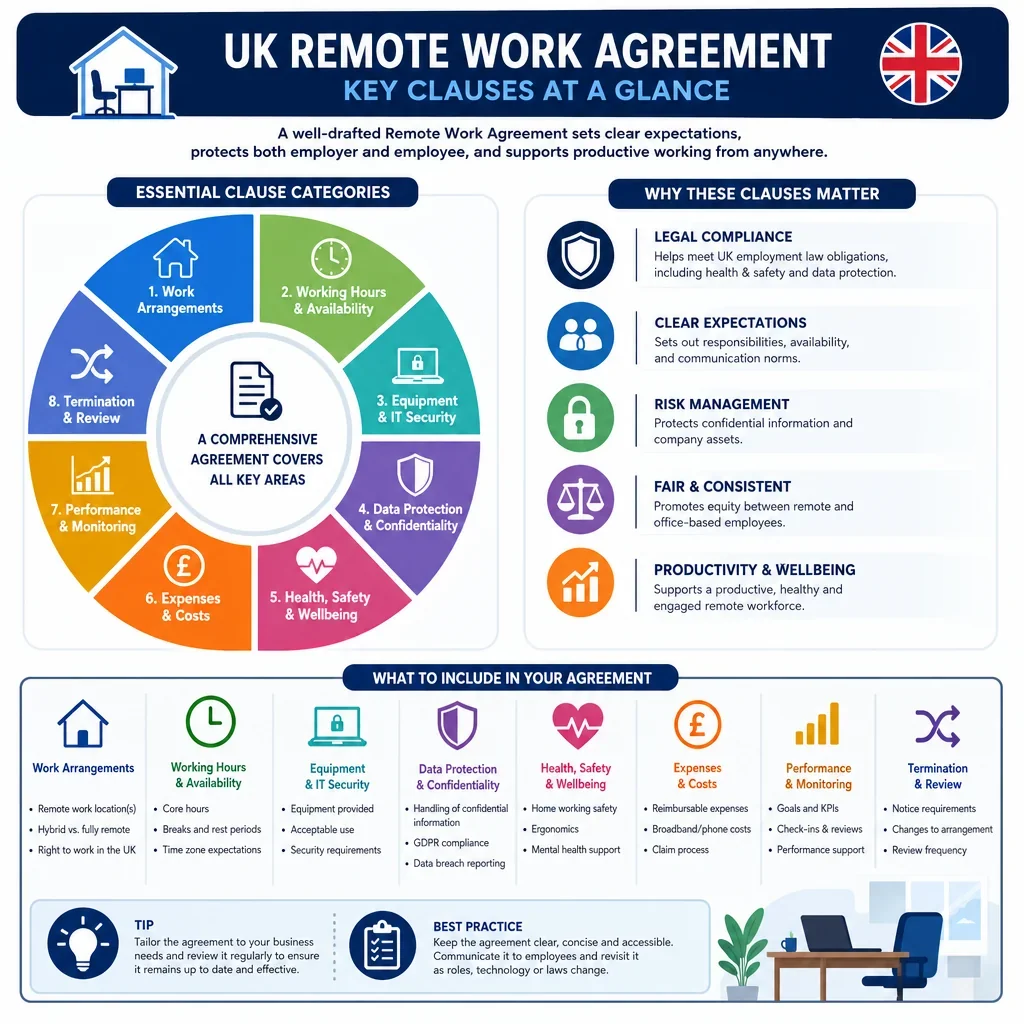
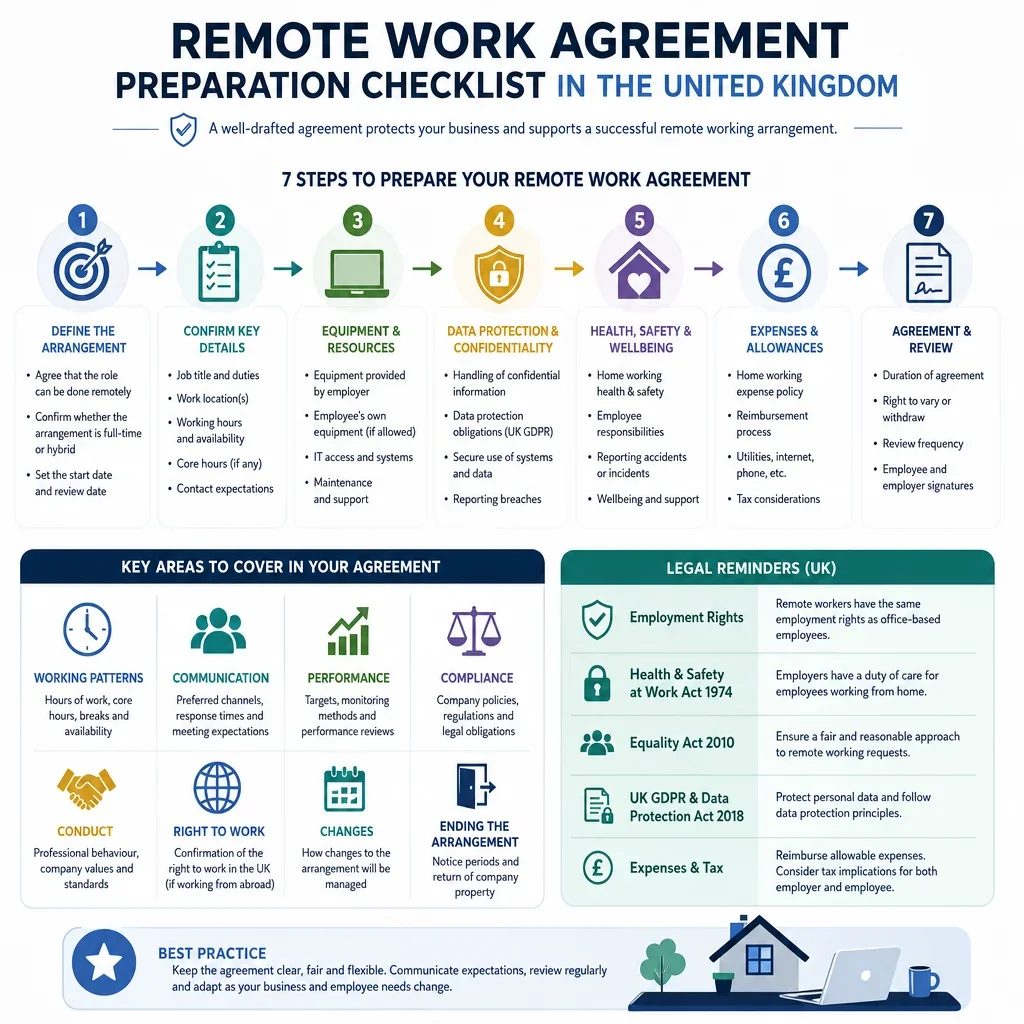
UK remote working arrangements vary widely, so the agreement should match the pattern actually used. Fully remote and home-based roles usually need detailed clauses on the designated workplace, equipment, expenses, health and safety, confidentiality, data protection, insurance, and home access for risk assessments. Hybrid and rota-based models need clearer rules on office attendance, desk booking, travel expectations, working hours, and changes to office days.
When Is A Flexible Working Request Needed?
Employees in Great Britain can make a statutory flexible working request from day one of employment under the Employment Rights Act 1996 and Flexible Working Regulations. Permanent moves to remote, hybrid, compressed, annualised, or term-time patterns should normally be documented as contractual changes after consultation and approval.
Which Arrangements Need The Most Management Control?
Remote contact-centre work, client-site hybrid work, fixed-day hybrid work, emergency remote working, and overseas remote working usually require higher oversight because employers must manage service coverage, supervision, security, working time, immigration, tax, and health and safety risks. Output-based fully remote work and occasional work-from-home days usually need less day-to-day control but still require clear deliverables and availability windows.
What UK Legal Risks Are Most Relevant?
- Health and safety: employers retain duties for home workers, including suitable risk assessment and safe workstation arrangements.
- Working time: remote workers still need limits on weekly working time, rest breaks, night work protections, and holiday arrangements.
- Data protection: remote work agreements should include secure device use, confidentiality, document handling, reporting breaches, and UK GDPR compliance.
- Equality and fairness: hybrid rotas and remote approvals should be applied consistently to reduce discrimination and indirect disadvantage risks.
- International working: overseas remote work should usually require prior written approval because tax residence, payroll, immigration, employment law, insurance, and data transfer issues can arise quickly.
FAQs
You Might Also Be Interested In