United Kingdom Remote Work Agreement Clause Library
Clause name | Clause purpose | Clause category | Typical use cases | Drafting notes |
|---|---|---|---|---|
Core | ||||
Remote Work Location | Identifies the authorised place or places where the employee may work remotely. | Working arrangements | Homeworking, hybrid work, or approval of a regular alternative UK address. | Require prior written approval for changes, especially overseas working or shared premises. |
Optional | ||||
Remote Work Eligibility | Sets the criteria for who may work remotely and when approval may be refused. | Management and performance | Roles requiring site presence, supervision, secure systems, or minimum performance standards. | Apply criteria consistently to reduce discrimination and employee relations risks. |
Situation-specific | ||||
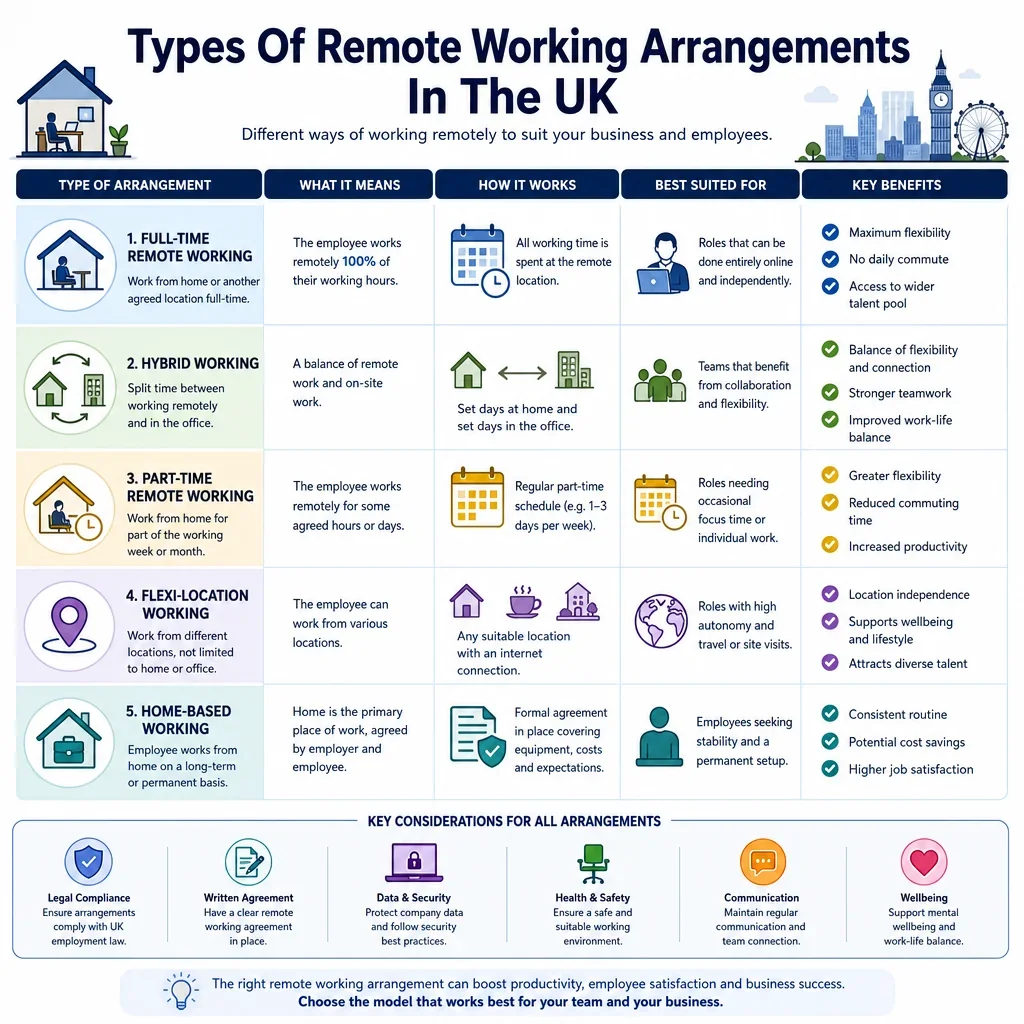
Hybrid Attendance Pattern | States the balance between remote working and workplace attendance. | Working arrangements | Employees working fixed office days, anchor days, or team collaboration days. | Clarify whether attendance days are fixed, variable, manager-led, or business-needs based. |
Core | ||||
Working Hours | Confirms expected hours, availability windows, and whether flexible working applies. | Working arrangements | Remote staff with core hours, compressed hours, flexitime, or customer-facing duties. | Align with contract terms and Working Time Regulations limits and rest breaks. |
Availability And Responsiveness | Sets expectations for being contactable during working hours and responding to messages. | Working arrangements | Distributed teams relying on email, messaging tools, calls, or live support cover. | Avoid unrealistic instant-response duties account for breaks, meetings, and focused work. |
Optional | ||||
Out Of Hours Contact | Defines when the employee is not expected to monitor work communications. | Working arrangements | Remote roles where boundaries blur due to mobile devices or international colleagues. | Tie to agreed hours, rest periods, emergency escalation, and wellbeing policies. |
Core | ||||
Remote Working Duties | Confirms that normal role duties continue while working remotely. | Employee duties | Any remote work arrangement where the job description remains unchanged. | Avoid changing contractual duties unless the employment contract permits or the employee agrees. |
Performance Standards | States that output, quality, conduct, and performance expectations remain applicable remotely. | Management and performance | Output-based work, client service, sales, support teams, and probationary arrangements. | Use objective measures and avoid surveillance-heavy wording unless justified and transparent. |
Supervision And Check-Ins | Provides for regular management meetings, progress updates, and support while remote. | Management and performance | Remote employees, junior staff, new starters, or teams working asynchronously. | Specify frequency and method without creating excessive monitoring obligations. |
Communication Tools | Identifies approved communication channels for work discussions and documents. | Working arrangements | Teams using email, Teams, Slack, Zoom, shared drives, or case management tools. | Prohibit unapproved consumer apps for confidential or personal data unless assessed. |
Meeting Attendance | Requires attendance at virtual or in-person meetings when reasonably required. | Working arrangements | Hybrid teams, client meetings, appraisals, training, and disciplinary meetings. | Address notice, travel expectations, accessibility, and reasonable adjustments. |
Situation-specific | ||||
Workplace Attendance On Request | Allows the employer to require attendance at the workplace for specified business reasons. | Working arrangements | Training, team days, audits, equipment collection, emergencies, or sensitive meetings. | Give reasonable notice where possible and consider disability, caring, and distance issues. |
Core | ||||
Home Workspace Suitability | Requires a safe, secure, and suitable workspace for remote duties. | Health and safety | Homeworking involving desks, screens, confidential calls, or regular office-style work. | Link to risk assessment and do not require home access without consent and notice. |
Health And Safety Compliance | Confirms employer and employee obligations for safe remote working. | Health and safety | All UK remote work arrangements, especially regular or permanent homeworking. | Reflect employer duties under health and safety law and employee cooperation duties. |
Remote Working Risk Assessment | Requires completion and review of health and safety risk assessments for remote work. | Health and safety | Homeworking setups, new equipment, pregnancy, disability, or changed work location. | Use proportionate self-assessment for low-risk work reassess when circumstances change. |
Display Screen Equipment Assessment | Covers workstation assessment for employees using screens as a significant part of work. | Health and safety | Laptop, monitor, keyboard, mouse, and desk-based remote office work. | Address eye tests, training, breaks, and suitable workstation adjustments. |
Accident And Incident Reporting | Requires prompt reporting of work-related accidents, injuries, hazards, and near misses. | Health and safety | Home office injuries, electrical hazards, stress incidents, or equipment-related accidents. | Clarify reporting route and preserve employer obligations for reportable incidents. |
Optional | ||||
Wellbeing And Isolation | Recognises risks of stress, isolation, overwork, and reduced support when remote. | Health and safety | Fully remote roles, lone workers, high-pressure roles, or dispersed teams. | Include support channels, check-ins, workload escalation, and stress risk awareness. |
Core | ||||
Equipment Provision | Lists equipment supplied by the employer for remote work. | Equipment and expenses | Laptops, monitors, phones, chairs, headsets, keyboards, security tokens, or software. | Record ownership, condition, authorised use, support, insurance, and return obligations. |
Care Of Employer Property | Requires proper care, storage, and protection of employer equipment and documents. | Equipment and expenses | Employees taking laptops, files, phones, access cards, or tools off-site. | Address damage, loss, theft, personal use, and immediate notification duties. |
Return Of Equipment And Materials | Requires return of employer property when remote work ends or employment terminates. | Termination and review | Leavers, role changes, revoked homeworking, or replacement equipment. | Specify timing, method, cost responsibility, data deletion, and access revocation. |
Remote Working Expenses | Explains which homeworking costs are reimbursable and how claims are made. | Equipment and expenses | Internet, phone, office supplies, postage, travel, utilities, or ergonomic items. | Set pre-approval rules, caps, evidence requirements, and tax treatment disclaimers. |
Situation-specific | ||||
Home Internet And Utilities | Allocates responsibility for reliable internet, phone access, electricity, and utility costs. | Equipment and expenses | Employees using personal broadband or utilities for regular remote work. | State whether the employer contributes, reimburses, or requires minimum connectivity. |
Travel To Workplace And Business Travel | Clarifies when travel from the remote location is reimbursable. | Equipment and expenses | Hybrid workers attending the office, client sites, training, or occasional meetings. | Distinguish ordinary commuting from business travel and align with expenses policy. |
Insurance And Home Restrictions | Requires the employee to consider home insurance, tenancy, mortgage, or lease restrictions. | Equipment and expenses | Permanent homeworking, business visitors, stored equipment, or rented homes. | Do not require intrusive disclosure ask for confirmation where proportionate. |
Core | ||||
Confidential Information | Protects business, client, employee, and supplier information accessed remotely. | Confidentiality and data protection | Remote access to customer data, trade secrets, financial data, HR records, or contracts. | Align with employment contract confidentiality terms and post-termination restrictions. |
Data Protection Compliance | Requires compliance with UK GDPR, Data Protection Act 2018, and employer policies. | Confidentiality and data protection | Any remote handling of personal data, HR data, customer data, or special category data. | Refer to policies and training avoid duplicating detailed privacy procedures inaccurately. |
Information Security | Sets technical and organisational safeguards for remote systems and data. | Confidentiality and data protection | Use of VPNs, MFA, encryption, approved cloud storage, and secure networks. | Use specific security requirements that match the organisationu0027s IT controls. |
Acceptable Use Of IT Systems | Controls use of employer systems, devices, internet access, and software. | Confidentiality and data protection | Remote device use, personal browsing, software downloads, cloud tools, and email use. | Cross-refer to IT, cyber security, monitoring, and disciplinary policies. |
Situation-specific | ||||
Use Of Personal Devices | Controls whether employees may use personal devices for work. | Confidentiality and data protection | BYOD phones, personal laptops, home printers, or personal cloud storage risks. | Require approval, security controls, remote wipe consent, and separation of personal data. |
Core | ||||
Secure Storage Of Documents | Requires safe storage of paper files, devices, passwords, and removable media at home. | Confidentiality and data protection | Roles handling printed contracts, HR files, medical data, legal files, or client records. | Specify lockable storage, clean desk rules, disposal, and no family access. |
Situation-specific | ||||
Printing And Paper Records | Limits printing and governs handling of hard-copy work documents. | Confidentiality and data protection | Legal, finance, healthcare, HR, public sector, or regulated work done from home. | Require secure printing, approved disposal, and avoid personal printers where risky. |
Core | ||||
Data Incident Reporting | Requires prompt reporting of suspected data loss, unauthorised access, or cyber incidents. | Confidentiality and data protection | Lost laptops, misdirected emails, malware, stolen files, or exposed screens. | Use immediate reporting language because ICO notification deadlines can be short. |
Private Calls And Meetings | Requires confidential conversations to be held where they cannot be overheard. | Confidentiality and data protection | HR calls, legal advice, client meetings, health data, or commercially sensitive matters. | Address headphones, screen positioning, recording permissions, and shared homes. |
Situation-specific | ||||
Remote Work Monitoring | Explains any monitoring of systems, productivity, communications, or device use. | Management and performance | Time tracking, call recording, system logs, productivity dashboards, or security monitoring. | Be transparent, proportionate, documented, and consistent with ICO employment monitoring guidance. |
Time Recording | Requires accurate recording of hours worked, breaks, overtime, or billable time. | Management and performance | Hourly workers, consultants, regulated work, client billing, or overtime controls. | Align with working time, pay, overtime, and record-keeping requirements. |
Optional | ||||
Overtime Approval | Prevents unauthorised overtime and sets approval rules for extra hours. | Working arrangements | Remote workers who may work late without direct supervision. | Ensure rules do not result in unlawful deductions or minimum wage issues. |
Core | ||||
Sickness Absence While Remote | Confirms sickness reporting rules still apply when working remotely. | Employee duties | Employees who may feel able to work from home while unwell. | Clarify reporting, fit notes, sick pay, and not working while certified unfit. |
Annual Leave And Remote Working | Confirms holiday booking rules apply and remote work is not a substitute for leave. | Employee duties | Employees working from holiday locations or trying to combine leave and work. | Align with holiday entitlement, approval procedures, and overseas working limits. |
Situation-specific | ||||
Childcare And Dependants | Clarifies that remote work requires ability to perform duties without inappropriate interruption. | Employee duties | Employees caring for children or dependants during working hours. | Draft sensitively consider flexible working, emergency leave, and discrimination risks. |
Flexible Working Requests | Explains how statutory flexible working requests interact with the remote work arrangement. | Working arrangements | Employees requesting permanent homeworking, hybrid work, altered hours, or compressed hours. | Reflect day-one request rights and the statutory handling process. |
Reasonable Adjustments | Allows remote working terms to be adjusted for disability or other protected needs. | Health and safety | Disabled employees needing adapted equipment, altered hours, or reduced office attendance. | Do not use standard terms to override Equality Act reasonable adjustment duties. |
Overseas Remote Working | Restricts or controls remote work outside the United Kingdom. | Working arrangements | Employees asking to work abroad temporarily, from holiday homes, or while travelling. | Require prior approval due to tax, immigration, employment law, security, and data risks. |
Right To Work And Immigration Compliance | Confirms remote work must comply with right to work and visa restrictions. | Working arrangements | Sponsored workers, overseas work requests, or employees with visa conditions. | Check Home Office requirements before permitting work from another country. |
Tax And Payroll Implications | Flags that remote location may affect tax, social security, or payroll obligations. | Working arrangements | Cross-border remote work, extended overseas stays, or employees moving within the UK. | Do not give tax advice require disclosure and employer approval before location changes. |
Regulatory Compliance | Ensures remote working complies with sector-specific regulatory duties. | Employee duties | Financial services, legal, healthcare, education, public sector, or regulated advice roles. | Cross-refer to professional rules, audit trails, call recording, and record retention. |
Optional | ||||
Intellectual Property Created Remotely | Confirms ownership and protection of work product created during remote work. | Confidentiality and data protection | Software, designs, documents, inventions, creative content, research, or product work. | Align with employment contract IP clauses include consultants separately if relevant. |
Conflicts Of Interest And Outside Work | Prevents remote working from enabling undisclosed outside work or competing activities. | Employee duties | Remote workers with flexible hours, secondary jobs, freelance work, or client conflicts. | Use proportionate approval requirements and respect lawful secondary employment rights. |
Professional Conduct Remotely | Applies workplace conduct, dress, behaviour, and communication standards to remote work. | Employee duties | Client-facing video calls, remote collaboration, social media, and digital communications. | Avoid overly prescriptive home rules unless linked to legitimate business needs. |
Remote Working Training | Requires completion of training for remote systems, security, health and safety, or procedures. | Management and performance | New remote workers, new software, cyber security awareness, DSE, or data handling. | Record mandatory training, refresher cycles, and consequences of non-completion. |
Situation-specific | ||||
Remote Onboarding | Sets arrangements for induction, training, equipment setup, and early supervision remotely. | Management and performance | New starters hired into remote-first or hybrid roles. | Include access setup, probation support, buddy systems, and initial check-in frequency. |
Probation And Remote Work | Links remote work to probationary performance, training, and supervision requirements. | Management and performance | New employees whose suitability for remote work has not yet been tested. | Avoid using probation to bypass contractual remote work rights without clear wording. |
Core | ||||
Review Of Remote Work Arrangement | Allows periodic assessment of whether the arrangement remains suitable. | Termination and review | Trial periods, permanent homeworking, hybrid schedules, or changing business needs. | State review frequency, criteria, consultation process, and possible outcomes. |
Situation-specific | ||||
Trial Period | Makes remote working temporary until assessed after a defined period. | Termination and review | First-time remote work, new hybrid policy, performance concerns, or flexible working pilots. | Specify end date, evaluation criteria, and whether terms become permanent if not reviewed. |
Temporary Suspension Of Remote Work | Allows remote work to be paused for urgent business, safety, or security reasons. | Termination and review | Cyber incidents, unsafe workspace, performance investigation, or equipment failure. | Use fair, reasonable, and proportionate triggers consider contractual variation issues. |
Core | ||||
Withdrawal Of Remote Work Permission | Sets when and how remote work permission may be withdrawn. | Termination and review | Performance issues, role changes, confidentiality risks, business needs, or unsuitable workspace. | Avoid absolute unilateral rights include notice, consultation, and equality considerations. |
Contractual Status And Variation | Clarifies whether remote work terms vary the employment contract or are discretionary. | Termination and review | Permanent homeworking, hybrid work added after hire, or flexible working approvals. | Be clear if contractual changing contractual terms normally requires agreement or proper process. |
Interaction With Employer Policies | Confirms relevant policies continue to apply during remote work. | Management and performance | IT, data protection, expenses, sickness, disciplinary, grievance, and health and safety policies. | List key policies and state whether policies are non-contractual unless intended otherwise. |
Breach Of Remote Work Terms | Explains that breach may lead to disciplinary action or withdrawal of remote working. | Termination and review | Security breaches, refusal to attend meetings, falsified hours, or misuse of equipment. | Align with disciplinary procedure and ensure sanctions are proportionate and evidence-based. |
Optional | ||||
Business Continuity And Connectivity Failure | Sets what happens if internet, power, systems, or home workspace become unavailable. | Working arrangements | Power cuts, broadband outages, system downtime, cyber incidents, or home emergencies. | Specify reporting, alternative work location, office attendance, paid time, and backup plans. |
Emergency Remote Working | Allows temporary remote work during emergencies affecting workplace access. | Working arrangements | Severe weather, transport disruption, public health incidents, or building closures. | Distinguish emergency homeworking from permanent contractual homeworking. |
Visitors And Third Parties At Home | Restricts third-party access to work equipment, documents, and confidential discussions. | Confidentiality and data protection | Shared accommodation, family homes, housemates, cleaners, or visitors during work hours. | Focus on access to work material, not controlling the employeeu0027s private life. |
Situation-specific | ||||
Employer Access To Home Workspace | Sets conditions for any employer visit to inspect equipment or health and safety. | Health and safety | Equipment installation, risk assessment, retrieval, or serious safety concerns. | Require consent, reasonable notice, limited purpose, and respect for privacy and household members. |
Accessible Remote Working Arrangements | Ensures remote systems, meetings, and equipment are accessible to the employee. | Health and safety | Disabled workers using assistive technology, captions, ergonomic equipment, or adjusted processes. | Assess individual needs and avoid one-size-fits-all remote working requirements. |
Optional | ||||
Pay And Benefits Unaffected | Confirms whether pay, benefits, allowances, and location-based benefits change remotely. | Equipment and expenses | Employees moving to remote-first work or relocating away from the office area. | Any pay reduction or benefit removal may require consultation and agreement. |
Core | ||||
Contractual Place Of Work | Defines whether the home, office, or both are contractual places of work. | Working arrangements | Hybrid contracts, home-based roles, relocation requests, or office attendance disputes. | Place of work affects mobility, expenses, redundancy pools, and contract variation issues. |
Optional | ||||
Notices And Correspondence | States where employment notices and formal correspondence may be sent. | Management and performance | Remote employees rarely attending the office or using digital HR systems. | Ensure compatibility with the employment contract notice clause and statutory documents. |
Maintenance And Technical Support | Sets support process for faulty equipment, software issues, and security updates. | Equipment and expenses | Remote employees dependent on laptops, VPNs, specialist software, or phones. | Require prompt reporting and prohibit unauthorised repairs or software changes. |
Core | ||||
Software Updates And Security Patches | Requires timely installation of updates, patches, antivirus, and security controls. | Confidentiality and data protection | Remote devices connecting to employer networks or processing personal data. | State whether updates are automatic and require cooperation with IT instructions. |
Passwords And Multi-Factor Authentication | Requires secure credentials and authentication for remote access. | Confidentiality and data protection | Cloud services, VPN access, email, HR systems, finance systems, and customer databases. | Prohibit sharing credentials and require immediate reporting of compromise. |
Situation-specific | ||||
Removable Media And External Storage | Controls use of USB drives, external hard drives, and other portable storage. | Confidentiality and data protection | Sensitive data transfers, offline work, field roles, or limited internet access. | Require encryption, approval, inventory records, and secure destruction or return. |
Record Retention And Deletion | Requires remote workers to retain, file, and delete records according to policy. | Confidentiality and data protection | Regulated businesses, legal files, HR records, finance records, or personal data handling. | Avoid local copies and align with retention schedules and legal hold processes. |
Confidential Waste Disposal | Sets secure disposal rules for printed or physical confidential materials at home. | Confidentiality and data protection | Employees printing client files, contracts, HR documents, or financial information. | Use shredding, secure return, or approved confidential waste services. |
Collective Agreements And Consultation | Acknowledges remote terms may be affected by collective agreements or consultation duties. | Termination and review | Unionised workplaces, large-scale hybrid policy changes, or workforce-wide contract changes. | Check recognition agreements and consultation obligations before changing arrangements. |
Optional | ||||
Governing Law And UK Scope | Confirms the arrangement is intended for UK employment and UK-based work unless approved. | Termination and review | UK employers with employees requesting international remote work or relocation. | Do not assume UK law alone resolves overseas tax, immigration, or local employment rights. |
What Clauses Should A UK Remote Work Agreement Usually Include?
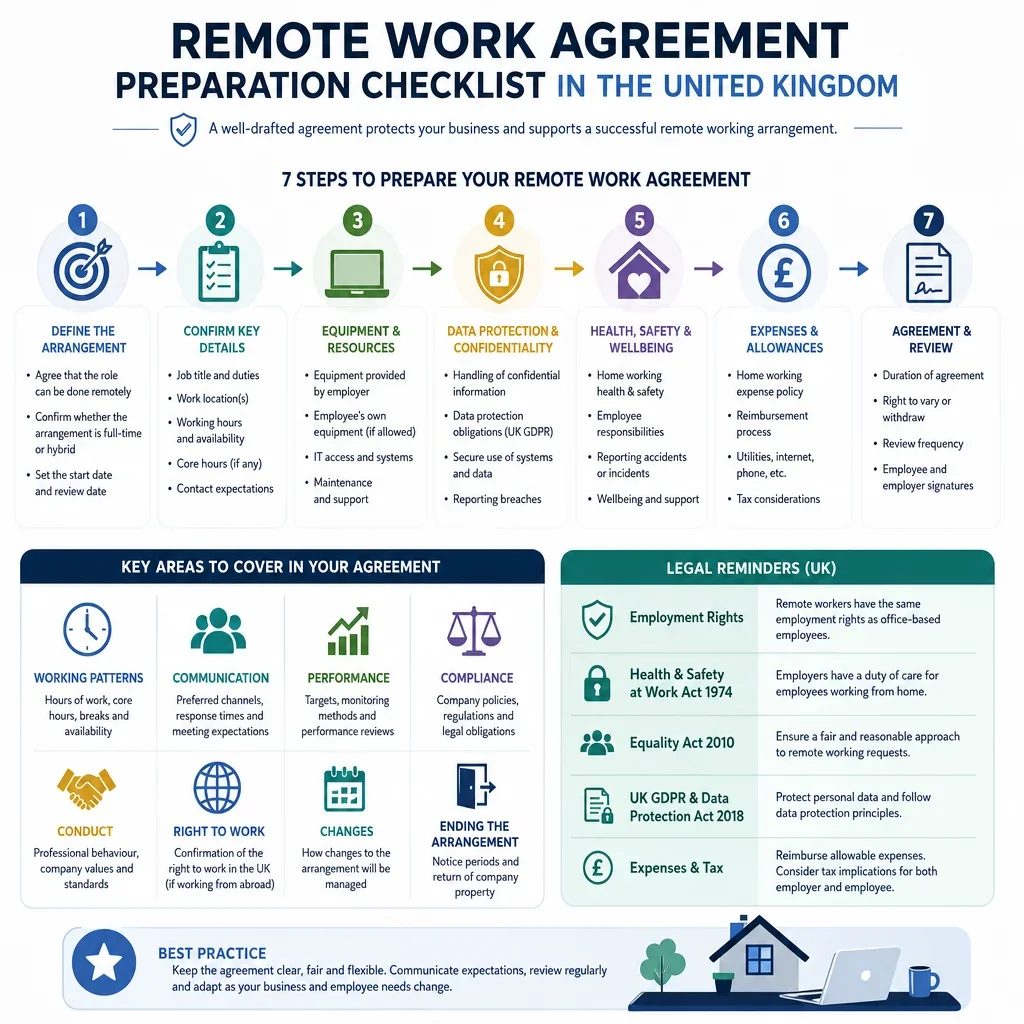
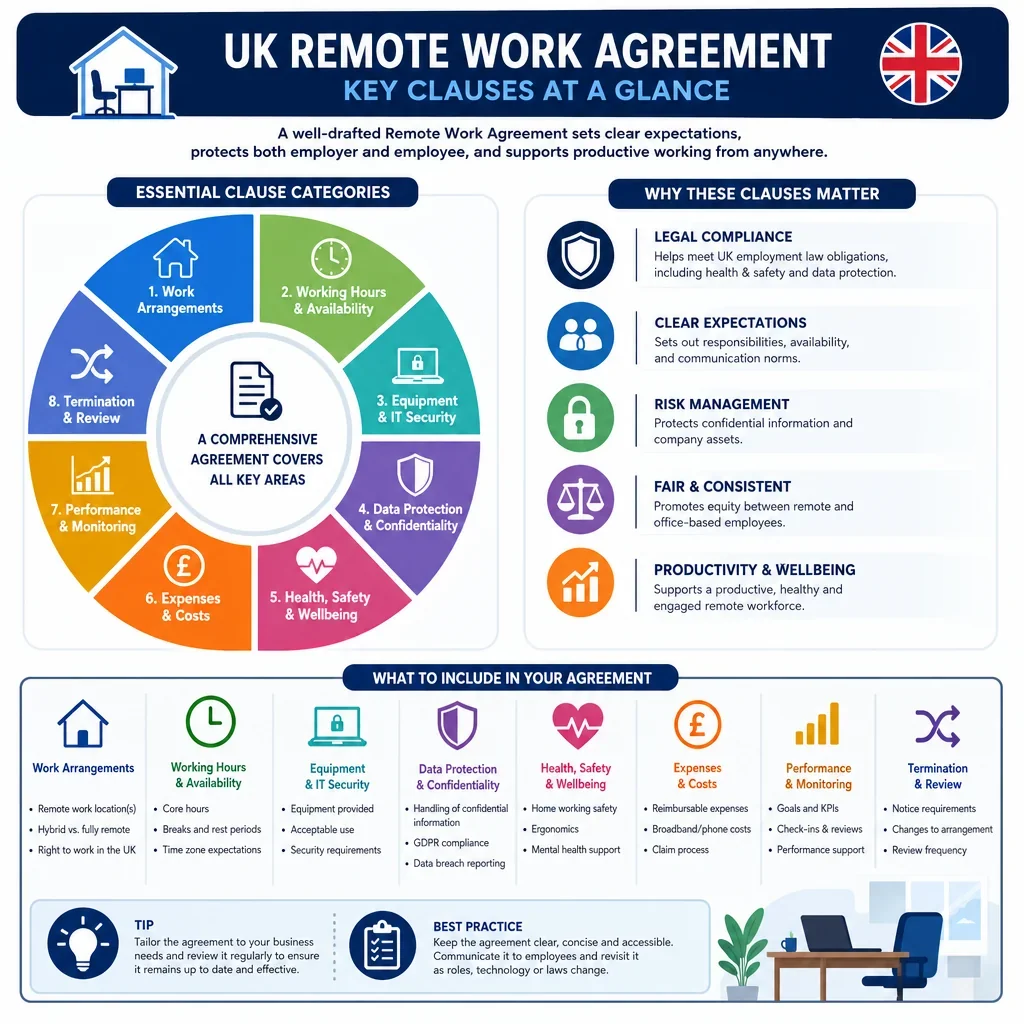
A strong UK remote work agreement should cover the practical working arrangement, not just state that the employee may work from home. The core clauses usually include the remote work location, working hours, duties, supervision, equipment, expenses, health and safety, confidentiality, data protection, and review or termination of the arrangement.
How Should Employers Deal With Health And Safety For Remote Workers?
UK employers still owe health and safety duties where employees work remotely. The agreement should support risk assessment, display screen equipment checks, accident reporting, safe workstation requirements, and the employee\u0027s duty to cooperate. Clauses should not imply that legal responsibility is transferred entirely to the employee.
What Data Protection Clauses Matter Most For Remote Work?
Remote work increases risks around devices, home networks, paper files, video calls, and family access to confidential material. The agreement should require secure systems, password protection, approved storage, reporting of data incidents, and compliance with the employer\u0027s UK GDPR policies. Data protection clauses should be consistent with the employment contract, IT policy, privacy notices, and disciplinary procedure.
Can A Remote Work Agreement Be Changed Or Withdrawn?
Many UK remote work arrangements are contractual or closely linked to contractual terms. A review, trial period, variation, and withdrawal clause can help manage business needs, performance issues, confidentiality risks, or health and safety concerns. Employers should avoid wording that suggests a unilateral right to impose changes where consultation or agreement may be required.
FAQs
You Might Also Be Interested In