Prenuptial Agreement Preparation Checklist In The United Kingdom
Step Name | Step Description | Typical Responsibility | Inputs Needed | Suggested Timing |
|---|---|---|---|---|
Initial Discussion | ||||
Discuss Whether A Prenup Is Appropriate | Talk openly about why an agreement is wanted and what issues it should cover. | Both partners | Marriage plans, broad financial concerns, family expectations | 6 to 12 months before wedding |
Define Main Objectives | Identify key goals such as protecting premarital assets, businesses or children from earlier relationships. | Both partners | Asset priorities, family commitments, future financial plans | 6 to 12 months before wedding |
Confirm Relevant UK Jurisdiction | Check whether the agreement is intended for England and Wales, Scotland or Northern Ireland. | Both partners and legal advisers | Home addresses, wedding location, future residence plans | Before drafting starts |
Understand Court Treatment In England And Wales | Note that a prenup is not automatically binding but may carry weight if freely made, informed and fair. | Both partners and legal advisers | Basic explanation of Radmacher principles | Before committing to terms |
Set A Prenup Timetable | Create a schedule for disclosure, advice, negotiation and signing before wedding pressures peak. | Both partners and solicitors | Wedding date, solicitor availability, disclosure deadlines | At least 6 months before wedding |
Avoid Last-Minute Signing | Plan to sign well before the wedding to reduce pressure or duress arguments. | Both partners and solicitors | Wedding date, final draft, advice confirmations | Aim for at least 28 days before wedding |
Identify Third-Party Interests | Check whether family trusts, parents or business partners affect assets to be protected. | Relevant partner and solicitor | Trust details, family loans, shareholder agreements | Before financial disclosure |
Information Gathering | ||||
Collect Personal Details | Record full names, addresses, occupations and relationship details for both parties. | Both partners | Names, addresses, occupations, dates of birth | 5 to 6 months before wedding |
Collect Marriage Details | Record the planned wedding date, venue and whether there will be overseas ceremonies. | Both partners | Wedding booking, ceremony details, overseas plans | 5 to 6 months before wedding |
Flag International Factors | Identify citizenship, overseas assets or likely relocation that may affect advice and drafting. | Both partners and solicitors | Nationalities, domicile facts, foreign assets, relocation plans | Before drafting starts |
Record Previous Relationships | Identify earlier marriages, civil partnerships, divorce orders and existing obligations. | Each partner | Decree absolute, final order, consent order, maintenance orders | Before financial disclosure |
Identify Children And Dependants | Record existing children, expected children and other dependants whose needs may be relevant. | Both partners | Children's ages, childcare costs, school fees, maintenance duties | Before drafting financial terms |
Gather Income Information | Compile salary, bonuses, dividends, rental income and self-employed earnings. | Each partner | Payslips, P60, tax returns, dividend vouchers, accounts | 4 to 6 months before wedding |
List Bank And Savings Accounts | List current accounts, savings, ISAs, premium bonds and cash holdings. | Each partner | Recent statements, account numbers, balances | 4 to 6 months before wedding |
List Property Interests | Identify homes, buy-to-let property, overseas property and beneficial interests. | Each partner | Title registers, mortgage statements, valuations, tenancy details | 4 to 6 months before wedding |
Record Mortgage Liabilities | Record mortgages, legal charges, equity release and secured loans. | Each partner | Mortgage statements, redemption figures, charge details | 4 to 6 months before wedding |
List Investments | Compile shares, funds, cryptoassets, bonds, options and investment platforms. | Each partner | Portfolio statements, share certificates, wallet records, valuations | 4 to 6 months before wedding |
Gather Pension Details | Identify workplace, private, defined benefit and overseas pensions. | Each partner | CETV statements, scheme details, pension forecasts | 4 to 6 months before wedding |
List Business Interests | Identify shares, directorships, partnerships, sole trades and LLP interests. | Each partner | Company accounts, shareholder agreements, partnership deeds, valuations | 4 to 6 months before wedding |
Identify Trusts And Family Wealth | Record trust interests, family companies, gifts and likely inheritances where relevant. | Relevant partner and solicitor | Trust letters, gift documents, family loan records, estate planning notes | 4 to 6 months before wedding |
List Unsecured Debts | Record credit cards, personal loans, student loans, tax debts and guarantees. | Each partner | Loan statements, credit card balances, HMRC demands, guarantees | 4 to 6 months before wedding |
List High-Value Personal Items | Identify jewellery, vehicles, art, antiques, watches and collections. | Each partner | Receipts, insurance schedules, valuations, photographs | 4 to 6 months before wedding |
Prepare Asset Schedule | Summarise each party's assets, liabilities and approximate net worth in a schedule. | Each partner and solicitor | All asset and debt information | Before formal disclosure exchange |
Estimate Current And Future Needs | Estimate housing, income, childcare and retirement needs if the marriage later ends. | Both partners and advisers | Budgets, housing costs, childcare costs, pension needs | Before agreeing financial terms |
Discuss Family Home Treatment | Decide whether the home is shared, ring-fenced or subject to occupation rights on separation. | Both partners and solicitors | Ownership details, mortgage, contributions, housing needs | Before first draft |
Identify Ring-Fenced Assets | List premarital, inherited, gifted or family assets intended to remain separate. | Each partner and solicitor | Asset histories, gift records, inheritance documents, valuations | Before first draft |
Discuss Future Assets | Agree how later savings, property, bonuses, shares or inheritances should be treated. | Both partners and solicitors | Expected career path, bonuses, inheritance prospects, investment plans | Before first draft |
Discuss Debt Responsibility | Agree how premarital debts, joint debts and future borrowing should be handled. | Both partners and solicitors | Debt schedules, loan purposes, repayment plans, guarantees | Before first draft |
Discuss Maintenance Expectations | Consider whether spousal maintenance, clean break aims or needs-based support should be included. | Both partners and solicitors | Income data, budgets, childcare plans, career break plans | Before first draft |
Consider Career Breaks | Address childcare, relocation, caring duties or business support that may affect earning capacity. | Both partners and solicitors | Children plans, career plans, relocation plans, care responsibilities | Before first draft |
Separate Child Maintenance Issues | Recognise that child maintenance is subject to statutory rules and cannot be finally excluded by a prenup. | Both partners and solicitors | Childcare plans, school fees, child maintenance assumptions | Before drafting child-related clauses |
Check Matrimonial Causes Act Factors | Consider needs, resources, standard of living, age, marriage length and children when assessing fairness. | Solicitors | Financial disclosure, needs analysis, family circumstances | Before terms are finalised |
Financial Disclosure | ||||
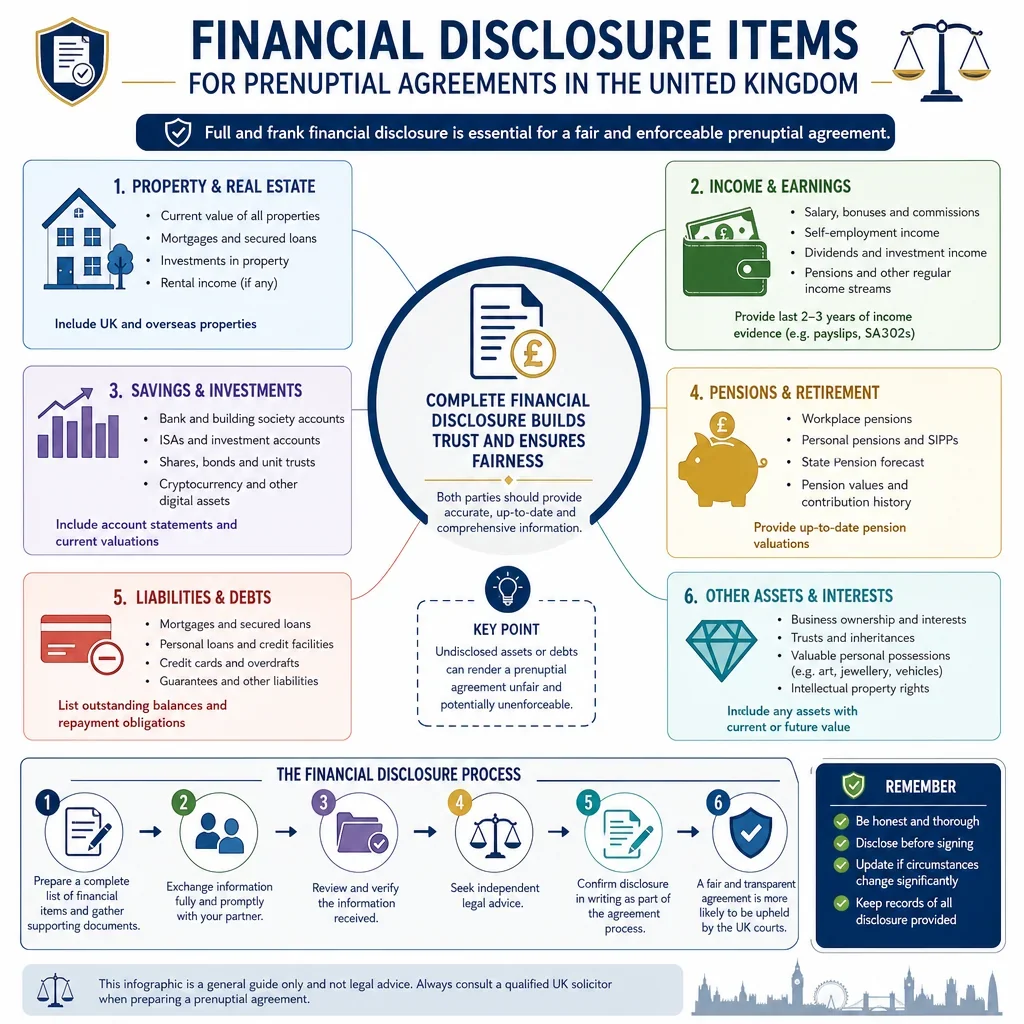
Exchange Financial Disclosure | Provide a clear summary of assets, liabilities, income and pensions to the other party. | Each partner and solicitor | Asset schedule, statements, valuations, pension documents, income evidence | 3 to 5 months before wedding |
Prepare Disclosure Schedules | Create schedules showing each party's disclosed finances for attachment or reference. | Solicitors and each partner | Final disclosure summaries, valuations, explanatory notes | Before final draft |
Obtain Key Asset Valuations | Value significant property, businesses, pensions or investments where approximate figures are not enough. | Asset owner and adviser | Valuer reports, business accounts, pension CETVs, market appraisals | 3 to 5 months before wedding |
Ask Disclosure Questions | Raise concise questions about unclear assets, valuations, debts or income sources. | Each solicitor | Disclosure schedules, supporting documents, valuation queries | Before negotiation of final terms |
Confirm Disclosure Completeness | Confirm each party has enough financial information to make an informed decision. | Each partner and solicitor | Final disclosure schedules, answers to questions, advice notes | Before signing any final draft |
Drafting | ||||
Choose Drafting Solicitor | Agree which solicitor prepares the first draft and who reviews it independently. | Both partners | Solicitor details, agreed objectives, disclosure summary | 3 to 4 months before wedding |
Draft Background Recitals | Set out marriage plans, disclosure, advice, objectives and confirmation of voluntary entry. | Drafting solicitor | Personal details, wedding date, advice details, disclosure schedules | 3 to 4 months before wedding |
Draft Separate Property Clauses | State which assets should remain separate and how growth or replacements are treated. | Drafting solicitor | Ring-fenced asset list, valuation evidence, asset history | 3 to 4 months before wedding |
Draft Shared Property Clauses | Define joint property, shared savings and assets acquired during the marriage. | Drafting solicitor | Future asset plans, contribution expectations, joint account plans | 3 to 4 months before wedding |
Draft Family Home Clauses | Set out ownership, occupation, sale and housing arrangements if the relationship ends. | Drafting solicitor | Title documents, mortgage, housing needs, contribution history | 3 to 4 months before wedding |
Draft Business Protection Clauses | Address company shares, voting control, dividends, valuation and sale restrictions. | Drafting solicitor and business adviser | Company documents, accounts, shareholder agreements, valuation evidence | 3 to 4 months before wedding |
Draft Pension Clauses | Set out intended treatment of pension rights while preserving court discretion on divorce. | Drafting solicitor | Pension values, scheme details, retirement needs analysis | 3 to 4 months before wedding |
Draft Maintenance Clauses | Record intended spousal support, clean break terms or review triggers for future needs. | Drafting solicitor | Income data, budgets, childcare plans, career break plans | 3 to 4 months before wedding |
Draft Debt Clauses | Allocate responsibility for premarital debts, joint debts and future liabilities. | Drafting solicitor | Debt schedules, guarantees, credit agreements | 3 to 4 months before wedding |
Draft Inheritance And Gift Clauses | State how inheritances, family gifts and inter-family loans should be treated. | Drafting solicitor | Gift letters, wills, trust notes, loan agreements | 3 to 4 months before wedding |
Draft Review Clause | Include review triggers such as children, relocation, illness, major wealth change or fixed anniversaries. | Drafting solicitor | Likely life events, review dates, future plans | During first or revised draft |
Draft Confidentiality Clause | Set limits on sharing private financial and family information disclosed for the agreement. | Drafting solicitor | Disclosure material, permitted recipients, adviser details | During first draft |
Draft Governing Law Clause | State the intended governing law and forum, especially where international factors exist. | Drafting solicitor | Residence plans, nationalities, foreign assets, overseas legal advice | During first draft |
Consider Postnup Fallback | Plan a postnuptial confirmation if timing becomes too tight before the wedding. | Both partners and solicitors | Wedding date, draft status, advice status, unresolved issues | If final signing is delayed |
Independent Advice | ||||
Appoint Independent Solicitors | Each party should instruct a separate adviser to avoid conflicts and support informed consent. | Each partner | Solicitor engagement letters, ID documents, draft agreement | 3 to 5 months before wedding |
Receive Advice On Legal Effect | Understand the agreement's effect, limitations and likely weight if challenged on divorce. | Each partner and solicitor | Draft agreement, disclosure schedules, personal objectives | Before negotiation is finalised |
Keep Advice Confirmation | Keep evidence that each party received advice and had time to consider it. | Solicitors and each partner | Advice letters, attendance notes, certificate of advice if used | Before signing |
Confirm Capacity And Free Will | Confirm each party understands the agreement and is not under undue pressure. | Each solicitor | Client meeting notes, timing records, medical concerns if any | Before signing |
Check Language Understanding | Arrange translation or interpretation if either party may not fully understand English legal wording. | Relevant partner and solicitor | Language needs, translated draft, interpreter details | Before advice meeting |
Raise Legal Advice Questions | Ask about unclear clauses, court discretion, fairness risks and negotiation options. | Each partner and solicitor | Draft agreement, advice note, concerns list | Before approving final draft |
Negotiation | ||||
Negotiate Core Terms | Discuss disputed issues such as home ownership, maintenance, pensions, debts and business assets. | Both partners and solicitors | Draft agreement, disclosure, advice comments, proposal schedule | 2 to 4 months before wedding |
Record Negotiation History | Keep a clear record of proposals, counteroffers and agreed changes. | Solicitors | Emails, marked-up drafts, meeting notes, proposal letters | Throughout negotiation |
Review Overall Fairness | Assess whether the outcome would meet needs and avoid obvious unfairness at separation. | Both solicitors and both partners | Final terms, needs analysis, disclosure, advice notes | Before approving final draft |
Revise Draft Agreement | Update clauses to reflect agreed changes and remove inconsistencies. | Drafting solicitor | Marked-up draft, agreed amendments, updated schedules | After negotiation rounds |
Check Final Draft Accuracy | Check names, dates, clause references, schedules, values and signing blocks. | Both solicitors and both partners | Final draft, disclosure schedules, ID details, wedding date | Before execution copies are prepared |
Signing | ||||
Prepare Signing Copies | Prepare clean final copies with all schedules and signature pages included. | Solicitors | Final approved agreement, schedules, witness requirements | At least 1 month before wedding |
Check Deed Formalities | Ensure execution as a deed is properly arranged where the agreement is intended to be a deed. | Solicitors | Final agreement, witness details, signing instructions | Before signing appointment |
Arrange Independent Witnesses | Arrange suitable adult witnesses who are independent and physically present where required. | Each partner and solicitor | Witness names, addresses, occupations, signing venue | Before signing appointment |
Sign Final Agreement | Sign the final agreed document with witnesses and no outstanding disclosure or advice issues. | Both partners, witnesses and solicitors | Final agreement, ID, witnesses, advice confirmations | Preferably at least 28 days before wedding |
Date The Agreement Correctly | Insert the correct completion date only when all parties have properly signed. | Solicitors | Signed counterparts, witness details, completion confirmation | On signing or completion date |
Store Signed Originals | Store original signed copies and complete electronic scans securely. | Both partners and solicitors | Signed originals, scans, solicitor file references | Immediately after signing |
Post-Signing Review | ||||
Confirm Marriage Took Place | Record that the planned marriage occurred after the agreement was signed. | Both partners | Marriage certificate, wedding date confirmation | After wedding |
Review After Children | Reassess housing, income, childcare and inheritance terms after children are born or adopted. | Both spouses and solicitors | Children's details, childcare costs, updated budgets, housing needs | After birth, adoption or major childcare change |
Review After Major Wealth Change | Update the agreement after a large inheritance, business sale, redundancy or major asset purchase. | Both spouses and solicitors | Updated asset schedule, valuation evidence, tax and estate planning notes | Soon after major change |
Review After Relocation | Check whether moving within the UK or abroad affects governing law, assets or enforceability. | Both spouses and legal advisers | New residence, foreign advice, asset locations, immigration plans | Before or soon after relocation |
Schedule Periodic Reviews | Review whether the agreement still meets needs and reflects current circumstances. | Both spouses | Updated finances, family circumstances, review clause, legal advice | Every 3 to 5 years or as agreed |
Prepare Postnuptial Update | Use a postnuptial agreement to update or confirm terms after marriage. | Both spouses and solicitors | Existing prenup, updated disclosure, revised terms, independent advice | When circumstances materially change |
Align With Wills | Check wills, death benefits and estate planning do not conflict with the agreement. | Both spouses and private client advisers | Wills, pension nominations, life policies, trust documents | After signing and after marriage |
Update Nominations And Policies | Review pension death benefit nominations, life insurance and beneficiary forms. | Both spouses | Pension forms, life policies, beneficiary nominations, agreement terms | After marriage and major life events |
Keep Updated Financial Records | Keep records showing asset origins, inheritances, gifts and separate property changes. | Both spouses | Statements, valuations, gift letters, inheritance documents, sale records | Ongoing after signing |
When Should A UK Prenuptial Agreement Be Started?
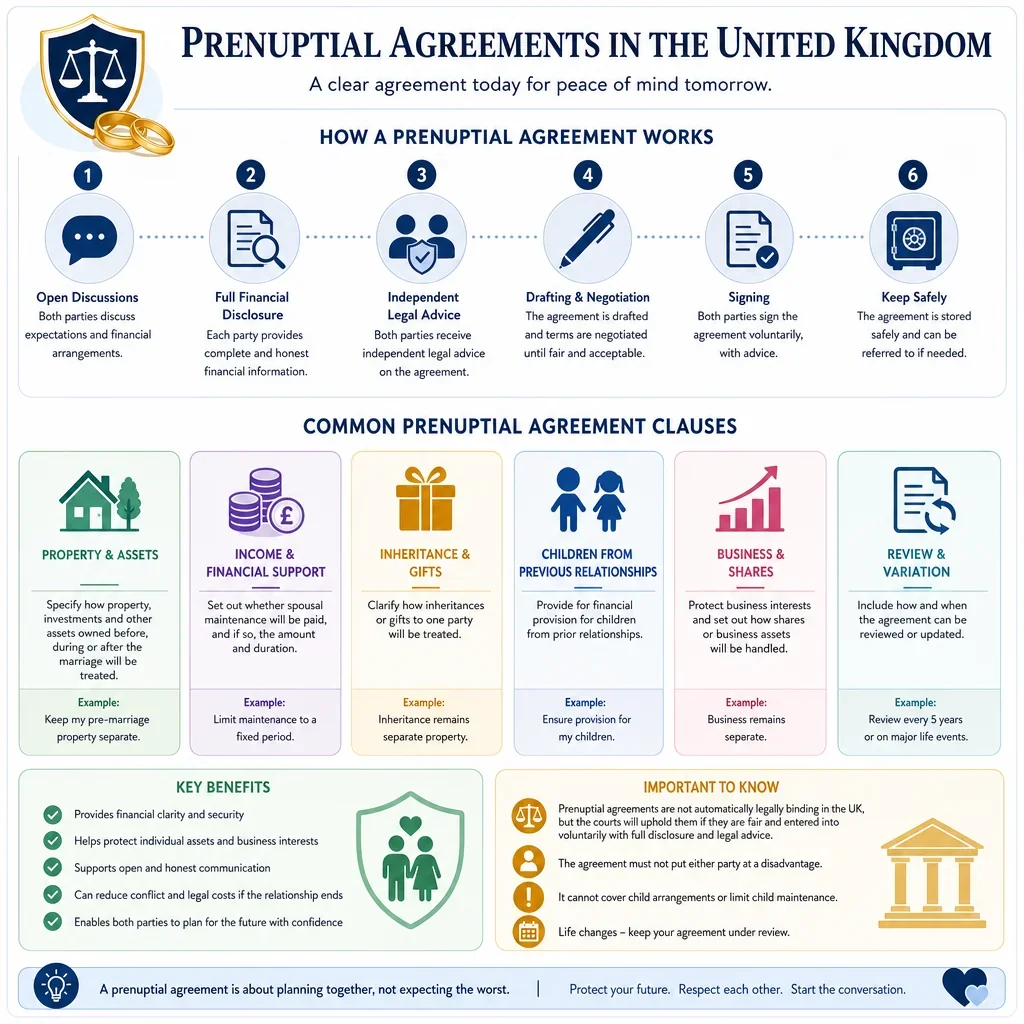
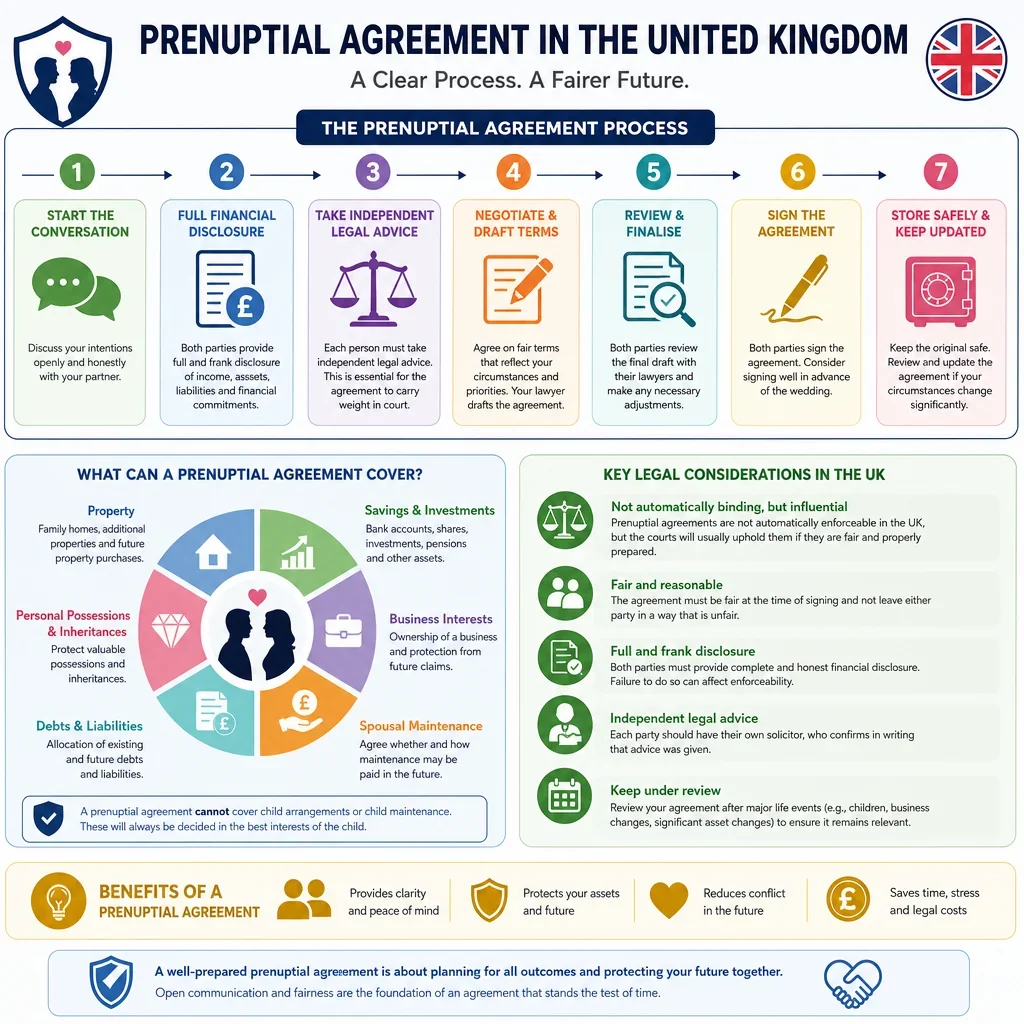
Start early. A practical target is to complete financial disclosure, independent legal advice, negotiation and signing well before the wedding, commonly at least 28 days before the ceremony. Rushed signing shortly before the wedding can create arguments about pressure, understanding and fairness.
What Makes A Prenup More Likely To Be Given Weight In England And Wales?
Although prenuptial agreements are not automatically binding in England and Wales, the Supreme Court in Radmacher v Granatino said the court should give effect to an agreement freely entered into with full appreciation of its implications unless it would be unfair. The checklist therefore focuses on early preparation, full financial disclosure, independent advice, negotiation records and final fairness review.
What Information Should Be Ready Before Drafting?
Each party should usually prepare clear details of income, property, savings, investments, pensions, business interests, debts, expected inheritances and future plans. Incomplete disclosure can undermine informed consent and later enforceability arguments.
Why Is Independent Legal Advice Important?
Each person should normally use a separate solicitor. Independent advice helps show that both parties understood the agreement, were not under undue pressure and had a fair opportunity to negotiate before signing.
What Should Be Reviewed After Signing?
Keep the signed agreement safely and review it after major life events such as children, relocation, business sale, major inheritance, illness or long separation. A review clause can help keep the agreement aligned with needs and fairness over time.
FAQs
You Might Also Be Interested In