

Payment Structures For UK Service Agreements
Created:
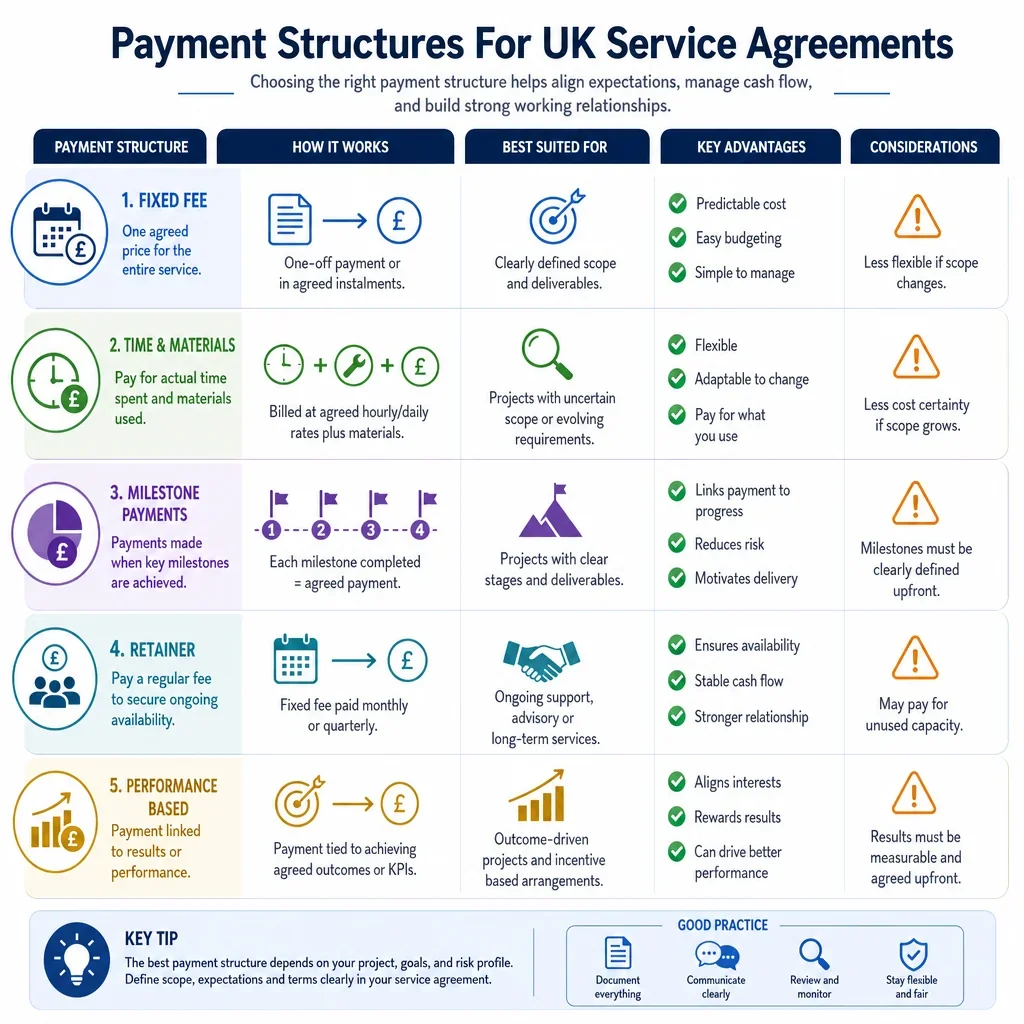
Understanding payment structures helps UK businesses and contractors set clear expectations, reduce disputes, and manage cash flow. This guide supports anyone preparing an AI Generated Service Agreement for use in the United Kingdom.
Payment Model | How It Works | Suitable Engagement Type | Advantages | Potential Drawbacks | Administration Level |
|---|---|---|---|---|---|
Fixed fee | |||||
Fixed project fee | Client pays one agreed price for a defined scope of services or deliverables. | Short project One off service | High price certainty simple invoicing easy to compare quotes. | Scope creep risk provider may underprice unclear work. | Low |
Fixed fee with change control | A fixed price applies to the agreed scope extra work needs written approval and separate pricing. | Short project Long project | Preserves budget certainty while allowing controlled variations. | Requires clear scope, variation process and records of approvals. | Medium |
Fixed fee with cap on extras | Core fee is fixed and additional charges cannot exceed an agreed cap without approval. | Long project Variable workload | Limits client exposure while giving provider some flexibility. | Cap may be reached before work is complete renegotiation may be needed. | Medium |
Fixed fee per deliverable | Each report, design, document or output has an agreed standalone price. | Short project Variable workload | Scales with output easy to pause or expand work. | Disputes may arise over what counts as one deliverable. | Medium |
Fixed fee per task | Provider charges a set amount for each completed task from a defined task list. | Ongoing services Variable workload | Predictable unit pricing suitable for repeatable work. | Task definitions must be precise to avoid fee disputes. | Medium |
Hourly or daily rate | |||||
Day rate | Client pays an agreed daily rate for each day or part-day worked. | Long project Variable workload | Flexible for uncertain work simple rate card. | Budget can drift without caps, forecasts or approval controls. | Medium |
Hourly rate | Provider records time spent and invoices at agreed hourly rates. | Variable workload Ongoing services | Fair for unpredictable tasks client pays for actual time. | High tracking burden client has less price certainty. | High |
Blended hourly rate | One average hourly rate applies regardless of which team member performs the work. | Long project Ongoing services | Simpler billing than multiple rates smooths seniority differences. | May overcharge junior-heavy work or underpay senior-heavy work. | Medium |
Tiered rate card | Different hourly or daily rates apply by role, seniority, location or service category. | Long project Variable workload | More accurate pricing for mixed teams and specialist work. | More complex invoices rates and role allocation must be monitored. | High |
Time and materials with cap | Work is charged by time and approved expenses, but total charges are capped. | Variable workload Long project | Balances flexibility with maximum spend protection. | Provider may stop or renegotiate once the cap is reached. | High |
Open time and materials | Client pays all properly incurred time and materials at agreed rates. | Variable workload Ongoing services | Maximum flexibility for uncertain or urgent work. | Weak cost certainty unless reporting and approvals are robust. | High |
Milestone payments | |||||
Milestone payments | Payment is released when agreed project stages or deliverables are completed. | Long project Short project | Improves cash flow links payment to progress. | Completion and acceptance criteria must be clear. | Medium |
Milestone payments with acceptance testing | Payment follows completion of a milestone and client acceptance against agreed criteria. | Long project | Ties fees to objective deliverable quality and completion. | Acceptance delays can affect provider cash flow. | High |
Stage payment schedule | Fees are paid in predetermined stages, such as start, draft, final delivery and completion. | Short project Long project | Predictable cash flow for both parties. | May not reflect actual work effort at each stage. | Medium |
Progress billing by percentage completion | Invoices are raised as agreed percentages of the project are completed. | Long project | Aligns payments with gradual progress rather than final delivery only. | Percentage completion can be subjective without measurable criteria. | High |
Retainer | |||||
Monthly retainer | Client pays a recurring monthly amount for access to agreed services or capacity. | Ongoing services | Stable provider income predictable client budgeting. | Unused capacity may be wasted unless rollover rules apply. | Low |
Retainer with included hours | Monthly fee includes a set number of hours extra hours are charged separately. | Ongoing services Variable workload | Combines baseline support with flexible additional work. | Requires tracking of used hours and overage approvals. | Medium |
Use-it-or-lose-it retainer | Unused monthly allocation expires at the end of each billing period. | Ongoing services | Protects provider capacity planning and revenue. | Client may pay for unused services consumer fairness issues may need review. | Medium |
Rolling retainer with rollover hours | Unused hours can roll into later periods, usually subject to expiry or a cap. | Ongoing services Variable workload | More client-friendly than expiring retainers supports fluctuating demand. | Provider may accumulate future delivery obligations. | High |
Availability retainer | Client pays for priority access or reserved capacity, with work billed separately or included. | Ongoing services Variable workload | Secures provider availability during busy periods or emergencies. | Must distinguish payment for availability from payment for actual work. | Medium |
Subscription | |||||
Flat monthly subscription | Client pays a fixed recurring fee for access to defined services each period. | Ongoing services | Simple recurring billing predictable revenue and cost. | Needs clear renewal, cancellation and service scope terms. | Low |
Tiered subscription packages | Client selects a service tier with different features, limits or support levels. | Ongoing services | Allows upselling clients can match package to need. | Feature limits and upgrade rules must be transparent. | Medium |
Annual subscription paid upfront | Client pays for 12 months of services in advance, often at a discounted rate. | Ongoing services | Improves provider cash flow may reduce client cost. | Refund, termination and service failure consequences must be clear. | Low |
Auto-renewing subscription | Subscription renews automatically unless cancelled within the agreed notice period. | Ongoing services | Continuity of service reduces renewal administration. | Renewal and cancellation terms need prominent, fair drafting, especially for consumers. | Medium |
Per-user subscription | Recurring charges are based on the number of authorised users or seats. | Ongoing services Variable workload | Scales with client size common for SaaS and support services. | Needs user counting, true-up and unauthorised access rules. | Medium |
Usage based | |||||
Per-transaction fee | Client pays a fee for each transaction, request, case, booking or processed item. | Variable workload Ongoing services | Costs track actual usage and volume. | Requires accurate usage data and audit rights. | High |
Per-unit usage fee | Charges are calculated by units consumed, such as messages, records, pages or checks. | Variable workload Ongoing services | Granular pricing fair where volumes fluctuate. | Can be hard to forecast without usage caps or alerts. | High |
Consumption band pricing | Usage is charged in bands, with different rates applying above set thresholds. | Variable workload Ongoing services | Supports volume discounts and predictable scaling. | Band thresholds and measurement periods must be clear. | High |
Minimum monthly commitment plus usage | Client pays a minimum monthly amount, with extra charges for usage above the included allowance. | Ongoing services Variable workload | Gives provider baseline revenue while preserving usage scalability. | Client may pay minimum fees during low-use periods. | High |
Subscription, Usage based | |||||
Subscription with overage fees | Base subscription includes an allowance extra use is charged at agreed overage rates. | Ongoing services Variable workload | Predictable base cost with flexibility for higher demand. | Unexpected overage bills if alerts, caps or reporting are absent. | High |
Deposit plus balance | |||||
Deposit plus final balance | Client pays an upfront deposit and the remaining balance on completion or before delivery. | One off service Short project | Reduces provider non-payment risk confirms client commitment. | Refund and cancellation treatment must be clear and lawful. | Low |
Non-refundable deposit | Client pays a deposit that the provider says is retained if the client cancels. | One off service Short project | Compensates provider for reserved time and initial costs. | May be unfair if retention exceeds genuine loss, especially in consumer contracts. | Low |
Refundable deposit | Deposit is credited against the price or returned if refund conditions are met. | One off service Short project | Encourages booking while being more client-friendly. | Provides weaker protection if cancellation causes real loss. | Medium |
Fixed fee, Deposit plus balance | |||||
Payment in advance | Client pays all or part of the fee before services begin. | One off service Short project | Strong provider cash-flow protection and reduced credit risk. | Client may require refund, service credit or termination protections. | Low |
Deposit plus balance | |||||
Balance due before release | Provider withholds final deliverables until the remaining balance is paid. | One off service Short project | Improves payment leverage before valuable outputs are transferred. | Must align with acceptance, IP licence and delivery obligations. | Low |
Hourly or daily rate, Usage based | |||||
Monthly billing in arrears | Provider invoices monthly after services, time or usage have been delivered. | Ongoing services Variable workload | Client pays for actual work after performance. | Provider carries credit risk until invoices are paid. | Medium |
Retainer, Subscription | |||||
Monthly billing in advance | Client pays the monthly fee before the relevant service period starts. | Ongoing services | Improves provider cash flow and reduces payment default risk. | Termination and pro-rata refund rules should be explicit. | Low |
Quarterly billing | Client pays a recurring fee every three months, in advance or arrears. | Ongoing services | Reduces invoice frequency suitable for stable services. | Larger invoices may increase default impact. | Low |
Milestone payments, Usage based | |||||
Success fee | Additional or primary fee becomes payable when an agreed outcome is achieved. | One off service Long project | Aligns provider reward with measurable client outcome. | Outcome definition, causation and timing can be disputed. | High |
Milestone payments | |||||
Performance bonus | Provider receives extra payment for exceeding agreed KPIs or service levels. | Long project Ongoing services | Incentivises high performance and measurable results. | KPI measurement and data ownership must be reliable. | High |
Subscription, Retainer | |||||
Service credits against future fees | Client receives fee credits if agreed service levels are not met. | Ongoing services | Provides pre-agreed financial remedy for service shortfalls. | May undercompensate serious losses unless remedies are preserved. | High |
Retainer, Usage based | |||||
Call-off drawdown from prepaid balance | Client prepays a balance and services are deducted as work is ordered or used. | Ongoing services Variable workload | Fast ordering reduces invoice friction for repeated small tasks. | Needs balance statements, expiry rules and refund provisions. | High |
Usage based, Retainer | |||||
Prepaid service credits | Client buys credits that can be redeemed against defined services or usage units. | Variable workload Ongoing services | Encourages repeat use and simplifies small transactions. | Credit valuation, expiry and refunds must be clear. | High |
Fixed fee, Hourly or daily rate | |||||
Fixed fee plus hourly extras | Core scope is fixed price out-of-scope work is billed at agreed hourly rates. | Short project Variable workload | Clear base cost with flexibility for additional requests. | Requires strict distinction between included and excluded work. | Medium |
Retainer, Fixed fee | |||||
Retainer plus project fees | Monthly retainer covers routine support discrete projects are quoted separately. | Ongoing services Short project | Separates routine work from larger deliverables. | Boundary between support and project work can be disputed. | Medium |
Fixed fee | |||||
Fixed fee plus reimbursable expenses | Client pays fixed service fee plus approved travel, materials or third-party costs. | Short project One off service | Keeps service price clear while passing through external costs. | Expense approval, evidence and caps are needed. | Medium |
Usage based | |||||
Cost plus margin | Client reimburses actual costs plus an agreed markup or management fee. | Variable workload Long project | Transparent where inputs are uncertain or market-priced. | Needs cost evidence, approval rights and excluded cost rules. | High |
Pass-through expenses at cost | Client reimburses approved third-party expenses without markup. | Variable workload Ongoing services | Transparent and fair for unavoidable third-party costs. | Requires receipts, approvals and rules on recoverable expenses. | Medium |
Commission on sales | Provider receives a percentage of sales, revenue or transactions generated. | Ongoing services Variable workload | Directly links payment to revenue generation. | Requires precise rules on qualifying sales, refunds and attribution. | High |
Referral fee per introduction | Fee is payable for each qualifying introduction or converted referral. | Variable workload One off service | Low upfront cost rewards measurable introductions. | Needs anti-bribery, regulated sector and qualification checks. | Medium |
Revenue share | Parties divide specified revenue streams according to agreed percentages. | Long project Ongoing services | Aligns incentives where both parties contribute to commercial success. | Requires audit rights and clear gross versus net revenue definitions. | High |
Royalty style usage fee | Fee is calculated by use, distribution, sales or exploitation of agreed materials or rights. | Ongoing services Variable workload | Links provider payment to value generated from work product. | Needs audit rights, reporting periods and IP ownership clarity. | High |
Fixed fee, Milestone payments | |||||
Deferred payment | Payment is postponed until a future date, event or funding milestone. | Short project Long project | Helps client manage cash flow where provider accepts credit risk. | Provider faces non-payment risk late payment protections should be addressed. | Medium |
Instalment plan | A fixed fee is split into scheduled instalments over an agreed period. | Long project One off service | Improves affordability and provider payment regularity. | Missed instalments need suspension, termination and interest rules. | Medium |
Milestone payments, Deposit plus balance | |||||
Escrowed payment release | Client funds are held by a third party and released when agreed conditions are met. | One off service Long project | Reduces payment and delivery risk for both parties. | Adds cost, setup time and dependency on escrow rules. | High |
Fixed fee | |||||
Payment on completion | Client pays the agreed fee only after the services are completed. | One off service Short project | Client-friendly simple for low-risk work. | Provider bears full payment risk until completion. | Low |
Fixed fee, Milestone payments | |||||
Payment on acceptance | Payment becomes due after the client accepts the completed deliverable or service stage. | One off service Long project | Links payment to client confirmation of satisfactory delivery. | Needs deemed acceptance rules to prevent unreasonable delay. | Medium |
Fixed fee, Hourly or daily rate, Usage based | |||||
Purchase order based billing | Services are billed only against approved purchase orders or statements of work. | Ongoing services Variable workload | Improves client budget control and internal approvals. | Delayed purchase orders can delay work or payment. | High |
Fixed fee, Hourly or daily rate, Milestone payments | |||||
Statement of work pricing | Each statement of work sets its own pricing, payment timetable and deliverables. | Long project Ongoing services Variable workload | Flexible for multi-project relationships under one master agreement. | Order of precedence and inconsistent terms must be managed. | Medium |
Subscription, Fixed fee | |||||
Licence fee plus support subscription | Client pays a one-off licence or setup fee plus recurring support or maintenance fees. | Ongoing services One off service | Separates initial access or setup from ongoing service obligations. | IP, support scope and renewal terms must be carefully separated. | Medium |
Fixed fee, Subscription | |||||
Setup fee plus recurring fee | Client pays an initial onboarding or configuration fee and then recurring service charges. | Ongoing services | Recovers upfront implementation effort separately from ongoing support. | Refund and termination treatment of setup fees should be explicit. | Low |
Fixed fee, Hourly or daily rate | |||||
Minimum fee per engagement | A minimum charge applies even if actual time or usage is low. | One off service Variable workload | Protects provider from uneconomic small jobs. | Must be transparent, especially in consumer-facing services. | Low |
Fixed fee, Hourly or daily rate, Milestone payments, Retainer, Subscription, Usage based, Deposit plus balance | |||||
Statutory late payment interest and compensation | Commercial debts may attract statutory interest and fixed compensation for late payment unless displaced by a substantial remedy. | Short project Long project Ongoing services One off service Variable workload | Encourages prompt payment and provides a default remedy for B2B late payment. | Parties should still draft clear due dates and contractual remedies. | Medium |
VAT exclusive pricing | Prices are stated net of VAT, with VAT added where chargeable at the applicable rate. | Short project Long project Ongoing services One off service Variable workload | Common in B2B contracts preserves supplier margin when VAT applies. | Consumer-facing prices usually need particular care because total payable price must be clear. | Medium |
Fixed fee, Subscription, Deposit plus balance | |||||
VAT inclusive pricing | The stated price includes VAT where VAT is chargeable. | One off service Ongoing services Short project | Clearer total price for consumers and small clients. | Supplier must absorb VAT from the stated price unless wording allows changes. | Medium |
How Should UK Service Agreements Structure Payment Terms?
The safest payment model depends on certainty of scope, duration and usage. Fixed fees, deposits and milestone payments work best where deliverables are clear. Hourly, daily and usage-based models are better where workload is uncertain, but they need stronger approval, reporting and cap provisions.
Which Payment Terms Reduce Disputes?
- Define the trigger for payment: link invoices to acceptance, delivery, time worked, usage data, recurring dates or agreed milestones.
- Include VAT wording: UK service agreements should state whether prices are inclusive or exclusive of VAT and when VAT invoices will be issued.
- Address late payment: business-to-business contracts can refer to statutory interest and compensation under the Late Payment of Commercial Debts legislation, unless the contract provides a substantial contractual remedy.
- Control variable fees: hourly, daily, call-off, overage and success-based models should include approval processes, rate cards, caps, audit rights or reporting requirements.
- Protect cash flow: deposits, retainers, staged payments and payment in advance can reduce non-payment risk, but should be drafted carefully where consumer rules or refund obligations may apply.
Want to Generate Your own Service Agreement?
Docaro AI can help you write your own Service Agreement for use in the United Kingdom in minutes.
FAQs
A UK service agreement can use a fixed fee, hourly or daily rate, milestone payments, retainer, subscription, commission, expenses-based billing, or a mixed payment model.
Show All FAQs
You Might Also Be Interested In
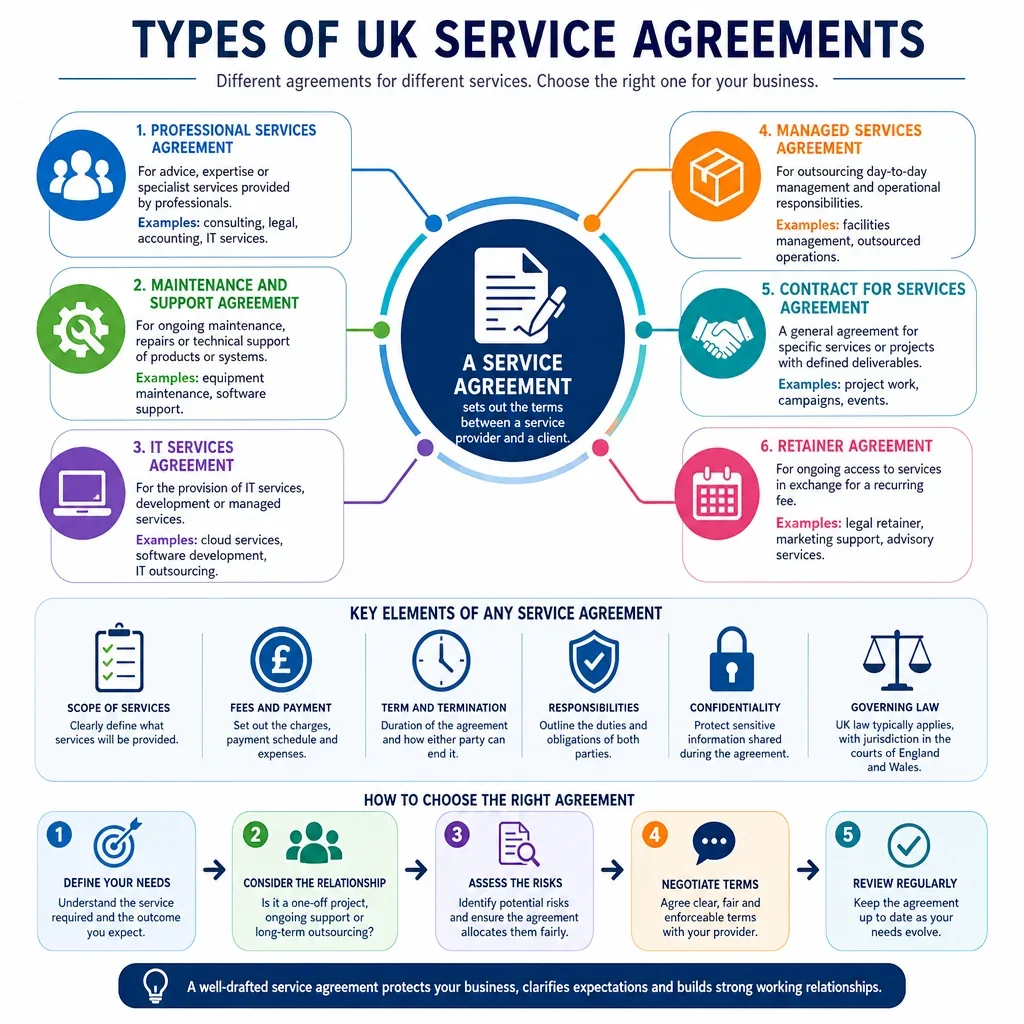
Explore common types of UK service agreements and choose the right contract for your business or client relationship.
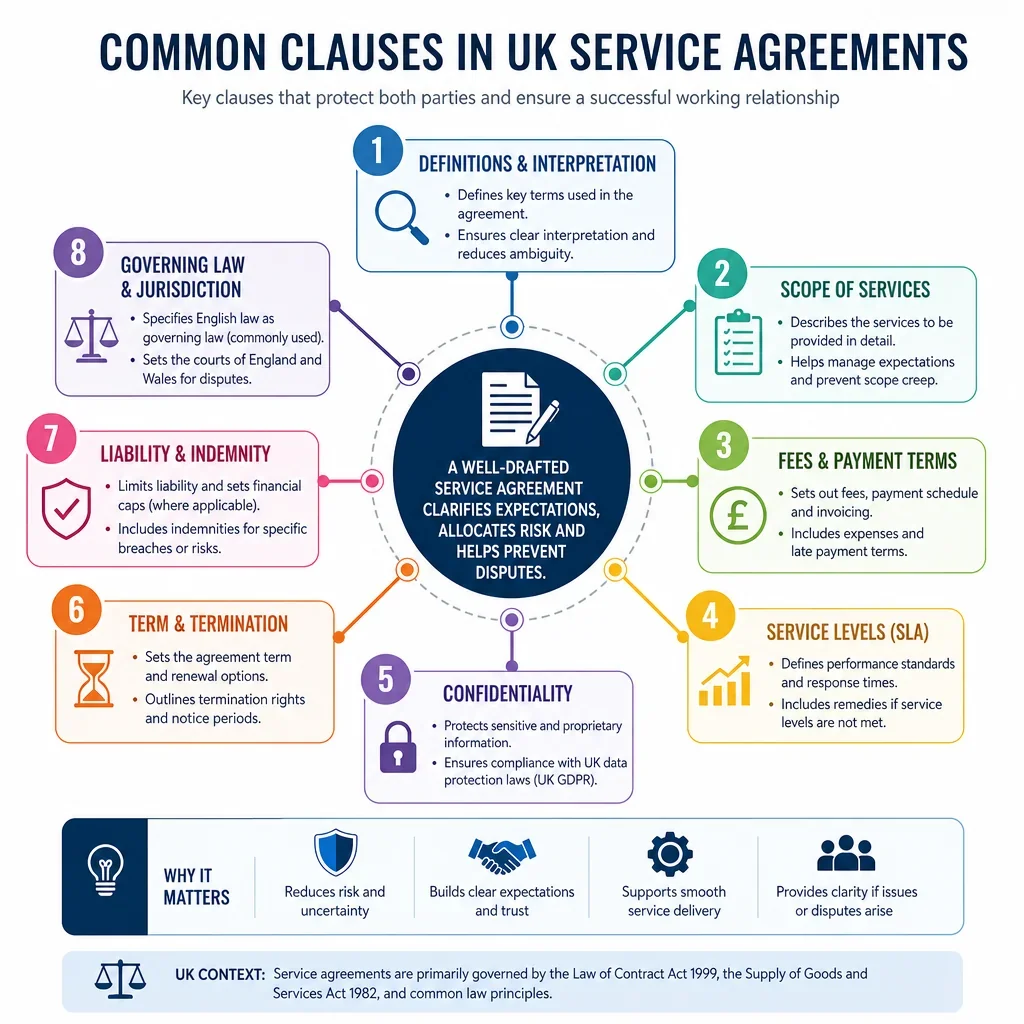
Learn common clauses in UK service agreements and why they matter for clearer contracts, obligations, payments and dispute handling.