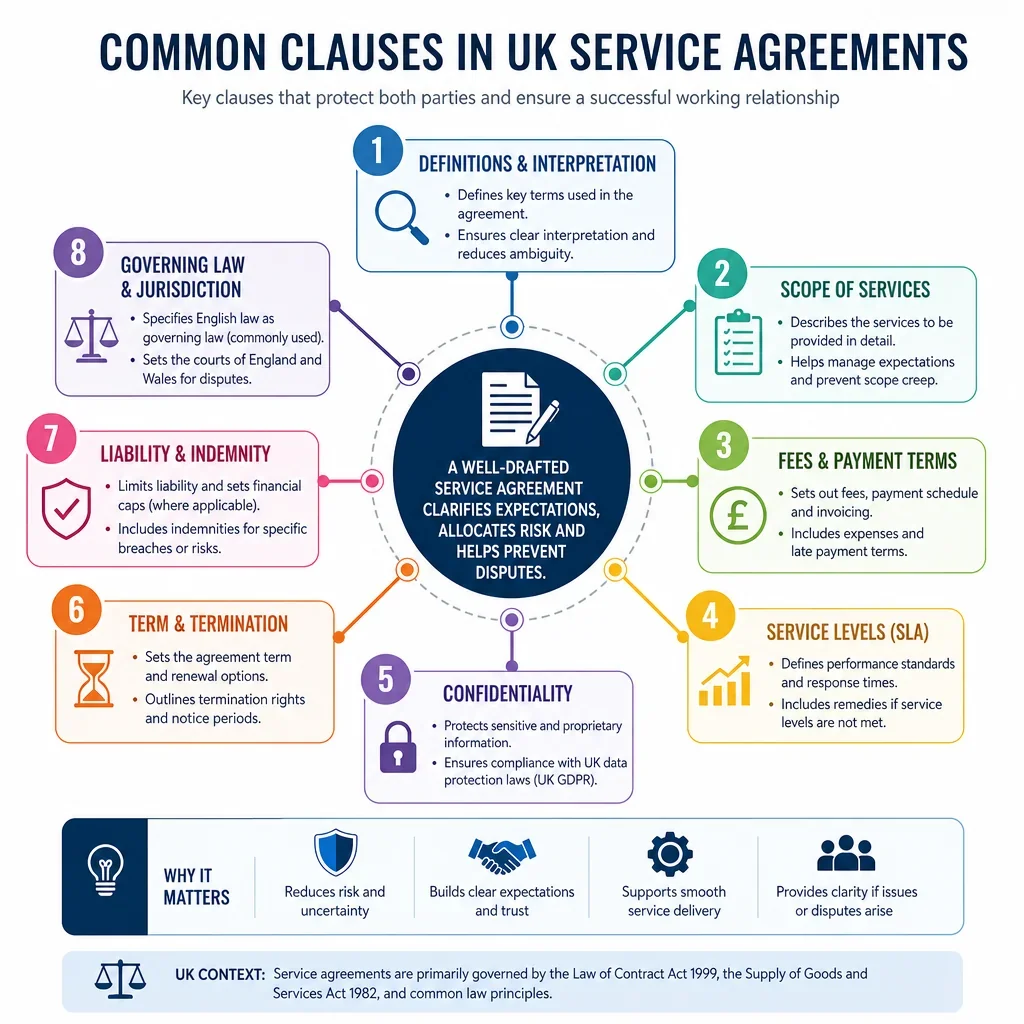
Common Clauses In UK Service Agreements
Clause Name | Purpose | Inclusion Priority | Drafting Notes | Primary Protection Focus |
|---|---|---|---|---|
Scope and performance | ||||
Services Description | Defines the services the supplier must provide. | Usually essential | Describe deliverables, exclusions, assumptions and dependencies clearly. | Balanced |
Statement Of Work | Sets project-specific scope, timetable and charges. | Often recommended | Use for modular services or repeat engagements. | Balanced |
Service Standards | States required quality and performance standards. | Usually essential | Tie standards to measurable outputs where possible. | Customer protection |
Reasonable Skill And Care | Confirms the professional care standard for services. | Usually essential | Consider whether statutory implied terms are excluded or modified. | Customer protection |
Deliverables | Identifies outputs to be produced by the supplier. | Usually essential | Specify format, content, acceptance and delivery dates. | Balanced |
Project Milestones | Breaks performance into dated project stages. | Often recommended | State dependencies and consequences of missed milestones. | Customer protection |
Acceptance Testing | Sets how deliverables are reviewed and accepted. | Often recommended | Include test criteria, deemed acceptance and rejection process. | Customer protection |
Change Control | Controls changes to scope, timing or price. | Usually essential | Require written approval before extra work becomes chargeable. | Balanced |
Customer Responsibilities | States cooperation and inputs required from the customer. | Usually essential | Link delays or failures to relief for the supplier. | Supplier protection |
Access To Premises And Systems | Allows required access to perform the services. | Often recommended | Address site rules, security, remote access and notice. | Supplier protection |
Key Personnel | Identifies important personnel assigned to the services. | Sometimes relevant | Control replacement, qualifications and minimum involvement. | Customer protection |
Subcontracting | Regulates supplier use of subcontractors. | Often recommended | State consent requirements and continuing supplier responsibility. | Customer protection |
Service Levels | Sets measurable availability, response or resolution targets. | Often recommended | Define metrics, exclusions, reporting and service credits. | Customer protection |
Payment and pricing | ||||
Service Credits | Provides credit remedy for service level failure. | Sometimes relevant | Clarify whether credits are sole remedy or additional remedy. | Customer protection |
Fees And Charges | States the price for the services. | Usually essential | Specify fixed fees, time rates, retainers or usage charges. | Balanced |
Payment Terms | States when and how invoices must be paid. | Usually essential | Include invoice timing, due date, currency and bank charges. | Supplier protection |
Late Payment Interest | Discourages late payment and compensates delay. | Often recommended | Refer to agreed rate or statutory commercial late payment rights. | Supplier protection |
VAT | States whether prices include or exclude VAT. | Usually essential | Specify VAT treatment and valid VAT invoice requirements. | Balanced |
Expenses | Controls reimbursable costs incurred by the supplier. | Often recommended | Require prior approval, receipts and expense caps. | Depends on negotiation |
Price Review | Allows charges to change during the contract. | Sometimes relevant | State notice, frequency, indexation and objection rights. | Supplier protection |
Set-Off | Controls deductions from sums due. | Sometimes relevant | Suppliers often restrict set-off customers often preserve it. | Depends on negotiation |
Disputed Invoices | Sets process for challenging invoice amounts. | Often recommended | Require prompt dispute notice and payment of undisputed sums. | Balanced |
Deposit Or Advance Payment | Secures payment before work begins. | Sometimes relevant | State refundability and allocation against invoices. | Supplier protection |
Minimum Spend | Commits customer to minimum purchase value. | Sometimes relevant | Avoid ambiguity about unused services and carry-forward. | Supplier protection |
Term and termination | ||||
Term | States when the agreement starts and ends. | Usually essential | Include commencement date, initial term and continuation basis. | Balanced |
Renewal | Explains whether the agreement renews automatically. | Often recommended | State notice deadlines and renewed term length. | Depends on negotiation |
Termination For Convenience | Allows termination without breach after notice. | Sometimes relevant | Consider minimum term, notice period and termination fees. | Customer protection |
Termination For Material Breach | Allows termination for serious contractual default. | Usually essential | State cure period and non-remediable breach examples. | Balanced |
Termination For Non-Payment | Allows supplier exit after unpaid invoices. | Often recommended | Include reminder, suspension right and cure period. | Supplier protection |
Termination For Insolvency | Allows exit if a party becomes insolvent. | Often recommended | Draft around statutory restrictions on some insolvency termination rights. | Balanced |
Suspension Of Services | Lets supplier pause services in defined cases. | Often recommended | Limit to non-payment, security risk or customer breach. | Supplier protection |
Consequences Of Termination | Sets post-termination obligations and payments. | Usually essential | Cover accrued fees, data return, IP licences and survival. | Balanced |
Exit Assistance | Supports orderly transition to another supplier. | Sometimes relevant | State duration, charges, cooperation and knowledge transfer. | Customer protection |
Survival | Keeps selected clauses effective after termination. | Usually essential | List confidentiality, IP, payment, liability and dispute clauses. | Balanced |
Liability and risk | ||||
Liability Cap | Limits maximum recoverable liability. | Usually essential | Ensure caps are reasonable and reflect insurance and risk. | Supplier protection |
Exclusion Of Indirect Loss | Excludes remote or consequential losses. | Often recommended | List excluded loss types and consider UCTA reasonableness. | Supplier protection |
Uncapped Liabilities | Identifies liabilities not subject to the cap. | Usually essential | Death or personal injury from negligence cannot be excluded. | Balanced |
Indemnity | Creates a direct reimbursement obligation for specified losses. | Often recommended | Define trigger events, covered losses and claim procedure. | Depends on negotiation |
Professional Indemnity Insurance | Requires insurance for professional service risks. | Often recommended | Specify cover amount, period and evidence of policy. | Customer protection |
Public Liability Insurance | Requires cover for injury or property damage claims. | Sometimes relevant | Important for on-site or customer-facing services. | Customer protection |
Cyber Insurance | Requires cover for cyber and data incidents. | Sometimes relevant | Use where systems, hosting or personal data are involved. | Customer protection |
Warranties | Sets contractual assurances about services and authority. | Usually essential | Separate performance warranties from legal capacity warranties. | Customer protection |
Disclaimer Of Guarantees | Avoids promises of specific commercial outcomes. | Often recommended | Must not contradict express obligations or statutory controls. | Supplier protection |
Force Majeure | Relieves performance for events beyond reasonable control. | Often recommended | Define events, notice, mitigation and long-stop termination. | Balanced |
Mitigation | Requires steps to reduce avoidable loss. | Sometimes relevant | Align with common law duty to mitigate damages. | Balanced |
Confidentiality and data | ||||
Confidentiality | Protects non-public business and technical information. | Usually essential | Define confidential information, exceptions and permitted disclosures. | Balanced |
Data Protection | Allocates obligations for personal data handling. | Usually essential | Identify controller, processor, purposes and lawful safeguards. | Balanced |
Processor Terms | Adds mandatory processor obligations under UK GDPR. | Often recommended | Include Article 28-type instructions, security and assistance terms. | Customer protection |
International Data Transfers | Controls transfer of personal data outside the UK. | Sometimes relevant | Use UK adequacy, IDTA or UK addendum where needed. | Customer protection |
Information Security | Requires technical and organisational security measures. | Often recommended | Attach security schedule for sensitive or hosted services. | Customer protection |
Data Breach Notification | Requires prompt notice of security incidents. | Often recommended | Set notice timing shorter than regulatory reporting deadline. | Customer protection |
Data Return Or Deletion | Controls data handling at end of services. | Often recommended | State return format, deletion certificate and backup treatment. | Customer protection |
Freedom Of Information | Addresses disclosure requests for public sector customers. | Specialist use only | Public authorities may need disclosure despite confidentiality. | Customer protection |
Intellectual property | ||||
Background IP | Preserves pre-existing intellectual property ownership. | Usually essential | Define supplier tools, customer materials and third-party IP. | Balanced |
Foreground IP Ownership | States who owns newly created deliverables. | Usually essential | Use express assignment if customer should own IP. | Depends on negotiation |
IP Licence | Grants rights to use retained IP. | Usually essential | State scope, territory, term, exclusivity and sublicensing. | Balanced |
Moral Rights Waiver | Reduces creator objections to later use or modification. | Sometimes relevant | Obtain waivers from individuals creating copyright works. | Customer protection |
Open Source Software | Controls use of open source components in deliverables. | Sometimes relevant | Require disclosure and restrict copyleft contamination risks. | Customer protection |
Third-Party Materials | Identifies external content or software used in services. | Often recommended | Ensure customer receives required licences and usage restrictions. | Balanced |
Customer Materials Licence | Lets supplier use customer materials for the services. | Often recommended | Limit licence to contract purposes and required duration. | Supplier protection |
IP Infringement Indemnity | Protects against third-party IP infringement claims. | Often recommended | Include exclusions for customer materials and unauthorised modifications. | Customer protection |
Portfolio Use | Allows supplier to reference work in marketing. | Sometimes relevant | Require customer consent for names, logos or confidential work. | Supplier protection |
Dispute resolution | ||||
Escalation Procedure | Requires senior discussions before formal proceedings. | Often recommended | Set escalation levels, timeframes and without prejudice status. | Balanced |
Mediation | Encourages settlement before litigation or arbitration. | Sometimes relevant | Consider CPR expectations on ADR and pre-action conduct. | Balanced |
Expert Determination | Refers technical or valuation disputes to an expert. | Sometimes relevant | Define expert appointment, remit, procedure and binding effect. | Balanced |
Arbitration | Requires private arbitral determination of disputes. | Specialist use only | Specify seat, rules, language and number of arbitrators. | Depends on negotiation |
Governing Law | Identifies the law governing the agreement. | Usually essential | For UK use, specify England and Wales, Scotland or Northern Ireland. | Balanced |
Jurisdiction | Identifies courts that may hear disputes. | Usually essential | State exclusive or non-exclusive jurisdiction clearly. | Balanced |
Injunctive Relief | Preserves urgent court remedies for serious breaches. | Sometimes relevant | Useful for confidentiality, IP and restrictive covenant breaches. | Depends on negotiation |
Administration | ||||
Parties | Identifies the contracting entities accurately. | Usually essential | Check legal names, company numbers and registered offices. | Balanced |
Definitions And Interpretation | Clarifies key terms and interpretation rules. | Usually essential | Keep defined terms consistent across schedules and SOWs. | Balanced |
Notices | Sets valid methods for formal communications. | Usually essential | Specify email validity, addresses and deemed receipt times. | Balanced |
Entire Agreement | Limits reliance on pre-contract statements. | Usually essential | Do not attempt to exclude liability for fraud. | Supplier protection |
Variation | Controls how the agreement can be amended. | Usually essential | Require written amendments signed or approved by authorised persons. | Balanced |
Assignment | Controls transfer of rights or obligations. | Often recommended | Consider group transfers, business sales and consent rights. | Depends on negotiation |
No Partnership Or Agency | Confirms parties remain independent contractors. | Often recommended | Avoid conduct inconsistent with the stated relationship. | Balanced |
Third Party Rights | Controls enforcement by non-parties. | Usually essential | Exclude or define rights under the 1999 Act. | Balanced |
Severance | Preserves the agreement if a clause is invalid. | Often recommended | Allow deletion or modification of unenforceable wording. | Balanced |
Waiver | Prevents delay from becoming loss of rights. | Often recommended | State waiver must be express and limited. | Balanced |
Counterparts And Electronic Signature | Allows signing in separate copies or electronically. | Often recommended | Electronic signatures are generally admissible under UK law. | Balanced |
Anti-Bribery And Corruption | Requires compliance with anti-bribery laws. | Often recommended | Include audit, training and termination rights for higher-risk work. | Balanced |
Modern Slavery | Requires anti-slavery compliance in supply chains. | Sometimes relevant | Use for larger organisations or supply-chain services. | Customer protection |
Sanctions Compliance | Prevents dealings breaching UK sanctions rules. | Sometimes relevant | Important for international services or regulated sectors. | Balanced |
Audit Rights | Allows checks of compliance, usage or records. | Sometimes relevant | Limit frequency, notice, confidentiality and disruption. | Customer protection |
Record Keeping | Requires retention of contract-related records. | Sometimes relevant | Specify retention period and access for audits or disputes. | Customer protection |
Non-Solicitation | Restricts poaching staff or key contractors. | Sometimes relevant | Keep duration, persons and restricted acts reasonable. | Depends on negotiation |
Non-Exclusivity | Confirms parties may work with others. | Often recommended | State if exclusivity is intended and its boundaries. | Supplier protection |
Conflict Of Interest | Requires disclosure or avoidance of conflicting duties. | Sometimes relevant | Important for advisers, agencies and professional services. | Customer protection |
TUPE | Allocates employee transfer risks on outsourcing changes. | Specialist use only | Use where services transfer, retender or insource. | Depends on negotiation |
What Clauses Should A UK Service Agreement Usually Include?
Most UK service agreements need a clear combination of scope, service standards, payment, term, termination, liability, confidentiality, data protection, intellectual property, notices and governing law clauses. These are the clauses most likely to prevent disputes about what is being supplied, when payment is due, who owns deliverables and what happens if the relationship ends.
Which Clauses Need Special Care Under UK Law?
Clauses limiting liability, excluding implied terms, controlling personal data, transferring intellectual property and restricting post-termination conduct need careful drafting. In business-to-business contracts, liability limits and exclusions are particularly affected by the Unfair Contract Terms Act 1977. Consumer-facing services also need to reflect the Consumer Rights Act 2015.
How Should Risk Be Allocated In A UK Service Agreement?
A balanced agreement usually separates recoverable losses, liability caps, uncapped liabilities, indemnities, insurance and force majeure. Suppliers commonly seek caps, exclusions of indirect loss and payment protections. Customers commonly seek service levels, remedies, audit rights, confidentiality, data security, IP ownership and termination rights for poor performance.
Why Are Data Protection And IP Clauses So Important For Services?
Many service agreements involve customer data, software, creative work or reports. If personal data is processed, UK GDPR and the Data Protection Act 2018 usually require specific processor obligations. If deliverables are created, intellectual property ownership or licensing must be explicit because ownership will not always pass automatically merely because the customer paid for the work.
FAQs
You Might Also Be Interested In