UK Mutual Release Agreement Preparation Checklist
Information Item | Why It Matters | Requirement Level | Best Collection Stage |
|---|---|---|---|
Party details | |||
Full legal names of all individual parties | Identifies who gives and receives the release. | Required | Before drafting |
Company names and Companies House numbers | Confirms exact corporate identity and avoids misnaming. | Required | Before drafting |
Registered office addresses for company parties | Supports correct notices, party descriptions and service details. | Recommended | Before drafting |
Trading names or business names used in the dispute | Links the release to documents using non-legal names. | Recommended | Before drafting |
Residential or service addresses for individuals | Needed for identification and formal notice provisions. | Required | Before drafting |
Email addresses for contractual notices | Determines whether notice by email is permitted and effective. | Recommended | During drafting |
Solicitor or representative contact details | Ensures communications and completion documents reach the right person. | Optional | During drafting |
Signing details | |||
Authority of each signatory to bind the party | Reduces risk that a party later challenges execution authority. | Required | Before signing |
Board, member or partner approval evidence | Shows internal approval where settlement authority is limited. | Depends on circumstances | Before signing |
Power of attorney if signing for another person | Confirms the attorney can execute the release. | Depends on circumstances | Before signing |
Supporting documents | |||
Copy of the contract or agreement being settled | Defines the obligations and claims to be released. | Required | Before drafting |
Contract variations, extensions and side letters | Prevents the release ignoring later changed obligations. | Recommended | Before drafting |
Background facts | |||
Short chronology of key events | Helps draft accurate recitals and define the dispute. | Required | Before drafting |
Plain English description of the dispute | Frames the scope of the mutual release. | Required | Before drafting |
Claims and obligations | |||
Court, tribunal or arbitration claim numbers | Connects the release to live proceedings and discontinuance steps. | Depends on circumstances | Before drafting |
Supporting documents | |||
Particulars of claim, defence and counterclaim | Identifies pleaded claims and counterclaims to release. | Depends on circumstances | Before drafting |
Letters before claim and responses | Shows the claims asserted before settlement. | Recommended | Before drafting |
Settlement emails, heads of terms or offers | Shows agreed commercial terms to be documented. | Required | Before drafting |
Without prejudice correspondence to be incorporated | Confirms which settlement communications become binding terms. | Depends on circumstances | Before drafting |
Claims and obligations | |||
Any Part 36 offer and acceptance status | Part 36 may affect costs and settlement mechanics. | Depends on circumstances | Before drafting |
Specific claims each party will release | Core term defining what rights are surrendered. | Required | During drafting |
Whether unknown claims are included or excluded | Controls whether later-discovered claims are waived. | Recommended | During drafting |
Whether future claims are released | Prevents ambiguity about claims arising after signature. | Depends on circumstances | During drafting |
Claims expressly carved out from the release | Preserves rights that should survive settlement. | Recommended | During drafting |
Obligations that continue after release | Avoids accidentally cancelling duties such as confidentiality or payment. | Recommended | During drafting |
Whether liability is admitted or denied | Settlement usually records no admission unless agreed otherwise. | Recommended | During drafting |
Need for non-disparagement wording | Restricts damaging comments after the settlement. | Optional | During drafting |
Confidentiality requirements and exceptions | Defines who may know the terms and lawful disclosures. | Recommended | During drafting |
Agreed public statement or announcement | Controls external messaging about the settlement. | Optional | During drafting |
Property, equipment or documents to be returned | Ensures practical handover duties are not overlooked. | Depends on circumstances | During drafting |
Personal data to return, delete or retain | Supports lawful data handling after settlement. | Depends on circumstances | During drafting |
UK GDPR compliance position | Personal data clauses must reflect UK data protection duties. | Depends on circumstances | During drafting |
Data Protection Act 2018 considerations | Relevant where settlement involves personal data processing. | Depends on circumstances | During drafting |
Intellectual property rights affected by settlement | Clarifies whether IP claims, licences or ownership survive. | Depends on circumstances | Before drafting |
Security, guarantees or indemnities to release | Prevents accidental survival or release of third-party support. | Depends on circumstances | Before drafting |
Party details | |||
Third parties intended to benefit from release | Allows affiliates, officers or insurers to be protected. | Depends on circumstances | During drafting |
Claims and obligations | |||
Third party enforcement position | Controls whether named third parties can enforce terms. | Depends on circumstances | During drafting |
Payment terms | |||
Settlement sum payable by each party | States the financial consideration for the release. | Depends on circumstances | Before drafting |
Payment due date or trigger event | Determines when the release becomes financially complete. | Depends on circumstances | During drafting |
Bank account details for payment | Enables accurate settlement payment and reduces fraud risk. | Depends on circumstances | Before signing |
Currency of any settlement payment | Avoids exchange rate and payment amount disputes. | Depends on circumstances | During drafting |
Instalment schedule and missed payment consequences | Sets timing and remedies for staged settlement payments. | Depends on circumstances | During drafting |
VAT treatment of settlement sums | Determines whether VAT is added, included or outside scope. | Recommended | During drafting |
Tax responsibility and indemnity wording | Allocates risk for tax due on settlement payments. | Recommended | During drafting |
Who pays legal costs and court fees | Avoids separate disputes about costs after release. | Recommended | During drafting |
Interest on late settlement payments | Encourages timely payment and quantifies delay cost. | Optional | During drafting |
Whether release is conditional on cleared funds | Prevents release taking effect before payment is received. | Recommended | During drafting |
Dates | |||
Agreement effective date | Establishes when obligations and releases begin. | Required | During drafting |
Date each party will sign | Shows execution timing and helps resolve priority issues. | Required | Before signing |
Period covered by the dispute and release | Limits or broadens the time scope of released claims. | Recommended | Before drafting |
Deadlines for payment, return or dismissal steps | Turns settlement promises into enforceable timetable obligations. | Recommended | During drafting |
Relevant limitation dates for claims | Shows whether claims are live, expired or near expiry. | Recommended | Before drafting |
Claims and obligations | |||
Limitation Act 1980 position | Limitation periods affect settlement leverage and claim scope. | Recommended | Before drafting |
Signing details | |||
Whether the agreement should be a deed | A deed may help where consideration is uncertain. | Depends on circumstances | During drafting |
Deed formalities under section 1 | Relevant if the release is executed as a deed. | Depends on circumstances | Before signing |
Company execution method under Companies Act 2006 | Sets common rules for company execution of documents. | Required | Before signing |
Witness names, addresses and occupations | Needed where individual signatures or deeds require witnessing. | Depends on circumstances | Before signing |
Whether electronic signatures will be used | Confirms signing platform, authentication and witness process. | Optional | Before signing |
Claims and obligations | |||
Governing law of the agreement | Determines which legal system interprets the release. | Required | During drafting |
Court jurisdiction or dispute forum | States where enforcement disputes will be heard. | Recommended | During drafting |
Any dispute resolution escalation process | Sets process for disputes about the settlement agreement. | Optional | During drafting |
Steps to discontinue or stay proceedings | Ensures live claims are formally ended or paused. | Depends on circumstances | During drafting |
Supporting documents | |||
Need for consent order or Tomlin order | May be needed to record settlement of court proceedings. | Depends on circumstances | Before signing |
Signing details | |||
Required regulator, insurer or funder approvals | Some settlements need external consent before binding release. | Depends on circumstances | Before signing |
Party details | |||
Insurer involvement and policy claim reference | Insurers may fund settlement or need release protection. | Depends on circumstances | Before drafting |
Claims and obligations | |||
Whether the dispute includes employment statutory claims | Statutory employment claims need special settlement formalities. | Depends on circumstances | Before drafting |
Employment Rights Act 1996 settlement limits | A release of many employment claims must satisfy statutory conditions. | Depends on circumstances | Before drafting |
Supporting documents | |||
Whether an Acas COT3 is required | COT3 can settle employment tribunal claims through Acas. | Depends on circumstances | Before signing |
Claims and obligations | |||
Whether personal injury claims are included | Personal injury releases need careful exclusion and advice wording. | Depends on circumstances | Before drafting |
Negligence exclusion limits under UCTA 1977 | Liability for death or personal injury from negligence cannot be excluded. | Depends on circumstances | During drafting |
Party details | |||
Whether any party is a consumer | Consumer settlements may face fairness and transparency controls. | Depends on circumstances | Before drafting |
Claims and obligations | |||
Consumer Rights Act 2015 fairness issues | Unfair consumer terms may be unenforceable. | Depends on circumstances | During drafting |
Supporting documents | |||
Whether standard terms or exclusions are used | Unreasonable exclusions may be challenged in some business contexts. | Depends on circumstances | Before drafting |
Claims and obligations | |||
Unfair Contract Terms Act 1977 review | Certain exclusions and limits must satisfy statutory controls. | Depends on circumstances | During drafting |
Party details | |||
Whether any party is insolvent or near insolvency | May affect authority, enforceability and creditor challenge risk. | Depends on circumstances | Before drafting |
Claims and obligations | |||
Insolvency Act 1986 challenge risk | Transactions may be challenged if insolvency rules apply. | Depends on circumstances | Before signing |
Supporting documents | |||
Existing injunctions, undertakings or court orders | Settlement must not conflict with current court obligations. | Depends on circumstances | Before drafting |
Earlier settlement or release agreements | Prevents inconsistent releases or double recovery. | Recommended | Before drafting |
Invoices, credit notes and account statements | Supports accurate settlement figures and debt releases. | Recommended | Before drafting |
Loss calculations and supporting evidence | Explains settlement amount and released damages claims. | Recommended | Before drafting |
Expert reports or valuations relied on | May inform settlement value and warranty exclusions. | Optional | Before drafting |
Claims and obligations | |||
Assets, shares or rights to be transferred | Some settlements require transfers as well as releases. | Depends on circumstances | Before drafting |
Supporting documents | |||
Land or lease interests affected by settlement | Property settlements may need extra deeds or registrations. | Depends on circumstances | Before drafting |
HM Land Registry title numbers | Identifies property interests covered by the settlement. | Depends on circumstances | Before drafting |
Party details | |||
Preferred notice method and notice addresses | Determines how formal communications under the agreement are served. | Recommended | During drafting |
Claims and obligations | |||
Documents or promises to remain outside entire agreement clause | Preserves side obligations not included in the release. | Recommended | During drafting |
Confirmation claims have not been assigned | Ensures the releasing party still owns the claims. | Recommended | During drafting |
Supporting documents | |||
Assignments or novations affecting the dispute | Identifies who has standing to release or enforce claims. | Depends on circumstances | Before drafting |
Party details | |||
Capacity issues for individuals signing | Minors, protected parties or bankrupts may need special approval. | Depends on circumstances | Before drafting |
Mental Capacity Act 2005 issues | Relevant if a party may lack capacity to settle. | Depends on circumstances | Before signing |
Whether a minor or protected party is involved | Settlements may need court approval under civil procedure rules. | Depends on circumstances | Before signing |
Signing details | |||
Whether parties will sign in counterparts | Allows separate signature pages to form one agreement. | Optional | Before signing |
Delivery requirements if signed as a deed | A deed may not bind until delivered. | Depends on circumstances | Before signing |
Who keeps originals and signed copies | Supports later proof of terms and execution. | Recommended | After signing |
Supporting documents | |||
Proof of payment and completion evidence | Shows settlement conditions have been satisfied. | Recommended | After signing |
Evidence of discharge of charges or security | Confirms secured obligations have been released where agreed. | Depends on circumstances | After signing |
Filed notice of discontinuance or sealed order | Proves formal disposal of court proceedings. | Depends on circumstances | After signing |
What Information Is Needed To Prepare A UK Mutual Release Agreement?
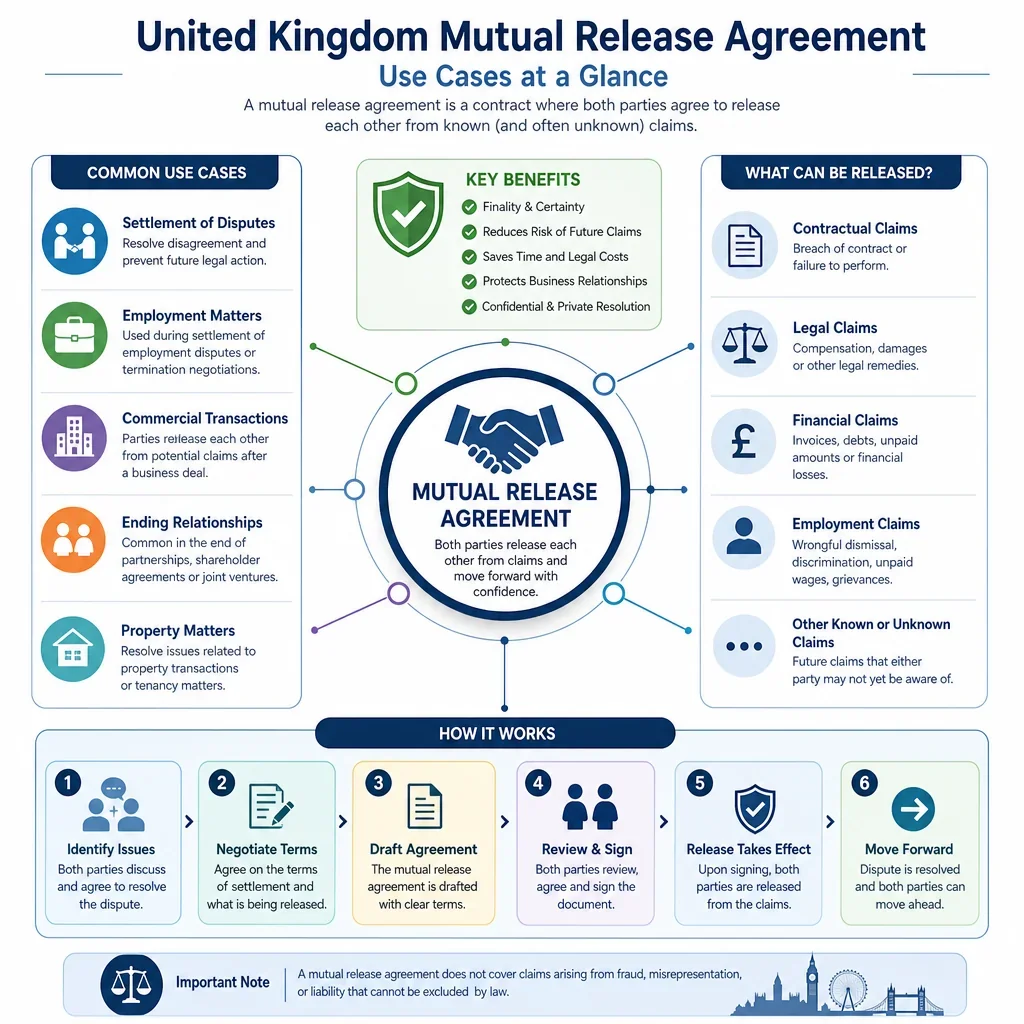
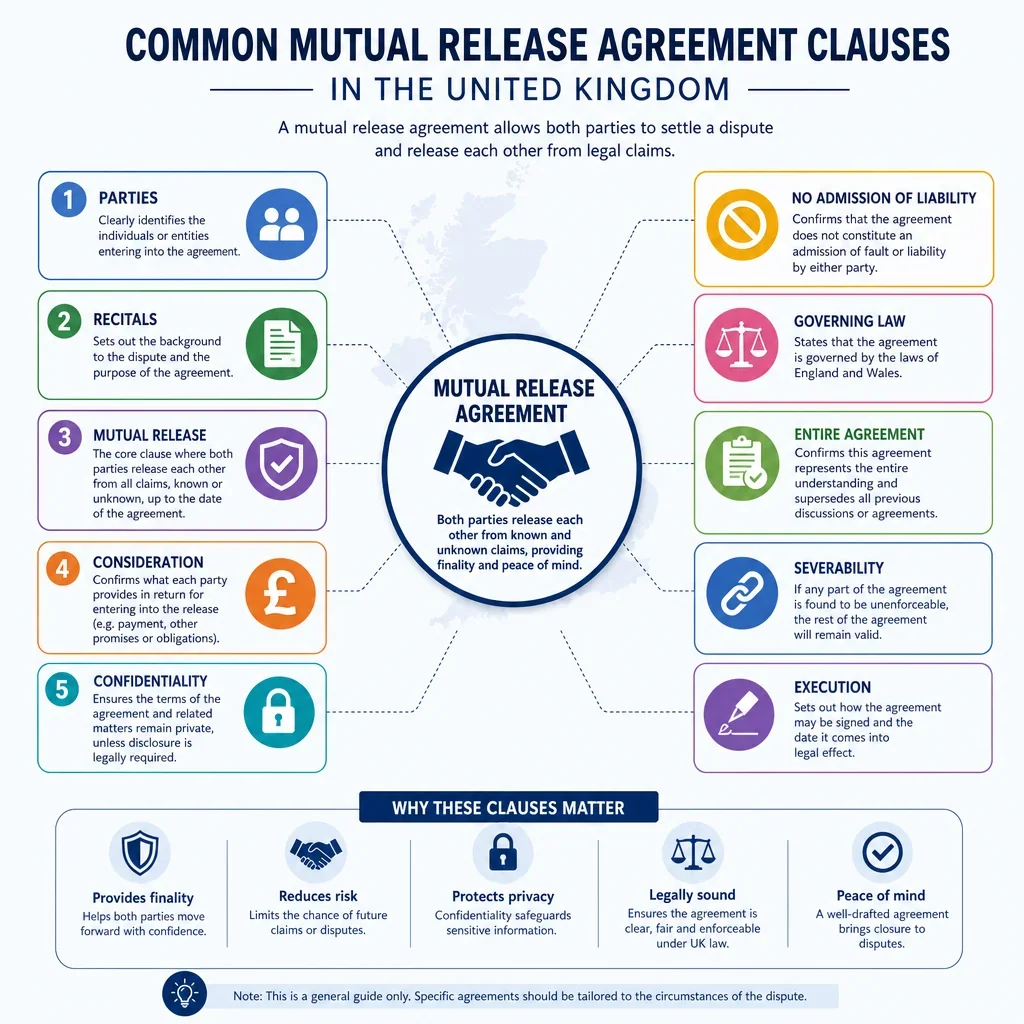
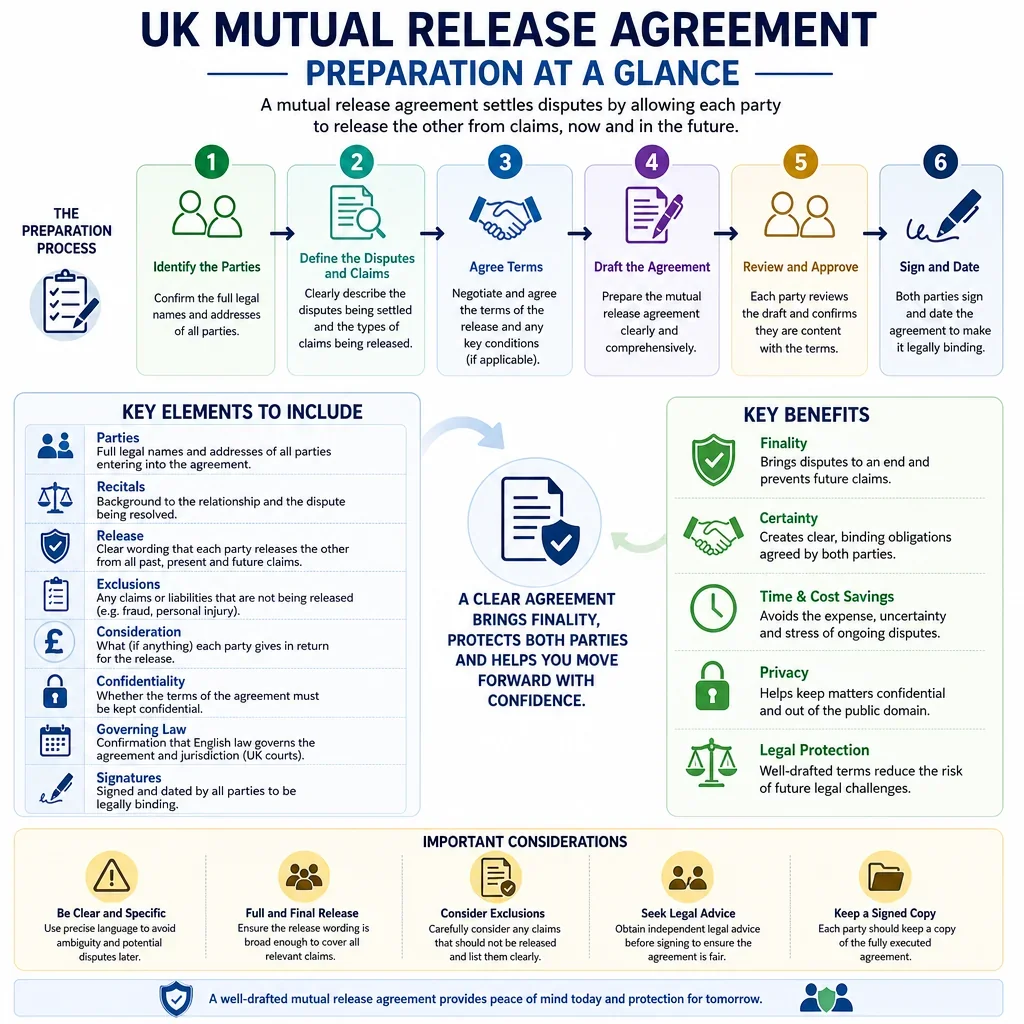
A mutual release agreement works best when the parties identify the exact dispute, contracts, invoices, events and claims being released. Vague wording can create uncertainty about whether unknown claims, future claims or statutory rights were intended to be covered.
When Should UK Parties Collect Evidence Before Signing?
Key evidence should be collected before drafting, including the underlying contract, correspondence, settlement emails, invoices, court or tribunal documents and any authority to sign. This helps ensure the release matches the real dispute and avoids releasing claims unintentionally.
What UK Legal Issues Need Special Care?
- Employment disputes: most statutory employment claims usually need an Acas COT3 or a compliant settlement agreement under section 203 of the Employment Rights Act 1996.
- Consumer or unfair terms: releases involving consumers or standard terms may need review under the Consumer Rights Act 2015 and unfair contract terms rules.
- Personal injury: attempts to exclude liability for death or personal injury caused by negligence are restricted by the Unfair Contract Terms Act 1977.
- Confidentiality and data: confidentiality, announcements and personal data handling should align with UK GDPR and the Data Protection Act 2018.
Why Do Signing And Payment Details Matter?
The agreement should state who signs, their authority, whether it is signed as a deed, when it takes effect, how payment is made and what happens if payment is late. These details are often decisive when a release is conditional on settlement funds clearing.
FAQs
You Might Also Be Interested In