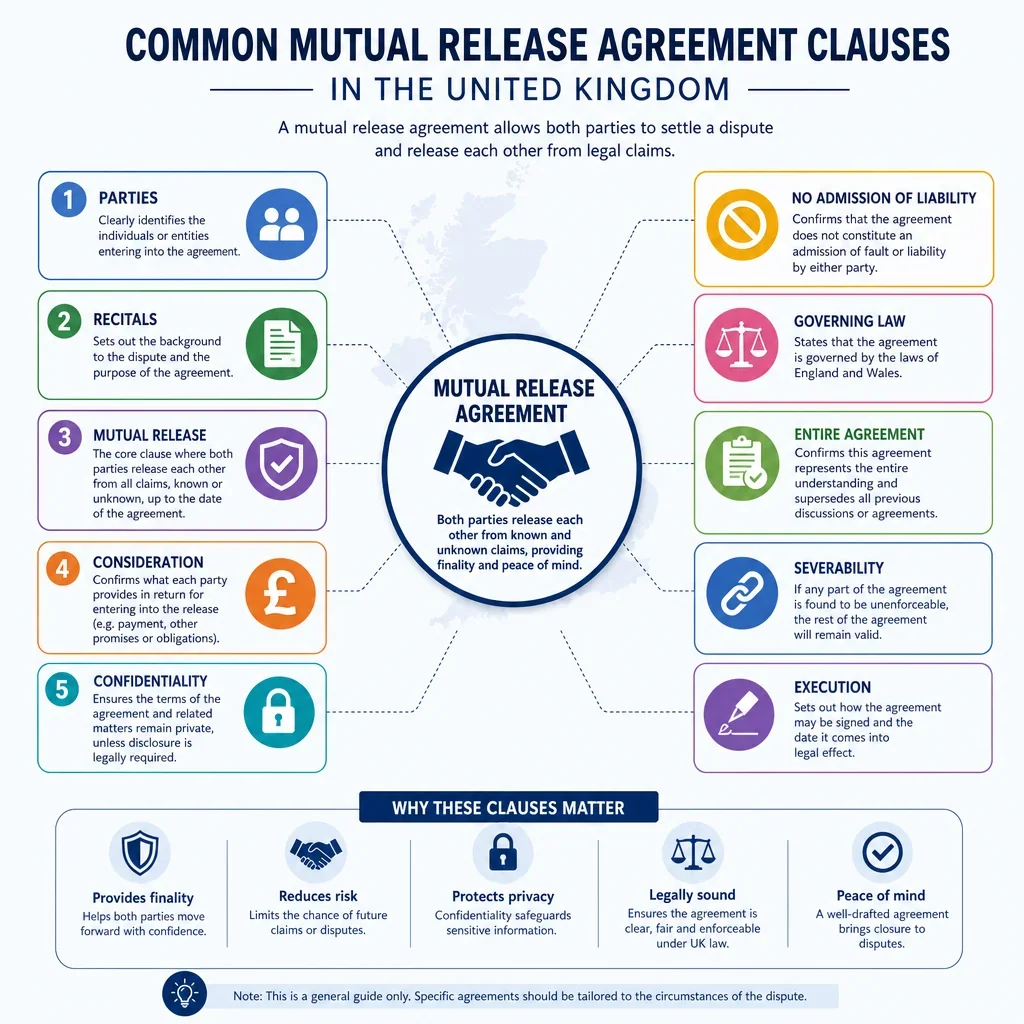
Common Mutual Release Agreement Clauses In The United Kingdom
Clause Name | Purpose | Importance Level | When To Include |
|---|---|---|---|
Core release | |||
Mutual Release Of Claims | Both parties release each other from specified claims. | Essential | In almost every mutual release or settlement. |
Definition Of Released Claims | Defines exactly which claims are being waived. | Essential | Where the release must cover contracts, debts, torts, or statutory claims. |
Known Claims Release | Releases claims already known to the parties. | Common | Where negotiations concerned identified disputes or invoices. |
Unknown Claims Release | Attempts to waive undiscovered claims arising before completion. | Context-specific | Where parties want finality beyond known disputes. |
Excluded Claims And Carve-Outs | Preserves claims that should not be waived. | Essential | Where future obligations, fraud, or statutory rights must remain enforceable. |
Future Obligations Carve-Out | Confirms ongoing duties are not released. | Essential | Where payment, confidentiality, handover, or warranties continue after signing. |
Liability limitation | |||
Fraud And Dishonesty Carve-Out | Prevents release of fraud or dishonest concealment. | Common | Where parties want enforceability without protecting wrongdoing. |
Criminal Liability Carve-Out | Confirms criminal matters are not compromised. | Optional | Where alleged misconduct may involve regulators or law enforcement. |
Core release | |||
No Admission Of Liability | Settlement is not treated as admitting fault. | Common | Where reputation, insurance, or regulatory consequences matter. |
Covenant Not To Sue | Promises not to start or continue released claims. | Common | Where extra protection against proceedings is required. |
Dispute resolution | |||
Withdrawal Of Proceedings | Requires existing claims to be discontinued or dismissed. | Context-specific | Where court, tribunal, arbitration, or adjudication is already underway. |
Payment | |||
Settlement Payment | States amount, payer, payee, and payment date. | Essential | Where any money is paid for the release. |
Payment Method And Bank Details | Specifies transfer method and account details. | Common | Where bank transfer, staged payment, or escrow mechanics are needed. |
Instalment Payments | Allows payment by agreed instalments. | Optional | Where the payer cannot or will not pay in one lump sum. |
Late Payment Interest | Applies interest if settlement sums are late. | Common | Where commercial debts or delayed settlement payment risk exists. |
VAT Treatment | States whether amounts include or exclude VAT. | Context-specific | Where settlement relates to taxable supplies or invoices. |
Tax Responsibility | Allocates responsibility for tax on payments. | Context-specific | Where employment, consultancy, or compensation payments may be taxable. |
Tax Indemnity | Protects payer if tax authority later seeks tax. | Context-specific | Common in employment and termination settlements. |
Legal Costs | States who pays legal costs and advice fees. | Common | Where solicitors, advisers, court costs, or settlement agreement advice are involved. |
Confidentiality | |||
Confidentiality Of Agreement | Keeps agreement terms and negotiations private. | Common | Where settlement amount, allegations, or business terms are sensitive. |
Permitted Disclosures | Allows disclosure to advisers, tax authorities, courts, and regulators. | Essential | Whenever confidentiality is imposed. |
Protected Disclosure Carve-Out | Preserves rights to make protected disclosures. | Context-specific | Employment, consultancy, regulated sector, or misconduct settlements. |
Non-Disparagement | Prevents damaging statements about the other party. | Optional | Where reputation, employment references, or public comments matter. |
Agreed Public Statement | Controls any public explanation of the settlement. | Optional | Where customers, employees, investors, or media may ask questions. |
Data Protection Compliance | Requires lawful handling of personal data. | Context-specific | Where personal data, personnel files, or customer records are exchanged. |
Return Or Destruction Of Confidential Information | Requires confidential material to be returned or destroyed. | Common | Business, employment, shareholder, or supplier exits. |
Liability limitation | |||
Limitation Of Liability | Caps liability for breach of settlement terms. | Optional | Where ongoing obligations create post-settlement liability risk. |
Reasonableness Of Liability Limits | Supports compliance with statutory reasonableness rules. | Context-specific | Where exclusions or caps may fall under UCTA 1977. |
Consumer Rights Carve-Out | Avoids excluding non-excludable consumer protections. | Context-specific | Where one party is a consumer or sole trader acting personally. |
Administrative | |||
Authority And Capacity Warranties | Confirms parties can enter and perform the agreement. | Essential | All agreements, especially companies, partnerships, estates, and agents. |
Core release | |||
No Assignment Of Claims Warranty | Confirms released claims have not been transferred. | Common | Where debts, insurance recoveries, or litigation rights may have been assigned. |
Boilerplate | |||
Third Party Rights | Controls whether non-parties can enforce benefits. | Common | Where group companies, officers, employees, or insurers are released. |
Core release | |||
Released Parties Definition | Identifies affiliates, directors, employees, and successors protected. | Essential | Where more than the named parties should be protected. |
Boilerplate | |||
Successors And Assigns | Binds successors and permitted assignees. | Common | Where parties may merge, sell assets, or transfer rights. |
No Waiver Of Settlement Breach | Prevents delay from waiving enforcement rights. | Common | Where performance may occur over time. |
Entire Agreement | Supersedes prior statements and negotiations. | Common | Where prior discussions should not create extra obligations. |
Variation In Writing | Requires amendments to be written and signed. | Common | Where parties want to prevent informal changes. |
Severance | Keeps agreement effective if one term is invalid. | Common | Useful where releases, exclusions, or restrictions may be challenged. |
Administrative | |||
Notices | Sets valid methods and addresses for notices. | Common | Where payment defaults, confidentiality breaches, or handover duties may arise. |
Dispute resolution | |||
Governing Law | States which UK legal system governs the agreement. | Essential | Always, especially across England, Wales, Scotland, or Northern Ireland. |
Jurisdiction | Chooses courts for disputes about the agreement. | Essential | Always, unless arbitration is chosen instead. |
Negotiation Or Mediation Before Proceedings | Requires escalation or mediation before litigation. | Optional | Where parties want a structured route before court action. |
Arbitration | Refers disputes to private arbitration. | Optional | High-value, cross-border, confidential, or specialist disputes. |
Enforcement Costs | Makes defaulting party pay enforcement costs. | Optional | Where payment default or breach risk is significant. |
Administrative | |||
Counterparts | Allows parties to sign separate copies. | Common | Remote signing or multiple parties. |
Electronic Signature | Allows valid electronic execution where appropriate. | Common | Remote execution or digital document workflows. |
Execution As A Deed | Uses deed formalities to strengthen enforceability. | Context-specific | Where consideration is unclear or limitation period benefits are wanted. |
Company Execution Formalities | Ensures company signing complies with statutory rules. | Context-specific | Where a UK company signs, especially as a deed. |
Core release | |||
Consideration | Identifies value exchanged for the mutual release. | Essential | Where the agreement is not executed as a deed. |
Administrative | |||
Effective Date | States when releases and obligations take effect. | Essential | All releases, especially if payment or signatures happen later. |
Core release | |||
Conditions Precedent To Release | Release takes effect only after conditions are met. | Context-specific | Where payment, handover, resignation, or discontinuance must occur first. |
Liability limitation | |||
Consequences Of Breach | States remedies for breach of settlement terms. | Common | Where confidentiality, payment, or non-disparagement is important. |
Payment | |||
Repayment Or Clawback | Requires repayment if key terms are breached. | Optional | Where settlement payment is conditional on confidentiality or handover. |
Liability limitation | |||
Indemnity For Third Party Claims | Protects against claims brought through the releasing party. | Context-specific | Where affiliates, assignees, employees, or subcontractors may bring claims. |
Administrative | |||
Insurance Notification And Recovery | Preserves or coordinates insurance notification and recoveries. | Context-specific | Where professional indemnity, directors, product, or liability insurance may respond. |
Core release | |||
Statutory Employment Claims Waiver | Waives employment claims only if statutory conditions are met. | Context-specific | Employee or worker settlement involving Employment Rights Act claims. |
Administrative | |||
Independent Legal Advice Certificate | Records required independent advice for employment settlement validity. | Context-specific | When settling statutory employment claims. |
Confidentiality | |||
Pre-Termination Negotiations Protection | Protects qualifying employment settlement negotiations from tribunal evidence. | Context-specific | Pre-termination employment negotiations about ordinary unfair dismissal. |
Core release | |||
Equality Act Claims Waiver | Waives discrimination claims only through compliant settlement terms. | Context-specific | Employment, services, partnership, or discrimination-related settlements. |
Administrative | |||
Employment Reference | Sets agreed form and process for references. | Optional | Employment exits where future references are important. |
Resignation Or Termination Arrangements | Records termination date, role exit, and practical steps. | Context-specific | Employment, director, partner, or shareholder exits. |
Core release | |||
Post-Termination Restrictions Preservation | Keeps valid restrictive covenants or duties alive. | Context-specific | Senior employee, founder, shareholder, or consultant exits. |
Administrative | |||
Intellectual Property Assignment Or Licence | Transfers or confirms rights to IP created before settlement. | Context-specific | Creative, software, consultancy, founder, or contractor disputes. |
Moral Rights Waiver | Waives author moral rights where legally possible. | Context-specific | Creative works, software documentation, designs, or marketing materials. |
Return Of Property | Requires return of equipment, keys, documents, and assets. | Common | Employment, tenancy, supplier, partnership, or business separation. |
Account And Access Removal | Removes system access and returns credentials. | Context-specific | Technology, employment, SaaS, agency, or contractor exits. |
Companies House Filings | Requires company filings after director or secretary changes. | Context-specific | Director, company secretary, shareholder, or founder settlements. |
Share Transfer Completion | Records share transfer documents and completion steps. | Context-specific | Shareholder, founder, investor, or joint venture exits. |
Core release | |||
Guarantee Or Security Release | Releases guarantees, charges, or security interests if agreed. | Context-specific | Loan, lease, supplier credit, or director guarantee settlements. |
Administrative | |||
Discharge Of Charges Or Liens | Requires registration or release of security interests. | Context-specific | Company security, asset finance, property, or secured debt settlements. |
Core release | |||
Lease Or Tenancy Release | Settles rent, dilapidations, deposit, or tenancy liabilities. | Context-specific | Landlord and tenant settlements or early surrender arrangements. |
Dispute resolution | |||
Construction Adjudication Settlement | Settles adjudication outcomes and related construction claims. | Context-specific | Construction contract, payment notice, defects, or adjudication disputes. |
Liability limitation | |||
Insolvency And Preference Carve-Out | Recognises insolvency claims may not be fully released. | Context-specific | Where a party is insolvent or at risk of insolvency. |
Core release | |||
Limitation Period Acknowledgement | Records timing of claims and settlement finality. | Optional | Where old claims, deed execution, or limitation deadlines matter. |
Confidentiality | |||
Without Prejudice Status | Preserves settlement privilege for negotiations where applicable. | Common | During genuine settlement negotiations before the final agreement. |
Administrative | |||
Subject To Contract Until Signed | Prevents binding settlement until execution. | Common | During negotiations or draft exchanges before approval. |
Board Or Member Approval | Makes settlement conditional on required approvals. | Context-specific | Companies, charities, LLPs, partnerships, clubs, or public bodies. |
Confidentiality | |||
Regulatory Notification Carve-Out | Allows reporting to regulators despite confidentiality. | Context-specific | Financial services, healthcare, legal services, charities, or regulated work. |
Administrative | |||
Sanctions And Anti-Bribery Compliance | Prevents payments or conduct breaching compliance laws. | Context-specific | Cross-border, high-risk, public sector, or agent-related settlements. |
Payment | |||
Source Of Funds And AML Checks | Allows checks before accepting settlement funds. | Context-specific | High-value, overseas, property, legal services, or regulated settlements. |
No Set-Off Or Deduction | Requires full payment without unilateral deductions. | Optional | Where counterclaims, invoices, or deductions may be asserted. |
Currency And Exchange Rate | States payment currency and exchange treatment. | Optional | Cross-border or foreign currency settlements. |
Escrow Or Stakeholder Payment | Holds settlement funds pending completion conditions. | Optional | Where simultaneous exchange, release, or handover is required. |
Core release | |||
Full And Final Settlement Acknowledgement | Confirms settlement fully resolves the specified dispute. | Essential | All final settlements and releases. |
Liability limitation | |||
No Reliance | Limits reliance on statements outside the agreement. | Common | Where parties want to avoid collateral misrepresentation arguments. |
Misrepresentation Carve-Out | Keeps exclusions aligned with misrepresentation controls. | Context-specific | Where no-reliance or entire-agreement wording limits misrepresentation claims. |
Core release | |||
Partnership Or LLP Release | Settles partner capital, profits, losses, and exit claims. | Context-specific | Partnership, LLP member, professional firm, or joint practice exits. |
Estate Or Probate Release | Settles beneficiary, executor, or estate administration claims. | Context-specific | Inheritance, executor, trustee, or family settlement disputes. |
Trustee Or Fiduciary Release | Settles claims against trustees or fiduciaries. | Context-specific | Trust, charity, pension, or fiduciary administration disputes. |
Payment | |||
Inclusive Settlement Sum | Clarifies whether payment includes interest, costs, and VAT. | Common | Where costs, interest, VAT, or expenses could be claimed separately. |
Core release | |||
Schedule Of Released Matters | Lists disputes, contracts, invoices, and proceedings released. | Common | Complex settlements involving several disputes or documents. |
Boilerplate | |||
Survival Of Key Clauses | Keeps confidentiality, law, payment, and enforcement terms alive. | Common | Where obligations continue after completion or termination. |
Administrative | |||
Delivery Of Signed Copies | Sets how signed copies are exchanged and delivered. | Optional | Remote, multi-party, or time-sensitive signing. |
Boilerplate | |||
Interpretation And Definitions | Explains defined terms and drafting conventions. | Common | Longer agreements with defined parties, claims, dates, or documents. |
Administrative | |||
Originals And Copies | Treats copies as valid evidence of the agreement. | Optional | Electronic files, scanned signatures, or remote completions. |
Dispute resolution | |||
Cumulative Remedies | Confirms remedies are additional unless stated otherwise. | Optional | Where injunctions, damages, repayment, and costs may all matter. |
Injunctive Relief For Confidentiality Breach | Allows urgent court orders for confidentiality breaches. | Optional | Sensitive commercial, employment, IP, or reputational settlements. |
Core release | |||
Customer Or Staff Non-Solicitation Preservation | Confirms agreed restrictions are not released. | Context-specific | Business sale, franchise, agency, employee, or shareholder exits. |
Payment | |||
Final Account Statement | Records final balance between the parties. | Common | Debt, construction, supplier, landlord, or partnership settlements. |
Security For Settlement Payment | Provides collateral or guarantee for deferred payment. | Optional | Large instalments, weak credit, or insolvency risk. |
Cross-Default | Makes one default trigger wider enforcement rights. | Optional | Multi-contract or staged settlement arrangements. |
Core release | |||
Agents And Representatives Release | Extends protection to advisers and representatives. | Context-specific | Where solicitors, agents, brokers, or negotiators may face related claims. |
Group Company Release | Releases parent, subsidiary, and affiliated companies. | Context-specific | Corporate groups, shared services, group contracting, or intra-group disputes. |
Partial Release Only | Limits release to named claims or documents only. | Context-specific | Where parties continue trading or have separate unresolved disputes. |
Reservation Of Rights | Preserves rights not expressly released. | Common | Where only a narrow settlement is intended. |
Continuing Contract Terms | Keeps specified contract provisions in force. | Context-specific | Ongoing customer, supply, licence, lease, or service relationships. |
Administrative | |||
Termination Of Underlying Contract | Ends the original contract as part of settlement. | Context-specific | Supplier, licence, employment, consultancy, or partnership separations. |
Dispute resolution | |||
Waiver Of Appeal Or Review Rights | Stops challenges to agreed orders or decisions. | Context-specific | Where proceedings, adjudications, or determinations are being settled. |
Consent Order Or Tomlin Order | Records settlement in a court order where appropriate. | Context-specific | Settling active civil proceedings in England and Wales. |
Employment Tribunal Withdrawal | Requires withdrawal or dismissal of tribunal claims. | Context-specific | Employment settlement where tribunal proceedings exist. |
ACAS COT3 Settlement | Uses ACAS conciliation settlement for employment disputes. | Context-specific | Employment claims settled through ACAS early conciliation. |
Administrative | |||
Further Assurance | Requires further documents to complete the settlement. | Common | Share transfers, IP assignments, releases of security, or filings. |
Records Retention | Allows lawful retention of necessary settlement records. | Optional | Where confidentiality or data deletion duties need retention exceptions. |
Liability limitation | |||
Non-Compromisable Family Or Maintenance Rights Carve-Out | Avoids releasing rights that private settlement cannot finally remove. | Context-specific | Family, cohabitation, divorce, or maintenance-related settlements. |
Personal Injury Unknown Claims Carve-Out | Preserves injury claims not intended to be settled. | Context-specific | Workplace, accident, property, or insurance settlements with injury risk. |
What Clauses Should A UK Mutual Release Agreement Usually Include?
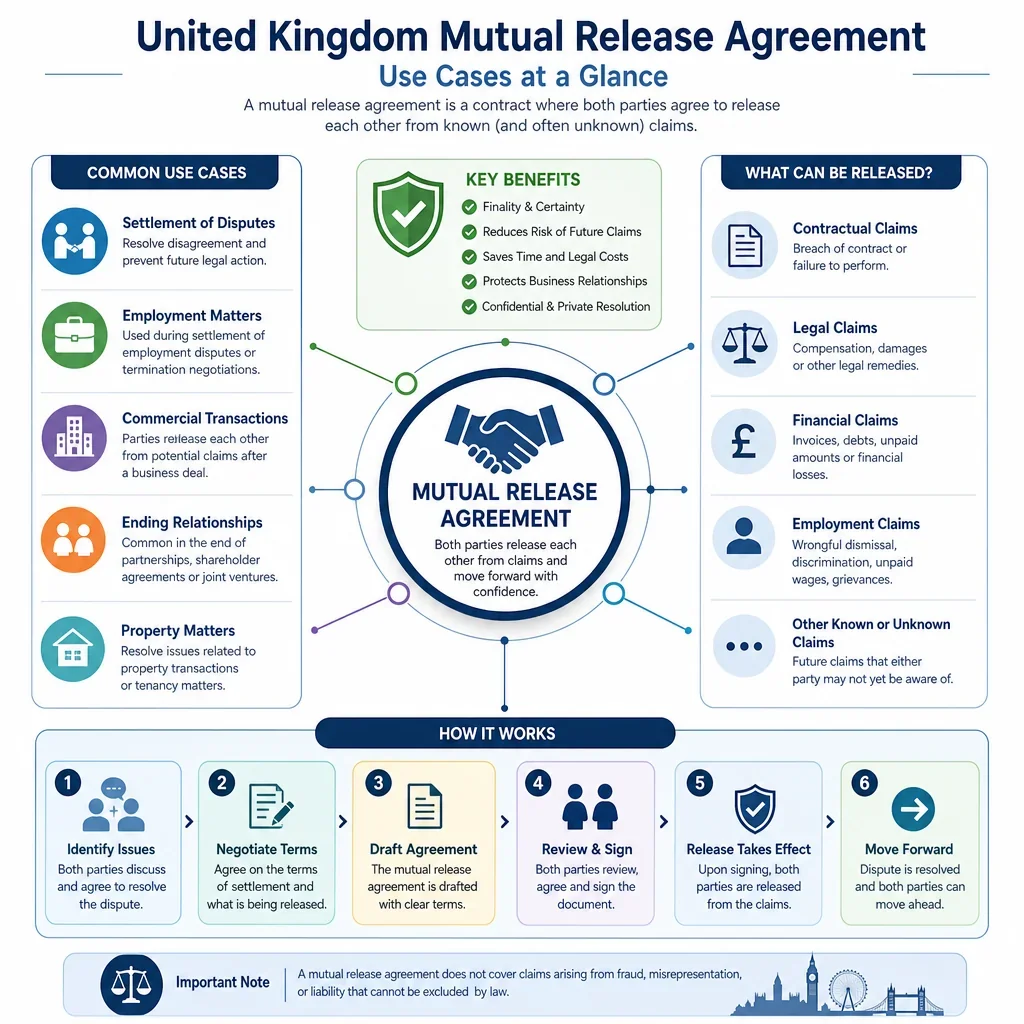
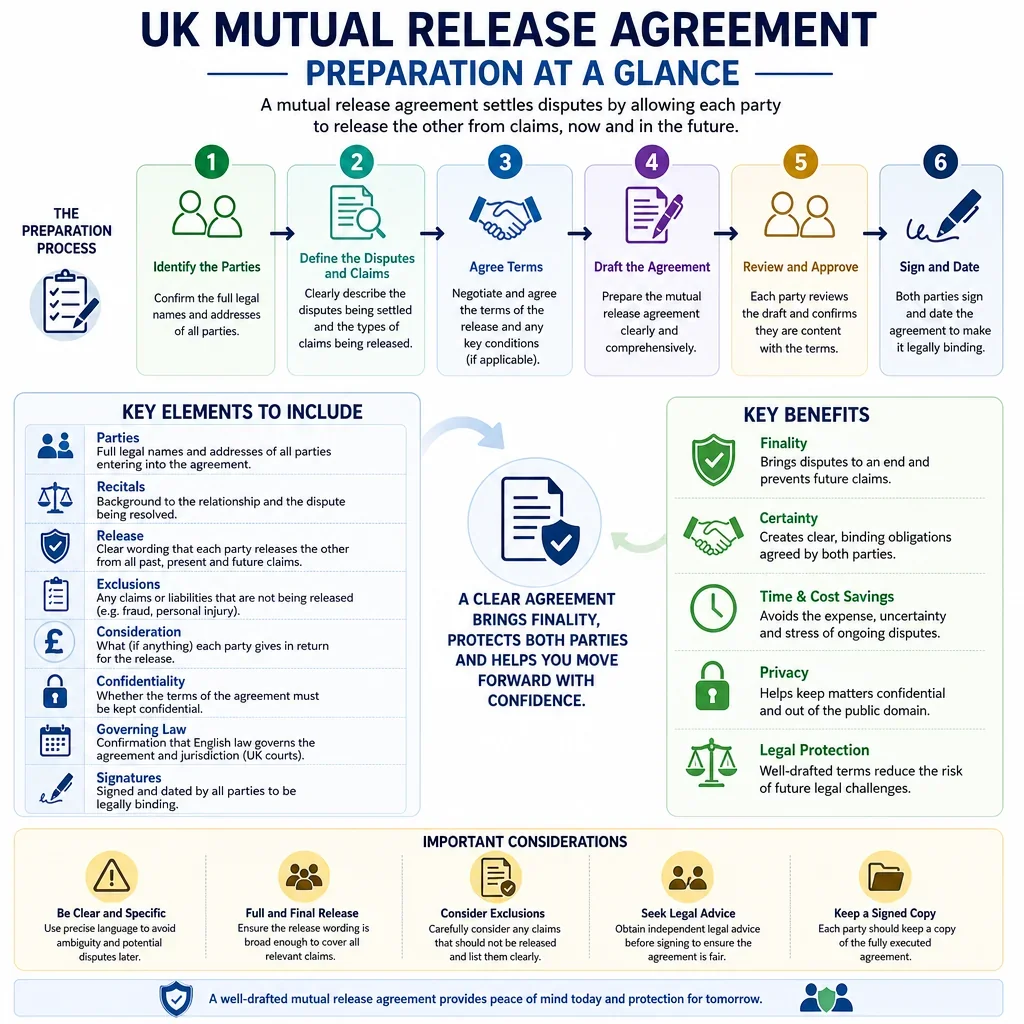
A robust UK mutual release agreement usually needs more than a simple statement that both sides release each other. The most important provisions define the released claims, identify the released parties, state the effective date, and set out any settlement payment or other consideration. Without these details, the parties may later dispute whether a particular debt, contract claim, employment claim, director claim, guarantee, or unknown liability was actually released.
Which Clauses Are Most Context-Specific In The UK?
Several clauses depend heavily on the facts. A Section 111A Employment Rights Act 1996 wording may be relevant to pre-termination employment negotiations, while a Section 203 Employment Rights Act 1996 waiver is only effective for many statutory employment claims if settlement agreement conditions are met. Clauses dealing with data protection, tax indemnities, insurance, intellectual property, property handover, and Companies Act filings should be included only where the release is connected to those issues.
Can A Mutual Release Exclude Fraud Or Future Claims?
UK agreements commonly carve out fraud, fraudulent misrepresentation, deliberate concealment, criminal liability, future obligations, and claims that cannot lawfully be compromised. This is important because over-broad releases can create enforceability risk, especially where consumer, employment, statutory, or public policy protections apply. Parties should be precise about whether the release covers only known claims, all claims arising before the date of the agreement, or specified unknown claims.
Why Do Boilerplate Clauses Matter In A Mutual Release?
Boilerplate clauses such as governing law, jurisdiction, entire agreement, third party rights, variation, counterparts, and notices reduce procedural uncertainty. For UK use, English law and English courts are common choices, but Scottish or Northern Irish arrangements may require different drafting. If non-parties such as group companies, directors, employees, insurers, or guarantors are intended to benefit, the agreement should address the Contracts (Rights of Third Parties) Act 1999.
FAQs
You Might Also Be Interested In