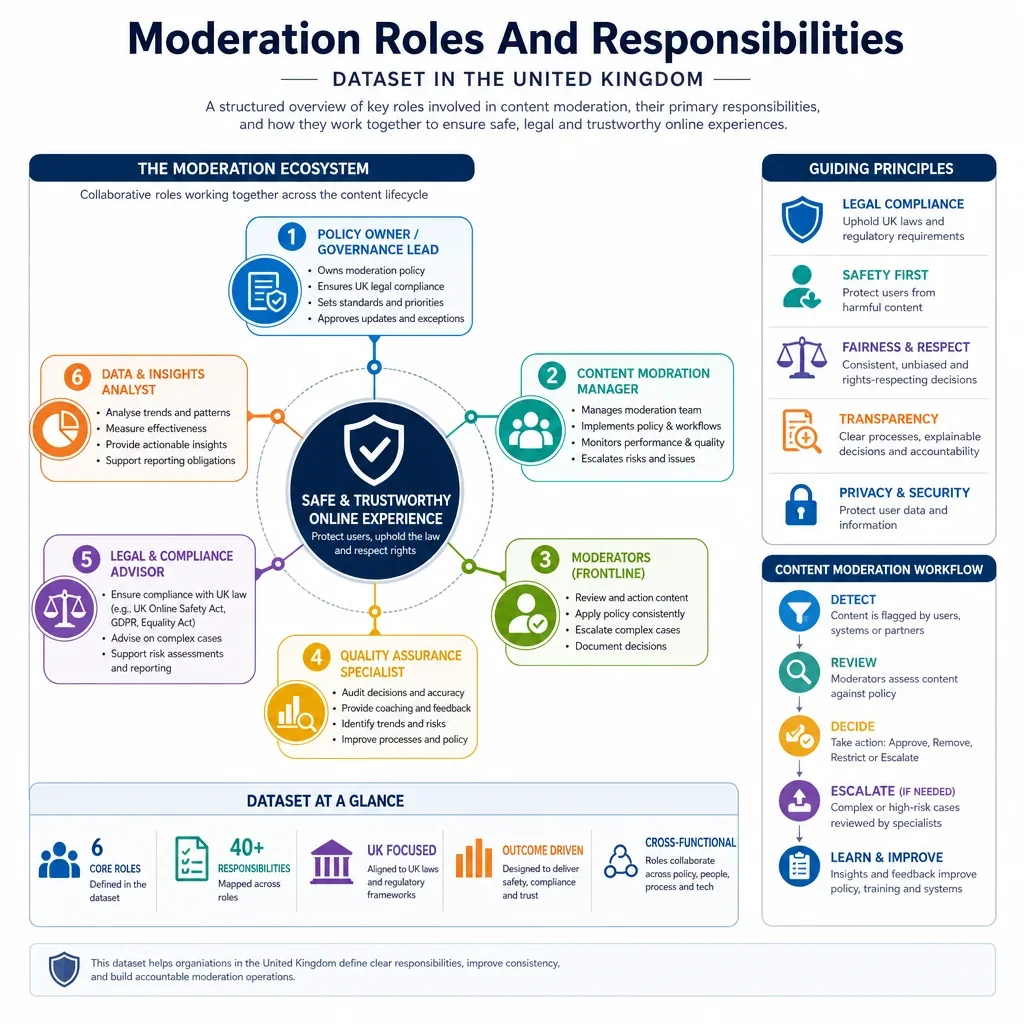
Moderation Roles And Responsibilities Dataset In The United Kingdom
Role Name | Role Description | Key Responsibilities | Authority Limits | Record Keeping Level |
|---|---|---|---|---|
Operational | ||||
Frontline Moderator | Reviews user content and applies moderation rules at first instance. | Assess content, remove or allow content, apply labels, issue warnings, and document decisions. | Must escalate borderline, illegal, child safety, legal, or high-profile cases. | Medium |
Supervisory | ||||
Senior Moderator | Experienced moderator who handles complex cases and supports frontline staff. | Review escalations, mentor moderators, resolve difficult cases, and check decision consistency. | Cannot change policy or decide major legal risks without governance approval. | High |
Moderation Team Lead | Manages the day-to-day moderation team and queue performance. | Allocate queues, monitor quality, approve escalations, manage staffing, and enforce procedures. | Needs policy owner approval for rule changes and legal approval for sensitive disclosures. | High |
Operational | ||||
Queue Manager | Controls prioritisation of moderation queues and service levels. | Triage reports, prioritise urgent harms, route cases, and manage backlog risks. | May prioritise cases but should not override substantive moderation outcomes. | Medium |
Governance | ||||
Content Policy Owner | Owns the content moderation policy and rule framework. | Draft rules, approve updates, define enforcement actions, and align policy with legal duties. | Needs senior approval for major risk, product, or terms changes. | High |
Trust and Safety Manager | Leads the operational trust and safety function for user-generated content. | Oversee enforcement strategy, risk controls, team capability, escalations, and incident response. | Must escalate legal compliance, budget, and major public-interest risks to leadership. | High |
Operational | ||||
Appeals Reviewer | Reviews user appeals against moderation decisions. | Reassess decisions, consider user evidence, uphold or overturn outcomes, and record reasons. | Should be independent from the original decision where practicable must escalate legal issues. | High |
Support | ||||
Complaints Handler | Handles complaints about moderation decisions, process failures, or user safety concerns. | Acknowledge complaints, gather evidence, coordinate review, communicate outcomes, and track trends. | Cannot determine complex legal, child safety, or law enforcement matters alone. | High |
Legal Counsel | Provides legal advice on moderation, disclosures, liability, and regulatory obligations. | Advise on illegal content, defamation, privacy, IP, regulatory notices, and enforcement risk. | Advises on legal risk final commercial decisions may require senior management approval. | High |
Governance | ||||
Data Protection Officer | Oversees data protection compliance in moderation processes. | Advise on UK GDPR, DPIAs, retention, access controls, user rights, and data sharing. | Must act independently does not own operational moderation decisions. | High |
Support | ||||
Privacy Lead | Manages privacy controls where moderation uses personal data. | Review data minimisation, retention, redaction, access permissions, and privacy notices. | Must escalate high-risk processing to the DPO or senior owner. | High |
Governance | ||||
Child Safety Lead | Leads moderation controls for child safety and child sexual exploitation risks. | Escalate child harm, approve safety actions, coordinate reporting, and train moderators. | Must follow legal reporting and evidence preservation procedures cannot ignore urgent risks. | High |
Operational | ||||
Illegal Content Specialist | Reviews suspected illegal content and advises on applicable escalation routes. | Assess illegality indicators, prioritise serious harm, preserve evidence, and escalate to legal teams. | Must not provide formal legal determinations unless legally authorised. | High |
Terrorism Content Escalation Lead | Handles suspected terrorist content and related urgent escalations. | Review terrorism indicators, remove high-risk content, preserve evidence, and liaise with legal contacts. | Must escalate law enforcement requests and uncertain cases to legal counsel. | High |
Hate and Harassment Specialist | Assesses hate speech, harassment, abuse, and targeted hostility cases. | Apply abuse rules, assess protected characteristic context, recommend sanctions, and track repeat conduct. | Must escalate threats, criminal hate indicators, and public figure cases. | High |
Threats and Violence Specialist | Reviews threats, incitement, self-harm, and credible violence risks. | Assess credibility, prioritise imminent harm, escalate emergencies, and recommend restrictions. | Emergency disclosures or police contact require approved legal or safety process. | High |
Support | ||||
Self-Harm and Suicide Safety Lead | Oversees response to self-harm, suicide, and vulnerable user content. | Escalate imminent risk, apply supportive interventions, coordinate crisis resources, and train reviewers. | Cannot provide clinical advice urgent risk must follow approved emergency procedures. | High |
Operational | ||||
Fraud and Scams Specialist | Reviews suspected fraud, scams, impersonation, and financial harm content. | Detect scam patterns, remove fraudulent content, restrict accounts, and escalate serious fraud indicators. | Must escalate suspected criminal networks, payment data, and law enforcement issues. | High |
Intellectual Property Takedown Officer | Handles copyright, trade mark, and counterfeit content complaints. | Review IP notices, request evidence, remove infringing content, and handle counter-notices. | Complex ownership disputes and legal threats require legal counsel review. | High |
Support | ||||
Defamation Review Lead | Coordinates review of allegedly defamatory user content. | Assess defamation complaints, preserve evidence, seek legal advice, and manage takedown responses. | Should not determine contested defamation issues without legal counsel. | High |
User Support Agent | Provides user-facing support about moderation actions and reporting tools. | Answer queries, explain procedures, route reports, and provide standard policy information. | Cannot reverse decisions unless authorised must escalate appeals and safety risks. | Medium |
Community Manager | Manages community standards, user engagement, and non-enforcement interventions. | Promote positive conduct, issue guidance, identify community tensions, and feed policy insights. | Should not make serious enforcement decisions without moderation team involvement. | Medium |
Governance | ||||
Policy Reviewer | Periodically reviews moderation rules for clarity, consistency, and legal alignment. | Review enforcement data, propose updates, assess edge cases, and document rationale. | May recommend changes but final approval sits with the policy owner or board. | High |
Support | ||||
Quality Assurance Analyst | Audits moderation decisions for accuracy, consistency, and procedural compliance. | Sample decisions, score quality, identify errors, recommend training, and report trends. | Usually cannot overturn decisions directly unless granted review authority. | High |
Moderation Trainer | Trains moderators on policy rules, tools, wellbeing, and escalation procedures. | Deliver onboarding, maintain guidance, run calibration sessions, and assess readiness. | Cannot approve policy changes without the policy owner. | Medium |
Moderator Wellbeing Lead | Supports moderators exposed to distressing or harmful content. | Monitor wellbeing risks, arrange support, manage exposure controls, and escalate workplace concerns. | Must refer health, HR, or safeguarding issues to appropriate specialists. | Medium |
Governance | ||||
Product Safety Manager | Ensures platform features support safe and effective moderation. | Design reporting flows, friction, user controls, age-appropriate protections, and safety mitigations. | Must obtain legal, privacy, and leadership sign-off for high-impact product changes. | High |
Support | ||||
Reporting Tools Owner | Owns user reporting, flagging, and abuse notification mechanisms. | Maintain report forms, categories, routing rules, acknowledgements, and accessibility of reporting tools. | Cannot change enforcement standards without policy approval. | Medium |
Governance | ||||
Automated Moderation Systems Owner | Owns automated detection, ranking, filtering, and moderation tooling. | Set tool requirements, monitor errors, manage thresholds, support human review, and document limitations. | High-impact automation requires privacy, legal, and governance approval. | High |
Support | ||||
AI Model Risk Reviewer | Reviews risks from AI systems used to detect or action content. | Assess bias, false positives, explainability, human oversight, and data protection impacts. | Can recommend suspension or controls deployment decisions require accountable owner approval. | High |
Governance | ||||
Transparency Reporting Lead | Prepares transparency and accountability reporting on moderation activity. | Compile metrics, explain enforcement trends, verify data, and support regulatory reporting. | Published reports require legal, policy, and senior sign-off. | High |
Online Safety Compliance Officer | Coordinates compliance with UK online safety obligations. | Track duties, maintain compliance evidence, coordinate risk assessments, and liaise with Ofcom where needed. | Cannot override board risk decisions must escalate non-compliance promptly. | High |
Support | ||||
Regulatory Liaison Officer | Manages communications with regulators about moderation and platform safety. | Coordinate responses, track deadlines, gather evidence, and maintain regulator contact records. | Substantive submissions require legal and senior approval. | High |
Law Enforcement Liaison Officer | Handles lawful requests and urgent contacts from law enforcement agencies. | Verify requests, coordinate preservation, manage disclosures, and record legal basis. | User data disclosures require legal basis and approved process. | High |
Evidence Preservation Officer | Preserves moderation evidence for disputes, investigations, and lawful requests. | Secure snapshots, logs, metadata, chain of custody, retention holds, and deletion releases. | Retention beyond normal periods needs legal or privacy approval. | High |
Supervisory | ||||
Incident Response Lead | Coordinates major moderation incidents and safety crises. | Activate incident plans, assign workstreams, approve urgent mitigations, and lead post-incident review. | Public statements, legal notifications, and major product actions require senior approval. | High |
Support | ||||
Crisis Communications Lead | Manages external and internal communications during moderation incidents. | Prepare statements, coordinate user messaging, brief stakeholders, and align communications with facts. | Cannot publish sensitive statements without legal and executive sign-off. | Medium |
Governance | ||||
Senior Accountable Officer | Senior leader accountable for moderation governance and safety risk management. | Approve risk appetite, major controls, resourcing, policy direction, and regulatory response strategy. | Must act within law, board governance, and regulatory obligations. | High |
Board Sponsor | Board-level sponsor for online safety and moderation governance. | Receive risk reports, challenge controls, approve strategic changes, and oversee accountability. | Does not handle individual cases except exceptional reputational or legal matters. | High |
Risk Committee | Governance body reviewing systemic moderation, safety, and compliance risks. | Review dashboards, incidents, audit findings, risk assessments, and remediation plans. | Individual enforcement decisions remain with operational or appeal roles. | High |
Internal Audit Reviewer | Independently audits moderation controls and governance evidence. | Test controls, review records, assess compliance, identify gaps, and track remediation. | Provides assurance and recommendations does not run moderation operations. | High |
Support | ||||
External Expert Reviewer | Independent specialist engaged to review sensitive cases or systemic policy issues. | Provide expert input on harm, rights, safety, language, culture, or technical issues. | Advisory only unless contractually given decision-making authority. | Medium |
Human Rights and Freedom of Expression Reviewer | Reviews difficult moderation cases affecting expression, journalism, protest, or public interest. | Assess proportionality, public interest, context, and less restrictive enforcement options. | Advice must be balanced against contractual terms, safety duties, and legal risk. | High |
Equality and Accessibility Lead | Advises on fair, accessible, and non-discriminatory moderation processes. | Review accessibility, reasonable adjustments, bias risks, protected characteristics, and inclusive notices. | Cannot override safety decisions but can require escalation of discrimination risks. | Medium |
Governance | ||||
Age Assurance Lead | Manages age-related controls affecting moderation and child safety. | Set age assurance requirements, review age signals, manage child access controls, and document risks. | High-risk age assurance methods require privacy, legal, and product approval. | High |
Supervisory | ||||
Vendor Moderation Manager | Manages outsourced moderation providers and contractual performance. | Set SLAs, monitor quality, ensure training, audit vendor controls, and manage data access. | Cannot delegate legal accountability major vendor changes need procurement and legal approval. | High |
Support | ||||
Data Access Administrator | Controls access rights to moderation tools, queues, and user data. | Provision accounts, review permissions, revoke access, monitor privileged access, and keep logs. | Access must follow approved role-based permissions and least privilege principles. | High |
Security Lead | Protects moderation systems, evidence, logs, and staff accounts from security threats. | Manage system security, incident response, access monitoring, logging, and vulnerability remediation. | Content decisions remain with moderation security incidents require approved escalation. | High |
Governance | ||||
Terms of Service Owner | Owns the user terms that authorise moderation actions. | Maintain enforceable terms, align policy language, approve user notice wording, and manage updates. | Legal review required for material changes affecting consumer rights or platform liability. | High |
Support | ||||
Consumer Protection Compliance Lead | Reviews moderation rules and user communications for consumer law fairness. | Check fairness of terms, notices, sanctions, subscription impacts, and complaint routes. | Cannot approve unfair terms legal review required for complex consumer issues. | Medium |
Operational | ||||
Sanctions and Account Enforcement Officer | Applies account-level sanctions after content or conduct breaches. | Issue warnings, suspensions, bans, feature limits, and repeat-offender sanctions. | Permanent bans, monetisation loss, or high-value account action may require senior review. | High |
Support | ||||
Notice and Explanation Officer | Ensures users receive clear notices about moderation decisions. | Draft templates, include rule references, explain outcomes, and signpost appeal routes. | Cannot disclose sensitive enforcement methods or third-party personal data without approval. | Medium |
Operational | ||||
User Reporting Reviewer | Reviews reports submitted by users or trusted flaggers. | Validate reports, classify harm type, request context, and route for moderation action. | May triage but should not decide complex enforcement without moderator review. | Medium |
Support | ||||
Trusted Flagger Coordinator | Manages relationships with trusted reporters and expert flagging partners. | Onboard partners, prioritise trusted reports, monitor report quality, and manage feedback loops. | Trusted reports should inform but not automatically determine enforcement outcomes. | Medium |
Localisation and Language Reviewer | Provides language, slang, dialect, and cultural context for moderation cases. | Interpret context, identify coded abuse, review translations, and support consistent decisions. | Advisory role unless trained and authorised as a moderator. | Medium |
Operational | ||||
Marketplace Safety Reviewer | Reviews prohibited listings, unsafe goods, and marketplace abuse. | Remove banned listings, escalate dangerous products, review seller conduct, and coordinate recalls. | Product safety, recall, or criminal matters require legal or compliance escalation. | High |
Advertising Content Reviewer | Reviews ads and promoted content for policy and advertising standards compliance. | Review misleading claims, restricted categories, targeting concerns, and ad landing pages. | Regulated ads and legal claims require specialist or legal approval. | High |
Political Content Reviewer | Reviews political, electoral, civic, or public-interest content escalations. | Assess election misinformation, impersonation, civic harm, public interest, and labelling options. | High-profile or election-period decisions require policy, legal, and communications escalation. | High |
Governance | ||||
Misinformation Policy Specialist | Develops and applies rules for harmful misinformation and manipulated media. | Define harm thresholds, assess expert sources, recommend labels, removals, or friction. | Public health, election, or national security cases require expert and legal escalation. | High |
Support | ||||
Medical Misinformation Adviser | Provides expert input on health-related misinformation moderation. | Advise on health claims, credible sources, risk of harm, and proportional interventions. | Advisory only cannot provide personal medical advice to users. | Medium |
Research and Risk Analyst | Analyses moderation trends, harms, abuse tactics, and emerging risks. | Produce risk reports, detect coordinated abuse, evaluate controls, and support policy changes. | Analytical role enforcement action requires authorised moderation staff. | Medium |
Metrics and Data Analyst | Maintains moderation metrics, dashboards, and performance reporting. | Track volumes, action rates, appeal outcomes, error rates, response times, and SLA performance. | Must avoid unauthorised personal data use and escalate data quality issues. | Medium |
Governance | ||||
Retention and Deletion Owner | Owns retention rules for moderation records, evidence, and user reports. | Set retention periods, manage legal holds, approve deletion schedules, and document exceptions. | Must align retention with UK GDPR, legal holds, and law enforcement preservation duties. | High |
Support | ||||
Data Subject Rights Coordinator | Handles user rights requests affecting moderation data. | Coordinate access, deletion, objection, restriction, and rectification requests involving moderation records. | Must consider exemptions, third-party data, and legal holds before disclosure or deletion. | High |
Accessibility Complaints Handler | Handles complaints that moderation tools or notices are inaccessible. | Review accessibility barriers, coordinate adjustments, improve templates, and escalate discrimination risks. | Cannot reject reasonable adjustment issues without equality or legal review. | Medium |
Repeat Offender Analyst | Identifies repeat violators, ban evasion, and coordinated harmful behaviour. | Analyse account history, link patterns, recommend sanctions, and support enforcement escalation. | Account linking and profiling must follow privacy controls and approved thresholds. | High |
Vulnerable User Support Lead | Coordinates moderation responses involving vulnerable adults or at-risk users. | Escalate safeguarding concerns, adapt communications, coordinate support resources, and document risk decisions. | Cannot provide professional safeguarding advice unless qualified urgent risks require escalation. | High |
User Education Lead | Creates guidance to help users understand rules and safer participation. | Publish rule explainers, warning copy, safety prompts, and educational interventions. | Educational content must align with approved policy and legal requirements. | Low |
Governance | ||||
Policy Change Approver | Approves material changes to moderation rules and enforcement standards. | Review impact assessments, approve change logs, set implementation dates, and mandate training. | Must obtain legal, privacy, and senior approval for high-risk changes. | High |
Support | ||||
Calibration Facilitator | Runs sessions to align moderators on difficult or ambiguous policy applications. | Select sample cases, discuss outcomes, record agreed interpretations, and update guidance. | Cannot create binding rules unless approved by policy owner. | Medium |
Operational | ||||
High-Profile Account Reviewer | Handles escalations involving public figures, journalists, brands, or large accounts. | Apply standard rules, assess public interest, coordinate communications, and prevent inconsistent treatment. | Must not give preferential treatment sensitive cases require policy and legal review. | High |
Monetisation Enforcement Reviewer | Reviews moderation actions affecting revenue, creator payments, or advertising eligibility. | Apply monetisation rules, suspend earnings, restore eligibility, and explain commercial impacts. | Significant financial impacts or contractual disputes require legal or commercial approval. | High |
Who Should Be Named In A UK Content Moderation Policy?
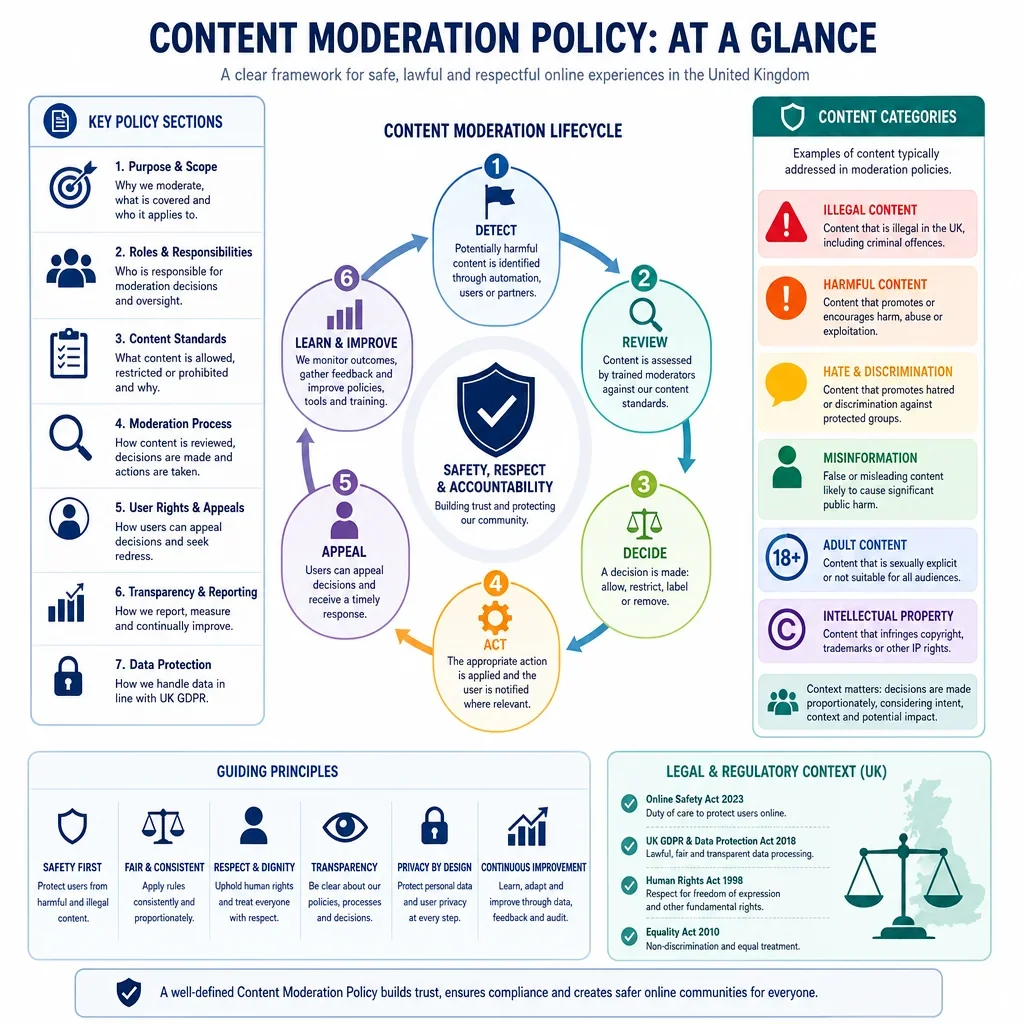
A robust UK moderation policy should separate operational decisions, appeals, legal escalation, data protection, and senior governance. The dataset shows that high-risk actions, such as removing lawful-but-sensitive content, reporting suspected illegal content, restricting accounts, or disclosing user data, should not sit with a single frontline moderator.
Which Moderation Roles Need The Highest Record Keeping?
High record keeping is most important for roles that make or review impactful decisions: trust and safety leads, appeals reviewers, complaints handlers, legal counsel, DPOs, child safety leads, law enforcement liaison, and senior accountable officers. Records should capture the content reviewed, policy rule applied, rationale, user notice, reviewer identity, escalation path, and outcome.
How Do UK Legal Duties Affect Moderation Responsibilities?
UK services should align moderation governance with duties under the Online Safety Act 2023, UK GDPR and the Data Protection Act 2018, consumer protection rules, equality law, and defamation risk. In practice, this means assigning named owners for illegal content escalation, child protection, user complaints, data access controls, transparency reporting, and legal review of difficult cases.
What Is The Safest Escalation Model For Content Moderation?
The records support a tiered model: frontline moderators handle routine enforcement; senior moderators and queue leads handle complex or borderline cases; specialist teams cover child safety, terrorism, fraud, intellectual property, privacy, and vulnerable users; independent appeals or review roles reassess disputed outcomes; and governance roles audit consistency and approve policy changes.
Why Should Appeals Be Kept Separate From Initial Moderation?
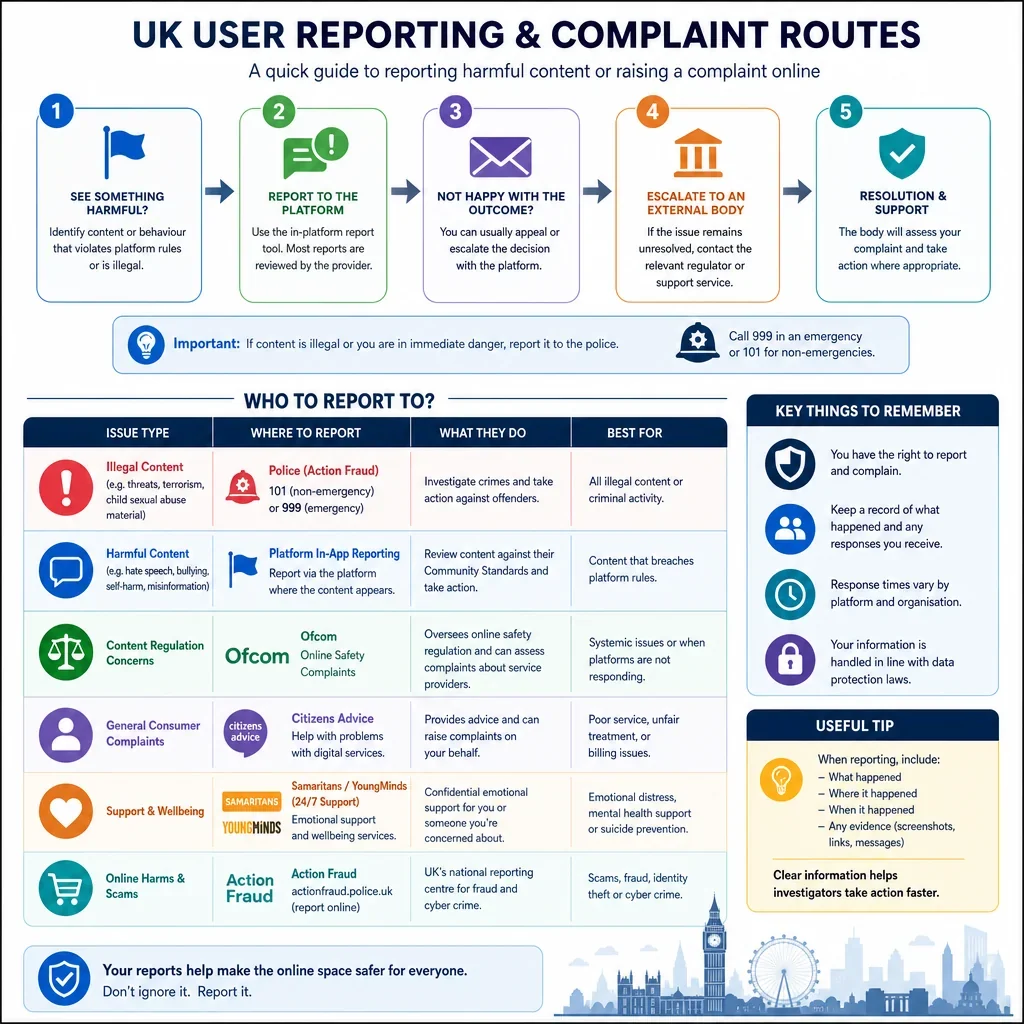
Separating appeals from first-instance moderation reduces bias, improves procedural fairness, and supports defensible records if a user challenges a decision. Appeals reviewers should generally be able to uphold, overturn, or vary a moderation outcome, but should escalate legal, child safety, law enforcement, or systemic policy issues.
FAQs
You Might Also Be Interested In