United Kingdom Letter Of Intent Clause Library
Clause Name | Clause Purpose | Typical Binding Treatment | Drafting Risk | Drafting Notes |
|---|---|---|---|---|
Commercial term | ||||
Transaction Description | Identifies the proposed deal or project covered by the letter. | Usually non-binding | Medium | Keep factual and avoid language suggesting a concluded agreement. |
Indicative Price | States a proposed or indicative price for the transaction. | Usually non-binding | High | Say it is indicative, subject to diligence, contract, and approvals. |
Valuation Basis | Explains assumptions behind the proposed valuation. | Usually non-binding | Medium | List assumptions such as cash-free debt-free, working capital, and accounts date. |
Payment Terms | Outlines proposed timing and method of payment. | Usually non-binding | Medium | Clarify whether completion payments, deferred payments, or instalments are illustrative only. |
Deposit | Records any proposed upfront payment or holding deposit. | May be binding | High | State if paid, refundable, forfeitable, held on trust, or credited at completion. |
Deferred Consideration | Sets out proposed post-completion payment mechanics. | Usually non-binding | High | Keep high-level unless formula, dates, and contingencies are fully intended. |
Earn-Out | Describes proposed performance-linked future consideration. | Usually non-binding | High | Flag accounting basis, targets, control, information rights, and dispute process. |
Assets Included | Lists the assets proposed to be included in the transaction. | Usually non-binding | Medium | Avoid exhaustive transfer language unless the clause is intended to bind. |
Excluded Assets | Identifies assets not expected to transfer. | Usually non-binding | Medium | Use indicative wording and reconcile with diligence findings. |
Assumed Liabilities | Outlines liabilities proposed to be assumed or excluded. | Usually non-binding | High | State assumptions clearly avoid binding debt assumption language. |
Shares To Be Acquired | Specifies proposed share class and percentage to be acquired. | Usually non-binding | Medium | Check issued share capital, options, pre-emption rights, and consents. |
Property Terms | Summarises proposed lease, sale, or occupation terms. | Depends on wording | High | For land sales, remember written signed contract requirements under section 2 LPMPA 1989. |
Contracting Out Of Security Of Tenure | Flags any intention to exclude business tenancy renewal rights. | Depends on wording | High | Formal warning and declaration procedure is needed before lease completion. |
Employee Transfer Assumptions | Records assumptions about employees moving with a business transfer. | Usually non-binding | High | Address TUPE assumptions, consultation, employee liability information, and indemnities later. |
Intellectual Property Treatment | States proposed ownership, licensing, or assignment approach for IP. | Usually non-binding | High | Identify registered rights, background IP, foreground IP, and licence scope. |
Technology Access | Outlines proposed access to software, systems, or platforms. | May be binding | Medium | If access begins before contract, include security, licence, and revocation terms. |
Scope Of Services | Summarises proposed services, deliverables, or collaboration scope. | Usually non-binding | Medium | Avoid detailed commitment wording unless interim services are intended. |
Proposed Contract Term | States expected duration of the final agreement. | Usually non-binding | Low | Distinguish final contract term from LOI expiry or exclusivity period. |
Process term | ||||
Conditions Precedent | Lists events that must occur before the main deal proceeds. | Depends on wording | High | State whether conditions are process milestones only or binding obligations. |
Due Diligence Access | Allows access to information for investigation before contract. | Often binding | Medium | Tie access to confidentiality, data protection, privilege, and reasonable notice. |
Data Room Rules | Controls use, copying, and access to data room material. | Often binding | Medium | Specify authorised users, download limits, audit trail, and withdrawal rights. |
Indicative Timetable | Sets expected milestones for diligence, negotiation, and completion. | Usually non-binding | Low | Use target dates and avoid absolute obligations unless intended. |
Definitive Agreements | Confirms final obligations will be in later signed documents. | Often binding | High | Use clear subject to contract wording to avoid unintended contractual effect. |
Subject To Contract | States that main deal terms are not binding until formal contract. | Often binding | High | Repeat consistently and carve out clauses intended to bind immediately. |
No Obligation To Proceed | Preserves freedom not to complete the proposed transaction. | Often binding | High | State neither party must proceed unless and until definitive documents are signed. |
Binding Clauses List | Identifies which provisions are legally binding. | Often binding | High | List binding clauses expressly and say all others are non-binding. |
Internal Approvals | Makes the proposal subject to board, investor, or management approval. | Depends on wording | Medium | Specify whose approval is needed and whether seeking it is obligatory. |
Regulatory Approvals | Flags approvals or clearances required from regulators. | Depends on wording | High | Consider CMA merger control, sector consents, subsidies, sanctions, and investment screening. |
National Security And Investment Clearance | Addresses possible UK investment screening approval requirements. | Depends on wording | High | Mandatory notification may apply in sensitive sectors before completion. |
Competition Law Compliance | Prevents exchange or coordination that could breach competition law. | Often binding | High | Limit competitively sensitive information sharing and avoid gun-jumping. |
Sanctions Compliance | Requires parties to comply with UK sanctions restrictions. | Often binding | High | Include screening, no prohibited dealings, and right to terminate for sanctions risk. |
Anti-Bribery And Corruption | Requires lawful conduct during negotiations and transaction planning. | Often binding | Medium | Cover improper payments, facilitation payments, gifts, and third-party advisers. |
Confidentiality | ||||
Confidentiality Obligation | Protects confidential information exchanged during negotiations. | Often binding | High | Define protected information, purpose, exceptions, duration, and permitted recipients. |
Existing NDA Priority | Coordinates the LOI with any earlier non-disclosure agreement. | Often binding | Medium | State whether the NDA survives, prevails, or is supplemented by the LOI. |
Permitted Disclosure | Allows disclosure to advisers, funders, group companies, or regulators. | Often binding | Medium | Require recipients to know and follow confidentiality restrictions. |
Compelled Disclosure | Allows disclosure required by law, court, regulator, or exchange. | Often binding | Medium | Require prior notice where lawful and limit disclosure to required extent. |
Return Or Destruction Of Information | Requires confidential materials to be returned or destroyed on request. | Often binding | Medium | Allow archival, legal, regulatory, and automatic backup exceptions. |
Personal Data Handling | Controls use of personal data shared during negotiations. | Often binding | High | Address UK GDPR roles, lawful basis, security, minimisation, and transfers. |
Public Announcements | Restricts public statements about the proposed transaction. | Often binding | Medium | Require consent, with exceptions for legal or market disclosure duties. |
Restricted Use Of Information | Limits information use to evaluating the proposed transaction. | Often binding | Medium | Define the permitted purpose narrowly and include affiliates and advisers. |
Non-Solicitation Of Staff | Restricts poaching employees during or after negotiations. | May be binding | High | Limit duration, roles covered, and exclude general recruitment adverts. |
Non-Solicitation Of Customers | Restricts targeting customers learned about through negotiations. | May be binding | High | Use only where justified narrow scope, customers, period, and territory. |
No Contact With Target Stakeholders | Prevents unauthorised contact with employees, customers, suppliers, or landlords. | Often binding | Medium | Permit approved contacts and ordinary-course existing relationships. |
Exclusivity | ||||
Exclusivity Period | Prevents a party from negotiating with others for a set period. | Often binding | High | Define duration, restricted transactions, affected parties, and permitted exceptions. |
Lock-Out Undertaking | Stops a seller from dealing with third-party bidders temporarily. | May be binding | High | Use a certain fixed period agreements to negotiate in good faith are risky. |
No-Shop Restriction | Prevents actively seeking competing offers. | Often binding | High | Define solicitation, indirect approaches, advisers, and unsolicited inbound interest. |
No-Talk Restriction | Restricts discussions with competing bidders or counterparties. | Often binding | High | Consider fiduciary duties, listed company rules, and board discretion. |
Standstill | Restricts acquiring securities or taking control-related steps. | Often binding | High | Use for public or widely held companies align with takeover and market rules. |
Costs and expenses | ||||
Break Fee | Requires payment if the proposed transaction does not proceed in defined cases. | May be binding | High | Define triggers, amount, genuine rationale, and any regulatory limits. |
Each Party Bears Own Costs | States each party pays its own negotiation and adviser costs. | Often binding | Medium | Say it survives termination and covers legal, tax, finance, and diligence costs. |
Expense Reimbursement | Requires one party to reimburse specified transaction costs. | May be binding | High | Cap amounts, define eligible costs, evidence, VAT treatment, and payment date. |
VAT Treatment | Records whether stated amounts include or exclude VAT. | May be binding | Medium | State VAT exclusivity, invoicing, and tax assumptions for fees and deposits. |
Stamp Taxes Responsibility | Allocates responsibility for stamp duty, SDLT, or related taxes. | May be binding | Medium | Specify buyer payment responsibility and note tax advice is deal-specific. |
Governing law | ||||
Governing Law | Selects the law governing the LOI. | Often binding | Medium | Use England and Wales, Scotland, or Northern Ireland deliberately. |
Jurisdiction | Identifies the courts for disputes about the LOI. | Often binding | Medium | Choose exclusive or non-exclusive jurisdiction and align with governing law. |
Dispute Resolution Process | Sets escalation, mediation, arbitration, or court steps for LOI disputes. | Often binding | Medium | Keep proportionate detailed arbitration clauses need seat, rules, and language. |
Service Of Notices And Process | Specifies how formal notices or proceedings may be served. | Often binding | Medium | Include addresses, email rules if allowed, deemed receipt, and agent details. |
Termination | ||||
Termination Rights | Allows parties to end the LOI or negotiation process. | Often binding | Medium | State notice requirements and effect on binding surviving clauses. |
Expiry Date | Sets the date the LOI or offer lapses. | Often binding | Low | Distinguish expiry of offer, exclusivity, confidentiality, and cost obligations. |
Survival Of Binding Terms | Confirms certain obligations continue after expiry or termination. | Often binding | Medium | List surviving clauses, especially confidentiality, costs, law, jurisdiction, and remedies. |
Termination For Breach | Allows termination if binding LOI obligations are breached. | Often binding | Medium | Identify material breaches and whether cure periods apply. |
Longstop Date | Sets final date for signing or completion target before process ends. | Depends on wording | Low | Clarify if it automatically ends exclusivity or only the commercial proposal. |
Process term | ||||
Good Faith Negotiations | Encourages parties to negotiate honestly or constructively. | Depends on wording | High | Avoid bare agreements to negotiate specify concrete conduct if binding. |
Reasonable Endeavours | Requires efforts to progress specified steps or approvals. | May be binding | High | Identify the objective, effort standard, deadline, and excluded burdens. |
Other | ||||
No Reliance On Information | Limits reliance on information provided before final contract. | May be binding | High | Exclusions may be controlled by reasonableness rules under misrepresentation law. |
Limitation Of Liability | Limits liability for breach of binding LOI obligations. | May be binding | High | Check reasonableness, carve-outs, fraud, confidentiality, and data breaches. |
Equitable Remedies | Recognises injunctive relief may be sought for breach of binding terms. | Often binding | Medium | Common for confidentiality, exclusivity, non-solicit, and IP misuse breaches. |
Authority To Sign | Confirms signatories have authority to bind the relevant party. | Often binding | Medium | Check company capacity, board approval, delegated authority, and execution block. |
Corporate Capacity | Confirms each corporate party can enter the LOI. | May be binding | Medium | Confirm legal name, registration number, directors, and constitutional approvals. |
Assignment | Controls transfer of rights or obligations under the LOI. | Often binding | Low | Permit group transfers only if confidentiality and liability remain clear. |
Third Party Rights | Controls whether non-parties may enforce LOI terms. | Often binding | Medium | Exclude or expressly include rights under the Contracts Rights of Third Parties Act 1999. |
Entire Agreement For Binding Terms | Clarifies the LOI is the complete agreement for binding provisions only. | May be binding | High | Do not undermine non-binding commercial terms or existing NDA priority. |
Amendments In Writing | Requires changes to the LOI to be written and agreed. | Often binding | Low | Specify signed writing or email approval by authorised representatives. |
Counterparts And Electronic Signature | Allows signature in counterparts and by electronic means. | Often binding | Low | Ensure signature method suits any deed, land, or corporate execution requirement. |
Notices | Sets how formal notices under the LOI must be given. | Often binding | Low | Include addresses, recipients, email validity, and deemed delivery times. |
No Partnership Or Agency | Prevents the LOI creating partnership, agency, or joint venture status. | Often binding | Low | Useful where parties collaborate before signing the final agreement. |
Exclusivity | ||||
Exclusivity Remedy | Specifies remedies for breach of exclusivity obligations. | May be binding | High | Consider damages, reimbursement, injunctions, and proof of loss limitations. |
Commercial term | ||||
Financing Condition | Makes the proposed deal subject to funding being obtained. | Usually non-binding | Medium | Clarify whether financing efforts are discretionary or subject to an endeavours duty. |
Exclusivity | ||||
Conditions To Exclusivity | Links exclusivity to buyer progress, funding, or diligence milestones. | May be binding | High | State objective milestones and whether failure ends exclusivity automatically. |
Process term | ||||
Conduct Pending Completion | Sets expectations for business conduct before final agreement or completion. | Depends on wording | High | Avoid control-like obligations that create competition or gun-jumping issues. |
Transition Planning | Allows planning for handover, integration, or service migration. | May be binding | Medium | Restrict operational steps until contract, consents, and competition clearance. |
Commercial term | ||||
Insurance Requirements | Flags insurance expected for interim work or final transaction. | May be binding | Medium | Make binding only if interim access, site visits, or services begin. |
Process term | ||||
Site Access | Allows visits to premises for inspections or diligence. | Often binding | Medium | Include health and safety, insurance, escorting, timing, and confidentiality. |
Health And Safety Compliance | Requires safe conduct during site visits or interim activities. | Often binding | Medium | Apply to inspections, visitors, contractors, equipment, and site rules. |
Environmental Due Diligence | Permits investigation of environmental risks and compliance issues. | May be binding | Medium | Control intrusive surveys, permits, sampling, reinstatement, and third-party consent. |
Commercial term | ||||
Indicative Warranties | Flags warranties expected in the final contract. | Usually non-binding | Medium | Say warranties are illustrative and subject to disclosure and negotiation. |
Indicative Indemnities | Identifies indemnities expected in definitive documents. | Usually non-binding | High | Avoid operative indemnity wording unless an immediate indemnity is intended. |
Indicative Restrictive Covenants | Outlines proposed non-compete or non-solicit terms for final contract. | Usually non-binding | High | Keep reasonable in scope, duration, territory, and legitimate interest. |
Tax Structuring Assumptions | Records tax assumptions affecting structure, price, or completion mechanics. | Usually non-binding | High | Mark assumptions as non-advice and subject to specialist tax review. |
Escrow Or Retention | Proposes holding part of consideration to cover claims or adjustments. | Usually non-binding | Medium | Identify amount, duration, release triggers, interest, and escrow agent later. |
Working Capital Adjustment | Outlines proposed price adjustment for working capital at completion. | Usually non-binding | High | Define target, actual calculation, accounting policies, and dispute process later. |
Confidentiality | ||||
Confidentiality Duration | Sets how long confidentiality obligations last. | Often binding | Medium | Use a fixed period or indefinite protection for trade secrets where appropriate. |
Adviser Access | Permits advisers to receive information and assist negotiations. | Often binding | Low | Make the disclosing party responsible for adviser confidentiality breaches. |
Privilege Preservation | Protects legal privilege when information is shared. | Often binding | Medium | State disclosure is limited and does not waive privilege where possible. |
Clean Team Arrangements | Restricts sensitive information to approved independent reviewers. | Often binding | High | Use for competitors define clean team members, reports, and redactions. |
Commercial term | ||||
Parent Support Or Guarantee | Records whether parent support may be required for final obligations. | Depends on wording | High | Do not create an unintended guarantee guarantees normally need written signed terms. |
Security For Obligations | Outlines proposed security, charge, or collateral arrangements. | Usually non-binding | High | Leave operative security terms to definitive finance or security documents. |
Confidentiality | ||||
Confidentiality Breach Notification | Requires prompt notice of unauthorised disclosure or misuse. | Often binding | Medium | Include mitigation, cooperation, and data breach escalation if personal data is involved. |
Process term | ||||
Status Of Letter | Explains whether the LOI is binding, non-binding, or partly binding. | Often binding | High | Place prominently and avoid inconsistent mandatory language elsewhere. |
Acceptance And Signature | Sets how the LOI is accepted or acknowledged. | Depends on wording | Medium | Clarify signature binds only listed binding clauses if that is intended. |
Exclusivity | ||||
Exclusivity Start Date | Identifies when exclusivity obligations begin. | Often binding | Medium | Tie start to signature, payment, information access, or a specified date. |
Exclusivity Carve-Outs | Allows specified actions despite exclusivity restrictions. | Often binding | High | Cover existing discussions, legal duties, unsolicited offers, and group transactions. |
Early End To Exclusivity | Sets when exclusivity ends before the stated expiry date. | Often binding | Medium | Link to missed milestones, withdrawal, breach, or failure to provide funding evidence. |
Other | ||||
Independent Advice | Records that parties may obtain their own legal, tax, and financial advice. | May be binding | Low | Useful where parties are unequal or commercially inexperienced. |
Confidentiality | ||||
Confidentiality Exceptions | Excludes information already known, public, independently developed, or lawfully received. | Often binding | Medium | Require evidence that an exception applies and exclude wrongful publication. |
Information Security | Requires appropriate security for shared documents and systems. | Often binding | Medium | Specify access controls, encryption, audit logs, and secure deletion. |
Costs and expenses | ||||
Costs On Withdrawal | Allocates costs if a party withdraws or breaches process obligations. | May be binding | High | Define withdrawal events, causation, caps, evidence, and excluded costs. |
Exclusivity | ||||
Consideration For Exclusivity | Records payment or mutual promises supporting exclusivity. | May be binding | High | Ensure enforceability by including clear consideration or deed execution if needed. |
Other | ||||
Execution As A Deed | Provides deed execution where consideration may be absent or formalities apply. | May be binding | High | Use correct company or individual deed formalities and delivery wording. |
Costs and expenses | ||||
Land Transaction Tax Assumptions | Flags Welsh land transaction tax assumptions for property deals. | Usually non-binding | Medium | Use for Welsh property distinguish from SDLT in England and Northern Ireland. |
LBTT Assumptions | Flags Scottish land and buildings transaction tax assumptions. | Usually non-binding | Medium | Use for Scottish property align with Scots law property documentation. |
Which Letter Of Intent Clauses Are Most Likely To Bind UK Parties?
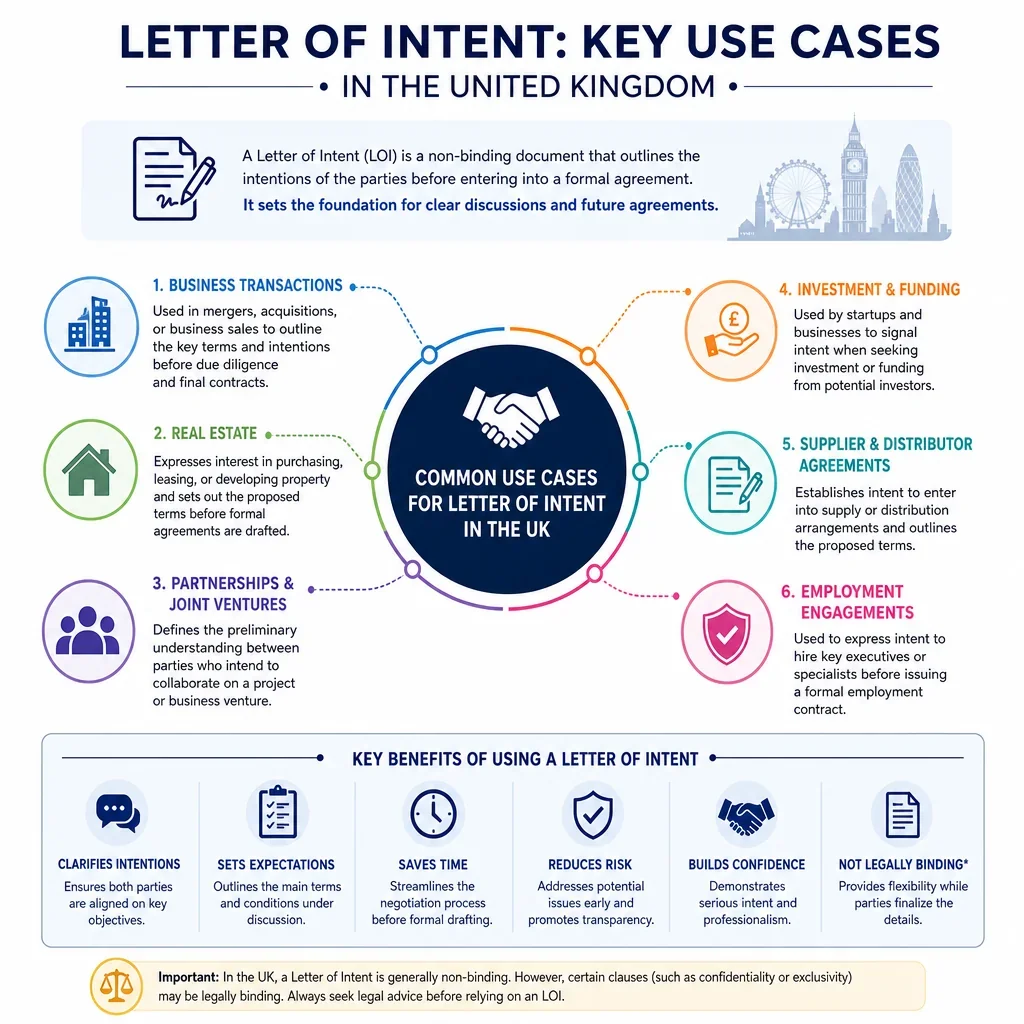
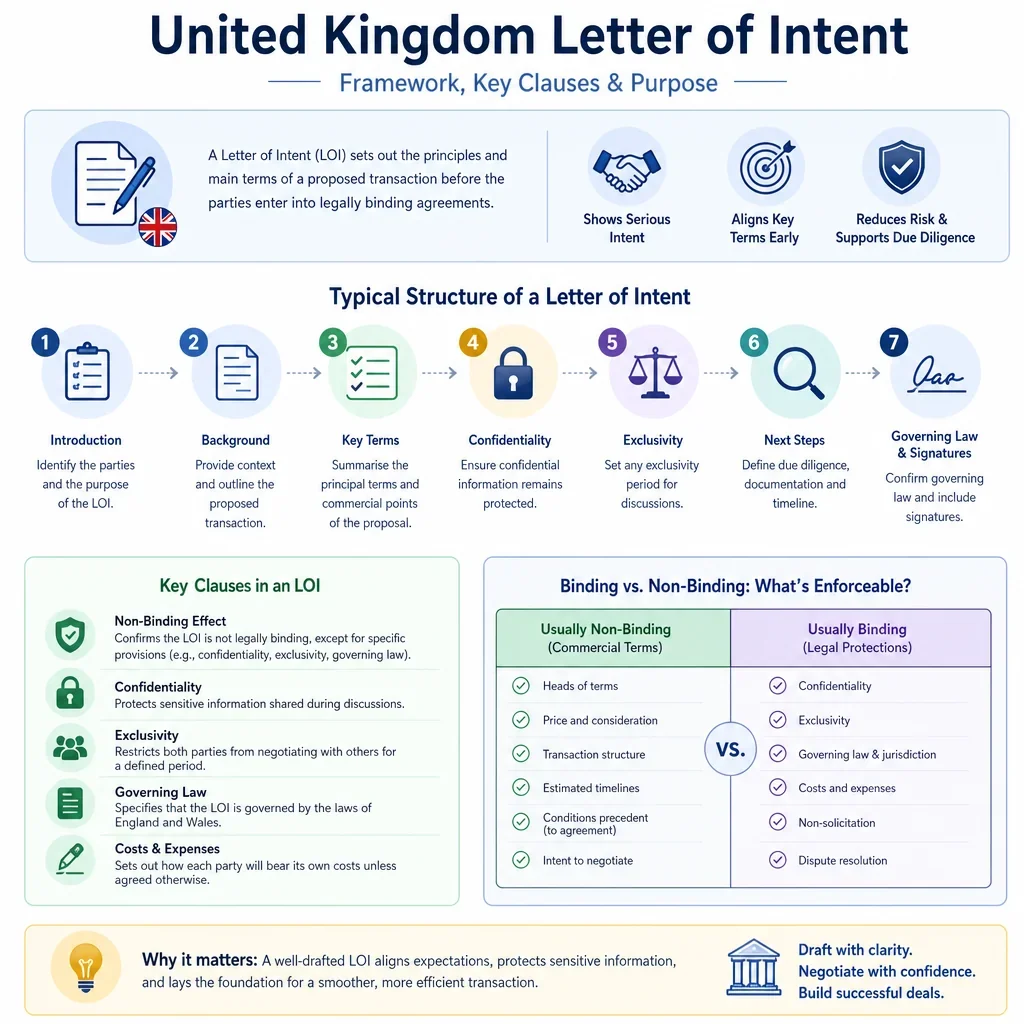
In a UK letter of intent, commercial deal terms are commonly drafted as non-binding, while confidentiality, exclusivity, costs, governing law, dispute resolution, announcements, and return of information are often intended to be binding. The key drafting task is to say expressly which clauses are binding and which are not.
Why Is Clear Wording Important In A UK Letter Of Intent?
UK courts look at objective intention, certainty of terms, and whether the parties intended legal relations. A document labelled a letter of intent can still create binding obligations if its wording and conduct support that result. Use a clear non-binding statement for heads of terms, and separate it from binding obligations such as confidentiality or exclusivity.
What Clauses Need The Most Drafting Care?
- Exclusivity and lock-out clauses: define the restricted conduct, duration, parties covered, and any permitted exceptions.
- Confidentiality and personal data clauses: align disclosure controls with UK GDPR, the Data Protection Act 2018, and any existing NDA.
- Costs, break fees, deposits, and good faith obligations: state whether payment or conduct obligations are binding, when they arise, and how they are calculated.
- Subject to contract and no obligation to proceed wording: use these clauses consistently so the letter does not accidentally become a concluded contract.
How Should A UK Letter Of Intent Support A Future Contract?
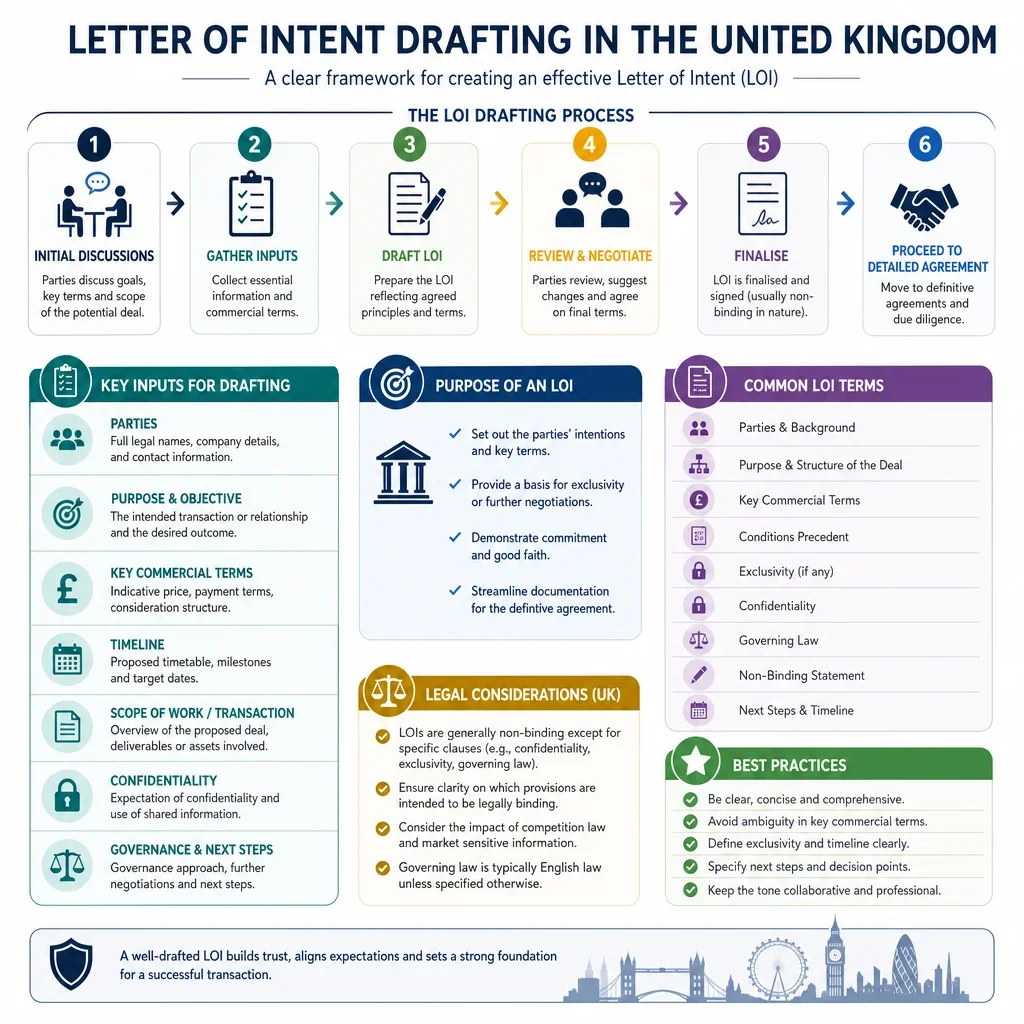
The dataset shows that a strong letter of intent should separate deal framework clauses from binding process clauses. It should identify the transaction, timetable, due diligence scope, approvals, conditions, confidentiality, exclusivity, governing law, termination, and next steps, while making clear that the main transaction remains subject to definitive documents and required approvals.
FAQs
You Might Also Be Interested In