Common Seller Warranties In UK Share Purchase Agreements
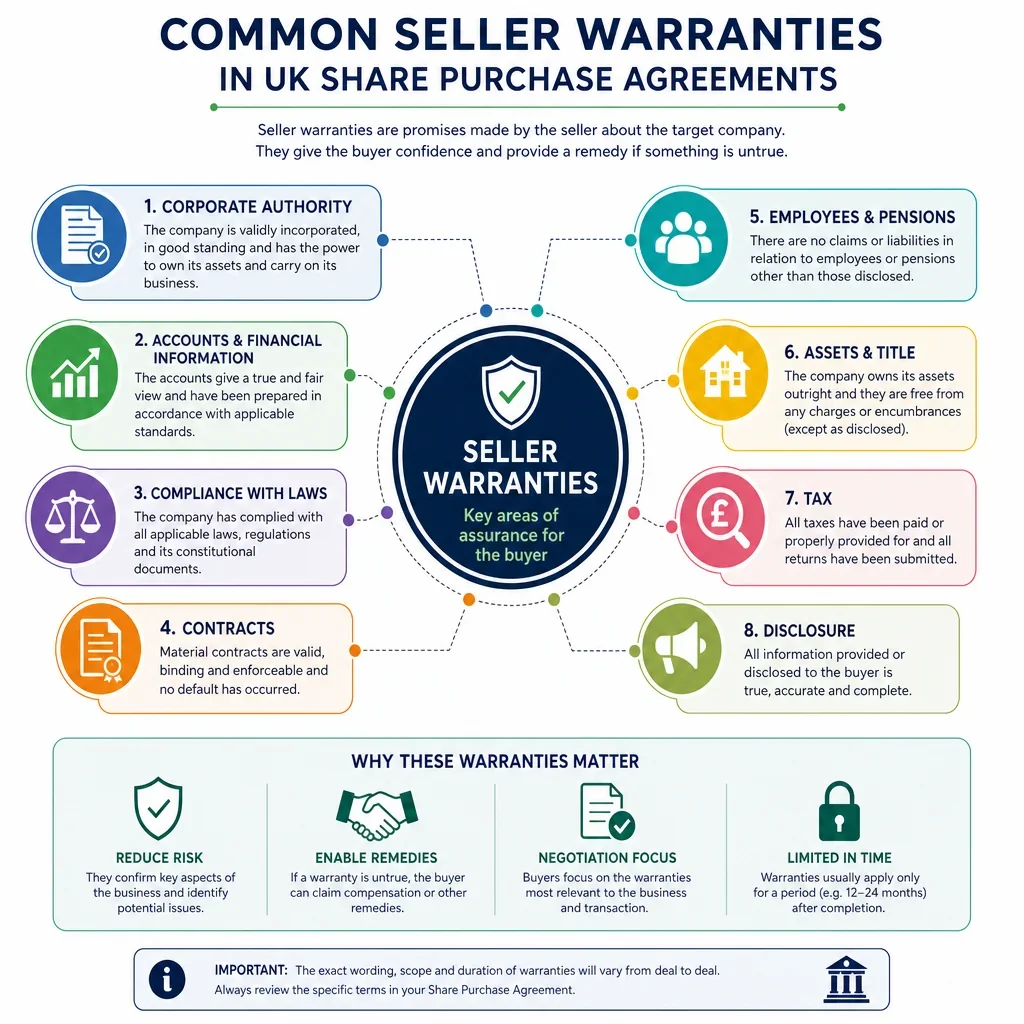
Warranty Topic | Warranty Summary | Buyer Rationale | Risk Level | Typical Disclosure Examples |
|---|---|---|---|---|
Title to shares | ||||
Legal title to sale shares | Seller owns the shares and can transfer full legal and beneficial title. | Confirms buyer will receive the shares it is paying for without ownership disputes. | High | Share certificates, stock transfer forms, register of members, prior transfer documents. |
No share encumbrances | The shares are free from charges, liens, options, pledges and third-party rights. | Protects against a third party claiming rights over the acquired shares. | High | Security documents, option agreements, shareholder agreements, articles containing transfer restrictions. |
Issued share capital | The target's issued share capital is as stated in the agreement. | Verifies the buyer is acquiring the expected percentage ownership. | High | Statement of capital, Companies House filings, register of members, cap table. |
No options or conversion rights | No person has a right to subscribe for, acquire or convert into shares. | Avoids unexpected dilution or post-completion claims to equity. | High | EMI option schedules, convertible loan notes, warrants, subscription agreements. |
Corporate authority | ||||
Seller authority to sell | Seller has power and authority to enter into and perform the SPA. | Reduces risk that the sale is invalid or unauthorised. | High | Board minutes, shareholder approvals, powers of attorney, constitutional documents. |
Target corporate status | The target is duly incorporated and validly existing under its governing law. | Confirms the company being acquired exists and is properly constituted. | Medium | Certificate of incorporation, Companies House profile, articles of association. |
Articles and constitutional compliance | The target has complied with its articles and shareholder approvals. | Identifies invalid allotments, transfers or corporate actions. | Medium | Articles, resolutions, minutes, shareholder consents, waivers of pre-emption rights. |
Statutory registers | The target's statutory registers are accurate, complete and up to date. | Company registers are key evidence of members, directors and charges. | Medium | Register of members, PSC register, register of directors, register of charges. |
Companies House filings | All required filings and confirmations have been made on time and accurately. | Late or inaccurate filings may indicate governance weaknesses or penalties. | Medium | Confirmation statements, accounts filings, SH01 forms, TM01/AP01 forms, charges. |
Accounts and finance | ||||
Accounts true and fair | The accounts give a true and fair view and were properly prepared. | Buyer relies on accounts to value the company and assess liabilities. | High | Audited accounts, management accounts, accounting policies, audit adjustments. |
Management accounts reliability | Recent management accounts were prepared consistently and fairly show trading. | Covers performance since the last statutory accounts date. | High | Monthly management accounts, variance reports, forecasts, notes on normalisations. |
No undisclosed liabilities | The target has no material liabilities except those disclosed or in accounts. | Protects against hidden debts, provisions and contingent liabilities. | High | Creditor schedules, guarantees, claims, accruals, provisions, off-balance sheet obligations. |
Borrowings and debt | All borrowings, overdrafts, leases and financial indebtedness are disclosed. | Debt affects enterprise value, completion payments and covenant compliance. | High | Facility agreements, bank statements, debentures, lease schedules, repayment letters. |
Grants and subsidies | All public grants and subsidies are disclosed and conditions have been met. | Breach of grant terms may trigger repayment after completion. | Medium | Grant agreements, Innovate UK letters, local authority funding, compliance reports. |
Working capital and stock | Stock, debtors and creditors are fairly stated and recoverable in ordinary course. | Supports price adjustments and confirms cash conversion assumptions. | Medium | Aged debtor reports, stock counts, bad debt provisions, creditor listings. |
Tax | ||||
Corporation tax compliance | The target has filed corporation tax returns and paid tax due. | Historic corporation tax liabilities stay with the company after completion. | High | CT600 returns, HMRC correspondence, tax computations, payment records, enquiries. |
VAT compliance | The target is properly VAT registered and has submitted accurate VAT returns. | VAT errors can create assessments, interest and penalties. | High | VAT registration, returns, partial exemption calculations, HMRC notices, option to tax. |
Tax, Employment | ||||
PAYE and NICs | PAYE, NICs and payroll taxes have been deducted, reported and paid. | Payroll tax failures can lead to HMRC recovery and penalties. | High | RTI submissions, payroll records, P11Ds, settlement agreements, HMRC reviews. |
Tax, Title to shares | ||||
Stamp duty on share transfers | Stamp duty on previous share transfers has been properly paid or adjudicated. | Unstamped transfers may affect title evidence and register updates. | Medium | Stamped stock transfer forms, HMRC confirmations, relief claims, group relief papers. |
Tax | ||||
No tax disputes or enquiries | There are no current or threatened HMRC enquiries, disputes or investigations. | Open enquiries may produce material historic tax liabilities. | High | HMRC letters, enquiry notices, information requests, settlement discussions, disclosures. |
No tax avoidance schemes | The target has not used notifiable or aggressive tax avoidance arrangements. | Avoidance schemes can trigger accelerated payments, penalties and reputational risk. | High | DOTAS reference numbers, promoter correspondence, tax opinions, HMRC challenges. |
Employment | ||||
Employee terms disclosed | All employee contracts, salaries, benefits and policies are accurately disclosed. | Employee costs and obligations directly affect valuation and integration. | Medium | Employee schedule, contracts, handbook, bonus plans, benefits summaries. |
Employment, Litigation | ||||
No employment disputes | There are no material employee grievances, claims or tribunal proceedings. | Employment claims can create compensation, management time and reputational issues. | Medium | Grievance files, ACAS correspondence, tribunal claims, settlement agreements. |
Employment, Tax | ||||
Worker status and contractors | Contractors are correctly classified and employment tax obligations are met. | Misclassification can lead to PAYE, NICs, holiday pay and employment claims. | High | Consultancy agreements, status determinations, IR35 assessments, contractor invoices. |
Employment | ||||
Pension arrangements | All pension schemes and auto-enrolment obligations are disclosed and compliant. | Pension deficits and auto-enrolment failures can be costly. | High | Scheme rules, contribution schedules, auto-enrolment letters, Pensions Regulator correspondence. |
Holiday pay and working time | Holiday pay, working time and rest obligations have been complied with. | Historic underpayments can generate group claims and arrears. | Medium | Holiday records, payroll calculations, opt-out agreements, time records. |
Employment, Compliance | ||||
Right to work checks | The target has carried out required right to work checks for staff. | Non-compliance can cause civil penalties and sponsor licence issues. | High | Right to work records, share codes, visa copies, sponsor licence records. |
Contracts | ||||
Material contracts disclosed | All material customer, supplier and partnership contracts are disclosed and valid. | Contract rights often underpin revenue, supply continuity and valuation. | High | Signed contracts, order forms, framework agreements, side letters, renewal notices. |
Change of control consents | No material contract is terminable or breached due to the share sale unless disclosed. | A share sale may trigger consent rights or termination rights. | High | Contracts with change of control clauses, consent letters, waiver requests. |
No material contract default | The target is not in material breach of its important contracts. | Existing defaults may lead to termination, damages or lost revenue. | High | Default notices, service credit claims, late delivery notices, dispute correspondence. |
Onerous contract terms | No material contract contains unusual, loss-making or non-arm's length terms unless disclosed. | Hidden onerous obligations can erode future profits. | Medium | Most-favoured-customer clauses, penalties, exclusivity, rebates, minimum purchase commitments. |
Property | ||||
Property interests disclosed | All freehold, leasehold and occupational property interests are disclosed. | Premises can be critical to operations and may carry liabilities. | High | Land Registry titles, leases, licences to occupy, rent deposit deeds. |
Lease compliance | The target has complied with leases and there are no material landlord disputes. | Lease breaches may cause forfeiture, dilapidations or unexpected costs. | High | Rent statements, licences for alterations, landlord notices, dilapidations schedules. |
Property, Compliance | ||||
Planning and building control | Property use and alterations have required planning and building approvals. | Non-compliance may restrict use or require remedial works. | Medium | Planning permissions, building control certificates, lawful use certificates, enforcement notices. |
Environmental liabilities | There are no undisclosed contamination, waste or environmental compliance liabilities. | Environmental remediation and regulatory action can be very costly. | High | Environmental reports, permits, waste transfer notes, contamination surveys, notices. |
Intellectual property | ||||
Registered IP ownership | The target owns or has rights to use all registered IP listed. | Brand, software and patents may be core acquisition assets. | High | Trade mark, patent and design registrations, renewal records, assignments, licences. |
Unregistered IP and know-how | The target owns or may lawfully use key copyright, know-how and confidential information. | Protects software, content, databases, processes and trade secrets. | High | Developer assignments, copyright licences, NDAs, invention records, repository access logs. |
Intellectual property, Litigation | ||||
No IP infringement | The target does not infringe third-party IP and no IP claims are threatened. | IP claims can stop trading, require rebranding or trigger damages. | High | Cease and desist letters, settlement agreements, clearance searches, licence notices. |
Intellectual property | ||||
Software and open source | Software is owned or licensed and open-source use complies with licence terms. | Open-source breaches can affect proprietary code and commercial exploitation. | High | Software bill of materials, OSS policy, licences, developer contracts, source code audit. |
Data protection | ||||
UK GDPR compliance | The target complies with UK GDPR and Data Protection Act 2018 obligations. | Data breaches and unlawful processing can cause fines and operational disruption. | High | Privacy notices, RoPA, DPIAs, processor contracts, ICO correspondence, breach logs. |
ICO registration and fees | The target has paid any required data protection fee to the ICO. | Shows basic data protection compliance and avoids ICO enforcement risk. | Low | ICO fee certificate, registration details, exemption analysis. |
No reportable data breaches | There have been no undisclosed personal data breaches requiring notification. | Breaches can trigger ICO action, claims and customer loss. | High | Incident logs, ICO notifications, data subject notices, remediation reports. |
Data protection, Compliance | ||||
Electronic marketing compliance | Email, SMS and cookie marketing complies with PECR and consent rules. | Unlawful marketing can undermine customer lists and attract ICO penalties. | Medium | Consent records, cookie banners, suppression lists, marketing policies, ICO letters. |
Compliance | ||||
Anti-bribery compliance | The target has not engaged in bribery and has adequate anti-bribery procedures. | Bribery issues can cause criminal liability, debarment and reputational damage. | High | Anti-bribery policy, gifts register, agent due diligence, training records, investigations. |
Sanctions compliance | The target has not breached UK sanctions and does not deal with sanctioned persons. | Sanctions breaches can lead to criminal penalties and blocked transactions. | High | Sanctions screening records, customer lists, export destinations, OFSI correspondence. |
Compliance, Employment | ||||
Health and safety compliance | The target complies with health and safety laws and has no undisclosed incidents. | Incidents may cause enforcement, claims and operational stoppages. | High | Risk assessments, HSE notices, accident book, RIDDOR reports, training records. |
Compliance, Contracts | ||||
Competition law compliance | The target has not engaged in anti-competitive agreements or abuse of dominance. | Competition breaches can cause large fines and follow-on damages claims. | High | Distribution agreements, pricing policies, CMA correspondence, trade association records. |
Compliance, Assets and trading | ||||
Licences and permits | The target holds all licences and permits needed to carry on its business. | Missing or non-transferable permissions may stop trading after completion. | High | Regulatory licences, premises licences, sector permits, renewal applications, notices. |
Compliance, Employment | ||||
Modern slavery compliance | The target complies with modern slavery obligations and supply chain policies. | Supply chain labour issues can cause legal and reputational harm. | Medium | Modern slavery statement, supplier due diligence, training records, audit reports. |
Litigation | ||||
No litigation or claims | There is no current, pending or threatened litigation or arbitration unless disclosed. | Claims may create liabilities, injunctions or management distraction. | High | Claim forms, letters before action, settlement agreements, arbitration notices, counsel advice. |
Litigation, Compliance | ||||
No regulatory investigations | No regulator is investigating or threatening action against the target. | Investigations can lead to fines, licence loss and mandatory remediation. | High | Regulator correspondence, warning notices, inspection reports, undertakings, remediation plans. |
Litigation, Accounts and finance | ||||
No insolvency proceedings | The target is not insolvent and no insolvency process is pending or threatened. | Insolvency risk may affect value, completion certainty and creditor challenges. | High | Statutory demands, winding-up petitions, lender notices, cash flow forecasts. |
Assets and trading | ||||
Ownership of business assets | The target owns or validly leases the assets needed to operate the business. | Ensures operational assets are available after completion. | High | Asset register, finance leases, hire agreements, retention of title terms, insurance schedules. |
Asset condition | Material plant, equipment and assets are in reasonable working order. | Avoids immediate replacement costs and operational interruption. | Medium | Maintenance logs, inspection reports, warranty claims, capex plans, equipment surveys. |
Assets and trading, Accounts and finance | ||||
Trading since accounts date | Since the accounts date, business has traded in the ordinary course. | Confirms no value leakage or abnormal trading before completion. | High | Management accounts, board minutes, large transactions, customer losses, dividend records. |
Assets and trading, Contracts | ||||
Key customer and supplier relationships | No key customer or supplier has ended or threatened to reduce business. | Protects against undisclosed revenue or supply chain deterioration. | High | Top customer schedules, churn notices, supplier termination letters, pipeline reports. |
Assets and trading | ||||
Insurance cover | The target maintains adequate insurance and has disclosed material claims. | Insurance affects recovery for historic incidents and ongoing risk protection. | Medium | Policies, broker letters, claims history, reservation of rights letters, renewal terms. |
Assets and trading, Litigation, Compliance | ||||
Product and service liability | Products and services comply with requirements and there are no undisclosed liability claims. | Defective products or services can cause claims, recalls and regulatory action. | High | Complaints logs, recall notices, product testing, warranty claims, safety certificates. |
Accounts and finance, Contracts | ||||
Related party transactions | All transactions with sellers, directors and connected persons are disclosed. | Identifies non-market terms, value leakage and post-completion dependencies. | Medium | Director loan accounts, service agreements, family supplier contracts, intercompany balances. |
Accounts and finance | ||||
Bank accounts and mandates | All bank accounts, signatories and mandates are disclosed. | Helps secure cash control and prevent unauthorised withdrawals after completion. | Medium | Bank account list, mandate forms, online banking users, facility letters. |
Accounts and finance, Assets and trading | ||||
Security and charges | All charges, guarantees and security interests granted by the target are disclosed. | Security can restrict assets, financing and distributions after completion. | High | Debentures, charges register, guarantees, intercreditor agreements, release documents. |
Corporate authority, Accounts and finance | ||||
Information supplied to buyer | Information supplied in due diligence is accurate and not misleading in material respects. | Buyer relies on data room information when pricing and negotiating protections. | High | Data room index, Q&A log, correction notices, documents withheld or superseded. |
What Seller Warranties Matter Most In A UK Share Purchase Agreement?
High-risk warranties commonly cluster around title to shares, accounts, tax, litigation, key contracts, property, IP, data protection and regulatory compliance. In a share sale, the buyer inherits the target company with its historic liabilities, so warranties are often used to flush out issues through disclosure rather than to guarantee a risk-free business.
How Should A Buyer Use The Disclosure Letter?
The disclosure letter is as important as the warranties. Specific disclosures should attach or identify supporting evidence such as Companies House filings, statutory registers, accounts, tax correspondence, employment schedules, property documents, IP registrations, data protection records and material contracts. Vague or general disclosures may leave uncertainty about whether the buyer has accepted the risk.
Which UK Legal Areas Most Often Drive Warranty Drafting?
- Companies Act 2006: title, allotment, transfers, registers, accounts and corporate authority warranties often link to company law compliance.
- Tax legislation: corporation tax, VAT, PAYE, NICs, SDLT, stamp duty and loan relationships commonly require detailed warranties and a separate tax covenant.
- Employment law: TUPE, pensions, worker status, disputes, holiday pay and redundancy liabilities can materially affect price and post-completion operations.
- UK GDPR and Data Protection Act 2018: warranties should test whether the target can lawfully use customer, employee and marketing data after completion.
Why Do Sellers Need Precise Warranty Limits?
Sellers should align warranties with their actual knowledge and the disclosed information. In UK transactions, sellers commonly negotiate monetary caps, time limits, de minimis thresholds, knowledge qualifiers and exclusions for matters fairly disclosed, especially for tax, environmental, data protection and litigation exposure.
FAQs
You Might Also Be Interested In