Common Clauses In UK Share Purchase Agreements
Clause Name | Purpose | When Used | Typical Beneficiary | Negotiation Notes |
|---|---|---|---|---|
Parties and background | ||||
Parties | Identifies the buyer, seller and any guarantor or covenantor. | Used in every SPA, especially where there are multiple sellers or group companies. | Neutral | Check capacity, execution authority, addresses and whether sellers are individuals, trustees or corporate entities. |
Recitals And Background | Sets out transaction context and identifies the target company and shares. | Used in most SPAs to summarise the commercial background without creating operative obligations. | Neutral | Avoid factual statements that conflict with warranties or operative clauses. |
Definitions And Interpretation | Defines key terms and sets rules for interpreting the agreement. | Used in all but the simplest SPAs. | Neutral | Defined terms often decide price, claim thresholds, tax covenant scope and completion deliverables. |
Target Company Details | Records the company name, number, registered office, issued shares and statutory information. | Used where the SPA schedules corporate details of the company being acquired. | Buyer focused | Reconcile against Companies House records, the register of members and the target’s articles. |
Sale and purchase mechanics | ||||
Agreement To Sell And Purchase Shares | Creates the primary obligation for the seller to sell and the buyer to buy the shares. | Used in every SPA as the operative sale provision. | Mutual | Specify legal and beneficial title, full title guarantee and whether sale is simultaneous or conditional. |
Title To Shares And Full Title Guarantee | Requires the seller to transfer ownership free from encumbrances and with title assurances. | Used where buyer wants assurance that the seller owns and can transfer the shares. | Buyer focused | Sellers may qualify title guarantee where they have limited knowledge or are trustees or nominees. |
No Encumbrances | Confirms shares are free from security interests, options, liens and third-party rights. | Used in nearly all SPAs, especially where shares were pledged or subject to investor rights. | Buyer focused | Define encumbrance broadly and require releases before or at completion. |
Sale Of Entire Issued Share Capital | Confirms that the transaction covers all shares in issue. | Used in full company acquisitions rather than minority stake purchases. | Buyer focused | Check options, growth shares, preference shares, warrants and convertible instruments. |
Sale Of Part Shareholding | Sets out mechanics for buying less than all shares in the target. | Used for minority investments, partial exits and management rollovers. | Mutual | Coordinate with shareholders’ agreement, reserved matters, drag, tag and pre-emption rights. |
Stock Transfer Form | Requires delivery of executed stock transfer forms for legal transfer of shares. | Used for transfers of UK certificated shares. | Buyer focused | Ensure correct consideration, execution, stamping position and delivery with share certificates. |
Price and payment | ||||
Stamp Duty On Share Transfer | Allocates responsibility for UK stamp duty and related filing steps. | Used where UK shares are transferred for consideration above the applicable threshold. | Neutral | Usually paid by the buyer address timing, electronic stamping and registration delay. |
Sale and purchase mechanics | ||||
Registration In Register Of Members | Requires the company to register the buyer as holder of the shares. | Used because legal membership depends on entry in the register of members. | Buyer focused | Completion should include board approval and register updates, not merely signed transfers. |
Conditions and completion | ||||
Board Approval Of Transfers | Requires directors to approve share transfers and related completion documents. | Used where the company’s articles give directors power to refuse or approve transfers. | Buyer focused | Check articles and any shareholders’ agreement for transfer restrictions. |
Pre-Emption Rights Waiver | Confirms any rights of first refusal or transfer pre-emption have been waived or complied with. | Used where articles or shareholders’ agreements restrict transfers to outsiders. | Buyer focused | Distinguish statutory allotment pre-emption rights from contractual transfer pre-emption rights. |
Price and payment | ||||
Purchase Price | States the consideration payable for the shares. | Used in every SPA, whether price is fixed, adjusted, deferred or partly non-cash. | Mutual | Define currency, VAT assumption, payment date, bank details and any set-off rights. |
Payment Mechanics | Sets how, when and to whom the purchase price is paid. | Used where money is transferred at completion or in later instalments. | Mutual | Address CHAPS timing, cleared funds, payment agents and allocation among multiple sellers. |
Completion Accounts | Adjusts the price after completion using accounts prepared at the completion date. | Used where value depends on actual cash, debt or working capital at completion. | Mutual | Accounting policies, hierarchy, expert determination and deadlines are usually heavily negotiated. |
Net Debt Adjustment | Adjusts price for debt less cash at completion. | Used in cash-free, debt-free pricing structures. | Mutual | Define debt-like items, cash-like items, overdrafts, leases, tax, intra-group balances and transaction costs. |
Working Capital Adjustment | Adjusts price against an agreed target level of working capital. | Used where the buyer expects the business to transfer with normal operating liquidity. | Mutual | Target working capital, seasonal trends and accounting consistency are key points. |
Locked Box Mechanism | Fixes price by reference to historic accounts and restricts value leakage before completion. | Used where buyer accepts a fixed price and has confidence in locked box accounts. | Seller focused | Buyer seeks robust leakage definitions, undertakings and indemnities seller seeks certainty and exclusions. |
Leakage Covenant | Prevents value extraction from the target between locked box date and completion. | Used in locked box transactions. | Buyer focused | Debate often centres on permitted leakage, ordinary-course payments and claim deadlines. |
Permitted Leakage | Carves out agreed payments that do not breach the leakage covenant. | Used with locked box pricing. | Seller focused | Common items include disclosed dividends, salaries, intra-group services and transaction costs. |
Earn-Out | Makes part of the price depend on the target’s future performance. | Used where buyer and seller disagree on valuation or future growth risk. | Mutual | Define metrics, accounting rules, conduct protections, audit rights and dispute procedure. |
Deferred Consideration | Allows part of the price to be paid after completion. | Used where buyer needs staged funding or seller accepts delayed payment risk. | Buyer focused | Seller may seek security, guarantees, interest, acceleration and restrictions on set-off. |
Escrow Or Retention | Holds part of the price to secure warranty, indemnity or adjustment claims. | Used where buyer wants accessible recovery funds after completion. | Buyer focused | Negotiate amount, release dates, claim notices, interest and escrow agent terms. |
Interest On Late Payment | Applies interest if a payment is not made when due. | Used for deferred consideration, adjustments, indemnity payments and completion defaults. | Mutual | Rate may be contractual or linked to statutory commercial debt interest where applicable. |
Set-Off Rights | Allows or restricts deduction of claims from amounts payable. | Used where deferred consideration, earn-outs or completion adjustments may overlap with claims. | Mutual | Buyer seeks broad set-off seller usually wants only agreed or finally determined claims. |
Conditions and completion | ||||
Conditions Precedent | Makes completion conditional on specified events occurring or being waived. | Used where completion cannot happen immediately after signing. | Mutual | Define responsibility, long-stop date, waiver rights and consequences of failure. |
Regulatory Consents | Requires approvals or clearances needed before completion. | Used in regulated sectors, financial services, competition-sensitive deals or foreign investment cases. | Mutual | Allocate filing control, information duties, remedies, costs and hell-or-high-water obligations. |
National Security And Investment Act Clearance | Makes completion conditional on UK national security clearance where required. | Used for acquisitions involving sensitive sectors or qualifying control thresholds. | Mutual | Mandatory notification can make completion before approval void and expose parties to sanctions. |
FCA Change In Control Approval | Requires regulatory approval for acquiring control of an FCA-regulated firm. | Used where the target or group includes an authorised financial services firm. | Mutual | Timetable and buyer information obligations are critical because approval may take time. |
Merger Control Clearance | Addresses competition law clearance and CMA merger review risk. | Used where the acquisition may qualify for UK merger control review. | Mutual | UK merger notification is generally voluntary, but CMA intervention risk may justify a condition. |
Third-Party Consents | Requires consents from lenders, landlords, customers, suppliers or shareholders. | Used where contracts contain change of control, assignment or consent provisions. | Buyer focused | Seller may resist making commercial counterparty consent a condition unless business-critical. |
Conduct Of Business Before Completion | Controls how the target is run between signing and completion. | Used where there is a gap between exchange and completion. | Buyer focused | Buyer wants consent rights seller needs ordinary-course flexibility and competition law compliance. |
Access To Information Before Completion | Allows buyer access to records, premises and management before completion. | Used where completion is delayed and buyer needs monitoring or integration planning. | Buyer focused | Limit disruption, confidentiality risks, personal data sharing and competitively sensitive information. |
Material Adverse Change Condition | Allows buyer not to complete if a serious adverse event occurs. | Used in larger or higher-risk deals with a split signing and completion. | Buyer focused | Sellers seek narrow objective triggers and exclusions for market-wide events. |
Long-Stop Date | Sets the final date for satisfying conditions and completing the sale. | Used where conditions precedent may delay completion. | Mutual | Negotiate extension rights where regulatory approvals are delayed. |
Completion | Sets when and where completion happens and what each party must do. | Used in every SPA. | Mutual | Completion steps should be simultaneous unless the agreement says otherwise. |
Seller Completion Deliverables | Lists documents and items the seller must deliver at completion. | Used in all SPAs to evidence transfer and control handover. | Buyer focused | Usually includes transfers, certificates, resignations, minutes, registers, powers of attorney and releases. |
Buyer Completion Deliverables | Lists payment and documents the buyer must deliver at completion. | Used in all SPAs where buyer has completion obligations. | Seller focused | Seller may require proof of funds, board approvals, guarantees and executed ancillary documents. |
Director Resignations And Appointments | Changes target company officers at completion. | Used where seller-appointed directors leave and buyer-appointed directors take control. | Buyer focused | Include resignation letters, releases, filings and settlement of director loan accounts. |
Release Of Security | Requires discharge of charges or guarantees affecting the target or shares. | Used where target assets or shares secure debt being repaid at completion. | Buyer focused | Obtain payoff letters, deeds of release and Companies House charge satisfaction filings. |
Auditor Resignation Or Confirmation | Deals with auditor changes or confirmations at completion. | Used where buyer wants to replace advisers or confirm no audit issues. | Buyer focused | Companies Act rules regulate auditor resignation statements and company filings. |
Failure To Complete | Sets remedies if a party fails to comply with completion obligations. | Used where completion steps are simultaneous and default risk exists. | Mutual | Options include deferral, specific performance, termination, interest and damages. |
Warranties and indemnities | ||||
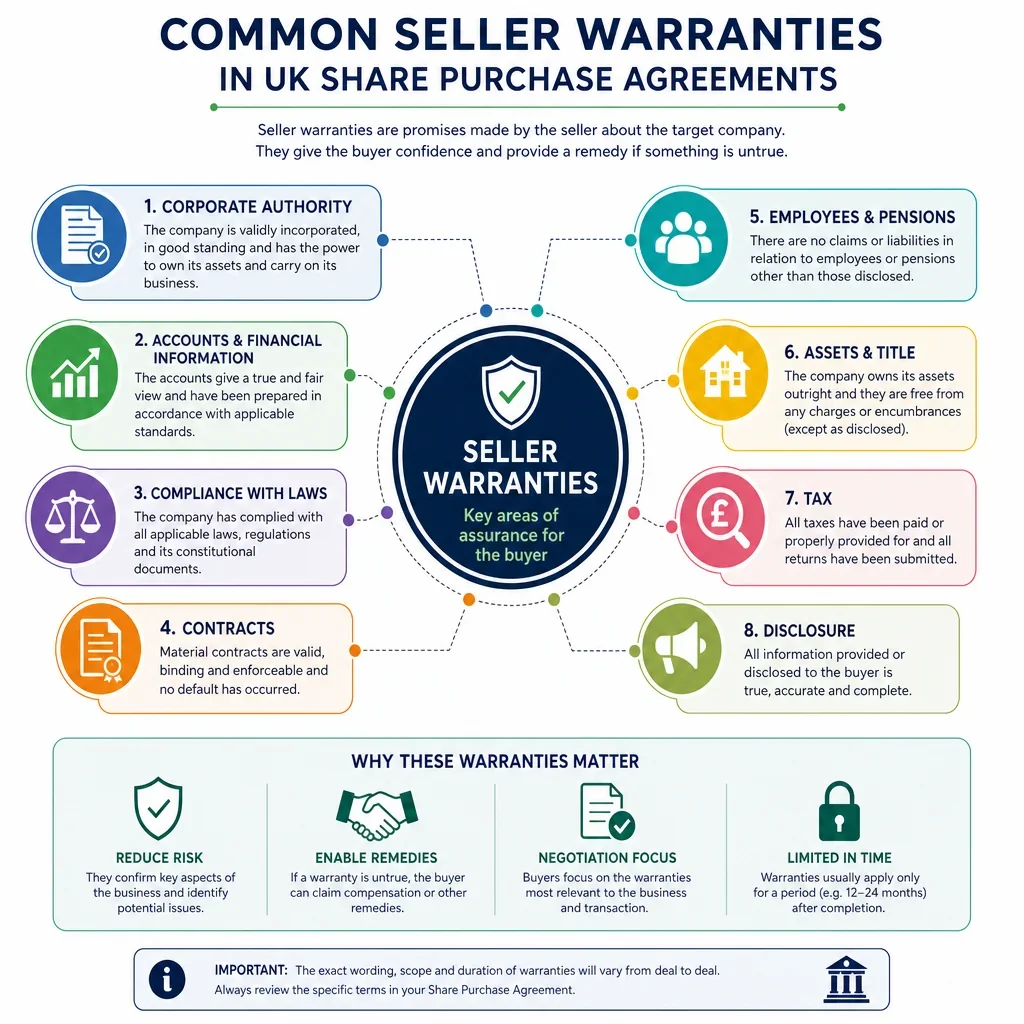
General Warranties | Gives contractual statements about the target and seller that support buyer claims if untrue. | Used in most SPAs except very limited title-only sales. | Buyer focused | Scope, knowledge qualifiers, materiality, repetition and disclosure are central issues. |
Title And Capacity Warranties | Confirms seller ownership, authority and ability to transfer the shares. | Used in almost every SPA, including seller-friendly transactions. | Buyer focused | Often excluded from general financial caps or subject to higher caps. |
Accounts Warranties | Confirms accounts give a proper picture and were prepared consistently. | Used where buyer relies on historic financial statements for valuation. | Buyer focused | Sellers seek to reference Companies Act accounts standards and limit forward-looking implications. |
Management Accounts Warranty | Covers accuracy and consistency of unaudited management accounts. | Used where buyer relies on recent trading figures after last statutory accounts. | Buyer focused | Seller may qualify because management accounts are not audited and may lack year-end adjustments. |
Locked Box Accounts Warranty | Supports fixed price by warranting the locked box accounts. | Used in locked box deals. | Buyer focused | Buyer may require warranties on debt, cash, working capital and no undisclosed liabilities. |
Trading Since Accounts Date Warranty | Confirms business has traded normally since the accounts date. | Used where there is a gap between accounts date and signing. | Buyer focused | Common carve-outs include disclosed events, ordinary course changes and market conditions. |
Assets Warranty | Confirms the target owns or can use assets needed for the business. | Used for asset-heavy businesses or where key assets are business-critical. | Buyer focused | Review leased assets, finance leases, retention of title, shared group assets and asset registers. |
Property Warranties | Covers ownership, occupation, leases and property liabilities. | Used where the target owns or occupies real estate. | Buyer focused | Coordinate with Land Registry searches, leases, rent deposits, planning and environmental review. |
Intellectual Property Warranties | Covers ownership, use, validity and infringement risk for IP rights. | Used where brands, software, patents, copyright or know-how are material. | Buyer focused | Check employee-created IP, contractor assignments, licences, open-source software and group ownership. |
Information Technology Warranties | Covers IT systems, cybersecurity, software licences and business continuity. | Used for technology-dependent businesses or where systems are critical to operations. | Buyer focused | Consider cyber incidents, escrowed source code, outsourced systems and post-completion separation. |
Data Protection Warranties | Covers compliance with UK GDPR, Data Protection Act duties and data security. | Used where the target processes personal data, especially customer, employee or special category data. | Buyer focused | Buyer may seek disclosure of breaches, ICO correspondence, processors and international transfers. |
Employment Warranties | Covers employees, consultants, disputes, benefits, policies and compliance. | Used where the target has employees, workers, contractors or senior management. | Buyer focused | Focus on status, dismissals, grievances, immigration, bonuses, restrictive covenants and contractor risk. |
TUPE Warranties | Addresses employment transfer risk under TUPE where relevant to the wider transaction. | Mainly used where a share sale is linked to a business transfer, hive-up or outsourcing. | Buyer focused | TUPE generally applies to business transfers rather than a pure share sale, but related steps may trigger it. |
Pensions Warranties | Covers pension schemes, auto-enrolment and contributions. | Used where the target employs staff or participates in pension arrangements. | Buyer focused | Defined benefit exposure, auto-enrolment compliance and unpaid contributions need specific attention. |
Tax Warranties | Covers tax compliance, filings, disputes, reliefs and exposures. | Used in most UK SPAs because historic tax liabilities remain in the target. | Buyer focused | Often paired with a separate tax covenant and subject to specialist limitations. |
VAT Warranties | Covers VAT registration, returns, payments, groups and option to tax issues. | Used where the target makes taxable supplies or holds VAT-sensitive property. | Buyer focused | VAT grouping, partial exemption, bad debt relief and opted property often need detail. |
Litigation And Disputes Warranties | Covers current, threatened and potential disputes or investigations. | Used where undisclosed claims could materially affect value or operations. | Buyer focused | Sellers seek knowledge qualifiers and disclosure of correspondence or claims history. |
Compliance With Laws Warranties | Confirms the target has complied with applicable legal and regulatory obligations. | Used in most SPAs, especially regulated or operationally complex businesses. | Buyer focused | Seller may narrow by materiality, time periods, specific laws and actual knowledge. |
Anti-Bribery And Corruption Warranties | Covers bribery, facilitation payments, improper benefits and anti-corruption controls. | Used where the target has agents, public sector dealings or higher-risk jurisdictions. | Buyer focused | Buyer may require policy, training, agent due diligence and investigation disclosure. |
Sanctions Warranties | Covers compliance with UK sanctions and absence of dealings with sanctioned persons. | Used in international businesses, financial services, trade, logistics and energy deals. | Buyer focused | Consider ownership and control tests, screening procedures and high-risk counterparties. |
Anti-Money Laundering Warranties | Covers AML compliance, customer due diligence and suspicious activity procedures. | Used in regulated sectors or businesses handling financial flows or high-risk customers. | Buyer focused | Buyer may require disclosure of SARs, customer files, policies and regulator correspondence where lawful. |
Modern Slavery Warranties | Covers slavery, human trafficking and supply chain compliance controls. | Used where the target has substantial turnover, supply chains, labour agencies or overseas sourcing. | Buyer focused | Check statements, policies, supplier audits and sector-specific risk. |
Environmental Warranties | Covers permits, contamination, waste, pollution and environmental compliance. | Used for manufacturing, property, energy, waste, chemicals and industrial businesses. | Buyer focused | Specialist due diligence may lead to separate environmental indemnities or insurance. |
Health And Safety Warranties | Covers workplace safety compliance, incidents, enforcement and risk assessments. | Used where employees, premises, vehicles, machinery or public-facing operations create safety risk. | Buyer focused | Investigate reportable incidents, HSE correspondence, insurance history and improvement notices. |
Insurance Warranties | Covers insurance policies, premiums, claims and adequacy of cover. | Used in most SPAs to assess risk transfer and claims history. | Buyer focused | Check whether group policies end at completion and whether run-off cover is needed. |
Material Contracts Warranties | Covers key customer, supplier, finance and operational contracts. | Used where revenue, supply or operations depend on important contracts. | Buyer focused | Focus on change of control, termination rights, exclusivity, rebates and unusual liabilities. |
Customers And Suppliers Warranties | Covers concentration risk and changes in key trading relationships. | Used where the target relies on a small number of major customers or suppliers. | Buyer focused | Sellers resist broad assurances about future customer behaviour. |
Borrowings And Finance Warranties | Covers loans, guarantees, security, defaults and financial instruments. | Used where the target has debt, facilities, guarantees or intra-group funding. | Buyer focused | Tie into repayment, security releases, change of control consents and net debt definitions. |
Insolvency Warranties | Confirms no insolvency proceedings, distress, administration or winding-up events exist. | Used in most SPAs, especially distressed or leveraged targets. | Buyer focused | Buyer may add solvency and no preference or transaction at undervalue wording. |
Grants And Subsidies Warranties | Covers public funding, grants, subsidies and clawback risk. | Used where the target has received government grants, innovation funding or regional support. | Buyer focused | Review change of control restrictions, project milestones, reporting duties and repayment triggers. |
Related Party Transactions Warranties | Identifies contracts, balances and benefits involving sellers or connected persons. | Used where owner-managed or group companies have connected-party dealings. | Buyer focused | Often linked to repayment of director loans and termination of intra-group arrangements. |
Disclosure Letter | Qualifies warranties by disclosing exceptions and known issues. | Used whenever warranties are given. | Seller focused | Buyer wants fair, specific disclosure seller wants general disclosures and data room disclosure. |
Data Room Disclosure | Specifies whether data room documents qualify the warranties. | Used where due diligence materials are hosted electronically. | Seller focused | Buyer may require indexing, searchability, upload cut-off and specific disclosure for key matters. |
Specific Indemnities | Provides recovery for identified risks or liabilities. | Used where due diligence reveals known issues not priced fully into the deal. | Buyer focused | Negotiate scope, causation, mitigation, caps, duration, conduct of claims and tax treatment. |
Tax Covenant | Allocates pre-completion tax liabilities to the seller. | Used in most UK share sales because the buyer acquires the company with historic tax risk. | Buyer focused | Usually contains exclusions for provided, disclosed, post-completion and buyer-caused tax liabilities. |
Tax Gross-Up | Increases a payment so the recipient is left whole after tax. | Used for indemnity, covenant or warranty payments that may be taxable. | Buyer focused | Sellers seek exclusions where payment is treated as price adjustment or tax arises from buyer status. |
Warranty And Indemnity Insurance | Records how W&I insurance interacts with seller liability and claims. | Used in private M&A where parties want a cleaner seller exit or enhanced buyer recourse. | Mutual | Address policy exclusions, subrogation waiver, seller fraud carve-out and retention. |
Repetition Of Warranties | States whether warranties are repeated at completion. | Used where signing and completion are on different dates. | Buyer focused | Sellers may repeat only fundamental warranties or allow updated disclosure. |
Limitations on liability | ||||
Seller Knowledge Qualifier | Limits warranties by reference to what specified sellers or managers know. | Used where sellers cannot warrant matters absolutely. | Seller focused | Define whose knowledge counts and whether it includes due enquiry. |
Liability Cap | Limits the seller’s maximum financial exposure for claims. | Used in most SPAs with warranties or indemnities. | Seller focused | Caps often differ for business warranties, title warranties, tax and fraud. |
De Minimis Threshold | Prevents small individual claims from being brought. | Used to avoid minor warranty disputes. | Seller focused | Buyer may ask for aggregation of related claims to meet the threshold. |
Basket Or Aggregate Threshold | Requires claims to exceed an aggregate amount before recovery. | Used in most negotiated warranty limitation schedules. | Seller focused | Negotiate tipping basket versus excess-only deductible. |
Claim Time Limits | Sets contractual deadlines for notifying warranty, tax or indemnity claims. | Used in almost all SPAs with seller liability. | Seller focused | Contractual periods are often shorter than statutory limitation periods, except for tax and title claims. |
Notice Of Claims | Specifies how buyer must notify seller of a claim. | Used where seller liability is subject to procedural conditions. | Seller focused | Disputes often concern required detail, estimated loss, timing and whether notice defects invalidate claims. |
Contingent And Unquantified Claims | Allows notification before a claim amount is fully known. | Used where tax, litigation or third-party claims may develop over time. | Buyer focused | Seller may require expiry if proceedings are not issued within a set period after quantification. |
Conduct Of Third-Party Claims | Controls defence or settlement of claims that may trigger seller liability. | Used for indemnities, tax covenants, litigation and regulatory claims. | Mutual | Seller wants control or consultation buyer wants protection of business reputation and operations. |
Mitigation Of Loss | Requires buyer to take reasonable steps to reduce recoverable loss. | Used in warranty and indemnity limitation schedules. | Seller focused | Buyer resists obligations that require commercially harmful steps or litigation against customers. |
No Double Recovery | Prevents buyer recovering twice for the same loss. | Used where price adjustments, indemnities, insurance and warranty claims may overlap. | Seller focused | Coordinate with completion accounts, tax savings, insurance proceeds and third-party recoveries. |
Exclusion For Disclosed Matters | Excludes claims based on matters fairly disclosed to the buyer. | Used with disclosure letters and data room materials. | Seller focused | Buyer should insist disclosure is sufficiently clear, specific and accessible. |
Buyer Knowledge Exclusion | Limits claims for matters the buyer knew about before signing. | Used where seller wants due diligence knowledge to restrict warranty claims. | Seller focused | Buyer often resists or limits to actual knowledge of named deal team members. |
Fraud And Dishonesty Carve-Out | Prevents liability limits protecting a party from fraud or dishonest concealment. | Used in seller limitation clauses and W&I insurance structures. | Buyer focused | Define whether fraud by managers, agents or sellers is attributed to all sellers. |
Exclusion Of Consequential Loss | Excludes specified indirect or consequential categories of loss. | Used where parties want to narrow recoverable damages. | Seller focused | Draft carefully because English law treatment of consequential loss can be technical. |
Exclusive Remedies | States whether SPA remedies replace other rights or remedies. | Used to create contractual certainty after completion. | Seller focused | Buyer should preserve fraud, specific performance, confidentiality and restrictive covenant remedies. |
Post-completion obligations | ||||
Seller Restrictive Covenants | Restricts seller competition, solicitation or interference after completion. | Used where sellers are founders, managers or have customer influence. | Buyer focused | Restrictions must be reasonable in scope, duration and territory to be enforceable. |
Non-Solicitation Of Customers And Employees | Prevents seller targeting key customers, suppliers or staff after sale. | Used where goodwill and workforce stability are key to value. | Buyer focused | Narrow lists of protected persons or customers can improve enforceability. |
Confidentiality | Protects confidential transaction and business information. | Used in all SPAs, often alongside a pre-existing NDA. | Mutual | Include exceptions for advisers, regulators, law, financing sources and public announcements. |
Public Announcements | Controls press releases and external communications about the transaction. | Used where publicity could affect employees, customers, markets or listed company rules. | Mutual | Allow announcements required by law, stock exchange rules or regulators. |
Transitional Services | Requires seller or group to provide temporary support after completion. | Used in carve-outs or group sales where target depends on seller systems or staff. | Buyer focused | Define services, service levels, charges, exit plan, data access and liability. |
Separation From Seller Group | Manages disentanglement of the target from seller group arrangements. | Used where the target shared employees, IT, premises, brands, contracts or licences with the seller group. | Buyer focused | Identify stranded costs, migration responsibilities, replacement contracts and shared data issues. |
Intra-Group Balances | Settles or releases amounts owed between the target and seller group. | Used where the target is part of a group before completion. | Mutual | Coordinate with net debt, leakage, tax, distributions and completion payments. |
Delivery And Retention Of Records | Transfers company books and regulates access to historic records. | Used where seller may need records for tax, litigation or accounting after completion. | Mutual | Address statutory record retention, confidentiality and reasonable access. |
Post-Completion Tax Cooperation | Allocates control and cooperation for tax returns, audits and pre-completion tax matters. | Used where tax periods straddle completion or seller retains tax covenant exposure. | Mutual | Agree who prepares returns, who controls disputes and how tax refunds are shared. |
Run-Off Insurance | Maintains insurance cover for historic acts or claims after completion. | Used for directors and officers, professional indemnity or claims-made policies. | Mutual | Negotiate who pays, cover period, insured persons and policy limits. |
Release Of Seller Guarantees | Releases sellers from guarantees or support given for the target. | Used where sellers or their group guaranteed target obligations before completion. | Seller focused | Buyer may need to procure replacement guarantees, deposits or lender consent. |
Power Of Attorney Pending Registration | Allows buyer to exercise shareholder rights before registration is completed. | Used where stamp duty or register updates may delay formal registration. | Buyer focused | Ensure execution formalities for powers of attorney are satisfied. |
Further Assurance | Requires parties to sign further documents needed to give effect to the sale. | Used in most SPAs to deal with post-completion formalities. | Mutual | Consider time limits, costs and whether obligations extend to affiliates. |
Personal Data Sharing | Regulates personal data transfers and processing during and after the transaction. | Used where employee, customer or supplier personal data is shared for due diligence or integration. | Mutual | Address lawful basis, minimisation, security, processor status and international transfer restrictions. |
Boilerplate | ||||
Governing Law | States which law governs the SPA. | Used in every SPA, commonly English law for UK private company share sales. | Neutral | Coordinate with jurisdiction, service of process and any overseas parties. |
Jurisdiction | Selects the courts or forum for disputes. | Used in every SPA. | Neutral | Choose exclusive or non-exclusive jurisdiction and consider enforcement against overseas sellers. |
Arbitration | Refers disputes to private arbitration rather than court litigation. | Used for confidential, cross-border or specialist disputes. | Mutual | Specify seat, rules, language, number of arbitrators and emergency relief. |
Expert Determination | Refers accounting or valuation disputes to an independent expert. | Used for completion accounts, earn-outs, leakage and price adjustment disputes. | Mutual | Define expert’s mandate, process, costs, binding effect and manifest error standard. |
Notices | Sets how formal notices must be given and when they are effective. | Used in every SPA, especially important for claims notices. | Neutral | Be precise on email, deemed receipt, overseas service and address changes. |
Entire Agreement | Confirms the SPA supersedes prior statements and agreements. | Used to limit reliance on pre-contractual statements outside the SPA. | Seller focused | Buyer should preserve fraud and any expressly relied-upon due diligence reports. |
Non-Reliance | States that buyer has not relied on statements outside the SPA. | Used to reduce misrepresentation claims based on sales materials or negotiations. | Seller focused | Must be drafted with reasonableness controls in mind and should not exclude fraud. |
Variation | Requires changes to be made in writing and signed by the parties. | Used in most SPAs to avoid informal amendments. | Neutral | Consider whether electronic signatures or affiliate consents are acceptable. |
Waiver | Prevents delay or partial enforcement being treated as waiver of rights. | Used in most SPAs. | Neutral | Specify that waivers must be in writing and are limited to the particular breach. |
Severance | Allows invalid provisions to be removed while preserving the rest of the agreement. | Used in most SPAs, especially with restrictive covenants. | Mutual | Cannot always save an unreasonable restraint draft covenants carefully from the outset. |
Counterparts | Allows parties to sign separate copies of the SPA. | Used where parties sign remotely or in different locations. | Neutral | Coordinate with electronic signature rules and deed execution requirements if relevant. |
Assignment | Controls whether rights under the SPA can be transferred. | Used where buyer may assign to funders, group companies or W&I insurers. | Mutual | Seller may restrict assignment to avoid increased exposure or unknown claimants. |
Third Party Rights | States whether non-parties can enforce SPA terms. | Used in most SPAs to exclude or define third-party enforcement rights. | Neutral | May preserve rights for target officers, seller group members, insurers or financing parties. |
Costs And Expenses | Allocates transaction costs and adviser fees. | Used in every SPA. | Neutral | Clarify whether target-paid transaction costs are debt, leakage or permitted costs. |
Survival Of Obligations | Specifies which clauses continue after completion or termination. | Used where obligations such as confidentiality, claims, restrictions and tax continue. | Mutual | Align survival with claim periods, restrictive covenants and termination rights. |
Parent Company Guarantee | Makes a parent or group company support a party’s obligations. | Used where buyer or seller is a special purpose vehicle or has limited covenant strength. | Mutual | Check guarantor capacity, financial strength, demand mechanics and continuing guarantee wording. |
Execution Formalities | Ensures the SPA and ancillary documents are validly signed. | Used in every SPA, especially where deeds, powers of attorney or corporate parties are involved. | Neutral | Check Companies Act execution, authority, witnesses for deeds and overseas entity requirements. |
What Clauses Matter Most In A UK Share Purchase Agreement?
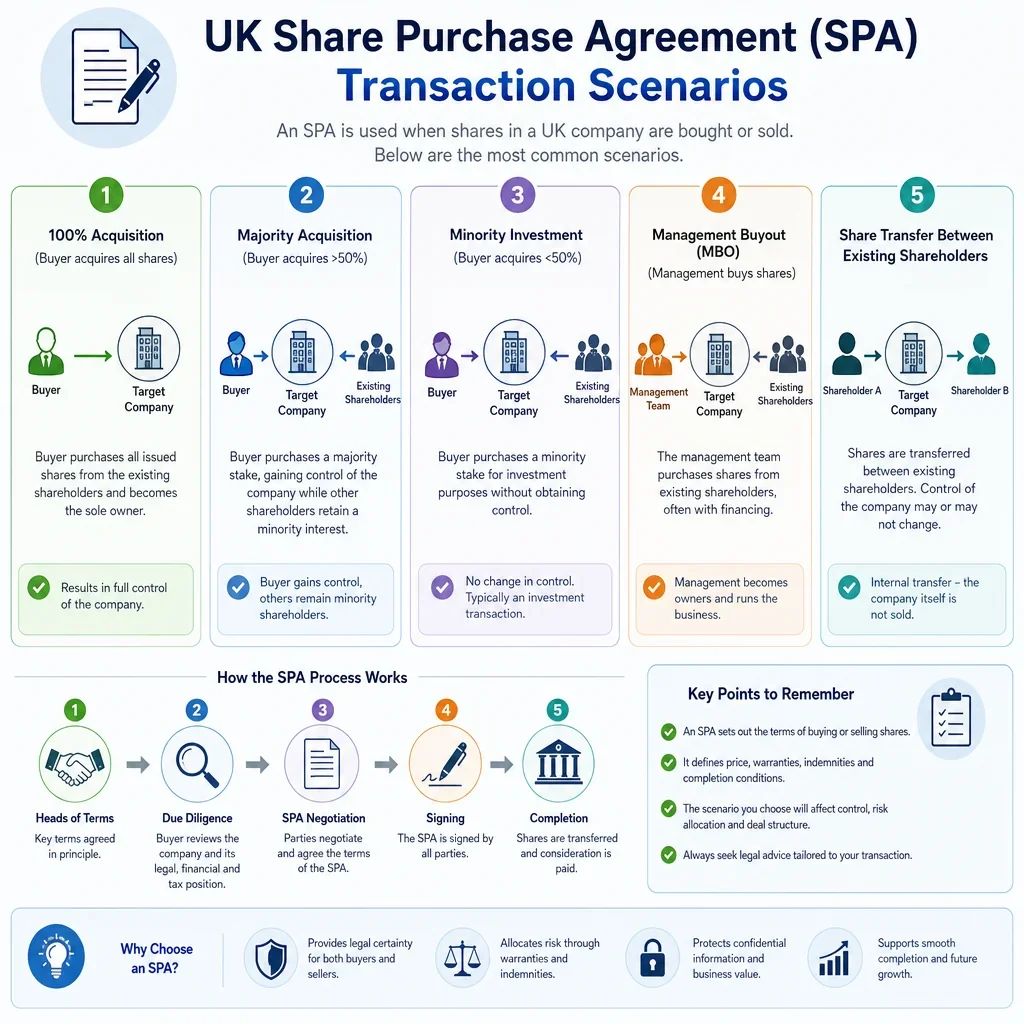
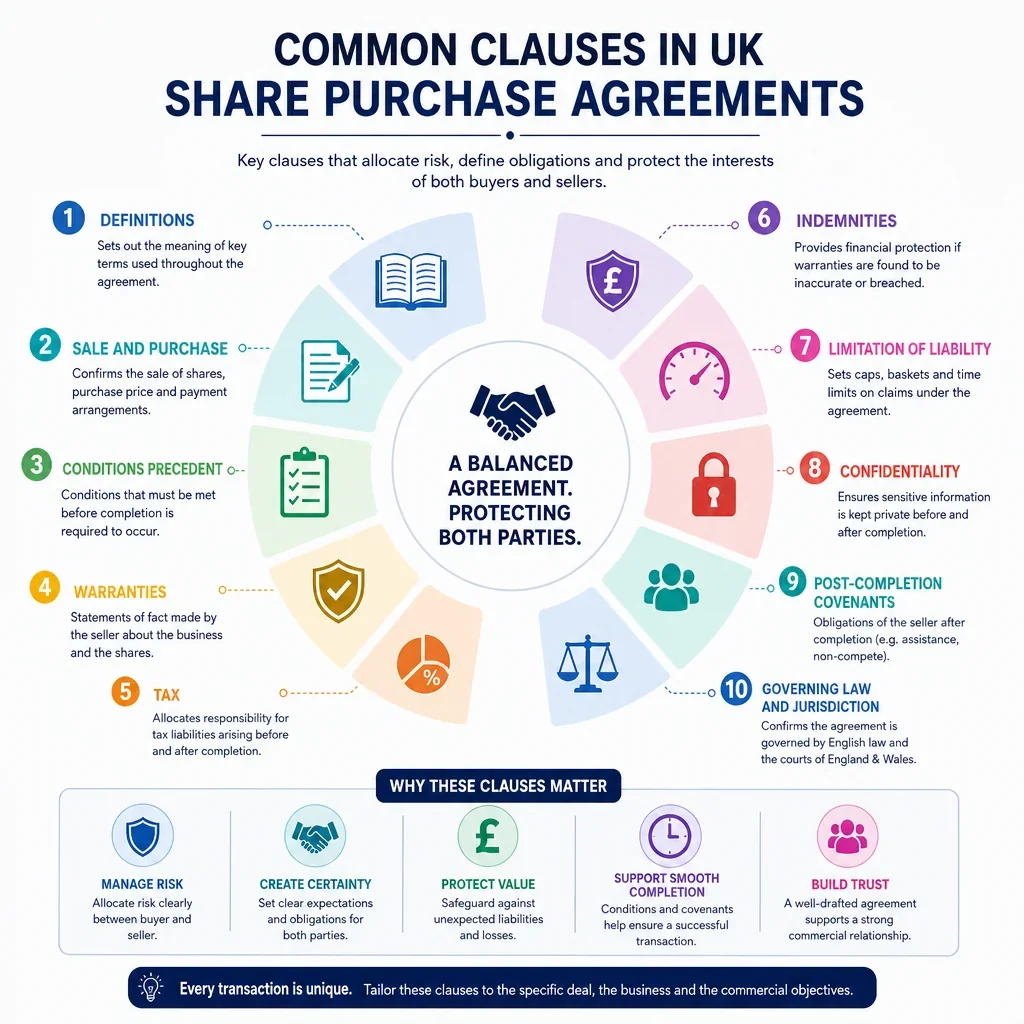
A UK share purchase agreement is usually driven by four linked areas: the mechanics for transferring shares, the price adjustment or deferred payment structure, the warranty and indemnity package, and the contractual limits on seller liability. The most negotiated clauses are often not the introductory sale clause, but the accounts, tax, leakage, completion, warranty limitation and post-completion control provisions.
Why Do Warranties, Indemnities And Disclosure Need To Work Together?
In UK practice, warranties allocate information risk, disclosure qualifies the seller’s liability, and indemnities allocate specific known risks such as tax, litigation or identified liabilities. A buyer should avoid treating these clauses as interchangeable: an indemnity is commonly drafted as a pound-for-pound recovery mechanism, while a warranty claim usually requires proof of breach and loss.
When Is The Purchase Price Mechanism The Key Commercial Issue?
The price clause is especially important where value may move between signing and completion. A locked box structure shifts focus to leakage protection and seller covenants from the locked box date, while completion accounts shift focus to working capital, debt, cash, accounting policies and dispute resolution.
Which UK Legal Issues Should Buyers And Sellers Not Miss?
- Share transfer formalities: UK share transfers commonly require a stock transfer form, board approval, register updates and possible stamp duty treatment under HMRC practice.
- Company law authority: restrictions in the company’s articles, pre-emption rights and Companies Act requirements can affect whether completion can occur cleanly.
- Employment and pensions: although TUPE usually relates to business transfers rather than a pure share sale, employment, pension and incentive warranties remain significant because the target company continues as employer.
- Tax: tax covenants and tax warranties are central in UK SPAs because liabilities remain inside the target after completion unless expressly allocated.
FAQs
You Might Also Be Interested In