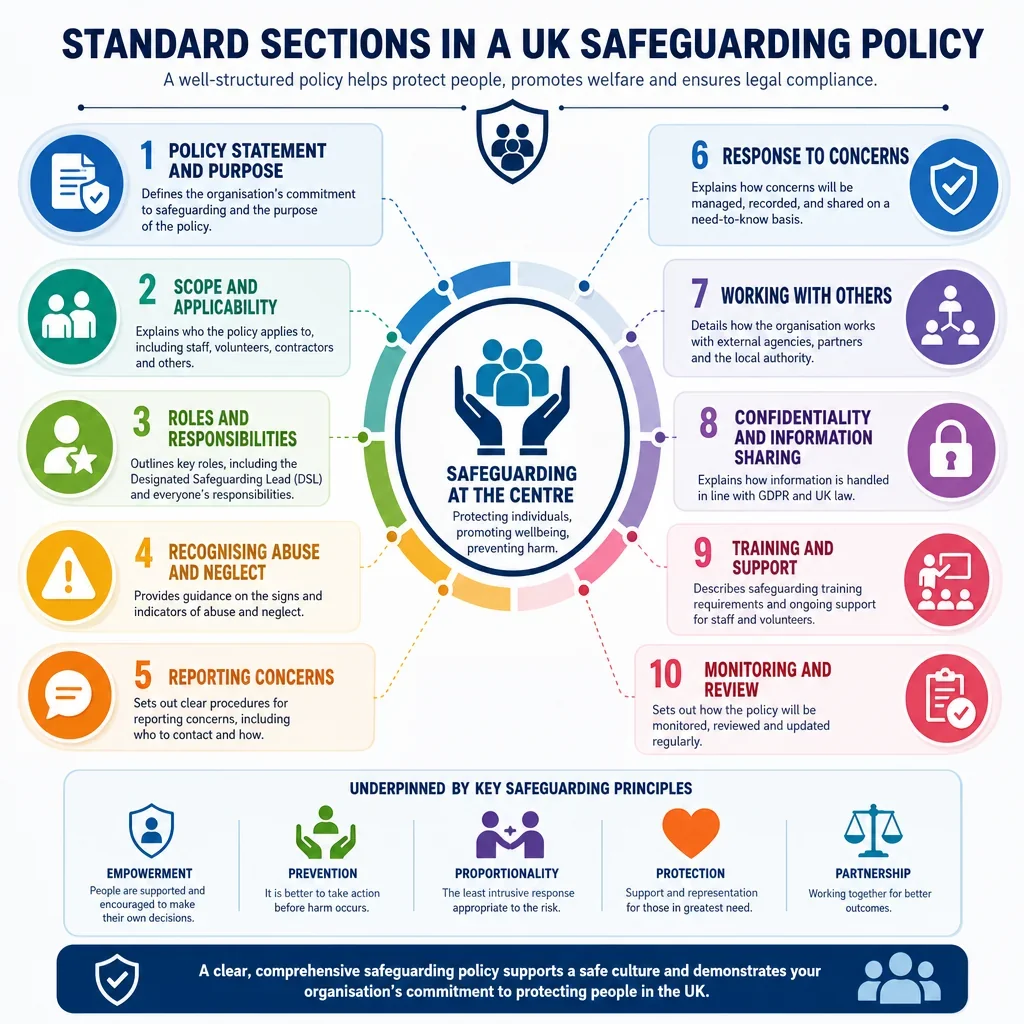
Standard Sections In A UK Safeguarding Policy
Purpose | Section Category | Inclusion Priority | Example Content Areas |
|---|---|---|---|
Purpose and safeguarding commitment | |||
States the organisation's commitment to protecting children or adults at risk from harm. | Introductory | Usually essential | Safeguarding statement, zero tolerance of abuse, welfare-first approach, duty to act. |
Scope and application | |||
Explains who the policy applies to and which activities, locations and services are covered. | Introductory | Usually essential | Staff, volunteers, contractors, trustees, online services, off-site activities, partner organisations. |
Legal and statutory framework | |||
Identifies the main UK laws and guidance that shape the safeguarding policy. | Introductory | Usually essential | Children Act 1989, Children Act 2004, Care Act 2014, Working Together, KCSIE, Equality Act 2010, UK GDPR. |
Key definitions | |||
Defines important terms so everyone understands the policy consistently. | Introductory | Usually essential | Child, young person, adult at risk, abuse, neglect, harm, exploitation, regulated activity. |
Safeguarding principles | |||
Sets out the values that guide safeguarding decisions and interventions. | Introductory | Usually essential | Empowerment, prevention, proportionality, protection, partnership, accountability, child-centred practice. |
Types and indicators of abuse | |||
Helps people recognise possible abuse, neglect or exploitation. | Introductory | Usually essential | Physical, emotional, sexual, neglect, financial, discriminatory, organisational, domestic abuse, self-neglect. |
Specific child safeguarding risks | |||
Lists particular risks that staff must be alert to when working with children. | Introductory | Often recommended | Child sexual exploitation, criminal exploitation, county lines, FGM, radicalisation, bullying, online abuse. |
Specific adult safeguarding risks | |||
Explains adult safeguarding concerns that may arise in care, support or community settings. | Introductory | Context dependent | Financial abuse, domestic abuse, modern slavery, organisational abuse, neglect, self-neglect, coercive control. |
Designated safeguarding lead | |||
Identifies the lead person responsible for safeguarding oversight and referrals. | Roles and responsibilities | Usually essential | Name or role, contact details, deputy cover, availability, referral authority, advice to staff. |
Senior leadership responsibilities | |||
Clarifies leadership accountability for safeguarding culture, resources and compliance. | Roles and responsibilities | Usually essential | Governance, policy approval, safer recruitment, training oversight, audit, escalation routes. |
Trustee, governor or board responsibilities | |||
Explains board-level responsibility for safeguarding governance and assurance. | Roles and responsibilities | Context dependent | Safeguarding lead trustee, risk oversight, serious incident reporting, policy monitoring, accountability. |
Staff and volunteer responsibilities | |||
Sets expectations for everyone who works or volunteers for the organisation. | Roles and responsibilities | Usually essential | Duty to report concerns, follow procedures, attend training, maintain boundaries, keep records. |
Code of conduct and professional boundaries | |||
Describes acceptable and unacceptable behaviour when working with children or adults at risk. | Roles and responsibilities | Usually essential | Appropriate contact, lone working, gifts, favouritism, language, physical contact, power imbalance. |
Safer recruitment | |||
Explains how the organisation checks suitability before appointing staff or volunteers. | Procedures | Usually essential | Application checks, references, identity, qualifications, interviews, employment history, risk assessment. |
DBS and barred list checks | |||
Sets out when criminal record and barred list checks are required or considered. | Procedures | Often recommended | Regulated activity, enhanced checks, barred list checks, update service, handling disclosures, rechecks. |
Regulated activity assessment | |||
Explains how the organisation decides whether roles involve regulated activity. | Procedures | Context dependent | Frequency, supervision, personal care, teaching, health care, relevant establishments, barred roles. |
Reporting safeguarding concerns | |||
Tells people how to report a concern internally and without delay. | Procedures | Usually essential | Who to contact, urgent concerns, out-of-hours route, written report, no investigation by staff. |
Immediate danger and emergency action | |||
Explains what to do where someone is at immediate risk of serious harm. | Procedures | Usually essential | Call 999, preserve safety, contact children's social care or adult social care, inform DSL. |
Responding to disclosures | |||
Guides staff on how to respond if someone tells them about abuse or harm. | Procedures | Usually essential | Listen, reassure, avoid leading questions, explain limits of confidentiality, record exact words. |
Referral to statutory agencies | |||
Explains when and how concerns are referred to local authority or police services. | Procedures | Usually essential | Children's social care, adult safeguarding team, police, LADO, referral forms, consent considerations. |
Escalation and professional disagreement | |||
Sets out what to do if a concern is not acted on appropriately. | Procedures | Often recommended | Challenge decisions, speak to senior leaders, contact local safeguarding partners, document escalation. |
Allegations against staff or volunteers | |||
Explains how concerns about people in positions of trust are managed. | Procedures | Usually essential | Report to senior lead, LADO contact, suspension considerations, confidentiality, disciplinary process. |
Low-level concerns | |||
Encourages reporting of behaviour that may not meet the allegation threshold but causes concern. | Procedures | Often recommended | Self-reporting, boundary concerns, patterns of behaviour, confidential records, management action. |
Whistleblowing and speaking up | |||
Provides a route to raise safeguarding failures, cover-ups or unsafe practice. | Procedures | Often recommended | Protected disclosures, external reporting, no retaliation, confidential concerns, senior contacts. |
Information sharing | |||
Explains when safeguarding information may or must be shared with others. | Procedures | Usually essential | Consent, vital interests, public task, proportionality, need-to-know sharing, recording decisions. |
Confidentiality and privacy | |||
Clarifies that confidentiality cannot override the need to protect someone from harm. | Procedures | Usually essential | Limits of confidentiality, privacy notices, secure sharing, lawful basis, restricted access. |
Consent, capacity and best interests | |||
Explains how consent and mental capacity affect adult safeguarding decisions. | Procedures | Context dependent | Capacity assessment, best interests, supported decision-making, refusal of help, serious risk exceptions. |
Listening to children and young people | |||
Ensures children's views, wishes and feelings are considered in safeguarding responses. | Procedures | Often recommended | Child-centred practice, age-appropriate communication, advocacy, participation, recording the child's voice. |
Making Safeguarding Personal | |||
Promotes adult safeguarding responses that focus on the person's desired outcomes. | Procedures | Context dependent | Personal outcomes, choice, control, advocacy, proportional action, risk enablement. |
Online safety and digital communication | |||
Explains safeguards for online services, digital contact and technology use. | Procedures | Often recommended | Online abuse, filtering, monitoring, social media, direct messaging, livestreaming, remote sessions. |
Photography, filming and media use | |||
Controls how images and recordings are taken, stored and shared safely. | Procedures | Context dependent | Consent, image storage, naming children, social media, parental requests, prohibited devices. |
Supervision and staffing ratios | |||
Sets expected supervision levels to reduce avoidable safeguarding risks. | Procedures | Context dependent | Adult-to-child ratios, lone working, mixed groups, toilet supervision, breaks, activity risk assessment. |
Lone working and one-to-one contact | |||
Reduces risks when staff work alone with children or adults at risk. | Procedures | Often recommended | Open doors, visibility, check-ins, records, home visits, transport, risk assessment. |
Transport and travel | |||
Explains safeguards for transporting children or adults at risk. | Procedures | Context dependent | Consent, driver checks, insurance, seatbelts, route planning, two-adult rule, emergency contacts. |
Trips, events and off-site activities | |||
Sets safeguarding controls for activities away from the normal premises. | Procedures | Context dependent | Risk assessments, consent, emergency contacts, supervision, accommodation, medication, missing person procedure. |
Intimate and personal care | |||
Protects dignity and safety during personal or intimate care tasks. | Procedures | Context dependent | Care plans, consent, privacy, same-sex care preferences, recording, staff suitability, two-person support. |
Physical intervention and restraint | |||
Sets limits on physical intervention to prevent harm and protect rights. | Procedures | Context dependent | Last resort, reasonable force, de-escalation, incident recording, parental notification, post-incident review. |
Peer-on-peer abuse and harmful behaviour | |||
Explains how harmful behaviour between children or service users is identified and managed. | Procedures | Often recommended | Bullying, sexual harassment, sexual violence, hazing, online abuse, support for victim and alleged perpetrator. |
Sexual violence and sexual harassment | |||
Sets procedures for responding to sexual misconduct involving children or young people. | Procedures | Context dependent | Risk assessment, police referral, victim support, alleged perpetrator management, confidentiality, education setting duties. |
Domestic abuse | |||
Explains how domestic abuse may affect children, adults at risk, staff or service users. | Procedures | Often recommended | Coercive control, MARAC, DASH risk assessment, children as victims, safety planning, specialist support. |
Prevent, radicalisation and extremism | |||
Explains how concerns about radicalisation or extremism are identified and referred. | Procedures | Context dependent | Prevent duty, Channel referral, vulnerability indicators, online radicalisation, local authority advice. |
Female genital mutilation | |||
Explains recognition and reporting of FGM risk or disclosure. | Procedures | Context dependent | Mandatory reporting duty, risk indicators, travel concerns, police reporting, support services. |
Modern slavery and human trafficking | |||
Explains how to identify and respond to exploitation, trafficking and forced labour concerns. | Procedures | Often recommended | National Referral Mechanism, forced labour, criminal exploitation, sexual exploitation, consent, police contact. |
Missing child or adult at risk | |||
Sets steps to take when a child or adult at risk cannot be located. | Procedures | Context dependent | Immediate search, police contact, parent or carer notification, risk factors, return discussion, incident log. |
Complaints relating to safeguarding | |||
Explains how safeguarding-related complaints are handled alongside formal safeguarding procedures. | Procedures | Often recommended | Complaint route, safeguarding triage, independence, timescales, escalation, complainant support. |
Support for those affected by safeguarding concerns | |||
Explains how victims, survivors, families, staff and witnesses will be supported. | Procedures | Often recommended | Emotional support, referrals, advocacy, reasonable adjustments, trauma-informed communication, staff debriefing. |
Equality, diversity and reasonable adjustments | |||
Ensures safeguarding procedures are accessible and non-discriminatory. | Procedures | Often recommended | Protected characteristics, interpreters, accessible information, disability adjustments, cultural competence, anti-discrimination. |
Visitors, contractors and external providers | |||
Explains safeguarding controls for non-staff who access premises or services. | Procedures | Context dependent | Sign-in, ID checks, supervision, safeguarding briefing, contractor clauses, reporting concerns. |
Partnership working and multi-agency cooperation | |||
Explains how the organisation works with local safeguarding partners and other agencies. | Procedures | Often recommended | Local safeguarding partnerships, information sharing, strategy discussions, joint risk management, referral follow-up. |
Safeguarding risk assessment | |||
Explains how safeguarding risks are identified, assessed and controlled in activities. | Procedures | Often recommended | Activity hazards, vulnerable groups, supervision, environment, online risks, mitigation, review after incidents. |
Safeguarding training | |||
Sets training expectations so people can recognise, report and respond to concerns. | Training and awareness | Usually essential | Induction, refresher training, DSL training, role-specific training, records of attendance, updates. |
Induction and policy briefing | |||
Ensures new starters understand safeguarding expectations before working independently. | Training and awareness | Usually essential | Policy sign-off, reporting route, code of conduct, DSL details, whistleblowing, online safety. |
Awareness for service users, parents and carers | |||
Explains how people using the service know how to raise safeguarding concerns. | Training and awareness | Often recommended | Safeguarding notices, child-friendly information, complaints route, DSL contact, accessible formats. |
Supervision, support and reflective practice | |||
Provides structured support for staff handling safeguarding work or difficult concerns. | Training and awareness | Often recommended | Case supervision, debriefing, wellbeing, learning discussions, professional curiosity, management oversight. |
Safeguarding records | |||
Explains how safeguarding concerns, actions and decisions are documented. | Records and review | Usually essential | Factual notes, dates, exact words, body maps, decisions, referrals, secure storage, access controls. |
Data protection and retention | |||
Sets rules for lawful storage, retention and deletion of safeguarding information. | Records and review | Usually essential | UK GDPR, Data Protection Act 2018, special category data, retention schedule, secure disposal, subject access. |
Incident review and organisational learning | |||
Ensures safeguarding incidents lead to improvements in policy, training and practice. | Records and review | Often recommended | Lessons learned, action plans, safeguarding practice reviews, audit findings, policy updates. |
Serious incident and regulator reporting | |||
Explains when safeguarding incidents must be reported to regulators or commissioners. | Records and review | Context dependent | Charity Commission serious incidents, CQC notifications, Ofsted, commissioners, internal approvals. |
Monitoring and safeguarding audit | |||
Checks whether safeguarding arrangements are working in practice. | Records and review | Often recommended | Case file audits, training compliance, DBS tracking, incident trends, action plans, board reports. |
Policy review and version control | |||
States how often the policy is reviewed and who approves changes. | Records and review | Usually essential | Annual review, named owner, approval date, next review date, version history, legal updates. |
Related policies and procedures | |||
Lists other documents that support safeguarding implementation. | Records and review | Often recommended | Recruitment, whistleblowing, complaints, data protection, health and safety, behaviour, online safety, disciplinary. |
What Sections Should A UK Safeguarding Policy Usually Include?
A robust UK safeguarding policy will normally cover scope, legal framework, definitions of abuse, roles and responsibilities, reporting procedures, managing allegations, safer recruitment, confidentiality, record keeping, training, and review. These sections help show how the organisation identifies concerns, acts on them, and records decisions.
Which UK Legal Duties Most Affect Safeguarding Policy Content?
For organisations working with children, policy drafting should reflect statutory guidance such as Working Together To Safeguard Children and, for schools and colleges, Keeping Children Safe In Education. Adult safeguarding policies should reflect the Care Act 2014 and the six safeguarding principles in the Care and Support Statutory Guidance.
Why Should Reporting, Escalation And Records Be Separate Sections?
Reporting, escalation and record keeping perform different functions. Reporting explains who must be told and how; escalation explains what to do if action is delayed or inadequate; records explain how concerns, decisions and referrals are documented. Separating them makes the policy easier to follow during urgent safeguarding situations.
When Are Extra Safeguarding Sections Needed?
Extra sections are often needed where the organisation has higher-risk activities, such as online services, photography, transport, overnight stays, regulated activity, international work, or direct care. These areas may require more detailed controls on consent, supervision, information sharing, DBS checks, and referral routes.
FAQs
You Might Also Be Interested In