

Settlement Agreement Validity Requirements In United Kingdom
Created:
This guide explains the key validity requirements for settlement agreements in the United Kingdom, helping readers understand when an agreement is likely to be enforceable. It is part of our AI Generated British Settlement Agreement resources.
Requirement Name | Requirement Description | Responsible Party | Consequence of Non-Compliance | Suggested Evidence |
|---|---|---|---|---|
Statutory Requirement | ||||
Agreement must be in writing | The settlement must be recorded in a written agreement, not just agreed orally. | All Parties | Agreement May Be Invalid | Signed agreement, dated final version, email sending execution copy. |
Particular complaints or proceedings identified | The agreement must relate to specific complaints or proceedings being settled. | Employer | Claim Waiver May Fail | Schedule of claims, pleaded complaints, grievance, correspondence identifying issues. |
Adviser Requirement | ||||
Employee must receive independent advice | The employee must receive advice on the terms and effect of the agreement and its impact on tribunal rights. | Employee | Claim Waiver May Fail | Signed adviser certificate, advice attendance note, adviser invoice. |
Adviser must be a qualifying independent adviser | The adviser must fall within an approved category, such as a qualified lawyer, authorised trade union official or advice centre worker. | Independent Adviser | Claim Waiver May Fail | Adviser certificate showing professional status, SRA number or union authorisation. |
Adviser must be independent of the employer | The adviser must not be acting for, employed by or connected with the employer in a way that compromises independence. | Independent Adviser | Claim Waiver May Fail | Adviser independence confirmation and conflict check note. |
Adviser must have insurance or indemnity | The adviser must be covered by professional indemnity insurance or equivalent protection for advice on the agreement. | Independent Adviser | Claim Waiver May Fail | Adviser certificate confirming insurance or indemnity cover. |
Drafting Requirement | ||||
Adviser identified in the agreement | The agreement must identify the adviser who gave the employee independent advice. | Employer | Claim Waiver May Fail | Agreement clause naming adviser and signed adviser certificate. |
Agreement must state statutory conditions are satisfied | The agreement should state that the statutory settlement agreement conditions are met. | Employer | Claim Waiver May Fail | Statutory compliance clause in executed agreement. |
Statutory Requirement | ||||
Equality Act qualifying settlement rules met | Discrimination claim waivers must meet Equality Act qualifying settlement conditions. | All Parties | Claim Waiver May Fail | Equality Act claims listed and adviser certificate covering discrimination rights. |
Drafting Requirement | ||||
Discrimination claims specifically listed | Any race, sex, disability, age, religion, sexual orientation, pregnancy or other Equality Act claims should be expressly identified. | Employer | Claim Waiver May Fail | Claims schedule referencing relevant Equality Act provisions. |
Unfair dismissal claim expressly covered | If relevant, ordinary unfair dismissal rights should be expressly included in the settled claims. | Employer | Claim Waiver May Fail | Claims schedule naming unfair dismissal and effective termination date. |
Whistleblowing claims expressly considered | Any protected disclosure or whistleblowing detriment or dismissal claim should be specifically assessed and listed if intended to be settled. | Employer | Claim Waiver May Fail | Disclosure review, pleaded whistleblowing issues, specific claim wording. |
Protected disclosures not unlawfully restricted | Confidentiality wording must not prevent protected disclosures under whistleblowing law. | Employer | Increased Dispute Risk | Carve-out for protected disclosures, regulators and legal obligations. |
Practical Requirement | ||||
ACAS COT3 alternative identified where used | If settlement is through ACAS conciliation, ensure the COT3 terms accurately capture the settlement instead of relying on adviser requirements. | All Parties | Depends on Requirement | ACAS COT3, conciliator correspondence, early conciliation certificate. |
Drafting Requirement | ||||
Existing proceedings accurately referenced | If tribunal or court proceedings exist, the claim numbers and parties should be accurately recorded. | All Parties | Increased Dispute Risk | ET1, ET3, tribunal case number, court claim form, dismissal order. |
Withdrawal or dismissal of claims addressed | Where claims have been issued, the agreement should say how and when they will be withdrawn or dismissed. | All Parties | Administrative Issue | Consent order, withdrawal email, tribunal confirmation, dismissal judgment. |
Practical Requirement | ||||
Parties have capacity and authority | Each signatory should have legal capacity and authority to enter the agreement. | All Parties | Agreement May Be Invalid | Board approval, HR authority, power of attorney, identity checks. |
Drafting Requirement | ||||
Valid consideration provided | The employee should receive something of value in return for settling claims, often an ex gratia payment. | Employer | Agreement May Be Invalid | Payment clause, payroll record, bank confirmation, consideration recital. |
Settlement payment amount stated clearly | The agreement should state the gross and net payment amounts, timing and payment method. | Employer | Increased Dispute Risk | Payment schedule, payslip, BACS record, signed payment clause. |
Tax treatment addressed | The agreement should allocate taxable earnings, notice pay and termination payments and state who bears tax risk. | Employer | Increased Dispute Risk | Tax indemnity, payroll calculations, PAYE deductions, HMRC guidance note. |
Practical Requirement | ||||
Post-employment notice pay considered | The employer should calculate whether termination payments include taxable post-employment notice pay. | Employer | Administrative Issue | PENP calculation, notice clause, payroll worksheet, payslip. |
Payment timing linked to completion | Payment should be conditional on receipt of signed agreement and adviser certificate where appropriate. | Employer | Administrative Issue | Completion checklist, signed certificate, payment approval email. |
Accrued wages and holiday pay calculated | Final salary, accrued holiday, commission and other contractual sums should be calculated and paid correctly. | Employer | Increased Dispute Risk | Final payslip, holiday calculation, payroll records, commission statement. |
Drafting Requirement | ||||
Notice pay or PILON addressed | The agreement should state whether notice is worked, paid in lieu or waived by agreement. | Employer | Increased Dispute Risk | Contract notice clause, termination letter, PILON calculation, payslip. |
Statutory redundancy pay rights addressed | If redundancy is involved, statutory and enhanced redundancy payments should be clearly identified. | Employer | Increased Dispute Risk | Redundancy calculation, length of service record, redundancy policy, payslip. |
Accrued pension rights not improperly waived | The agreement should not purport to surrender protected accrued occupational pension rights unless legally permitted. | Employer | Claim Waiver May Fail | Pension carve-out, pension provider confirmation, benefits statement. |
Practical Requirement | ||||
Pension contributions reconciled | Employer and employee pension contributions up to termination should be checked and paid where due. | Employer | Administrative Issue | Pension contribution schedule, payroll records, provider receipt. |
Drafting Requirement | ||||
Personal injury claims handled carefully | Known personal injury claims should be identified unknown injury claims are often carved out to reduce enforceability risk. | Depends | Claim Waiver May Fail | Injury disclosure, occupational health report, express carve-out or specific settlement wording. |
Future claims not overbroadly waived | Waivers should not rely only on broad future claims wording specific claims and known facts should be addressed. | Employer | Claim Waiver May Fail | Claims schedule, factual background, express exclusions for claims that cannot be waived. |
Unknown claims assessed before waiver | Unknown claims clauses should be drafted carefully and supported by adequate advice and consideration. | All Parties | Depends on Requirement | Advice note, expanded consideration clause, negotiated settlement language. |
Confidentiality clause includes lawful carve-outs | Confidentiality wording should allow legal advice, tax advice, close family disclosure, regulators, criminal reporting and protected disclosures. | Employer | Increased Dispute Risk | NDA carve-out clause, adviser review note, SRA-compliant drafting checklist. |
Non-derogatory statement clause balanced | Any non-derogatory wording should be clear about who is bound and should not restrict protected disclosures. | All Parties | Increased Dispute Risk | Clause identifying employer representatives and whistleblowing carve-out. |
Practical Requirement | ||||
Employment reference wording agreed | If a reference is part of the deal, wording and response process should be attached or clearly described. | Employer | Increased Dispute Risk | Agreed reference schedule, HR instruction, reference request log. |
Drafting Requirement | ||||
Restrictive covenants confirmed or varied | The agreement should state whether existing post-termination restrictions remain, are varied or are released. | Employer | Increased Dispute Risk | Employment contract, covenant schedule, variation wording, legal review note. |
Practical Requirement | ||||
Return of company property addressed | The agreement should require return of devices, documents, keys, cards and confidential information. | Employee | Administrative Issue | Return checklist, courier receipt, IT disablement record, employee certificate. |
Drafting Requirement | ||||
Data protection obligations preserved | The agreement should not prevent lawful data subject rights or statutory data protection duties. | All Parties | Increased Dispute Risk | Data protection carve-out, privacy notice, DSAR handling note. |
Practical Requirement | ||||
Immigration and right-to-work issues checked | Where employment ends or sponsorship is involved, right-to-work and sponsor reporting duties should be checked. | Employer | Administrative Issue | Sponsor management record, termination report, right-to-work file. |
Drafting Requirement | ||||
Family leave rights expressly considered | Claims about maternity, paternity, adoption, parental leave or flexible working should be listed if relevant. | Employer | Claim Waiver May Fail | Leave records, flexible working request, claims schedule, payroll records. |
Working time claims expressly considered | Claims about holiday pay, rest breaks, working hours or night work should be identified if settled. | Employer | Claim Waiver May Fail | Holiday records, timesheets, rota records, claims schedule. |
Practical Requirement | ||||
National minimum wage issues checked | Any underpayment risk should be checked because minimum wage obligations may trigger HMRC enforcement as well as civil claims. | Employer | Increased Dispute Risk | Pay records, hours records, deductions review, arrears calculation. |
Drafting Requirement | ||||
Unlawful deductions claims identified | Claims for unpaid wages, deductions, bonus, commission or expenses should be specifically included if settled. | Employer | Claim Waiver May Fail | Payroll records, bonus plan, commission plan, expenses ledger, claims schedule. |
TUPE claims assessed where relevant | If a business transfer or service provision change is involved, TUPE claims and liability allocation should be expressly considered. | Depends | Claim Waiver May Fail | Transfer documents, employee liability information, indemnity clauses, claims schedule. |
Collective redundancy claims considered | Where collective redundancy duties may apply, protective award claims should be identified if intended to be settled. | Employer | Claim Waiver May Fail | Consultation records, HR1 form, employee representative notes, claims schedule. |
Trade union claims considered | Claims about trade union membership, activities, recognition or industrial action should be listed if relevant. | Employer | Claim Waiver May Fail | Union correspondence, disciplinary records, claims schedule, adviser note. |
Health and safety detriment claims considered | Claims about health and safety detriment or dismissal should be specifically assessed and listed if settled. | Employer | Claim Waiver May Fail | Risk assessments, complaints, grievance records, claims schedule. |
Practical Requirement | ||||
Employment status checked | The parties should check whether the person is an employee, worker, office-holder or contractor and draft claims accordingly. | All Parties | Increased Dispute Risk | Contract, payslips, working practices evidence, status analysis note. |
Drafting Requirement | ||||
Governing law and jurisdiction stated | The agreement should state the governing law and forum, commonly England and Wales or the relevant UK jurisdiction. | Employer | Increased Dispute Risk | Governing law clause and jurisdiction clause in signed agreement. |
Practical Requirement | ||||
Scotland-specific execution checked | If Scottish law applies, execution formalities and terminology should be checked for Scots law requirements. | Depends | Depends on Requirement | Scottish execution block, witness details if needed, Scots law review note. |
Northern Ireland statutory regime checked | For Northern Ireland employment, local statutory references and Labour Relations Agency conciliation routes should be checked. | Depends | Depends on Requirement | Northern Ireland law review, LRA documentation, local claims schedule. |
Evidence Requirement | ||||
Agreement signed by all required parties | All parties who give releases, promises or indemnities should sign the final agreed version. | All Parties | Agreement May Be Invalid | Complete signed copy, e-signature audit trail, counterpart clause. |
Agreement dated on completion | The final agreement should be dated to show when it became binding and when payment duties start. | All Parties | Administrative Issue | Dated signature page, completion email, signed counterpart bundle. |
Electronic signature evidence retained | If signed electronically, retain evidence showing identity, intention to sign and document integrity. | All Parties | Increased Dispute Risk | E-signature certificate, audit log, email authentication, final PDF hash. |
Adviser certificate completed and attached | A separate adviser certificate should confirm the statutory advice, adviser status, independence and insurance. | Independent Adviser | Claim Waiver May Fail | Signed adviser certificate attached to the agreement. |
Practical Requirement | ||||
Reasonable time to consider offer | Employees should normally be given reasonable time to consider the proposed agreement ACAS suggests at least 10 calendar days unless agreed otherwise. | Employer | Increased Dispute Risk | Offer letter date, deadline, extension emails, negotiation timeline. |
No improper pressure or undue influence | The employee should not be threatened, misled or pressured into signing without proper time and advice. | Employer | Agreement May Be Invalid | Meeting notes, offer letter, adviser confirmation, negotiation record. |
Settlement discussions privilege limits understood | Protected conversations and without prejudice rules have limits, especially for discrimination, automatic unfair dismissal and improper behaviour. | All Parties | Increased Dispute Risk | Without prejudice correspondence, section 111A notes, discrimination risk review. |
Evidence Requirement | ||||
Final version matches advised version | The employee should sign the same version on which the independent adviser gave advice, or receive advice on any changes. | All Parties | Claim Waiver May Fail | Version control, tracked changes, adviser approval email, final signed PDF. |
Drafting Requirement | ||||
Entire agreement clause included | The agreement should state whether it replaces prior discussions and records all settlement terms. | Employer | Increased Dispute Risk | Entire agreement clause, negotiation correspondence, final term sheet. |
Employee warranties checked | Warranties about claims, offers, misconduct, property and confidentiality should be accurate and not unfairly broad. | All Parties | Increased Dispute Risk | Warranty clause, disclosure schedule, adviser note, employee confirmations. |
Clawback clauses proportionate | Any repayment clause for breach should be proportionate and drafted to reduce penalty clause risk. | Employer | Increased Dispute Risk | Clawback clause, rationale note, legal review, breach impact assessment. |
Practical Requirement | ||||
Legal fee contribution stated | The agreement should state the employer contribution to independent advice fees and whether VAT is included. | Employer | Administrative Issue | Fee contribution clause, adviser invoice, payment record. |
Drafting Requirement | ||||
Share schemes and options addressed | Any share options, LTIPs, RSUs or employee shareholder rights should be dealt with consistently with plan rules. | Employer | Increased Dispute Risk | Plan rules, vesting statement, leaver classification, tax note. |
Bonus and commission terms resolved | The agreement should say whether bonus, commission or incentives are paid, waived or included in the settlement sum. | Employer | Increased Dispute Risk | Bonus plan, commission statement, calculation sheet, express waiver wording. |
Practical Requirement | ||||
Director or officer resignations documented | If the employee is a director, officer or trustee, separate resignation and Companies House filings may be needed. | Depends | Administrative Issue | Resignation letter, board minutes, Companies House filing, trustee records. |
Expenses and company card balances reconciled | Outstanding expenses, advances and company card liabilities should be reconciled before or at completion. | All Parties | Administrative Issue | Expense claims, receipts, card statement, payroll deduction authority. |
Benefits end date confirmed | Private medical insurance, company car, phone, allowances and other benefits should have clear end dates or continuation terms. | Employer | Administrative Issue | Benefits schedule, insurer notice, car return record, payroll records. |
Internal and external announcement agreed | If communications are important, agreed announcement wording and timing should be included. | All Parties | Increased Dispute Risk | Announcement schedule, communications plan, approval emails. |
Drafting Requirement | ||||
Regulatory reference duties preserved | For regulated roles, reference wording must not prevent accurate regulatory references or notifications. | Employer | Increased Dispute Risk | SMCR assessment, regulatory reference file, FCA notification record. |
Safeguarding reporting duties not restricted | Settlement terms must not prevent required safeguarding, DBS, professional body or regulator referrals. | Employer | Increased Dispute Risk | Safeguarding review, referral record, regulatory carve-out clause. |
Criminal reporting carve-out included | Confidentiality wording should not stop reporting criminal conduct to police or law enforcement. | Employer | Increased Dispute Risk | Police reporting carve-out, NDA review note, adviser comments. |
Adviser Requirement | ||||
Advice covers terms and effect | The adviser must advise on what the agreement means and how it affects the employee's ability to bring tribunal claims. | Independent Adviser | Claim Waiver May Fail | Adviser certificate expressly covering terms, effect and tribunal rights. |
Practical Requirement | ||||
Offer letter marked appropriately | Settlement correspondence should be marked appropriately, such as without prejudice or subject to contract, where legally justified. | Employer | Increased Dispute Risk | Offer letter, meeting invitation, negotiation emails. |
Subject to contract status managed | Negotiations should make clear that no binding settlement exists until agreed conditions and signatures are completed. | All Parties | Increased Dispute Risk | Subject to contract wording, final execution email, completion checklist. |
Drafting Requirement | ||||
Employer claims and deductions addressed | If the employer releases or reserves claims against the employee, this should be stated clearly. | Employer | Increased Dispute Risk | Employer release clause, property review, loan or training cost records. |
Statutory Requirement | ||||
Any wage deductions authorised | Any deduction from wages must be legally authorised, contractually permitted or consented to in writing. | Employer | Increased Dispute Risk | Written consent, contract clause, payroll deduction record. |
Drafting Requirement | ||||
Termination date stated accurately | The effective termination date should be clear because it affects limitation, notice, benefits and tax. | Employer | Increased Dispute Risk | Termination letter, payroll record, HR system entry, agreement definition. |
Practical Requirement | ||||
Limitation dates checked | Tribunal limitation dates and ACAS early conciliation pauses should be checked before relying on settlement timing. | Depends | Increased Dispute Risk | Limitation calculation, ACAS certificate, termination date, claim chronology. |
Drafting Requirement | ||||
Re-employment restriction considered | Any bar on future employment or agency work should be clear, proportionate and non-discriminatory. | Employer | Increased Dispute Risk | Re-employment clause, equality impact note, recruitment system instruction. |
Practical Requirement | ||||
Victimisation and discrimination risk reviewed | Terms should not penalise the employee for doing a protected act, such as raising discrimination concerns. | Employer | Increased Dispute Risk | Equality review, grievance records, settlement rationale, adviser comments. |
Reasonable adjustments made for process | Disabled employees may need adjustments to meetings, deadlines, format or communication during settlement discussions. | Employer | Increased Dispute Risk | Adjustment requests, agreed extensions, accessible documents, meeting notes. |
Vulnerability and capacity concerns checked | If capacity, illness or vulnerability is apparent, signing should be paused or safeguards used before completion. | All Parties | Agreement May Be Invalid | Capacity assessment, medical note, adviser confirmation, adjusted timetable. |
Minor or young worker issues checked | If the worker is under 18, capacity, guardian involvement and enforceability should be checked. | Depends | Agreement May Be Invalid | Age verification, guardian correspondence, specialist legal advice note. |
Employer solvency and authority checked | If the employer is insolvent or near insolvency, administrator authority and employee statutory payment rights should be checked. | Depends | Depends on Requirement | Administrator approval, insolvency correspondence, Redundancy Payments Service records. |
Drafting Requirement | ||||
Non-waivable rights excluded | The agreement should exclude claims or rights that cannot lawfully be waived or are not intended to be settled. | Employer | Increased Dispute Risk | Exclusions clause for pension rights, protected disclosures, accrued entitlements and enforcement rights. |
Right to enforce agreement preserved | The waiver should not prevent a party from enforcing the settlement agreement itself. | All Parties | Increased Dispute Risk | Enforcement carve-out in claims waiver clause. |
Severance clause included | A severance clause can help preserve valid terms if one clause is unenforceable. | Employer | Depends on Requirement | Severance clause in signed agreement. |
What Makes A UK Settlement Agreement Valid?
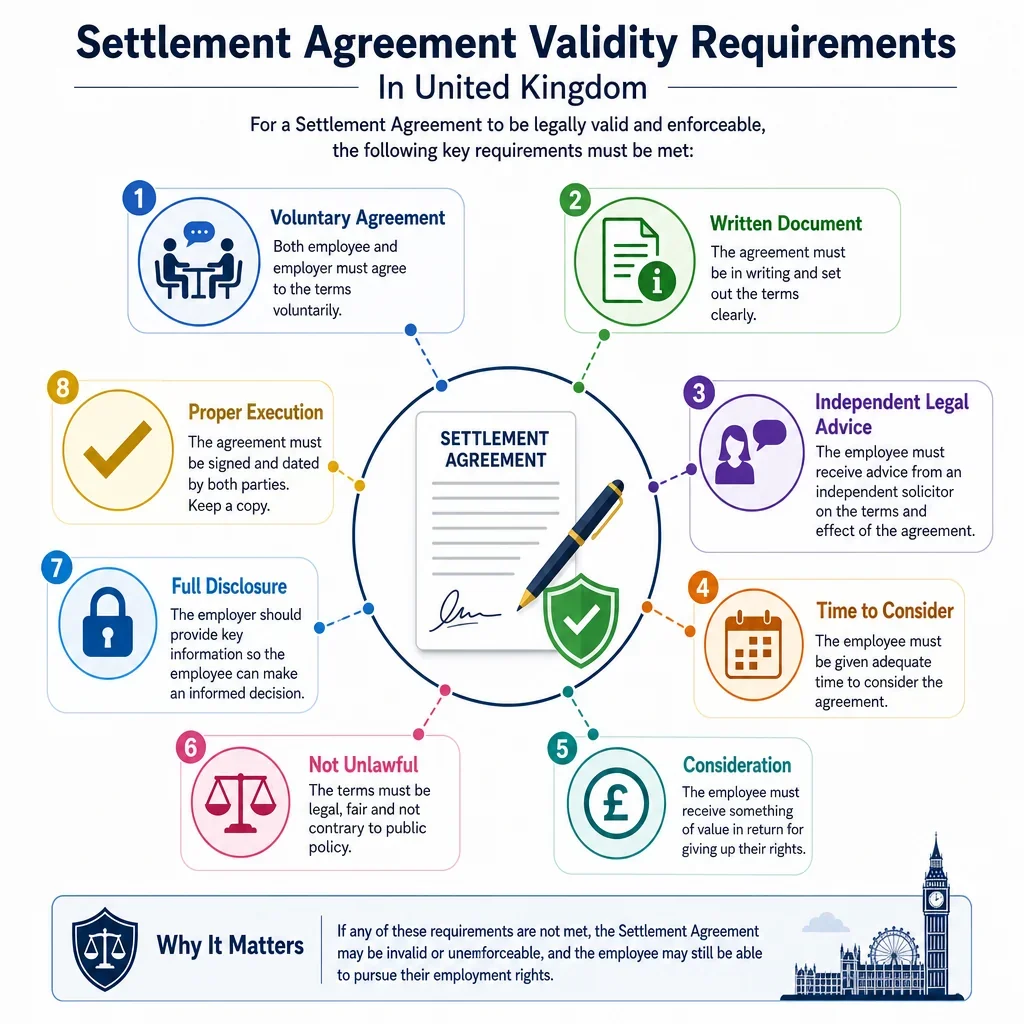
A settlement agreement used to waive UK employment claims usually needs more than signatures and payment terms. For statutory employment claims, the agreement should be in writing, relate to particular complaints or proceedings, and the employee must receive advice from a qualifying independent adviser with appropriate insurance or indemnity.
Which Requirements Most Often Affect Enforceability?
- Independent legal advice is central: without advice from a qualified independent adviser, statutory claim waivers under employment legislation may fail.
- Claims must be identified clearly: broad wording alone is risky; the agreement should list the specific claims being settled, such as unfair dismissal, discrimination, notice pay or holiday pay where relevant.
- The adviser certificate matters: the adviser should be named, their capacity stated, and their insurance or indemnity confirmed.
- Special claims need care: ACAS COT3 settlements, pension rights, accrued pension entitlements, personal injury claims and future unknown claims may need different treatment or may not be safely waived by standard wording.
- Evidence should be retained: signed copies, adviser certificates, proof of payment, board or HR approvals, and final employment calculations help reduce later disputes.
When Should Employers Use Extra Caution?
Extra checking is advisable where the employee has potential discrimination, whistleblowing, TUPE, collective redundancy, pregnancy, long-term sickness, restrictive covenant, bonus, share scheme or pension issues. These areas are technically sensitive and poor drafting can leave important liabilities unsettled.
Want to Generate Your own Settlement Agreement?
Docaro AI can help you write your own Settlement Agreement for use in the United Kingdom in minutes.
FAQs
A settlement agreement is only legally binding in the UK if it is in writing, relates to specific complaints or proceedings, and the employee receives advice from an independent legal adviser.
Show All FAQs
You Might Also Be Interested In
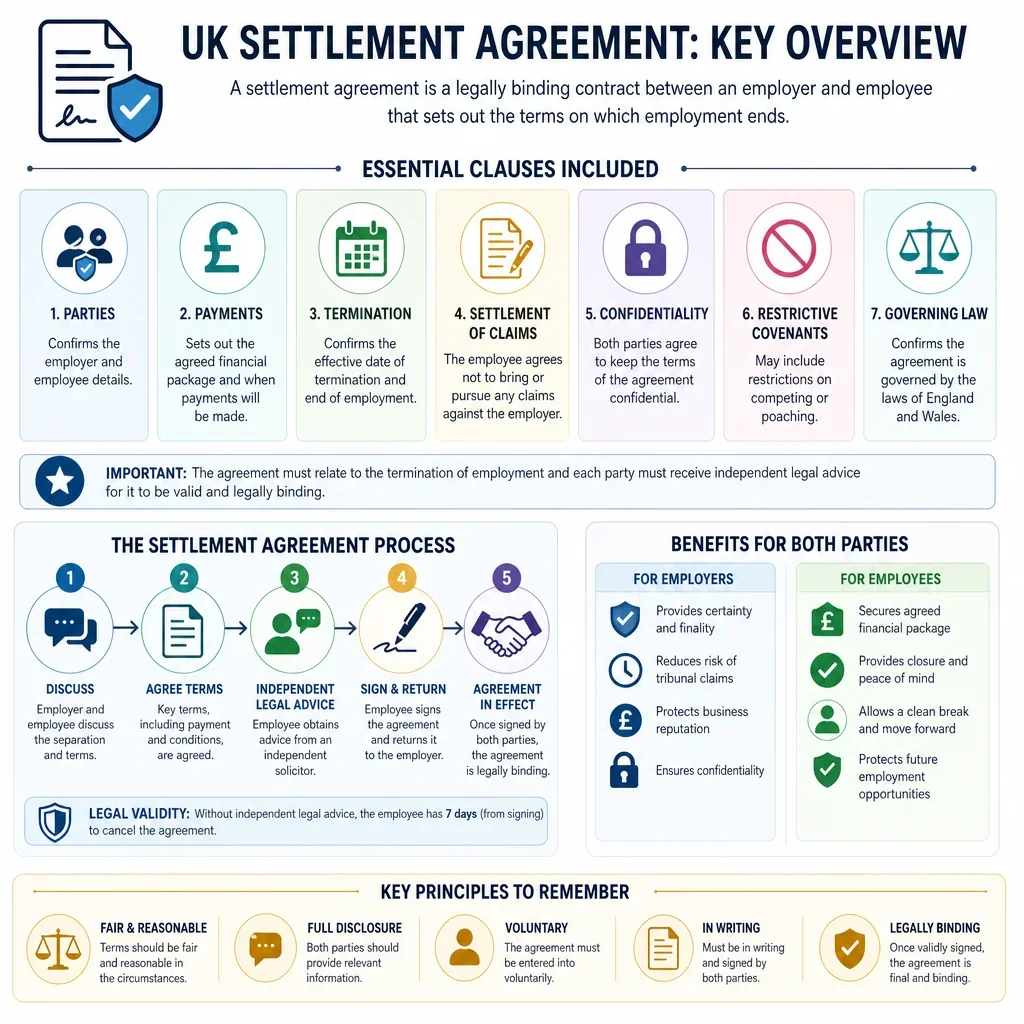
UK settlement agreement clause directory with practical insights into common terms, usage, and relevance for employers and employees.
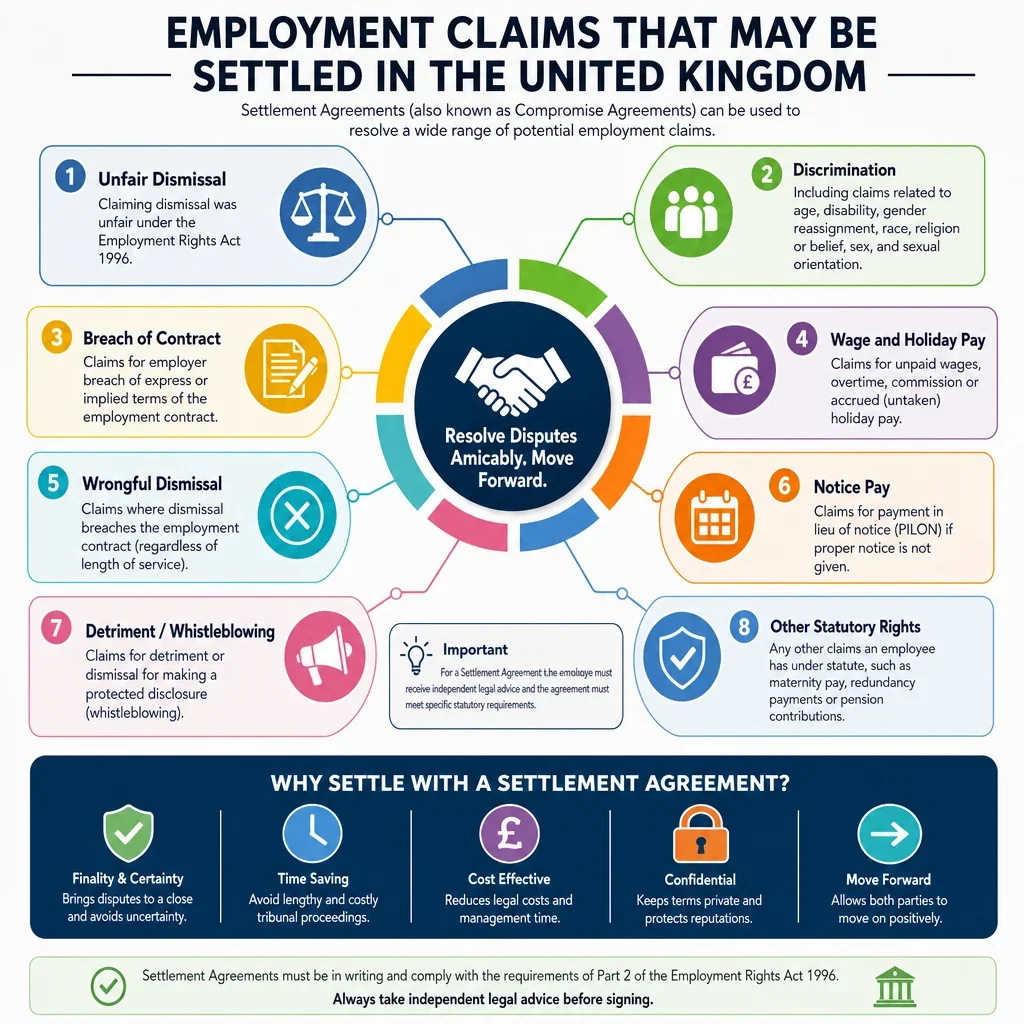
United Kingdom guide to employment claims that may be settled, helping employees and employers understand common claim types.