Section 21 Notice Period And Date Calculation Dataset In The United Kingdom
Jurisdiction | Minimum Notice Period | Notice Period Start Point | Expiry Date Consideration | Calculation Method | Practical Timing Notes |
|---|---|---|---|---|---|
Standard Section 21 notice for an English assured shorthold tenancy | |||||
England | At least 2 months. | Date the notice is served on the tenant. | Choose a date at least 2 months after service. | Months | Build in extra service time and keep proof of service. |
Using prescribed Form 6A in England | |||||
England | Form 6A states the tenant must be given at least 2 months. | Service of the completed Form 6A. | Insert an expiry date not earlier than 2 months after service. | Months | Use the current official form and retain the signed notice copy. |
Notice served during first 4 months of original English AST | |||||
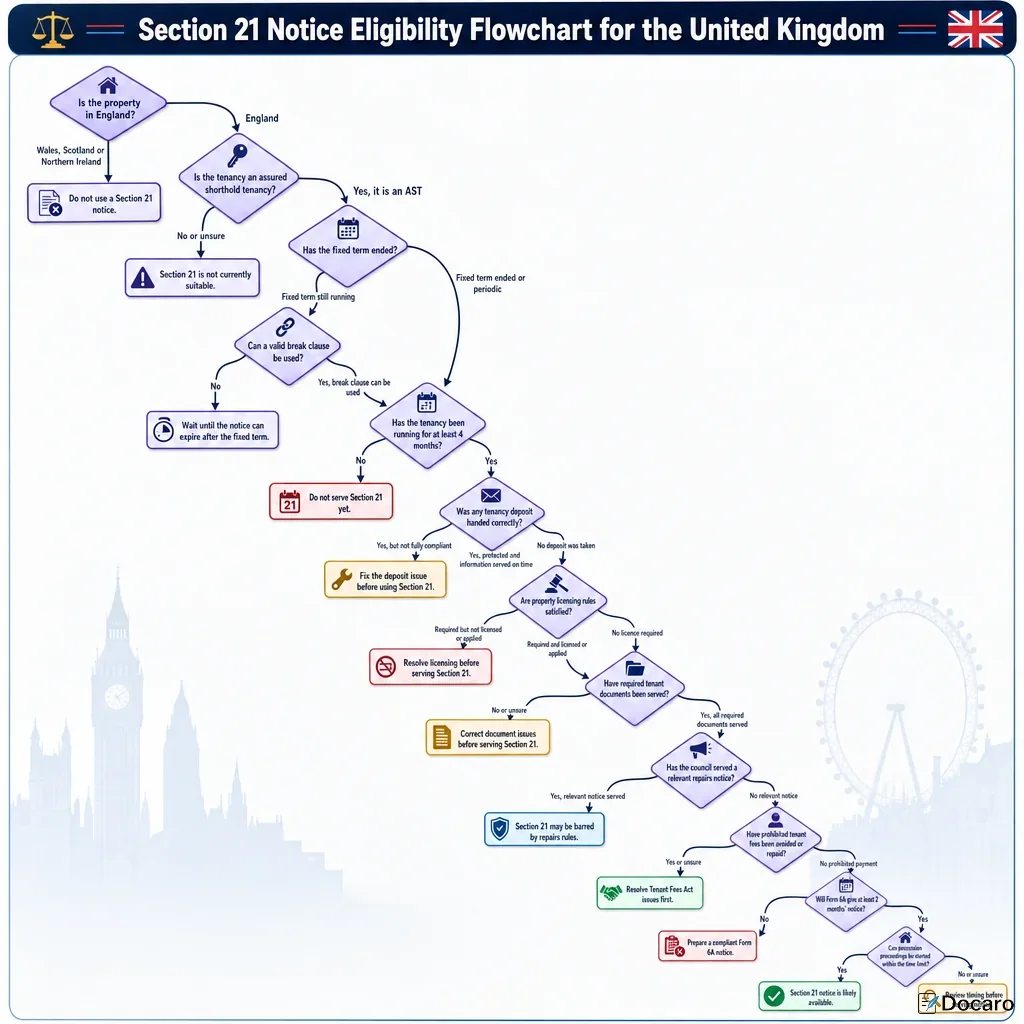
England | A Section 21 notice generally cannot be served in the first 4 months of the original tenancy. | Earliest service is after the first 4 months have passed. | Expiry must still allow at least 2 months from valid service. | Months | Do not count a notice served too early as valid. |
Replacement tenancy after earlier tenancy with same parties and property | |||||
England | The 4-month restriction is measured from the start of the original tenancy, not the replacement tenancy. | Original tenancy start date is relevant for the 4-month bar. | Notice expiry must still be at least 2 months after service. | Months | Check whether the tenancy is a true replacement tenancy. |
English fixed-term AST where possession is sought after the term | |||||
England | At least 2 months, and possession cannot be required before the fixed term ends unless a break clause applies. | Date of service, subject to the first 4 months rule. | Use a date no earlier than both 2 months after service and the end of the fixed term. | Case specific | Check fixed-term end date and any break clause wording. |
English fixed-term AST with landlord break clause | |||||
England | At least 2 months, plus any longer break-clause notice requirement. | Usually service of notice in the way required by the contract. | Expiry should satisfy both Section 21 and break clause dates. | Case specific | Serve exactly as the tenancy agreement requires. |
English statutory periodic AST after fixed term ends | |||||
England | At least 2 months. | Date the notice is served during the periodic tenancy. | Usually need not expire on the last day of a period for post-2015 English ASTs. | Months | Still check older tenancy dates and the form used. |
English contractual periodic AST with special notice wording | |||||
England | At least 2 months, subject to any contractual timing rules. | Date of service, then check contract period dates. | May need alignment with a tenancy period if contract requires it. | Case specific | Read the periodic tenancy clause before choosing the date. |
English periodic AST with rent period longer than 2 months | |||||
England | Notice period must be at least as long as the tenancy period, up to a 6-month maximum. | Date of service of the notice. | Use the longer tenancy period if it exceeds 2 months, capped at 6 months. | Tenancy period based | Identify the actual period length before using a 2-month date. |
English quarterly periodic AST | |||||
England | At least one quarterly period, because it is longer than 2 months. | Date of service. | Allow at least 3 months from service, subject to contract wording. | Tenancy period based | Do not assume monthly timing where rent is quarterly. |
English six-monthly periodic AST | |||||
England | At least 6 months if the tenancy period is 6 months. | Date of service. | Allow a full 6 months from service. | Tenancy period based | This is the practical maximum under the long-period rule. |
English annual periodic AST | |||||
England | At least 6 months because the long-period rule is capped at 6 months. | Date of service. | Allow at least 6 months from service, subject to contract issues. | Tenancy period based | Check whether the period is truly annual or rent is merely paid annually. |
English weekly periodic AST | |||||
England | At least 2 months because the weekly period is shorter than 2 months. | Date of service. | Use at least a 2-month expiry date. | Months | Weekly rent does not reduce the statutory 2-month minimum. |
English monthly periodic AST | |||||
England | At least 2 months. | Date of service. | A date 2 months after service is usually the minimum. | Months | Add a few days if service method is uncertain. |
Notice served mid-month in England | |||||
England | At least 2 calendar months from service. | Actual service date, not the next rent day. | Same day two months later is commonly used, with a safety margin. | Months | If unsure about service, choose a later expiry date. |
Notice served at the end of a month in England | |||||
England | At least 2 months short months can make date selection risky. | Actual service date. | Use a conservative later date if the target month has fewer days. | Months | Avoid borderline expiry dates such as February after 30 or 31 December. |
Notice period crosses February or a leap day | |||||
England | Still at least 2 months February may alter practical date choice. | Date the notice is served. | Pick a later date if month-length rules could be disputed. | Months | Add buffer days around February and leap years. |
Section 21 notice served by hand in England | |||||
England | At least 2 months from service, subject to any tenancy period rule. | When the notice is delivered in accordance with the agreement or evidence. | Calculate from the proven delivery date. | Case specific | Use a witness, dated photo or certificate of service. |
Section 21 notice served by first class post in England | |||||
England | At least 2 months from deemed or proven service. | Usually the deemed delivery date under the agreement or service rules. | Add postal delivery time before counting the 2 months. | Case specific | Post early, get proof of posting and avoid tight deadlines. |
Postal service affected by weekends or bank holidays | |||||
England and Wales | Allow for deemed service on a business day before the minimum notice period starts. | Deemed service date, not necessarily posting date. | Move expiry later if delivery is delayed by non-business days. | Calendar days | Bank holidays can push practical service later. |
Section 21 notice sent by signed-for post | |||||
England | At least 2 months from effective service. | Only from effective delivery or deemed service. | Do not rely on a failed signed-for delivery date. | Case specific | Signed-for post can fail if the tenant does not sign. |
Section 21 notice served by email in England | |||||
England | At least 2 months from valid service if email service is permitted. | When email service is validly effected under the agreement or consent. | Calculate from the valid email service date and time. | Case specific | Use email only if the tenancy agreement or tenant consent allows it. |
Tenancy agreement contains a service clause | |||||
England | At least the statutory minimum, counted from service under the contract clause. | The service date produced by the tenancy agreement method. | Allow any contractual deemed service period before expiry. | Case specific | Follow the contract clause unless it conflicts with mandatory law. |
Notice contains an expiry date that is too early | |||||
England | A notice giving less than the required minimum is at risk of invalidity. | Actual valid service date. | If too early, a fresh notice may be needed. | Case specific | Use a cautious later date rather than a borderline date. |
Deadline to start court claim after English Section 21 notice | |||||
England | Court claim usually must be started within 6 months of the date the notice was given. | Date the Section 21 notice was given. | Do not let the notice become time-expired before issuing the claim. | Months | Diary the claim deadline when the notice is served. |
Court claim deadline where long periodic notice is required | |||||
England | Where more than 2 months is required, claim deadline is generally 4 months from the expiry date in the notice. | Notice expiry date is key for the extended claim deadline. | Issue proceedings within 4 months after the expiry date stated in the notice. | Months | Applies to longer-period cases, not ordinary 2-month notices. |
Tenant remains after Section 21 notice expiry | |||||
England | Landlord must wait until the notice period has expired before seeking possession. | Expiry of the valid notice period. | After expiry, landlord normally applies to court rather than changing locks. | Case specific | Possession requires a court order if the tenant stays. |
Accelerated possession claim after English Section 21 notice | |||||
England | Can be used after a valid Section 21 notice has expired, if requirements are met. | After the notice expiry date. | Claim must also be within the notice life-span deadline. | Case specific | Keep tenancy agreement, notice and service evidence ready. |
Standard possession claim after English Section 21 notice | |||||
England | Proceed only after the valid notice period has expired. | Notice expiry date. | Issue within the statutory notice life-span if relying on Section 21. | Case specific | Do not delay so long that a fresh notice is needed. |
Deposit not protected before serving Section 21 in England | |||||
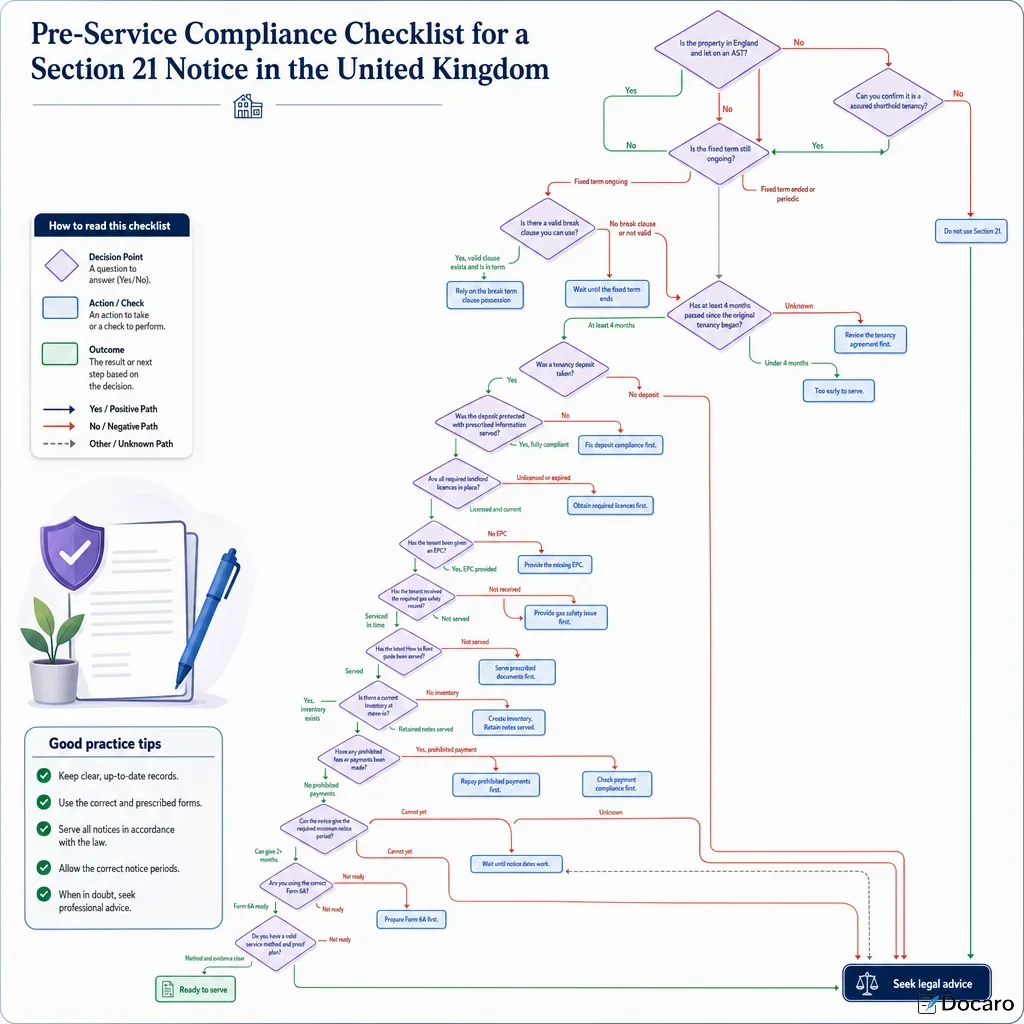
England | A Section 21 notice may be invalid until deposit compliance issues are resolved. | Serve only after resolving relevant deposit protection restrictions. | Do not calculate the notice period from a premature invalid notice. | Case specific | Check protection and prescribed information before service. |
Deposit prescribed information not served before Section 21 | |||||
England | Section 21 may be blocked until prescribed information has been given. | After valid service of missing prescribed information where legally effective. | Serve the Section 21 only after the restriction is lifted. | Case specific | Keep dated evidence of prescribed information service. |
How to Rent guide not given before Section 21 in England | |||||
England | A valid Section 21 notice generally requires the latest required guide to have been given first. | After the guide has been served where required. | Do not serve the notice before completing this prerequisite. | Case specific | Record the version and date of service of the guide. |
EPC not given before Section 21 in England | |||||
England | A Section 21 notice may be invalid if the required EPC was not given first. | After required EPC compliance is completed. | Serve the notice after meeting EPC prerequisite timing. | Case specific | Keep evidence of EPC supply to the tenant. |
Gas safety record timing before Section 21 in England | |||||
England | A Section 21 notice may be invalid if gas safety requirements were not met before service. | After required gas safety record compliance, where applicable. | Do not serve until gas safety timing issues are checked. | Case specific | Gas safety timing is highly fact-sensitive after case law. |
Tenant complaint and improvement notice before Section 21 in England | |||||
England | Section 21 may be barred for 6 months after certain local authority improvement or emergency remedial notices. | Date the relevant local authority notice is served. | A notice served during the barred period may be invalid. | Months | Check complaint history and council notices before service. |
Unlicensed HMO before Section 21 in England | |||||
England | Section 21 may be unavailable while a required HMO licence is absent, unless an application or exemption applies. | After licensing restriction is removed or relevant application is made. | Do not count time from a notice served while barred. | Case specific | Check mandatory, additional and selective licensing before service. |
Unlicensed selectively licensed property before Section 21 | |||||
England | Section 21 may be unavailable if a required licence is missing and no valid application or exemption exists. | After licensing compliance, application or exemption. | Serve only when Section 21 is no longer barred by licensing rules. | Case specific | Local licensing schemes can change check the council area. |
Prohibited tenant fee or holding deposit not repaid before Section 21 | |||||
England | Section 21 may be restricted until a prohibited payment or unlawfully retained holding deposit is repaid. | After repayment or other statutory resolution. | Do not serve the notice before the fee restriction is cleared. | Case specific | Audit fees and holding deposit history before calculating dates. |
Section 21 notice for joint tenants in England | |||||
England | At least 2 months, served so all joint tenants are properly addressed and notified. | Effective service on the tenant parties. | Calculate from the latest effective service if served separately. | Case specific | Use correct names and keep service evidence for each tenant. |
Tenant not currently living at property but tenancy continues | |||||
England | At least 2 months from valid service at an appropriate address or method. | Effective service under contract, statute or court-accepted method. | Use a cautious date if service location may be disputed. | Case specific | Consider serving at all permitted addresses and documenting attempts. |
Tenant is in rent arrears but landlord uses Section 21 in England | |||||
England | Section 21 still generally requires at least 2 months rent arrears do not shorten it. | Date of valid Section 21 service. | Arrears may suggest a separate Section 8 route but not a shorter Section 21 date. | Months | Do not confuse Section 21 and Section 8 notice periods. |
Serving Section 21 and Section 8 notices at the same time | |||||
England | Each notice has its own minimum period Section 21 generally remains at least 2 months. | Service date for each separate notice. | Do not use the shorter Section 8 date as the Section 21 expiry date. | Case specific | Record separate proof of service for each notice. |
Landlord wants a specific move-out date in England | |||||
England | Work backwards so service occurs more than 2 months before the desired date. | Planned service date after all prerequisites are met. | Desired move-out date must not be earlier than the legal minimum expiry date. | Months | Serve early enough to absorb postal and proof issues. |
Notice served shortly before English fixed term ends | |||||
England | At least 2 months, so expiry will fall after the fixed term if served too late. | Date the notice is validly served. | Cannot require possession earlier than the 2-month expiry date. | Months | Serve well before term end if the intended date is the term end date. |
Notice served exactly 2 months before intended expiry date | |||||
England | May be valid if service is proved on that day, but it is high risk. | Actual proven service date. | If service is one day late, expiry may be too early. | Months | Add buffer days rather than relying on exact same-day service. |
Notice served around a UK bank holiday | |||||
England and Wales | Minimum period is unchanged, but service may be delayed. | Effective service date after any delivery delay. | Move expiry later if postal service or business-day rules are affected. | Calendar days | Check England and Wales bank holiday dates before posting. |
Section 21 notice expiry date falls on a weekend | |||||
England | Weekend expiry is not automatically invalid if the full minimum period is given. | Valid service date. | Court or admin steps may wait until the next working day. | Calendar days | Use a weekday expiry for clarity if there is no downside. |
Documenting Section 21 service date with certificate of service | |||||
England and Wales | Evidence should show service occurred before the minimum period began. | Date recorded as service date on the evidence. | The recorded service date supports the expiry calculation. | Case specific | Complete service evidence immediately after delivery or posting. |
Welsh periodic standard occupation contract no-fault landlord notice | |||||
Wales | Commonly at least 6 months for a landlord no-fault notice under Renting Homes rules. | Date the landlord notice is given to the contract-holder. | Do not use the English 2-month Section 21 period for Welsh occupation contracts. | Months | Use Welsh Renting Homes forms and terminology, not English Form 6A. |
Welsh fixed-term standard occupation contract ending without fault | |||||
Wales | Rules are case-specific and depend on the contract type, term length and Welsh Renting Homes provisions. | Usually the date a valid Welsh notice is given. | Expiry cannot be calculated using English Section 21 assumptions. | Case specific | Check the written statement and Welsh statutory notice route. |
Welsh no-fault notice early in occupation contract | |||||
Wales | A landlord no-fault notice generally cannot require possession within the first 6 months of occupation. | Occupation date and notice-giving date both matter. | Expiry must comply with both the 6-month notice period and first-occupation restrictions. | Case specific | Check the occupation date before choosing a Welsh expiry date. |
Deadline to issue Welsh possession claim after no-fault notice | |||||
Wales | Possession claim timing is governed by Welsh statutory limits after the notice date and expiry. | The date the Welsh landlord notice is given and the expiry date. | Check the statutory claim window before issuing proceedings. | Case specific | Diary Welsh claim deadlines separately from English Section 21 deadlines. |
Welsh converted occupation contract after 1 December 2022 | |||||
Wales | Timing may depend on transitional provisions and the converted contract status. | Case-specific conversion and notice dates. | Do not assume the pre-2022 Section 21 calculation applies unchanged. | Case specific | Review conversion date, written statement and Welsh guidance. |
Property location determines English Section 21 or Welsh Renting Homes route | |||||
England and Wales | Use England rules for property in England and Welsh Renting Homes rules for property in Wales. | Depends on the notice route for the property jurisdiction. | Wrong jurisdiction can mean wrong form, wrong period and invalid timing. | Case specific | Do not use UK-wide shorthand when the property is in Wales. |
Property is outside England and Wales | |||||
England and Wales | Section 21 is not the correct route for Scotland or Northern Ireland. | Use the relevant devolved eviction rules instead. | Do not calculate a Section 21 expiry for non-England property. | Case specific | This dataset covers England and Wales only. |
How Long Is A Section 21 Notice Period In England And Wales?
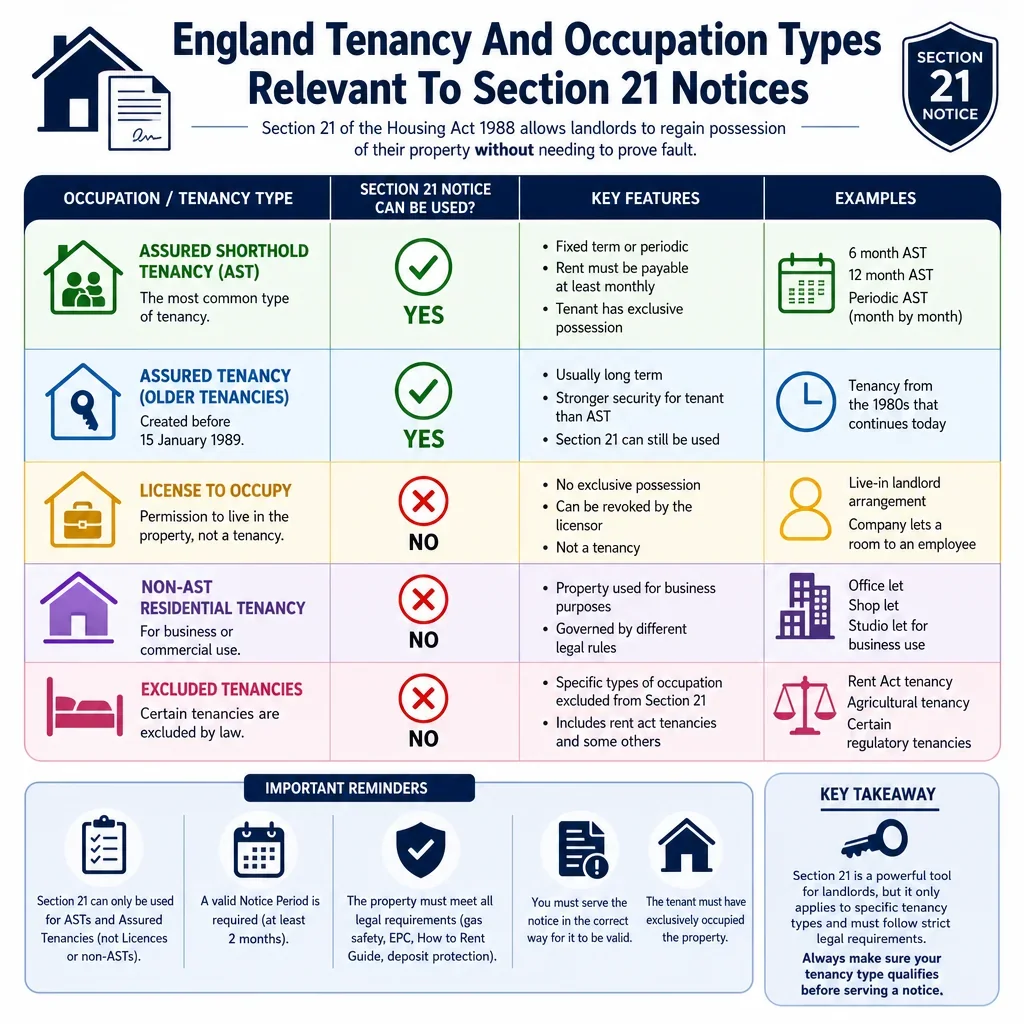
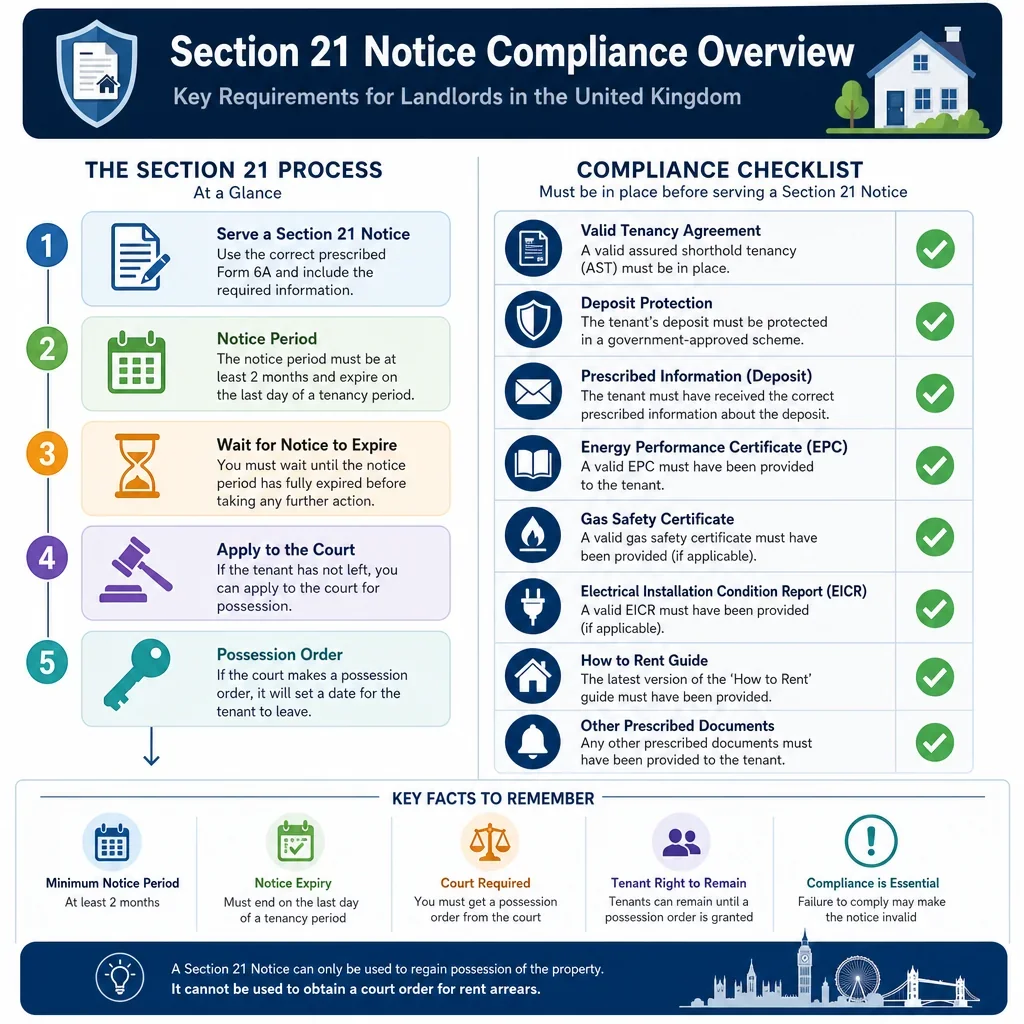
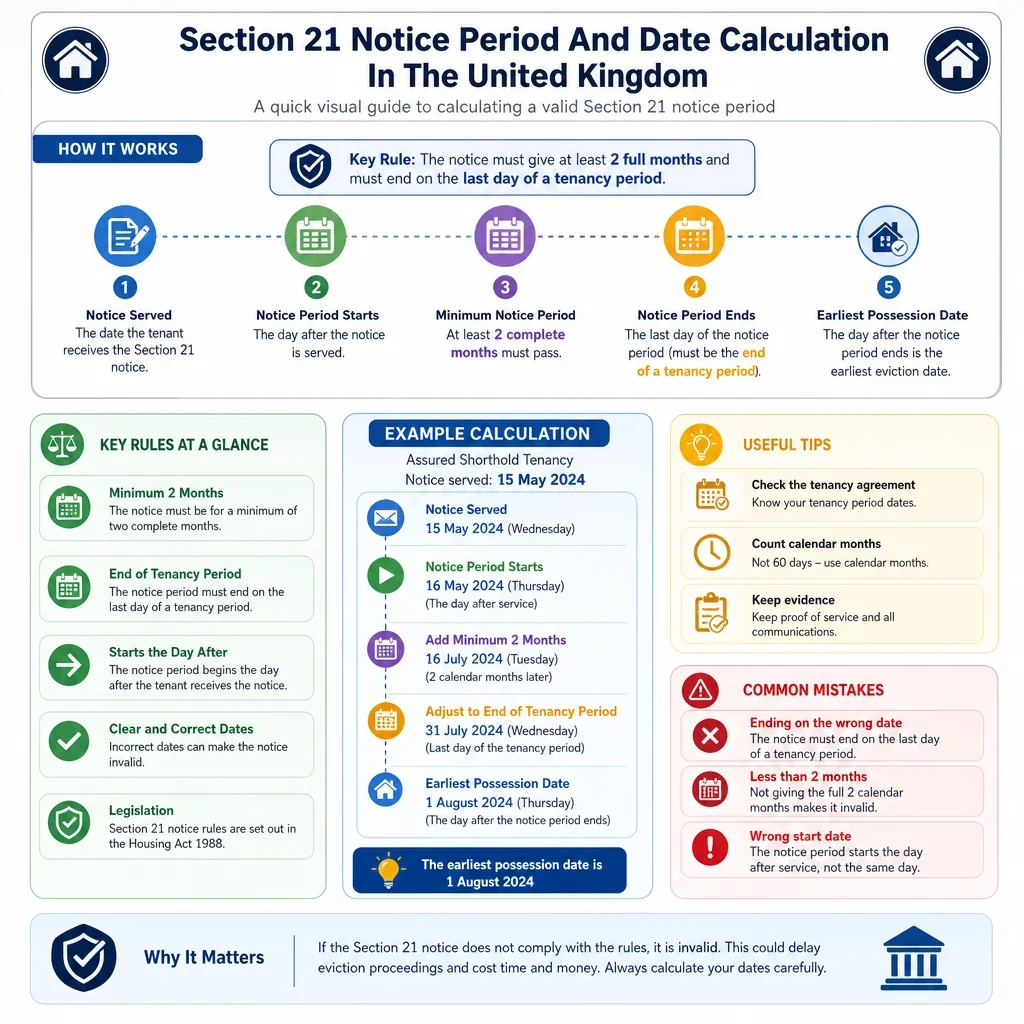
For most current assured shorthold tenancies in England, a Section 21 notice must give at least 2 months notice. In Wales, the ordinary no-fault possession route for occupation contracts is usually a landlord notice under Renting Homes rules rather than the English Section 21 process, and the usual minimum period is commonly 6 months for a no-fault landlord notice.
When Should The Section 21 Notice Expiry Date Be Chosen?
For a standard English Section 21 notice, the safest practical approach is to count from the date the notice is actually served, not merely the date it is signed. Add at least 2 clear months and allow extra time for post, weekends, bank holidays and evidence of service.
Does A Section 21 Notice Have To End On A Rent Day?
In England, a Section 21 notice generally does not need to expire on the last day of a tenancy period. Older pre-2015 rules made period dates more important for some periodic tenancies, so documents and calculations should still be checked carefully for unusual or old tenancies.
What Happens After The Notice Expires?
Expiry of the notice does not itself end the tenancy. If the tenant does not leave, the landlord normally has to start a possession claim. In England, court proceedings based on Form 6A generally must be started within the statutory life of the notice, commonly within 6 months from the date the notice was given where the 2-month notice period applies.
Why Is Service Evidence Important For Date Calculation?
The key date is usually the date of service. Hand delivery, first class post, recorded delivery, email or other methods can produce different evidence issues and may be affected by the tenancy agreement. Keeping a certificate of service, postal proof and a copy of the notice helps avoid disputes about whether the minimum notice period was actually given.
FAQs
You Might Also Be Interested In