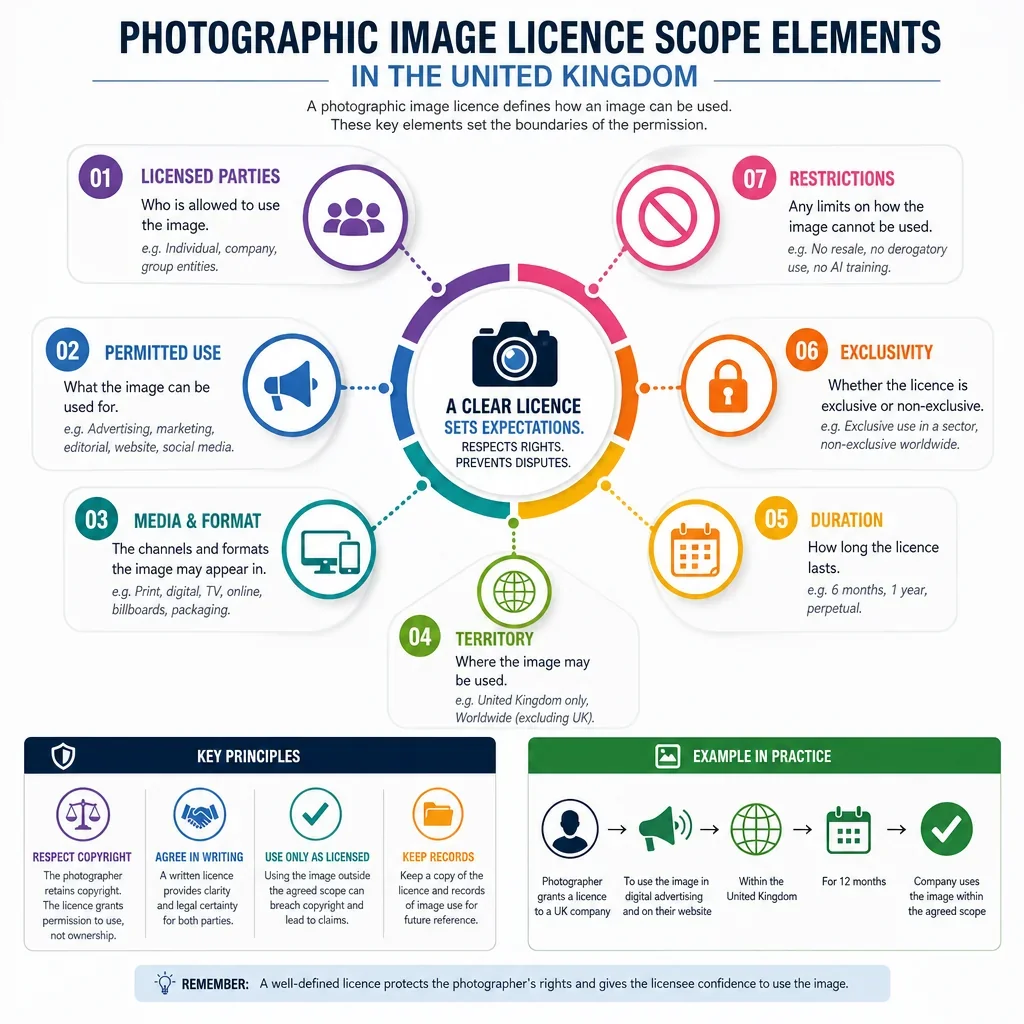
Photographic Image Licence Scope Elements In The United Kingdom
Scope element | Provision description | Typical options | Drafting importance | Risk of ambiguity |
|---|---|---|---|---|
Territory | ||||
United Kingdom only | Limits image use to England, Wales, Scotland and Northern Ireland. | "UK only", "United Kingdom territory", or specified UK nations. | Often required | May imply wider online or international use than intended. |
Worldwide use | Allows use in all countries and regions. | "Worldwide", "global", or worldwide excluding named territories. | Often required | Online publication may be argued to exceed a narrow territory. |
Europe or EEA use | Defines whether European use includes EU, EEA, UK or non-EU states. | EU only, EEA only, Europe including UK, or named countries. | Sometimes required | "Europe" may be disputed after Brexit or for non-EU markets. |
Named country list | Restricts use to expressly listed countries. | Schedule of countries add approval process for new territories. | Sometimes required | Unlisted markets may be accidentally targeted by campaigns. |
Geo-targeted digital territory | Controls online use aimed at users in specified locations. | Geo-targeted ads only, no foreign paid targeting, or worldwide web access allowed. | Often required | Website access from abroad may conflict with territorial limits. |
Single venue or event territory | Limits use to a specific event, exhibition, shop or venue. | Named event, premises, exhibition stand, or campaign location only. | Sometimes required | Venue images may later be reused nationally or online. |
Duration | ||||
Perpetual licence term | Allows use for the full remaining copyright term unless terminated. | "Perpetual", "for the duration of copyright", or perpetual but revocable on breach. | Often required | Parties may dispute whether ongoing use survives campaign end. |
Fixed-term licence | Permits use for a set period only. | One month, one year, three years, or named start and end dates. | Usually required | Expired campaign materials may remain live and infringe copyright. |
Campaign-only duration | Allows use only for a named marketing or editorial campaign. | Named campaign, launch period, seasonal promotion, or event promotion. | Often required | Repeats, spin-offs and evergreen pages may exceed the licence. |
Archival retention after expiry | Allows copies to remain in archives after active use ends. | Internal archive only, no public display, or live historical press archive. | Sometimes required | Old webpages or PDFs may stay public after licence expiry. |
Renewal or extension right | Sets how the licence can continue after the initial term. | Automatic renewal, written renewal, fee-based extension, or no renewal. | Sometimes required | Unclear renewal may create unpaid continued use or sudden takedowns. |
Post-termination takedown period | Gives time to remove images after expiry or termination. | Immediate removal, 7 days, 30 days, or reasonable wind-down. | Often required | Operational delays may create infringement claims. |
Duration, Media channels | ||||
Print run limit | Caps printed copies using the image. | One edition, 5,000 copies, unlimited copies, or reprint approval required. | Often required | Reprints may exceed paid usage scope. |
Exclusivity | ||||
Non-exclusive licence | Allows photographer to license the same image to others. | Expressly state "non-exclusive" and reserve all other rights. | Usually required | Client may wrongly assume competitors cannot use the image. |
Exclusive licence | Prevents the owner and others from using licensed rights within scope. | Exclusive for territory, term, media, sector, or campaign only. | Often required | Exclusive licences under UK copyright law require signed written grant. |
Sole licence | Licensee is the only third-party licensee, but owner may retain use rights. | Sole licence with owner reservation define retained portfolio use. | Sometimes required | May be confused with full exclusivity. |
Sector exclusivity | Restricts licensing to competitors or a defined industry sector. | Exclusive for fashion, finance, travel, education, or named competitor list. | Sometimes required | Unclear sectors may permit competitor use or block unrelated licensing. |
Image-specific exclusivity | Applies exclusivity only to selected licensed images. | Exclusive hero image only non-exclusive gallery or outtakes. | Sometimes required | Photographer may reuse similar shots or alternates unexpectedly. |
Exclusivity, Media channels | ||||
Photographer portfolio use | Reserves the photographer's right to show work for self-promotion. | Portfolio website, social channels, awards, exhibitions, or embargoed release. | Sometimes required | Exclusive client may object to photographer publicity. |
Media channels | ||||
Website use | Allows publication on specified websites or domains. | Named domain, microsites, landing pages, blog, or intranet excluded. | Usually required | May not cover subdomains, partner sites or archived pages. |
Organic social media use | Allows unpaid posts on social media accounts. | Named platforms, all brand accounts, reposting, stories, or no boosting. | Usually required | Paid boosting or influencer reposts may fall outside scope. |
Paid social advertising | Permits sponsored or boosted social media adverts. | Named platforms, budget cap, campaign dates, territories, or impressions cap. | Often required | Advertising use is often higher value and may be disputed. |
Display and search advertising | Allows use in online banner, native, search or programmatic ads. | Display ads only, programmatic permitted, retargeting permitted, or no ad networks. | Often required | Ad network distribution may exceed intended audience or territory. |
Print marketing materials | Allows use in brochures, flyers, catalogues and posters. | Named materials, copy cap, reprint approval, or in-store only. | Often required | Large reprints or new formats may exceed agreed licence value. |
Media channels, Transferability | ||||
Press and PR distribution | Allows images to be supplied to journalists and media outlets. | Press pack only, editorial use only, no advertising, credit required. | Often required | Third-party publishers may reuse images beyond intended PR purpose. |
Media channels | ||||
Editorial use | Permits use in news, commentary, reviews or informational content. | Editorial only, no advertorial, no product endorsement, credit required. | Often required | Commercial promotion may be wrongly treated as editorial use. |
Internal business use | Allows use in internal presentations, reports and training materials. | Employees only, group companies included, no public distribution. | Sometimes required | External sharing may exceed a narrow internal licence. |
Email marketing use | Permits use in newsletters, customer emails and automated campaigns. | Named lists, campaign dates, transactional emails excluded or included. | Sometimes required | Emails may be forwarded or archived beyond licence period. |
Out-of-home advertising | Allows use on billboards, transport ads, kiosks and digital screens. | Named cities, sites, formats, dates, or impressions. | Sometimes required | High-visibility advertising may be outside standard marketing use. |
Product packaging use | Allows images on product labels, boxes and retail packaging. | SKU list, units cap, territory, sell-off period, or packaging only. | Often required | Stock already in market may remain after expiry. |
Merchandise and resale products | Allows use on goods sold for revenue. | No merchandise, listed products only, royalty share, or unit cap. | Often required | A marketing licence may not cover products bearing the photo. |
Broadcast and streaming use | Permits use in television, film, video, livestreams or on-demand media. | TV only, online video, cinema, VOD, duration and territory limits. | Sometimes required | Still image rights may not cover moving-image distribution. |
Public display and exhibition | Allows display in galleries, offices, events, shops or exhibitions. | Named venue, exhibition dates, print size, no onward sale. | Sometimes required | Display prints may be sold or toured without permission. |
Downloadable PDFs and documents | Allows images in downloadable brochures, reports or white papers. | Specified documents, no editable files, archive removal deadline. | Sometimes required | Downloaded copies cannot easily be withdrawn after expiry. |
Media channels, Transferability | ||||
Template or design system use | Allows image placement in reusable templates or brand systems. | Internal templates only, no third-party template distribution, named users. | Sometimes required | Templates may spread use beyond the original project. |
Transferability | ||||
No assignment of licence | Prevents the licensee transferring rights to another party. | No assignment without written consent permitted transfer on business sale. | Often required | Rights may be assumed transferable during restructuring or sale. |
Sublicensing right | Allows the licensee to grant usage rights to third parties. | No sublicensing, affiliates only, agencies only, or written approval required. | Usually required | Agencies, partners or platforms may use images without clear authority. |
Transferability, Territory | ||||
Group company use | Allows parent, subsidiary or group entities to use the images. | Named affiliates, current group only, worldwide group, or no affiliates. | Sometimes required | Group brands may use images outside the licensed client scope. |
Transferability | ||||
Agency and contractor use | Permits designers, agencies and suppliers to use images for the licensee. | Use solely for licensee, no own portfolio use, confidentiality required. | Often required | Suppliers may reuse images for other clients or case studies. |
Transferability, Media channels | ||||
Third-party platform upload permission | Allows upload to platforms whose terms require broad content licences. | Named platforms, social media only, no stock sites, no open repositories. | Often required | Platform terms may create rights wider than the photographer intended. |
Transferability | ||||
No resale or redistribution | Stops the licensee selling, sharing or licensing image files themselves. | No stock upload, no asset library resale, no standalone file transfer. | Usually required | Image files may be circulated as reusable assets. |
Transfer on merger or sale | Allows rights to pass to a successor business or asset buyer. | Permitted on sale of business, notice required, no competitor transfer. | Sometimes required | Acquirer may continue using images without clear licence chain. |
Modification rights | ||||
Cropping and resizing | Allows technical changes to fit formats and layouts. | Crop, resize and compress only no substantive alteration. | Usually required | Minor edits may be challenged as unauthorised adaptations or treatment. |
Retouching and colour correction | Allows visual adjustments to enhance or correct the image. | Basic retouching, colour grading, blemish removal, or approval required. | Often required | Heavy retouching may harm reputation or misrepresent subjects. |
Text, logos and graphic overlays | Allows brand, caption, copy or design elements to be added. | Permitted for layout only, no misleading endorsement, approval for sensitive use. | Often required | Overlays may create implied endorsement or derogatory treatment issues. |
Composites and montages | Allows combining the image with other images or design elements. | Permitted composites, no deceptive edits, photographer approval required. | Sometimes required | Composite context may affect moral rights, releases and brand approvals. |
AI editing or generation | Controls use of generative AI or automated enhancement tools on images. | No AI training, AI retouching only, generative expansion allowed, consent required. | Often required | Image may train models or create uncontrolled derivative outputs. |
Metadata and watermark removal | Controls removal of credits, copyright notices, watermarks or embedded metadata. | Remove watermarks after payment, keep copyright metadata, credit where practical. | Sometimes required | Attribution disputes and ownership confusion may arise. |
Moral rights waiver or consent | Addresses attribution and objection to derogatory treatment of the photograph. | No waiver, limited consent to edits, full written waiver where lawful. | Often required | Edits may trigger attribution or derogatory treatment disputes. |
Media channels, Modification rights | ||||
Credit and attribution requirement | States when and how the photographer must be credited. | Credit always, credit where practical, no credit in ads, specified credit line. | Often required | Failure to credit may breach contract or asserted moral rights. |
File format and resolution limits | Controls supplied quality and permitted output quality. | Web-resolution only, print-resolution, RAW excluded, layered files included. | Sometimes required | High-resolution files may enable unlicensed print or merchandise use. |
Transferability | ||||
Licence not copyright assignment | Confirms ownership stays with the photographer or copyright owner. | Licence only no assignment all ungranted rights reserved. | Usually required | Client may assume ownership UK assignments require signed writing. |
Media channels, Territory, Duration | ||||
Release-dependent usage limits | Aligns image use with model, performer, location or property releases. | Commercial use only if releases exist editorial only sensitive use approval. | Often required | Copyright permission may not clear privacy, passing off or release issues. |
Media channels, Modification rights | ||||
Sensitive use restriction | Bars use in controversial or high-risk contexts. | No politics, adult content, medical claims, gambling, defamation or endorsement. | Sometimes required | Subjects or photographer may object to reputationally harmful uses. |
Media channels, Transferability, Modification rights | ||||
Stock library licence alignment | Ensures downstream terms match stock agency restrictions. | Standard stock use, extended licence, no resale, no logo use, seat limits. | Sometimes required | Licensee may receive fewer rights than expected from the photographer. |
What Scope Terms Should A UK Photo Licence Always Define?
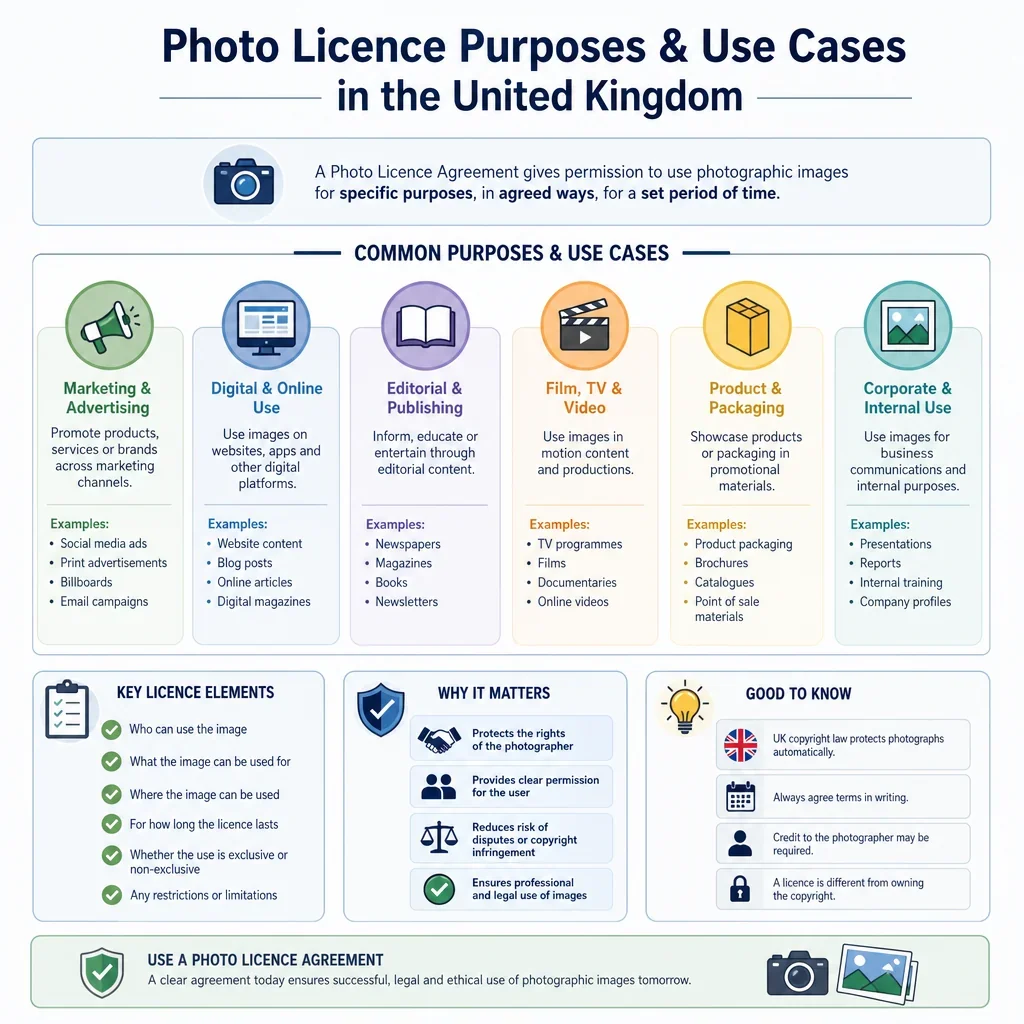
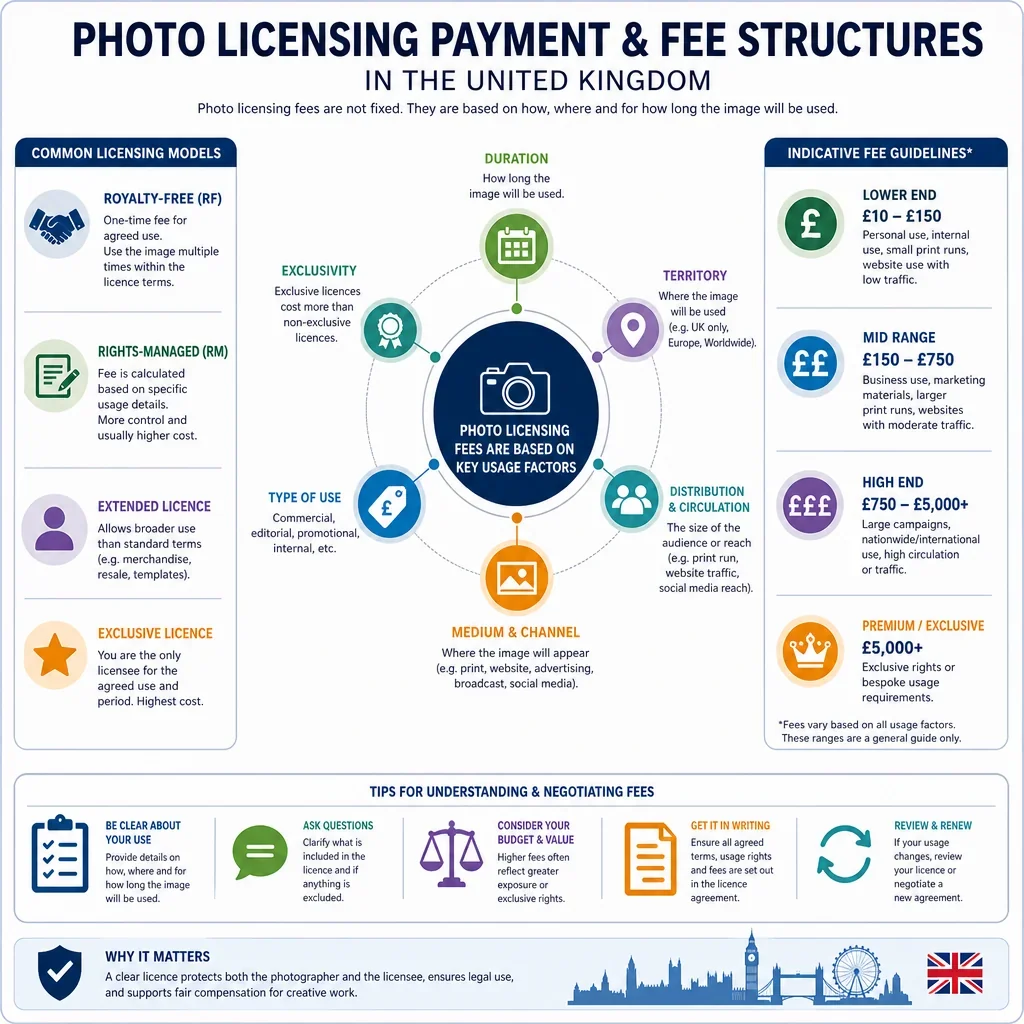
A UK photographic image licence should normally define where the image may be used, how long it may be used, whether the licence is exclusive, which media channels are covered, and whether edits or sublicensing are allowed. Copyright in photographs is protected under the Copyright, Designs and Patents Act 1988, so unclear scope wording can leave the licensee without permission for important uses.
Why Do Media Channels Matter In A Photo Licensing Agreement?
Media wording should be specific because website use, social media, paid advertising, print, packaging, email marketing, editorial use and broadcast use may carry different commercial value and risk. If a licence says only that an image may be used for marketing, the parties may later dispute whether that includes paid social ads, third-party platforms, out-of-home advertising or downloadable PDFs.
When Is Written Assignment Or Exclusive Licensing Important?
Under UK copyright law, copyright assignments must be in writing and signed, and an exclusive licence must also be in writing and signed by or on behalf of the copyright owner. A photo licence that is intended to be exclusive should therefore say so expressly and use signed written terms. Non-exclusive licences can be simpler, but they should still define scope to avoid accidental overuse.
What Are The Main Risks Of Ambiguous Modification Rights?
Modification rights should say whether the licensee may crop, resize, recolour, retouch, add text, create composites, use AI editing tools or remove metadata. Even where copyright permission is granted, photographers may retain moral rights, including the right to object to derogatory treatment in some circumstances, unless validly waived.
FAQs
You Might Also Be Interested In