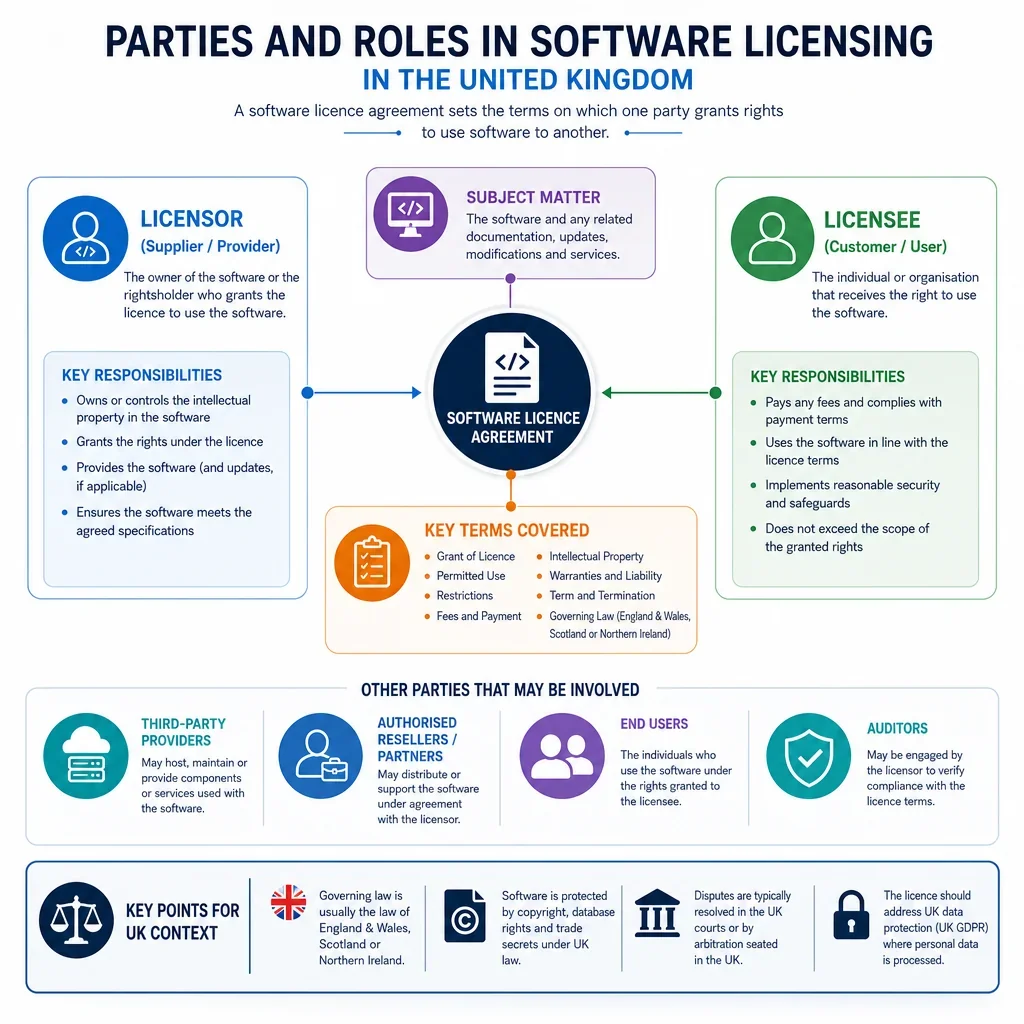
Parties And Roles In Software Licensing In The United Kingdom
Role Name | Role Description | Typical Rights | Typical Obligations | Contracting Status |
|---|---|---|---|---|
Licensor-side role | ||||
Licensor | Owner or authorised supplier granting rights to use the software. | Receive fees, enforce licence terms, protect IP, audit use, terminate for breach. | Grant licence, deliver software or access, provide agreed support, respect warranties. | Usually named as a party |
Licensee-side role | ||||
Licensee | Customer or organisation receiving permission to use the software. | Use software within scope, access updates, receive support if purchased. | Pay fees, restrict use to authorised users, protect credentials, comply with usage limits. | Usually named as a party |
Exclusive Licensee | Licensee granted rights to the exclusion of others, often including the licensor. | Exclusive use, possible enforcement rights, market protection, sublicensing if allowed. | Meet exclusivity conditions, pay minimum fees, market or exploit the software. | Usually named as a party |
Non-Exclusive Licensee | Licensee allowed to use software while licensor may grant similar rights to others. | Use software in permitted territory, business, devices or user numbers. | Observe scope limits, pay fees, avoid unauthorised copying or sublicensing. | Usually named as a party |
Licensor-side role | ||||
Sublicensor | Party authorised by the owner or main licensor to grant sub-licences. | Grant sublicences, collect sublicence fees, manage downstream compliance. | Act within upstream rights, flow down restrictions, report sales, protect owner IP. | Sometimes named as a party |
Licensee-side role | ||||
Sublicensee | Downstream user receiving rights from an authorised sublicensee or distributor. | Use software under flowed-down licence rights. | Comply with end-user terms, usage limits, confidentiality and IP restrictions. | Sometimes named as a party |
Licensor-side role | ||||
Software Copyright Owner | Person or company owning copyright in the program or related materials. | Control copying, adaptation, distribution and licensing of copyright works. | Usually none unless also contracting as licensor may warrant ownership if party. | Sometimes named as a party |
Software Vendor | Commercial supplier selling or licensing software to customers. | Market software, invoice customers, set licence tiers, enforce commercial terms. | Provide access, documentation, billing, support or maintenance as agreed. | Usually named as a party |
Licensor-side role, Service provider role | ||||
SaaS Provider | Supplier providing hosted software access rather than installed copies. | Manage platform, suspend misuse, update service, collect subscription fees. | Provide availability, security, support, data processing and service continuity terms. | Usually named as a party |
End user role | ||||
End User | Individual who actually uses the software under the licence. | Access and use software for permitted purposes. | Follow user restrictions, protect login details, avoid reverse engineering or misuse. | Usually referenced but not a party |
Named User | Specific identified person authorised to use a licence seat. | Use one assigned account or seat. | No account sharing, keep credentials confidential, use only for authorised purposes. | Usually referenced but not a party |
Concurrent User | User accessing software within a maximum simultaneous user limit. | Use software while concurrent capacity is available. | Avoid bypassing access controls or exceeding concurrency limits. | Usually referenced but not a party |
Authorised User | User permitted by the licensee and licence terms to access the software. | Access functions made available to that user class. | Comply with acceptable use, security, confidentiality and licence restrictions. | Usually referenced but not a party |
End user role, Licensee-side role | ||||
Licensee Employee | Employee of the licensee using software for the licensee's business. | Use software for internal business operations. | Follow employer controls, licence restrictions and confidentiality obligations. | Usually referenced but not a party |
End user role, Third party role | ||||
Contractor User | External contractor allowed to use software for the licensee's benefit. | Limited access needed to provide services to the licensee. | Use only for licensee work, maintain confidentiality, comply with restrictions. | Usually referenced but not a party |
End user role, Licensee-side role | ||||
Affiliate User | User employed by or acting for a group company of the licensee. | Use software if affiliates are included in the licence scope. | Comply with same restrictions as licensee users licensee often remains liable. | Usually referenced but not a party |
End user role, Third party role | ||||
Customer User | Customer of the licensee permitted to interact with the software or portal. | Access limited customer-facing functionality. | Observe acceptable use, account security and content restrictions. | Only relevant in specific arrangements |
End user role | ||||
Administrator User | User with elevated rights to configure software or manage accounts. | Create users, configure settings, access logs, manage permissions. | Apply access controls, manage credentials carefully, prevent unauthorised access. | Usually referenced but not a party |
Intermediary role | ||||
Reseller | Intermediary selling licences or subscriptions to end customers. | Resell licences, issue quotes, receive margin, manage customer orders. | Follow reseller terms, avoid unauthorised promises, pass through licence terms. | Sometimes named as a party |
Distributor | Channel partner authorised to distribute software through a territory or network. | Distribute software, appoint resellers if allowed, market in territory. | Meet channel rules, report sales, protect branding, flow down user terms. | Sometimes named as a party |
Service provider role, Intermediary role | ||||
Implementation Partner | Specialist helping configure, deploy, migrate or integrate the software. | Access software and customer systems for implementation work. | Perform services carefully, protect data, follow security and access controls. | Only relevant in specific arrangements |
Service provider role | ||||
Systems Integrator | Provider integrating licensed software with other systems or infrastructure. | Use APIs, test environments and documentation for integration. | Avoid damaging systems, maintain confidentiality, comply with API limits. | Only relevant in specific arrangements |
Support Provider | Party providing helpdesk, maintenance or technical support services. | Access logs, diagnostics, customer environments and support data. | Meet service levels, handle incidents, protect confidential information and data. | Sometimes named as a party |
Maintenance Provider | Provider supplying patches, updates, bug fixes or version upgrades. | Modify software, deploy fixes, access defect reports. | Provide agreed maintenance, avoid introducing defects, document changes. | Sometimes named as a party |
Service provider role, Third party role | ||||
Hosting Provider | Provider hosting software, databases or environments used to deliver the service. | Operate infrastructure, apply security controls, process hosted data. | Maintain availability, security, backups and data processing commitments. | Usually referenced but not a party |
Cloud Infrastructure Provider | Cloud platform supplier supporting storage, compute, networking or managed services. | Host workloads, monitor infrastructure, process service data. | Provide infrastructure security, resilience, uptime and processor terms if applicable. | Usually referenced but not a party |
Service provider role | ||||
Managed Service Provider | Outsourced provider managing software operation for the licensee or licensor. | Administer environments, access systems, perform monitoring and maintenance. | Follow security policies, service levels, confidentiality and usage restrictions. | Only relevant in specific arrangements |
Service provider role, Third party role | ||||
Service Bureau Operator | Operator using software to process work for multiple external customers. | Use software to deliver outsourced processing if expressly permitted. | Avoid unauthorised third-party use, maintain segregation, protect client data. | Only relevant in specific arrangements |
Intermediary role | ||||
White-Label Partner | Partner offering the software under its own brand. | Rebrand interface, market service, provide customer access if authorised. | Protect licensor IP, follow brand rules, handle customer terms and support. | Only relevant in specific arrangements |
Intermediary role, Licensor-side role | ||||
OEM Partner | Partner embedding or bundling software with its own product or hardware. | Bundle, pre-install, distribute or embed software in approved products. | Follow bundling limits, report units, pass through terms, protect IP notices. | Only relevant in specific arrangements |
Intermediary role, Service provider role | ||||
Value Added Reseller | Reseller adding configuration, consultancy or support to the licensed software. | Resell licences and provide added services. | Ensure service quality, pass through licence terms, avoid unauthorised modifications. | Sometimes named as a party |
Intermediary role | ||||
Marketplace Operator | Online marketplace through which software licences or subscriptions are purchased. | List products, process orders, apply marketplace rules and fees. | Display terms, handle billing mechanics, comply with platform commitments. | Only relevant in specific arrangements |
Service provider role, Third party role | ||||
Payment Processor | Provider handling card, direct debit or online payment processing. | Process payment data, deduct fees, reject suspicious transactions. | Process payments securely, meet data and payment compliance obligations. | Usually referenced but not a party |
Intermediary role, Service provider role | ||||
Billing Agent | Party issuing invoices or collecting fees on another party's behalf. | Invoice, collect payments, send reminders, manage billing records. | Accurately bill, account for collections, protect financial information. | Sometimes named as a party |
Third party role, Service provider role | ||||
Escrow Agent | Independent holder of source code or materials for release on agreed triggers. | Hold deposits, verify materials, release code when conditions are met. | Keep materials secure, follow escrow agreement, release only on valid trigger. | Only relevant in specific arrangements |
Licensee-side role | ||||
Escrow Beneficiary | Licensee or customer entitled to receive escrow materials after a release event. | Receive source code, build materials or documentation on release trigger. | Use released materials only for permitted maintenance or continuity purposes. | Only relevant in specific arrangements |
Licensor-side role | ||||
Escrow Depositor | Licensor or developer depositing source code with an escrow agent. | Maintain ownership and confidentiality of deposited materials before release. | Deposit complete and updated source code, build tools and documentation. | Only relevant in specific arrangements |
Licensor-side role, Third party role | ||||
Software Developer | Person or company that created the software or contributed code. | May retain IP, moral or contractual rights depending on ownership arrangements. | Assign or license rights, provide warranties, fix defects if contracted. | Sometimes named as a party |
Licensor-side role | ||||
Employee Developer | Employee who creates software in the course of employment. | May have limited personal rights employer often first copyright owner. | Follow employment IP, confidentiality and invention disclosure duties. | Usually referenced but not a party |
Third party role, Service provider role | ||||
Contractor Developer | External developer creating software or modifications for a customer or vendor. | May retain copyright unless assigned or licensed by contract. | Deliver code, assign or license IP, maintain confidentiality, meet specifications. | Sometimes named as a party |
Third party role | ||||
Open Source Contributor | Contributor of code made available under an open source licence. | License contribution under applicable open source terms. | Comply with contribution terms and any contributor licence agreement. | Usually referenced but not a party |
Licensee-side role, Third party role | ||||
Open Source Licence Recipient | Party using components governed by open source licence terms. | Use, copy, modify or distribute according to open source licence. | Comply with notices, attribution, source availability and copyleft conditions. | Usually referenced but not a party |
Third party role | ||||
Third-Party Component Owner | Owner of libraries, SDKs, databases or components embedded in the software. | License component, require notices, restrict redistribution or modification. | Usually none to customer unless separate licence applies. | Usually referenced but not a party |
Third party role, Service provider role | ||||
API Provider | Provider of interfaces or services used by the licensed software. | Set API limits, keys, terms, charges and availability rules. | Provide API access as contracted, protect credentials, publish technical changes. | Usually referenced but not a party |
Database Provider | Supplier of database content or datasets used with the software. | License database use, restrict extraction or re-utilisation. | Comply with database licence limits, attribution and data refresh terms. | Only relevant in specific arrangements |
Licensor-side role, Third party role | ||||
Documentation Owner | Owner of user guides, manuals, training materials or specifications. | Control copying, distribution and adaptation of documentation. | Provide accurate documentation if required by the agreement. | Usually referenced but not a party |
Trade Mark Owner | Owner of brands, logos or product names used with the software. | Control trade mark use and enforce brand restrictions. | May approve brand usage and maintain registrations if contracted. | Sometimes named as a party |
Licensee-side role, Licensor-side role | ||||
Data Controller | Party determining purposes and means of processing personal data. | Set processing instructions, choose lawful basis, determine retention and disclosures. | Comply with UK GDPR, transparency, lawful basis, rights handling and accountability. | Sometimes named as a party |
Service provider role, Licensor-side role | ||||
Data Processor | Party processing personal data on behalf of a controller. | Process personal data under documented controller instructions. | Use appropriate security, assist controller, restrict sub-processing, return or delete data. | Sometimes named as a party |
Third party role, Service provider role | ||||
Sub-Processor | Further processor engaged by a processor to handle personal data. | Process data for delegated service functions under authorised terms. | Meet equivalent processor obligations, security and confidentiality requirements. | Usually referenced but not a party |
End user role, Third party role | ||||
Data Subject | Identified or identifiable person whose personal data is processed. | Rights of access, rectification, erasure, restriction, portability and objection. | Usually none under the licence unless also an end user. | Usually referenced but not a party |
Licensee-side role | ||||
Customer Data Owner | Licensee or customer owning or controlling data uploaded to the software. | Upload, access, export and delete customer data subject to terms. | Ensure lawful data input, permissions, accuracy and backup where required. | Usually named as a party |
End user role, Licensee-side role | ||||
Content Contributor | User uploading text, files, media or other content into the software. | Create, upload, edit and share permitted content. | Avoid unlawful content, malware, IP infringement and confidentiality breaches. | Usually referenced but not a party |
Third party role, Service provider role | ||||
Licence Auditor | Internal or external auditor checking compliance with licence metrics. | Review records, installations, users, usage logs and deployment data. | Maintain confidentiality, minimise disruption, follow audit procedure. | Usually referenced but not a party |
Service provider role, Third party role | ||||
Security Tester | Tester performing vulnerability scanning, penetration testing or security review. | Run authorised tests, access test systems, report vulnerabilities. | Stay within test scope, avoid disruption, keep findings confidential. | Only relevant in specific arrangements |
End user role, Third party role | ||||
Beta Tester | User testing pre-release software and providing feedback. | Use beta software for evaluation and feedback. | Keep beta confidential, report issues, accept limited warranties and support. | Only relevant in specific arrangements |
End user role, Licensee-side role | ||||
Evaluation User | Prospective customer or user assessing software before purchase. | Use software for trial, testing or proof of concept only. | No production use, comply with trial limits, return or delete materials. | Sometimes named as a party |
End user role | ||||
Academic User | Student, researcher or educator using software under education terms. | Use software for teaching, study or non-commercial research. | Avoid commercial use, prove eligibility, follow institution licence limits. | Only relevant in specific arrangements |
End user role, Licensee-side role | ||||
Public Sector User | Government, NHS, local authority or public body user. | Use software for public sector functions within procurement terms. | Comply with security, records, procurement and data handling requirements. | Only relevant in specific arrangements |
Consumer User | Individual using software wholly or mainly outside trade, business or profession. | Statutory digital content rights and remedies under consumer law. | Pay price, follow lawful use restrictions and account terms. | Sometimes named as a party |
Licensee-side role | ||||
Business Customer | Commercial customer licensing software for business operations. | Use software for internal business purposes and authorised workflows. | Pay fees, manage users, comply with restrictions, accept liability allocation. | Usually named as a party |
Licensee-side role, Licensor-side role | ||||
Affiliate Entity | Group company of a contracting party included in licence scope. | Use, sell or support software if agreement extends rights to affiliates. | Comply with licence terms contracting party often remains responsible. | Usually referenced but not a party |
Third party role | ||||
Parent Company Guarantor | Parent company guaranteeing payment or performance of a contracting party. | Receive notices and cure opportunities if agreement provides. | Guarantee specified payment, indemnity or performance obligations. | Only relevant in specific arrangements |
Third party role, Service provider role | ||||
Professional Adviser | Legal, tax, accounting or technical adviser reviewing the agreement or software. | Receive confidential information if disclosure is permitted. | Maintain confidentiality and use information only for advisory purposes. | Usually referenced but not a party |
Licensee-side role, Licensor-side role, Third party role | ||||
Confidential Information Recipient | Party receiving confidential business, technical or security information. | Use confidential information for permitted contract purposes. | Keep information confidential, restrict disclosure, return or destroy on request. | Sometimes named as a party |
Confidential Information Discloser | Party disclosing confidential information under the agreement. | Control permitted use and disclosure of confidential information. | Mark or identify confidential material if the agreement requires. | Sometimes named as a party |
Indemnified Party | Party protected by an indemnity for specified claims or losses. | Claim defence, settlement, reimbursement or compensation under indemnity. | Give prompt notice, mitigate loss, allow defence control if required. | Sometimes named as a party |
Licensee-side role, Licensor-side role | ||||
Indemnifying Party | Party promising to cover specified third-party claims or losses. | Control defence, approve settlements, receive cooperation. | Defend, indemnify and hold harmless within agreed scope and limits. | Usually named as a party |
Third party role | ||||
IP Infringement Claimant | Third party alleging the software infringes its intellectual property rights. | Bring claims and seek remedies for alleged infringement. | Prove claim under applicable IP law and court procedure. | Usually referenced but not a party |
Regulator | Authority overseeing legal compliance relevant to software, data or consumers. | Investigate, request information, issue guidance or take enforcement action. | Act within statutory powers and regulatory duties. | Usually referenced but not a party |
Intermediary role | ||||
App Store Operator | Platform distributing mobile or desktop software to users. | Host app, process purchases, enforce platform policies, remove listings. | Apply store terms, display required information, handle platform billing mechanics. | Only relevant in specific arrangements |
Licensor-side role, Intermediary role | ||||
Developer Account Holder | Account owner publishing software through an app store or platform. | Publish apps, manage listings, receive sales reports and proceeds. | Comply with platform rules, user terms, privacy and update requirements. | Only relevant in specific arrangements |
End user role, Licensee-side role | ||||
Device Owner | Person or organisation owning hardware on which software is installed. | Install or run software if device-based licence permits. | Prevent unauthorised installations, copying or access from licensed devices. | Usually referenced but not a party |
Licensee-side role, End user role | ||||
Site Licence Administrator | Person managing licence deployment across an office, campus or site. | Assign seats, manage installations, maintain usage records. | Keep deployment within site limits and assist licence audits. | Usually referenced but not a party |
Enterprise Licence Manager | Person responsible for enterprise-wide software licence compliance. | Monitor usage, allocate entitlements, access reporting tools. | Maintain records, prevent overuse, coordinate renewals and audits. | Usually referenced but not a party |
Intermediary role, Licensee-side role | ||||
Procurement Agent | Agent buying licences for or on behalf of the end customer. | Negotiate pricing, place orders, manage purchase documentation. | Act within authority, disclose principal if required, avoid unauthorised commitments. | Sometimes named as a party |
Intermediary role, Licensee-side role, Licensor-side role | ||||
Authorised Representative | Person authorised to sign, administer or give notices for a party. | Sign order forms, approve changes, send notices or administer account. | Act within authority and keep contact details accurate. | Usually referenced but not a party |
Licensee-side role, Licensor-side role | ||||
Notice Recipient | Designated person or address for contractual notices. | Receive termination, breach, renewal or legal notices. | Monitor notices and route them internally for action. | Usually referenced but not a party |
Finance Contact | Person handling billing, purchase orders, invoices or payment queries. | Receive invoices, billing reports and payment reminders. | Process invoices, maintain billing details, raise disputes promptly. | Usually referenced but not a party |
Technical Contact | Person responsible for technical communications, incidents or configuration. | Receive technical updates, security alerts and support communications. | Coordinate implementation, incident response and technical information requests. | Usually referenced but not a party |
Service provider role | ||||
Training Provider | Provider delivering user training, onboarding or certification services. | Use training environments, materials and demo data for training. | Protect materials, data and confidentiality deliver agreed training services. | Only relevant in specific arrangements |
Third party role, Service provider role | ||||
Certification Body | Body assessing compliance, security, quality or software certification requirements. | Access evidence, audit controls, issue certificates or reports. | Maintain independence, confidentiality and assessment standards. | Only relevant in specific arrangements |
Service provider role, Third party role | ||||
Backup Provider | Provider storing backups of software environments or customer data. | Store, replicate and restore data for resilience purposes. | Protect backups, meet retention, restoration, deletion and security terms. | Usually referenced but not a party |
Disaster Recovery Provider | Provider supporting failover, recovery sites or continuity services. | Replicate systems, test recovery, access continuity environments. | Meet recovery objectives, security, testing and incident response commitments. | Usually referenced but not a party |
Analytics Provider | Provider measuring usage, performance or product analytics. | Collect usage metrics, logs and aggregated analytics data. | Handle analytics data lawfully, respect privacy and contractual limits. | Usually referenced but not a party |
Third party role, Service provider role | ||||
AI Model Provider | Provider of AI model, API or machine learning functionality used by software. | Process prompts, inputs and outputs under AI service terms. | Apply security, privacy, usage, output and model service commitments. | Usually referenced but not a party |
Who Should Be Named In A UK Software Licence Agreement?
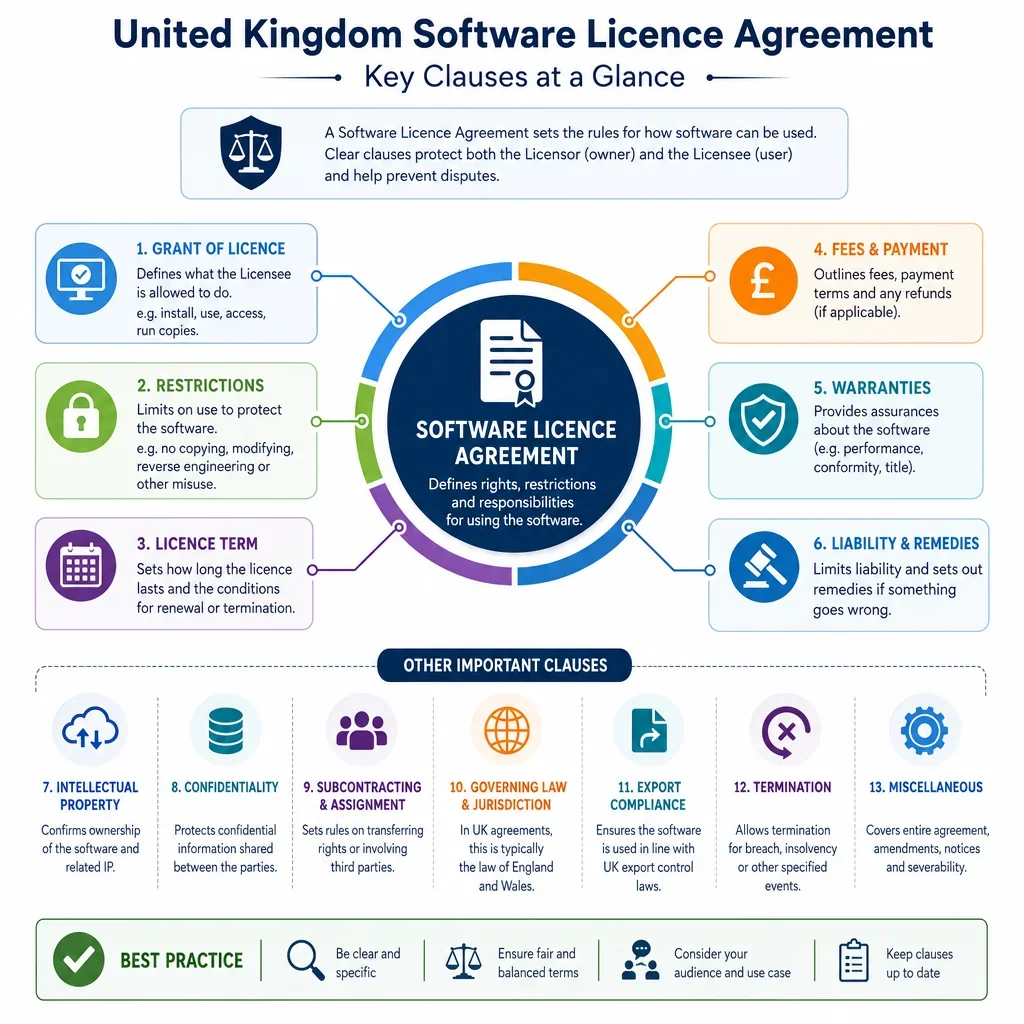
A UK software licence should clearly identify the licensor and licensee, because these roles usually carry the core grant of rights, payment duties, warranty allocation, liability limits and termination rights. Where a reseller, distributor, implementation partner, hosting provider or group company is involved, the agreement should state whether that party is a contracting party, an authorised intermediary or merely referenced.
Why Do End User Roles Matter In Software Licensing?
Even where the customer is the contracting licensee, the software may be used by employees, contractors, affiliates, named users, concurrent users or customers. The licence should define these user classes carefully because they determine scope of use, audit exposure, licence fees and responsibility for misuse.
When Are Third Parties Important In A Software Licence?
Third-party software owners, open source contributors, cloud infrastructure providers, escrow agents, payment processors and sub-processors can affect IP ownership, support, security, data protection and continuity. In the UK, customer-facing licence terms should also align with data protection obligations under the Data Protection Act 2018 and UK GDPR where personal data is processed.
What UK Legal Issues Should The Parties Consider?
- IP ownership: software copyright is generally protected under the Copyright, Designs and Patents Act 1988, so the licence should distinguish ownership from permitted use.
- Consumer users: if software is licensed to consumers, terms must be compatible with the Consumer Rights Act 2015, including rules on digital content.
- Business users: B2B licences should state whether affiliates, contractors and outsourced users are authorised, and who is liable for their acts.
- Data roles: where hosted software or SaaS is involved, the agreement should identify controllers, processors and sub-processors and include appropriate UK data processing terms.
FAQs
You Might Also Be Interested In