

Cookie User Rights And Controls In United Kingdom
Created:
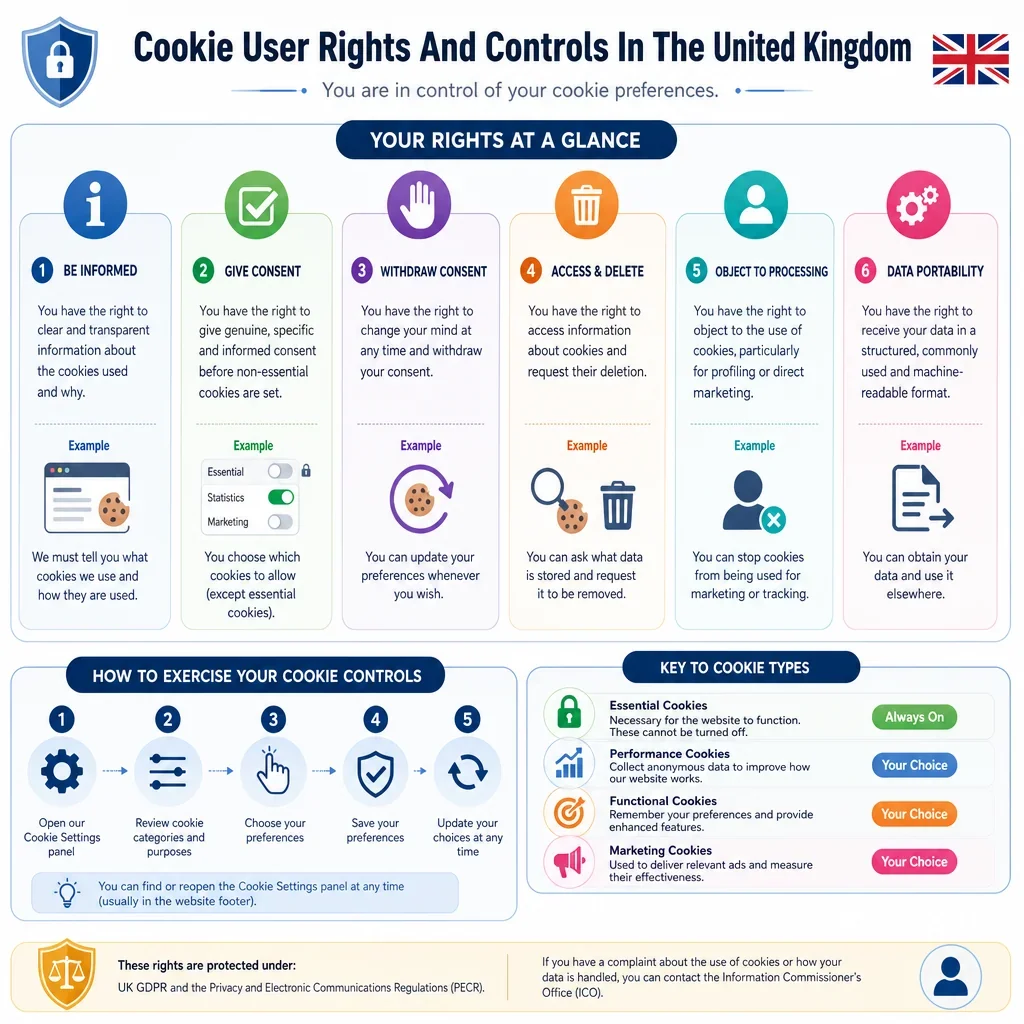
This guide explains key cookie user rights and controls in the United Kingdom, helping you understand the structured dataset and apply it to practical compliance decisions. For broader guidance, see our AI Generated British Cookie Policy resources.
How It Works | Control Method | Timing | Example User Wording | Limitations |
|---|---|---|---|---|
Accept all optional cookies | ||||
User selects an accept option and the site sets agreed non-essential cookies. | Cookie banner, Cookie settings tool | Before cookies are set | You can accept all optional cookies by selecting "Accept all". | Consent must be informed, specific and freely given pre-ticked choices are unsuitable. |
Reject all optional cookies | ||||
User selects a reject option and non-essential cookies are not set. | Cookie banner, Cookie settings tool | Before cookies are set | You can reject all optional cookies by selecting "Reject all". | Strictly necessary cookies may still be used without consent. |
Choose cookies by category | ||||
User toggles categories such as analytics, marketing or personalisation. | Cookie settings tool | Both | You can choose which types of optional cookies we use in "Cookie settings". | Categories must be clear enough for meaningful consent. |
Withdraw cookie consent | ||||
User revisits settings and turns off optional cookies previously accepted. | Cookie settings tool, Contact request | After cookies are set | You can withdraw your consent at any time by changing your cookie settings. | Withdrawal does not affect earlier lawful processing based on consent before withdrawal. |
Change saved cookie preferences | ||||
User opens a persistent settings link and updates selected purposes. | Cookie settings tool | After cookies are set | You can update your cookie choices at any time using the "Cookie settings" link. | Changes may not remove third-party cookies already stored in the browser. |
Understand necessary cookies cannot be disabled on-site | ||||
Site explains essential cookies used for requested services or communications. | Browser settings | Both | Necessary cookies are always on because the site cannot work properly without them. | Users may block them in the browser, but key services may stop working. |
Control analytics cookies | ||||
User allows or refuses cookies that measure visits and site performance. | Cookie banner, Cookie settings tool, Browser settings | Both | You can turn analytics cookies on or off in cookie settings. | Some aggregate server logs may still be used without analytics cookies. |
Control advertising cookies | ||||
User permits or refuses cookies used for targeted advertising and measurement. | Cookie banner, Cookie settings tool, Browser settings | Before cookies are set | You can refuse advertising cookies in cookie settings. | Refusal may not stop all adverts it usually limits personalisation and tracking. |
Control personalisation cookies | ||||
User allows or refuses cookies remembering preferences or tailoring content. | Cookie settings tool | Both | You can turn personalisation cookies on or off at any time. | Refusing may reduce remembered preferences or tailored features. |
Control social media cookies | ||||
User refuses embedded platform cookies or manages choices with the platform. | Cookie settings tool, Browser settings, Other | Before cookies are set | You can disable social media cookies before using embedded social features. | Platform account settings may also affect tracking outside this website. |
Delete cookies from the browser | ||||
User clears cookies and site data from the browser privacy settings. | Browser settings | After cookies are set | You can delete cookies already stored on your device using your browser settings. | Deleting cookies can sign you out and remove saved preferences. |
Block cookies in the browser | ||||
User configures browser rules to block all or selected cookies. | Browser settings | Before cookies are set | You can block cookies through your browser, although parts of the site may not work. | Blocking all cookies can break logins, baskets, forms and security features. |
Block third-party cookies | ||||
User prevents cookies set by domains other than the site visited. | Browser settings | Before cookies are set | You can block third-party cookies in your browser privacy settings. | Some embedded videos, maps, payment tools or social plugins may fail. |
Use private browsing mode | ||||
User browses in a mode that usually clears cookies when the session ends. | Browser settings | Both | Private browsing may limit cookies kept after you close the private window. | It does not make browsing anonymous to websites, employers or internet providers. |
Send a Do Not Track signal | ||||
User enables a browser signal requesting that sites do not track them. | Browser settings | Before cookies are set | Your browser may let you send a "Do Not Track" signal. | Many sites do not respond to this signal consent settings remain more reliable. |
Use Global Privacy Control where supported | ||||
User enables a browser or extension signal expressing a privacy preference. | Browser settings, Other | Before cookies are set | Where supported, we may treat recognised browser privacy signals as a preference. | UK cookie law does not currently make this a universal consent mechanism. |
Reset or limit device advertising ID | ||||
User changes mobile device settings for advertising identifiers and tracking. | Device settings | Both | You can manage mobile advertising identifiers in your device privacy settings. | This may not control browser cookies or all app-based tracking. |
Control app tracking permissions | ||||
User allows or refuses app tracking permissions in device privacy settings. | Device settings | Before cookies are set | If you use our app, device settings may let you control tracking permissions. | These settings do not replace website cookie choices in a browser. |
Control similar tracking technologies | ||||
User consents to or refuses pixels, SDKs, local storage or tags. | Cookie banner, Cookie settings tool, Browser settings, Device settings | Before cookies are set | Our cookie controls also apply to similar technologies such as pixels and local storage. | Some technologies cannot be removed by deleting browser cookies alone. |
Read cookie information before choosing | ||||
User reads purposes, providers and durations before accepting optional cookies. | Cookie banner, Cookie settings tool | Before cookies are set | You can see what cookies we use, why we use them and how long they last before deciding. | Information should be concise but detailed enough to support informed consent. |
Give consent for specific purposes | ||||
User agrees to separate purposes rather than one bundled consent. | Cookie settings tool | Before cookies are set | You can consent separately to analytics, personalisation and advertising cookies. | Bundled or vague consent may not meet UK GDPR consent standards. |
Refuse optional cookies without losing core access | ||||
User rejects optional cookies and can still use the basic service. | Cookie banner, Cookie settings tool | Before cookies are set | You can reject optional cookies and still use our website’s essential features. | Optional features that rely on refused cookies may be unavailable. |
Challenge a cookie wall | ||||
User queries access being made conditional on optional cookie consent. | Contact request, Other | Before cookies are set | Contact us if you believe access has been unfairly made conditional on optional cookies. | Assessment depends on whether consent is genuinely freely given in context. |
Have cookie choices remembered | ||||
Site stores a consent preference cookie to avoid repeated prompts. | Cookie settings tool | After cookies are set | We use a necessary cookie to remember your cookie choices. | If the preference cookie is deleted, you may be asked again. |
Review renewed consent requests | ||||
Site asks again when consent expires or cookie use materially changes. | Cookie banner, Cookie settings tool | Both | We may ask you to confirm your choices again if our cookies change. | Users should not be prompted so often that consent becomes pressured. |
Use Google Analytics opt-out add-on | ||||
User installs Google’s browser add-on to prevent Analytics measurement. | Browser settings, Other | Both | If we use Google Analytics, you may also use Google’s Analytics opt-out add-on. | It applies only to supported browsers and Google Analytics, not all analytics tools. |
Use online advertising opt-out tools | ||||
User opts out of behavioural advertising from participating companies. | Other, Browser settings | After cookies are set | You can use industry tools such as YourOnlineChoices to manage some advertising cookies. | Only participating companies are covered and opt-outs may be browser-specific. |
Manage advertising preferences with third-party platforms | ||||
User changes ad personalisation settings in platform accounts. | Other | Both | Some advertising partners let you manage ad personalisation in your account settings. | Platform settings do not automatically change this website’s cookie consent record. |
Control embedded video cookies | ||||
User accepts optional media cookies before playing embedded content. | Cookie settings tool, Other | Before cookies are set | Embedded videos may set cookies only if you enable media or marketing cookies. | Video may not play unless the relevant third-party cookies are allowed. |
Control embedded map cookies | ||||
User allows map provider cookies before loading an interactive map. | Cookie settings tool, Other | Before cookies are set | Interactive maps may be disabled unless you accept the relevant third-party cookies. | Static address information should remain available where practical. |
Ask questions about cookie use | ||||
User contacts the site operator for clarification or assistance. | Contact request | Not applicable | Contact us if you have questions about our use of cookies or similar technologies. | Contacting the operator is slower than using automated cookie controls. |
Request access to personal data linked to cookies | ||||
User makes a subject access request for personal data associated with identifiers. | Contact request | After cookies are set | You may ask for access to personal data we hold that is linked to cookie identifiers. | Applies where cookie data identifies or can identify the user. |
Request erasure of cookie-linked personal data | ||||
User asks the controller to delete personal data associated with cookie identifiers. | Contact request, Browser settings | After cookies are set | You may ask us to erase personal data linked to cookies where the law allows. | Deleting browser cookies does not always erase server-side records. |
Object to profiling based on cookie data | ||||
User objects to processing for profiling, analytics or direct marketing purposes. | Cookie settings tool, Contact request | After cookies are set | You can object to certain profiling using cookie data, especially for direct marketing. | Consent withdrawal and objection are different rights and may be handled separately. |
Request restriction of cookie-linked processing | ||||
User asks the controller to pause use of disputed cookie-linked personal data. | Contact request | After cookies are set | You may ask us to restrict how we use personal data linked to cookies in certain cases. | Only applies where UK GDPR conditions for restriction are met. |
Request portability of cookie-linked personal data | ||||
User asks for provided personal data in a structured, machine-readable format. | Contact request | After cookies are set | Where applicable, you may request portability of personal data linked to your cookies. | Usually applies only to data processed by automated means on consent or contract. |
Complain to the ICO about cookies | ||||
User raises concerns with the UK Information Commissioner’s Office. | Other | Not applicable | You can complain to the ICO if you are concerned about our use of cookies. | The ICO may expect you to raise the issue with the website first. |
Benefit from default off optional cookies | ||||
Optional cookies remain off until the user actively chooses them. | Cookie banner, Cookie settings tool | Before cookies are set | We do not set optional cookies unless you choose to allow them. | Technical scans may be needed to ensure no optional cookies fire early. |
See a clear reject option | ||||
User can reject optional cookies as easily as accepting them. | Cookie banner | Before cookies are set | You can select "Reject all" as easily as "Accept all". | Interface design should not nudge users unfairly toward acceptance. |
Have consent choices recorded accurately | ||||
Site records what the user consented to and when. | Cookie settings tool | After cookies are set | We keep a record of your cookie choices so we can apply them and demonstrate consent. | Records should be limited to what is needed for consent management. |
Clear local storage and site data | ||||
User clears site data in the browser, including local storage where supported. | Browser settings | After cookies are set | Your browser may let you clear cookies, local storage and other site data. | Browser controls vary and may not remove server-side identifiers. |
End session cookies by closing the browser | ||||
User closes the browser or session so session cookies expire. | Browser settings, Other | After cookies are set | Session cookies usually expire when you close your browser. | Some browsers restore sessions and keep certain data unless cleared. |
Know when persistent cookies expire | ||||
User checks cookie duration information in the policy or settings tool. | Cookie settings tool, Browser settings | Both | Our cookie list explains whether each cookie is session-only or persistent. | Actual expiry may change if the user clears cookies or revisits the site. |
Understand security cookies | ||||
Site uses essential cookies for authentication, fraud prevention or load balancing. | Browser settings | Both | Security cookies help keep your account and our website secure. | Disabling them may prevent secure login or transaction completion. |
Understand basket or checkout cookies | ||||
Site uses essential cookies to remember basket contents during checkout. | Browser settings | Both | Basket cookies are needed to provide the checkout service you request. | Blocking them may empty the basket or stop checkout working. |
Control preference cookies | ||||
User accepts or refuses cookies that remember language, region or display choices. | Cookie settings tool, Browser settings | Both | Preference cookies remember choices such as language or display settings. | Some preference cookies may be essential if needed to provide a requested setting. |
Use age-appropriate cookie controls | ||||
Child users receive clear, prominent privacy choices suitable for their age. | Cookie banner, Cookie settings tool, Device settings | Before cookies are set | If our service is likely to be used by children, we provide age-appropriate cookie choices. | Higher privacy defaults may be required for services likely accessed by children. |
Use accessible cookie controls | ||||
User can operate banner and settings with keyboard, screen reader or assistive tools. | Cookie banner, Cookie settings tool | Both | Our cookie controls are designed to be usable with common assistive technologies. | Poorly designed pop-ups can block access or prevent valid consent. |
Limit cross-site tracking | ||||
User enables browser or device features that reduce tracking across websites. | Browser settings, Device settings | Before cookies are set | Your browser or device may offer settings to reduce cross-site tracking. | These controls vary and may not block first-party analytics or logged-in tracking. |
Load blocked third-party content after consent | ||||
User enables a cookie category and reloads the blocked widget or page. | Cookie settings tool, Other | After cookies are set | After enabling these cookies, you may need to reload the page to view the content. | Some third-party widgets only check consent when the page first loads. |
Use opt-out cookies | ||||
A cookie records that the user opted out of a service or provider. | Cookie settings tool, Other | After cookies are set | Some opt-outs work by setting a cookie that records your refusal. | If the opt-out cookie is deleted, the opt-out may need to be set again. |
Set choices on each browser or device | ||||
User repeats cookie choices for each browser, device or user profile. | Cookie banner, Cookie settings tool, Browser settings, Device settings | Both | Your choices may need to be set separately on each browser and device you use. | Cookie preferences are often stored locally and may not sync across devices. |
Sync cookie choices to an account where offered | ||||
User logs in and the service applies saved preferences across sessions. | Cookie settings tool, Other | Both | If you are signed in, we may apply your cookie choices to your account where possible. | Account syncing may itself require limited necessary processing. |
Control testing and optimisation cookies | ||||
User allows or refuses cookies used for A/B testing or experience optimisation. | Cookie settings tool | Before cookies are set | You can choose whether we use testing cookies to improve page layouts and features. | Some strictly necessary testing for security or load balancing may be treated separately. |
Control heatmap or session recording cookies | ||||
User allows or refuses tools that record page interactions for analysis. | Cookie settings tool | Before cookies are set | You can refuse cookies used for heatmaps or session replay analytics. | These tools may involve personal data and require clear privacy information. |
Control affiliate tracking cookies | ||||
User allows or refuses cookies that attribute referrals or commissions. | Cookie settings tool, Browser settings | Before cookies are set | You can choose whether affiliate tracking cookies are used when you follow links. | Refusing may prevent attribution but should not affect basic site access. |
Understand payment provider cookies | ||||
Payment tools may set necessary cookies for fraud prevention and transaction completion. | Browser settings, Other | Both | Payment providers may use necessary cookies to process payments and prevent fraud. | Blocking them may stop payment authentication or checkout. |
Control email tracking pixels linked from the site | ||||
User manages marketing email consent or blocks remote images and pixels. | Contact request, Other, Device settings | Both | You can manage email tracking by changing email preferences or blocking remote images. | Email pixels are not browser cookies but may be described with similar technologies. |
Manage cookies in Google Chrome | ||||
User opens Chrome privacy settings to clear, allow or block cookies. | Browser settings | Both | Chrome users can manage cookies in Chrome’s privacy and security settings. | Menu names and features may change by version and device. |
Manage cookies in Safari | ||||
User changes Safari privacy settings to block or remove cookies and website data. | Browser settings | Both | Safari users can manage cookies and website data in Safari privacy settings. | Controls differ between macOS, iPhone and iPad. |
Manage cookies in Firefox | ||||
User clears cookies and site data or adjusts enhanced tracking protection. | Browser settings | Both | Firefox users can clear cookies and site data in Firefox settings. | Enhanced tracking protection may affect some third-party content. |
Manage cookies in Microsoft Edge | ||||
User deletes or blocks cookies in Edge privacy settings. | Browser settings | Both | Edge users can delete or block cookies in Microsoft Edge settings. | Enterprise or managed devices may restrict available settings. |
Protect choices on shared devices | ||||
User clears cookies, signs out or uses separate profiles on shared computers. | Browser settings, Device settings, Other | After cookies are set | On shared devices, consider signing out and clearing cookies after use. | Other users of the same profile may see or change stored preferences. |
Understand cookieless measurement after refusal | ||||
Site may use limited, non-cookie signals after optional cookies are refused. | Cookie settings tool, Contact request | After cookies are set | If you reject analytics cookies, we may still receive limited aggregate measurements without cookies. | If personal data is processed, UK GDPR transparency and lawful basis still apply. |
Ask about automated decisions using cookie data | ||||
User asks whether cookie-linked profiling affects significant decisions. | Contact request | After cookies are set | You may ask whether cookie-linked data is used for automated decisions about you. | Article 22 applies only to decisions with legal or similarly significant effects. |
Correct inaccurate cookie-linked personal data | ||||
User asks the controller to correct inaccurate personal data linked to identifiers. | Contact request | After cookies are set | You may ask us to correct inaccurate personal data linked to cookie identifiers. | Cookie deletion alone may not correct account or server-side profile data. |
Use site-specific cookie permissions | ||||
User allows, blocks or clears cookies for one website rather than all sites. | Browser settings | Both | Most browsers let you manage cookie permissions for individual websites. | Site-specific permissions may be overridden by global browser privacy settings. |
Control remarketing tags | ||||
User refuses tags that add them to advertising audiences after visiting pages. | Cookie banner, Cookie settings tool | Before cookies are set | You can refuse remarketing cookies that help show ads based on your visit. | Refusal may not remove audiences already created by third-party platforms. |
Control conversion tracking cookies | ||||
User allows or refuses cookies measuring ad clicks, purchases or sign-ups. | Cookie banner, Cookie settings tool | Before cookies are set | You can refuse conversion tracking cookies used to measure advertising results. | Aggregated non-cookie reporting may still be possible where lawful. |
Open a consent preference centre | ||||
User opens a detailed panel showing purposes, vendors and toggles. | Cookie settings tool | Both | Use our preference centre to view vendors and manage cookie purposes. | Long vendor lists should still be understandable and not obscure key choices. |
Choose cookies by vendor | ||||
User allows or refuses specific third-party providers in a preference centre. | Cookie settings tool | Before cookies are set | Where available, you can manage choices for individual third-party vendors. | Vendor choices can be complex and may depend on third-party compliance. |
What Cookie Controls Should A UK Website Explain?
UK cookie policies should clearly distinguish between strictly necessary cookies, which may usually be set without consent, and optional cookies such as analytics, advertising, personalisation and social media cookies, which generally need prior consent under PECR.
How Should Users Be Able To Change Cookie Choices?
- Users should normally be able to accept or reject non-essential cookies before they are set, usually through a cookie banner or consent tool.
- A persistent cookie settings link is important because users must be able to withdraw or change consent as easily as they gave it.
- Browser and device settings can help users block, delete or limit cookies, but they are not a complete substitute for valid website consent controls.
What Practical Limits Should A Cookie Policy Mention?
- Deleting cookies may remove stored preferences, including the user’s previous cookie choices, so the banner may appear again.
- Blocking all cookies can break login, basket, security and preference functions.
- Opt-outs for third-party advertising, analytics or social media tools may be device, browser or account specific and may not stop all tracking.
Want to Generate Your own Cookie Policy?
Docaro AI can help you write your own Cookie Policy for use in the United Kingdom in minutes.
FAQs
In the United Kingdom, cookie rules are mainly set by the Privacy and Electronic Communications Regulations (PECR), supported by the UK GDPR and the Data Protection Act 2018 where cookies involve personal data.
Show All FAQs
You Might Also Be Interested In
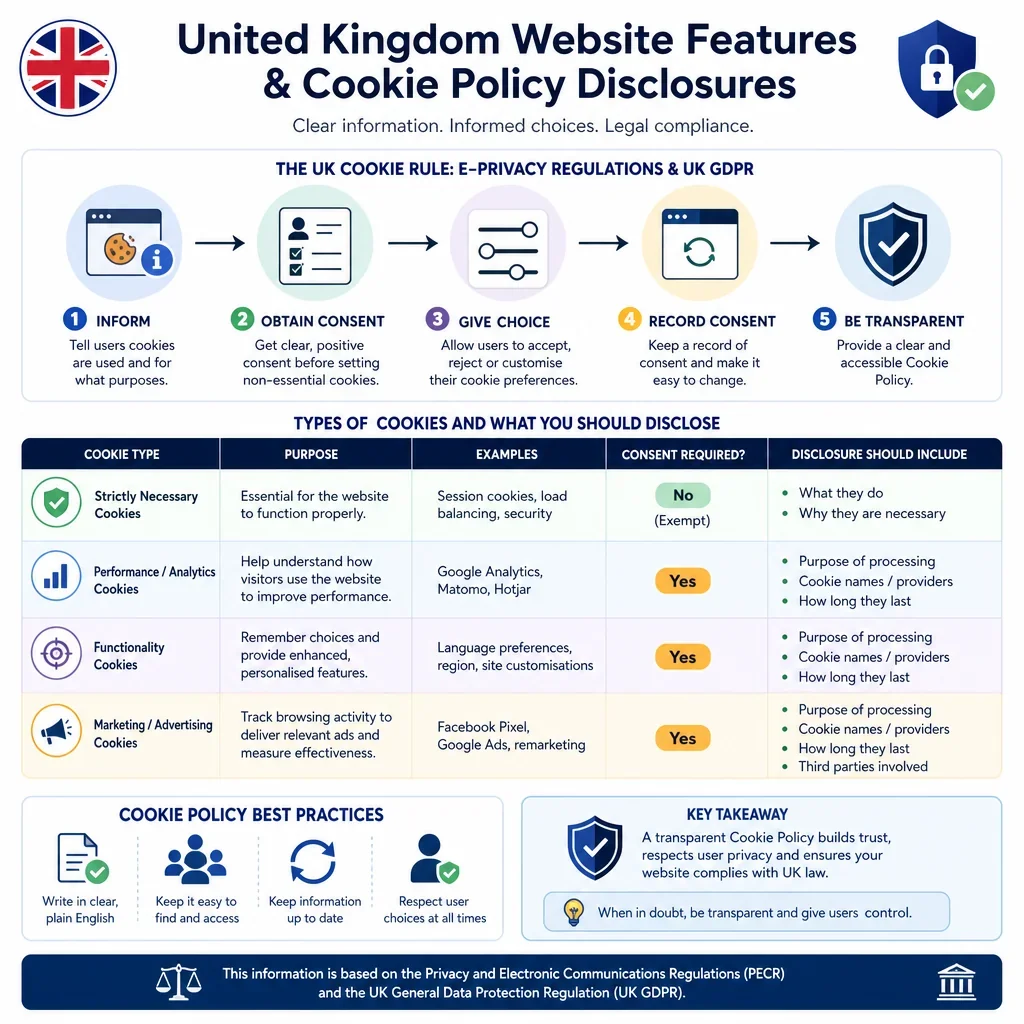
United Kingdom guide to website features and cookie policy disclosures, helping clarify compliance needs and user transparency.
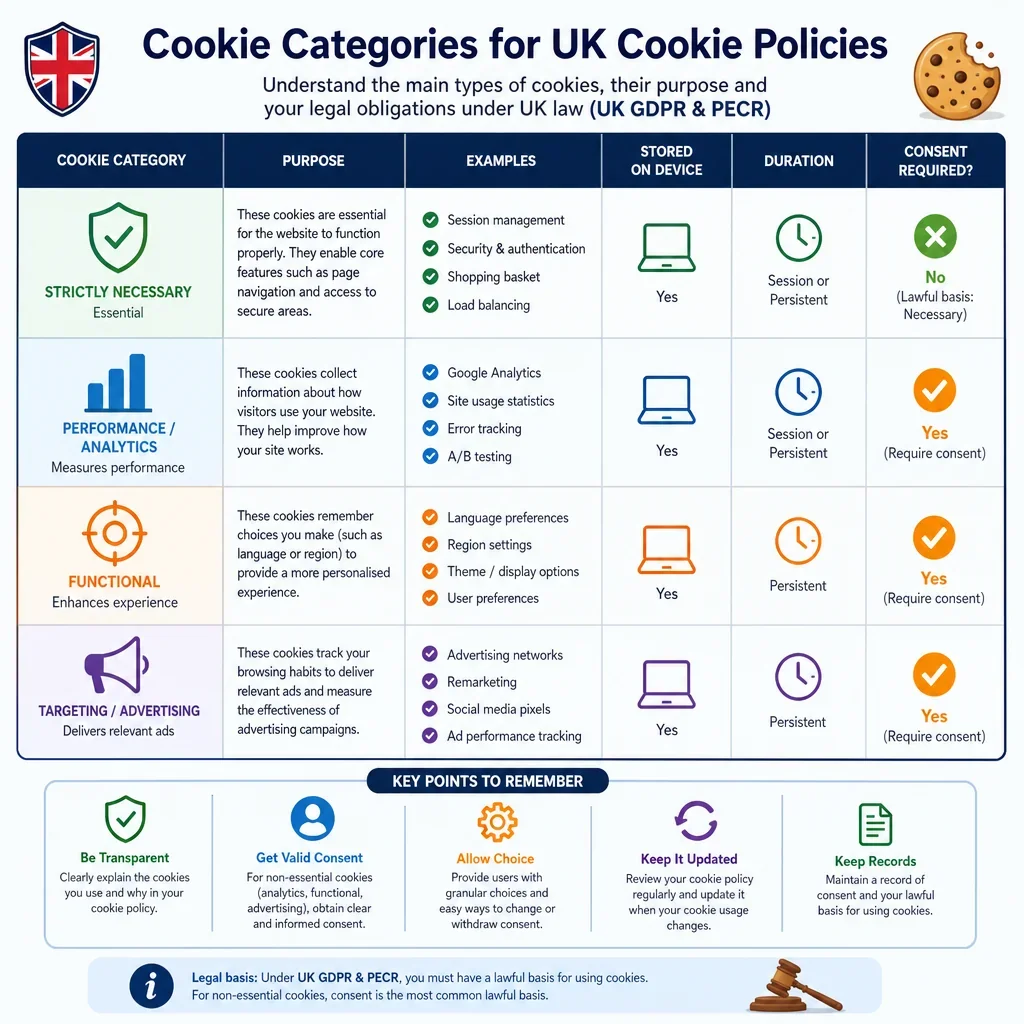
Explore UK cookie categories for clearer cookie policies, better consent management, and improved compliance with privacy rules.
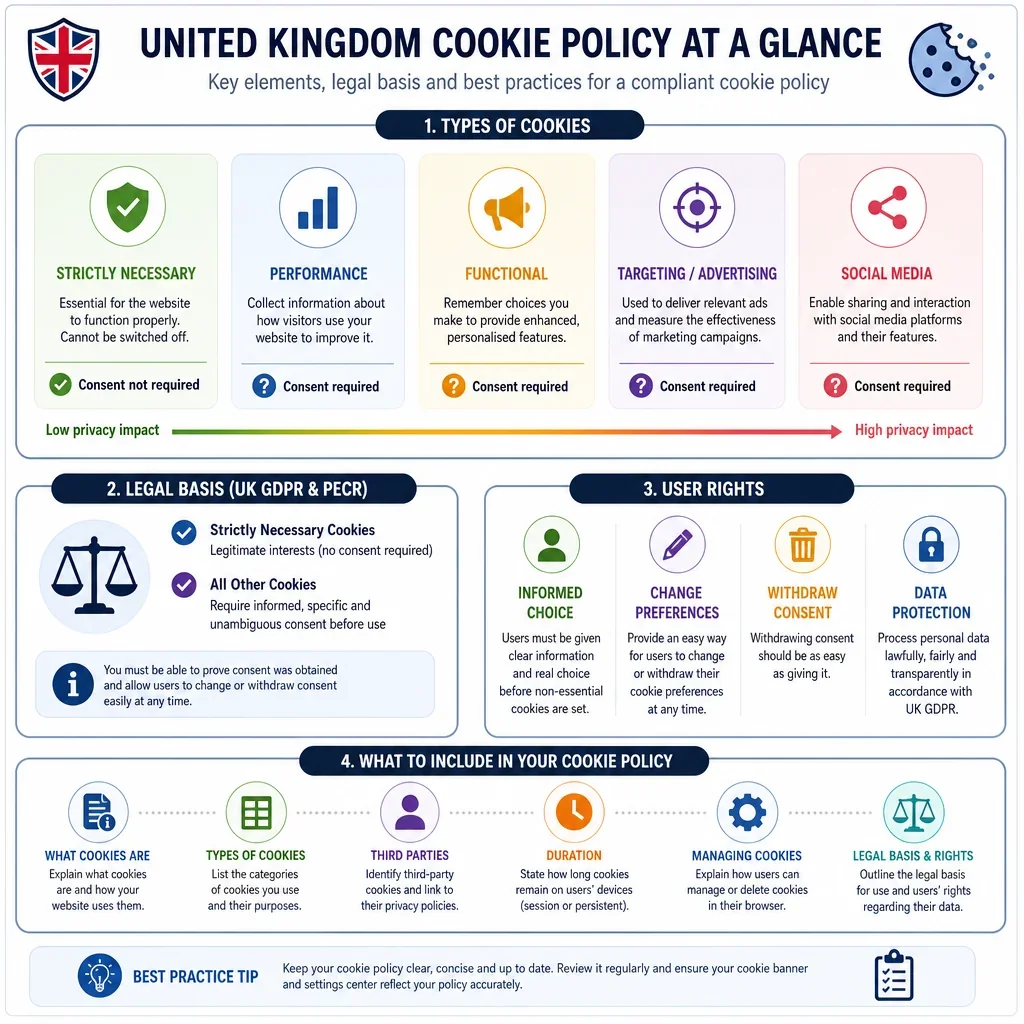
Explore the United Kingdom Cookie Policy Clause Library for practical clause examples to support clear, compliant cookie policy drafting.
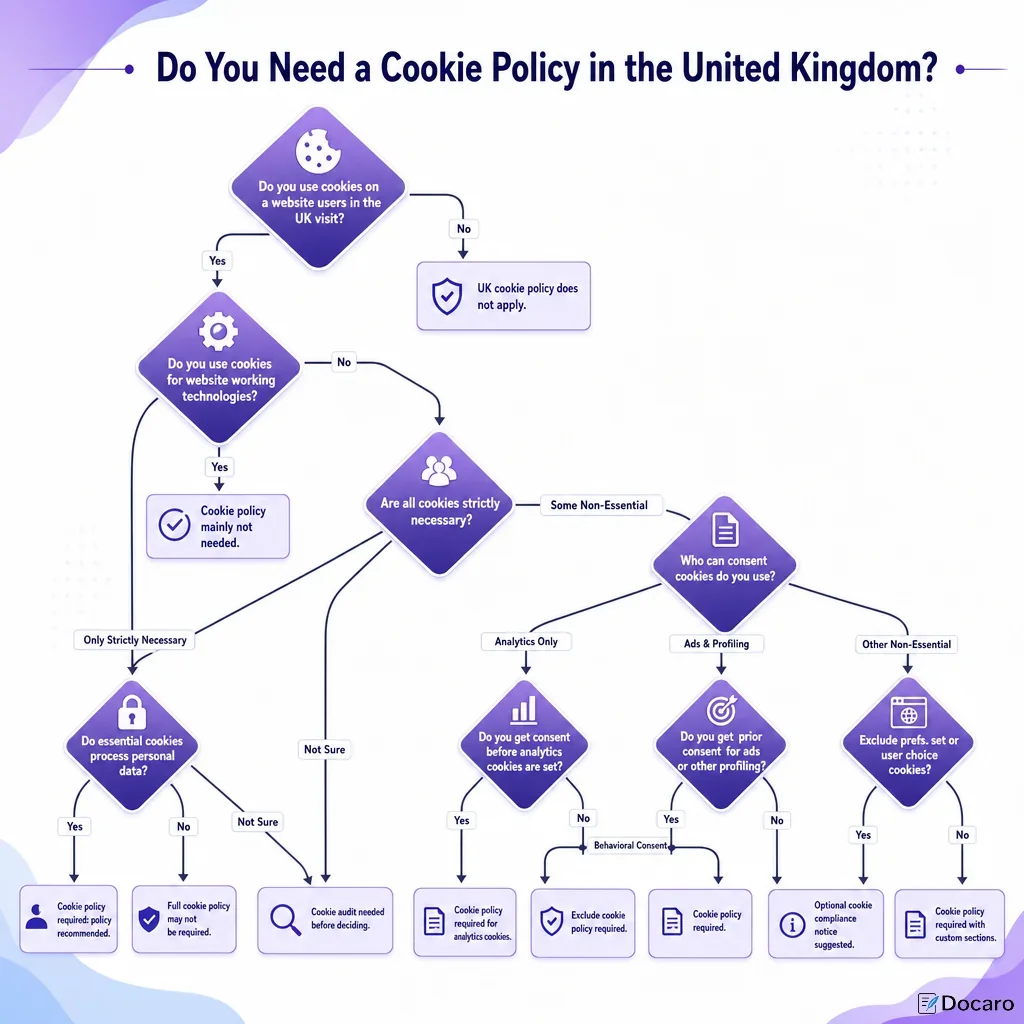
Do you need a cookie policy in the United Kingdom? Use this guide to understand UK cookie compliance and website obligations.
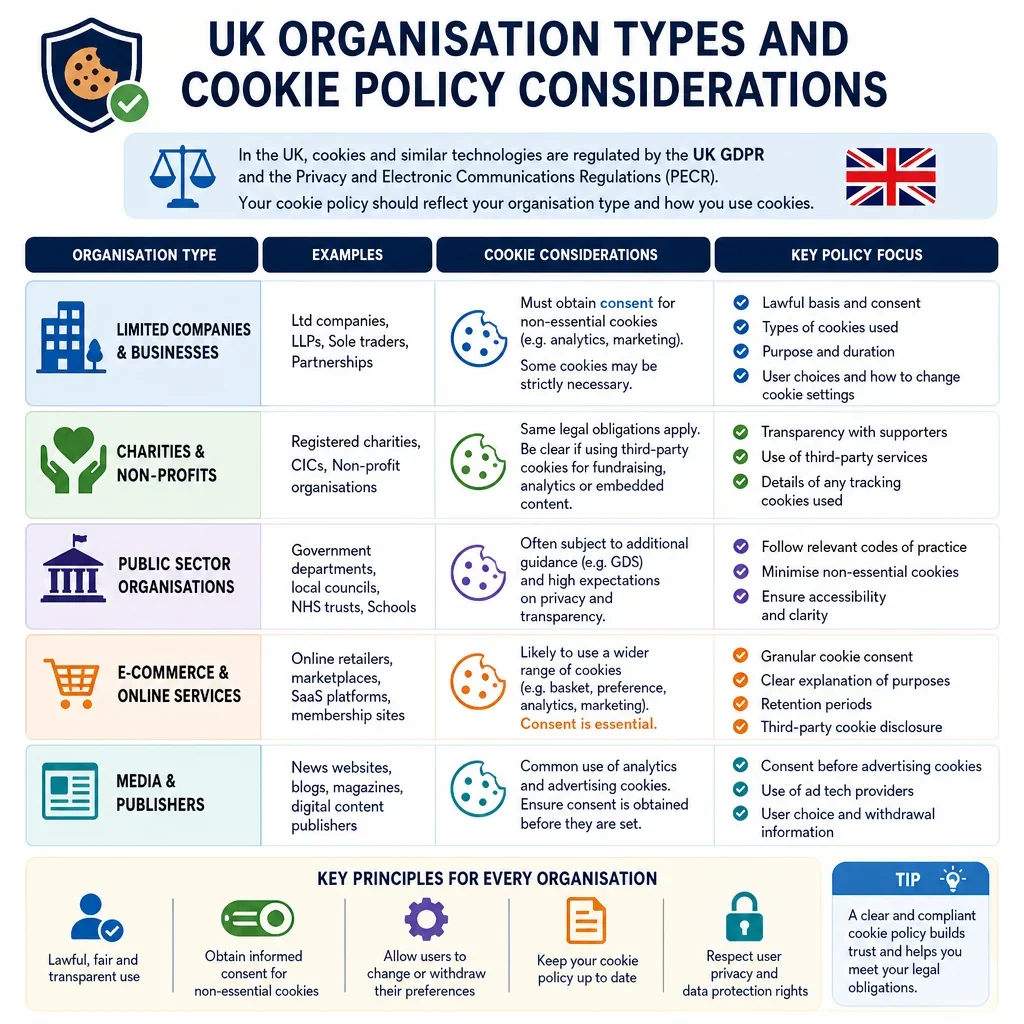
United Kingdom guide to organisation types and key cookie policy considerations for clearer compliance planning.
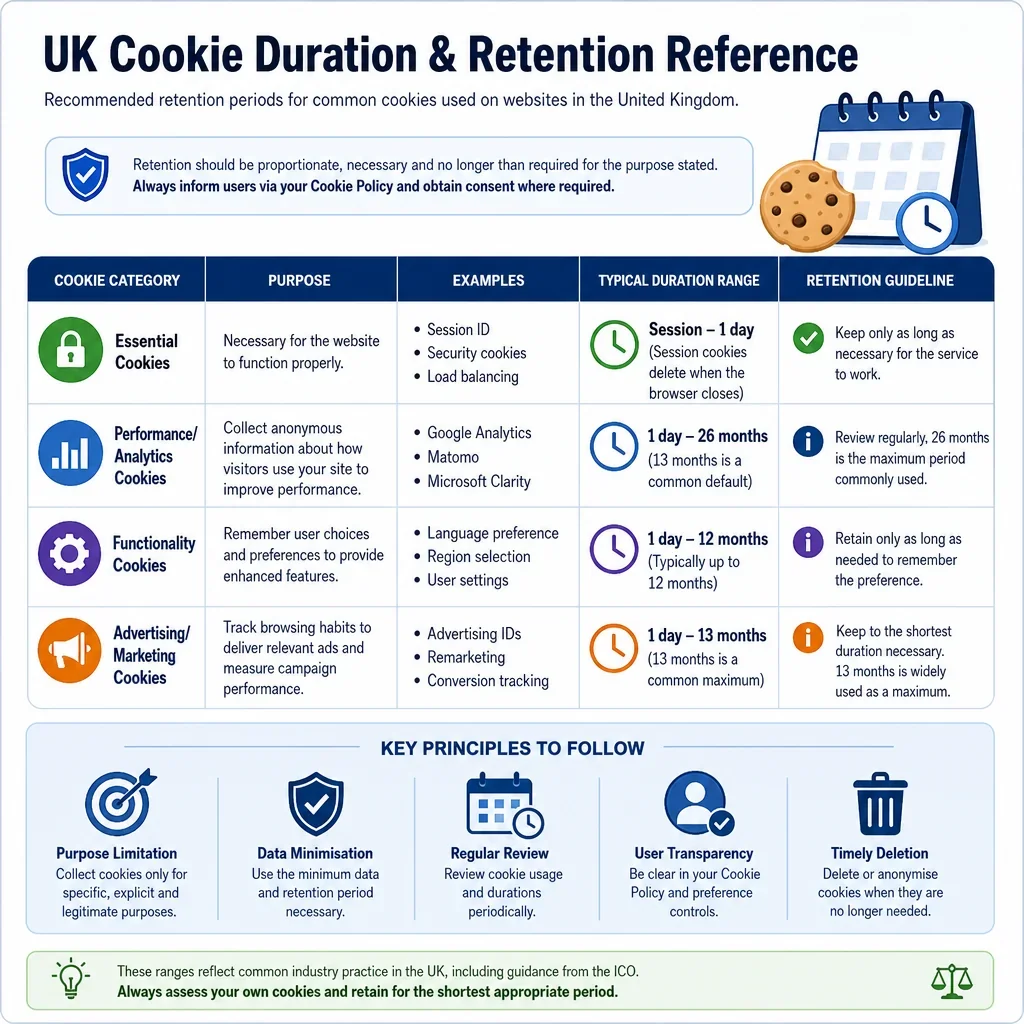
United Kingdom cookie duration and retention reference for understanding cookie lifespans, storage periods, and compliance planning.
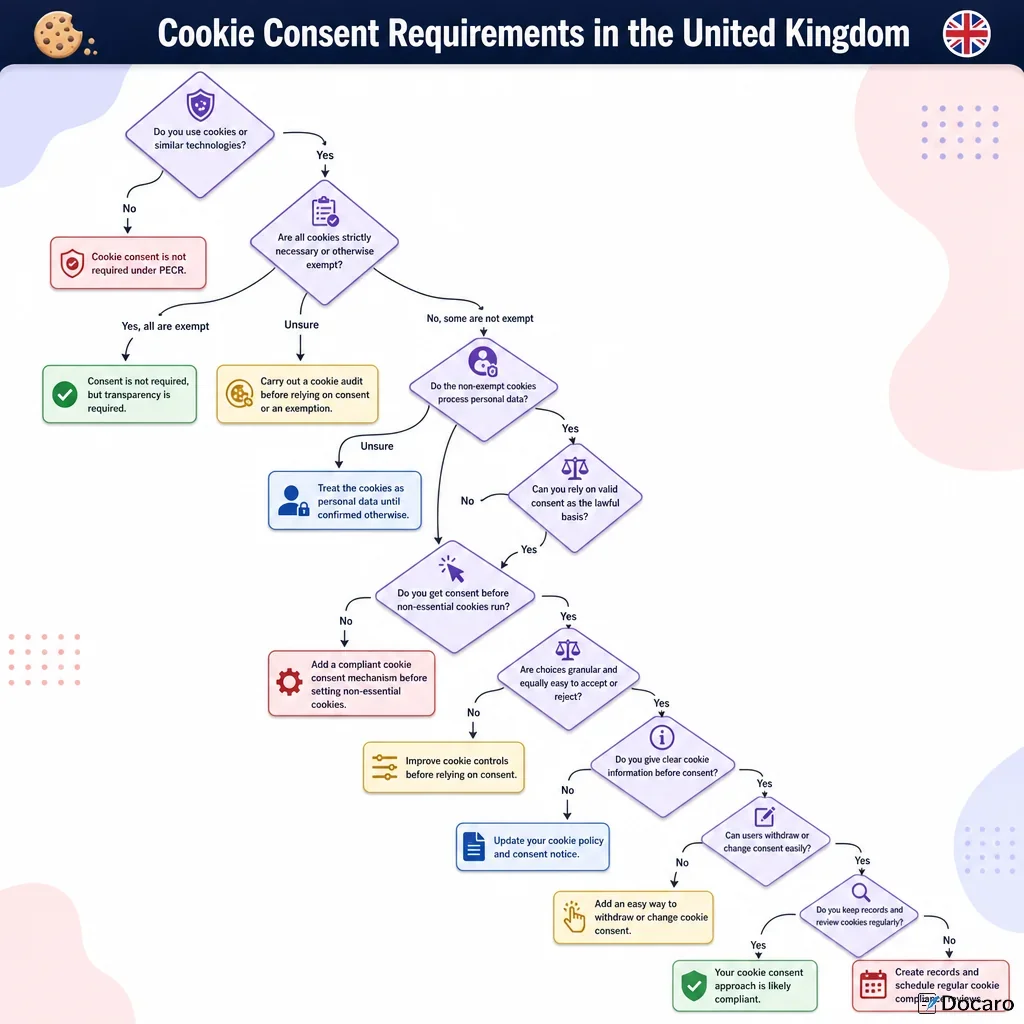
Understand cookie consent requirements in the United Kingdom with a clear flowchart for UK website compliance.