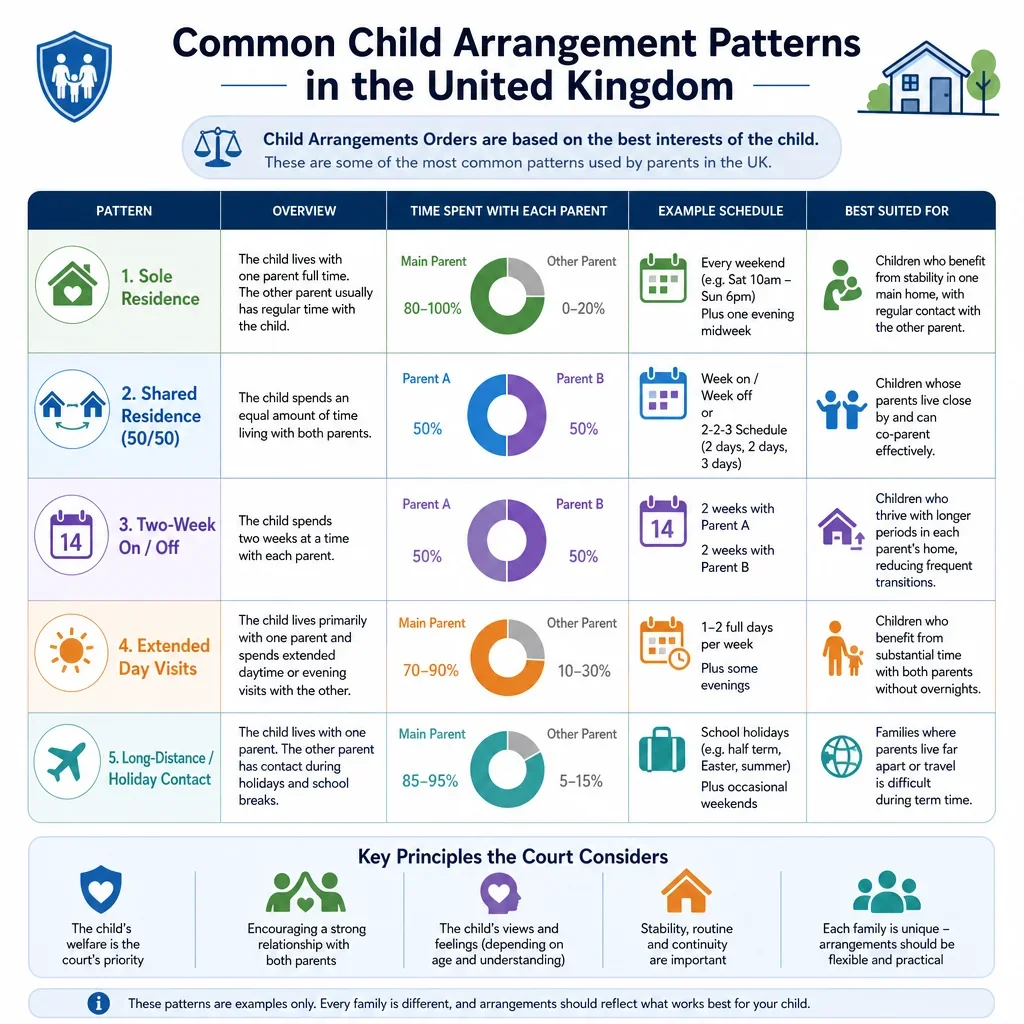
Common Child Arrangement Patterns In The United Kingdom
Arrangement Pattern | Pattern Description | Common Age Suitability | Practical Considerations | Coordination Level |
|---|---|---|---|---|
Primarily With One Parent | ||||
Alternate Weekends | Child lives mainly with one parent and spends every other weekend with the other parent. | Any Age | Define start and end times, transport duties and any missed-weekend make-up rules. | Low |
Alternate Weekends Plus Midweek Visit | Child stays mainly with one parent, with alternate weekends and a short midweek visit or tea-time contact. | Pre-School Child, Primary School Child | Works best when homes are close enough for weekday travel without disrupting bedtime. | Medium |
Alternate Weekends Plus Midweek Overnight | Child has alternate weekends and one overnight stay during the school week with the other parent. | Primary School Child, Secondary School Child | The overnight parent must manage school uniform, homework, breakfast and school drop-off. | Medium |
Weekday Weekend Split | ||||
Every Weekend With Other Parent | Child spends weekdays with one parent and most or all weekends with the other parent. | Primary School Child, Secondary School Child | May affect the weekday parent's leisure time and the weekend parent's activity commitments. | Medium |
Primarily With One Parent | ||||
Long Alternate Weekend | Child stays from Friday after school to Monday school drop-off every other weekend. | Primary School Child, Secondary School Child | Reduces Sunday handovers but requires reliable Monday school transport and school items. | Medium |
Daytime Weekend Contact | Child spends weekend daytime periods with one parent but sleeps at the main home. | Pre-School Child, Primary School Child | Useful where overnights are not yet established or the child needs one bedtime base. | Low |
Flexible Arrangement | ||||
Short Frequent Visits | Child has shorter but more frequent contact periods with the parent they do not live with. | Pre-School Child | Needs predictable timing, naps and feeding routines, and low-conflict handovers. | High |
Gradual Progression To Overnights | Contact starts with short visits and gradually increases to longer visits or overnight stays. | Pre-School Child, Primary School Child | Set review dates, progression triggers and what happens if the child struggles. | High |
Supervised Contact Sessions | Child spends time with a parent while another trusted adult or contact centre supervises. | Any Age | Use where safety, reintroduction or safeguarding concerns require controlled contact. | High |
Supported Contact Centre Visits | Child meets a parent at a contact centre where staff support but do not closely supervise. | Any Age | Check centre availability, referral requirements, fees and whether reports are provided. | High |
Indirect Contact Only | Parent-child contact occurs by letters, cards, messages, telephone or video rather than in person. | Any Age | Specify frequency, permitted channels, privacy expectations and who helps younger children respond. | Low |
Video Calls Between Stays | Child has scheduled video calls with the other parent between physical contact periods. | Any Age | Set call length, time window and what happens if the child is tired or unavailable. | Medium |
Alternating Weeks | ||||
Alternating Weeks | Child spends one full week with each parent on a repeating two-week cycle. | Primary School Child, Secondary School Child | Requires both homes to manage school, homework, activities and medical routines independently. | Medium |
Alternating Weeks With Midweek Visit | Child alternates weekly homes with a short midweek visit or call to the other parent. | Primary School Child, Secondary School Child | Helps reduce long gaps but adds travel or scheduling during the school week. | High |
Shared Care | ||||
2-2-3 Schedule | Child spends two days with one parent, two with the other, then a three-day weekend, alternating weekly. | Pre-School Child, Primary School Child | Frequent handovers suit close homes but can be disruptive if school items are forgotten. | High |
2-2-5-5 Schedule | Each parent has the same two weekdays every week and alternates the five-day weekend block. | Primary School Child, Secondary School Child | Predictable school-week responsibilities but five-day gaps may be long for younger children. | High |
3-4-4-3 Schedule | Child spends three days with one parent and four with the other, then swaps the next week. | Primary School Child, Secondary School Child | More even than weekends-only but requires both parents to cover weekdays and weekends. | High |
Split School Week | Child spends fixed school nights with each parent, such as Monday to Wednesday and Thursday to Friday. | Primary School Child, Secondary School Child | Works best with close homes, duplicated school supplies and clear homework responsibility. | High |
Weekday Weekend Split | ||||
School Nights With One Parent, Alternate Weekends With Other | Child stays at one home on school nights and alternates weekends with the other parent. | Primary School Child, Secondary School Child | Stable school routine but the other parent may need extra holiday or midweek time. | Low |
Primarily With One Parent | ||||
Term-Time Base With Holiday Balancing | Child has one main term-time home and spends longer school-holiday blocks with the other parent. | Primary School Child, Secondary School Child | Holiday dates, travel, childcare cover and passport arrangements should be specified. | Medium |
Flexible Arrangement | ||||
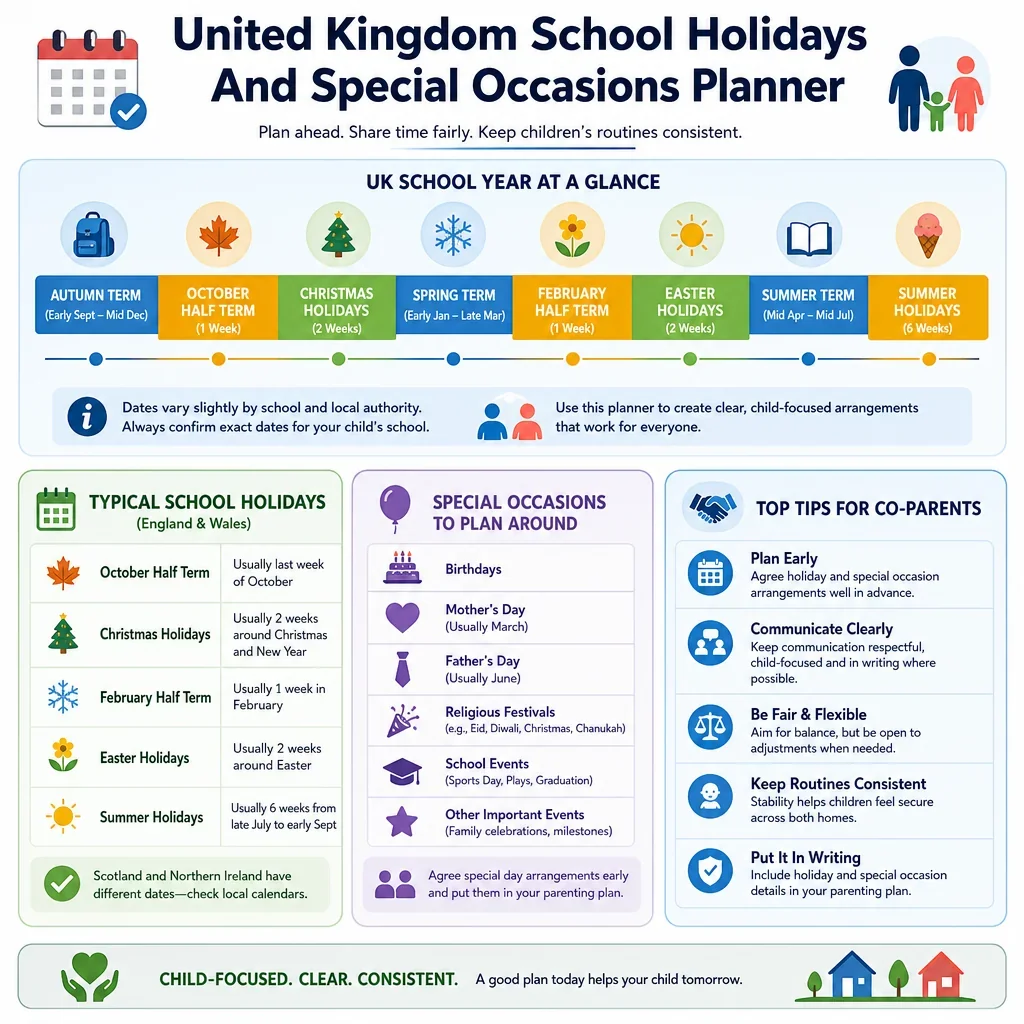
Equal School Holiday Split | Parents divide school holidays broadly equally, often by alternating weeks or halves. | Primary School Child, Secondary School Child | Set priority for booking leave, abroad travel notice and handover dates for each holiday. | Medium |
Alternating Christmas And New Year | Child spends Christmas with one parent and New Year with the other, alternating each year. | Any Age | Define exact holiday period, festive handover time and how family travel is handled. | Medium |
Split Christmas Day | Child spends part of Christmas Day with each parent, often with a midday handover. | Any Age | Can be stressful if travel is long specify location, timing and meal expectations. | High |
Alternating Child's Birthday | Parents alternate the child's birthday each year or divide the day into agreed time blocks. | Any Age | Set whether school-day contact, parties and extended-family events override the normal pattern. | Medium |
Mother's Day And Father's Day Fixed | Child spends Mother's Day and Father's Day with the relevant parent regardless of the usual rota. | Any Age | State whether the missed time is made up and what happens if it conflicts with holidays. | Low |
Long-Distance Block Contact | Child has fewer but longer stays with a distant parent, often in holidays and long weekends. | Primary School Child, Secondary School Child | Plan travel costs, handover points, luggage, school absence limits and video contact between stays. | High |
Overseas Holiday Contact | Child spends agreed holiday periods abroad with one parent. | Any Age | Written consent, passport holding, itinerary, emergency contact and return dates should be clear. | High |
Up To 28 Days Abroad By Lives-With Parent | A person named in a lives-with child arrangements order may take the child abroad for up to 28 days unless restricted. | Any Age | Check the order terms and obtain consent or court permission if travel exceeds permitted limits. | Medium |
Shared Care | ||||
Bird's Nest Parenting | Child remains in one home while parents rotate in and out according to an agreed schedule. | Any Age | Requires high trust, housing budget, household rules and clear responsibility for bills and chores. | High |
Flexible Arrangement | ||||
Shift-Work Rota Arrangement | Care pattern is built around a parent's changing work shifts rather than fixed weekly days. | Any Age | Needs rota notice deadlines, fallback care, holiday rules and a method for confirming dates. | High |
School-Gate Handover Pattern | Handover occurs through school drop-off and collection rather than direct parent-to-parent exchange. | Primary School Child, Secondary School Child | Reduces direct conflict but does not work during holidays, inset days or illness. | Low |
Neutral Handover Location | Parents exchange the child at a neutral public place or agreed third-party location. | Any Age | Use clear times, waiting periods and safety arrangements if direct contact is difficult. | Medium |
Third-Party Handover | A trusted adult collects or returns the child so parents do not meet directly. | Any Age | Identify the adult, authority to collect, timing, safeguarding limits and backup plan. | Medium |
Primarily With One Parent, Shared Care | ||||
Parallel Parenting Schedule | Parents follow a detailed schedule with minimal direct communication and limited flexibility. | Any Age | Needs precise wording, written communication channels and rules for emergencies and changes. | Low |
Flexible Arrangement | ||||
Different Patterns For Siblings | Siblings have different schedules because of age, schooling, needs or relationships. | Any Age | Consider sibling contact, fairness, transport complexity and each child's individual welfare. | High |
Teenager-Led Flexible Time | Older child has an agreed base pattern but some flexibility around study, friends and activities. | Secondary School Child | Avoid leaving all decisions to the child set minimum time, notice and parental agreement rules. | Medium |
Activity-Based Weekend Pattern | Contact is scheduled around regular sport, clubs, tuition or religious activities. | Primary School Child, Secondary School Child | State who transports, pays, attends events and decides whether activities continue. | High |
Late Collection Or Early Drop-Off Pattern | Handover times are adjusted around parent work hours, childcare or school wraparound care. | Any Age | Confirm childcare authority, cost sharing, lateness rules and emergency collection contacts. | Medium |
Infant Feeding-Sensitive Contact | Short contact periods are arranged around feeding, naps and the infant's established routine. | Pre-School Child | Record feeding times, expressed milk arrangements, naps and how contact may increase over time. | High |
Shared Care | ||||
Fixed Weekday Equal Shared Care | Each parent has fixed weekdays and alternate weekends, producing a near-equal overall split. | Primary School Child, Secondary School Child | Clear regularity helps school planning but both homes must support weekday responsibilities. | High |
Primarily With One Parent, Shared Care | ||||
9-5 Fortnight Pattern | Child spends nine nights per fortnight with one parent and five nights with the other. | Primary School Child, Secondary School Child | Balances stability with substantial time specify which school nights each parent covers. | Medium |
Primarily With One Parent | ||||
10-4 Fortnight Pattern | Child spends ten nights per fortnight with one parent and four nights with the other. | Any Age | Useful where one home is the school base add holiday time if broader balance is intended. | Low |
Flexible Arrangement | ||||
Relocation Transition Pattern | The pattern changes after a move, school change or new travel distance affects ordinary contact. | Any Age | Set the trigger date, temporary timetable, school impact and review mechanism. | High |
Phased Reintroduction After Absence | Contact restarts gradually after a parent-child relationship has had a long break. | Any Age | May need indirect contact first, professional support, review points and child-sensitive pacing. | High |
Child Welfare-Led Pattern | Any court-ordered arrangement must treat the child's welfare as the paramount consideration. | Any Age | Explain how the timetable supports the child's needs, schooling, safety and relationships. | Medium |
Agreed Parenting Plan Without Court Order | Parents may record agreed arrangements privately the court only makes an order if better than no order. | Any Age | Best for workable cooperation consider a formal order if enforcement or certainty is needed. | Medium |
Primarily With One Parent, Shared Care, Flexible Arrangement | ||||
Lives-With And Spends-Time-With Order | A Child Arrangements Order can state with whom a child lives, spends time or otherwise has contact. | Any Age | Use precise wording for residence, staying contact, visiting contact and indirect contact. | Medium |
Which Child Arrangement Pattern Is Most Practical In England And Wales?
The most workable pattern usually depends on the child\'s age, school routine, travel distance and the parents\' ability to communicate. Patterns with frequent handovers, such as 2-2-3 or 3-4-4-3 schedules, can preserve regular contact with both parents but usually need high coordination and predictable handover arrangements.
When Is Shared Care More Suitable?
Shared care patterns such as alternating weeks, 2-2-5-5 or midweek overnight schedules are most practical where both homes can support school, homework, activities and healthcare routines. They are often easier for primary or secondary school children than for very young children, unless both parents live close together and can manage consistent routines.
When Is A Primary Carer Pattern More Suitable?
Patterns where the child lives mainly with one parent and spends alternate weekends, midweek visits or holiday time with the other parent can be more stable for pre-school children, children with long school journeys, or cases where parental communication is limited. They still allow meaningful time with the non-resident parent if dates, times and collection responsibilities are clearly written down.
What Should A Parenting Plan Say About Handovers?
Any Child Arrangements plan should specify the ordinary weekly pattern, collection and return times, school-holiday arrangements, special days, telephone or video contact, and who is responsible for transport. This reflects the practical focus of the UK Government guidance on making child arrangements and helps reduce disputes about interpretation.
What Is The Legal Context For These Patterns?
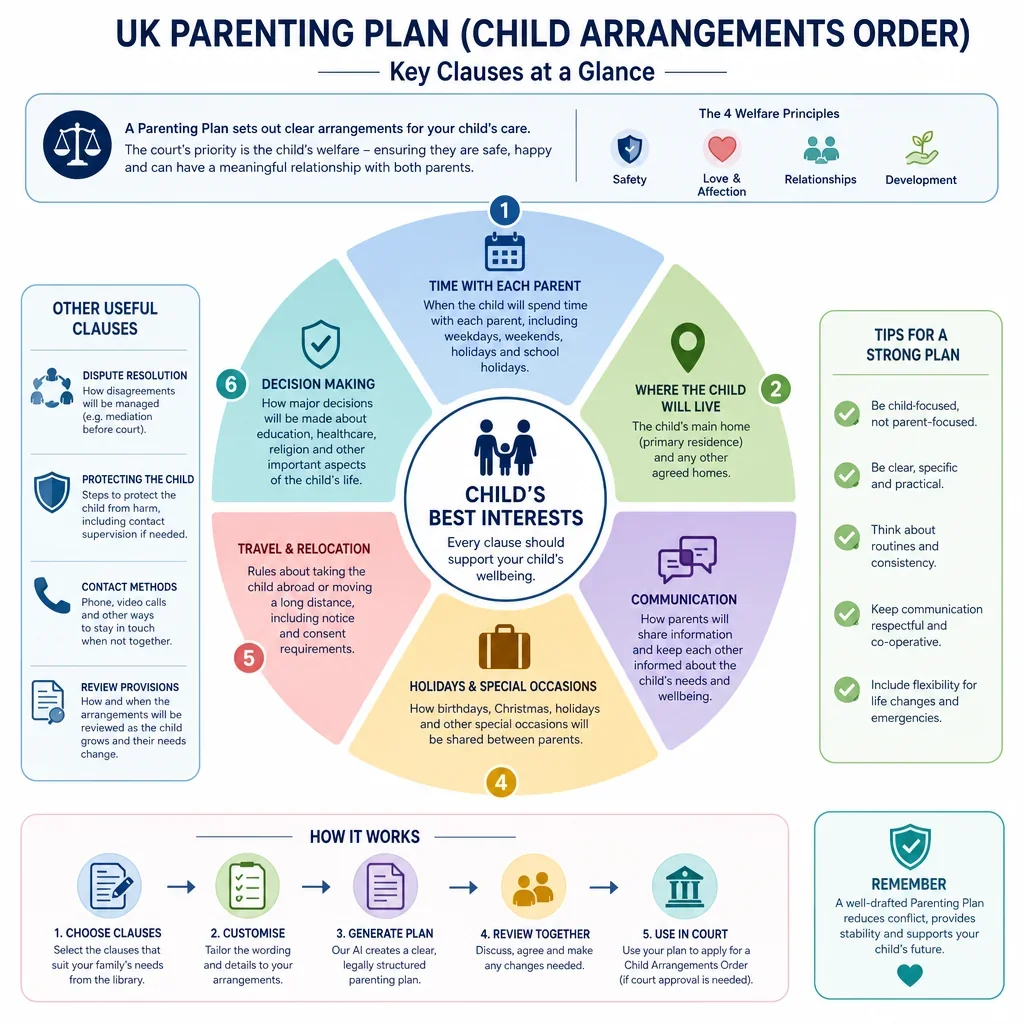
In England and Wales, the court\'s paramount consideration is the child\'s welfare under the Children Act 1989, section 1. The pattern chosen should therefore be framed around the individual child\'s needs, not as an automatic entitlement to equal time. A written parenting plan or proposed Child Arrangements Order should show how the schedule supports stability, schooling, relationships and safe contact.
FAQs
You Might Also Be Interested In