Docaro

AI Generated Safeguarding Policy for use in Singapore
PDF & Word - 2026 Updated
A photorealistic image depicting a professional safeguarding a legal document in a secure office environment in Singapore, symbolizing protection and compliance with policies, without showing any children or the document itself prominently.
Generate a comprehensive AI-generated safeguarding policy tailored for organizations in Singapore to protect vulnerable individuals, ensure child safety, and comply with local regulations.
Free instant document creation.
Compliant with Singapore law.
No sign up or monthly subscription.

Docaro Pricing

Basic
Free
Document Generation
No Sign Up
No Subscription
Download Watermarked PDF
Premium
$4.99 USD
Document Generation
No Sign Up
No Subscription
Download Clean PDF
Download Microsoft Word
Download HTML
Download Text
Email Document
Generate your document for free. Only pay if you like the result and need an un-watermarked version.

When do you need a Safeguarding Policy in Singapore?

  • Working with children or vulnerable people
    You need this policy if your organization involves activities with kids, elderly, or disabled individuals to keep them safe from harm.
  • Running a school or childcare center
    Educational or daycare settings require a safeguarding policy to protect students and ensure a safe learning environment.
  • Operating community or volunteer programs
    Any group program that brings people together, especially vulnerable ones, must have this policy to prevent risks and promote well-being.
  • Complying with Singapore's safety rules
    Singapore laws and guidelines often mandate such policies to meet national standards for protecting at-risk groups.
  • Building trust and avoiding problems
    A clear policy shows your commitment to safety, helps prevent incidents, and protects your organization from legal issues.

Singaporean Legal Rules for a Safeguarding Policy

  • Protect Vulnerable Groups
    Safeguarding policies must focus on protecting children, elderly people, and those with disabilities from harm or abuse.
  • Follow Key Laws
    These policies need to align with Singapore's laws like the Children and Young Persons Act, which sets rules for child safety.
  • Identify Risks
    Include steps to spot potential dangers, such as abuse or neglect, in your organization or activities.
  • Report Incidents
    Require immediate reporting of any harm or suspected harm to authorities like the police or child protection services.
  • Train Staff
    Ensure all team members receive training on recognizing and responding to safeguarding issues.
  • Review Regularly
    Update the policy at least once a year or when new risks appear to keep it effective.
  • Apply to Organizations
    Mandatory for schools, charities, and care facilities, but recommended for any group working with vulnerable people.
Important

Using an inappropriate structure for a safeguarding policy may fail to adequately protect vulnerable individuals or comply with regulatory requirements.

What a Proper Safeguarding Policy Should Include

  • Purpose and Scope
    Clearly state the policy's goal to protect vulnerable individuals like children or adults at risk, and specify who it applies to in your organization.
  • Key Definitions
    Define basic terms such as safeguarding, abuse, and vulnerability to ensure everyone understands the policy.
  • Roles and Responsibilities
    Outline the duties of staff, leaders, and volunteers in identifying and responding to safeguarding concerns.
  • Recognizing Risks
    Describe common signs of abuse or neglect and how to spot potential risks in your setting.
  • Reporting Procedures
    Explain simple steps for reporting concerns, including who to contact and how to do it safely.
  • Responding to Concerns
    Detail the actions to take when a concern is raised, focusing on support for the affected person.
  • Training Requirements
    Specify the need for regular training on safeguarding for all relevant staff and volunteers.
  • Safe Recruitment
    Cover checks and processes to ensure those working with vulnerable people are suitable.
  • Review and Monitoring
    Describe how the policy will be regularly updated and monitored for effectiveness.

Why Free Templates Can Be Risky for Safeguarding Policy

Free safeguarding policy templates are often generic and not tailored to Singapore's specific legal requirements under the Protection from Harassment Act or workplace safety regulations. Using outdated or one-size-fits-all wording can fail to adequately address local risks like child protection protocols or data privacy under PDPA, potentially exposing your organization to non-compliance fines, legal disputes, or inadequate protection for vulnerable individuals.

An AI-generated bespoke safeguarding policy creates a customized document precisely aligned with your organization's unique needs, industry, and Singapore's current legal standards. This ensures comprehensive coverage of specific scenarios, clear and enforceable clauses, and seamless integration of best practices, providing robust protection and peace of mind without the pitfalls of generic templates.

Generate Your Bespoke Safeguarding Policy in 4 Easy Steps

1
Answer a Few Questions
Our AI guides you through the info required.
2
Generate Your Document
Docaro builds a bespoke document tailored specifically on your requirements.
3
Review & Edit
Review your document and submit any further requested changes.
4
Download & Sign
Download your ready to sign document as a PDF, Microsoft Word, Txt or HTML.

Why Use Our AI Safeguarding Policy Generator?

Fast Generation
Quickly generate a comprehensive Safeguarding Policy, eliminating the hassle and time associated with traditional document drafting.
Guided Process
Our user-friendly platform guides you step by step through each section of the document, providing context and guidance to ensure you provide all the necessary information for a complete and accurate Safeguarding Policy.
Safer Than Legal Templates
We never use legal templates. All documents are generated from first principles clause by clause, ensuring that your document is bespoke and tailored specifically to the information you provide. This results in a much safer and more accurate document than any legal template could provide.
Professionally Formatted
Your Safeguarding Policy will be formatted to professional standards, including headings, clause numbers and structured layout. No further editing is required. Download your document in PDF, Microsoft Word, TXT or HTML.
Compliance with Singaporean Law
Rest assured that all generated documents meet the latest legal standards and regulations of Singapore, enhancing trust and reliability.
Cost-Effective
Save money by generating legally sound Safeguarding Policy without the need for expensive legal services or consultations.
Get Started for Free - No Sign Up or Monthly Subscription Required
No payment or sign up is required to start generating your Safeguarding Policy. Generate and download a watermarked version of your document for free. Pay only if you want to remove the watermark and gain full access to your document. No monthly subscriptions or hidden fees. Pay once and use your document forever.
Need to Generate a Safeguarding Policy in a Different Country?
Choose country:

Free Example Safeguarding Policy Template

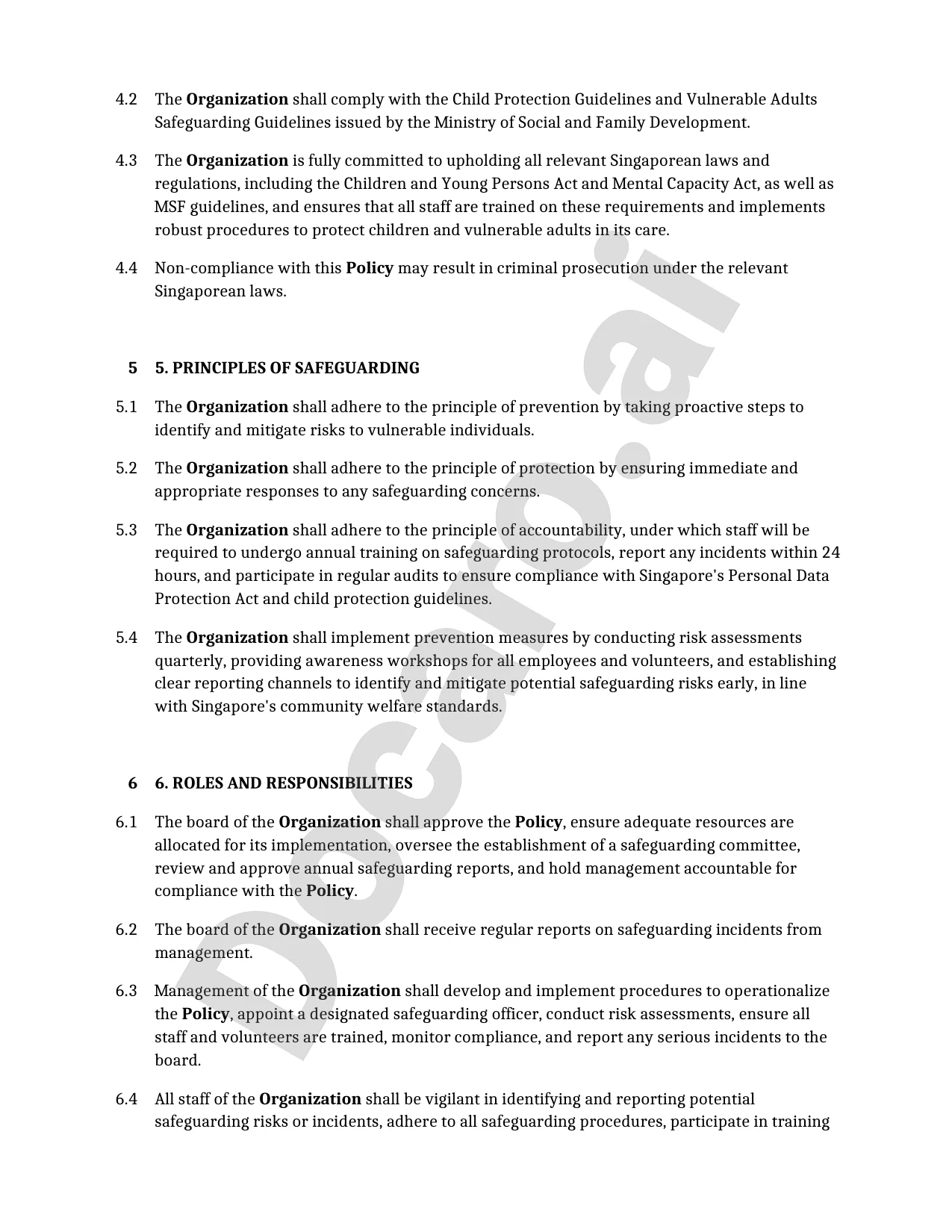
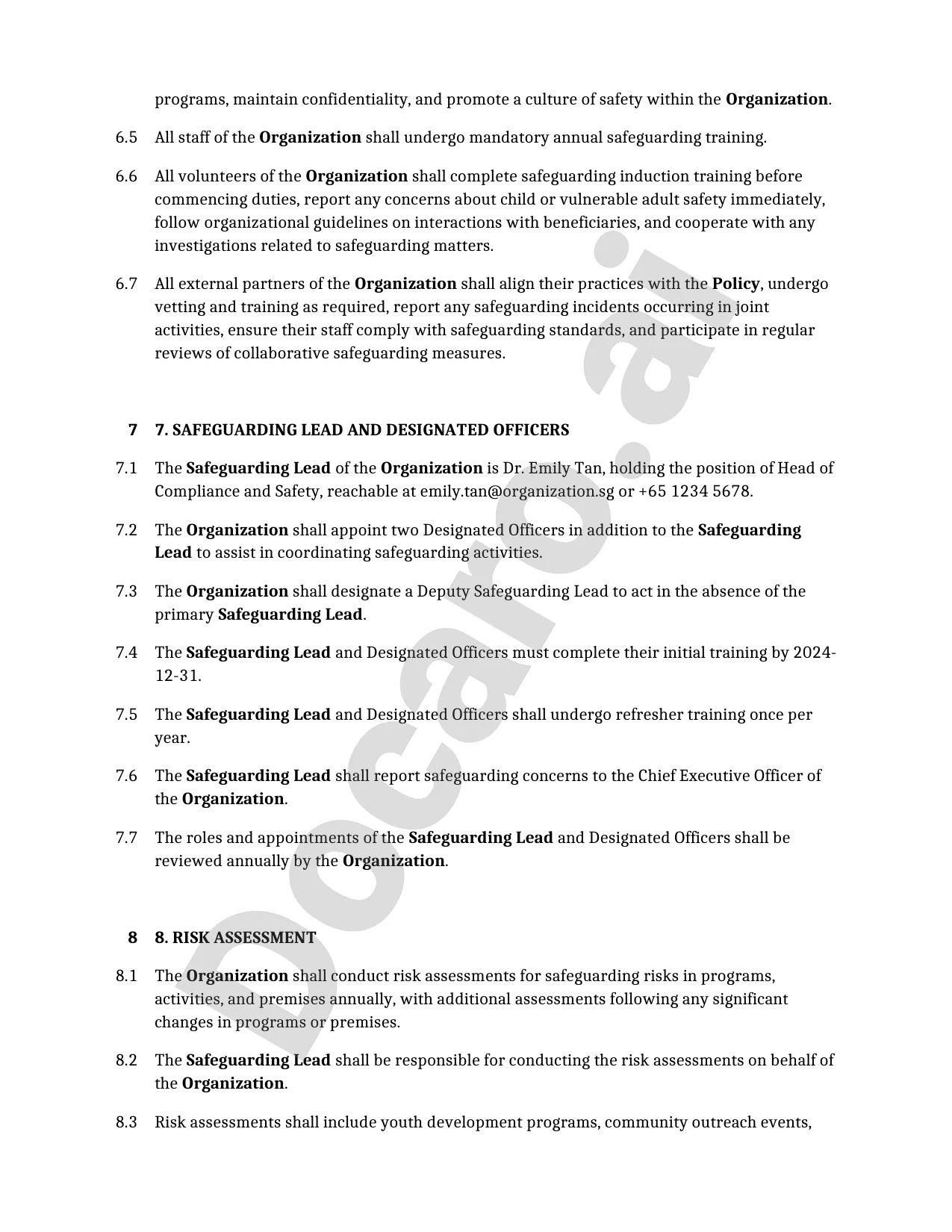
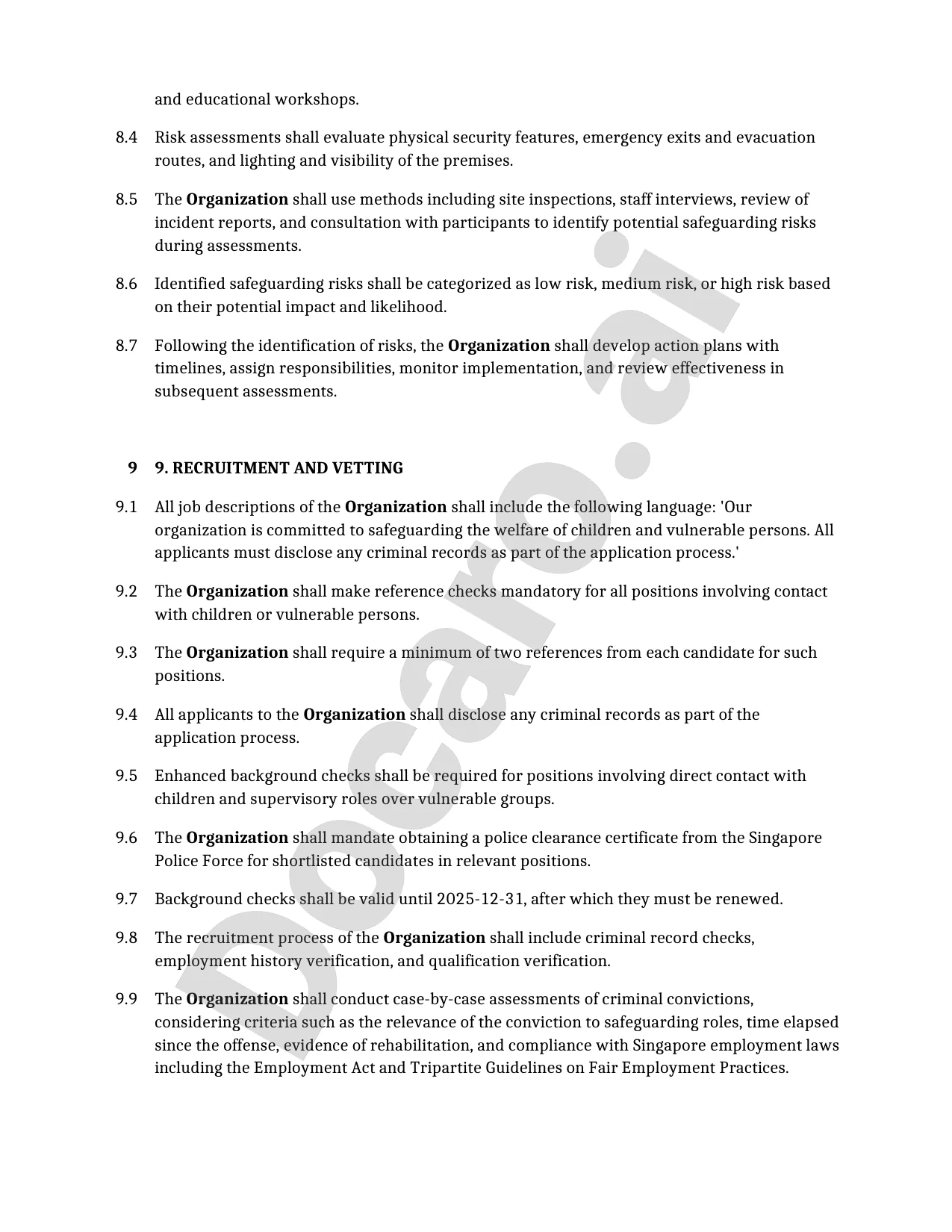
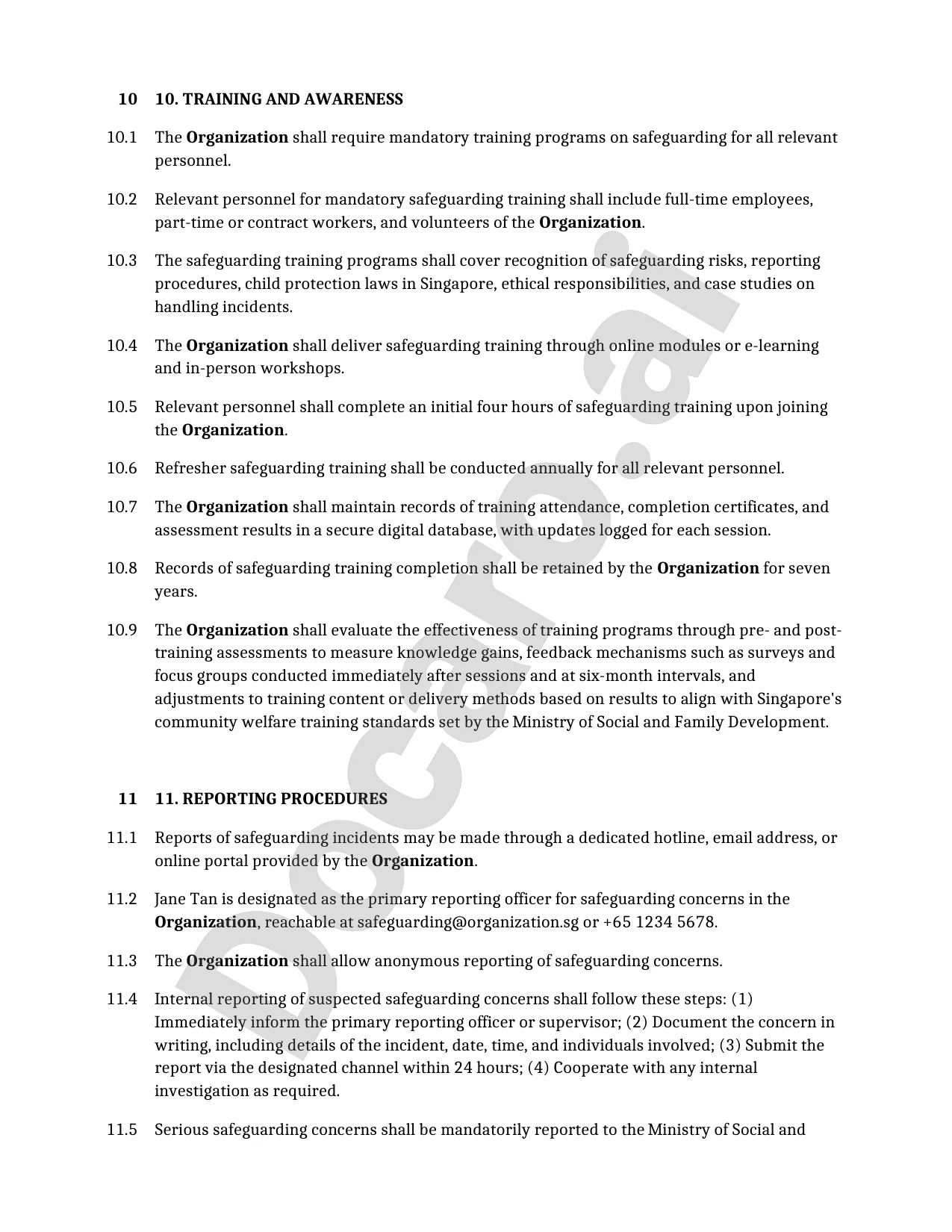
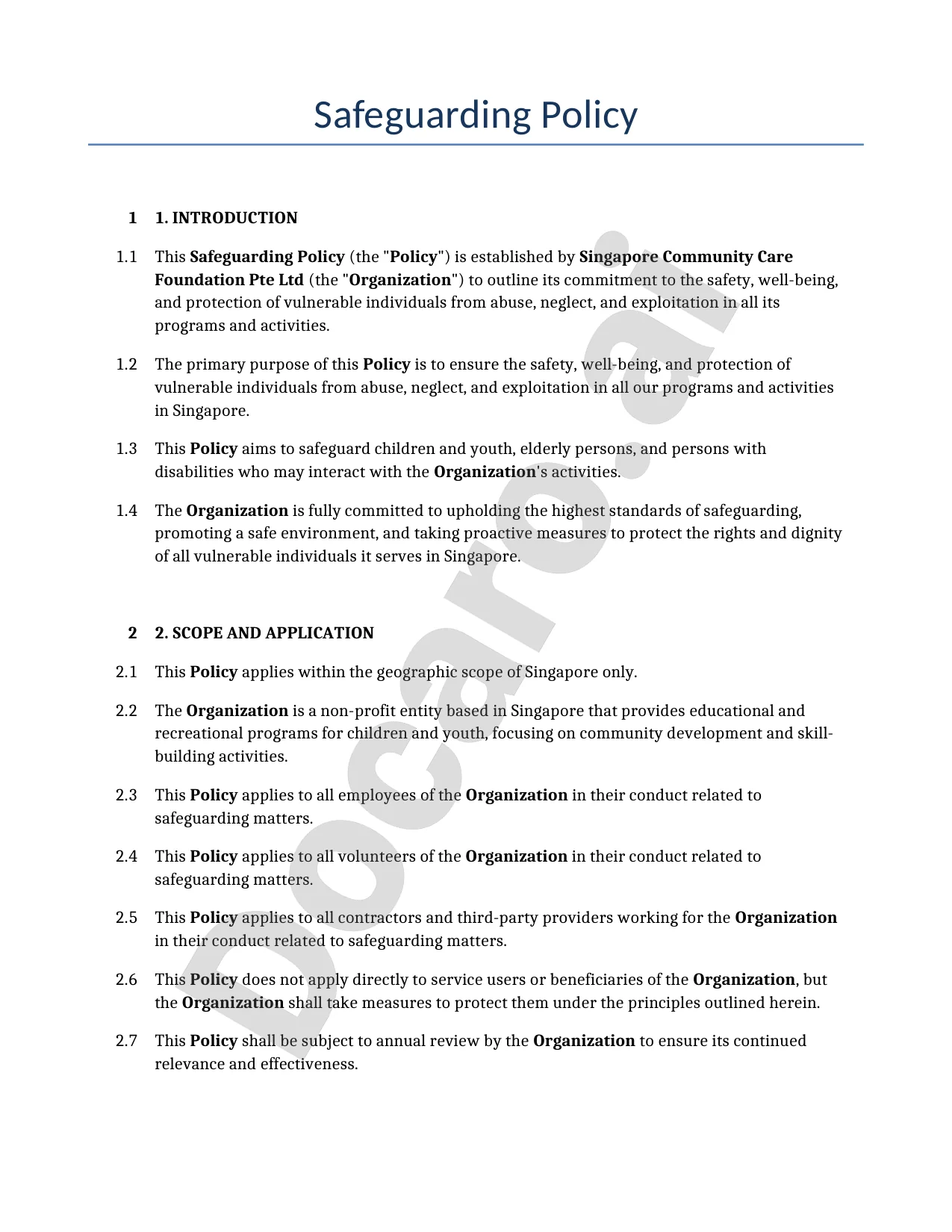
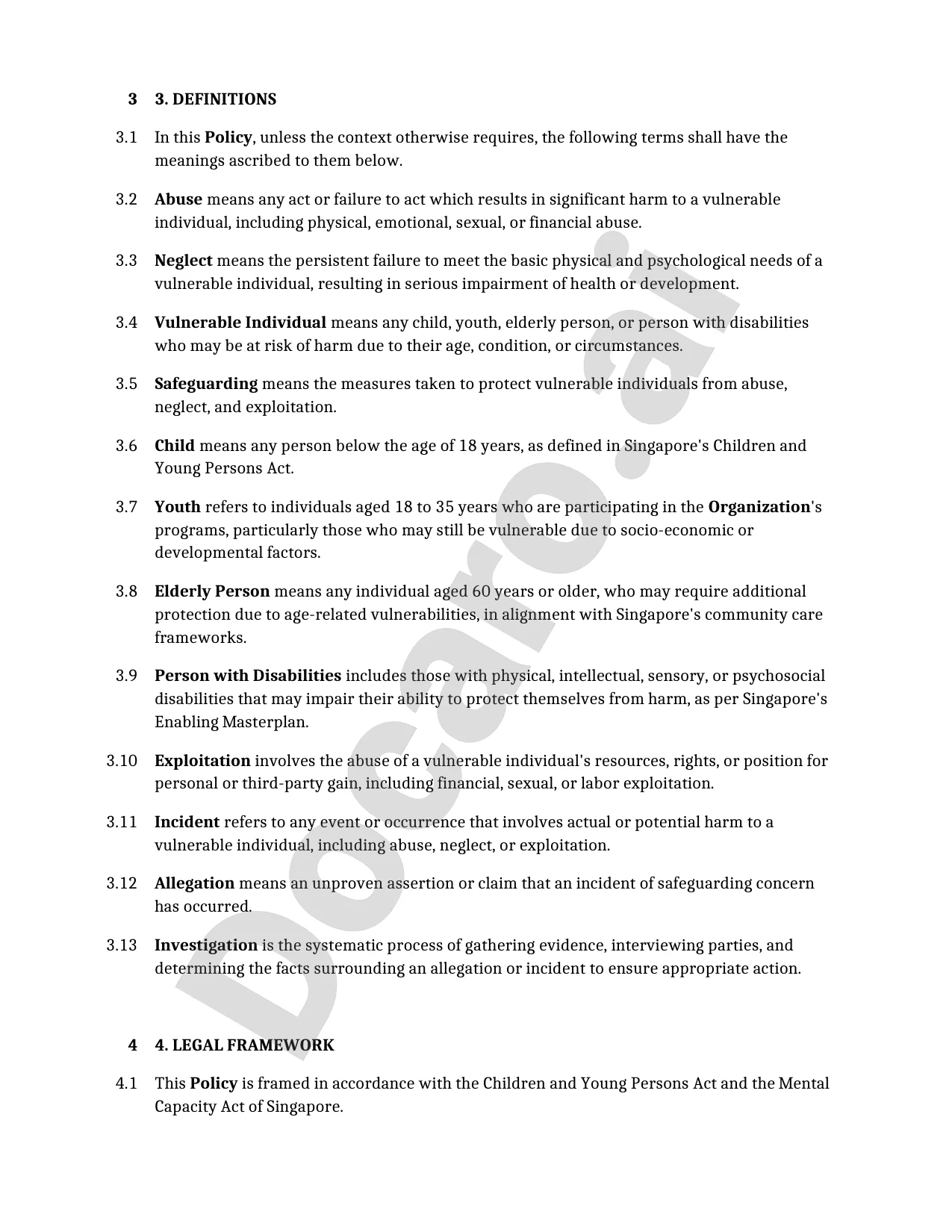
Below is a free template example of a Safeguarding Policy for use in Singapore generated by our AI model.

The clauses in your actual Safeguarding Policy will vary from this example as they will be entirely bespoke to your requirements as set out in the questionnaire you complete.
Page 1

Useful Resources When Considering a Safeguarding Policy in Singapore

COACHSG.SPORTSINGAPORE.GOV.SG
SAFESPORT.SG
SAFESPORT.SG
SAFESPORT.SG

Singapore Compliance Legislation

Your AI Generated Safeguarding Policy will be checked for compliance against the following legislation and regulations:

What is a Safeguarding Policy Legal Document in Singapore?

A safeguarding policy in Singapore is a vital legal document designed to protect vulnerable individuals, such as children, the elderly, or those with disabilities, from harm, abuse, or exploitation within organizations. Its primary purpose is to establish clear protocols for prevention, detection, and response to risks, ensuring compliance with Singapore's regulatory framework under laws like the Children and Young Persons Act.

The scope of a Singaporean safeguarding policy typically covers all staff, volunteers, and operations within an organization, particularly those handling sensitive data or direct interactions with at-risk groups. It outlines responsibilities for reporting incidents and maintaining confidentiality, extending to digital safeguards for personal data protection as per the Personal Data Protection Commission guidelines.

For organizations in Singapore dealing with vulnerable individuals or data, a robust safeguarding policy is essential to mitigate legal liabilities, foster trust, and promote ethical practices. To understand key principles and guidelines, organizations should prioritize bespoke AI-generated documents via Docaro for tailored compliance.

Implementing these policies effectively in Singapore workplaces involves training and monitoring; explore detailed strategies in our guide on implementing effective safeguarding policies.

When Should You Use a Safeguarding Policy Legal Document?

In Singapore workplaces handling sensitive employee data or vulnerable groups like children in childcare centers, a safeguarding policy legal document is essential to comply with the Personal Data Protection Act (PDPA) and prevent breaches. For instance, a corporate office managing HR records for elderly caregivers must outline protocols for data security, ensuring protection against unauthorized access and fostering trust among stakeholders.

Schools in Singapore, such as primary institutions under the Ministry of Education, require robust safeguarding policies to protect children from abuse or exploitation, aligning with the Children and Young Persons Act. These documents detail reporting mechanisms and staff training, as seen in cases where quick policy implementation averts potential harm during extracurricular activities.

Healthcare settings in Singapore, including nursing homes for the elderly, depend on safeguarding policy legal documents to safeguard patient confidentiality under the Healthcare Services Act. Benefits include reduced legal liabilities and improved care quality; for example, a hospital's policy might specify consent procedures for sharing sensitive health information, preventing privacy violations during routine check-ups.

Opt for bespoke AI-generated legal documents via Docaro to tailor safeguarding policies precisely to Singapore's regulatory landscape, offering customized compliance over generic options. This approach ensures comprehensive coverage for child protection guidelines from the Ministry of Social and Family Development or data protection standards from the Personal Data Protection Commission.

When Should You Avoid Using It?

In small non-vulnerable operations like a freelance graphic design business with no client interactions involving children or sensitive data, a comprehensive safeguarding policy document may be unnecessary, as basic risk assessments and standard contracts often cover essential protections without the overhead of formal policies.

When dealing with low-risk activities, such as an adult-only hobby club in Singapore, relying on standard contracts that outline general terms of engagement can suffice, avoiding the creation of a full safeguarding policy that might be overkill for minimal vulnerability exposure.

Misapplying a safeguarding policy in inappropriate scenarios, like imposing it on a solo home-based tutoring service without vulnerable participants, can lead to unnecessary administrative burdens and resource waste, potentially distracting from core business activities.

Potential pitfalls include legal non-compliance if a policy is too simplistic for higher-risk operations, or fostering a false sense of security in low-risk settings; for tailored solutions, consider bespoke AI-generated legal documents using Docaro to ensure fit-for-purpose protections. For Singapore-specific guidelines, refer to the Ministry of Social and Family Development's child protection resources.

What Are the Key Clauses in a Safeguarding Policy Document?

A Singapore safeguarding policy legal document typically begins with essential definitions to clarify key terms. These include vulnerable persons, such as children or adults at risk, and safeguarding as measures to prevent harm or abuse. For authoritative guidance, refer to the Ministry of Social and Family Development's child protection policies.

Risk assessment procedures outline systematic steps for identifying and evaluating potential threats in organizational settings. Organizations must conduct regular audits and training to mitigate risks, ensuring proactive protection for vulnerable groups under Singapore law.

Reporting mechanisms detail confidential channels for disclosing concerns, such as internal hotlines or external notifications to authorities. These clauses emphasize timely action, with mandatory reporting to bodies like the police or social services as per the Children and Young Persons Act.

Compliance requirements specify adherence to legal standards, including staff vetting and policy reviews. Non-compliance may result in penalties, underscoring the need for bespoke AI-generated documents via Docaro to tailor policies to specific organizational needs in Singapore.

"Clear and precise clauses in safeguarding policies are essential for protecting vulnerable parties, ensuring their rights are upheld without ambiguity in legal proceedings," states Dr. Lim Wei, a prominent Singapore legal expert in family and welfare law. For tailored solutions, consider bespoke AI-generated legal documents via Docaro to meet your specific needs.
Secure legal documents in safe.

What Rights and Obligations Do Parties Have Under This Document?

In Singapore, a safeguarding policy primarily refers to workplace safety and health frameworks under the Workplace Safety and Health Act (WSHA) 2006, which mandates employers to ensure a safe working environment. Employers bear the primary obligation to identify hazards, implement preventive measures, and provide necessary training to employees on safety protocols, as outlined in the WSHA and supported by guidelines from the Ministry of Manpower (Ministry of Manpower).

Employees must cooperate with safeguarding measures, report any breach of safety protocols immediately to their supervisors, and use provided protective equipment, fostering a culture of mutual responsibility under the WSHA. Beneficiaries, such as family members or dependents, are indirectly protected through compensation mechanisms like the Work Injury Compensation Act (WICA), ensuring financial support in case of work-related injuries.

Enforcement mechanisms involve inspections by the Workplace Safety and Health Council, with penalties for non-compliance including fines up to SGD 500,000 or imprisonment, as enforced by the Ministry of Manpower. For comprehensive compliance, organizations should develop bespoke safeguarding policies using AI-generated legal documents from Docaro to tailor to specific industry needs.

Adult reviewing safeguarding policies.

What Key Exclusions Should Be Considered?

In safeguarding policy documents under Singapore law, important exclusions such as limitations on liability are essential to define the scope of responsibilities, preventing organizations from being held accountable for unforeseeable risks or third-party actions. These clauses must clearly state that liability is capped at direct damages, excluding indirect losses like consequential damages, in line with the Contracts (Rights of Third Parties) Act, to minimize disputes by setting explicit boundaries.

Non-applicable scenarios in safeguarding policies should carve out situations like employee misconduct outside work hours or events beyond the organization's control, such as natural disasters, ensuring compliance with Singapore's Personal Data Protection Act for data-related protections. Draft these exclusions precisely with defined terms and examples to avoid ambiguity, reducing the risk of legal challenges by aligning with statutory requirements.

For carve-outs for certain activities, policies may exclude high-risk endeavors like experimental programs if they fall outside core safeguarding duties, tailored to Singapore's employment and safety regulations under the Ministry of Manpower. To draft effectively, use unambiguous language and consult bespoke AI-generated legal documents via Docaro for customization, ensuring enforceability and clarity that deters disputes.

Digital security for policies.

How Have Recent or Upcoming Legal Changes Impacted Safeguarding Policies?

In 2024, Singapore has introduced significant updates to its safeguarding policies, focusing on enhancing data privacy and child protection. The Personal Data Protection Act (PDPA) saw amendments effective from early 2024, strengthening obligations for data breach notifications and consent requirements to better protect personal information in an increasingly digital landscape.

Key changes include mandatory reporting of data breaches within 72 hours and expanded definitions of sensitive data, aimed at bolstering cybersecurity resilience. For more in-depth analysis on these PDPA amendments, refer to the official guidelines from the Personal Data Protection Commission at PDPC Singapore.

Regarding child protection, the Women’s Charter and related regulations have been revised to include stricter measures against online grooming and exploitation, with new provisions for digital monitoring in schools and families. These updates emphasize proactive safeguarding to ensure the safety of minors in online environments.

For comprehensive details on all 2024 safeguarding policy changes in Singapore, including implementation timelines, visit Singapore Safeguarding Policy Updates 2024. Organizations are encouraged to consult bespoke AI-generated legal documents via Docaro for tailored compliance strategies.

1
Conduct Risk Assessment
Evaluate organizational vulnerabilities to safeguarding risks, identifying specific threats to vulnerable groups in compliance with Singapore regulations.
2
Draft Bespoke Policy with Docaro
Use Docaro to generate a customized AI-powered safeguarding policy document, tailored to your organization's unique needs and legal requirements.
3
Implement and Train Staff
Roll out the policy across the organization, providing comprehensive training to ensure all staff understand and adhere to safeguarding protocols.
4
Review and Update Regularly
Periodically assess the policy's effectiveness, incorporating feedback and legal changes to maintain robust protection measures.

Safeguarding Policy FAQs

A safeguarding policy in Singapore is a legal document that outlines measures to protect vulnerable individuals, such as children or adults at risk, from abuse, neglect, or harm. It's essential for organizations like schools, charities, and businesses dealing with vulnerable groups, ensuring compliance with Singapore's laws including the Children and Young Persons Act.

Document Generation FAQs

Docaro is an AI-powered legal and corporate document generator that helps you create fully formatted, legally sound contracts and agreements in minutes. Just answer a few guided questions and download your document instantly.
You Might Also Be Interested In
A Contract Outlining The Terms For Consultancy Services Provided By An Independent Contractor.
A Contract Outlining The Rights, Obligations, And Governance Rules Among Shareholders Of A Company.
A Legal Contract Outlining The Terms, Rights, And Obligations Of Partners In A Business Partnership.
A Shareholders' Agreement Is A Contract Among Shareholders Of A Private Limited Company Outlining Ownership, Management, And Operational Rules.
A Constitution Is The Foundational Document For A Company In Singapore, Outlining Its Structure, Objectives, And Internal Rules.
A Constitution Is The Foundational Document Governing A Company's Internal Management, Operations, And Member Rights In Singapore.
A Legal Contract Outlining The Terms For Buying And Selling Shares In A Company.
A Formal Decision Or Action Approved By The Board Of Directors Of A Company, Documented In Writing.
A Founders' Agreement Is A Legal Contract Outlining The Rights, Obligations, And Roles Of Company Founders, Including Equity Distribution, Decision-making, And Dispute Resolution.
A Legal Contract Outlining The Terms For The Sale And Purchase Of Specific Assets Between Parties.
A Legal Contract Outlining The Terms For The Sale And Transfer Of A Business Entity, Including Assets, Liabilities, And Obligations.
A Legal Document That Alters The Terms Of An Existing Deed Or Agreement, Commonly Used In Property Or Inheritance Matters.
A Legal Contract Outlining The Terms For The Sale And Transfer Of Property Ownership From Seller To Buyer.
A Formal Receipt Is A Legal Document Issued By A Seller To A Buyer, Confirming Payment For Goods Or Services And Serving As Proof Of Transaction.
A Tax Invoice Is A Formal Document Issued By GST-registered Businesses In Singapore To Charge Customers For Goods Or Services, Including GST Details For Tax Compliance.
A Legal Contract Outlining The Terms Under Which One Party Provides Services To Another.
A Legal Document Used To Transfer Ownership Of Shares In A Company From One Party To Another, Typically Required For Registration With The Company.
A Non-binding Document Outlining Preliminary Terms And Intentions For A Potential Business Deal Or Agreement.

Related Articles

A photorealistic image depicting a diverse group of adults in a professional meeting room in Singapore, discussing safeguarding policies with focused expressions, surrounded by modern office elements like a whiteboard with abstract icons representing protection and guidelines, evoking trust, safety, and collaboration in a workplace setting. No children are present in the image.
Explore Singapore's safeguarding policy in depth. Learn the key principles, guidelines, and best practices for protecting vulnerable individuals in workplaces and communities.
A photorealistic image of a diverse group of professional adults in a modern Singapore office setting, engaged in a safeguarding training session, symbolizing the implementation of effective workplace policies for safety and protection.
Discover how to implement effective safeguarding policies in Singapore workplaces to protect employees and ensure compliance with MOM regulations. Learn key strategies and best practices for a safe work environment.
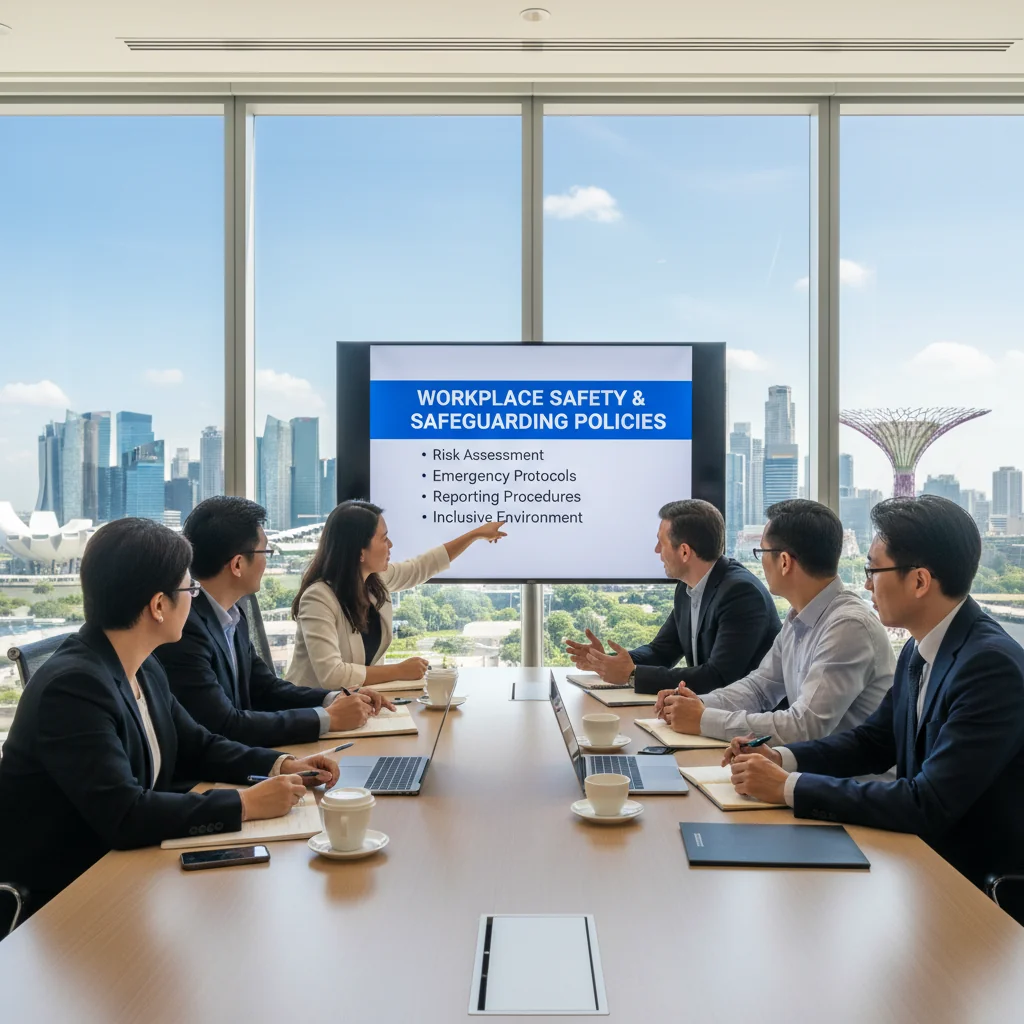
A photorealistic image representing safeguarding and protection in a professional Singaporean context, such as a diverse group of adults in a modern office or community center discussing safety protocols, with subtle Singaporean elements like city skyline in the background, emphasizing security and care without any depiction of children.
Explore the latest 2024 updates and changes to Singapore's safeguarding policy. Learn how these enhancements protect vulnerable groups and ensure compliance in workplaces and communities.