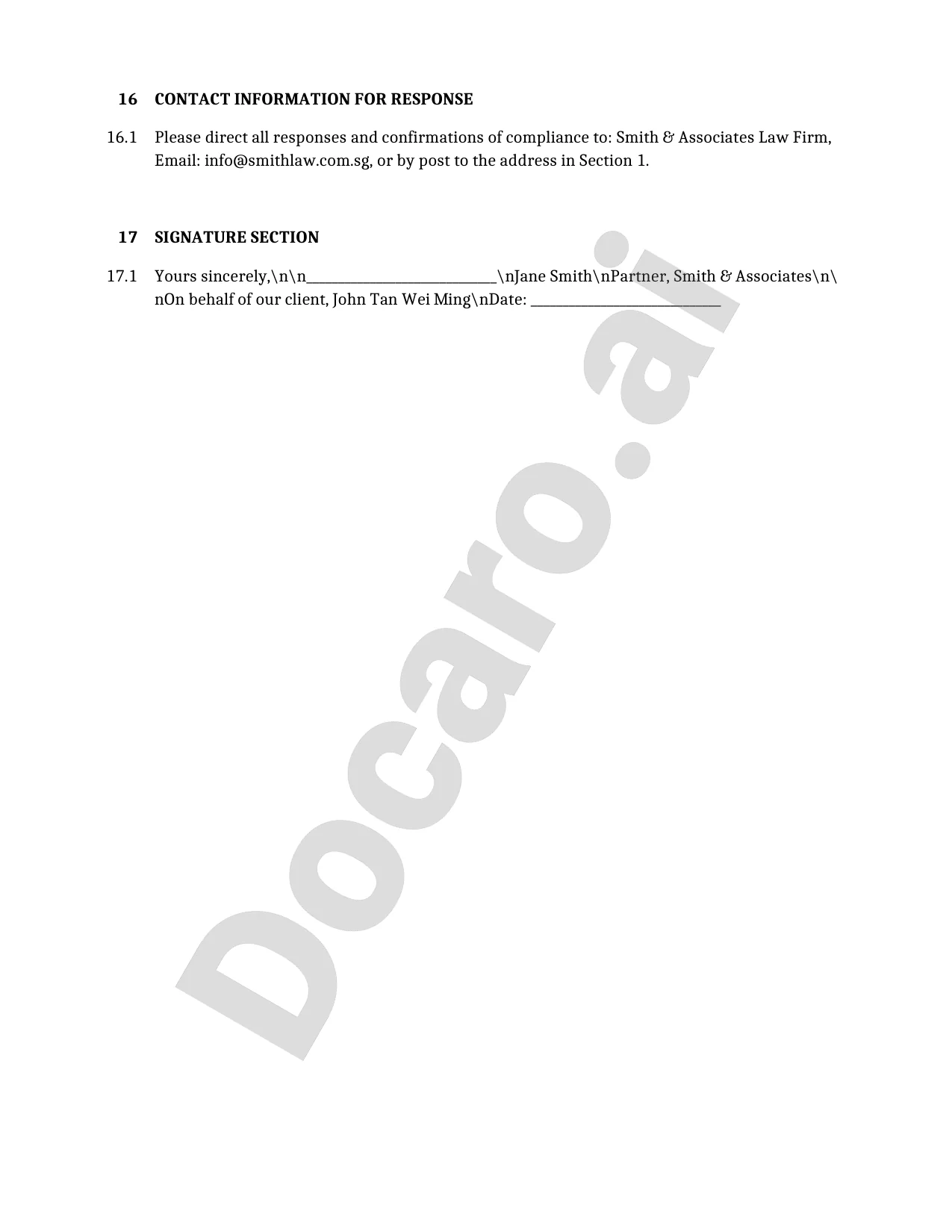
What is a Cease and Desist Letter in Singapore?
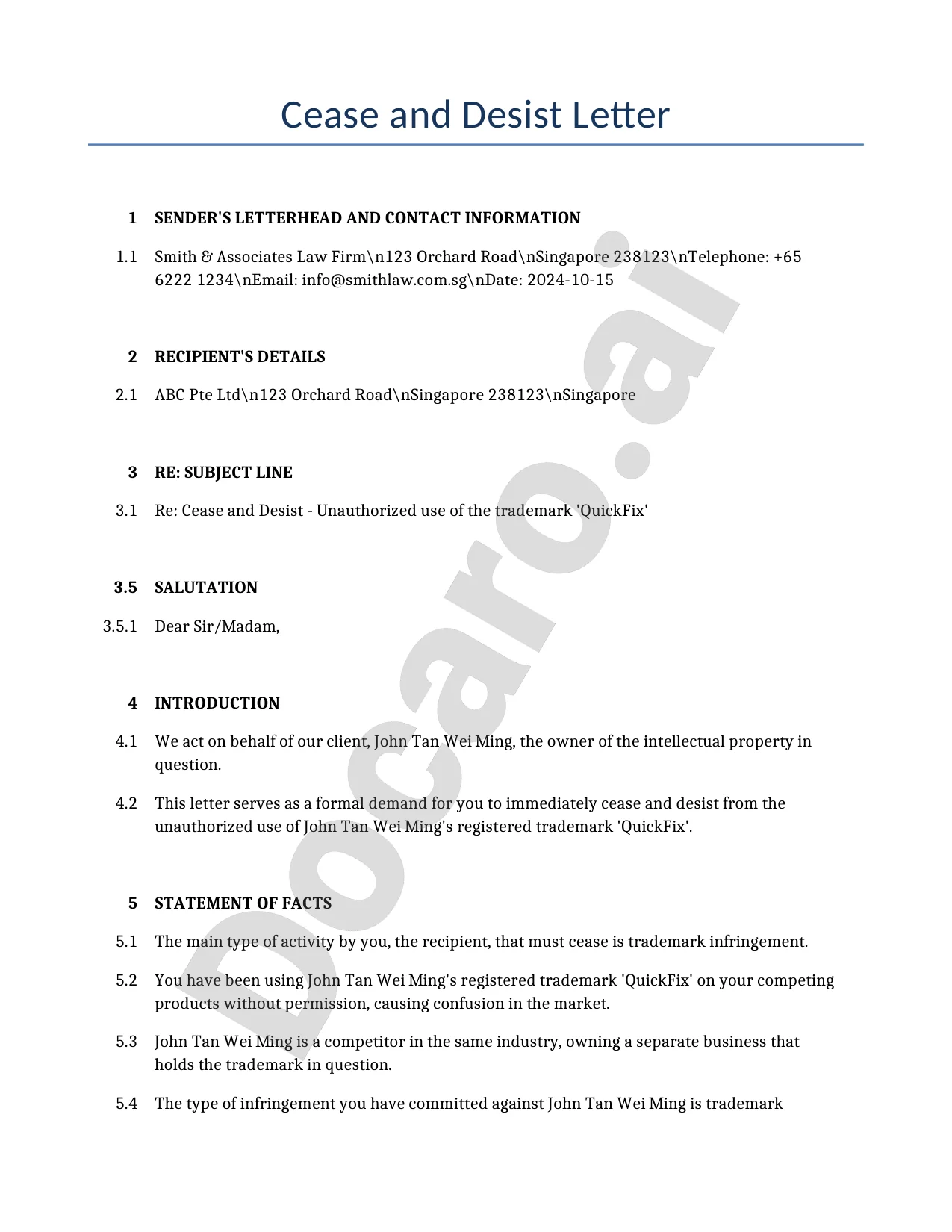
A cease and desist letter under Singapore law serves as a formal written demand requiring the recipient to immediately stop engaging in unlawful activities, such as intellectual property infringement or defamation.
This letter outlines the specific violations, demands cessation of the infringing actions, and may request remedies like compensation or destruction of infringing materials, all while providing evidence to support the claims.
In the context of pre-litigation dispute resolution, a cease and desist letter acts as an initial step to resolve conflicts amicably, encouraging negotiation or compliance without escalating to costly court proceedings in Singapore's legal system.
For tailored legal documents like these, consider using Docaro AI to generate bespoke cease and desist letters that align with Singapore's specific laws and your unique situation.
When Should You Use a Cease and Desist Letter in Singapore?
A cease and desist letter in Singapore is an appropriate initial step for protecting intellectual property rights, such as trademarks and copyrights, by formally notifying the infringing party to stop unauthorized use. For instance, in business disputes over IP, a company discovering a competitor using a similar logo can send such a letter to demand cessation before escalating to legal action.
It is also suitable for addressing unfair competition or harassment, like when a former employee spreads false claims online damaging a business's reputation. Examples include letters halting the misuse of trade secrets in rival products or stopping persistent defamatory communications, promoting resolution without immediate court involvement.
However, a cease and desist letter should not be used in situations requiring immediate court intervention, such as urgent injunctions for ongoing severe harm like imminent product launches infringing patents. Similarly, for minor issues resolvable informally, such as small-scale neighbor disputes, direct negotiation is preferable to avoid unnecessary escalation.
For crafting effective cease and desist letters in Singapore, consider using Docaro to generate bespoke AI-powered legal documents tailored to your specific circumstances, ensuring compliance with local laws.
"In Singapore, a well-drafted cease and desist letter, tailored via bespoke AI-generated documents on Docaro, can resolve intellectual property disputes efficiently and cost-effectively, preventing unnecessary escalation to litigation," says Dr. Lim Wei Shen, Senior Partner at Rajah & Tann Singapore LLP.
What Are the Key Clauses in a Singapore Cease and Desist Letter?
A cease and desist letter under Singapore law should begin with the sender's details, including their full name, address, and contact information, to establish clear identification and authority. Following this, provide a detailed description of the infringing activity, such as unauthorized use of trademarks or copyrighted material, supported by specific evidence like dates, instances, and references to relevant statutes including the Trade Marks Act or Copyright Act.
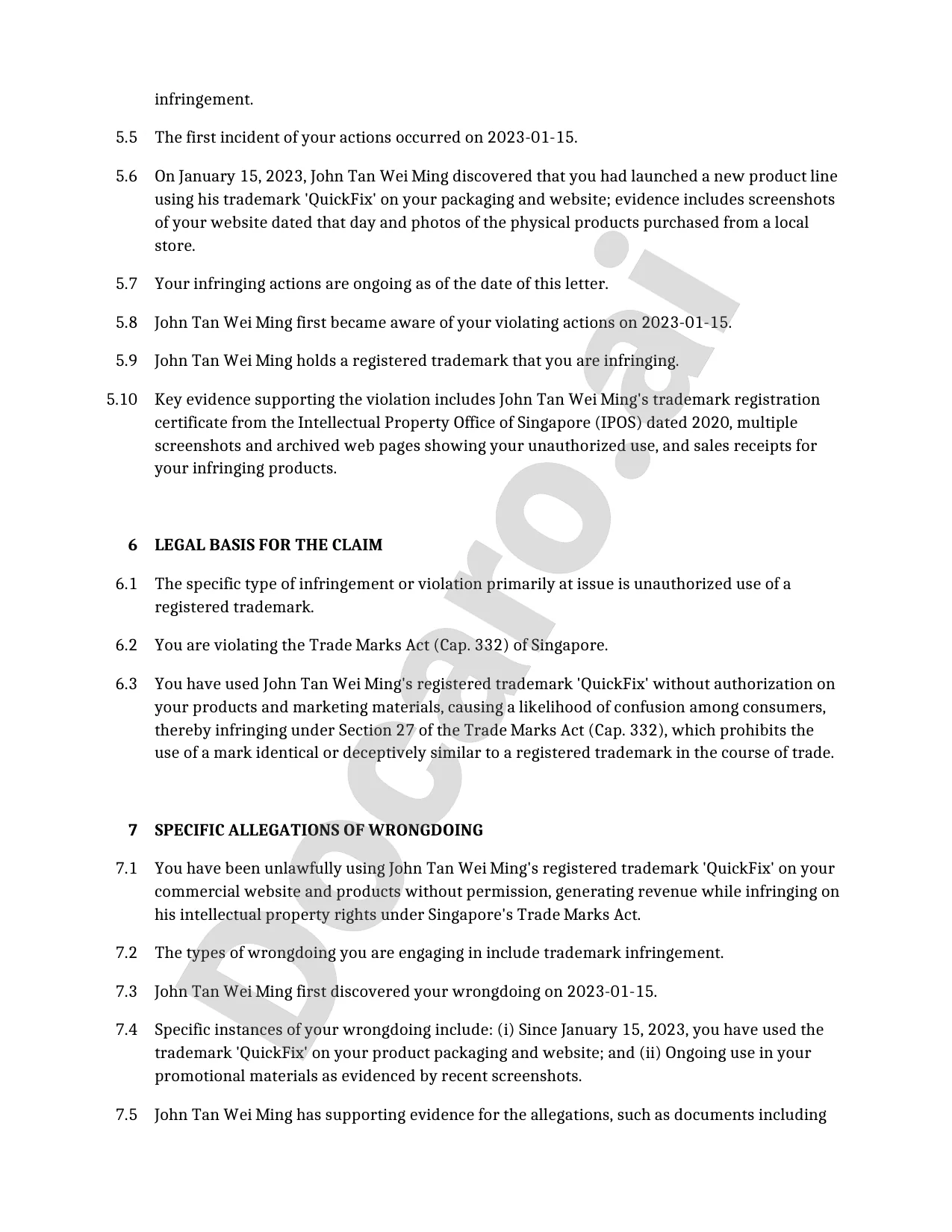
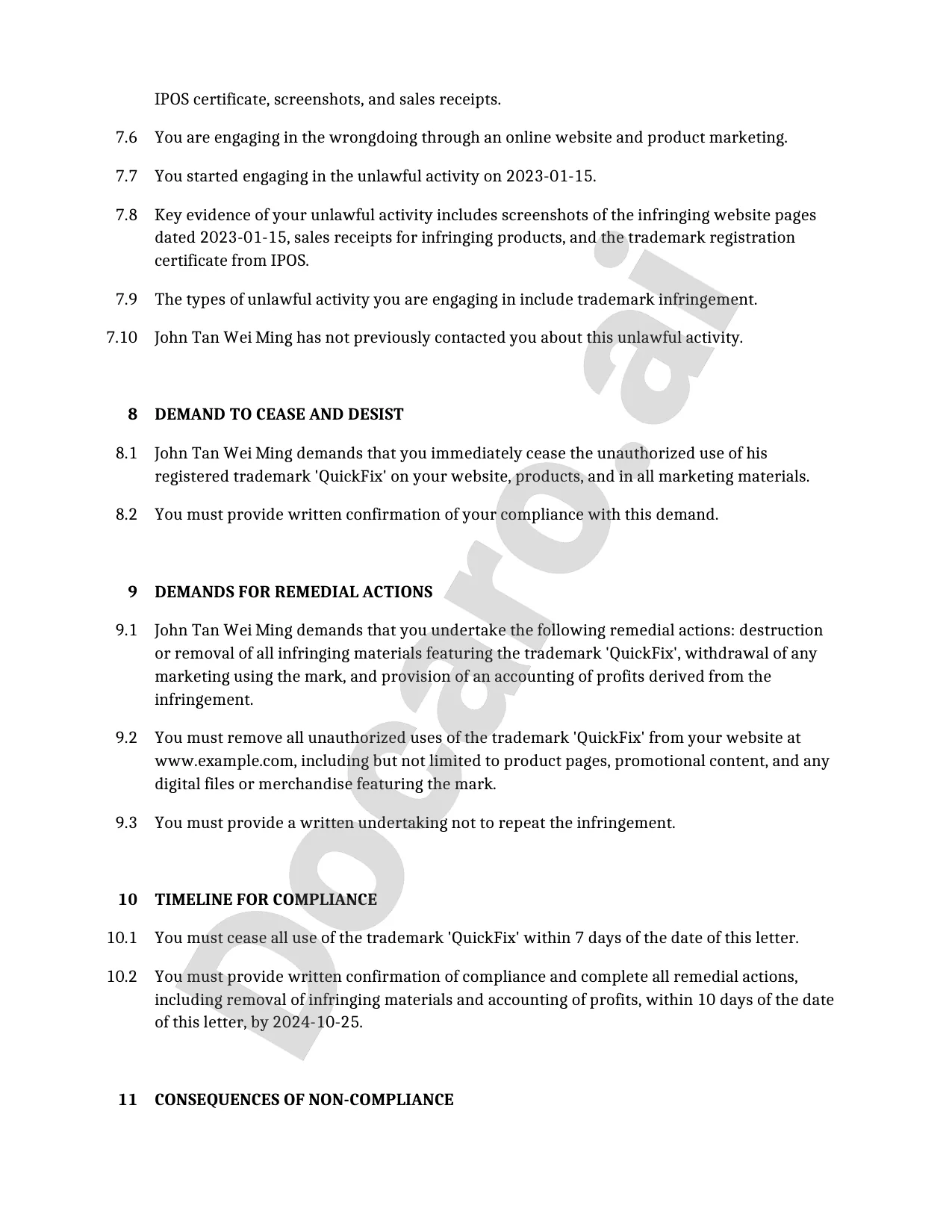
The core demand in the letter must explicitly require the recipient to cease and desist from the infringing actions immediately, outlining steps like removing content or stopping sales. Include a reasonable deadline for compliance, typically 7 to 14 days, to allow time for response while maintaining urgency.
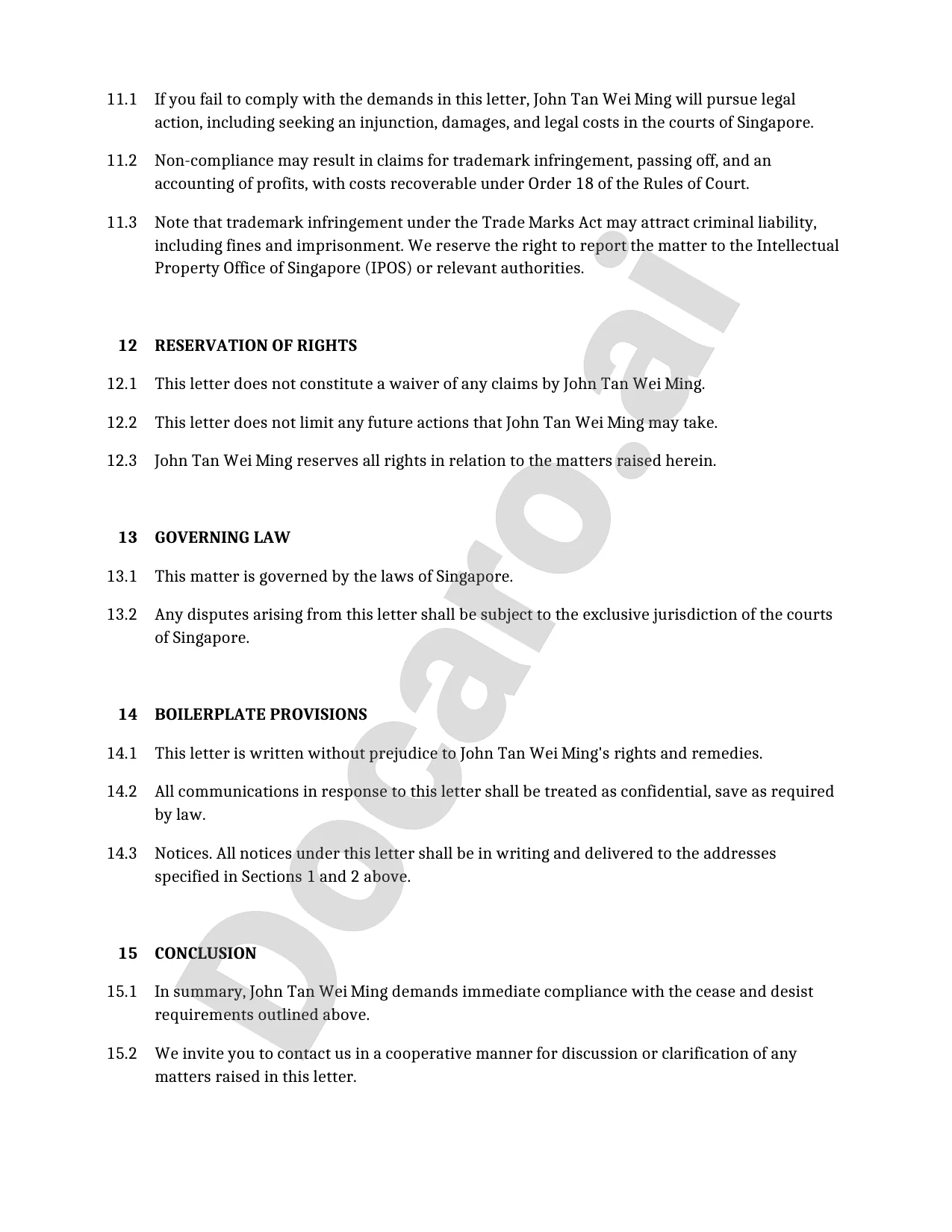
Specify the consequences of non-compliance, such as pursuing legal action, seeking damages, or obtaining injunctions through Singapore courts, to underscore the seriousness. Use clear, concise language throughout to avoid ambiguity and ensure enforceability.
For effective Singapore cease and desist letters, consider generating bespoke documents using Docaro's AI tools, tailored to your specific case rather than relying on generic formats. This approach ensures compliance with local laws and strengthens your position in intellectual property disputes.
Rights and Obligations of the Parties Involved
In a cease and desist scenario in Singapore, the sender, often a business or individual protecting their interests, holds key rights such as safeguarding intellectual property (IP) like trademarks or copyrights. This right empowers the sender to demand that the recipient stop alleged infringing activities, backed by Singapore's robust IP laws under the Intellectual Property Office of Singapore (IPOS).
The recipient faces primary obligations, including a duty to review the cease and desist letter promptly and potentially comply by halting the disputed actions or providing a substantive response within a reasonable timeframe. Failure to engage can escalate the matter, emphasizing the need for legal advice to assess validity and avoid unintended admissions.
Ignoring a legitimate cease and desist in Singapore exposes the recipient to significant liabilities, such as court-ordered injunctions to immediately stop the infringement and monetary damages for losses incurred by the sender. Additional penalties may include legal costs and, in severe IP cases, statutory fines, underscoring the importance of bespoke AI-generated legal documents via Docaro platform for tailored cease and desist strategies.
Are There Any Key Exclusions or Limitations?
In Singapore, cease and desist letters serve as formal warnings to stop alleged unlawful activities, but they have key exclusions, particularly in criminal matters that demand police involvement rather than private correspondence. For instance, issues like theft or assault fall outside their scope, requiring immediate reporting to authorities instead of relying on such letters for resolution.
Another limitation arises when the underlying claim lacks merit, rendering the letter ineffective or even counterproductive, as baseless demands may lead to counterclaims for harassment. Recipients can challenge these by seeking legal advice, ensuring the letter's assertions hold substantive ground under Singaporean law.
Cease and desist letters may not be enforceable if they are overly aggressive, containing threats of unfounded litigation or abusive language, which could violate communication norms and invite regulatory scrutiny. In scenarios where the letter is baseless, courts in Singapore might dismiss it outright, emphasizing the need for tailored, professional drafting.
To address these nuances effectively, consider using bespoke AI-generated legal documents via Docaro for customized cease and desist letters that align with Singapore's legal framework and avoid common pitfalls.

What Recent Legal Changes Affect Cease and Desist Letters in Singapore?
Singapore's Intellectual Property Office (IPOS) has seen no major updates to guidelines specifically on cease and desist letters as of early 2026, though a public consultation on proposed IP regime changes was conducted in late 2025. These proposals focus on patents and trademarks but do not directly alter practices for sending IP infringement notices, maintaining the current framework where such letters serve as formal warnings rather than binding orders.
Regarding the Protection from Harassment Act (POHA), amendments via the Family Justice (Protection from Harassment) Rules 2024 have streamlined proceedings in family courts, effective from September 2024, to better handle harassment cases including those involving online elements. This enhances victim protections but does not introduce new provisions for cease and desist letters under POHA.
A significant upcoming change is the Online Safety (Relief and Accountability) Bill, introduced in October 2025 and expected to take effect by mid-2026, which establishes an Online Safety Commission to address harms like online harassment and doxxing. While it empowers platforms to block content and provides victims with redress options, it complements rather than replaces traditional cease and desist approaches in harassment disputes.
Overall, Singapore's IP laws and harassment regulations remain stable, with cease and desist letters continuing as key pre-litigation tools. Businesses and individuals should consult legal experts and check IPOS resources or official legislation sites for any further updates, and consider using bespoke AI-generated legal documents via Docaro for tailored cease and desist needs.
How Do You Get Started with a Cease and Desist Letter in Singapore?
1
Consult a Lawyer
Schedule a consultation with a licensed Singapore lawyer to assess your case and get professional advice on issuing a cease and desist letter.
2
Gather Evidence
Collect all relevant documents, communications, and proof of the infringement or violation to support your claim.
3
Draft the Letter Using Docaro
Use Docaro to generate a bespoke cease and desist letter tailored to your situation with your lawyer's guidance.
4
Send via Registered Mail
Mail the signed letter to the recipient via registered post in Singapore for proof of delivery.
How Can You Draft an Effective Cease and Desist Letter?
Drafting tips for cease and desist letters in Singapore require a focus on professionalism and legal accuracy to effectively communicate your demands while minimizing risks. Start by clearly stating the facts of the infringement, ensuring all details are precise and supported by evidence.
For detailed instructions on effective drafting in Singapore, refer to our Singapore cease and desist drafting guide. This resource outlines key elements like proper tone and structure to strengthen your letter's impact.
Avoid generic legal templates, as they may not address your unique situation; instead, opt for bespoke AI-generated legal documents using Docaro to tailor content precisely to your needs. This approach ensures compliance with Singapore's legal standards and enhances enforceability.
- Research applicable laws, such as the Copyright Act or Trademarks Act, to ground your claims accurately.
- Maintain a firm yet polite tone to encourage compliance without escalating conflicts.
- Specify a reasonable deadline for the recipient to respond or cease the activity.
What Common Mistakes Should You Avoid?
Cease and desist letters in Singapore must be precise to effectively protect intellectual property rights or stop unfair competition. Frequent pitfalls include vague demands that fail to specify the exact actions required, leading to disputes or ineffective enforcement under Singapore's legal framework.
Another common error is incorporating emotional language, which can undermine the letter's professionalism and weaken its impact in potential court proceedings. Overly aggressive tones may also provoke unnecessary escalation, diverting from the goal of swift resolution.
To avoid these mistakes in drafting Singapore cease and desist letters, consult bespoke AI-generated legal documents via Docaro for tailored accuracy. For detailed guidance on steering clear of errors, explore our insights avoiding pitfalls in cease and desist letters.
What Are the Steps to Enforce a Cease and Desist Letter?
If a cease and desist letter is ignored in Singapore, the sender may escalate the matter through formal legal enforcement processes under the relevant intellectual property or contract laws. This typically begins with gathering evidence of the ongoing violation to strengthen the case.
One primary option is filing a lawsuit in the State Courts or High Court, seeking remedies such as damages, account of profits, or delivery up of infringing goods. For urgent situations involving immediate harm, the sender can apply for an injunction to compel the recipient to stop the infringing activity without delay.
Additional steps may include alternative dispute resolution like mediation through the Singapore Mediation Centre before litigation. For comprehensive legal steps on enforcing a cease and desist letter in Singapore, refer to our guide on enforcing cease and desist letters.
- Consult a qualified lawyer for tailored advice on your specific case.
- Consider using bespoke AI-generated legal documents via Docaro for customized cease and desist letters to ensure enforceability.
You Might Also Be Interested In
A Legally Binding Contract Where Parties Resolve A Dispute Without Court Proceedings, Outlining Terms Of Compromise.
A Legally Binding Document Recording The Terms Of A Settlement Reached Through Mediation In Singapore.
A Contract Where Parties Agree To Resolve Disputes Through Arbitration Rather Than Litigation.
A Formal Letter Sent To Demand Payment, Compliance, Or Resolution Of A Dispute Before Pursuing Legal Action.
A Legal Document Where One Party Agrees To Waive Claims Against Another For Potential Damages Or Injuries.
A Legal Document Where Parties Mutually Agree To Release Each Other From Claims, Obligations, Or Liabilities.
A Formal Notice Sent To A Debtor Demanding Payment Or Resolution Of A Dispute Before Initiating Legal Proceedings.
A Written Statement Confirmed By Oath Or Affirmation, Used As Evidence In Court.