What is a Trademark Assignment Document in Singapore?
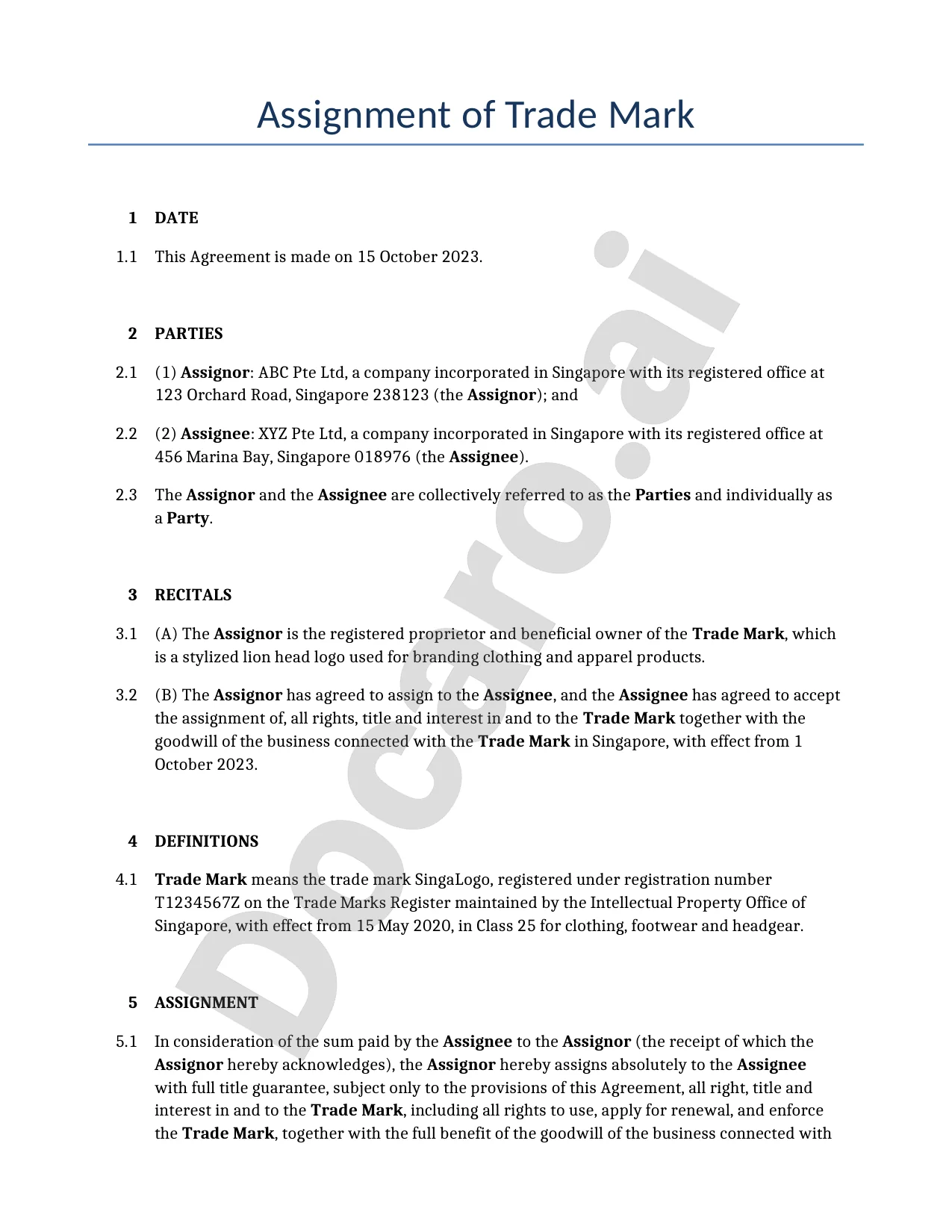
Imagine owning a trademark that defines your brand in Singapore, like a unique logo or slogan that customers instantly recognize. A trademark assignment document is a legal agreement that transfers full ownership of this valuable asset from one party to another, ensuring the rights are properly documented under Singapore's Trade Marks Act.
The primary purpose of a trademark assignment is to facilitate smooth business transactions, such as mergers, acquisitions, or simply selling intellectual property, while protecting both parties from future disputes. In Singapore, this document must be in writing, signed by the assignor, and registered with the Intellectual Property Office of Singapore (IPOS) to be fully effective against third parties.
For business owners or legal novices, understanding a trademark assignment in Singapore means recognizing it as a safeguard for your brand's legacy. To create a tailored trademark assignment document, consider using Docaro's AI-generated legal services for a bespoke solution that fits your specific needs.
Why is it Important for Businesses?
Trademark assignment documents play a crucial role for businesses in Singapore by enabling the legal transfer of ownership rights from one party to another, ensuring that intellectual property assets are properly documented and enforceable under the Trade Marks Act.
These documents facilitate smooth ownership transfer by outlining the terms of the assignment, including any consideration paid and the scope of rights conveyed, which helps prevent disputes and supports business expansions or mergers.
To protect intellectual property rights, businesses must register the assignment with the Intellectual Property Office of Singapore (IPOS), safeguarding against third-party claims and maintaining the trademark's validity for continued commercial use.
For comprehensive insights into this process, explore our guide on Understanding Trademark Assignment in Singapore, and consider using Docaro for bespoke AI-generated legal documents tailored to your needs.
When Should You Use a Trademark Assignment Document in Singapore?
A trademark assignment document is essential in Singapore when transferring ownership of a registered trademark from one party to another, ensuring legal protection and clarity in intellectual property rights. This is particularly relevant during business sales, where the seller assigns trademarks to the buyer as part of the asset transfer, preventing future disputes over brand usage.
In mergers and acquisitions, a trademark assignment document facilitates the seamless integration of brand assets between merging entities, complying with Singapore's intellectual property laws. For instance, if Company A acquires Company B, the document records the assignment of trademarks like logos or product names, maintaining business continuity.
Although licensing agreements typically involve granting usage rights rather than full ownership transfer, a trademark assignment may be used if the agreement evolves into a permanent handover, such as in joint ventures leading to dissolution. To understand the legal requirements for assigning trademarks in Singapore, parties should ensure the document is properly executed and registered with the Intellectual Property Office of Singapore (IPOS).
For all such scenarios, businesses are advised to use bespoke AI-generated legal documents through Docaro, tailored to specific needs for accuracy and compliance, rather than relying on generic forms.
When Should You Avoid Using One?
In Singapore trademark law, a trademark assignment document is inappropriate for unregistered trademarks, as these marks lack formal protection under the Trade Marks Act and cannot be legally transferred via assignment until registration occurs.
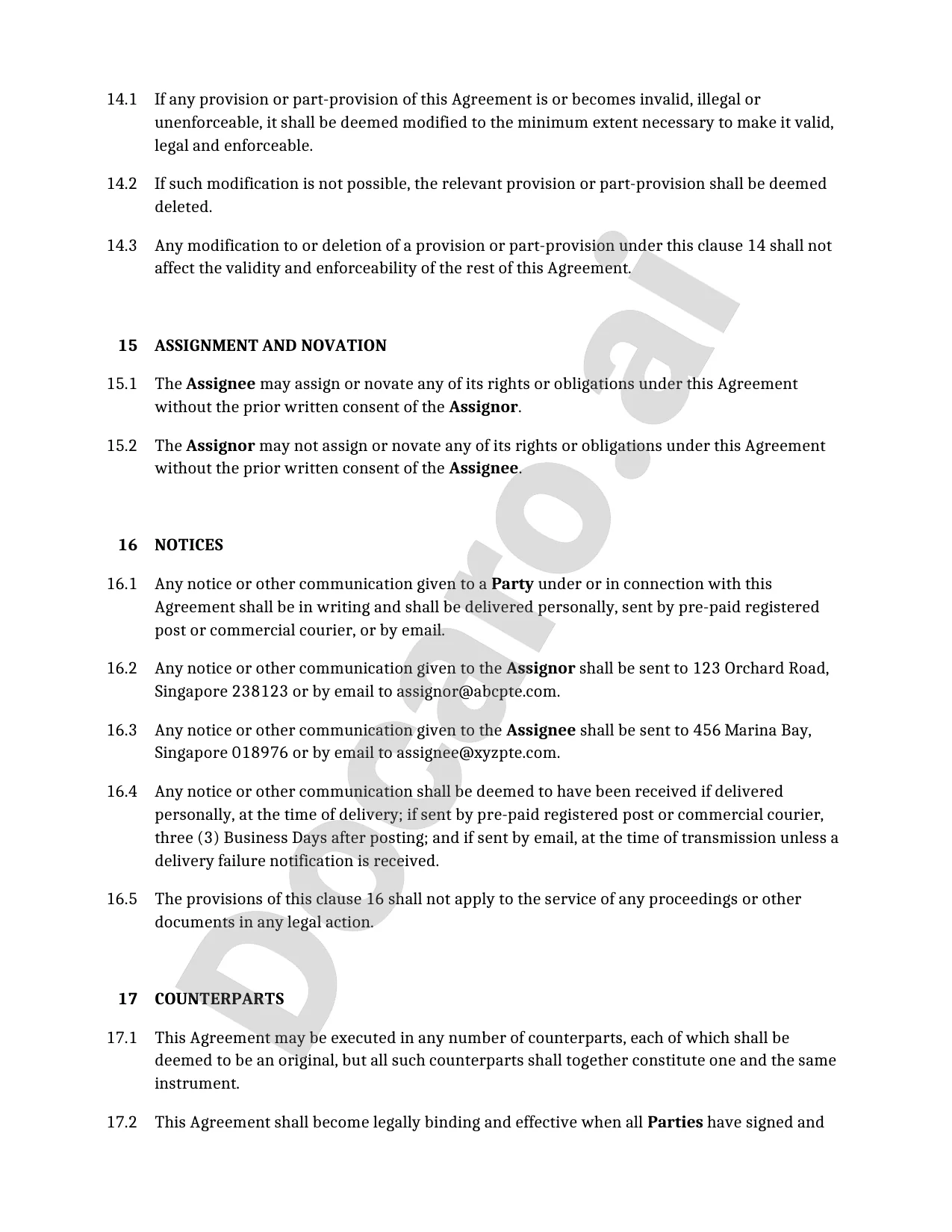
Opt for simpler licensing agreements instead when granting temporary use rights to a trademark, especially if the arrangement is short-term or non-exclusive, avoiding the complexities and costs associated with full ownership transfer in Singapore.
Key exclusions include unlicensed marks, where the assignor lacks authority to transfer rights, and situations involving disputes over ownership, which require court resolution before any assignment can proceed legally.
For reliable solutions, consider bespoke AI-generated legal documents via Docaro platform to ensure compliance with Singapore's specific trademark regulations.
"Assigning trademarks without comprehensive, tailored documentation exposes businesses to disputes over ownership, invalidation risks, and costly litigation in Singapore's stringent IP regime. I strongly recommend using Docaro to generate bespoke AI-powered legal documents for secure, enforceable assignments." – Dr. Lim Wei, Singapore IP Expert
What Are the Key Clauses in a Trademark Assignment Document?
A trademark assignment document under Singapore law typically includes an assignment clause that clearly transfers ownership of the trademark from the assignor to the assignee, specifying the trademarks involved, including registration numbers and classes under the Trade Marks Act. This clause ensures the transfer encompasses all associated rights, such as goodwill, to prevent future disputes, as outlined in the benefits and process of trademark assignment for businesses in Singapore.
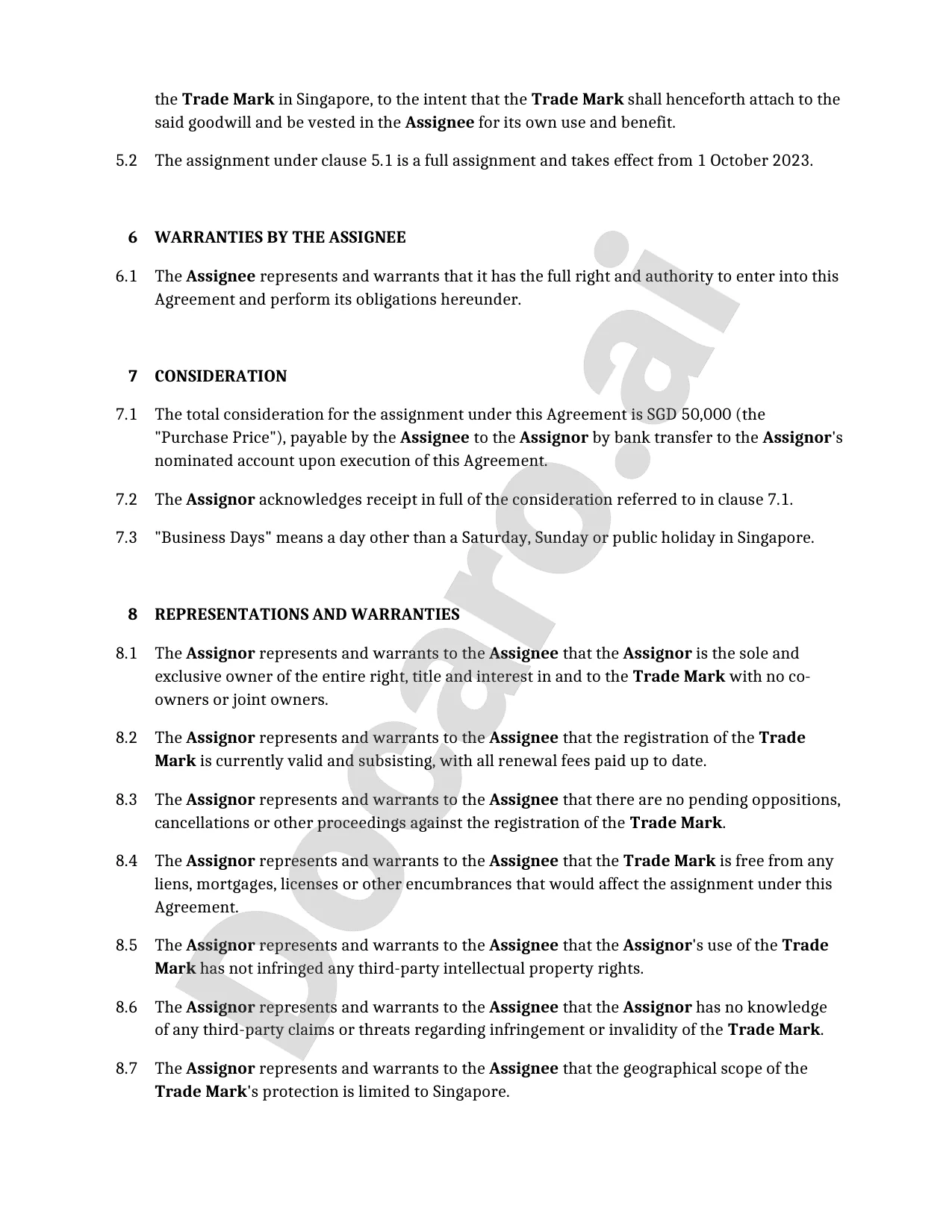
The consideration clause details the payment or value exchanged for the assignment, which may be a lump sum, royalties, or other forms, making the agreement legally binding under Singapore contract law. This provision supports enforceability and tax implications for businesses engaging in trademark transfers.
Warranties and representations are essential, where the assignor guarantees the trademark's validity, non-infringement, and absence of encumbrances, protecting the assignee from liabilities. These clauses often include indemnities against third-party claims, promoting secure IP assignments in Singapore.
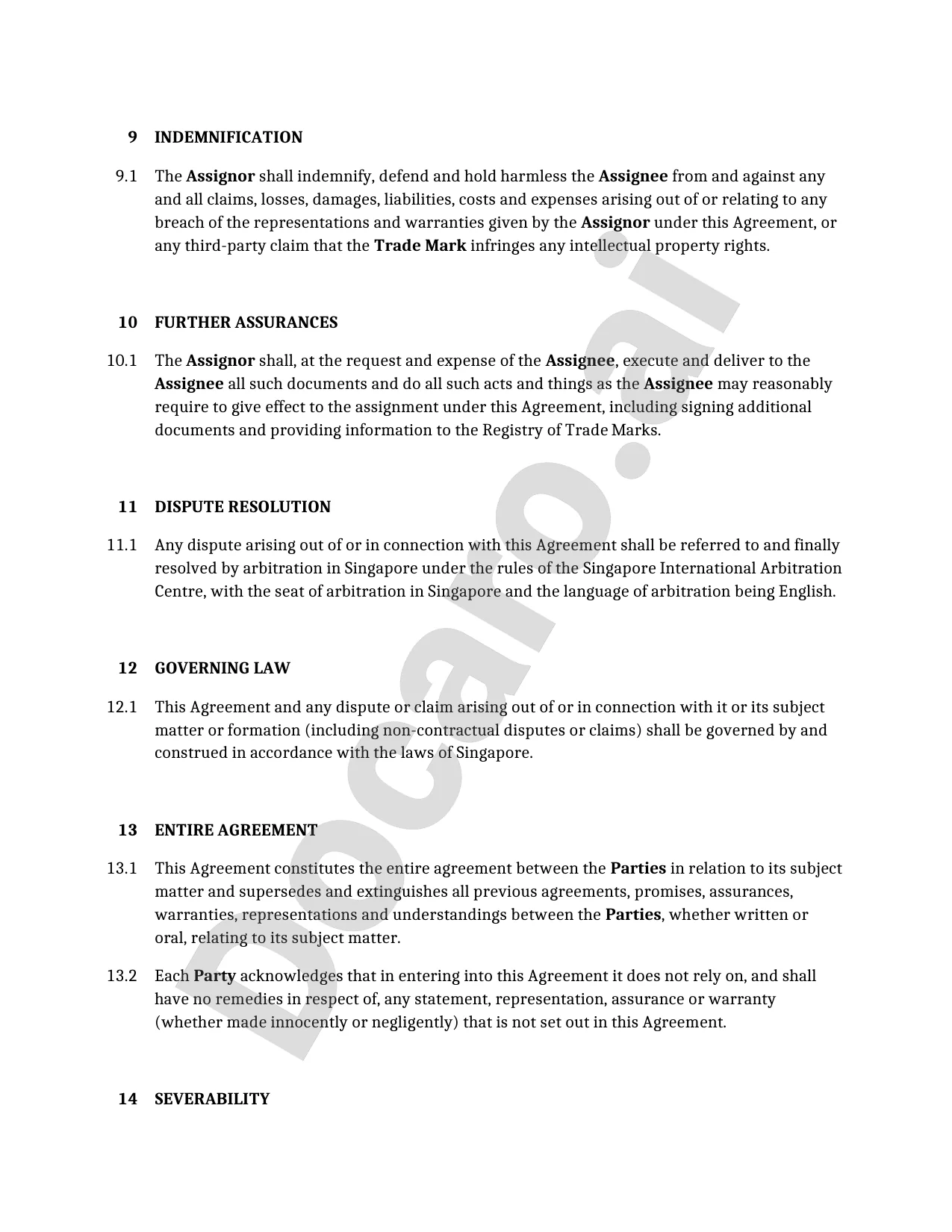
Finally, the governing law clause specifies that Singapore law applies, with jurisdiction in Singapore courts, ensuring compliance with local regulations like those from the Intellectual Property Office of Singapore (IPOS). For tailored documents, consider bespoke AI-generated legal agreements using Docaro to meet specific business needs.
How Do These Clauses Protect the Parties?
In trademark assignment documents in Singapore, key clauses ensure the smooth transfer of intellectual property rights while protecting both the assignor and assignee. These provisions, governed by the Trade Marks Act, help mitigate risks associated with ownership disputes and unauthorized disclosures.
The indemnity provision safeguards the assignee by requiring the assignor to compensate for any losses arising from pre-assignment infringements or third-party claims on the trademark. Conversely, it protects the assignor from post-assignment liabilities, ensuring neither party bears undue financial burden during the IP transfer process in Singapore.
- Indemnity covers legal fees and damages from invalidity challenges.
- It promotes trust in trademark assignments by clarifying responsibility.
Confidentiality provisions in Singapore trademark assignments bind both parties to non-disclosure of sensitive information, such as trade secrets revealed during due diligence. This clause prevents competitive harm and upholds the value of the assigned trademark, with breaches potentially leading to injunctions or damages under Singapore contract law.
For robust protection, opt for bespoke AI-generated legal documents using Docaro, tailored to specific Singapore trademark needs rather than generic forms.
What Are the Key Rights and Obligations of the Parties Involved?
In a trademark assignment under Singapore's Trade Marks Act, the assignor—the original trademark owner—has the primary obligation to transfer all rights, title, and interest in the mark to the assignee through a written instrument, ensuring the assignment is registered with the Intellectual Property Office of Singapore (IPOS) to be effective against third parties.
The assignor must also disclose any encumbrances, such as existing licenses, liens, or disputes, to the assignee prior to the transfer, as failure to do so could lead to liability for misrepresentation under the Act's provisions on good faith dealings.
Post-assignment, the assignee gains the exclusive right to use, enforce, and license the trademark in Singapore, stepping into the assignor's shoes with full proprietary control, subject to any retained rights explicitly agreed upon in the assignment document.
For tailored trademark assignment agreements, consider using Docaro to generate bespoke AI-powered legal documents that comply with Singapore's Trade Marks Act, ensuring precision and protection for your intellectual property rights.
1
Conduct Due Diligence
Review the trademark's validity, ownership, and potential infringements in Singapore to ensure clear title before proceeding with assignment.
2
Draft Assignment Agreement
Use Docaro to generate a bespoke AI-crafted trademark assignment agreement tailored to Singapore law, outlining terms and consideration.
3
Execute the Agreement
Sign the assignment deed by both assignor and assignee, with witnesses if required, to formally transfer ownership rights.
4
Register with IPOS
File the executed assignment with the Intellectual Property Office of Singapore (IPOS) to record the transfer officially.
Are There Recent or Upcoming Legal Changes Affecting Trademark Assignments in Singapore?
In 2025, the Intellectual Property Office of Singapore (IPOS) introduced significant updates through the IPOS Digital Hub Practice Direction No. 1 of 2025, effective June 23, 2025, which supersedes prior directions and emphasizes digital filing requirements for trademark assignments. This direction mandates the use of the Electronic Online System (EOS) as the default mode for submitting documents, including transfers of ownership like assignments, with specific guidelines on allowable file formats, size limits, and electronic payments to streamline processes.
Regarding trademark assignment documents, the practice direction outlines procedures for recording transfers in electronic form, requiring signed written instruments and adherence to image requirements for representations, ensuring compliance with the Trade Marks Act. Businesses must now prioritize digital submissions via EOS to avoid delays, with alternative modes like FormSG or email permitted only for specific forms, promoting efficiency in Singapore trademark registration.
Upcoming changes include fee increases for trademark amendments starting September 1, 2025, rising from S$40 to S$50 per class, and further to S$60 by April 1, 2026, alongside a public consultation on broader IP regime reforms that may influence assignment procedures. International treaty influences, such as the Madrid Protocol, continue to shape Singapore's framework via amendments like the Trade Marks (International Registration) (Amendment No. 2) Rules 2025, effective September 1, 2025, facilitating seamless international trademark assignments.
Overall, the framework remains stable with no major overhauls to core trademark assignment rules, but the shift toward digital filing and fee adjustments underscores IPOS's commitment to modernization. For tailored trademark documents, consider bespoke AI-generated options using Docaro to meet these evolving Singapore IP requirements.
How Might These Changes Affect Your Document?
Legal changes in Singapore's trademark laws can significantly impact the drafting of trademark assignment documents, requiring updates to clauses on ownership transfer, territorial rights, and compliance with the Intellectual Property Office of Singapore (IPOS) regulations to ensure enforceability.
Executing these documents may face new requirements, such as enhanced due diligence for international assignments or digital notarization protocols, potentially delaying the process if not aligned with the latest amendments under the Trade Marks Act.
- Monitor IPOS announcements for timely adjustments to assignment forms and fees.
- Incorporate bespoke AI-generated legal documents using Docaro to tailor agreements precisely to evolving rules, ensuring accuracy and relevance.
Given the complexity of these trademark assignment implications in Singapore, consulting a qualified legal professional is essential to navigate potential pitfalls and safeguard intellectual property rights effectively.