Docaro

AI Generated Singaporean Cookie Policy
PDF & Word - 2026 Updated

A photorealistic image representing data privacy and cookie consent in a digital context, showing a diverse group of adults in a modern Singapore office setting, interacting with computers and smartphones while ensuring secure online browsing, evoking trust and compliance without displaying any legal documents.
Generate a compliant Singaporean cookie policy with our AI tool, ensuring your website adheres to PDPC guidelines and enhances user privacy while optimizing for search engines.
Free instant document creation.
Compliant with Singapore law.
No sign up or monthly subscription.

Docaro Pricing

Basic
Free
Document Generation
No Sign Up
No Subscription
Download Watermarked PDF
Premium
$4.99 USD
Document Generation
No Sign Up
No Subscription
Download Clean PDF
Download Microsoft Word
Download HTML
Download Text
Email Document
Generate your document for free. Only pay if you like the result and need an un-watermarked version.

When do you need a Cookie Policy in Singapore?

  • If your website uses cookies
    You need a cookie policy to inform visitors about the small data files your site uses to remember their preferences and improve their experience.
  • When collecting user data online
    A cookie policy explains how your site gathers and uses information from visitors, helping them understand what data is being tracked.
  • To meet Singapore's data rules
    Singapore's Personal Data Protection Act requires clear notices about data collection, and a cookie policy ensures your site complies with these guidelines.
  • For any commercial website
    Even basic business sites that use analytics or ads need this policy to build trust and avoid potential fines for not disclosing data practices.
  • Why a well-drafted policy matters
    A clear and proper cookie policy protects your business by showing transparency, reducing legal risks, and encouraging user confidence in your site.

Singaporean Legal Rules for a Cookie Policy

  • Personal Data Protection Act (PDPA)
    Singapore's main law requires you to get user consent before collecting personal data through cookies and to inform them about what data is collected and why.
  • Clear User Consent
    You must ask for and get active agreement from users before placing non-essential cookies on their devices.
  • Transparency in Information
    Your cookie policy needs to explain simply what cookies are used for, what data they collect, and how users can manage or delete them.
  • Essential vs. Non-Essential Cookies
    Essential cookies for basic site functions don't need consent, but others like those for ads or tracking do.
  • User Control Options
    Provide easy ways for users to accept, reject, or change cookie preferences at any time.
  • Data Security Requirements
    Ensure cookie data is kept secure to prevent unauthorized access or breaches.
  • Compliance with Guidelines
    Follow advice from Singapore's Personal Data Protection Commission (PDPC) to keep your policy up to date and effective.
Important

Failing to incorporate mandatory PDPA compliance elements in a cookie policy can expose your website to regulatory fines and legal challenges in Singapore.

What a Proper Cookie Policy Should Include

  • Introduction to Cookies
    Explain what cookies are and how your website uses them to improve user experience.
  • Types of Cookies Used
    List the different kinds of cookies on your site, such as essential, performance, and marketing cookies.
  • Purpose of Each Cookie
    Describe why each type of cookie is needed, like remembering user preferences or analyzing site traffic.
  • Data Collection Details
    Outline what personal information cookies gather and how it's handled for privacy.
  • User Consent Options
    Detail how users can accept or reject non-essential cookies through clear settings.
  • Cookie Management Instructions
    Provide simple steps for users to control, disable, or delete cookies on their devices.
  • Third-Party Cookie Info
    Disclose any cookies from external services like analytics tools or ads, and their purposes.
  • Data Sharing Practices
    Explain if and how cookie data is shared with third parties while protecting user privacy.
  • Security Measures
    Assure users that cookie data is kept secure against unauthorized access.
  • Policy Updates Notice
    Inform users how they will be notified of changes to the cookie policy.

Why Free Templates Can Be Risky for Cookie Policy

Generic cookie policy templates often fail to address Singapore's specific data protection laws under the PDPA, using outdated or overly broad language that may not comply with consent requirements, leading to non-compliance fines, legal disputes, or loss of user trust.

AI-generated bespoke cookie policies are tailored to your website's unique features and Singapore's regulations, ensuring precise, up-to-date wording that accurately describes cookie usage, enhances compliance, and builds user confidence.

Generate Your Bespoke Cookie Policy in 4 Easy Steps

1
Answer a Few Questions
Our AI guides you through the info required.
2
Generate Your Document
Docaro builds a bespoke document tailored specifically on your requirements.
3
Review & Edit
Review your document and submit any further requested changes.
4
Download & Sign
Download your ready to sign document as a PDF, Microsoft Word, Txt or HTML.

Why Use Our AI Cookie Policy Generator?

Fast Generation
Quickly generate a comprehensive Cookie Policy, eliminating the hassle and time associated with traditional document drafting.
Guided Process
Our user-friendly platform guides you step by step through each section of the document, providing context and guidance to ensure you provide all the necessary information for a complete and accurate Cookie Policy.
Safer Than Legal Templates
We never use legal templates. All documents are generated from first principles clause by clause, ensuring that your document is bespoke and tailored specifically to the information you provide. This results in a much safer and more accurate document than any legal template could provide.
Professionally Formatted
Your Cookie Policy will be formatted to professional standards, including headings, clause numbers and structured layout. No further editing is required. Download your document in PDF, Microsoft Word, TXT or HTML.
Compliance with Singaporean Law
Rest assured that all generated documents meet the latest legal standards and regulations of Singapore, enhancing trust and reliability.
Cost-Effective
Save money by generating legally sound Cookie Policy without the need for expensive legal services or consultations.
Get Started for Free - No Sign Up or Monthly Subscription Required
No payment or sign up is required to start generating your Cookie Policy. Generate and download a watermarked version of your document for free. Pay only if you want to remove the watermark and gain full access to your document. No monthly subscriptions or hidden fees. Pay once and use your document forever.
Need to Generate a Cookie Policy in a Different Country?
Choose country:

Free Example Cookie Policy Template

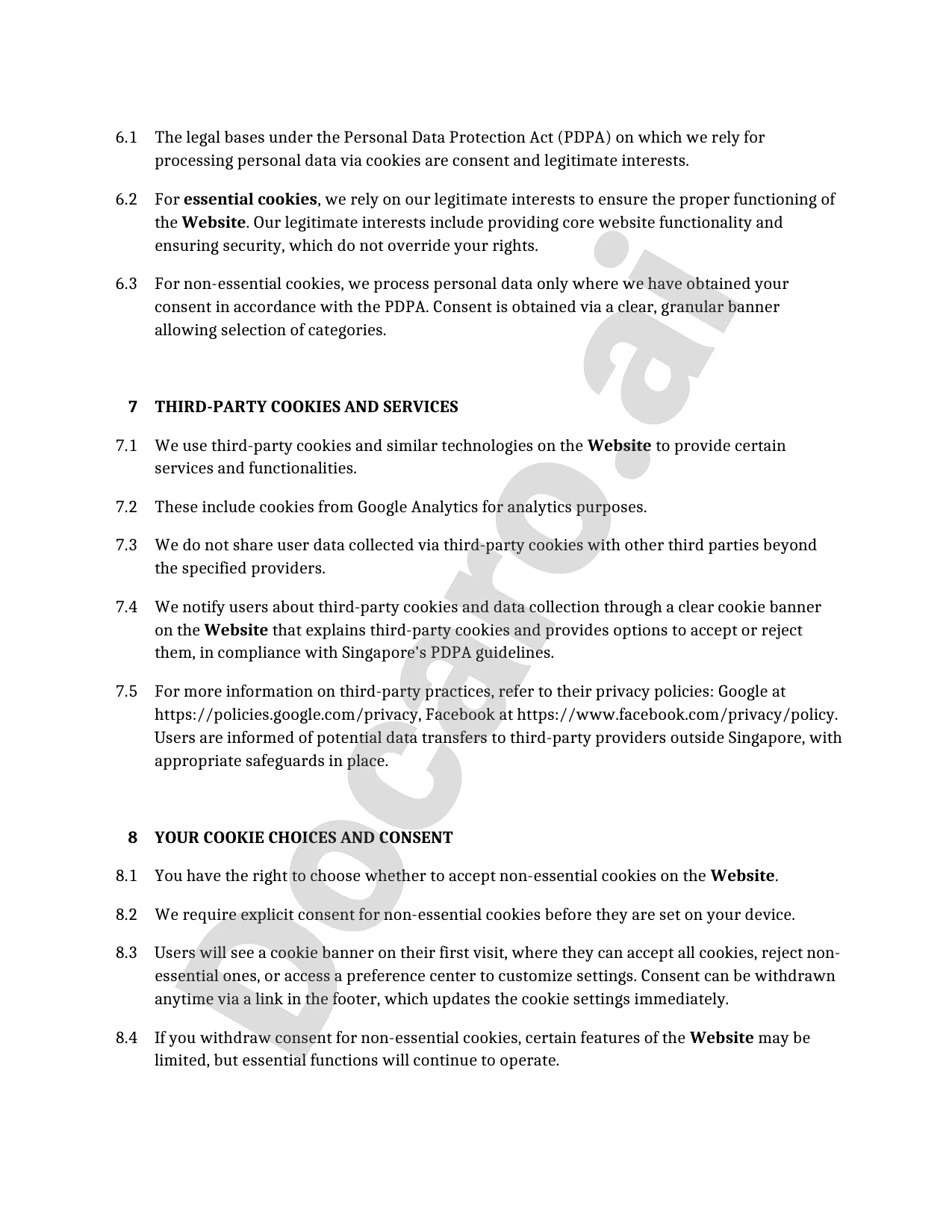
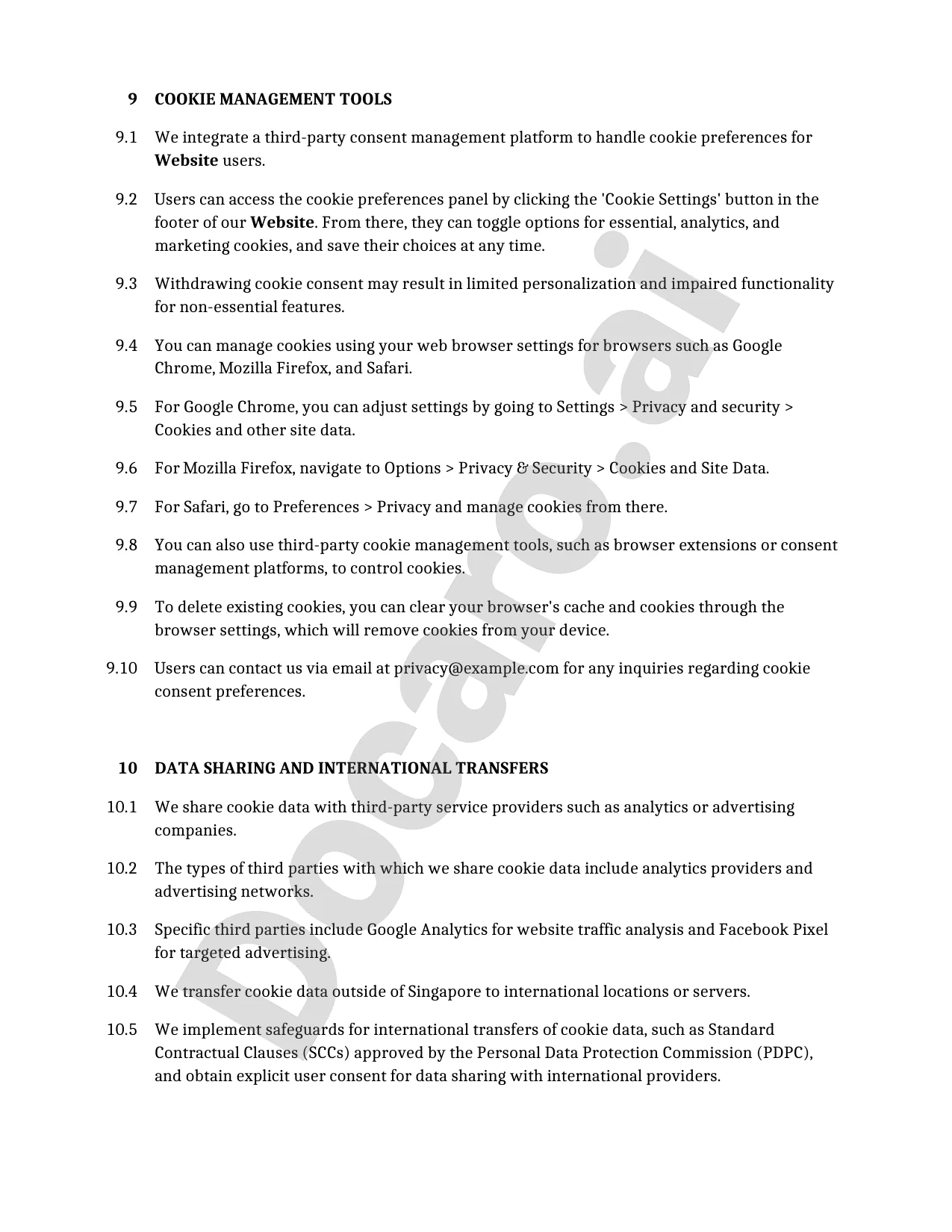
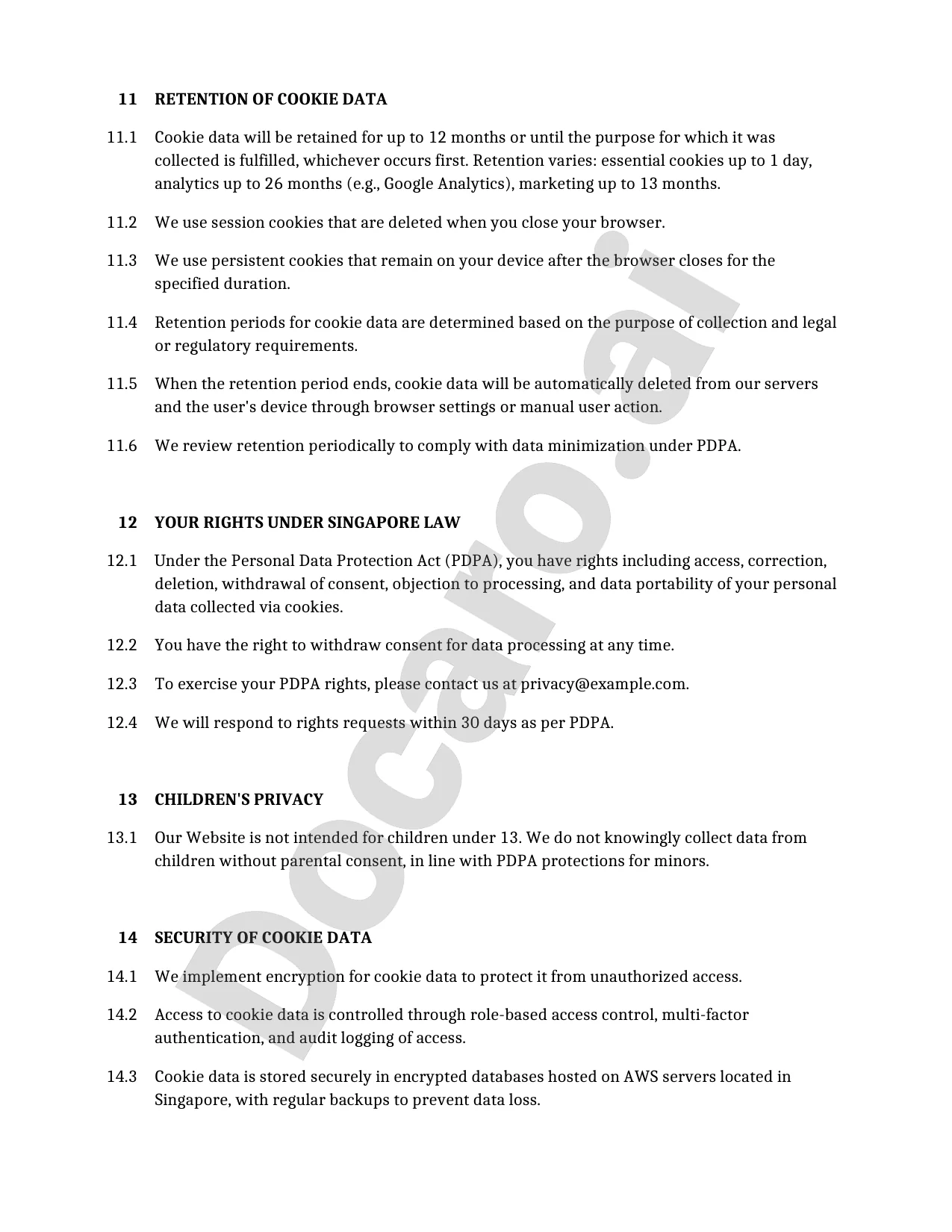
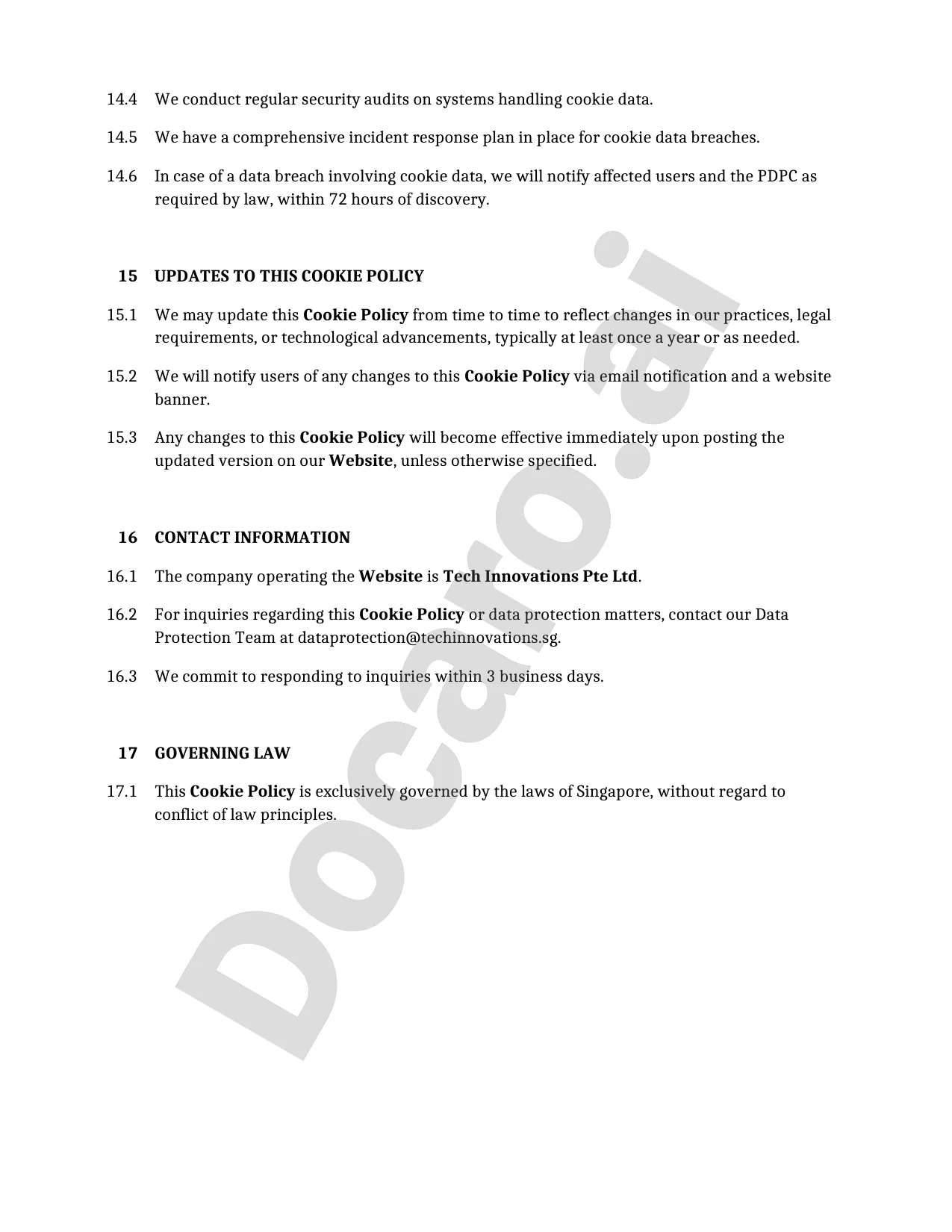
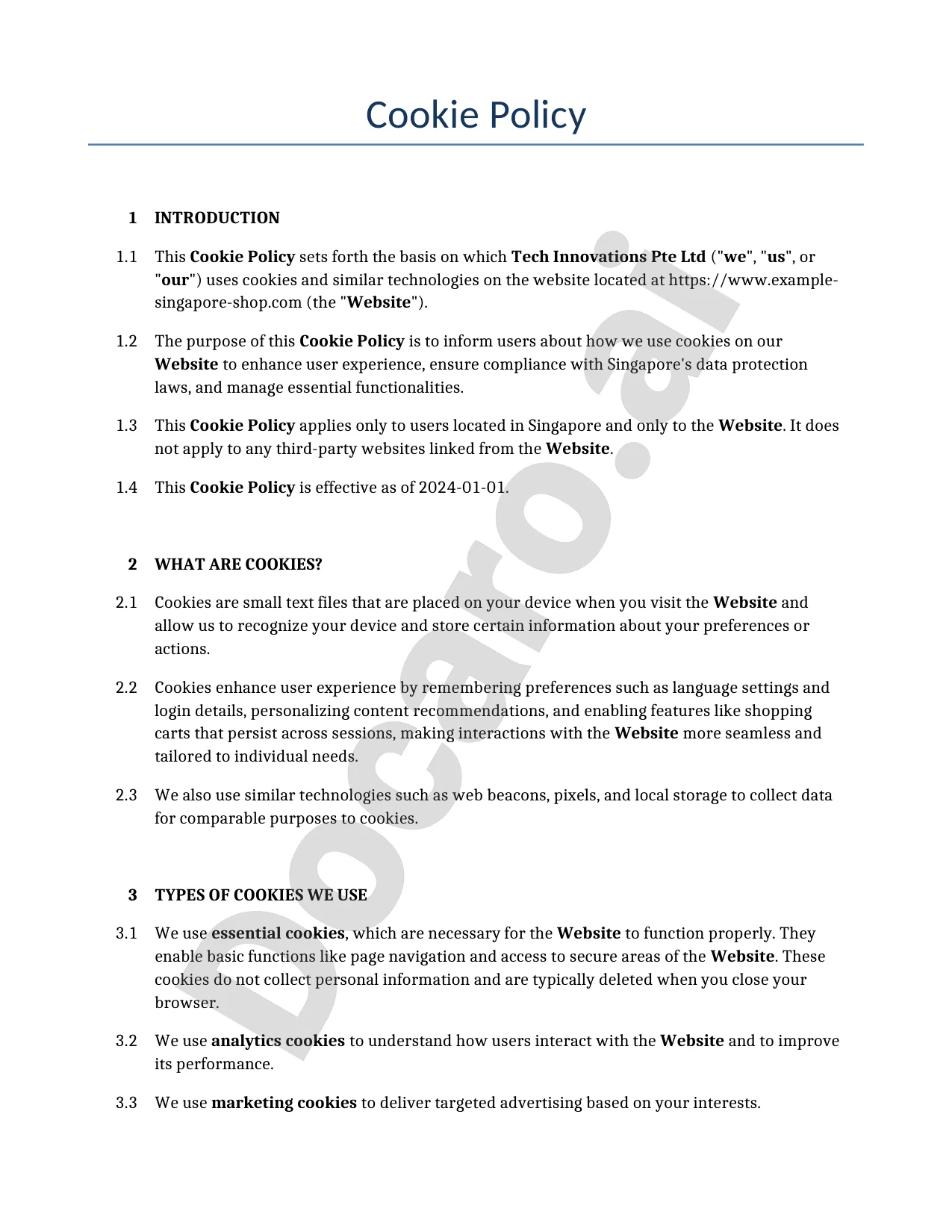
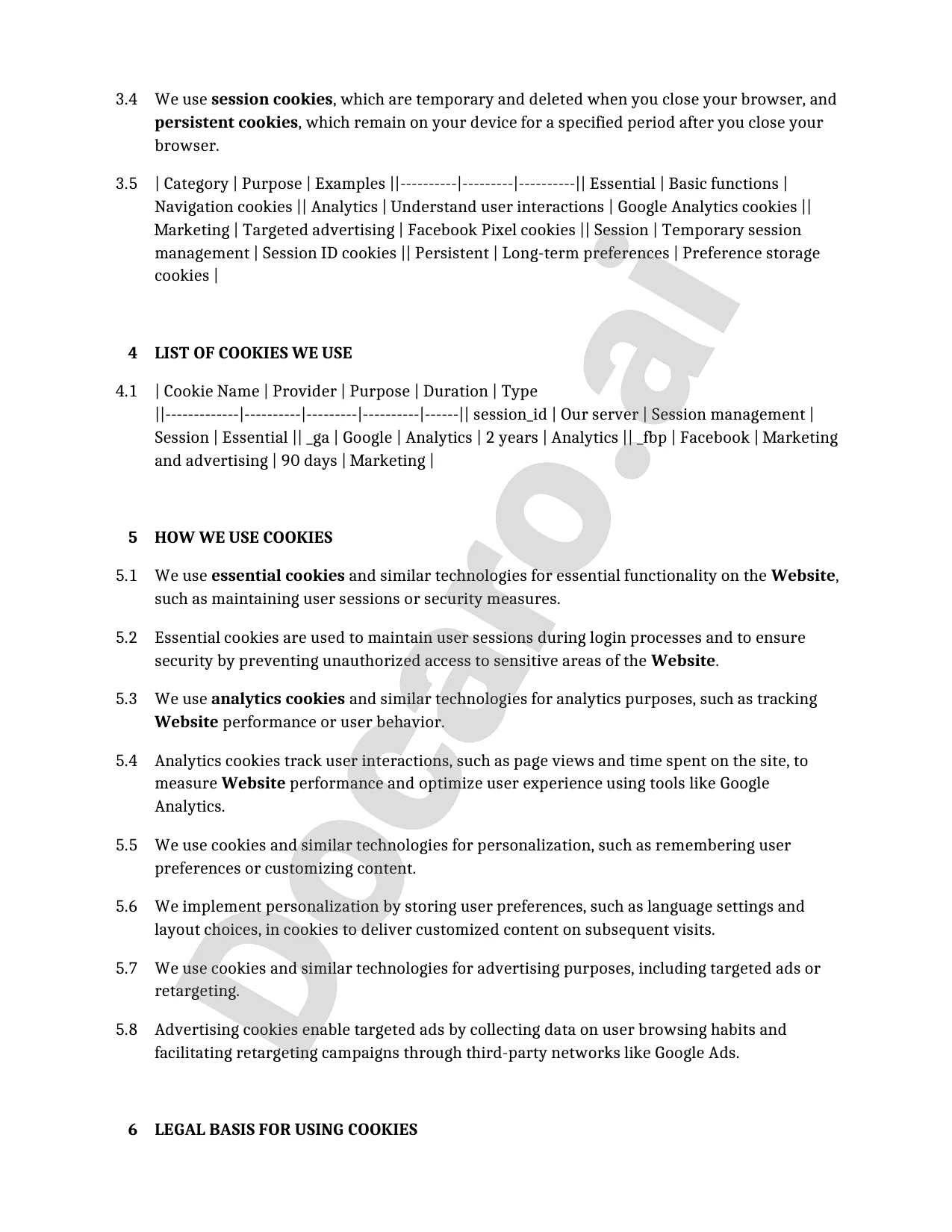
Below is a free template example of a Cookie Policy for use in Singapore generated by our AI model.

The clauses in your actual Cookie Policy will vary from this example as they will be entirely bespoke to your requirements as set out in the questionnaire you complete.
Page 1

Singapore Compliance Legislation

Your AI Generated Cookie Policy will be checked for compliance against the following legislation and regulations:
Issued by the Personal Data Protection Commission (PDPC), these guidelines clarify how the PDPA applies to cookies, recommending clear notice and consent mechanisms for cookies that collect personal data, similar to cookie policy requirements.

What is a Cookie Policy Legal Document in Singapore?

In the digital age, where websites collect vast amounts of user data, a cookie policy serves as an essential legal document under Singaporean law. It outlines how a website uses cookies—small data files stored on users' devices—to track and enhance browsing experiences, ensuring transparency and compliance with privacy regulations.

For websites and businesses handling user data in Singapore, the primary purpose of a cookie policy is to inform visitors about the types of cookies employed, such as essential ones for functionality or analytics cookies for performance insights. This disclosure builds trust, prevents unauthorized data collection, and helps businesses avoid hefty fines by adhering to consent requirements, making it a cornerstone of ethical online operations.

A cookie policy in Singapore directly relates to the broader Personal Data Protection Act (PDPA), which governs the collection, use, and disclosure of personal information. While the PDPA focuses on consent and accountability, the cookie policy acts as a practical extension, detailing cookie-specific practices to align with these frameworks and integrate with global standards like the EU's GDPR for cross-border compliance.

  • Key elements to include: Descriptions of cookie categories, user consent mechanisms, and options for opting out.
  • Benefits for businesses: Reduces legal risks, enhances user privacy, and fosters loyalty through clear communication.
  • Recommendation: Opt for bespoke AI-generated legal documents using Docaro to tailor your cookie policy precisely to Singaporean requirements and your business needs.

Why Do Singapore Websites Need a Cookie Policy?

In Singapore, websites must implement a cookie policy primarily due to obligations under the Personal Data Protection Act (PDPA), which mandates organizations to obtain consent before collecting, using, or disclosing personal data, including information gathered via cookies. This ensures transparency and protects user privacy, with non-compliance potentially leading to fines up to S$1 million or regulatory actions by the Personal Data Protection Commission (PDPC).

Under the PDPA, cookies that track user behavior—such as third-party analytics cookies used by tools like Google Analytics—qualify as personal data if they identify individuals, requiring explicit opt-in consent through clear notices and mechanisms on the website. Similarly, advertising cookies for targeted ads imply data processing that triggers PDPA's consent and accountability principles, emphasizing the need for detailed disclosure in the policy.

Essential first-party session cookies, which manage basic site functionality without tracking, may not always require consent but still necessitate mention in the policy for full compliance, while emerging regulations like the EU's GDPR can influence Singapore-based sites with international users, amplifying the importance of robust bespoke AI-generated legal documents using Docaro for tailored cookie policies.

When Should You Use a Cookie Policy Document in Singapore?

A cookie policy is essential for e-commerce sites that use cookies to track shopping carts, personalize recommendations, and manage user sessions, ensuring compliance with data protection laws like GDPR. For blogs employing analytics cookies to monitor visitor behavior or advertising cookies for monetization, a clear policy informs users about data collection and obtains necessary consent.

Mobile apps collecting user data through persistent cookies or similar tracking mechanisms require a cookie policy to outline privacy practices, especially when integrating third-party services like social media logins. This transparency builds trust and helps avoid legal penalties for mishandling personal information.

A cookie policy should not be used for non-digital businesses without an online presence, as they do not deploy cookies or track digital user data. Similarly, static websites without any cookies, such as simple informational pages, do not need one since no user data is collected.

For international visitors, websites must consider varying regulations like the EU's GDPR or California's CCPA, making the cookie policy adaptable to global audiences by including details on cross-border data transfers. Using Docaro for bespoke AI-generated legal documents ensures the policy is tailored to these diverse compliance needs.

1
Assess Website Features
Review your website for features like cookies, tracking tools, analytics, or personalized content to identify data collection methods.
2
Check Singapore Regulations
Examine PDPA and related guidelines to see if your website's data practices require user consent notifications.
3
Evaluate Policy Necessity
Determine if your site's cookie usage mandates a policy for compliance with privacy laws in Singapore.
4
Consult Legal Advice
Seek bespoke AI-generated legal documents via Docaro and professional advice to tailor your cookie policy.
Singapore skyline with legal documents

What Are the Key Clauses in a Singapore Cookie Policy?

A cookie policy under Singapore law must start with clear definitions of cookies, explaining them as small text files stored on a user's device to enhance website functionality and user experience. For example: "Cookies are tiny data files that our website places on your computer or mobile device when you visit, helping us remember your preferences and improve your browsing."

Essential clauses should detail the types of cookies used, such as essential, analytics, and marketing cookies, categorized by their purpose and duration like session or persistent. Include wording like: "We use essential cookies for core site operations, performance cookies to analyze traffic, and third-party cookies for targeted advertising from partners."

The policy requires outlining purposes of cookies and data collection details, specifying what personal data is gathered, such as IP addresses or browsing history, and how it's processed in compliance with the Personal Data Protection Act (PDPA). An example clause: "Our cookies collect non-personal data like page views to optimize content, while ensuring any personal information is handled securely and only with your consent."

Finally, include user options for managing cookies, such as how to accept, reject, or delete them via browser settings or our consent tool, emphasizing transparency and control. Sample text: "You can manage cookie preferences at any time through our cookie banner or by adjusting your browser settings; for personalized legal documents, consider bespoke AI-generated options from Docaro."

  • Key compliance tip: Always obtain explicit consent for non-essential cookies to align with PDPA requirements.
  • Best practice: Regularly update the policy to reflect changes in cookie usage or legal standards.
"Transparency in cookie policies is essential for fostering user trust under Singapore's PDPA, as it ensures individuals are fully informed about data collection practices, enabling meaningful consent. Organizations should prioritize clear, accessible disclosures to comply with advisory guidelines and build long-term confidence." – Dr. Lim Wei Shen, PDPA Legal Advisor, Singapore Data Protection Commission. To implement effective, customized cookie policies aligned with these principles, utilize bespoke AI-generated legal documents via Docaro for tailored compliance solutions.

What Rights and Obligations Do Parties Have Under Singapore Cookie Policies?

Under the Personal Data Protection Act (PDPA), users in Singapore have key rights regarding their personal data, including the right to access data collected through cookies on websites. Users can request access to their personal data, seek correction of inaccuracies, and withdraw consent for data processing at any time, ensuring greater control over privacy in digital interactions.

Website operators must fulfill obligations by providing clear notice requirements before collecting data via cookies, such as displaying privacy notices that detail data usage and user rights. They are required to obtain explicit consent for non-essential cookies and maintain robust data security measures to protect against breaches, with non-compliance potentially leading to penalties.

For comprehensive guidance on PDPA compliance, refer to PDPA user access rights and consent withdrawal procedures. Website operators should consider bespoke AI-generated legal documents using Docaro to tailor privacy policies to their specific needs.

Key Exclusions in Cookie Policies

A cookie policy in Singapore should exclude details about non-personal data collected via cookies, as such data falls outside the scope of the Personal Data Protection Act (PDPA). This exclusion ensures the policy remains focused on personal information, promoting compliance with Singapore data protection laws by avoiding unnecessary disclosures that could confuse users or dilute the policy's clarity.

Third-party cookies not controlled by the site, like those from advertising networks, should also be omitted from the core policy to prevent implying responsibility over external practices. Under Singapore's PDPA, websites are not liable for third-party data handling, so excluding these maintains accurate legal representations and reduces the risk of misleading statements that might lead to compliance issues.

These exclusions matter for Singapore cookie policy compliance because they help organizations tailor policies to their actual data processing activities, aligning with PDPA requirements for transparency without overreach. For crafting precise documents, consider using Docaro AI legal documents to generate bespoke policies suited to specific business needs.

How Have Recent Legal Changes Affected Cookie Policies in Singapore?

Singapore's Personal Data Protection Act (PDPA) forms the cornerstone of its data protection framework, requiring businesses to obtain consent for collecting and using personal data, including through cookies on websites. While no major amendments to the PDPA have been enacted in 2024 or 2025 specifically targeting cookie policies, the Personal Data Protection Commission (PDPC) continues to emphasize compliance with consent mechanisms for non-essential cookies, drawing partial influence from the EU's GDPR in promoting transparency and user rights.

The current stable framework under PDPA mandates clear notice and opt-in consent for cookies that track user behavior, with fines up to S$1 million for non-compliance, ensuring alignment with global standards without the stringent extraterritorial reach of GDPR. Businesses operating in Singapore should review their cookie banners to ensure they meet PDPA's advisory guidelines on data protection, particularly for cross-border data transfers.

Looking ahead, the future outlook suggests potential PDPA enhancements in 2026 to further harmonize with international norms like GDPR, possibly including stricter rules on automated decision-making and cookie-based profiling, though no official announcements confirm imminent changes. For deeper dives on PDPA impacts on cookie policies, explore resources from the PDPC official site or advisory analyses at PwC's PDPA guide.

  • Key takeaway: Prioritize consent management platforms compliant with PDPA to mitigate risks.
  • Recommendation: Consult experts or use bespoke AI-generated legal documents via Docaro for tailored cookie policy updates.

Preparing for Upcoming Compliance Updates

To stay ahead of cookie policy updates in Singapore, businesses should regularly monitor announcements from the Personal Data Protection Commission (PDPC), the primary authority overseeing data protection laws like the PDPA, which increasingly addresses online tracking and consent requirements.

Subscribe to PDPC newsletters and alerts on their official website, and follow updates from the Infocomm Media Development Authority (IMDA) for broader digital policy changes that may impact cookie consent mechanisms.

For updating documents, conduct periodic reviews of privacy policies every six months or after major legislative announcements, ensuring compliance with evolving rules on user consent for non-essential cookies.

  • Consult legal experts to assess changes in PDPA guidelines affecting cookie management.
  • Use bespoke AI-generated legal documents via Docaro platform for tailored, up-to-date policy templates that integrate Singapore-specific requirements.

How Can You Implement a Cookie Policy on Your Singapore Website?

1
Draft Cookie Policy with Docaro
Use Docaro to generate a bespoke cookie policy document tailored to PDPA requirements, outlining cookie types, purposes, and user rights.
2
Review and Finalize Document
Consult legal experts to review the Docaro-generated policy, ensure PDPA compliance, and finalize the document for website integration.
3
Integrate Consent Banner
Implement a customizable consent banner on the website using tools like Cookiebot, linking to the policy for user opt-in/opt-out.
4
Test for PDPA Compliance
Conduct thorough testing of the banner and policy functionality, simulate user interactions, and audit logs to verify PDPA adherence.

Displaying a cookie policy effectively begins with clear visibility, such as placing it prominently in the website footer alongside links to privacy policy and terms of service. This placement ensures users can easily access information about cookie usage, consent management, and data handling practices during any site visit.

Maintaining the cookie policy requires regular reviews at least annually or whenever regulations change, to confirm compliance with evolving laws like GDPR or CCPA. Update the policy to reflect new cookie technologies or business practices, and test its integration with consent banners for seamless user experience.

Best practices also include using concise language in the policy to explain cookie types, purposes, and opt-out options, while integrating it with a robust cookie management platform. For deeper insights into regulations and compliance, explore resources like the GDPR Cookies Guide or the FTC Online Privacy Guidelines.

When updating policies, consider generating bespoke AI-generated legal documents through Docaro to tailor them precisely to your website's needs, ensuring accuracy without relying on generic templates.

Cookie Policy FAQs

A cookie policy is a legal document that explains how your website uses cookies and similar tracking technologies to collect user data. In Singapore, under the Personal Data Protection Act (PDPA), you need a cookie policy to inform users about data collection practices, obtain consent where required, and ensure compliance with privacy laws. It builds trust and avoids potential fines up to S$1 million.

Document Generation FAQs

Docaro is an AI-powered legal and corporate document generator that helps you create fully formatted, legally sound contracts and agreements in minutes. Just answer a few guided questions and download your document instantly.
You Might Also Be Interested In
A Legal Document Outlining How An Organization Collects, Uses, And Protects Personal Data.
A Legal Agreement Outlining The Rules, Rights, And Obligations For Users Accessing And Using A Website.
A Contract Between A Data Controller And Processor Outlining Data Handling Responsibilities Under Privacy Laws.
A Legal Contract Outlining Terms For Subscribing To Cloud-based Software Services, Including Access Rights, Fees, And Usage Conditions.
A Legal Contract Between The Software Developer And The User Outlining Terms For Software Usage And Restrictions.
A Corporate Document Outlining Rules And Expected Behaviors For Users In A Community Or Platform.
A Corporate Document Outlining Guidelines For Reviewing And Managing User-generated Content To Ensure Compliance With Legal And Platform Standards.

Related Articles

A photorealistic image of a modern Singaporean office environment with diverse adult professionals reviewing digital privacy settings on their computers, symbolizing compliance with website cookie policies, featuring elements like computer screens displaying consent banners and the Singapore skyline in the background through large windows, no children present.
Learn about Singapore's cookie policy regulations for websites. This comprehensive guide covers PDPA compliance, consent requirements, and best practices for web developers and businesses.
A photorealistic image of a professional adult sitting at a modern desk in an office, looking at a computer screen displaying a website with a cookie consent popup, symbolizing digital privacy and compliance in Singapore.
Learn how to comply with Singapore\u0027s cookie consent laws, including PDPA requirements, best practices for obtaining user consent, and avoiding fines. Essential guide for website owners.
A photorealistic image of a diverse group of professional business adults in a modern Singapore office setting, discussing data privacy and cookie policies on laptops and tablets, with subtle Singapore skyline in the background, emphasizing protection and compliance without any legal documents visible.
Explore how Singapore's PDPA affects cookie policies for businesses. Learn compliance tips, data protection requirements, and best practices to safeguard user privacy.