Docaro

AI Generated IT Acceptable Use Policy for use in Singapore
PDF & Word - 2026 Updated

A photorealistic image of a diverse group of adult professionals in a modern Singapore office setting, collaboratively reviewing digital policies on laptops and tablets, symbolizing IT acceptable use and corporate compliance, with subtle Singapore skyline in the background through large windows, no children present.
Discover our AI-powered tool to effortlessly generate a customized IT acceptable use policy compliant with Singapore's data protection and cybersecurity regulations, ensuring your organization's digital assets are secure.
Free instant document creation.
Compliant with Singapore law.
No sign up or monthly subscription.

Docaro Pricing

Basic
Free
Document Generation
No Sign Up
No Subscription
Download Watermarked PDF
Premium
$4.99 USD
Document Generation
No Sign Up
No Subscription
Download Clean PDF
Download Microsoft Word
Download HTML
Download Text
Email Document
Generate your document for free. Only pay if you like the result and need an un-watermarked version.

When do you need an IT Acceptable Use Policy in Singapore?

  • Protecting Company Data
    You need this policy when employees use company computers and networks to safeguard sensitive information from unauthorized access or leaks.
  • Preventing Misuse of Resources
    It's essential for organizations to outline rules on personal internet use, ensuring work tools are not abused for non-work activities.
  • Ensuring Safe Internet Practices
    This document is crucial to guide staff on avoiding risks like viruses or scams, keeping the company's digital environment secure.
  • Supporting Business Growth
    As your team expands and adopts new tech, a clear policy helps maintain productivity and compliance with local data protection standards.
  • Reducing Legal and Financial Risks
    A well-drafted policy minimizes the chances of costly issues from employee errors, providing a foundation for handling any incidents effectively.

Singaporean Legal Rules for an IT Acceptable Use Policy

  • Personal Data Protection Act (PDPA)
    Your policy must include rules to protect employees' personal data, ensuring it's collected, used, and disclosed only with consent and for legitimate purposes.
  • Computer Misuse and Cybersecurity Act (CMCA)
    The policy should prohibit unauthorized access to IT systems, hacking, or spreading malware to prevent illegal cyber activities.
  • Protection from Harassment Act (POHA)
    It needs to ban cyberbullying, online harassment, or sharing harmful content through company IT resources.
  • Employment Act and Fair Dealing
    Rules must ensure fair treatment of employees regarding IT use, avoiding discrimination and promoting a safe work environment.
  • Intellectual Property Protection
    The policy should prevent unauthorized copying or sharing of copyrighted materials, trademarks, or company secrets via IT systems.
  • Compliance with Cybersecurity Guidelines
    Follow government standards for securing IT networks to safeguard against data breaches and cyber threats.
Important

Using the wrong structure for an IT acceptable use policy can fail to adequately address Singapore-specific data protection and cybersecurity regulations.

What a Proper IT Acceptable Use Policy Should Include

  • Purpose of the Policy
    Clearly state the policy's goal to guide employees on responsible IT use to protect company resources and data.
  • Scope and Applicability
    Define who the policy covers, such as all employees and contractors, and what systems it applies to, like company devices and networks.
  • Permitted and Prohibited Activities
    List allowed uses like work-related tasks and ban activities such as unauthorized software installation or accessing inappropriate content.
  • Data Protection and Confidentiality
    Require safeguarding of sensitive information and prohibit sharing confidential data without permission.
  • Password and Access Security
    Mandate strong passwords, regular updates, and no sharing of login credentials to prevent unauthorized access.
  • Internet and Email Usage
    Set rules for professional use of internet and email, including bans on personal streaming or sending offensive messages.
  • Software and Hardware Guidelines
    Outline approved software installations and maintenance of hardware to ensure system safety and compatibility.
  • Monitoring and Privacy Expectations
    Inform users that IT activities may be monitored for security, with no expectation of privacy on company systems.
  • Compliance and Consequences
    Detail enforcement steps, including warnings or disciplinary actions for policy violations.
  • Reporting Incidents
    Encourage immediate reporting of security issues or policy breaches to the IT team for quick resolution.

Why Free Templates Can Be Risky for IT Acceptable Use Policy

Free templates for IT acceptable use policies often rely on generic, one-size-fits-all language that fails to address the unique needs of your Singapore-based business. These outdated or poorly drafted documents may overlook local regulatory requirements, such as those under the Personal Data Protection Act (PDMA) or cybersecurity guidelines from the Cyber Security Agency (CSA), leaving your organization exposed to compliance risks, data breaches, and potential legal liabilities. Without customization, they might not align with your specific IT infrastructure, employee roles, or operational workflows, resulting in ineffective enforcement and increased vulnerability to internal threats.

Harness the power of AI to create a bespoke IT acceptable use policy tailored precisely to your company's context in Singapore. This advanced generation process incorporates up-to-date local laws, your business's unique policies, and industry best practices, ensuring comprehensive coverage of data security, internet usage, device management, and more. The result is a professional, enforceable document that minimizes risks, promotes a secure digital environment, and supports seamless compliance—all customized in real-time for superior protection and efficiency.

Generate Your Bespoke IT Acceptable Use Policy in 4 Easy Steps

1
Answer a Few Questions
Our AI guides you through the info required.
2
Generate Your Document
Docaro builds a bespoke document tailored specifically on your requirements.
3
Review & Edit
Review your document and submit any further requested changes.
4
Download & Sign
Download your ready to sign document as a PDF, Microsoft Word, Txt or HTML.

Why Use Our AI IT Acceptable Use Policy Generator?

Fast Generation
Quickly generate a comprehensive IT Acceptable Use Policy, eliminating the hassle and time associated with traditional document drafting.
Guided Process
Our user-friendly platform guides you step by step through each section of the document, providing context and guidance to ensure you provide all the necessary information for a complete and accurate IT Acceptable Use Policy.
Safer Than Legal Templates
We never use legal templates. All documents are generated from first principles clause by clause, ensuring that your document is bespoke and tailored specifically to the information you provide. This results in a much safer and more accurate document than any legal template could provide.
Professionally Formatted
Your IT Acceptable Use Policy will be formatted to professional standards, including headings, clause numbers and structured layout. No further editing is required. Download your document in PDF, Microsoft Word, TXT or HTML.
Compliance with Singaporean Law
Rest assured that all generated documents meet the latest legal standards and regulations of Singapore, enhancing trust and reliability.
Cost-Effective
Save money by generating legally sound IT Acceptable Use Policy without the need for expensive legal services or consultations.
Get Started for Free - No Sign Up or Monthly Subscription Required
No payment or sign up is required to start generating your IT Acceptable Use Policy. Generate and download a watermarked version of your document for free. Pay only if you want to remove the watermark and gain full access to your document. No monthly subscriptions or hidden fees. Pay once and use your document forever.
Need to Generate a IT Acceptable Use Policy in a Different Country?
Choose country:

Free Example IT Acceptable Use Policy Template

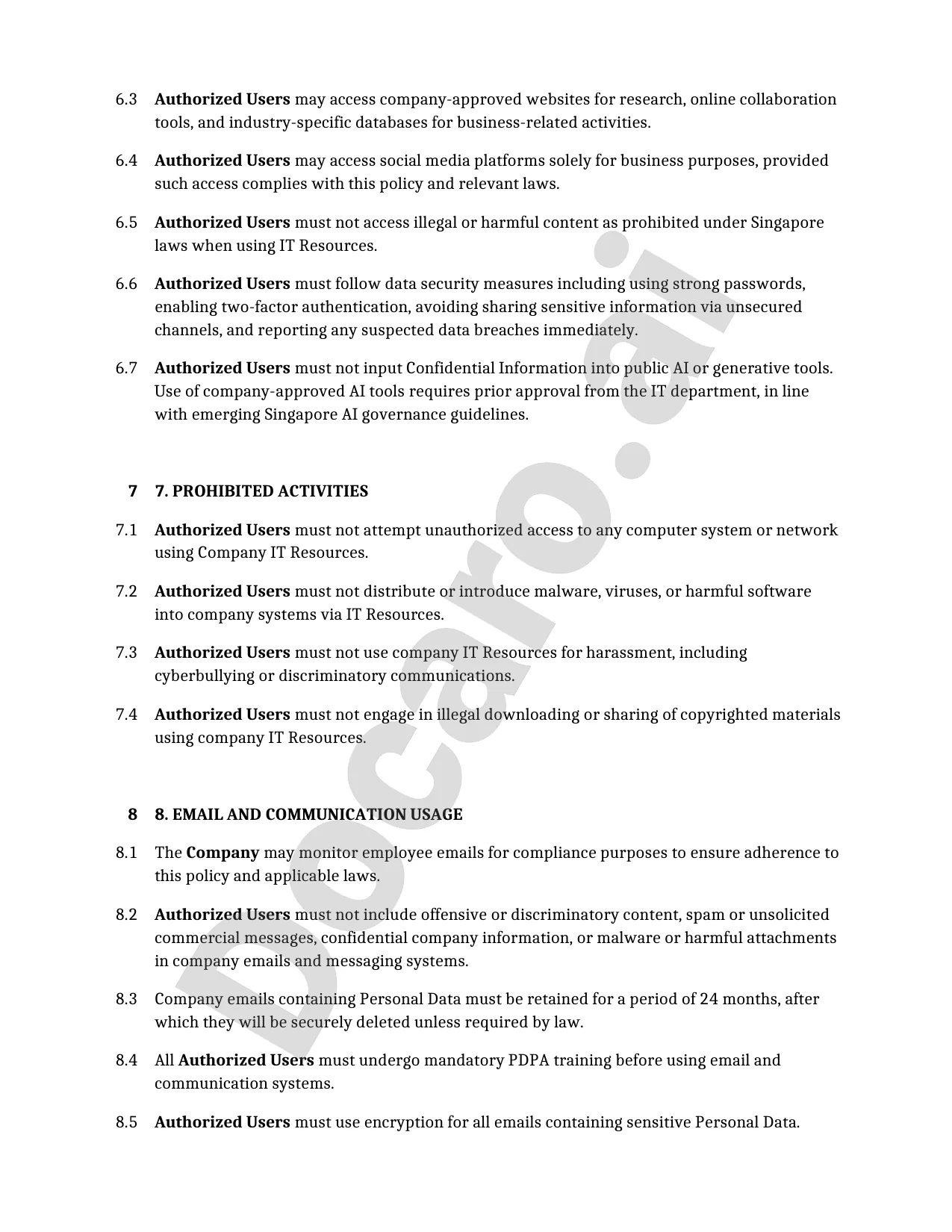
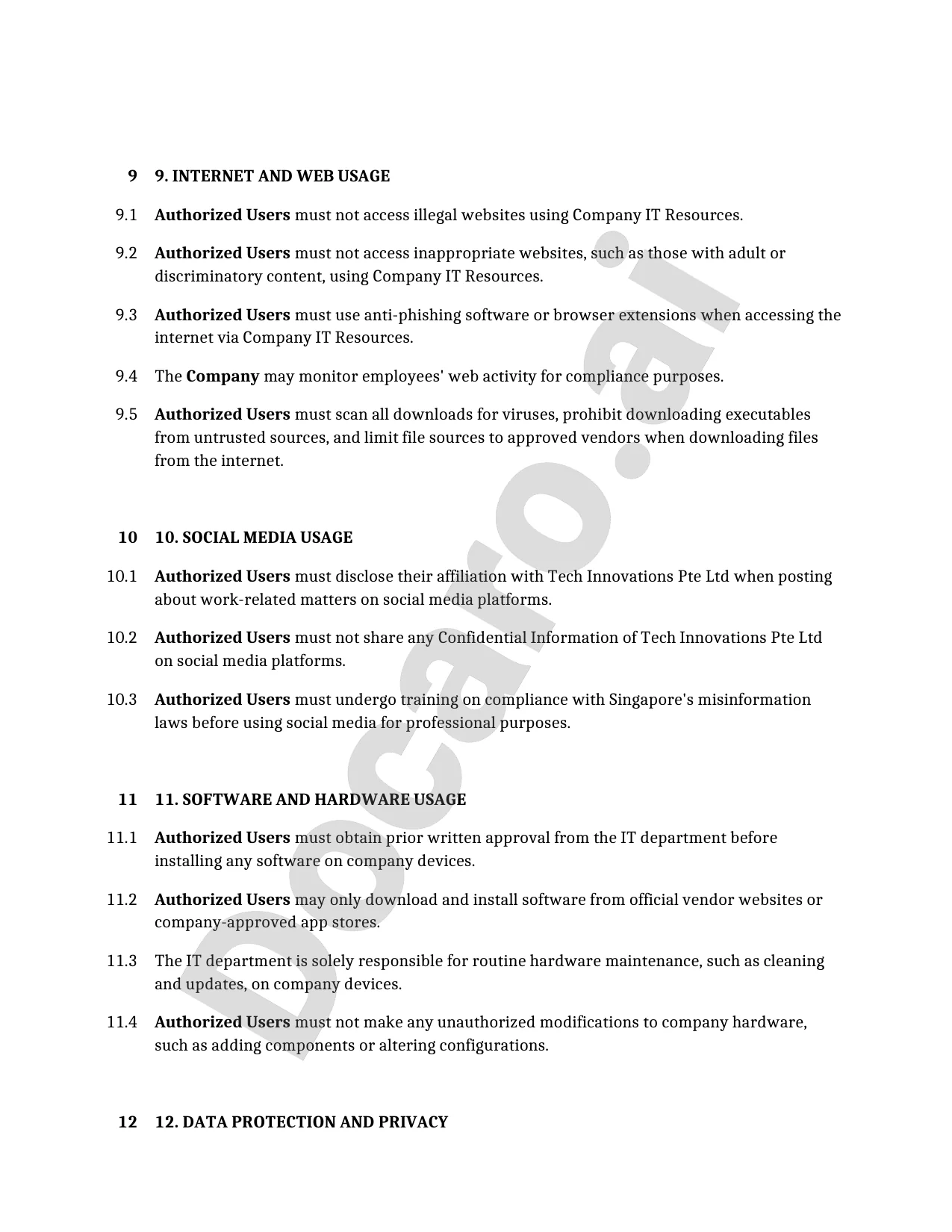
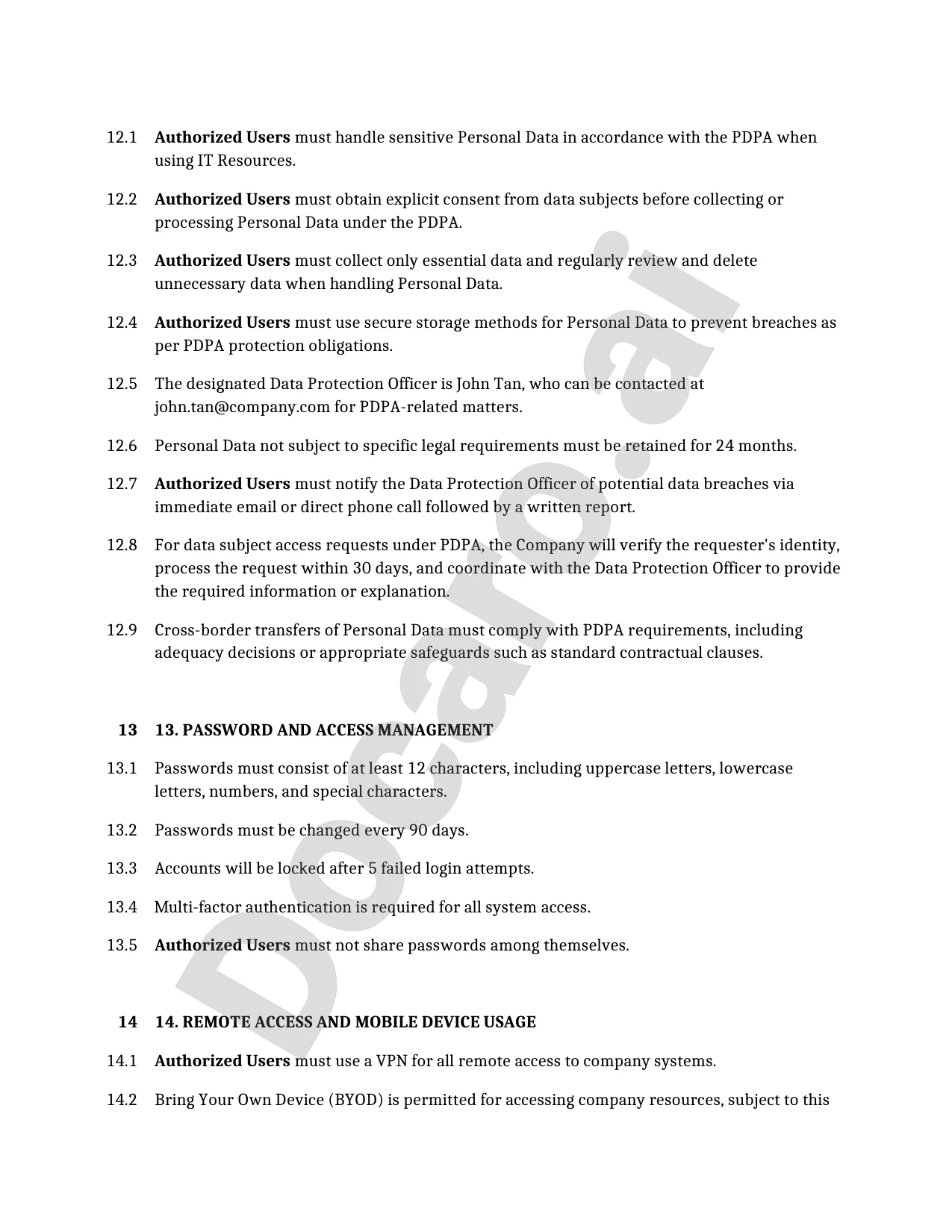
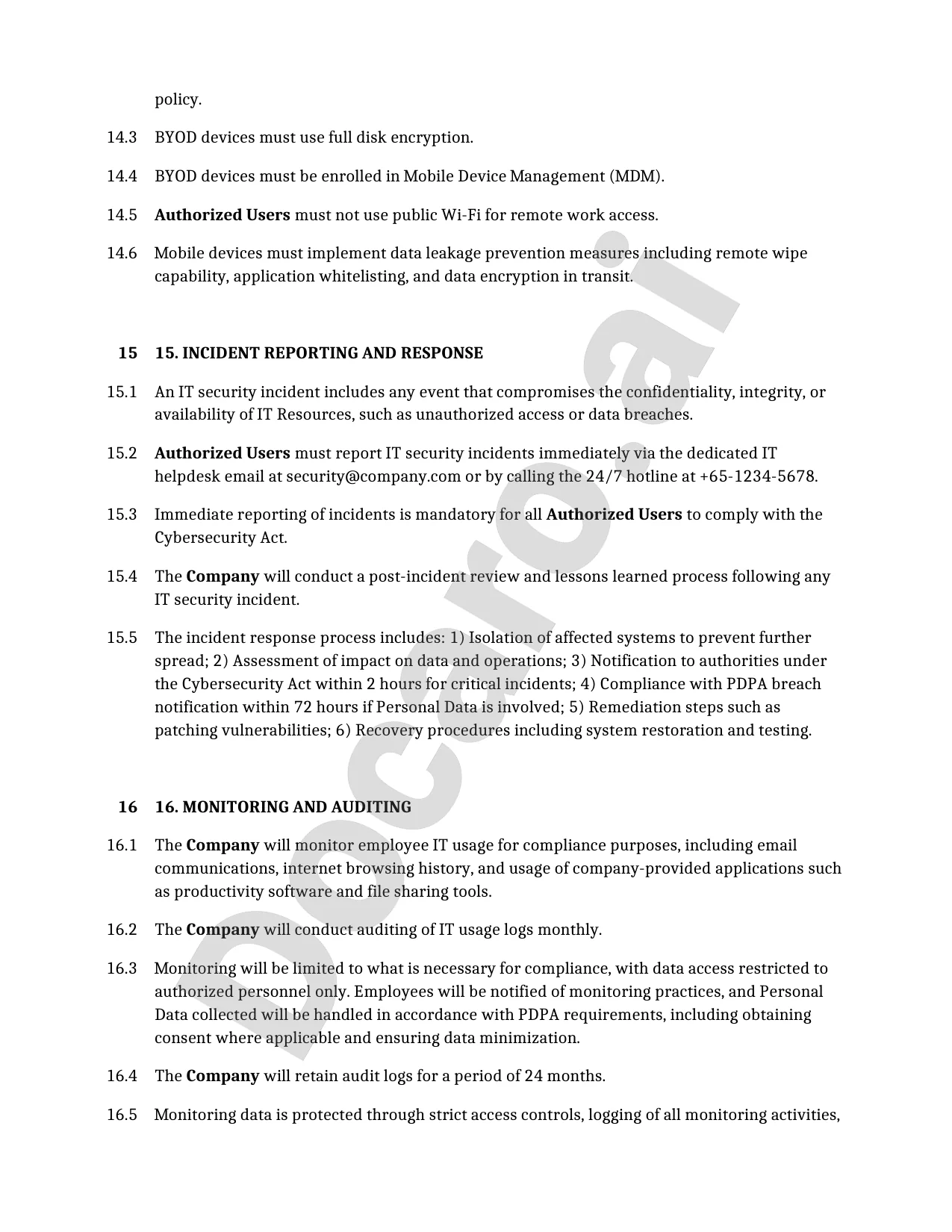
Below is a free template example of a IT Acceptable Use Policy for use in Singapore generated by our AI model.

The clauses in your actual IT Acceptable Use Policy will vary from this example as they will be entirely bespoke to your requirements as set out in the questionnaire you complete.
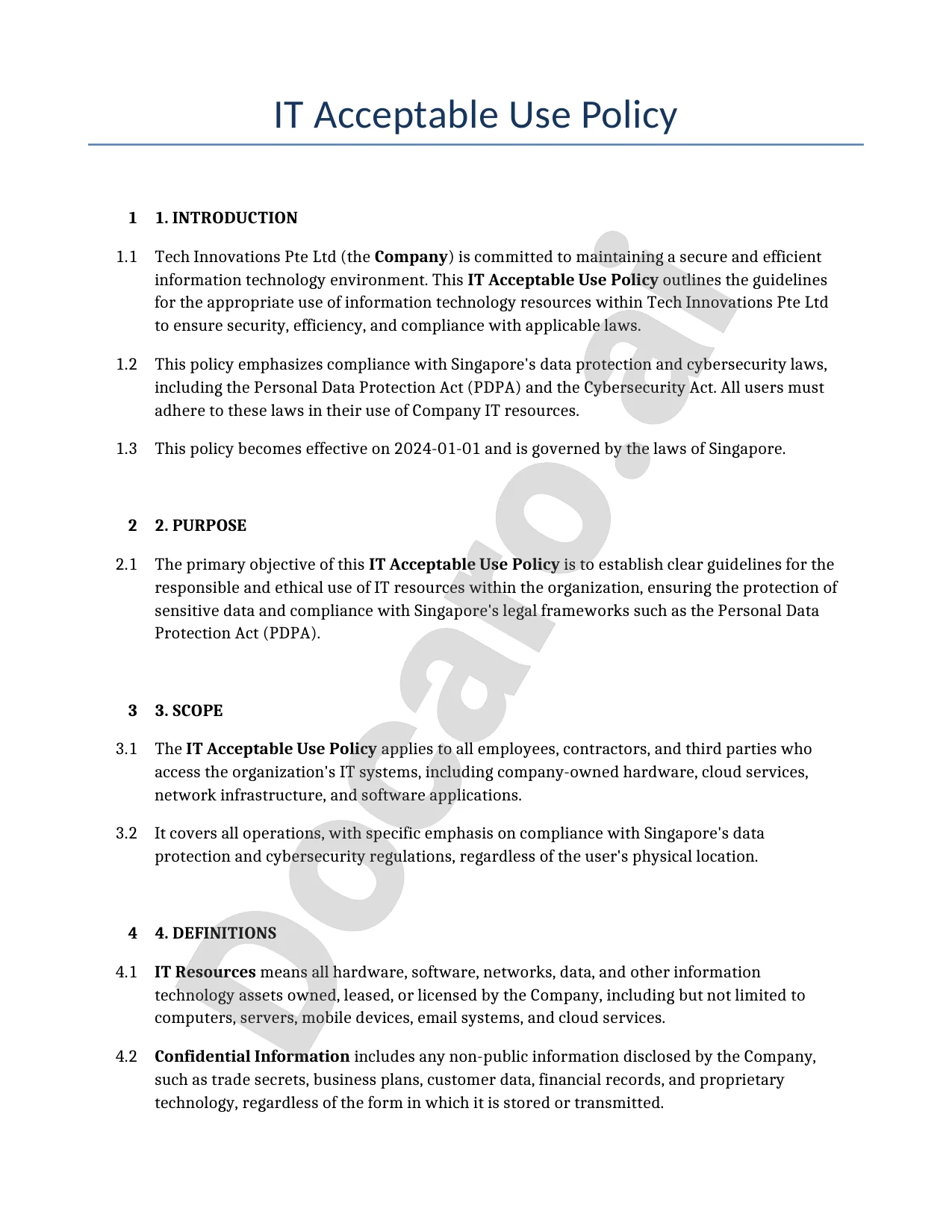
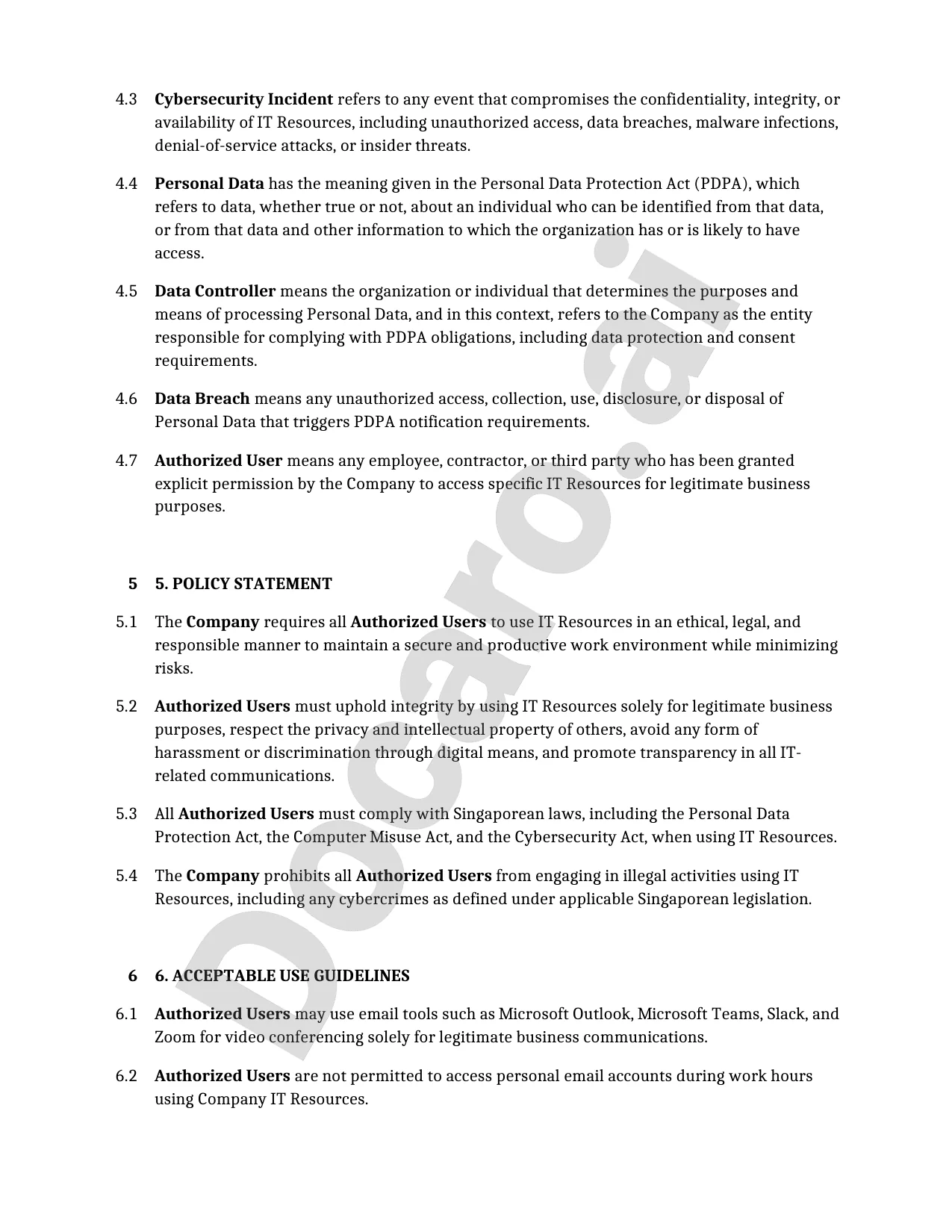
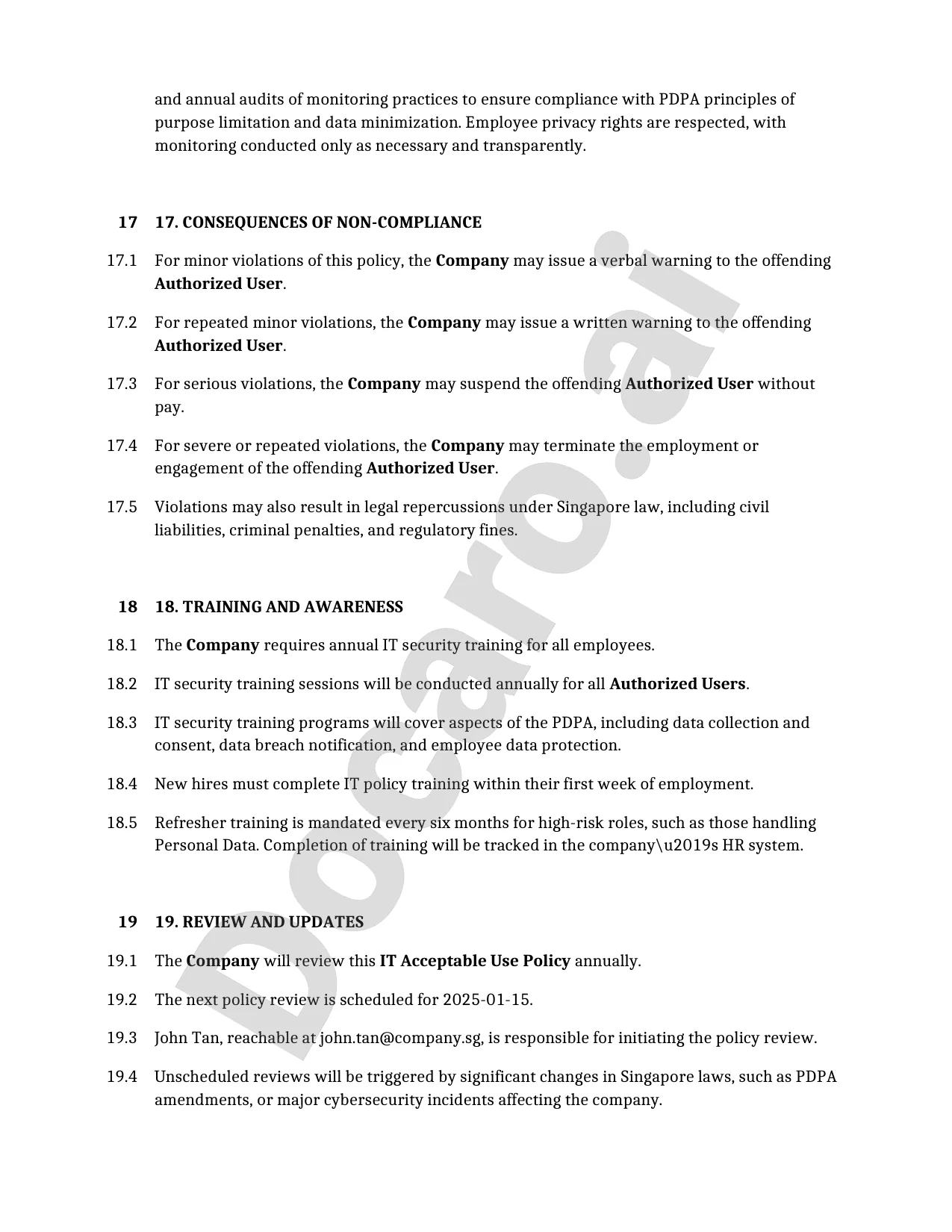
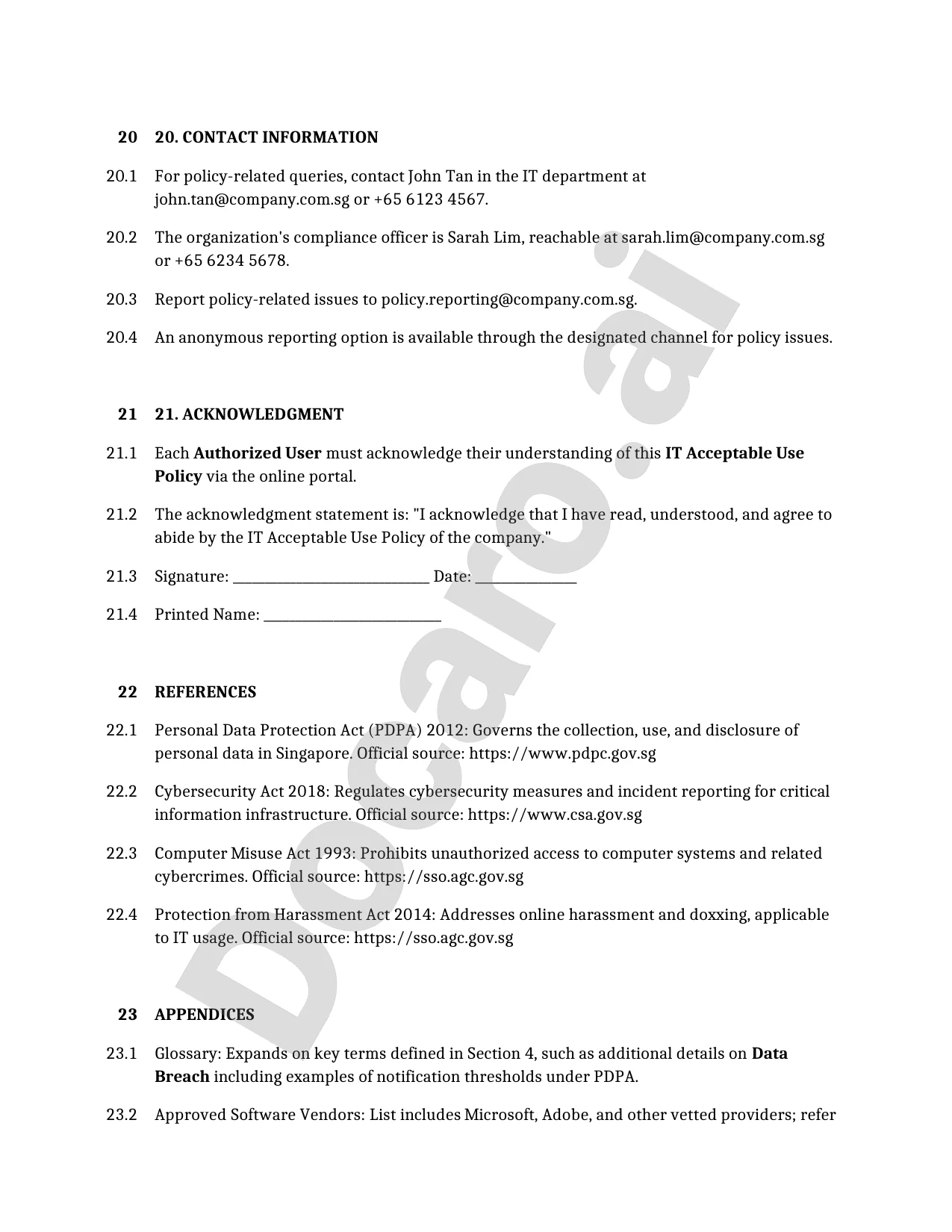
Page 1

Singapore Compliance Legislation

Your AI Generated IT Acceptable Use Policy will be checked for compliance against the following legislation and regulations:

What is an IT Acceptable Use Policy in Singapore?

In the bustling corporate landscape of Singapore, an IT Acceptable Use Policy (AUP) serves as a vital corporate document that outlines the rules and expectations for employees' use of information technology resources, such as computers, networks, and internet access. Its primary purpose is to safeguard sensitive data, prevent misuse, and ensure that IT systems support business operations without compromising security or compliance.

Under Singapore law, while there is no specific statute defining AUPs, they align closely with the Personal Data Protection Act (PDPA) enforced by the Personal Data Protection Commission (PDPC), which mandates organizations to protect personal data through robust policies. Businesses need an AUP to mitigate risks like data breaches, cyber threats, and legal liabilities, fostering a secure digital environment that complies with national regulations and promotes ethical IT practices.

Key guidelines from authorities like the Infocomm Media Development Authority (IMDA) emphasize secure network usage and cybersecurity best practices, as detailed in their resources on digital services regulations. For tailored protection, consider bespoke AI-generated corporate documents via Docaro, which can customize your AUP to fit your business needs precisely.

  • Prohibits unauthorized access to systems or data.
  • Requires reporting of security incidents promptly.
  • Encourages responsible use of company email and internet.

How does it differ from general IT policies?

An IT Acceptable Use Policy (AUP) in Singapore focuses primarily on guiding employee behavior regarding the use of company IT resources, such as computers, networks, and software, to ensure they align with organizational goals and legal standards. Unlike broader data protection policies, which emphasize compliance with the Personal Data Protection Act (PDPA) for handling personal data securely, an AUP uniquely targets everyday employee interactions to prevent misuse like unauthorized software installation or excessive personal use.

In contrast to cybersecurity frameworks, such as those outlined by the Cyber Security Agency of Singapore (CSA), which provide comprehensive strategies for threat detection and incident response across the entire organization, an AUP is employee-centric and highlights rules for acceptable activities, including prohibitions on accessing inappropriate content or sharing confidential information via personal devices. This makes AUPs essential for fostering a culture of responsible IT resource usage in Singaporean workplaces.

Key unique aspects of AUPs include specific guidelines on email etiquette, internet browsing limits, and social media policies during work hours, all tailored to mitigate risks from insider threats. For authoritative guidance, refer to the PDPC guidelines on data protection or the CSA resources for cybersecurity best practices in Singapore.

  • Employee Training: AUPs often mandate regular training sessions to reinforce proper IT habits.
  • Monitoring Clauses: They permit employer monitoring of IT usage to enforce compliance without infringing on privacy laws.
  • Consequences: Violations lead to disciplinary actions, distinguishing AUPs from advisory-only policies.

To create effective corporate documents like AUPs, consider bespoke AI-generated options using Docaro for customized, compliant policies suited to your Singapore business needs.

When should a business in Singapore use an IT Acceptable Use Policy?

A Singapore-based business should implement an IT Acceptable Use Policy in remote work setups to ensure employees access company resources securely from home or external locations. This policy outlines guidelines for using VPNs, secure devices, and avoiding public Wi-Fi, helping prevent unauthorized access and data breaches in hybrid work environments.

For handling sensitive data, such as customer information or financial records, an IT Acceptable Use Policy is essential to define protocols for data encryption, sharing, and storage. Businesses in sectors like finance or healthcare can use this to minimize risks of leaks or misuse, aligning with Singapore's Personal Data Protection Commission requirements.

To comply with industry regulations, companies must adopt an IT Acceptable Use Policy tailored to standards like those from the Monetary Authority of Singapore for financial institutions. This ensures adherence to cybersecurity mandates, reducing penalties and enhancing operational integrity.

The benefits include risk mitigation by curating clear rules that deter internal threats and legal compliance with Singapore's data protection laws. For bespoke policies, businesses should opt for AI-generated corporate documents using Docaro, ensuring customization to specific needs without relying on generic templates.

1
Assess Current IT Usage
Evaluate employee access to company devices, software, and networks to identify patterns of use and potential risks.
2
Identify Compliance Gaps
Review existing policies against industry regulations and data security standards to spot areas needing formal guidelines.
3
Analyze Business Risks
Assess vulnerabilities from unauthorized IT practices, such as data breaches or productivity losses, to gauge policy necessity.
4
Consult Legal Experts
Engage legal advisors for tailored advice, then use Docaro to generate a bespoke AI-powered IT Acceptable Use Policy.
Corporate office with IT policy documents

When should a business avoid using a standalone IT Acceptable Use Policy?

In Singapore's business landscape, a standalone IT Acceptable Use Policy may not be necessary for very small enterprises with minimal IT needs, such as sole proprietorships relying on basic email and cloud storage without complex networks. These setups often face low risks of data breaches or misuse, making a separate document redundant and administratively burdensome.

Integration into broader HR policies can render a standalone IT policy inappropriate, especially in small to medium enterprises (SMEs) where employee guidelines encompass technology use alongside conduct and confidentiality. For instance, Singapore's Tripartite Guidelines on Fair Employment Practices encourage holistic policy frameworks that cover IT within overall workplace rules, streamlining compliance without isolated documents.

Over-regulation through a standalone IT policy poses pitfalls like stifling innovation and employee productivity in agile Singapore firms, where excessive rules may deter creative tech adoption. It can also lead to compliance fatigue, increasing the chance of overlooked violations and potential fines under the Personal Data Protection Act (PDPA), as overly rigid policies distract from practical risk management.

To avoid these issues, businesses should opt for bespoke AI-generated corporate documents using Docaro, tailoring IT guidelines to specific needs without unnecessary standalone policies. This approach ensures relevance and efficiency, aligning with Singapore's emphasis on proportionate governance for SMEs.

"Without robust IT usage guidelines, corporations expose themselves to severe data breaches, regulatory penalties under Singapore's PDPA, and operational disruptions that can cost millions," warns Dr. Lee Wei Ling, Senior Partner at Rajah & Tann Singapore LLP. To safeguard your organization, implement bespoke IT policies tailored to your needs using Docaro's AI generation tools for customized, compliant documents.

What are the key clauses in an IT Acceptable Use Policy for Singapore companies?

An IT Acceptable Use Policy for corporations in Singapore must include clear prohibitions on unauthorized access to systems or data, aligning with the Computer Misuse Act, which criminalizes hacking and unauthorized modifications under sections 3 and 7. This clause should specify that employees are forbidden from attempting to access restricted areas without permission, emphasizing penalties like fines or imprisonment to deter violations and protect company assets.

Data sharing rules in the policy should outline strict guidelines on handling sensitive information, prohibiting unauthorized disclosure to external parties and mandating compliance with Singapore's Personal Data Protection Act. For instance, employees must use secure channels for sharing data and obtain approvals for any external transmissions, ensuring confidentiality and reducing risks of data breaches.

Monitoring provisions are essential, allowing the corporation to track IT usage for security and compliance purposes while informing users that activities on company systems are not private. This includes logging access and content reviews, but must balance with privacy considerations under Singapore law, notifying staff upfront to maintain transparency and legal defensibility.

Additional key clauses cover prohibitions on using IT resources for personal gain, such as running unauthorized software or engaging in illegal activities, with references to the Computer Misuse Act for broader cybercrime deterrence. Corporations should customize these using bespoke AI-generated documents via Docaro to fit specific operational needs, ensuring enforceability and relevance in Singapore's regulatory environment.

How do these clauses align with Singapore's legal framework?

An IT Acceptable Use Policy (AUP) in Singapore organizations must incorporate clauses that align with the Personal Data Protection Act (PDPA), which mandates the protection of personal data through consent, security measures, and breach notifications. For instance, AUP clauses prohibiting unauthorized access or sharing of personal data ensure compliance by restricting employee actions that could lead to data breaches, thereby avoiding fines up to S$1 million as outlined in the PDPC guidelines.

Under the Cybersecurity Act, critical information infrastructure operators are required to report incidents and implement security safeguards, which AUP clauses can support by mandating secure practices like using approved encryption and prohibiting risky behaviors such as downloading unverified software. These provisions help mitigate legal liabilities by demonstrating due diligence, potentially reducing penalties from the Cyber Security Agency of Singapore (CSA) for non-compliance.

To avoid legal risks, AUP clauses should include examples like bans on phishing simulations without approval, aligning with PDPA's data protection obligations and the Cybersecurity Act's incident reporting requirements. Organizations can generate bespoke AUP documents using Docaro to tailor these clauses precisely to their operations, ensuring robust defense against liabilities under Singapore's regulatory framework.

What recent or upcoming legal changes affect IT Acceptable Use Policies in Singapore?

Singapore's Personal Data Protection Act (PDPA) remains a cornerstone for IT Acceptable Use Policies, with ongoing advisory guidelines emphasizing data breach notifications and consent management. Recent amendments effective from 2021 have strengthened obligations for organizations, requiring prompt reporting of data breaches to the Personal Data Protection Commission (PDPC), which directly influences how companies draft and enforce their IT policies to ensure compliance.

In the cybersecurity domain, the Cybersecurity Act of 2018 continues to evolve, with the Cyber Security Agency of Singapore (CSA) issuing updated guidelines in 2023 for critical information infrastructure sectors. These developments mandate enhanced risk assessments and incident response plans, compelling businesses to integrate robust cybersecurity clauses into their Acceptable Use Policies to mitigate threats like ransomware and data leaks.

For the financial sector, the Monetary Authority of Singapore (MAS) has introduced Technology Risk Management (TRM) guidelines in 2021, with recent notices in 2024 focusing on cloud computing and AI risks. Financial institutions must now align their IT policies with these, including regular audits and employee training on secure data handling, to prevent cyber incidents that could undermine financial stability.

While no major overhauls are imminent, the current frameworks provide a stable foundation for IT governance in Singapore. Organizations should monitor announcements from the Infocomm Media Development Authority (IMDA) for potential updates on digital infrastructure and data protection, ensuring policies remain adaptive to emerging technologies.

What key exclusions should be considered in an IT Acceptable Use Policy?

In an IT Acceptable Use Policy (AUP) for Singapore businesses, key exclusions often permit personal device use under Bring Your Own Device (BYOD) policies. These allowances enable employees to access company resources on their own devices while requiring safeguards like encryption and remote wipe capabilities to protect sensitive data.

Exceptions for authorized security testing, such as penetration testing by approved vendors, are another vital exclusion in the AUP. This ensures that ethical hacking activities comply with Singapore's Personal Data Protection Commission (PDPC) guidelines without breaching policy rules.

These exclusions maintain flexibility by supporting modern work practices like remote access and innovation in cybersecurity, while ensuring compliance with local regulations such as the Cybersecurity Act. Businesses should customize AUPs using bespoke AI-generated tools like Docaro to align precisely with their operational needs.

What are the key rights and obligations under an IT Acceptable Use Policy in Singapore?

In Singapore, an IT Acceptable Use Policy (AUP) outlines the rights and obligations of employers and employees to ensure secure and productive use of information technology resources. Employers have the right to monitor IT usage, including emails and internet activity, as permitted under the Personal Data Protection Act (PDPA), to protect business interests and comply with data privacy laws, while employees must consent to such monitoring as part of their employment contract.

Employees bear key obligations under the AUP, such as reporting security breaches promptly to prevent data leaks, and adhering to guidelines on using company devices for non-work purposes. This aligns with the Employment Act, which emphasizes fair workplace practices, requiring employees to handle confidential information responsibly to avoid breaches that could lead to disciplinary action.

Mutual responsibilities for data security include employers providing training and tools to safeguard sensitive data, while employees must follow protocols like using strong passwords and avoiding unauthorized software. Both parties are bound by Singapore's cybersecurity framework under the Cybersecurity Act, fostering a collaborative environment to mitigate risks and ensure compliance with employment laws.

  • For tailored AUP documents, consider bespoke AI-generated corporate solutions using Docaro to meet specific organizational needs.
  • Refer to the Ministry of Manpower for guidance on employment rights in Singapore.

How can businesses enforce these rights and obligations?

Enforcing rights and obligations in an IT Acceptable Use Policy (AUP) begins with comprehensive training programs that educate employees on compliance requirements under Singapore's employment laws. Organizations should conduct regular sessions, including onboarding and annual refreshers, to ensure staff understand usage guidelines for company IT resources, aligning with the Ministry of Manpower's guidelines on fair workplace practices.

Audit processes are essential for monitoring adherence to the IT AUP, involving periodic reviews of system logs and user activities to detect violations without infringing on privacy rights protected by Singapore's Personal Data Protection Act. Implement automated tools and surprise checks to maintain transparency, ensuring audits are documented and proportionate as per employment regulations.

Disciplinary actions for AUP breaches must be progressive and compliant with Singapore's Employment Act, starting from warnings to potential termination based on severity. Develop clear escalation procedures in the policy, consulting HR to avoid unfair dismissal claims, and always provide employees with the right to appeal.

For best practices in implementing an IT AUP, refer to resources from the Cyber Security Agency of Singapore, which offers frameworks for secure IT governance. Advocate for bespoke AI-generated corporate documents using Docaro to tailor policies precisely to your organization's needs, ensuring full compliance with local regulations.

Where can I learn more about IT Acceptable Use Policies in Singapore?

In conclusion, mastering IT Acceptable Use Policy in Singapore ensures robust cybersecurity and regulatory compliance for businesses. For deeper insights, explore related resources tailored to Singapore's framework.

Additionally, consult authoritative Singapore sources like the IMDA's IT Security Guidelines for official standards. Consider using Docaro for bespoke AI-generated corporate documents to customize your IT Acceptable Use Policy effectively.

IT Acceptable Use Policy FAQs

An IT Acceptable Use Policy (AUP) is a formal document that outlines the rules and guidelines for employees' use of company IT resources, such as computers, networks, and internet access. In Singapore, it ensures compliance with local laws like the Personal Data Protection Act (PDPA) and Cybersecurity Act, protecting businesses from data breaches and legal risks.

Document Generation FAQs

Docaro is an AI-powered legal and corporate document generator that helps you create fully formatted, legally sound contracts and agreements in minutes. Just answer a few guided questions and download your document instantly.
You Might Also Be Interested In
A Document Outlining Company Policies, Employee Rights, And Workplace Rules.
A Document Outlining Expected Behaviors, Ethical Standards, And Rules For Individuals Or Organizations To Ensure Integrity And Compliance.
A Corporate Policy Outlining Commitments To Fostering Diverse Workplaces, Ensuring Equitable Opportunities, And Promoting Inclusive Practices.
A Corporate Policy Outlining Guidelines For Employees Working Remotely, In-office, Or In A Hybrid Model To Balance Flexibility And Productivity.
A Policy Outlining How An Organization Manages, Stores, And Disposes Of Data And Records To Ensure Compliance And Efficiency.
A Corporate Policy Outlining Procedures For Employees To Report Misconduct, Ensuring Confidentiality And Protection Against Retaliation.
A Policy Document Outlining Procedures For Handling Employee Misconduct And Workplace Complaints In Singapore Companies.
A Corporate Document Outlining Policies, Procedures, And Guidelines To Ensure Employee Safety And Compliance With Health Regulations In The Workplace.
A Document Outlining The Responsibilities, Duties, Required Skills, And Qualifications For A Specific Job Role.
A Performance Improvement Plan (PIP) Is A Formal Document Outlining An Employee's Performance Issues And A Structured Plan With Goals And Timelines To Help Them Improve, Often Used Before Potential Termination.
A Corporate Document Outlining The Principles And Approach To Employee Compensation, Including Pay Structures, Incentives, And Alignment With Business Goals.
A Corporate Document Outlining The Rationale And Justification For Promoting An Employee, Including Performance Details And Business Needs.
A Form Used By Companies To Gather Feedback From Departing Employees About Their Experiences And Reasons For Leaving.
A Documented Set Of Instructions Detailing How To Perform Routine Operations Consistently And Efficiently In An Organization.
A Document Outlining Procedures For Detecting, Responding To, And Recovering From Security Incidents In An Organization.
A Strategic Document Outlining Procedures To Maintain Operations During Disruptions And Restore Systems After Disasters.
A Corporate Document Outlining Rules, Procedures, And Responsibilities To Protect An Organization's Information Systems From Cyber Threats.
A Document Outlining Procedures And Standards To Ensure Product Or Service Quality In An Organization.
A Corporate Document Outlining A Company's Performance And Initiatives In Environmental, Social, And Governance Areas To Demonstrate Sustainability And Ethical Practices.

Related Articles

A photorealistic image of a diverse group of professional adults in a modern Singapore office environment, collaborating on IT systems with secure data interfaces on screens, symbolizing adherence to IT acceptable use policies in a business setting. The atmosphere is professional and innovative, with elements like laptops, servers, and subtle Singapore skyline in the background. No children are present in the image.
Discover essential insights into Singapore's IT Acceptable Use Policy. Learn key guidelines for businesses to ensure compliance, data security, and efficient IT practices in a regulated environment.
A photorealistic image of a diverse group of adult professionals in a modern Singapore office environment, collaboratively reviewing digital security guidelines on laptops and tablets, symbolizing the implementation of IT policies, with subtle Singapore skyline in the background through large windows, conveying trust, compliance, and technology integration.
Discover step-by-step guidance on creating and implementing a robust IT acceptable use policy in Singapore. Ensure compliance with PDPA and cybersecurity regulations for your organization.
A photorealistic image of a diverse group of adult professionals in a modern Singapore office environment, collaboratively reviewing digital security protocols on computers, symbolizing awareness and prevention of IT policy violations, with subtle Singaporean elements like city skyline in the background.
Discover frequent IT acceptable use policy violations in Singapore workplaces and practical strategies to prevent them, ensuring compliance and security for your organization.