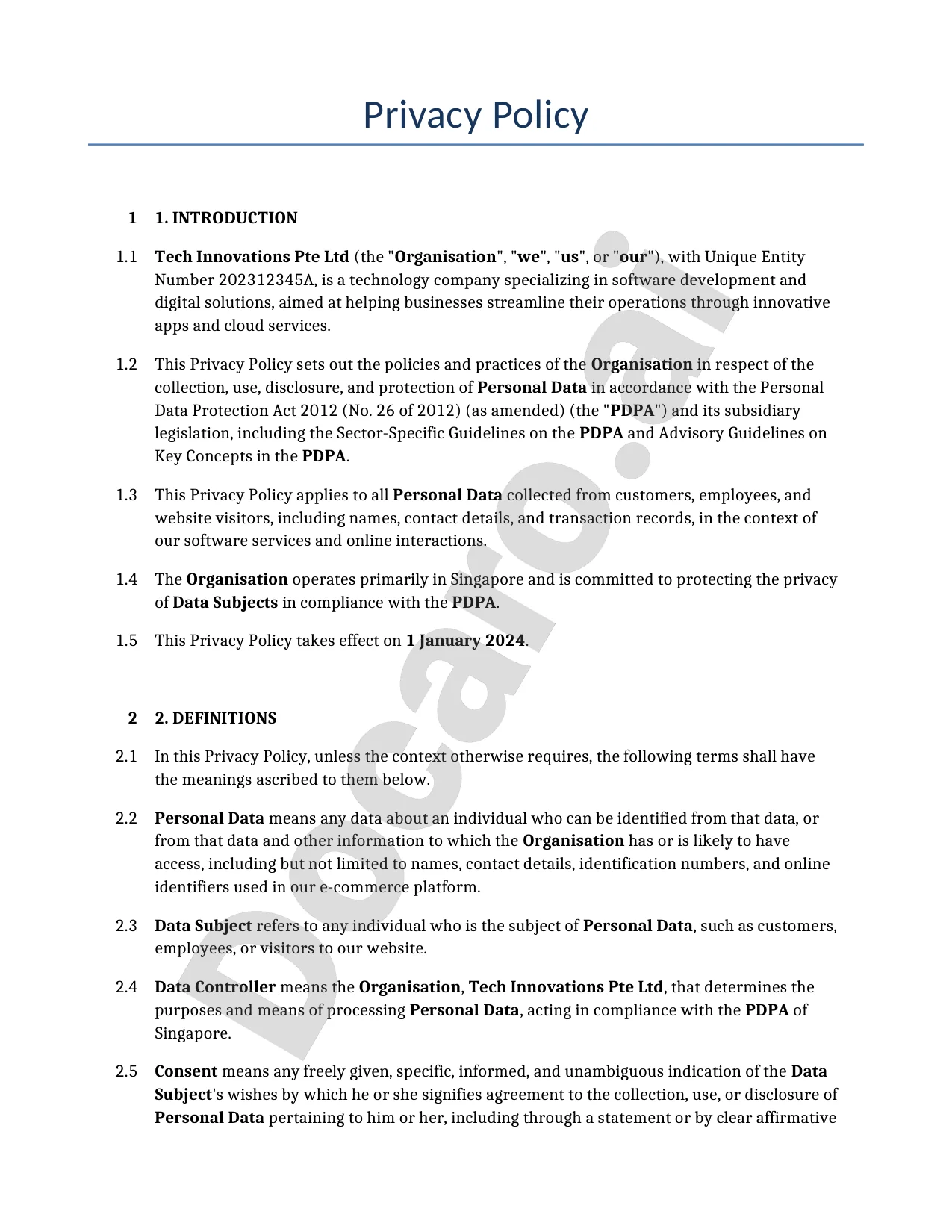
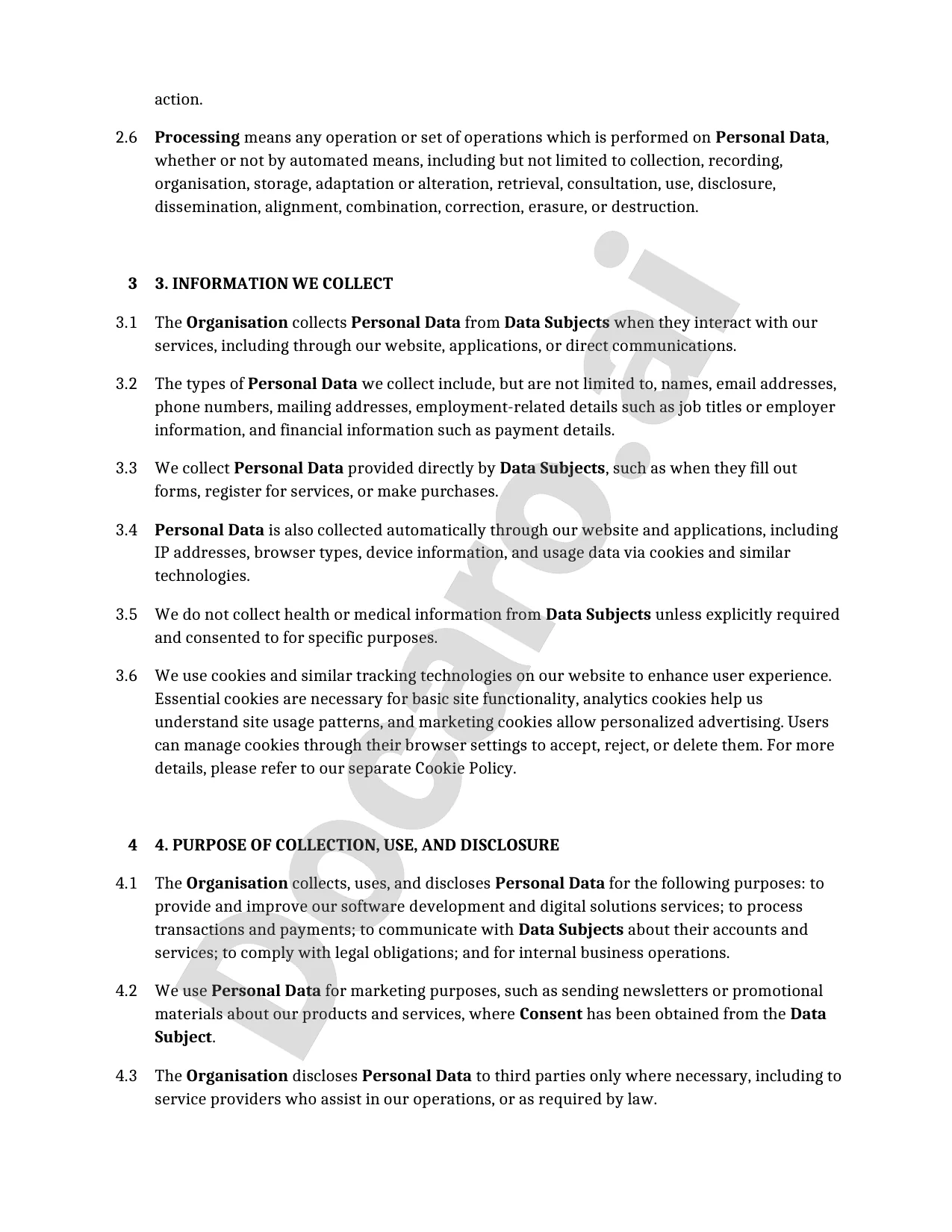
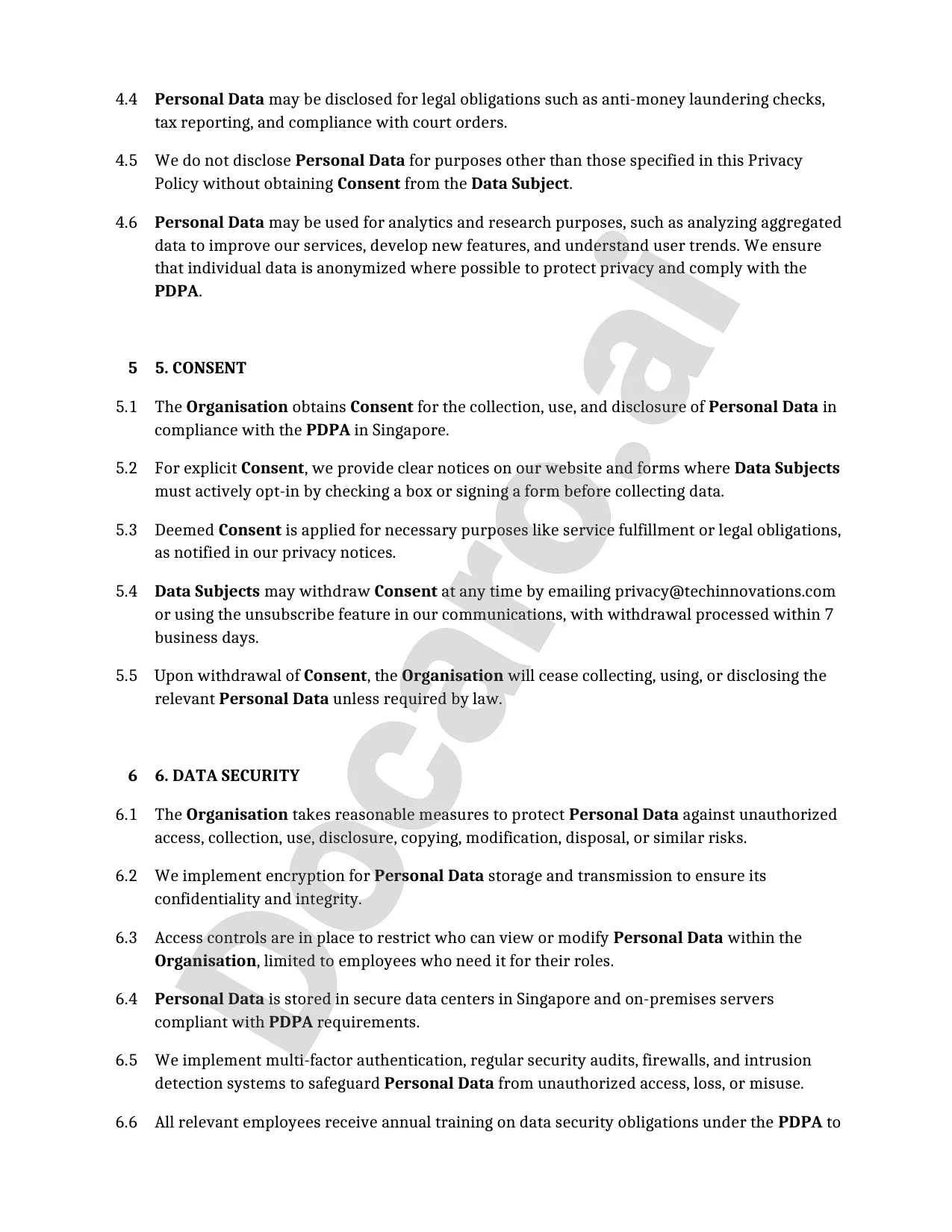
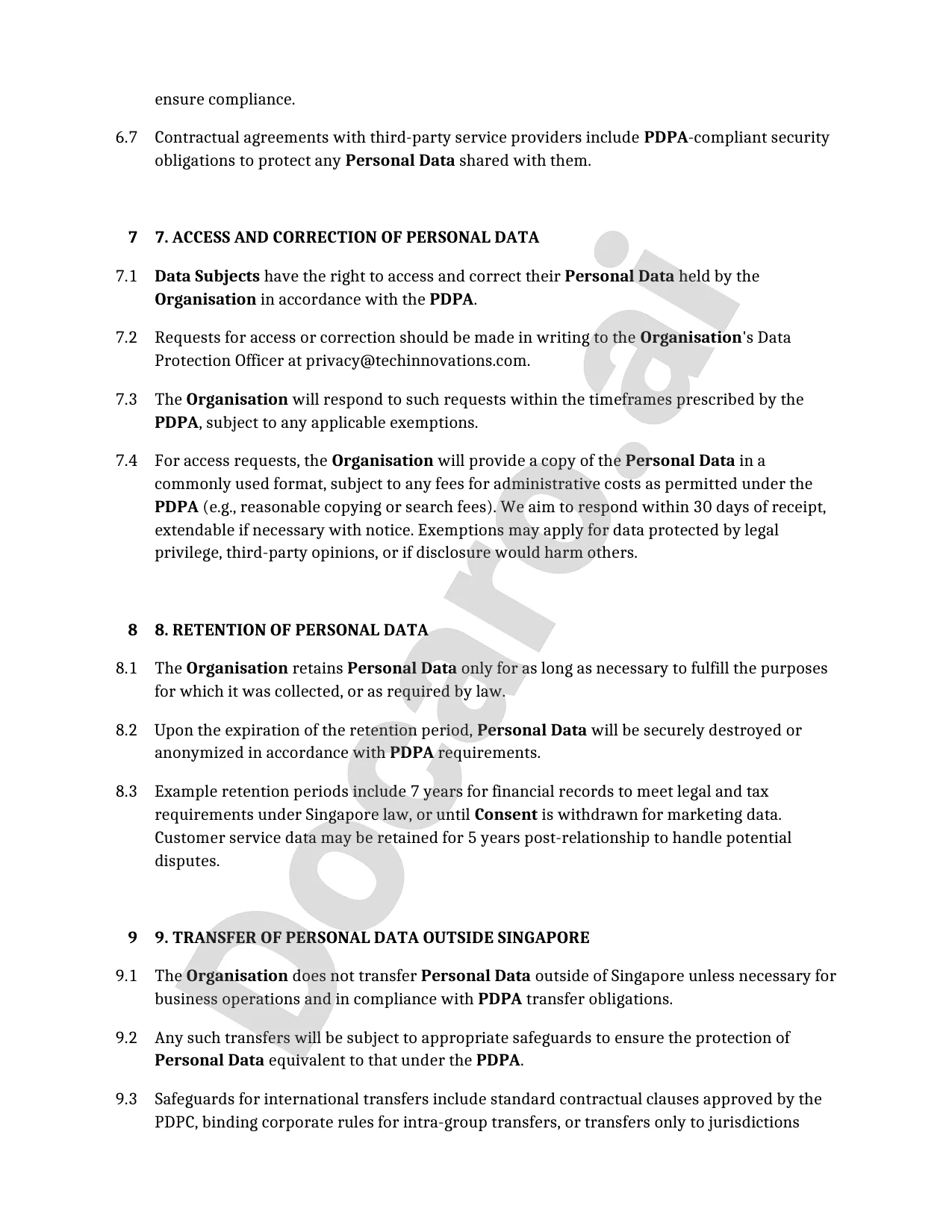
Docaro

AI Generated Singaporean Privacy Policy
PDF & Word - 2026 Updated

A photorealistic image representing privacy and data protection in Singapore, featuring a diverse group of adults in a modern office setting, discussing secure digital information on laptops and tablets, with subtle Singaporean elements like a city skyline in the background, emphasizing trust and confidentiality without showing any legal documents.
Generate a compliant AI-powered Singaporean privacy policy tailored for businesses handling personal data under the Personal Data Protection Act (PDMA), ensuring data privacy and legal adherence in Singapore.
Free instant document creation.
Legally compliant agreements.
No signup required.
Generate your document for free.
Download PDF, Word and email for $9.99 USD.

When do you need a Privacy Policy in Singapore?

  • Collecting Personal Information
    You need a privacy policy if your website or app collects any personal data from users, like names, emails, or addresses, to explain how you'll use it.
  • Operating an Online Business
    Any online store, service, or platform in Singapore that handles user data requires a privacy policy to comply with local data protection rules.
  • Using Cookies or Trackers
    If your site uses cookies, analytics, or tracking tools to monitor user behavior, a privacy policy is essential to inform users about data collection.
  • Sharing Data with Others
    When you share user information with third parties, such as partners or service providers, a privacy policy helps outline these practices clearly.
  • Building User Trust
    A well-drafted privacy policy reassures users that their data is safe, boosting confidence and encouraging engagement with your site.
  • Avoiding Legal Issues
    Having a clear privacy policy protects your business from fines or complaints under Singapore's Personal Data Protection Act by showing transparency.

Singaporean Legal Rules for a Privacy Policy

  • Legal Requirement
    In Singapore, businesses handling personal data must create a privacy policy under the Personal Data Protection Act (PDPA).
  • What to Include
    Your policy should clearly explain what personal data you collect, why you collect it, and how you use it.
  • User Rights
    It must inform users about their rights, like accessing their data, correcting errors, or asking to delete it.
  • Data Sharing
    State if and how you share data with others, such as partners or service providers.
  • Security Measures
    Describe steps you take to keep personal data safe from unauthorized access or loss.
  • Updates and Consent
    Explain how you'll notify users of policy changes and get their consent where needed.
  • Contact Information
    Provide ways for users to contact you about privacy concerns or data requests.
Important

Failing to align the privacy policy with Singapore's Personal Data Protection Act may result in non-compliance and regulatory penalties.

What a Proper Privacy Policy Should Include

  • Introduction to Data Handling
    Explain what personal information your organization collects and how it uses that data in simple terms.
  • Types of Personal Data Collected
    List the specific details like names, emails, or contact numbers that you gather from users.
  • How Data is Collected
    Describe the methods, such as forms, cookies, or tracking tools, used to obtain personal information.
  • Purpose of Data Use
    State clearly why you need the data, like improving services or sending updates.
  • Data Sharing Practices
    Outline if and with whom you share data, such as partners or service providers, while ensuring it's secure.
  • Data Storage and Security
    Detail how long data is kept and the steps taken to protect it from unauthorized access.
  • User Rights and Choices
    Inform users about their options to access, correct, or delete their personal data upon request.
  • Cookies and Tracking
    Explain the use of cookies or similar technologies and how users can manage their preferences.
  • Updates to the Policy
    Note how and when changes to the privacy policy will be communicated to users.
  • Contact Information
    Provide easy ways for users to reach out with privacy concerns or questions.

Why Free Templates Can Be Risky for Privacy Policy

Free privacy policy templates are often generic and not tailored to Singapore's Personal Data Protection Act (PDPA). Using outdated or mismatched wording can lead to non-compliance, expose your business to regulatory fines, or fail to adequately protect against data breach liabilities.

Our AI generates bespoke privacy policies customized to your specific business needs and Singapore's PDPA requirements, ensuring precise, up-to-date language that minimizes risks and provides robust data protection tailored just for you.

Generate Your Bespoke Privacy Policy in 4 Easy Steps

1
Answer a Few Questions
Our AI guides you through the info required.
2
Generate Your Document
Docaro builds a bespoke document tailored specifically on your requirements.
3
Review & Edit
Review your document and submit any further requested changes.
4
Download & Sign
Download your ready to sign document as a PDF, Word, Txt or HTML.

Why Use Our AI Privacy Policy Generator?

Fast Generation
Quickly generate a comprehensive Privacy Policy, eliminating the hassle and time associated with traditional document drafting.
Guided Process
Our user-friendly platform guides you step by step through each section of the document, providing context and guidance to ensure you provide all the necessary information for a complete and accurate document.
Safer Than Legal Templates
We never use legal templates. All documents are generated from first principles clause by clause, ensuring that your document is bespoke and tailored specifically to the information you provide. This results in a much safer and more accurate document than any legal template could provide.
Professionally Formatted
Your Privacy Policy will be formatted to professional standards, including headings, clause numbers and structured layout. No further editing is required. Download your document in PDF or Word.
Compliance with Singaporean Law
Rest assured that all generated documents meet the latest legal standards and regulations of Singapore, enhancing trust and reliability.
Cost-Effective
Save money by generating legally sound tenancy agreements without the need for expensive legal services or consultations.
Get Started for Free - No Sign Up Required
No payment or sign up is required to start generating your Privacy Policy. Simply answer a few questions and a preview of your final document will be generated.
Looking to Generate a Privacy Policy in a Different Country?
Choose country:

Compliance Legislation

Your AI Generated Privacy Policy will be checked for compliance against the following legislation and regulations:
The primary legislation governing the collection, use, disclosure, and protection of personal data in Singapore. It requires organizations to implement privacy policies and comply with data protection obligations.
Amends the PDPA to introduce new obligations including mandatory data breach notification, data portability, and enhanced protections for children's data, affecting privacy policy requirements.
Provides detailed rules on compliance with the PDPA, including requirements for privacy policies, consent mechanisms, and transfer of personal data abroad.
Issued by the Personal Data Protection Commission (PDPC), these guidelines clarify how the PDPA applies to privacy policies, including drafting tips and best practices.
Generate Your Bespoke Privacy Policy Now

What is a Privacy Policy in the Singapore Legal Context?

A privacy policy is a crucial document that outlines how an organization collects, uses, discloses, and protects personal data. Under Singapore's Personal Data Protection Act (PDPA), businesses must maintain transparent practices to safeguard individuals' information, ensuring compliance with legal obligations.

The policy plays a key role in informing users about data collection methods, such as what personal details are gathered and why. It details the purposes for data use, including how information supports services or marketing, while emphasizing consent and user rights.

Protection practices are highlighted to build trust, covering security measures against breaches and data retention periods. For deeper insights into Singapore privacy policy requirements for businesses, explore our guide at PDPA Compliance Essentials.

Organizations should opt for bespoke AI-generated legal documents using Docaro to tailor privacy policies precisely to their needs under the PDPA. Refer to the official Personal Data Protection Commission (PDPC) website for authoritative guidance on Singapore's data protection laws.

Businesses in Singapore must ensure transparency in data handling by clearly informing individuals about the purposes, collection methods, and use of their personal data, as required under the Personal Data Protection Act (PDPA). For compliance, generate bespoke legal documents tailored to your needs using Docaro.
Singapore skyline with legal documents

When Should Businesses Use a Privacy Policy in Singapore?

In Singapore, a privacy policy is mandatory under the Personal Data Protection Act (PDPA) for any organization that collects, uses, or discloses personal data, particularly in digital contexts like websites that gather user information such as names, emails, or browsing habits. For instance, e-commerce platforms handling customer details for transactions must prominently display a clear privacy policy to inform users about data practices and obtain consent where required, as outlined by the Personal Data Protection Commission (PDPC).

Apps, including mobile applications for services or social networking, are highly recommended to have a comprehensive privacy policy to comply with PDPA obligations, especially when processing sensitive data like location or health information, ensuring transparency and building user trust. This is crucial for app developers to avoid penalties, with guidelines available on the PDPC advisory guidelines.

However, a privacy policy should not be used for non-digital businesses that do not handle personal data, such as a small retail shop operating solely offline without collecting customer information through any electronic means. In such cases, PDPA compliance focuses on basic data protection practices rather than a formal policy document.

1
Assess Data Collection Practices
Review all methods your business uses to collect personal data from customers, employees, and users, including online forms and tracking tools.
2
Evaluate Legal and Regulatory Requirements
Identify applicable privacy laws like GDPR or CCPA based on your location, customer base, and data handling scope.
3
Analyze Risks and Compliance Needs
Determine if collected data requires protection measures and whether a policy is needed to mitigate legal risks.
4
Consult Legal Advice and Generate Policy
Seek expert legal counsel; use Docaro to create bespoke AI-generated privacy policy documents tailored to your business.

What Are the Key Clauses to Include in a Singapore Privacy Policy?

A compliant Privacy Policy for Singapore websites under the Personal Data Protection Act (PDPA) must clearly outline the purposes of data collection, ensuring they are specific and lawful. For instance, personal data is collected to provide services, improve user experience, and comply with legal obligations, with users informed transparently at the point of collection.

Consent mechanisms require explicit, informed agreement from individuals before processing their data, often through opt-in checkboxes or clear notices on websites. Businesses should allow users to withdraw consent easily, updating their practices to reflect PDPA's emphasis on voluntary participation, as detailed in guidelines from the Personal Data Protection Commission (PDPC).

Regarding data sharing and security measures, the policy must specify if data is shared with third parties like service providers, only for necessary purposes and under strict contracts. Robust security, such as encryption and access controls, protects against breaches, aligning with PDPA's protection obligations to safeguard personal data integrity.

User rights under PDPA include access, correction, and deletion of personal data, with businesses required to respond to requests within reasonable timelines. For a tailored approach, consider generating bespoke legal documents using Docaro to ensure your PDPA-compliant Privacy Policy fits your website's unique needs; reference our internal guide at Draft Compliant Privacy Policy for Singapore Websites.

How Do Rights and Obligations Affect These Clauses?

Under Singapore's Personal Data Protection Act (PDPA), data subjects enjoy key rights such as the right to access their personal data held by organizations, request corrections to inaccurate data, and withdraw consent for data processing at any time. These rights empower individuals to maintain control over their information, requiring data controllers to respond promptly to such requests within specified timelines.

Data controllers, as per PDPA obligations, must obtain informed consent before collecting or using personal data, implement reasonable security measures to protect it, and notify affected parties in case of breaches. They are also required to appoint a Data Protection Officer to oversee compliance, ensuring accountability in data handling practices.

These rights and obligations directly influence privacy policy clauses in Singapore organizations, where policies must clearly outline consent mechanisms, access and correction procedures, and withdrawal options to align with PDPA requirements. For instance, clauses should detail how individuals can exercise their rights, often including contact details for the Data Protection Officer, fostering transparency and trust.

To craft effective PDPA-compliant privacy policies, organizations should use bespoke AI-generated legal documents via Docaro, tailored to specific business needs rather than generic templates. For authoritative guidance, refer to the PDPC's PDPA overview or the PDPA legislation on Singapore's official statutes site.

What Key Exclusions Apply to Privacy Policies in Singapore?

The Personal Data Protection Act (PDPA) in Singapore provides key exclusions that can limit the scope of a privacy policy, particularly for activities not involving commercial transactions. For instance, data processed solely for personal or domestic purposes is exempt, meaning individuals handling personal information within a family or household setting need not comply with PDPA obligations, allowing privacy policies to exclude such non-commercial uses.

Another significant exclusion under PDPA applies to journalistic activities and literary or artistic works, where the act of collecting, using, or disclosing personal data for news reporting or creative expression is not regulated. This exemption ensures that media organizations and artists can operate without a comprehensive privacy policy covering these specific functions, though they must still consider ethical standards; for detailed guidelines, refer to the Personal Data Protection Commission (PDPC) advisory on media exemptions.

National security and law enforcement represent broad PDPA exclusions, permitting public agencies to process personal data without consent or policy constraints when it involves defense, security, or crime prevention. In these cases, a privacy policy may be limited or inapplicable, emphasizing the need for organizations to clearly delineate such scenarios to avoid overreach; organizations should consult bespoke AI-generated legal documents using Docaro for tailored compliance strategies under Singapore's PDPA framework.

What Recent or Upcoming Changes Impact Privacy Policies in Singapore?

The Personal Data Protection Act (PDPA) in Singapore has undergone significant amendments in recent years to strengthen data privacy protections. Key updates include enhanced obligations for organizations handling personal data, with a focus on consent management and data portability rights introduced in 2021.

Upcoming changes emphasize enhanced data breach notifications, requiring mandatory reporting to the Personal Data Protection Commission (PDPC) within 72 hours of discovery, alongside stricter penalties for non-compliance. These amendments aim to align Singapore's framework with global standards, ensuring timely response to breaches.

Revised rules on data transfer will impose clearer requirements for cross-border transfers, mandating safeguards like contractual clauses or binding corporate rules. For comprehensive details on these PDPA updates, refer to our guide at PDPA Key Updates.

Organizations should consult authoritative sources such as the PDPC website for official guidelines on compliance. Bespoke AI-generated legal documents using Docaro can help tailor PDPA-compliant policies to specific business needs.

"The recent updates to Singapore's Personal Data Protection Act (PDPA) significantly bolster data privacy safeguards by mandating stricter consent requirements, enhanced breach notification timelines, and greater accountability for data intermediaries, ensuring organizations adopt proactive measures to protect individuals' information in an increasingly digital landscape." - Dr. Lim Wei Shen, Senior Legal Advisor on Data Privacy, National University of Singapore. To ensure your organization's compliance with these strengthened PDPA provisions, opt for bespoke AI-generated legal documents tailored to your specific needs via [Docaro's custom PDPA toolkit](https://docaro.ai/pdpa-toolkit).
Business professional reviewing privacy policy

How Can Businesses Ensure Compliance with Privacy Policy Requirements?

1
Review PDPA Guidelines
Study the Personal Data Protection Act guidelines to understand compliance requirements for data handling and user rights.
2
Customize Clauses with Docaro
Use Docaro to generate bespoke AI-driven privacy policy clauses tailored to your business operations and PDPA standards.
3
Obtain Legal Review
Have a qualified legal professional review the Docaro-generated policy for accuracy and full PDPA compliance.
4
Implement Regular Updates
Schedule periodic reviews of the policy using Docaro to ensure ongoing compliance with evolving PDPA regulations.

Privacy Policy FAQs

A Privacy Policy in Singapore is a legal document that outlines how a business or website collects, uses, stores, and protects personal data of users. It ensures compliance with the Personal Data Protection Act (PDPA), Singapore's key data privacy law, by informing individuals about their data rights and the organization's data handling practices.

Document Generation FAQs

Docaro is an AI-powered legal document generator that helps you create fully formatted, legally sound contracts and agreements in minutes. Just answer a few guided questions and download your document instantly.
You Might Also Be Interested In
A Legal Agreement Outlining The Rules, Rights, And Obligations For Users Accessing And Using A Website.
A Contract Between A Data Controller And Processor Outlining Data Handling Responsibilities Under Privacy Laws.
A Legal Document Explaining How A Website Uses Cookies To Collect And Manage User Data.
A Legal Contract Outlining Terms For Subscribing To Cloud-based Software Services, Including Access Rights, Fees, And Usage Conditions.
A Legal Contract Between The Software Developer And The User Outlining Terms For Software Usage And Restrictions.

Related Articles

A photorealistic image of a diverse group of professionals in a modern Singapore office, engaged in a discussion about data privacy, with subtle Singaporean elements like a city skyline view, emphasizing trust and security in business practices, no children present.
Discover key Singapore privacy policy requirements for businesses under PDPA. Learn how to comply, draft effective policies, and avoid penalties in this comprehensive guide.
A photorealistic image representing data protection and privacy in a modern Singaporean office setting, with professionals discussing secure data management on computers, symbolizing updates to personal data protection laws.
Discover the latest updates to Singapore's Personal Data Protection Act (PDPA), including new privacy obligations, enforcement changes, and tips for businesses to ensure compliance and avoid penalties.
A professional scene representing data privacy and compliance for a Singapore website, featuring a diverse group of adults in a modern Singapore office setting, with subtle elements like digital locks, secure networks, or privacy icons in the background, emphasizing protection of personal information online.
Learn how to create a PDPA-compliant privacy policy for your Singapore website. Step-by-step guide to ensure data protection, user consent, and legal compliance.