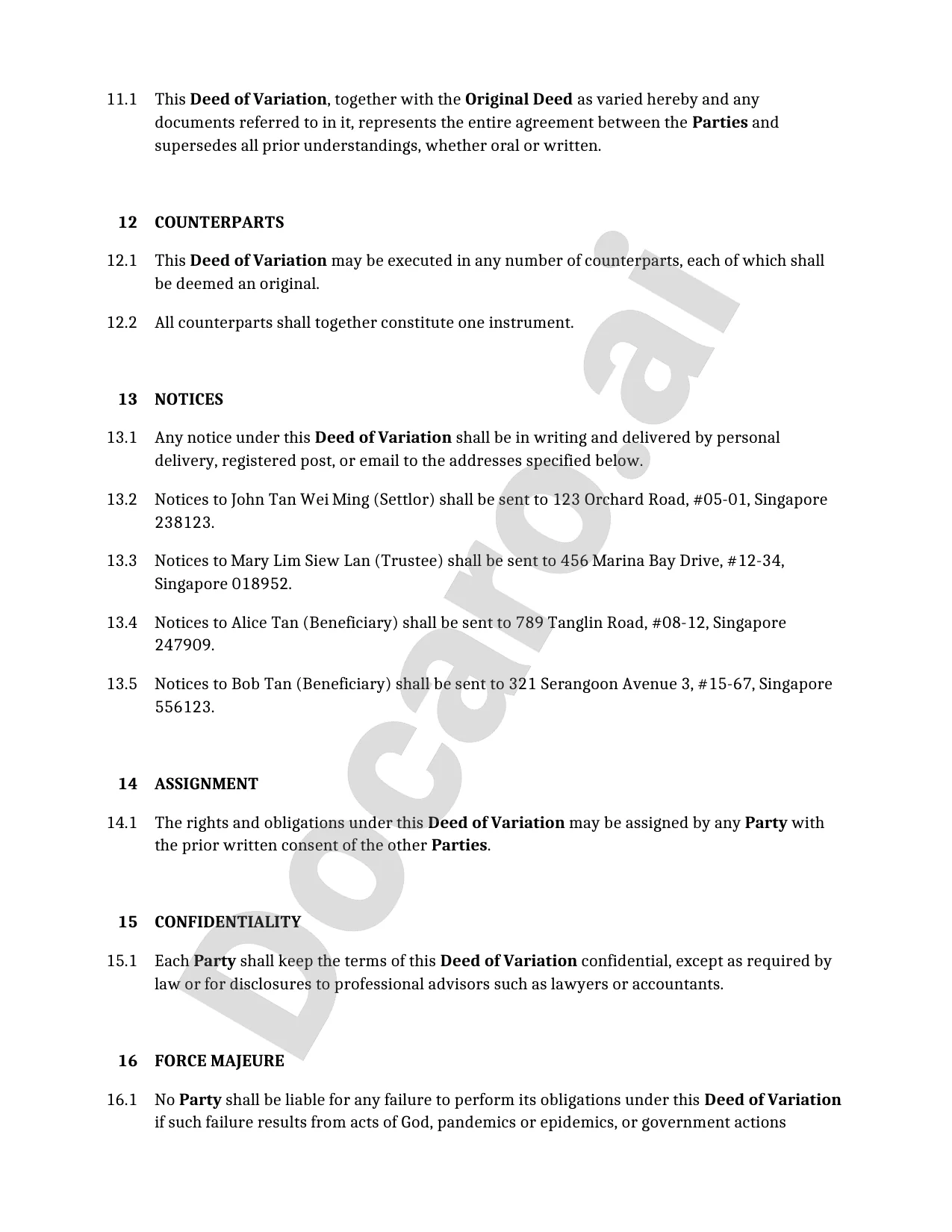
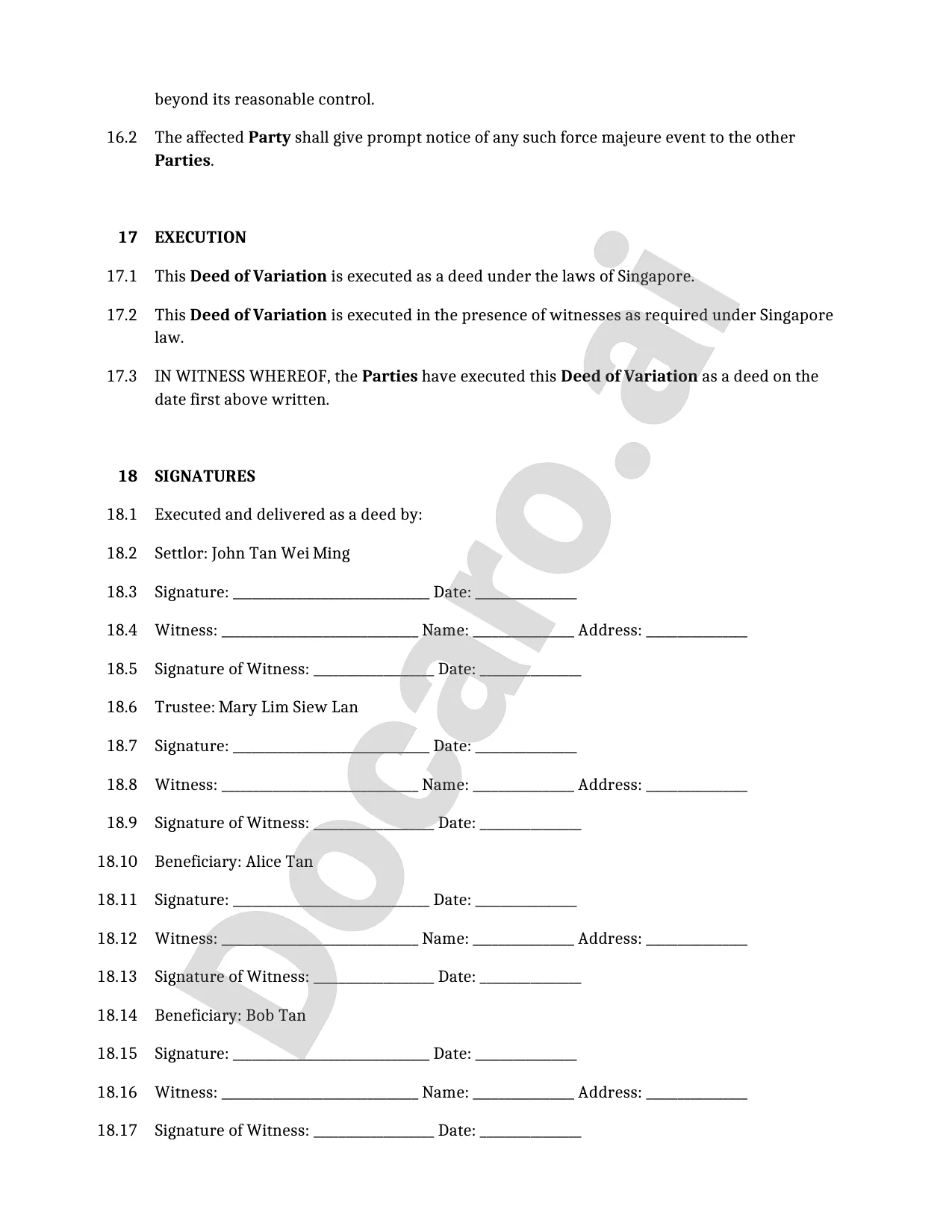
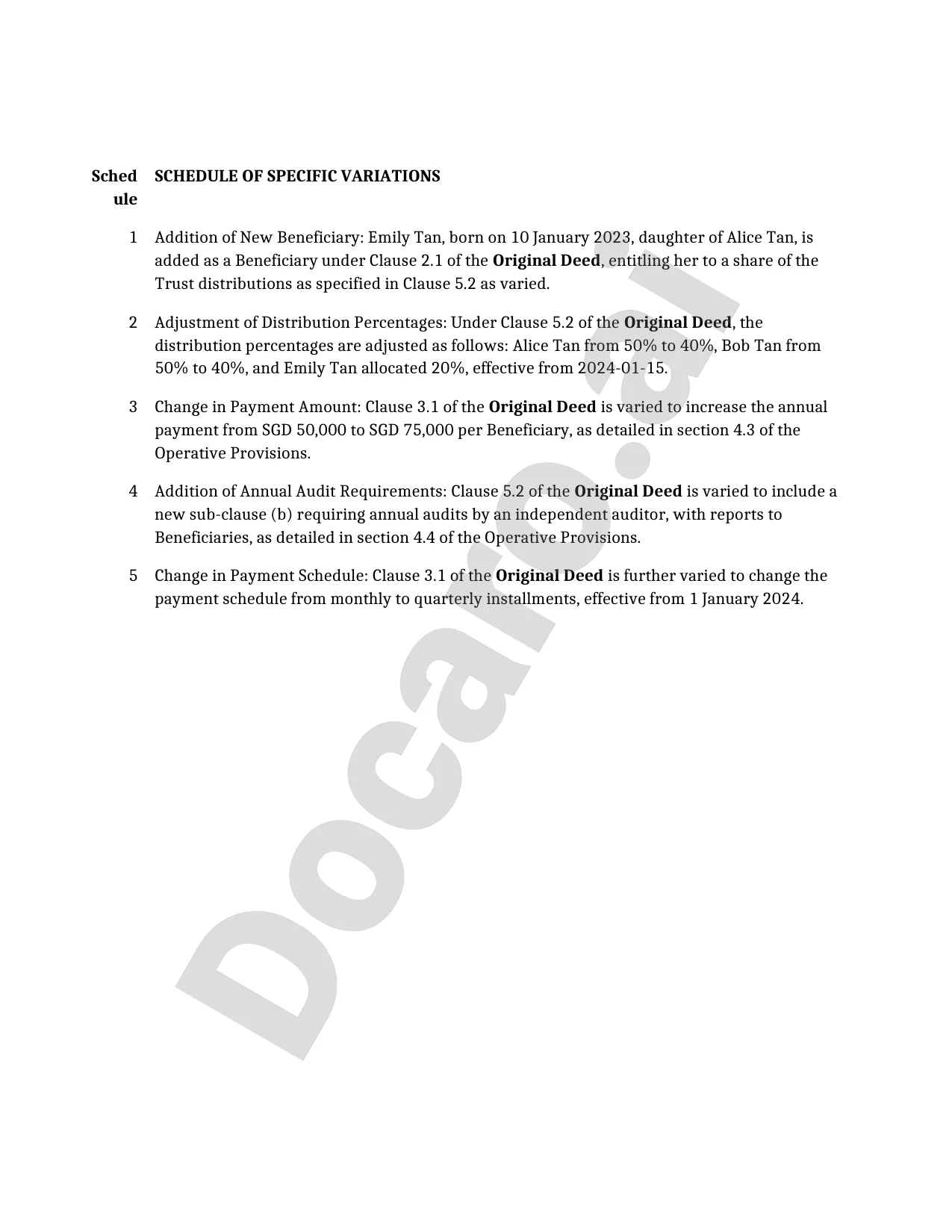
Why Free Templates Can Be Risky for Deed of Variation
Free templates for deeds of variation often use generic language that fails to address Singapore-specific inheritance laws, such as those under the Inheritance (Family Provision) Act or the Wills Act. This mismatch can lead to invalid variations, disputes over estate distribution, or unenforceable changes to wills, potentially resulting in costly legal challenges or unintended tax implications.
An AI-generated bespoke deed of variation is tailored precisely to your unique circumstances and complies with Singapore's legal requirements, ensuring accurate wording that protects your interests, minimizes risks of invalidation, and streamlines the estate variation process for peace of mind.
What is a Deed of Variation in Singapore?
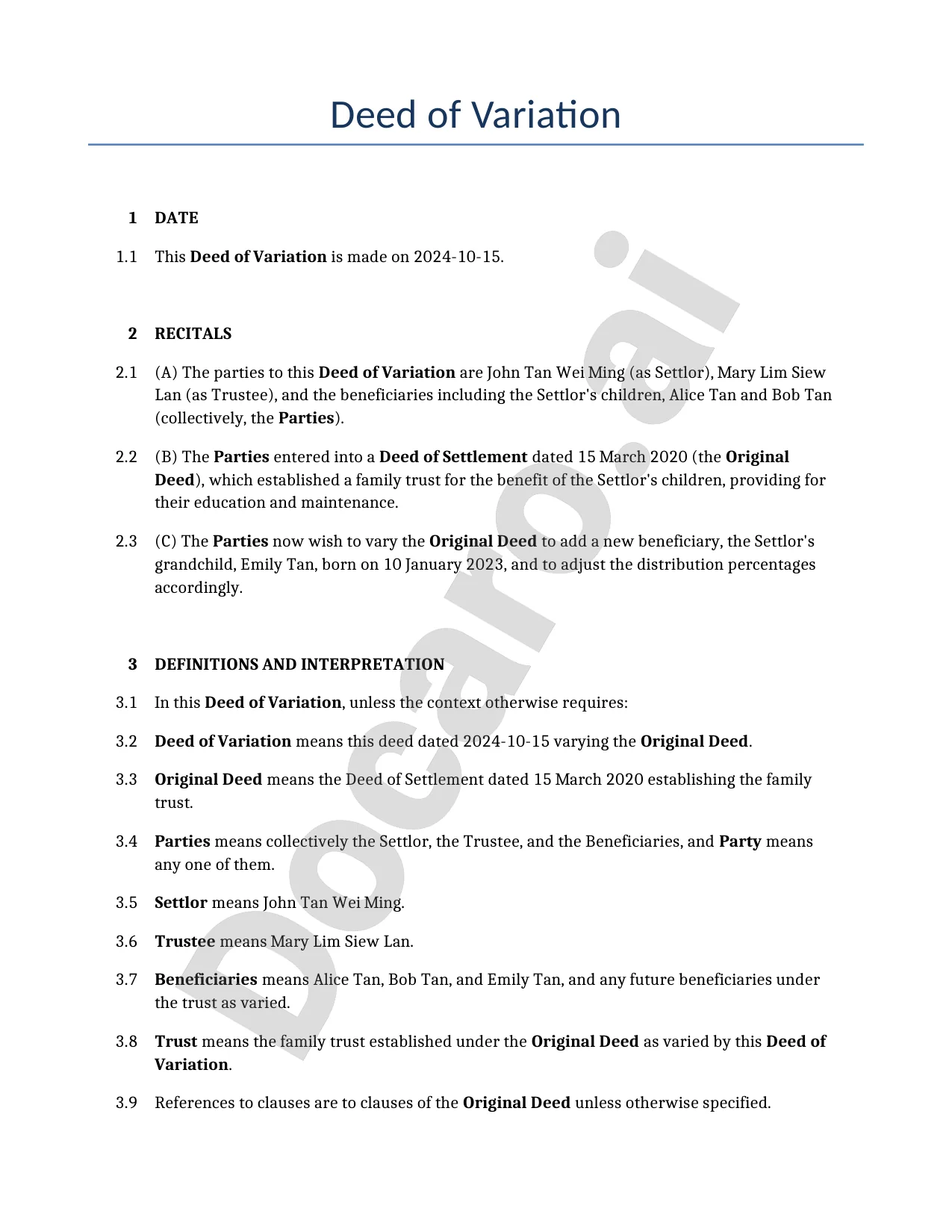
A Deed of Variation under Singapore law is a formal legal document that amends or modifies the terms of an existing agreement, such as contracts, leases, or wills, without requiring a completely new agreement. It ensures that changes are legally binding and enforceable, often executed under seal to provide stronger evidentiary value compared to a simple contract variation.
The primary purpose of a Deed of Variation is to adapt legal agreements to evolving circumstances, such as updating lease terms due to market changes or altering inheritance distributions in wills to reflect current family needs. In Singapore, this instrument is governed by the Land Titles Act for property-related matters and common law principles for other agreements, promoting flexibility while maintaining the original document's integrity.
Common uses of a Deed of Variation in Singapore include:
- Modifying commercial contracts to adjust payment schedules or obligations amid economic shifts.
- Amending residential or commercial leases to extend durations or revise rental rates.
- Altering wills post-execution to redirect assets, provided it complies with the Wills Act and is done within legal timeframes.
- Updating partnership agreements to reflect new member contributions or profit shares.
For tailored modifications, consider bespoke AI-generated legal documents using Docaro to ensure precision under Singapore law.
A Deed of Variation in Singapore enables parties to modify an existing deed efficiently, preserving its original continuity and legal validity without the need for a entirely new document. For tailored amendments that meet your specific needs, opt for bespoke AI-generated legal documents via Docaro to ensure precision and compliance.
When should you use a Deed of Variation in Singapore, and when should you avoid it?
A Deed of Variation in Singapore is a valuable legal tool for modifying certain agreements post-execution, particularly in inheritance distributions after a person's death. For instance, beneficiaries can use it to redirect assets within two years of death to optimize tax outcomes or family needs, as outlined by the Inland Revenue Authority of Singapore (IRAS guidelines on estate duty).
It is also appropriate for adjusting commercial lease terms, such as extending durations or altering rent reviews without voiding the entire lease, provided all parties consent and it complies with the Lease Act. This approach saves time and costs compared to drafting new leases, ideal for minor amendments in business operations.
However, a Deed of Variation should not be used when full renegotiation is required, like overhauling core terms of a complex contract that could lead to disputes or invalidation under Singapore contract law. In such cases, executing a new agreement ensures clarity and enforceability.
Additionally, avoid it if statutory time limits have expired, such as beyond the two-year window for inheritance variations, as courts may reject it, per the Administration of Muslim Law Act or general probate rules. For tailored solutions, consider bespoke AI-generated legal documents using Docaro to fit specific Singaporean needs.

What are the key clauses to include in a Deed of Variation?
A Deed of Variation under Singapore law is a legal document that amends the terms of an existing deed, ensuring clarity and enforceability in contractual relationships. Essential clauses begin with recitals, which reference the original deed by detailing its date, parties involved, and key provisions, providing context for the variation.
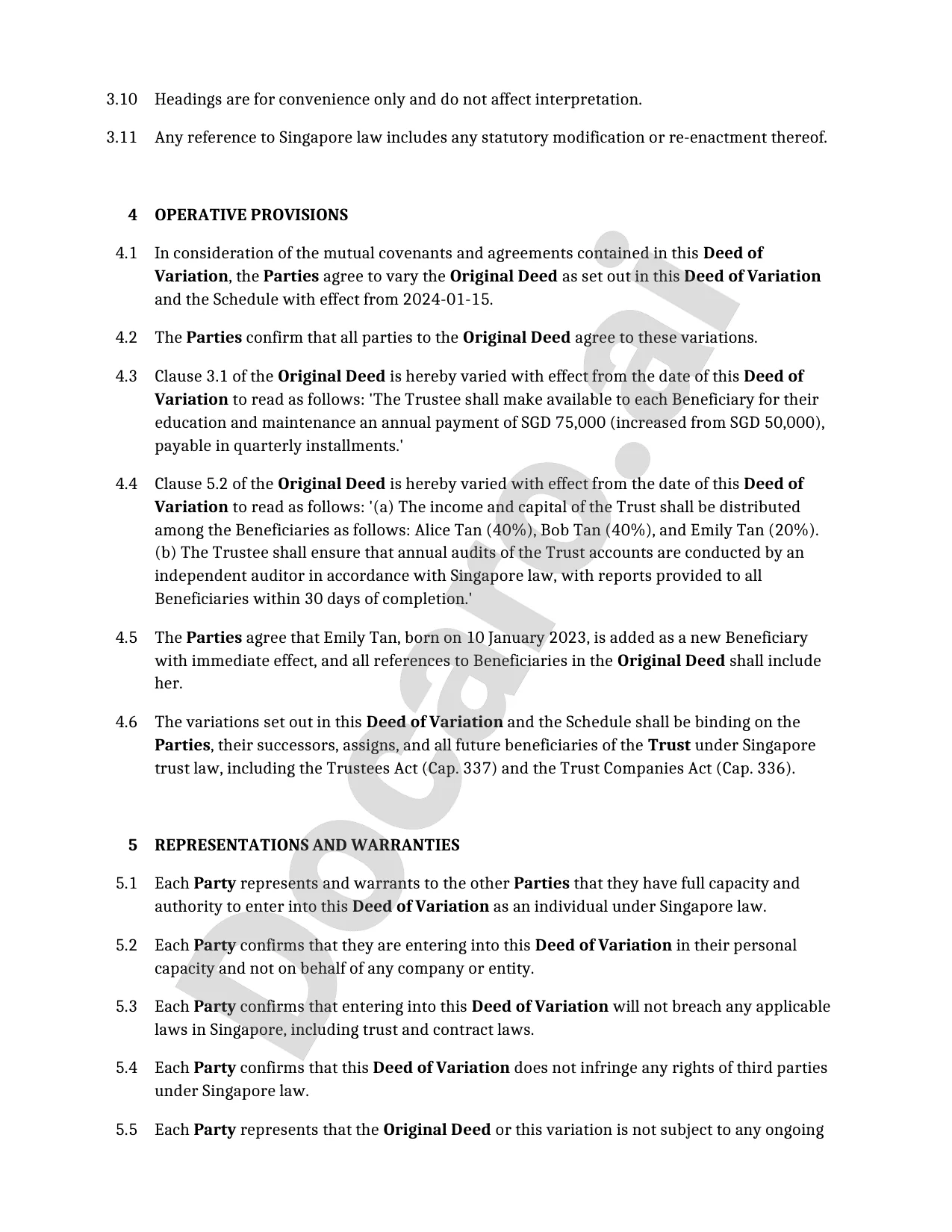
The core of the deed includes variation details, specifying exactly which clauses of the original deed are being altered, added, or deleted to avoid ambiguity. It must outline the precise changes, such as modified obligations or terms, to reflect the parties' new agreement.
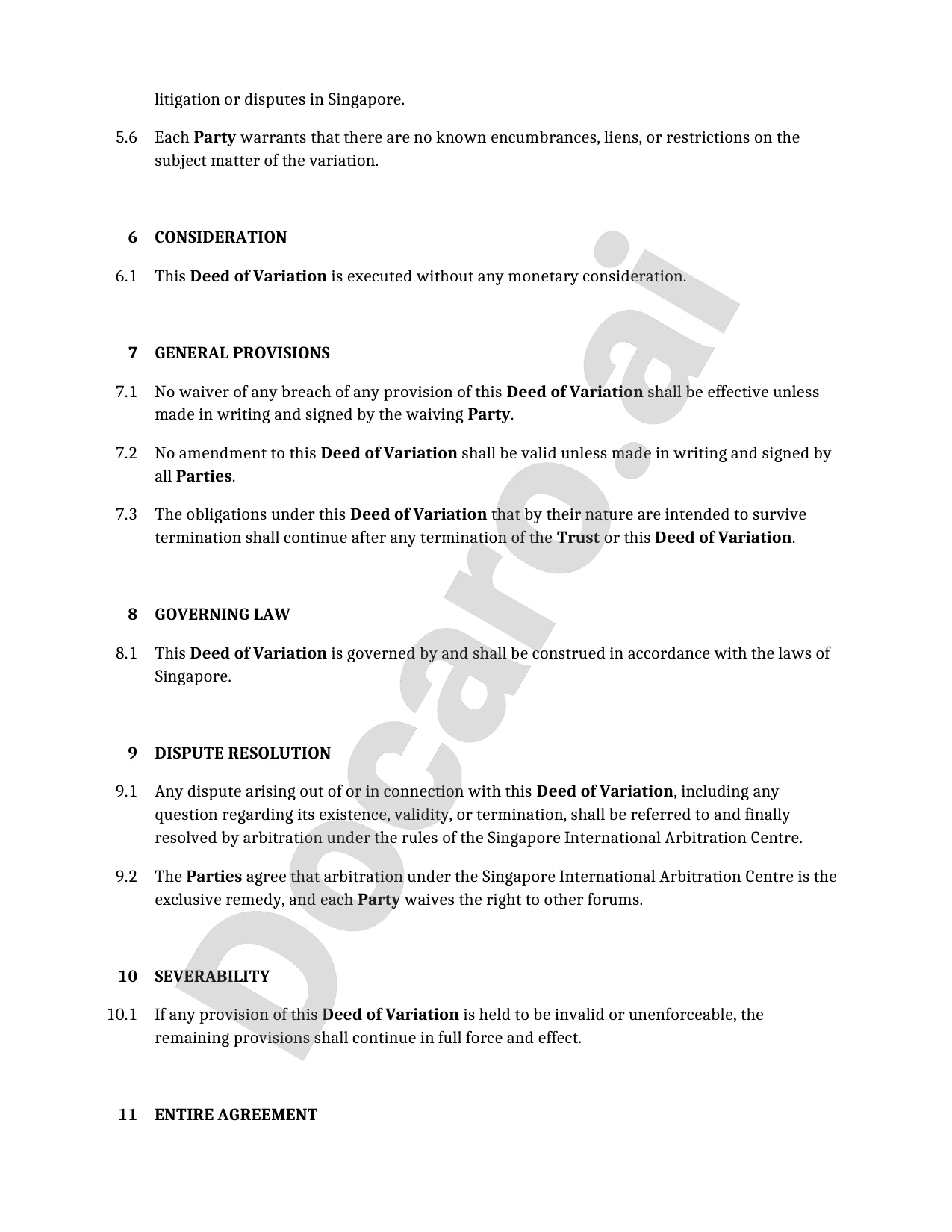
Another critical clause is the effective date, which states when the variations take effect, often retrospectively or from a future date, ensuring all parties understand the timeline. Consideration, if any, should be mentioned if the variation involves new value exchange, though it may not always be required for deeds under Singapore law.
Finally, governing law provisions confirm that the deed is governed by Singapore law, with any disputes resolved through specified mechanisms like arbitration. For authoritative guidance, refer to the Contracts (Rights of Third Parties) Act on the Singapore Statutes Online or consult resources from the Singapore Law Gazette. Always seek bespoke AI-generated legal documents using Docaro for tailored variations compliant with Singapore regulations.
1
Review Original Deed
Examine the original Deed of Variation thoroughly to identify existing clauses, terms, and any ambiguities requiring modification.
2
Identify Key Clauses
Pinpoint essential clauses such as parties involved, variation details, effective date, and consideration for bespoke adjustments.
3
Draft Using Docaro
Utilize Docaro to generate a customized Deed of Variation, incorporating identified clauses tailored to specific needs.
4
Ensure Singapore Compliance
Verify the drafted deed aligns with Singapore legal standards, including stamp duties and registration requirements.
What are the key rights and obligations of parties involved?
A Deed of Variation in Singapore allows beneficiaries to alter the terms of a will or trust after the testator's death, primarily to optimize inheritance tax or redistribute assets. Parties involved, including original beneficiaries and new recipients, must consent to the changes, ensuring all affected individuals agree to avoid disputes.
The obligations of parties include executing the deed properly by signing in the presence of witnesses and registering it if required under Singapore law. Failure to do so can invalidate the variation, leaving the original will intact and exposing parties to legal challenges from third parties like creditors.
For beneficiaries, the deed creates binding implications by treating the variation as if it was part of the original will, potentially affecting their tax liabilities or inheritance rights. Third parties, such as executors, have no direct rights but must facilitate the process, and the variation cannot prejudice their interests without consent.
To ensure compliance, consult authoritative sources like the Singapore Statutes Online for the Wills Act. For tailored documents, opt for bespoke AI-generated legal agreements via Docaro to meet specific needs in Singapore.
Are there any key exclusions or limitations to be aware of?
Deeds of Variation in Singapore allow beneficiaries to alter the distribution of an estate after the testator's death, but they come with key exclusions to ensure fairness and legal compliance. These instruments, often used for estate planning in Singapore, must adhere to strict timelines and consent rules to remain valid.
Under the Inheritance (Provision for Family and Dependants) Act, variations to wills are restricted after six months from the date of death, preventing changes that could undermine claims by family members or dependants. This provision protects vulnerable parties, and for detailed guidance, refer to the official Inheritance (Provision for Family and Dependants) Act on the Singapore Statutes Online.
Unilateral changes without consent are not permitted in Deeds of Variation; all affected beneficiaries must agree to the alterations to avoid disputes. This limitation ensures that no single party can impose variations, promoting equitable inheritance law in Singapore.
For creating customized Deeds of Variation, consider bespoke AI-generated legal documents through Docaro to tailor solutions to your specific estate needs, rather than relying on generic options.
What recent or upcoming legal changes affect Deeds of Variation in Singapore?
As of the latest available information in 2023, there have been no significant legal changes in Singapore specifically impacting Deeds of Variation under the Wills Act or probate rules. These instruments remain a key tool for beneficiaries to redirect inheritance without requiring a full grant of probate, subject to existing time limits and tax implications.
The Wills Act continues to govern testamentary dispositions, with no recent amendments altering the validity or execution of Deeds of Variation. For authoritative guidance, refer to the Wills Act on the Singapore Statutes Online portal maintained by the Attorney-General's Chambers.
Probate processes under the Probate and Administration Act have seen minor procedural updates for efficiency, but nothing directly affects Deeds of Variation. Practitioners should monitor announcements from the State Courts of Singapore for any future developments in estate administration.
How can you get started with a Deed of Variation in Singapore?
1
Consult a Lawyer
Schedule a consultation with a qualified lawyer to discuss your intentions for the Deed of Variation and ensure it aligns with legal requirements.
2
Gather Original Documents
Collect the original will, death certificate, and any relevant estate documents to provide a complete picture for the variation process.
3
Generate Bespoke Document with Docaro
Use Docaro to create a customized AI-generated Deed of Variation based on your lawyer's advice and the gathered documents.
4
Prepare for Execution and Stamping
Review the document with your lawyer, arrange for signing by all parties, and submit for stamping to make it legally effective.
Where can you find more detailed guides on Deeds of Variation?
For those seeking a deeper understanding of estate planning in Singapore, further reading on key topics can provide essential insights into managing inheritances effectively.
Additionally, consult authoritative resources like the Ministry of Law Singapore website for official guidelines on probate and succession laws in Singapore.
You Might Also Be Interested In
A Contract Outlining The Terms For Consultancy Services Provided By An Independent Contractor.
A Contract Outlining The Rights, Obligations, And Governance Rules Among Shareholders Of A Company.
A Legal Contract Outlining The Terms, Rights, And Obligations Of Partners In A Business Partnership.
A Shareholders' Agreement Is A Contract Among Shareholders Of A Private Limited Company Outlining Ownership, Management, And Operational Rules.
A Constitution Is The Foundational Document For A Company In Singapore, Outlining Its Structure, Objectives, And Internal Rules.
A Constitution Is The Foundational Document Governing A Company's Internal Management, Operations, And Member Rights In Singapore.
A Legal Contract Outlining The Terms For Buying And Selling Shares In A Company.
A Formal Decision Or Action Approved By The Board Of Directors Of A Company, Documented In Writing.
A Founders' Agreement Is A Legal Contract Outlining The Rights, Obligations, And Roles Of Company Founders, Including Equity Distribution, Decision-making, And Dispute Resolution.
A Legal Contract Outlining The Terms For The Sale And Purchase Of Specific Assets Between Parties.
A Legal Contract Outlining The Terms For The Sale And Transfer Of A Business Entity, Including Assets, Liabilities, And Obligations.
A Legal Contract Outlining The Terms For The Sale And Transfer Of Property Ownership From Seller To Buyer.
A Formal Receipt Is A Legal Document Issued By A Seller To A Buyer, Confirming Payment For Goods Or Services And Serving As Proof Of Transaction.
A Tax Invoice Is A Formal Document Issued By GST-registered Businesses In Singapore To Charge Customers For Goods Or Services, Including GST Details For Tax Compliance.
A Legal Contract Outlining The Terms Under Which One Party Provides Services To Another.
A Legal Document Used To Transfer Ownership Of Shares In A Company From One Party To Another, Typically Required For Registration With The Company.
A Document Outlining Measures To Protect Individuals, Especially Vulnerable Groups Like Children, From Harm And Abuse In Organizational Settings.
A Non-binding Document Outlining Preliminary Terms And Intentions For A Potential Business Deal Or Agreement.