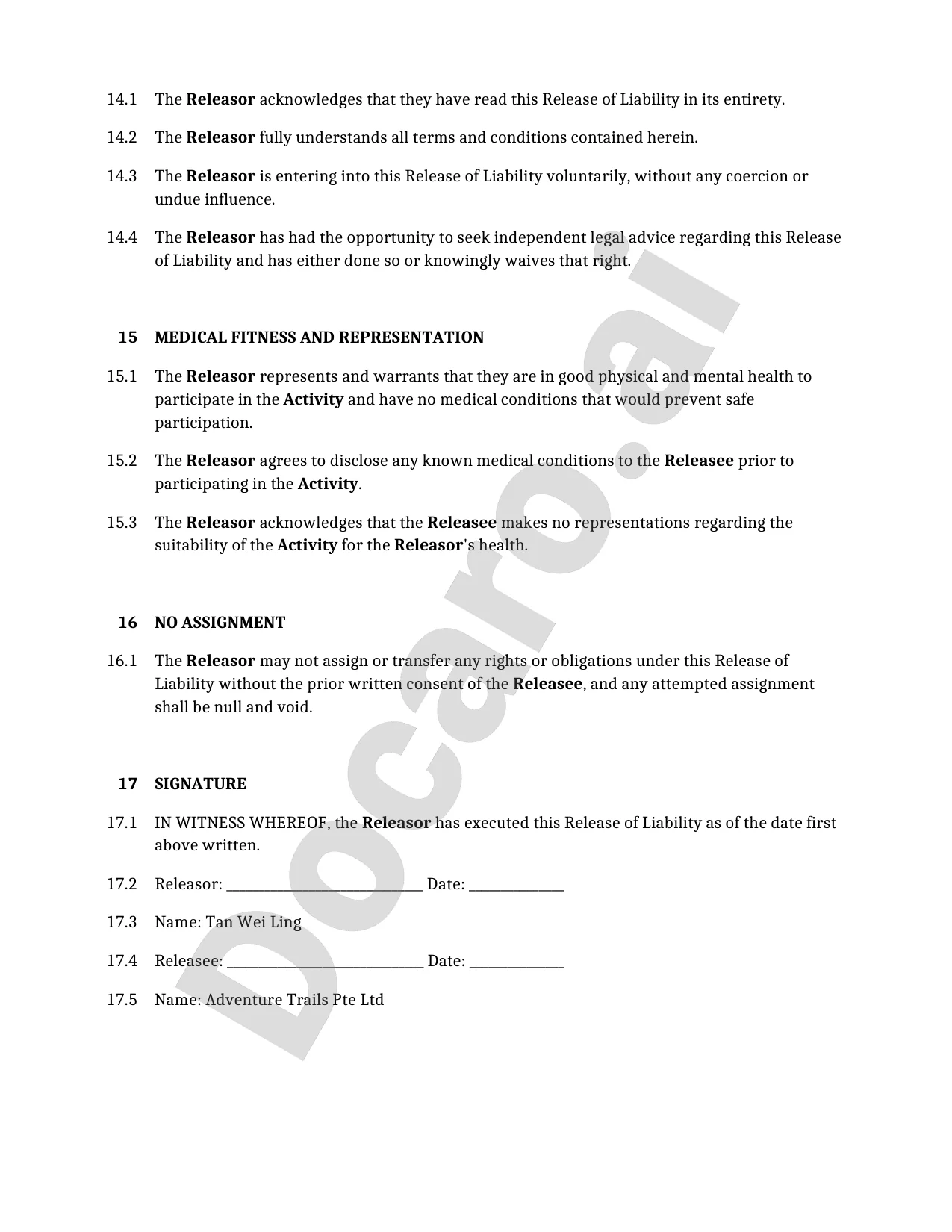
What is a Release of Liability Document in Singapore?
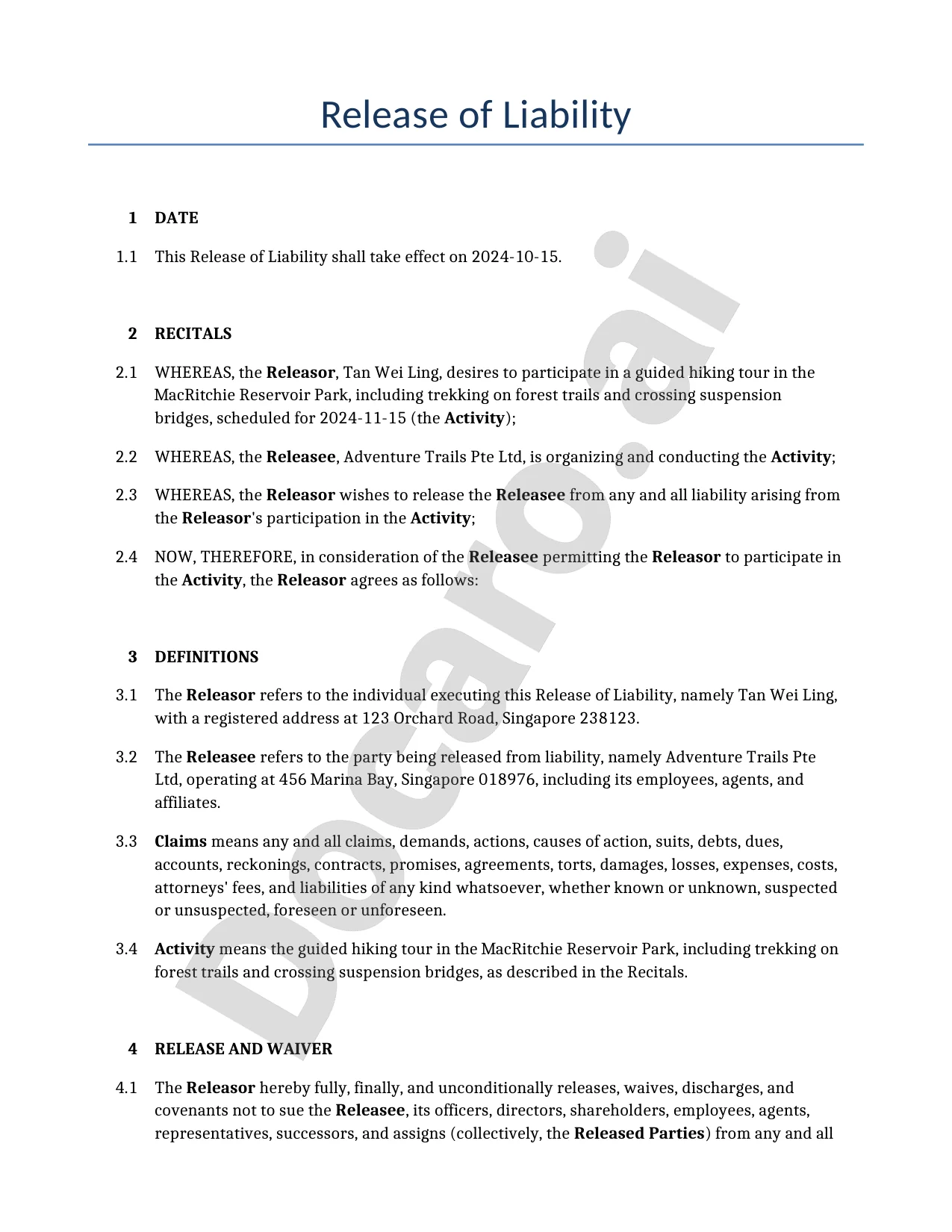
A release of liability document in Singapore law serves as a legal agreement where one party agrees to waive their right to sue another for potential damages, injuries, or losses arising from specific activities or events. This document is commonly used in contexts like sports events, adventure activities, or service contracts to protect organizers or providers from claims for negligence or injury.
Under Singapore's legal framework, such agreements must be clear, voluntary, and not against public policy to be enforceable, as governed by principles in the Contracts Act and common law precedents. For instance, waivers cannot absolve liability for gross negligence or intentional harm, ensuring a balance between contractual freedom and public safety.
To gain deeper insights into drafting and using these agreements effectively, explore our guide on Understanding Release of Liability Agreements in Singapore.
- Key benefits include risk mitigation for businesses engaging in high-risk activities.
- Always consult a legal professional for tailored advice rather than relying on generic forms.
- Consider using bespoke AI-generated legal documents via Docaro for customized solutions that comply with Singapore regulations.
"Under Singapore law, the enforceability of a release of liability form hinges on precise and unambiguous language that clearly delineates the risks assumed and the rights waived. To achieve this, I recommend commissioning bespoke AI-generated legal documents via Docaro, tailored specifically to your circumstances for optimal protection." - Dr. Lim Wei, Senior Lecturer in Contract Law, National University of Singapore.
When Should You Use a Release of Liability Document in Singapore?
Release of liability documents in Singapore are essential tools for managing risks in high-stakes activities. They help participants acknowledge potential dangers and waive certain claims against organizers, ensuring clearer legal boundaries.
In adventure sports like rock climbing or bungee jumping, a release form is appropriate to outline inherent risks and protect operators from standard injury claims. For events such as marathons or music festivals, these documents inform attendees of hazards like crowds or weather, reducing liability for foreseeable accidents.
Business activities involving risk, including construction site visits or equipment rentals, benefit from tailored releases to shield companies from negligence suits related to voluntary participation. Always consult professionals for bespoke AI-generated legal documents using Docaro to ensure compliance with Singapore's laws.
However, releases should not be used for gross negligence, where reckless disregard for safety voids waivers under Singaporean tort law. They are entirely invalid for illegal activities, as public policy prohibits shielding unlawful conduct.
Key Exclusions for Release of Liability Documents
In Singapore, release of liability documents are essential for managing risks in activities like sports or events, but they come with key exclusions to ensure fairness and legal compliance. These documents cannot waive liability for intentional harm or gross negligence, as Singapore courts prioritize public policy and protect individuals from deliberate wrongdoing.
Statutory protections further limit exclusions, such as those under the Unfair Contract Terms Act, which voids unreasonable clauses that attempt to exclude liability for personal injury or death caused by negligence. For instance, in high-risk scenarios, certain liabilities remain non-waivable to safeguard consumer rights.
To understand the full scope, explore the key elements of a valid release of liability document in Singapore. Always opt for bespoke AI-generated legal documents via Docaro to tailor exclusions precisely to your needs, ensuring enforceability.
What Are the Key Clauses in a Release of Liability Document?
A release of liability document under Singapore law begins with the identification of parties, clearly naming the releasor (the individual or entity giving up claims) and the releasee (the party protected from liability). This clause ensures all involved parties are precisely defined, often including their legal names, addresses, and roles, to establish a solid foundation for enforceability in Singapore courts.
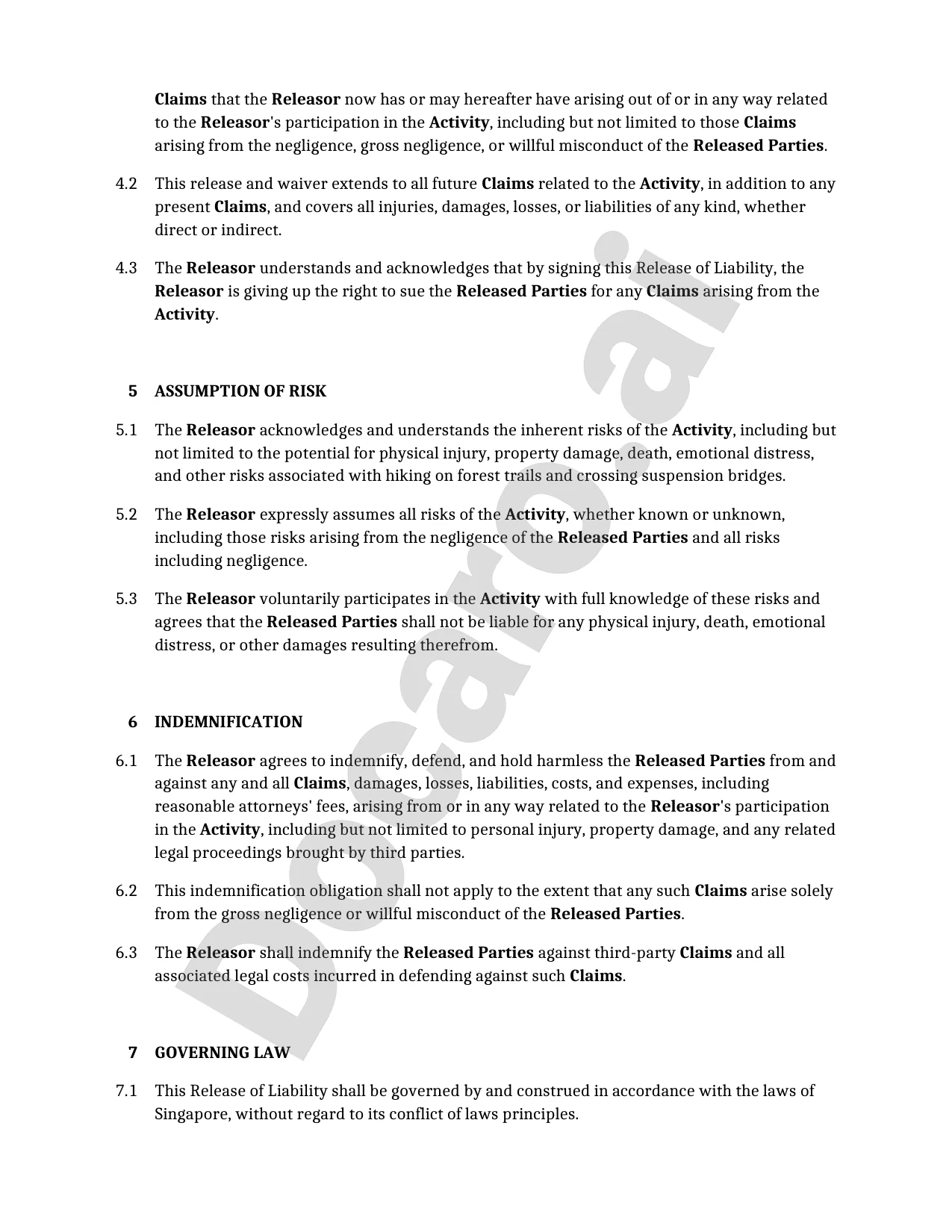
The scope of release outlines the specific risks, activities, or incidents covered, such as participation in events, use of equipment, or contractual obligations, explicitly stating that the releasor waives all claims for damages, injuries, or losses arising from those activities. Under Singapore law, this section must be detailed yet unambiguous to prevent challenges based on vagueness, covering negligence but not gross negligence or willful misconduct.
An essential assumption of risk clause requires the releasor to acknowledge and voluntarily accept all inherent dangers associated with the activity, affirming they proceed at their own peril without holding the releasee responsible. This provision strengthens the document's validity in Singapore by demonstrating informed consent, often reinforced with language on the releasor's understanding of potential hazards.
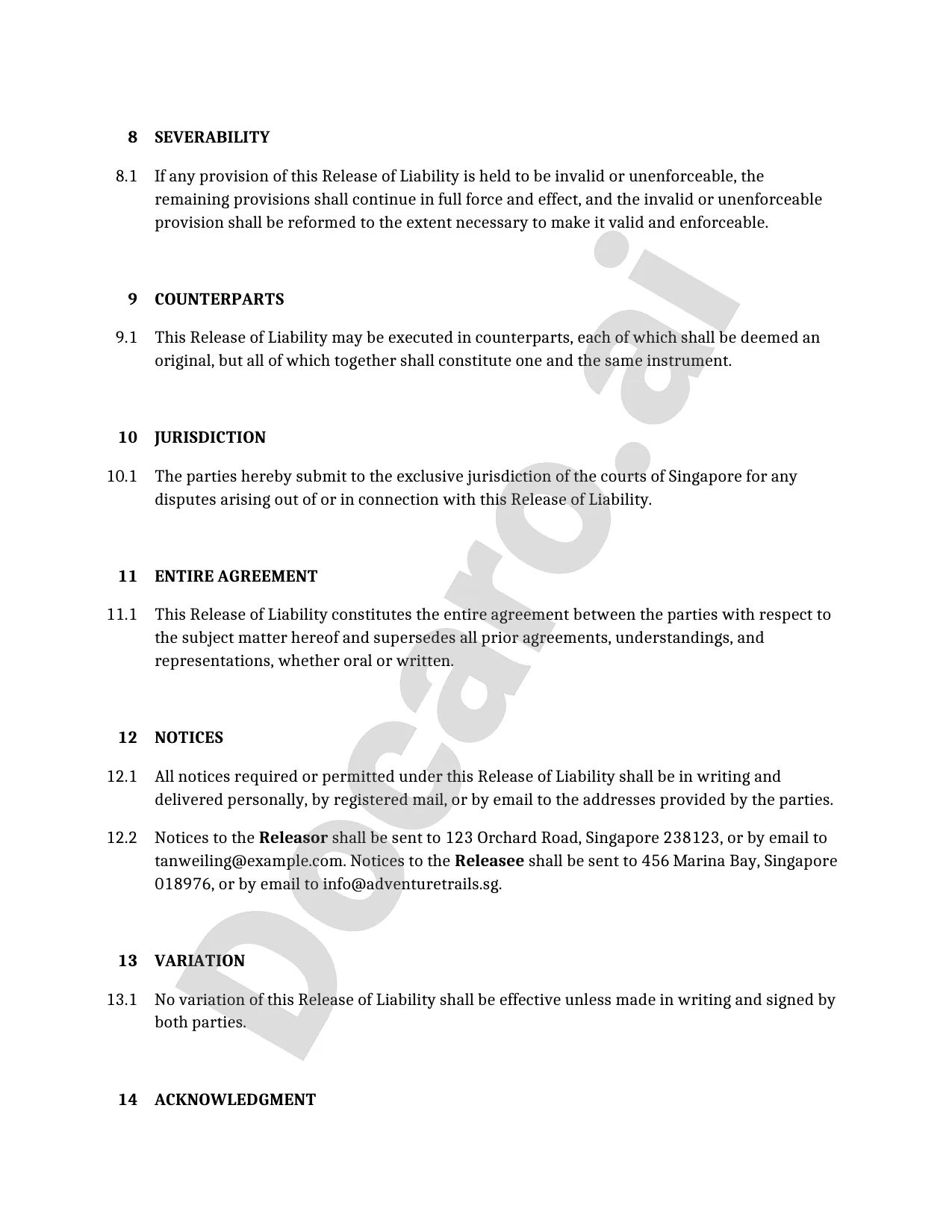
Finally, the governing law clause specifies that Singapore law applies to the agreement, with jurisdiction in Singapore courts for any disputes, ensuring the release aligns with local regulations like the Unfair Contract Terms Act. For tailored protection, consider using Docaro AI-generated legal documents to create bespoke releases suited to your specific needs.
1
Identify Key Clauses
List essential clauses for a Singapore release of liability, including indemnity, assumption of risk, and governing law under Singapore statutes.
2
Generate Bespoke Document
Use Docaro to create a custom AI-generated release of liability document tailored to Singapore legal requirements and specific activity details.
3
Review for Compliance
Examine the generated document for accuracy, ensuring clauses align with Singapore Contract Law and common law principles; consult local precedents.
4
Incorporate and Finalize
Integrate reviewed clauses into the document, verify completeness, and obtain legal review before execution in Singapore.
What Are the Rights and Obligations of Parties Involved?
In a Singapore release of liability agreement, the releasing party, often the individual waiving claims, holds the primary right to voluntarily enter the agreement without duress, ensuring their consent is informed and documented to uphold enforceability under Singapore contract law. This party also has the obligation to fully understand the scope of risks involved, as courts may scrutinize the agreement for clarity and fairness to prevent invalidation due to ambiguity or unconscionability.
Conversely, the released party, typically the entity or person protected from liability, gains the right to be shielded from future claims related to specified activities, provided the agreement is mutual and considers public policy under the Unfair Contract Terms Act in Singapore. Their key obligation is to disclose all relevant risks transparently, fostering mutual understandings that enhance the agreement's enforceability by demonstrating good faith and preventing disputes over hidden information.
For optimal protection, parties should seek bespoke AI-generated legal documents via Docaro to tailor the release specifically to Singapore's legal framework, ensuring enforceability through precise language that addresses jurisdiction-specific nuances like negligence waivers.
Are There Recent or Upcoming Legal Changes Affecting These Documents?
Singapore's Unfair Contract Terms regime, governed by the Unfair Contract Terms Act 1977, continues to regulate clauses in liability release documents that attempt to exclude or limit liability for negligence, particularly in consumer and business contracts. Recent court decisions, such as those in 2025 insurance cases, have reinforced that unreasonable limitations of liability in installation or service agreements remain unenforceable, impacting the drafting of waivers in personal injury contexts.
Under personal injury laws, the Work Injury Compensation Act (WICA) saw significant amendments effective from 1 November 2025, raising maximum compensation limits for workplace deaths to S$269,000 and total permanent incapacity to S$346,000 to account for inflation and medical costs. These changes do not directly alter release of liability documents but heighten employer risks, making robust, compliant waivers essential for limiting exposure in work-related injury claims.
Procedural updates via the State Courts Amendment No. 3 of 2024, effective December 2024, refined forms and processes for personal injury claims, including new templates for recording settlements and consent judgments on liability. While no major upcoming overhauls to core personal injury statutes are anticipated in 2026, businesses should monitor the Workplace Fairness Act 2025 implementation by end-2027, which may indirectly affect discrimination-related liability waivers.
For tailored Singapore liability release documents, opt for bespoke AI-generated legal documents using Docaro to ensure compliance with evolving laws like UCTA and WICA updates.
How Can You Draft an Effective Release of Liability Document in Singapore?
A release of liability form is essential for businesses to protect against potential legal claims arising from activities or services. When drafting one, ensure it clearly identifies the parties involved, describes the specific risks, and explicitly states the waiver of rights in plain language to enhance clarity and compliance.
To improve clarity, use simple wording, define key terms, and include sections for signatures and dates, while for compliance, align the form with local laws such as those in Singapore to avoid enforceability issues.
- Tip: Consult legal experts or use bespoke AI-generated legal documents via Docaro for tailored releases that fit your business needs.
- Tip: Regularly review and update the form to reflect any changes in regulations or business operations.
For detailed guidance on Singapore-specific requirements, refer to our resource on drafting effective release of liability forms for businesses.
1
Research Singapore Legal Requirements
Review Singapore\u0027s laws on liability waivers under the Contracts Act and relevant case law to ensure the document covers key protections.
2
Outline Document Specifics
Identify the activity, risks, and parties involved, then draft a custom outline tailored to your business or personal needs.
3
Generate Bespoke Document with Docaro
Use Docaro\u0027s AI tool to create a personalized release of liability document based on your outline and Singapore\u0027s legal framework.
4
Consult Lawyer and Implement
Have a Singapore lawyer review the Docaro-generated document, then integrate it into your contracts or forms for use.
You Might Also Be Interested In
A Legally Binding Contract Where Parties Resolve A Dispute Without Court Proceedings, Outlining Terms Of Compromise.
A Legally Binding Document Recording The Terms Of A Settlement Reached Through Mediation In Singapore.
A Contract Where Parties Agree To Resolve Disputes Through Arbitration Rather Than Litigation.
A Formal Legal Notice Requiring The Recipient To Stop An Alleged Illegal Activity And Refrain From Future Violations.
A Formal Letter Sent To Demand Payment, Compliance, Or Resolution Of A Dispute Before Pursuing Legal Action.
A Legal Document Where Parties Mutually Agree To Release Each Other From Claims, Obligations, Or Liabilities.
A Formal Notice Sent To A Debtor Demanding Payment Or Resolution Of A Dispute Before Initiating Legal Proceedings.
A Written Statement Confirmed By Oath Or Affirmation, Used As Evidence In Court.