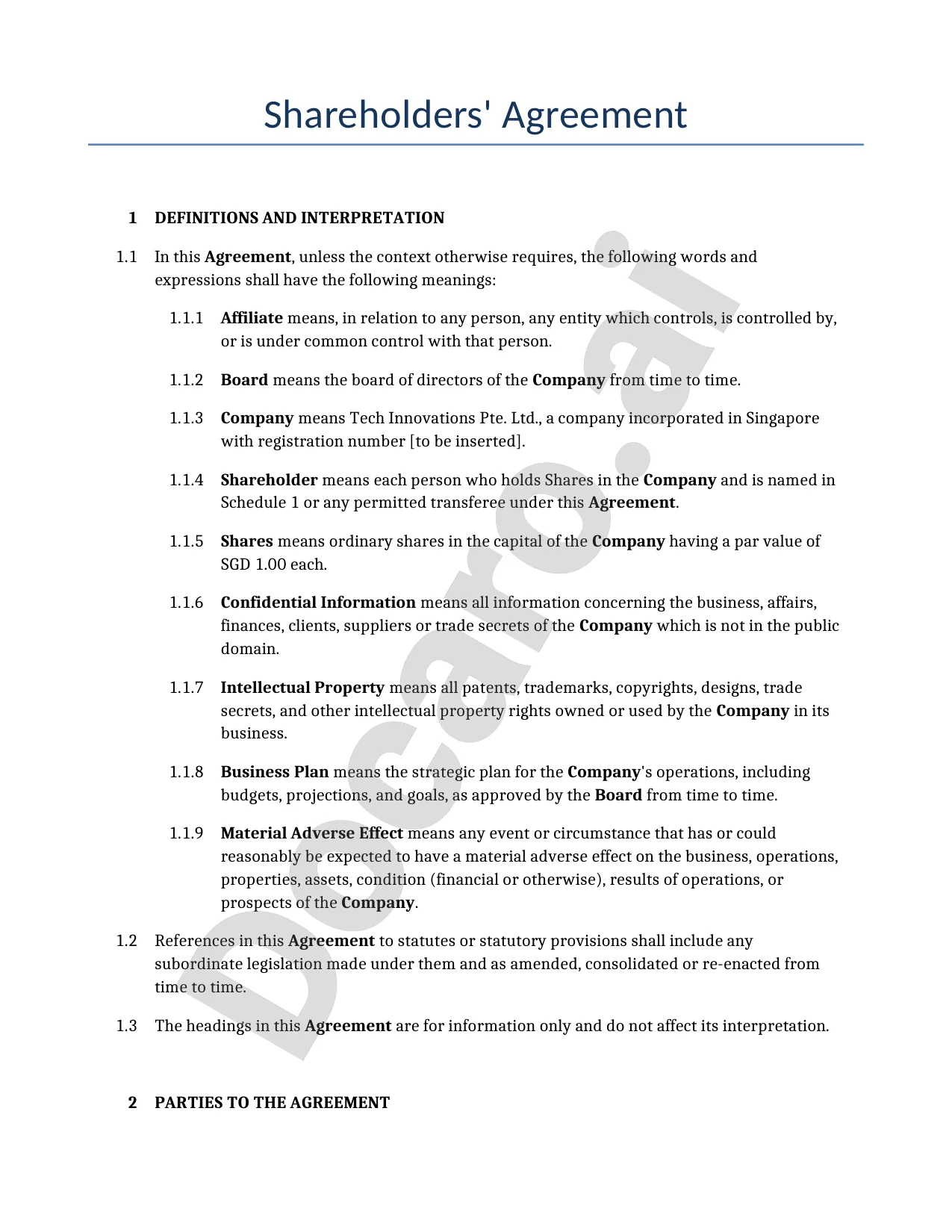
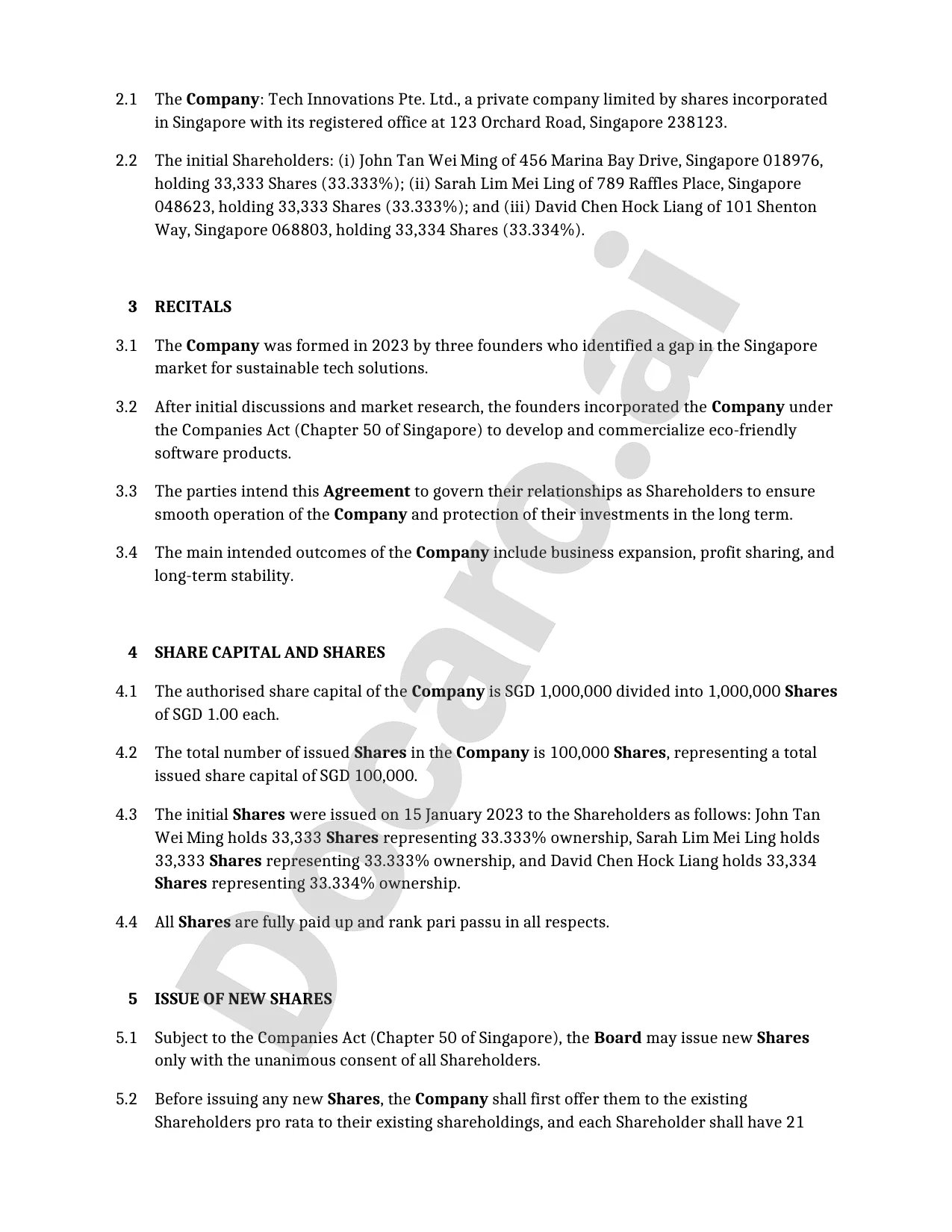
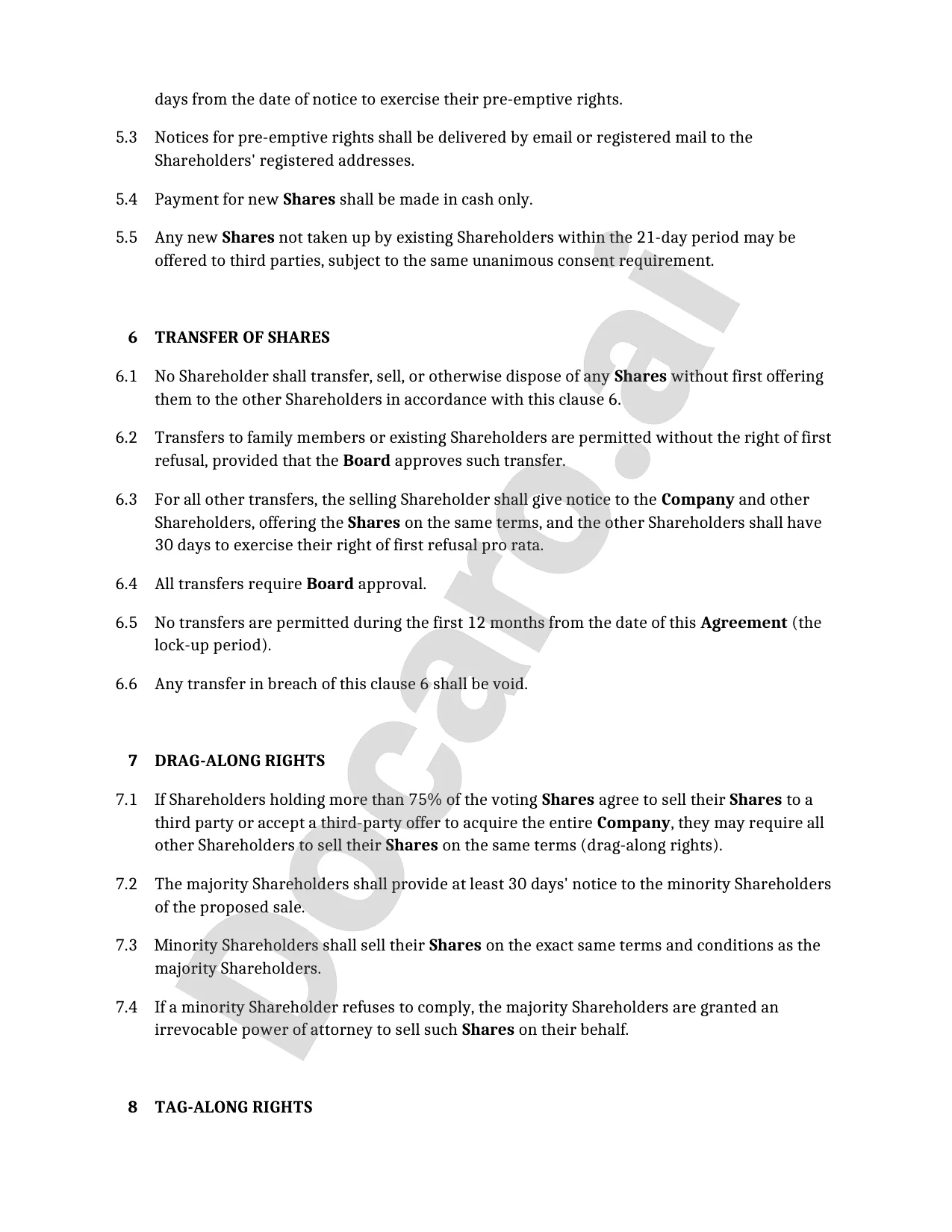
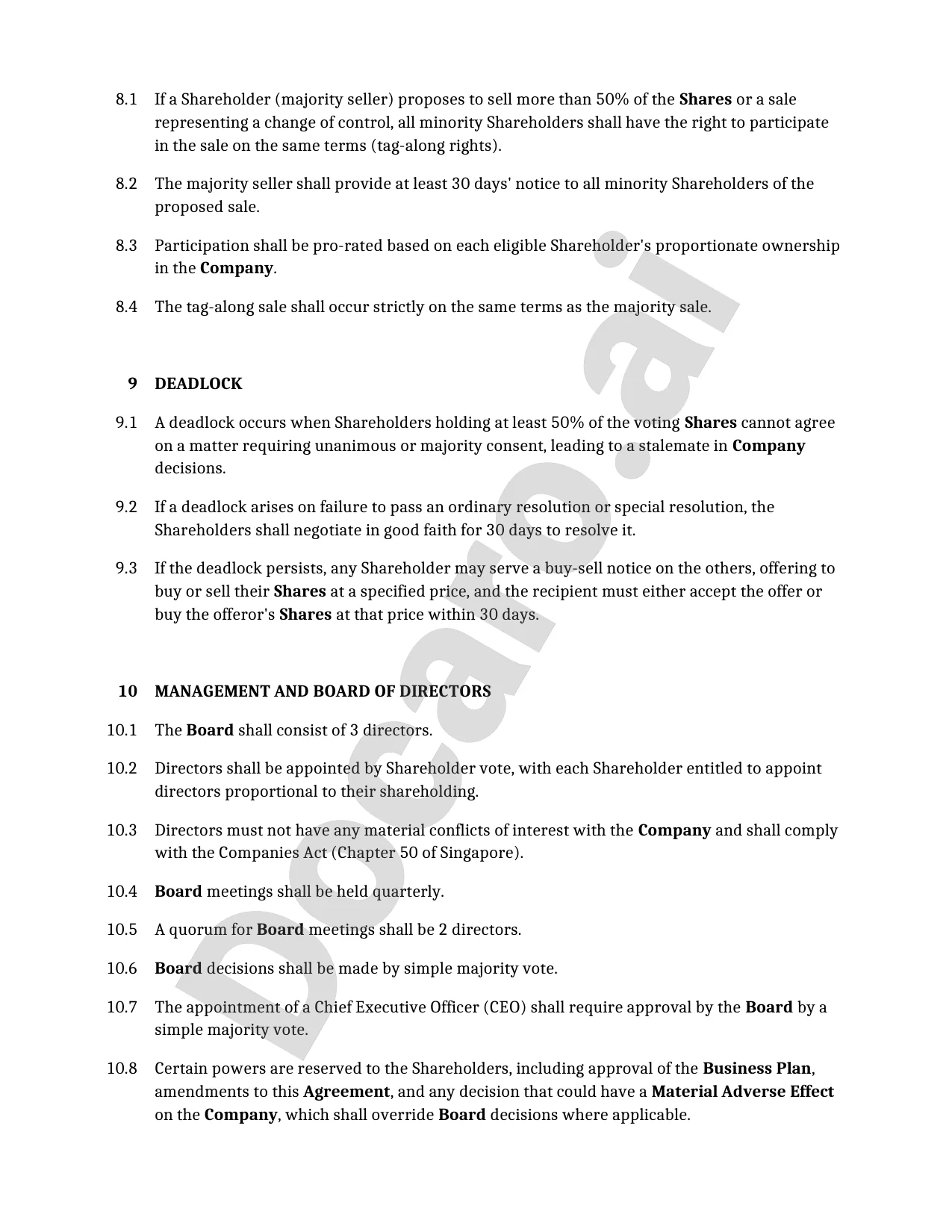
What is a Shareholders' Agreement in Singapore?
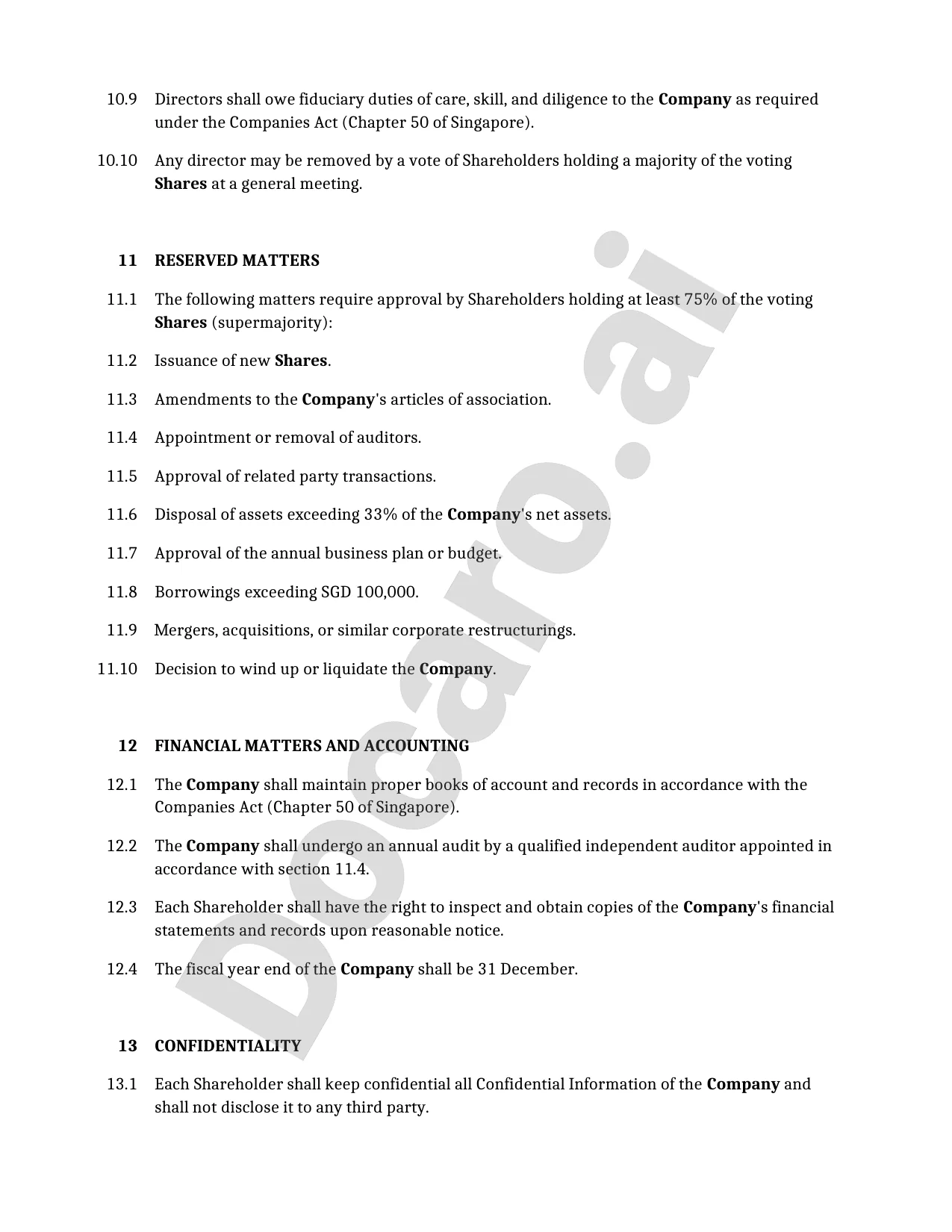
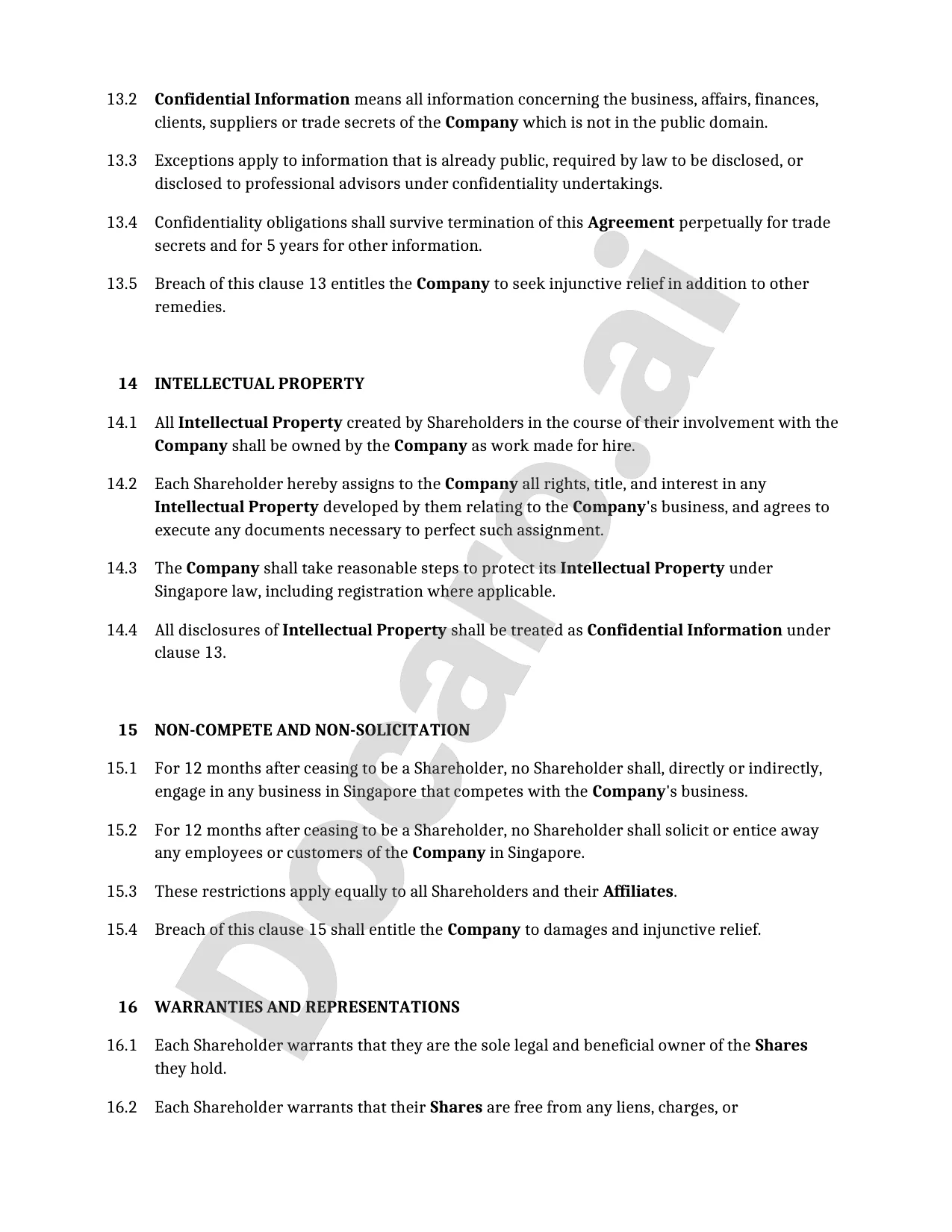
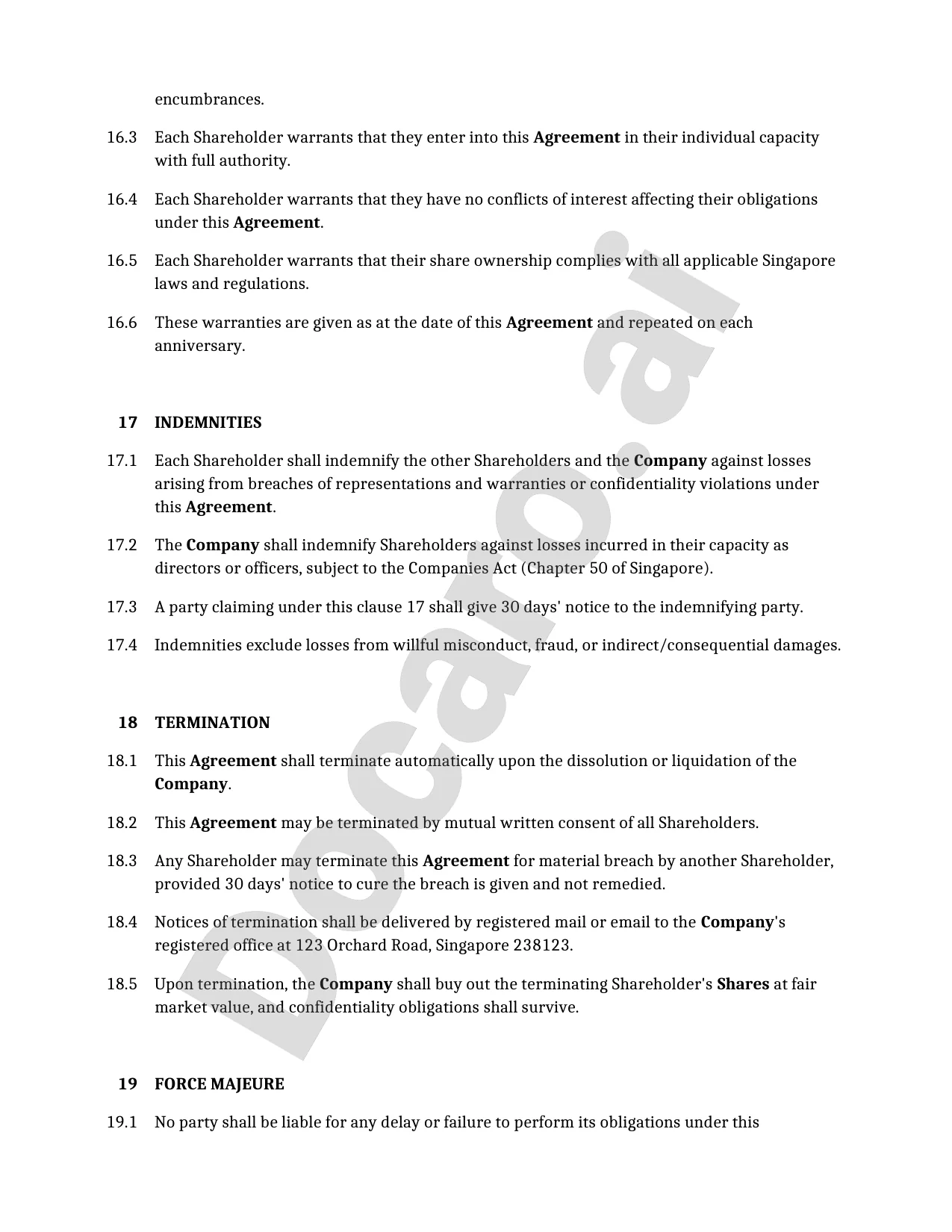
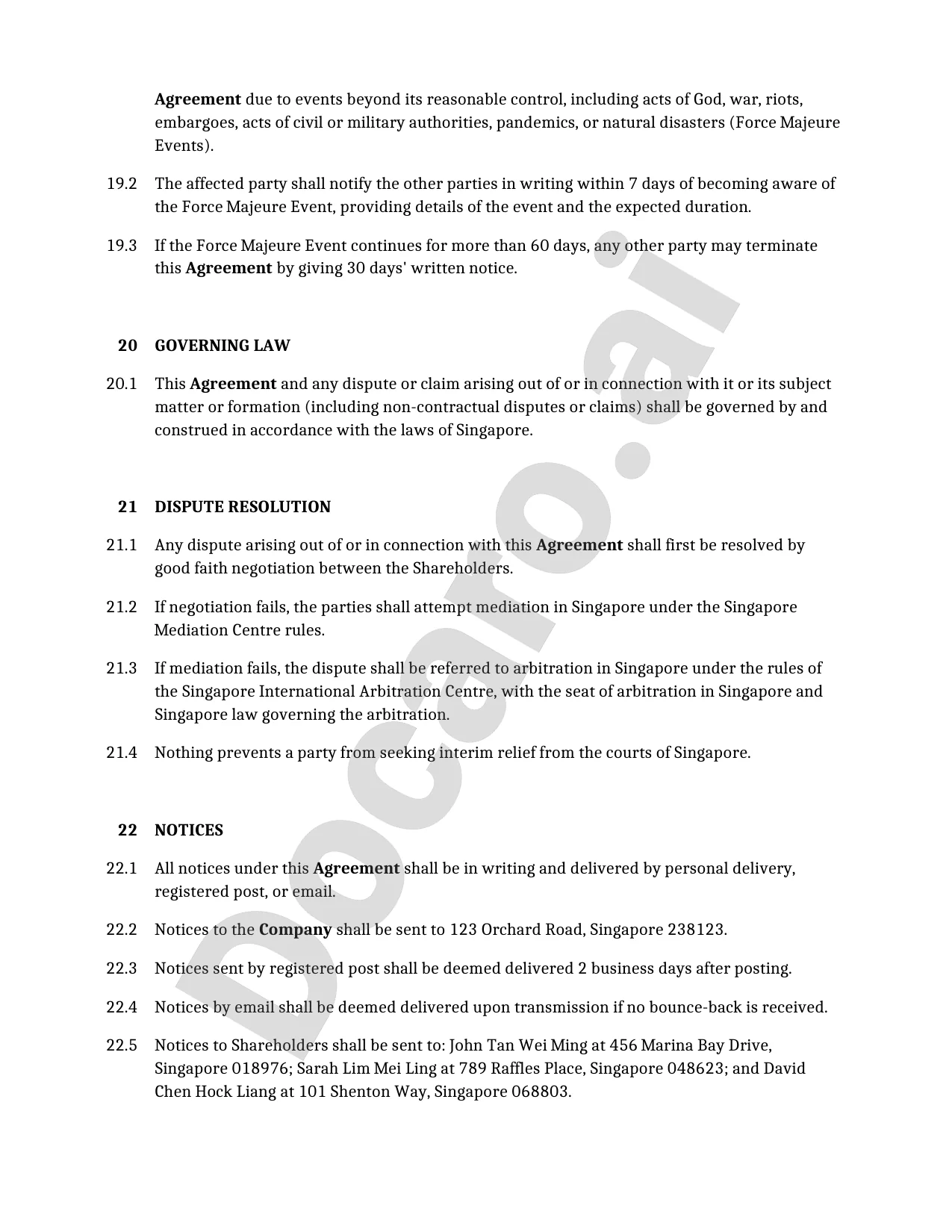
A Shareholders' Agreement under Singapore law is a private contract between shareholders of a company that outlines their rights, obligations, and the governance of the company. It is particularly vital for private companies in Singapore, where it helps prevent disputes by setting clear rules on share transfers, decision-making, and exit strategies.
The primary purpose of a Shareholders' Agreement is to protect minority shareholders and ensure smooth operations in closely held firms, complementing the statutory framework under the Companies Act. For private limited companies, it addresses gaps in standard regulations by customizing terms to the specific needs of the shareholders involved.
This agreement supplements the company's constitution by providing more detailed and flexible provisions that the constitution might not cover in depth, such as dispute resolution mechanisms or dividend policies. While the constitution is a public document filed with the Accounting and Corporate Regulatory Authority (ACRA), the Shareholders' Agreement remains confidential, offering tailored protections without public disclosure.
- Key benefits include regulating shareholder voting rights and management control to align with business goals.
- It promotes stability by including clauses on drag-along and tag-along rights during sales.
- For bespoke needs, consider using Docaro to generate customized Shareholders' Agreements tailored to Singapore law.
A well-drafted Shareholders' Agreement, generated bespoke via Docaro, safeguards against disputes and promotes seamless business continuity in Singapore.
When should you use a Shareholders' Agreement in Singapore?
In startups with multiple founders, a Shareholders' Agreement is essential to define equity distribution, decision-making processes, and exit strategies, preventing disputes that could derail early growth. For instance, it outlines voting rights and what happens if a founder leaves, ensuring smooth operations in Singapore's dynamic startup ecosystem.
Family businesses benefit greatly from a Shareholders' Agreement to manage succession planning and resolve potential conflicts among relatives, safeguarding the company's legacy. This document can specify roles and share transfers, which is crucial in Singapore where family-owned enterprises form a significant portion of the economy.
Companies with foreign investors in Singapore require a Shareholders' Agreement to address cross-border issues like repatriation of profits and compliance with local regulations under the Companies Act. It protects all parties by detailing governance, dispute resolution, and intellectual property rights, fostering trust in international partnerships.
To create a tailored Shareholders' Agreement, consider using Docaro for AI-generated legal documents, which ensures customization to your specific business needs without relying on generic templates.
When should you not use one?
A Shareholders' Agreement is typically unnecessary in business structures without multiple shareholders, such as sole proprietorships where a single owner controls all decisions without needing formal governance rules.
In the case of wholly-owned subsidiaries, a parent company fully owns the subsidiary, eliminating the need for a shareholders' agreement since there's no external shareholder involvement or dispute potential.
However, even for small ventures, introducing a shareholders' agreement can add unnecessary complexity, increasing administrative burdens and costs that might outweigh benefits in simple operations.
Potential drawbacks include overly rigid terms that stifle flexibility in startups, so for tailored solutions, consider bespoke AI-generated legal documents via Docaro platform to match your specific needs without generic templates.
What are the key clauses to include in a Singapore Shareholders' Agreement?
A shareholders agreement Singapore outlines critical rules to protect investors and ensure smooth company operations. Essential clauses like share transfer restrictions prevent unauthorized sales by requiring board approval or rights of first refusal, maintaining control among existing shareholders.
Decision-making processes in the agreement specify voting rights and thresholds for major decisions, such as appointing directors or approving budgets, fostering transparency and consensus. These provisions help avoid deadlocks in private limited companies by defining quorum requirements and supermajority votes.
For dispute resolution, the agreement often includes mediation or arbitration clauses to resolve conflicts efficiently without court involvement. This approach saves time and costs for shareholders in Singapore-based businesses.
Explore more on key clauses in shareholders agreement Singapore in our detailed guide: key clauses overview. For tailored protection, opt for bespoke AI-generated legal documents via Docaro to suit your specific needs.
1
Assess Business Needs
Evaluate the company's structure, shareholder roles, and objectives to identify essential protections and governance requirements for the agreement.
2
Consult Legal Experts
Engage Singapore-qualified lawyers to discuss specific risks and ensure compliance with local corporate laws.
3
Generate Bespoke Document with Docaro
Use Docaro's AI to create customized Shareholders' Agreement clauses tailored to your assessed needs and legal advice.
4
Review and Draft Key Clauses
Refine AI-generated clauses with experts, focusing on share transfers, dispute resolution, and exit provisions for completeness.
What are the key rights and obligations of parties under this agreement?
In Singapore, shareholders' rights under the Companies Act form the cornerstone of corporate governance, ensuring investor protection in a robust legal framework. Key entitlements include voting rights at general meetings to influence company decisions, such as electing directors, and dividend rights to receive a share of profits as declared by the board, proportional to their ownership stake.
Shareholders also enjoy information rights, mandating companies to disclose financial statements and material events, fostering transparency in Singapore's business environment. Additionally, they hold pre-emptive rights to maintain their proportional ownership during new share issuances, safeguarding against dilution.
Regarding obligations, shareholders in Singapore face limited direct duties but must comply with information disclosure requirements for substantial holdings, notifying the company and authorities under the Securities and Futures Act. Non-compete clauses typically apply to directors or key personnel rather than shareholders, though major shareholders may be bound indirectly through shareholder agreements to avoid competing interests.
For tailored legal solutions, consider bespoke AI-generated legal documents via Docaro platform, ensuring compliance with Singapore's evolving corporate laws without relying on generic templates.
Are there any recent or upcoming legal changes affecting Shareholders' Agreements in Singapore?
The Companies Act in Singapore underwent significant amendments in 2020, primarily through the Companies (Amendment) Act 2017 and subsequent updates, which enhanced corporate governance by introducing requirements for directors' duties and shareholder protections. These changes, effective from November 2020, mandate greater transparency in related-party transactions and strengthen provisions for shareholder rights in decision-making, directly influencing the drafting and enforceability of Shareholders' Agreements.
Specifically, the amendments require companies to obtain shareholder approval for certain transactions, which may necessitate revisions to existing agreements to align with new approval thresholds and disclosure rules. This impacts corporate governance in Singapore by ensuring agreements include clauses for compliance, reducing risks of disputes among shareholders.
As of March 2026, no major upcoming changes to the Companies Act specifically targeting Shareholders' Agreements have been announced by the Accounting and Corporate Regulatory Authority (ACRA). However, ongoing consultations on digital transformation and sustainability reporting could indirectly affect governance practices, advising companies to review agreements proactively.
For tailored updates, consult a legal expert or use Docaro for bespoke AI-generated legal documents that incorporate the latest Singapore corporate law requirements.
What key exclusions should you consider in a Shareholders' Agreement?
In Singapore, shareholders' agreements must carefully outline important exclusions to avoid redundancy with the Companies Act, which already governs core aspects like share issuance, directors' duties, and company dissolution. By excluding these statutory matters, the agreement focuses on bespoke provisions tailored to the company's needs, preventing unnecessary overlaps that could lead to conflicts.
The company's constitution similarly sets foundational rules on governance and operations, so shareholders' agreements should exclude matters like voting rights or board composition already detailed therein. To avoid conflicts, conduct a thorough review to ensure the agreement complements rather than contradicts these documents, maintaining clarity in Singapore corporate law.
Avoiding overlaps requires drafting precise clauses that reference the Companies Act or constitution where applicable, using cross-references to harmonize all governing documents. For optimal results, opt for bespoke AI-generated legal documents via Docaro platform, which customizes agreements to fit specific business contexts in Singapore without generic templates.
How can you draft a Shareholders' Agreement for your Singapore business?
The drafting process for a shareholders agreement in Singapore begins with a thorough assessment of your business structure, ownership details, and operational goals to ensure the document aligns precisely with your needs.
Customization is key, as it involves tailoring clauses on share transfer restrictions, voting rights, and dispute resolution to mitigate risks specific to your Singapore-based business, using Docaro's AI to generate bespoke legal documents that evolve with your company's growth.
For a detailed guide on drafting a shareholders agreement, explore our step-by-step resource Draft Shareholders Agreement Guide.
What common mistakes should you avoid in Singapore Shareholders' Agreements?
Shareholders agreements in Singapore are crucial for protecting business interests, yet frequent pitfalls can undermine their effectiveness. One common issue is vague language, which leads to misinterpretations and disputes among shareholders, potentially resulting in costly legal battles.
Another pitfall is omitting exit strategies, such as buy-sell provisions or dissolution clauses, leaving shareholders without clear paths for resolving conflicts or exiting the company. Failing to address share transfer restrictions can also allow unwanted parties to gain control, disrupting the company's stability.
- Inadequate dispute resolution mechanisms: Without specified mediation or arbitration processes, minor disagreements can escalate into major issues.
- Neglecting governance details: Overlooking voting rights or board composition often causes power imbalances in decision-making.
- Ignoring regulatory compliance: Not aligning with Singapore's Companies Act requirements can invalidate key agreement terms.
For in-depth avoidance tips on these and other Singapore shareholders agreement mistakes, explore our guide at Avoiding Common Pitfalls in Shareholders Agreements. Always opt for bespoke AI-generated legal documents via Docaro to ensure tailored, precise protection for your business.
1
Engage Legal Review
Have a qualified lawyer review the bespoke AI-generated Shareholders' Agreement from Docaro to ensure legal accuracy and compliance.
2
Consult Stakeholders
Gather input from all shareholders on the agreement's terms to address concerns and achieve consensus before finalizing.
3
Finalize and Execute
Incorporate feedback, proofread for errors, then have all parties sign the reviewed Shareholders' Agreement.
4
Schedule Periodic Updates
Plan annual reviews of the agreement to adapt to changing business needs and legal requirements.
You Might Also Be Interested In
A Contract Outlining The Terms For Consultancy Services Provided By An Independent Contractor.
A Contract Outlining The Rights, Obligations, And Governance Rules Among Shareholders Of A Company.
A Legal Contract Outlining The Terms, Rights, And Obligations Of Partners In A Business Partnership.
A Constitution Is The Foundational Document For A Company In Singapore, Outlining Its Structure, Objectives, And Internal Rules.
A Constitution Is The Foundational Document Governing A Company's Internal Management, Operations, And Member Rights In Singapore.
A Legal Contract Outlining The Terms For Buying And Selling Shares In A Company.
A Formal Decision Or Action Approved By The Board Of Directors Of A Company, Documented In Writing.
A Founders' Agreement Is A Legal Contract Outlining The Rights, Obligations, And Roles Of Company Founders, Including Equity Distribution, Decision-making, And Dispute Resolution.
A Legal Contract Outlining The Terms For The Sale And Purchase Of Specific Assets Between Parties.
A Legal Contract Outlining The Terms For The Sale And Transfer Of A Business Entity, Including Assets, Liabilities, And Obligations.
A Legal Document That Alters The Terms Of An Existing Deed Or Agreement, Commonly Used In Property Or Inheritance Matters.
A Legal Contract Outlining The Terms For The Sale And Transfer Of Property Ownership From Seller To Buyer.
A Formal Receipt Is A Legal Document Issued By A Seller To A Buyer, Confirming Payment For Goods Or Services And Serving As Proof Of Transaction.
A Tax Invoice Is A Formal Document Issued By GST-registered Businesses In Singapore To Charge Customers For Goods Or Services, Including GST Details For Tax Compliance.
A Legal Contract Outlining The Terms Under Which One Party Provides Services To Another.
A Legal Document Used To Transfer Ownership Of Shares In A Company From One Party To Another, Typically Required For Registration With The Company.
A Document Outlining Measures To Protect Individuals, Especially Vulnerable Groups Like Children, From Harm And Abuse In Organizational Settings.
A Non-binding Document Outlining Preliminary Terms And Intentions For A Potential Business Deal Or Agreement.