Why Free Templates Can Be Risky for Cohabitation Agreements
Free cohabitation agreement templates are often generic and not tailored to Singapore's legal requirements. They may overlook key local laws on property rights, financial obligations, or dispute resolution, leading to unenforceable clauses, unintended legal liabilities, or disputes that escalate into costly court battles.
Our AI-generated bespoke cohabitation agreements are customized to your specific circumstances and compliant with Singapore regulations. This ensures precise wording that protects both parties' interests, covers unique aspects like asset division or personal belongings, and provides a robust, enforceable document without the guesswork of generic templates.
What is a Cohabitation Agreement in Singapore?
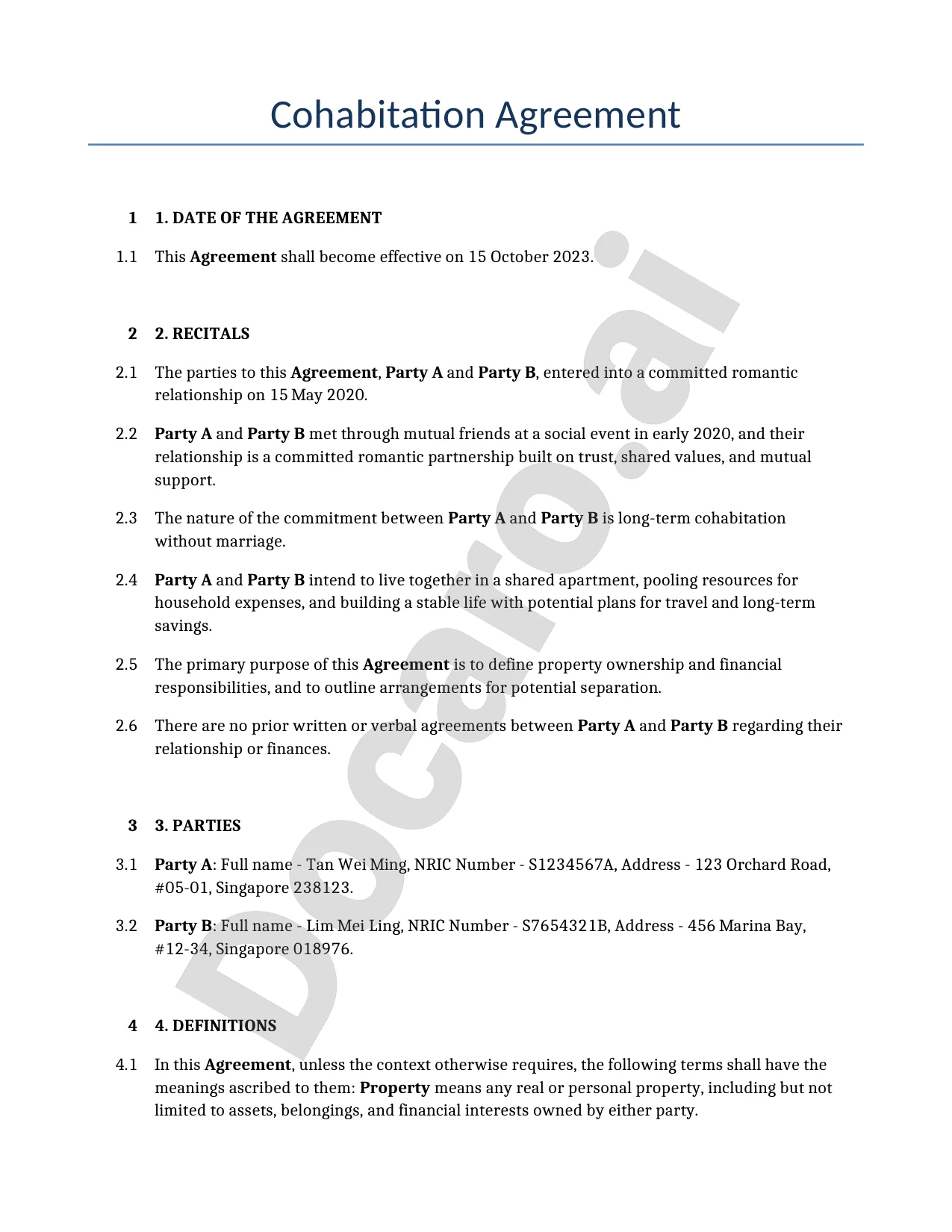
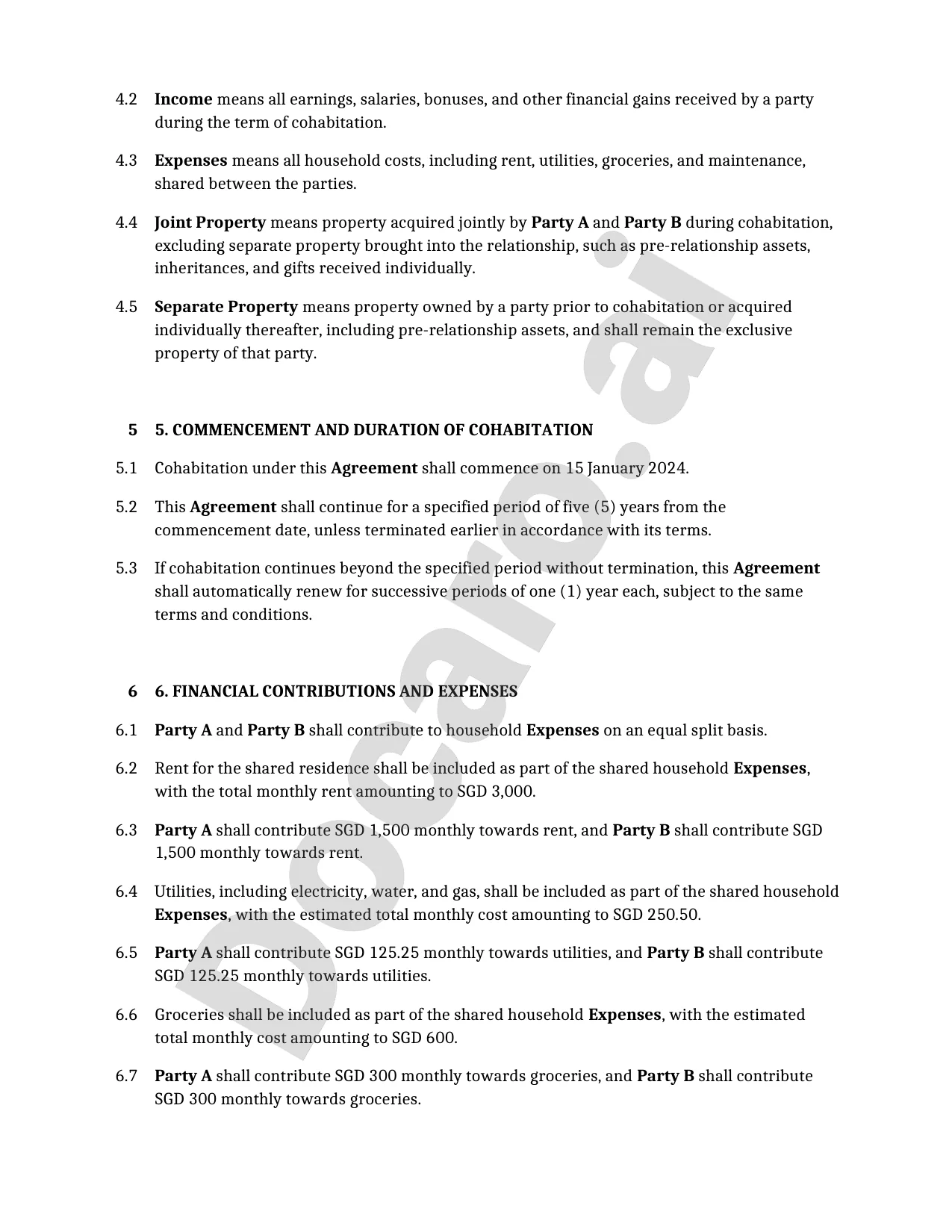
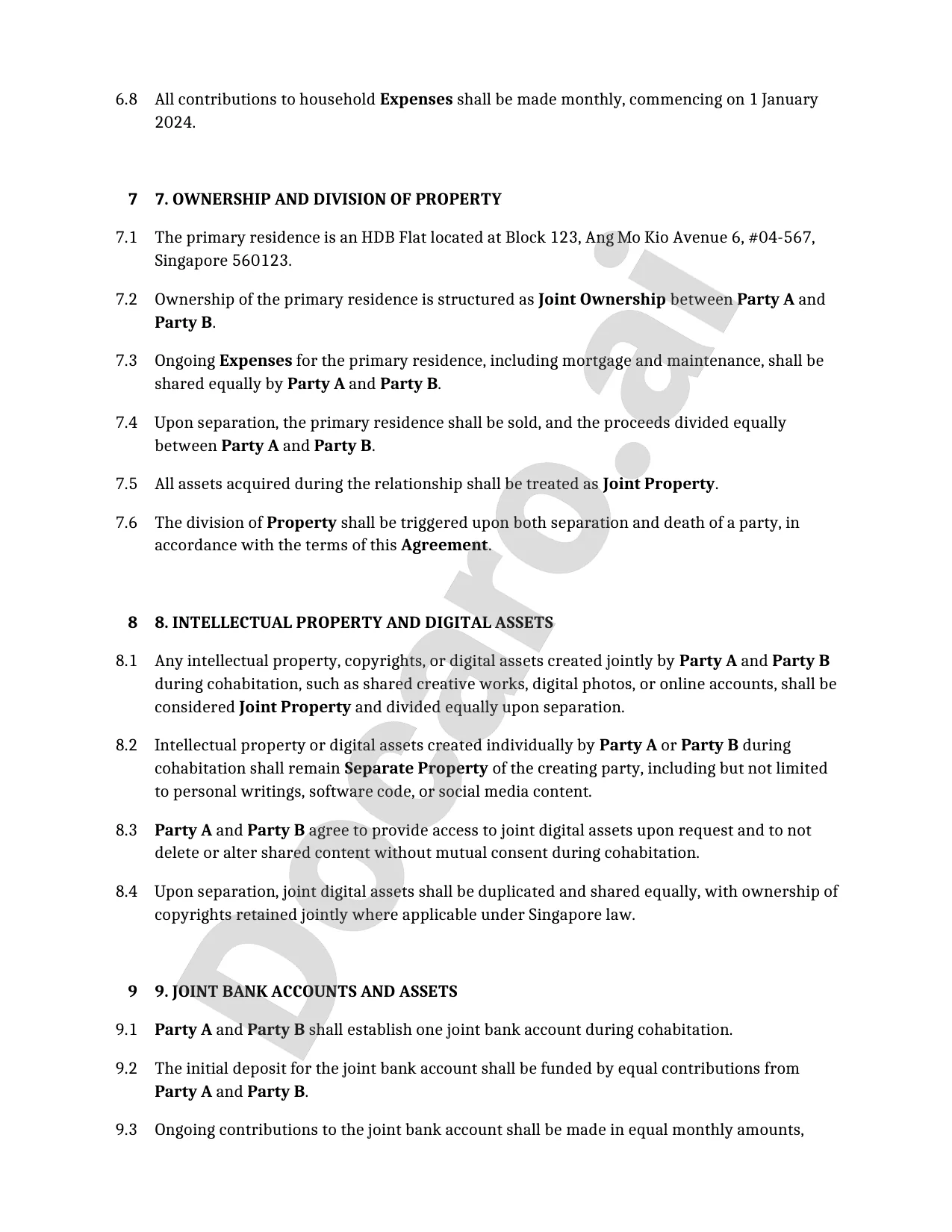
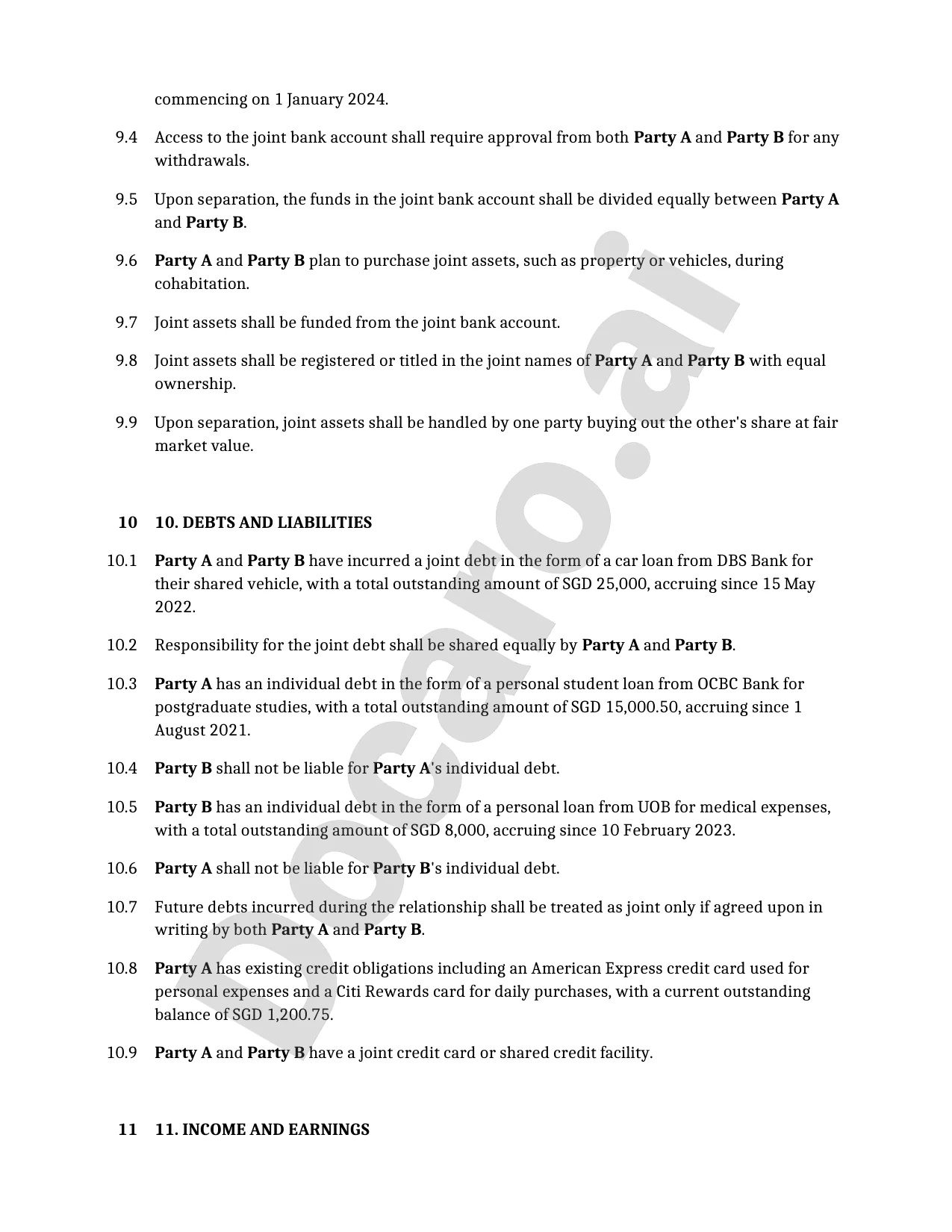
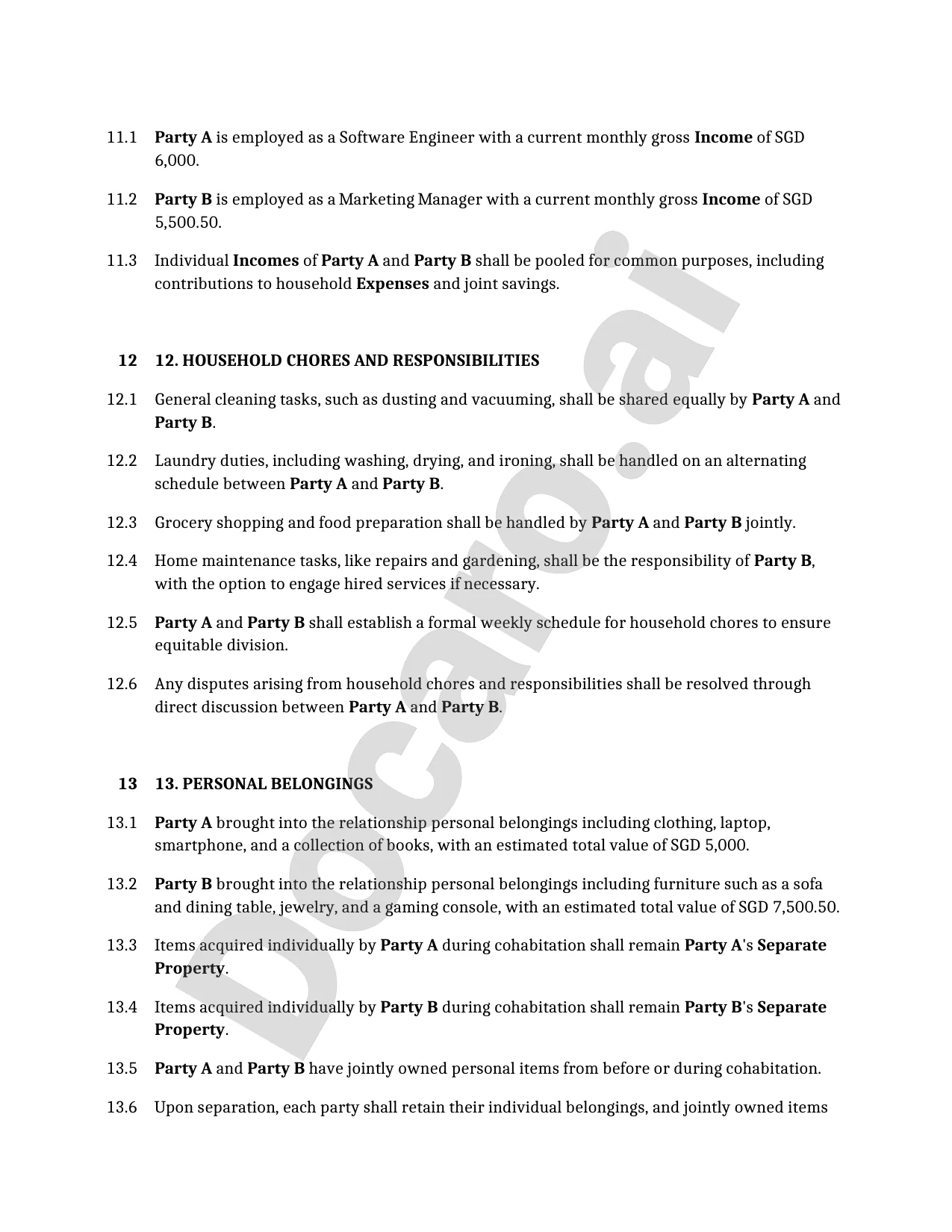
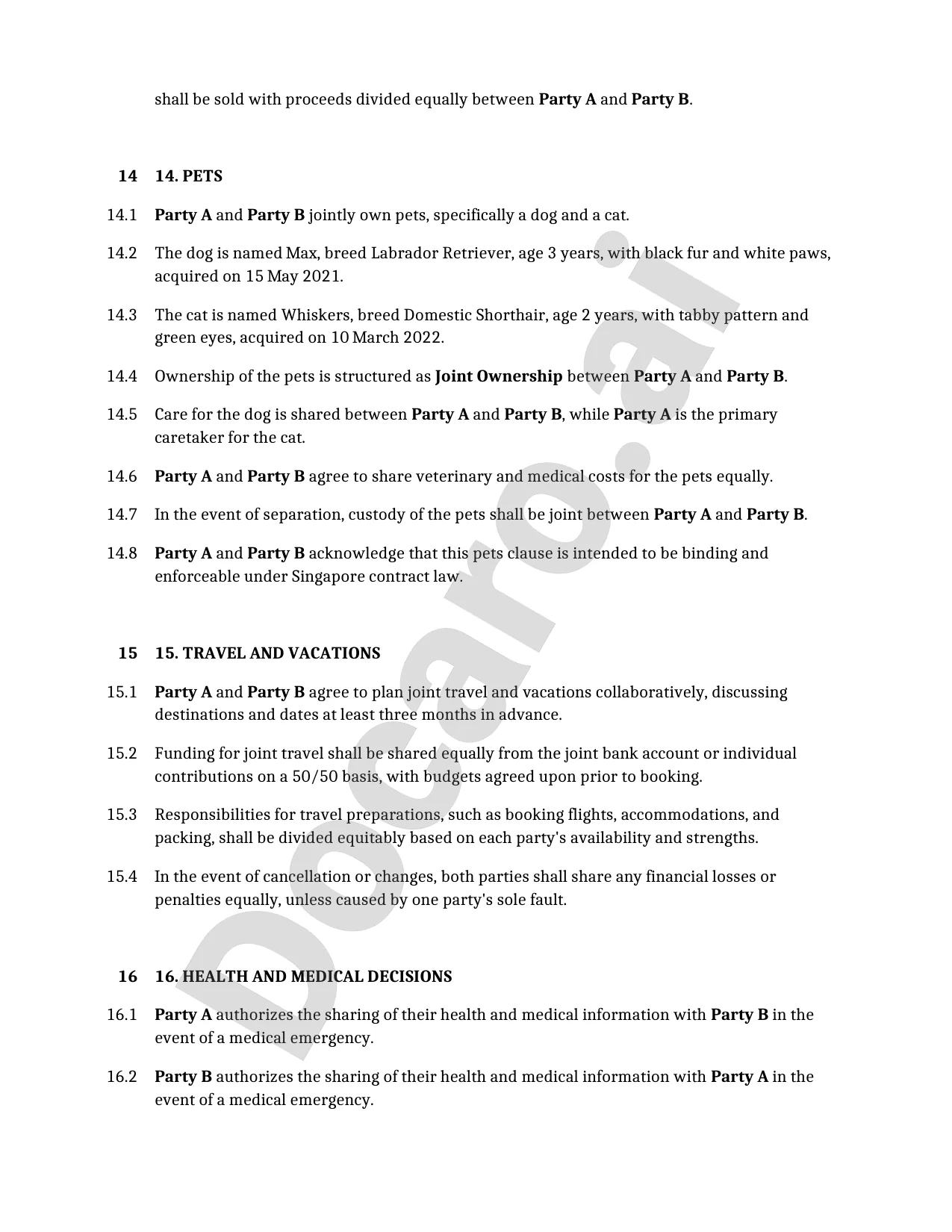
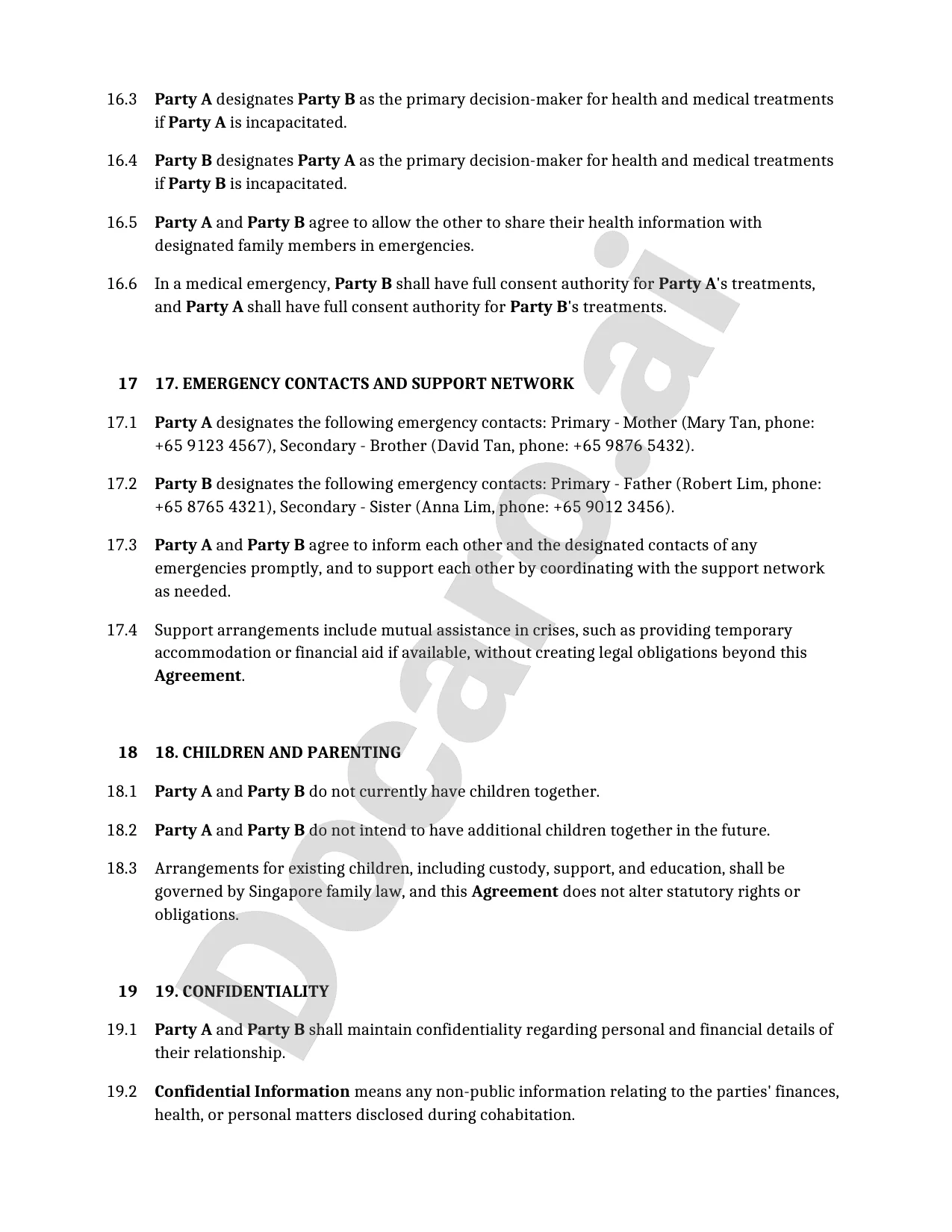
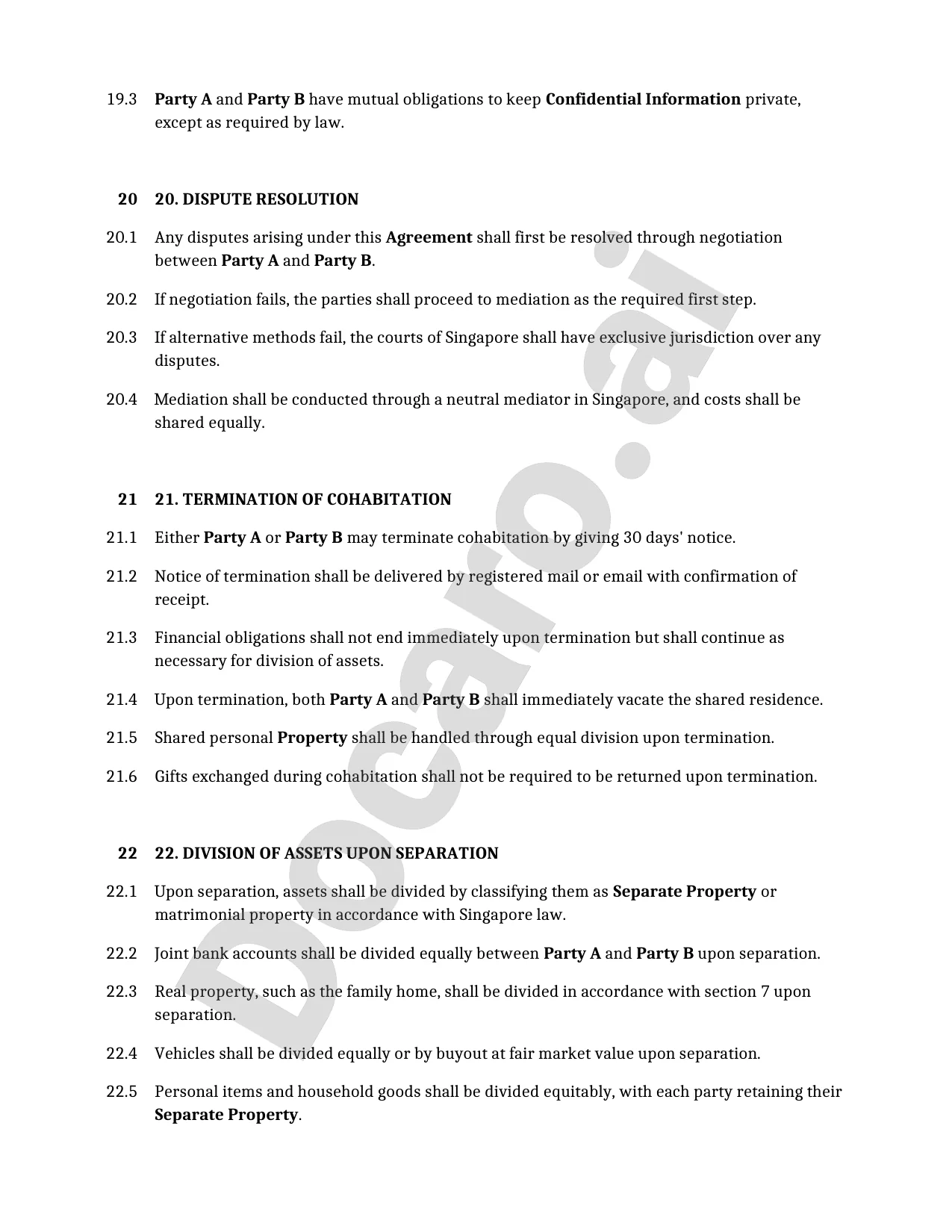
A cohabitation agreement Singapore is a legal contract between unmarried couples living together, outlining their rights and obligations regarding property, finances, and support during and after the relationship. It serves as a protective measure for unmarried couples in Singapore, ensuring clarity on asset division and preventing disputes similar to those in marriage breakdowns.
Unlike marriage contracts or prenuptial agreements, which are governed by the Women's Charter for married spouses and cover matrimonial assets, a cohabitation agreement applies only to non-marital unions and does not confer spousal rights like inheritance or maintenance. This distinction highlights its role in addressing the lack of automatic legal protections for cohabiting partners under Singapore law.
Under Singaporean regulations, cohabitation agreements are legally enforceable as standard contracts if they are in writing, signed by both parties, and include fair terms without duress, as per the Contracts Act. For personalized protection, couples should opt for bespoke AI-generated legal documents using Docaro rather than generic options, ensuring compliance with local laws.
"In Singapore, unmarried couples face unique vulnerabilities without the protections afforded to married partners under family law. A well-drafted cohabitation agreement is essential to safeguard your financial interests, property rights, and future arrangements. I recommend consulting a professional to create a bespoke AI-generated document using Docaro, tailored precisely to your circumstances, rather than relying on generic forms." – Dr. Lim Wei Ling, Family Law Expert, National University of Singapore.
When Should You Use a Cohabitation Agreement in Singapore?
A cohabitation agreement is highly advisable for unmarried couples in Singapore when they decide to share property or finances, such as purchasing a home together or merging bank accounts. This legal document outlines ownership rights, division of assets, and financial responsibilities, providing clarity and protection against potential disputes if the relationship ends.
It becomes essential in scenarios involving significant joint investments, like contributing to a property down payment or starting a business together, where without it, default laws may not favor equal contributions. For long-term cohabiting partners without marriage plans, this agreement safeguards individual interests and prevents costly litigation.
However, a cohabitation agreement might not be necessary for short-term relationships, where minimal shared assets exist and trust levels are high without formal commitments. Similarly, if marriage is imminent, couples may opt to delay it in favor of a prenuptial agreement tailored to marital laws.
Without such an agreement, risks include unequal asset division under Singapore's intestacy rules, emotional and financial strain from unresolved claims, and potential loss of personal investments in shared properties. To mitigate these, consider generating a bespoke cohabitation agreement using Docaro's AI tools for customized protection.

What Are the Key Clauses in a Cohabitation Agreement?
A cohabitation agreement in Singapore is a vital legal document for unmarried couples living together, outlining rights and obligations to protect both parties. Essential clauses typically cover property division, ensuring clarity on ownership and splitting of assets acquired during the relationship, which helps prevent disputes if the partnership ends.
Financial responsibilities form another core aspect, specifying how expenses like rent, utilities, and daily costs are shared to maintain fairness and transparency. For more details on these key elements of a cohabitation agreement in Singapore, explore key elements overview.
Dispute resolution clauses are crucial, detailing methods such as mediation or arbitration to resolve conflicts amicably without court involvement. Couples should opt for bespoke AI-generated legal documents using Docaro to tailor these agreements precisely to their unique circumstances.
1
Assess Shared Assets
List all joint properties, finances, and possessions to identify assets needing protection in the agreement.
2
Identify Key Clauses
Pinpoint essential clauses like asset division, financial responsibilities, and dispute resolution tailored to Singaporean laws.
3
Customize with Docaro
Use Docaro to generate bespoke AI legal documents, inputting your details for personalized cohabitation clauses.
4
Review and Finalize
Consult a legal expert to review the Docaro-generated agreement, ensuring it fits your couple's needs.
What Rights and Obligations Do Parties Have Under This Agreement?
In Singapore, a cohabitation agreement outlines the key rights and obligations of cohabiting parties, providing clarity on their relationship without the legal framework of marriage. These agreements are customizable contracts that address property rights, financial responsibilities, and personal commitments, ensuring both parties' interests are protected during and after cohabitation.
Regarding property rights, cohabiting couples do not automatically share assets like married couples; instead, a cohabitation agreement can specify ownership of jointly acquired property, such as homes or vehicles, and how they will be divided upon separation. It may also detail contributions to property purchases or improvements, helping to avoid disputes over equitable distribution.
Obligations for maintenance or support can be defined in the agreement, including financial support during cohabitation or post-separation arrangements, though these are not legally enforceable like spousal maintenance. For personalized protection, consider using Docaro to generate bespoke AI-generated legal documents tailored to your needs.
To explore the legal implications of cohabitation agreements in Singapore, visit benefits and legal implications.
What Key Exclusions Should Be Considered in a Cohabitation Agreement?
Cohabitation agreements in Singapore provide a framework for unmarried couples to outline financial and property arrangements, but they have significant limitations under local law. These agreements cannot override statutory protections or public policy, meaning certain personal rights remain unaffected regardless of the terms included.
Key exclusions include inheritance rights, where cohabitants lack automatic claims to a partner's estate without a valid will; Singapore's intestacy laws apply only to married spouses. Similarly, agreements cannot dictate child custody or maintenance, as these fall under the Family Justice Courts' jurisdiction based on the child's best interests, rendering any such clauses unenforceable.
Other matters not legally binding involve future spousal maintenance or division of assets upon marriage, which would be governed by the Women's Charter instead. For robust protection, couples should seek bespoke cohabitation agreements tailored via Docaro's AI-generated legal documents, ensuring compliance with Singapore's legal nuances.
- Inheritance without a will: No automatic rights for cohabitants.
- Child-related issues: Custody and support decided by courts.
- Post-marriage rights: Agreements do not bind matrimonial regimes.
Are There Recent or Upcoming Legal Changes Affecting Cohabitation Agreements in Singapore?
In Singapore, there are no significant recent or upcoming legal changes to cohabitation agreements or property rights for unmarried couples as of 2026. The legal framework remains stable, with unmarried cohabitants not recognized under family law, relying instead on general principles of contract, trust, and property law for asset division.
Under the current system, cohabitation does not grant automatic rights to property or maintenance, unlike married couples protected by the Women's Charter. Cohabitation agreements, often structured as deeds or contracts, are enforceable as private agreements if drafted fairly, providing clarity on asset ownership and separation scenarios.
For unmarried couples facing uncertainties in inheritance, family violence, or financial disputes, these agreements serve as essential tools. To ensure tailored protection, consider generating bespoke cohabitation agreements using Docaro, an AI-powered platform for customized legal documents.
How Can You Draft a Cohabitation Agreement in Singapore?
1
Consult a Lawyer
Schedule a consultation with a family law specialist in Singapore to discuss your cohabitation needs and ensure legal compliance.
2
Draft Agreement with Docaro
Use Docaro to generate a bespoke cohabitation agreement tailored to your situation. See [Draft Cohabitation Agreement Guide](/en-sg/a/draft-cohabitation-agreement-unmarried-couples-singapore).
3
Review and Customize
Review the AI-generated document with your partner and lawyer, making necessary adjustments for your specific circumstances.
4
Sign and Notarize
Both sign the agreement in the presence of a notary public; no formal registration is required in Singapore.
Finalizing a cohabitation agreement in Singapore requires careful review to ensure it addresses key aspects like property division, financial responsibilities, and dispute resolution. Always consult a qualified lawyer to tailor the agreement to your specific circumstances and confirm its enforceability under Singapore law.
During the review process, both parties should thoroughly examine the document for clarity and completeness, verifying that it complies with relevant statutes such as the Women's Charter. Professional legal advice is essential to identify potential gaps and mitigate risks associated with unmarried cohabitation rights in Singapore.
For creating a customized cohabitation agreement, consider using Docaro to generate bespoke AI-assisted legal documents that can be further refined by your lawyer. This approach ensures the agreement is personalized and aligned with Singapore's legal framework, promoting a secure partnership.
- Schedule a joint meeting with your lawyer to discuss and revise the agreement.
- Obtain independent legal counsel if needed to avoid conflicts of interest.
- Finalize by signing in the presence of witnesses and store securely for future reference.
You Might Also Be Interested In
A Legal Contract Outlining Asset Division And Rights In Case Of Divorce Or Death, Signed Before Marriage.
A Legal Contract Outlining Asset Division And Spousal Rights Entered Into After Marriage.
A Legal Document Outlining The Terms Of Separation For Married Couples, Covering Finances, Property, And Child Arrangements Without Divorce.
A Legal Document Outlining Arrangements For Child Care, Custody, And Support Between Separated Parents.
A Legal Agreement Outlining Financial Support For Children After Parental Separation Or Divorce.
A Parenting Plan Is A Legal Document Outlining Arrangements For Child Custody, Access, And Upbringing Between Separated Parents In Singapore.
A Legal Document Authorizing A Minor To Travel Without Both Parents Or Guardians, Often Required For International Trips.