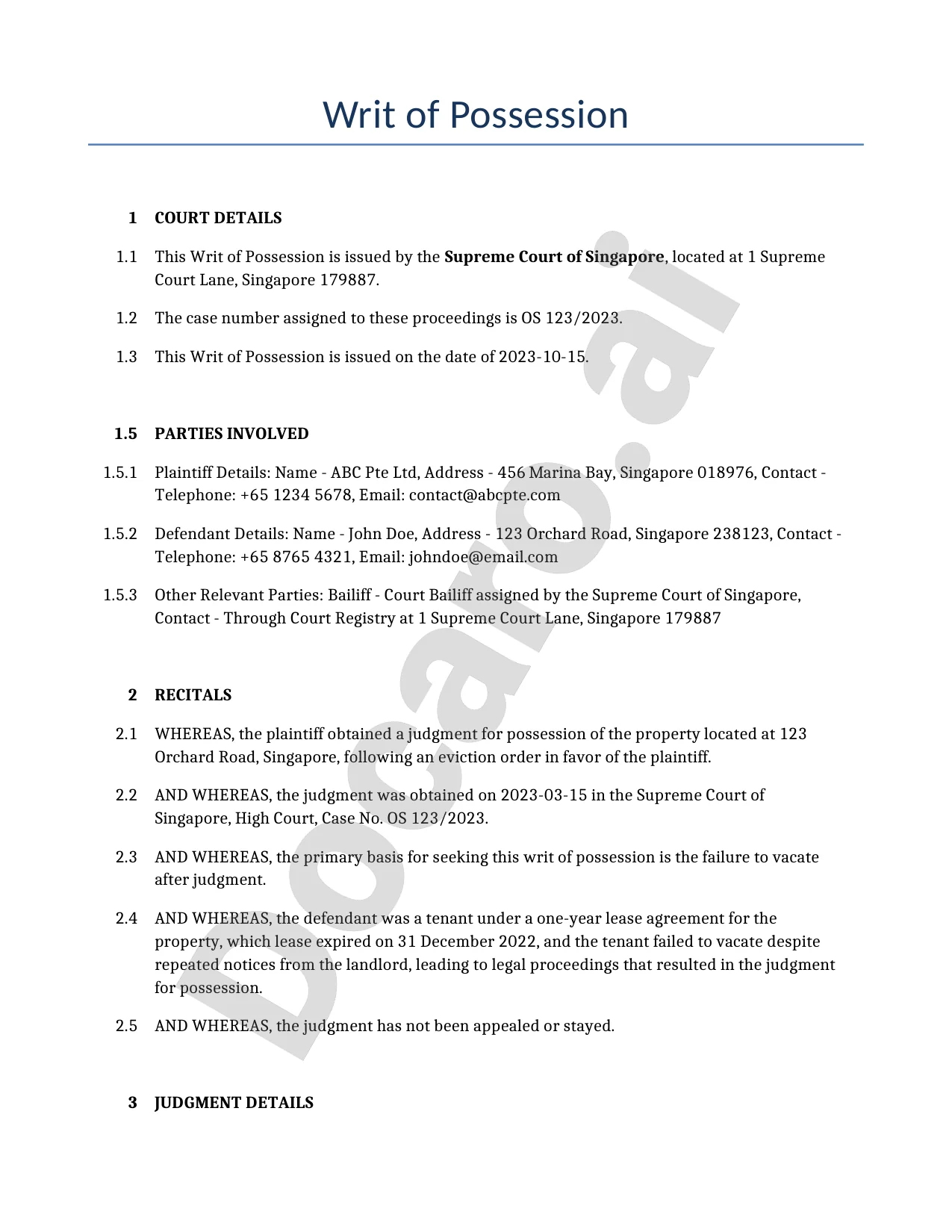
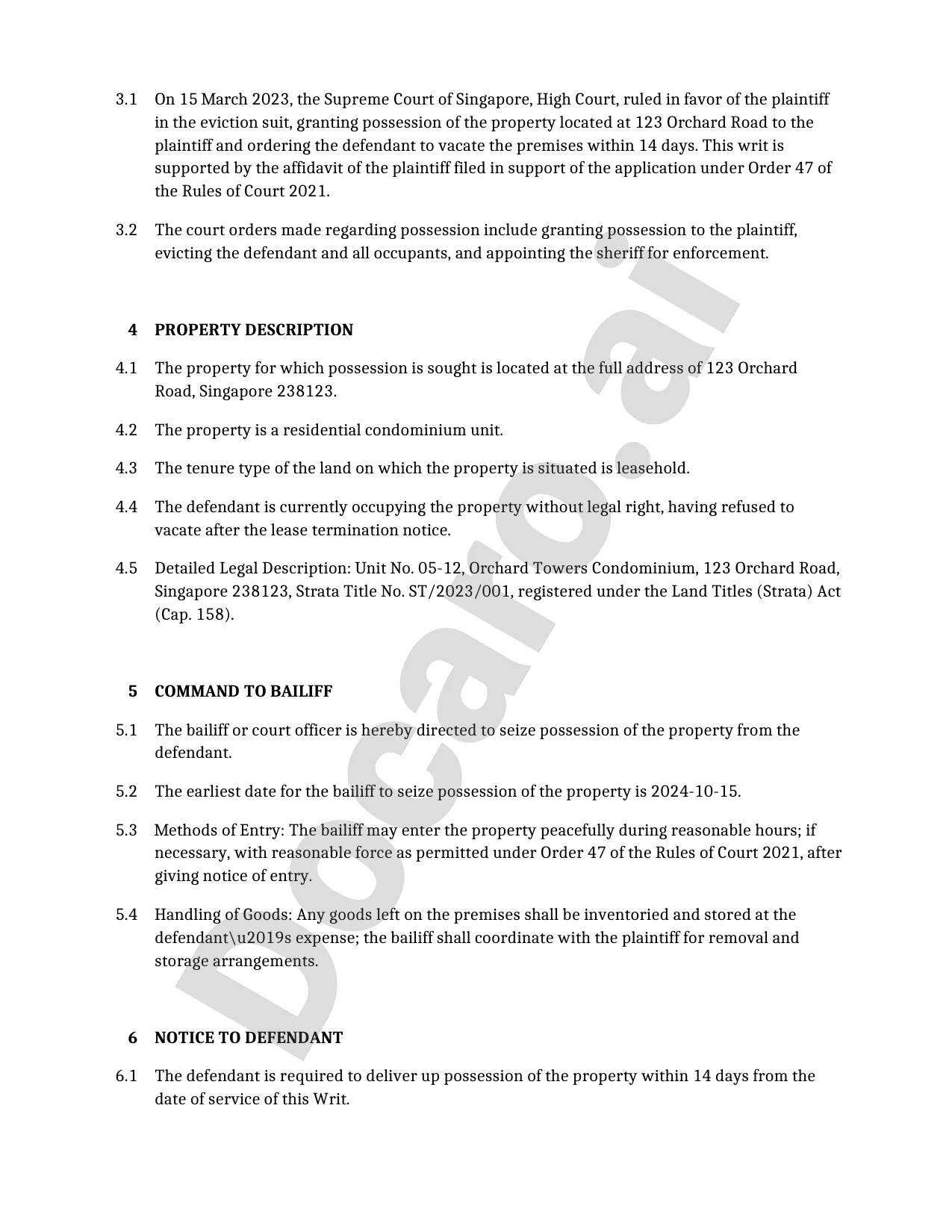
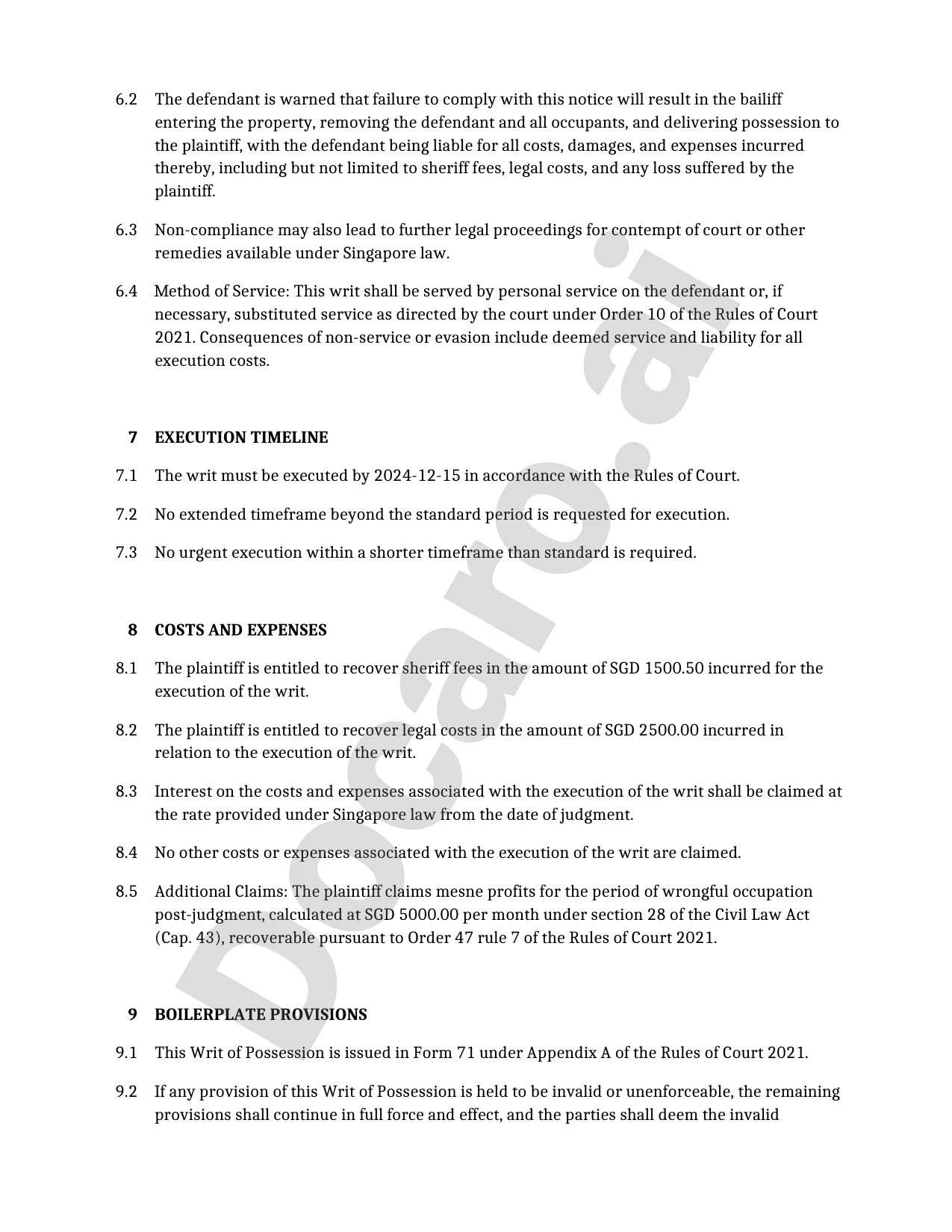
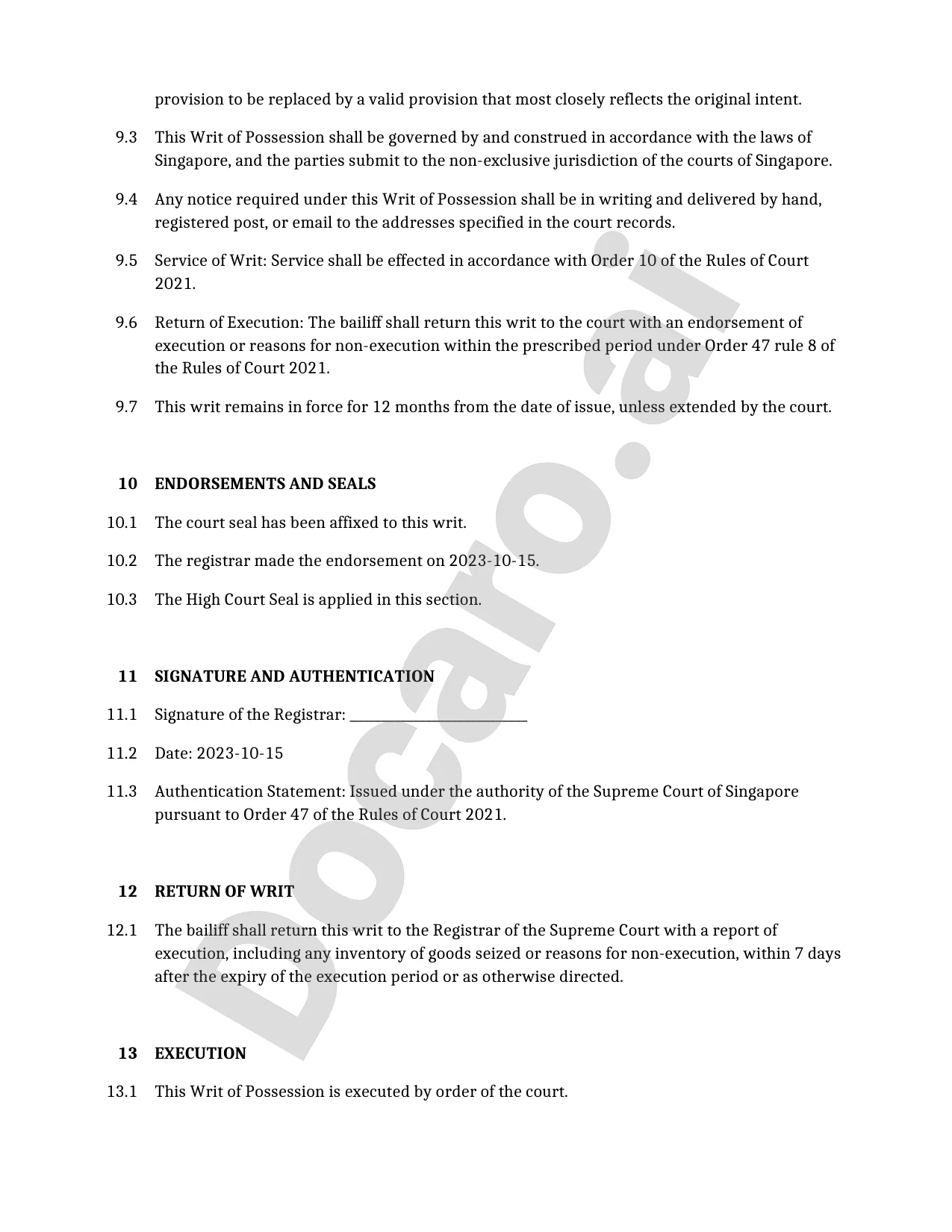
AI Generated Writ of Possession for use in Singapore PDF & Word - 2026 Updated
Generate a professional AI-powered Writ of Possession for commercial eviction in Singapore to efficiently recover your property rights under local tenancy laws.
Free instant document creation.
Legally compliant agreements.
No signup required.
Generate your document for free.
Download PDF, Word and email for $9.99 USD.
When do you need a Writ of Possession in Singapore?
Tenant refuses to leave after eviction
Use this document when a tenant ignores a court order to vacate your property, allowing you to legally reclaim possession.
Previous court judgment in your favor
It follows a successful eviction lawsuit, enforcing the court's decision to remove the tenant from the premises.
Protect your property rights
This writ ensures you can regain control of your commercial space without further delays or disputes.
Importance of a well-drafted document
A properly prepared writ avoids errors that could delay the process or lead to additional legal challenges.
Singaporean Legal Rules for a Writ of Possession
What It Is
A Writ of Possession is a court order that allows the landlord to reclaim a property from a tenant who hasn't left after the lease ends.
When to Use It
Use it only after getting a court judgment for possession, usually following failed eviction attempts like notices.
Court Involvement
You must apply to the State Courts in Singapore to obtain this writ from a judge.
Enforcement Process
The court bailiff will serve the writ and, if needed, remove the tenant and their belongings from the property.
Tenant Rights
Tenants get time to vacate after service, and they can apply to the court to set aside the writ if they have a valid reason.
Costs and Risks
Applying for the writ involves court fees, and wrongly using it can lead to legal penalties for the landlord.
Seek Advice
Always consult a lawyer to ensure the process follows Singapore's tenancy laws correctly.
Important
Using the incorrect format or structure for a commercial eviction notice may invalidate the eviction process under Singapore's tenancy laws.
What a Proper Writ of Possession Should Include
Court and Case Details
It must list the court issuing the writ and the case number for clear identification.
Parties Involved
It should name the landlord as the applicant and the tenant as the respondent.
Property Address
The full address of the property to be repossessed must be specified.
Order to Vacate
It directs the tenant to leave the property by a set date.
Authorization for Possession
It grants the landlord the right to take back control of the property.
Enforcement Instructions
It outlines how the bailiff or sheriff will enforce the eviction if needed.
Date and Signature
It includes the date of issue and the signature of the court officer.
Why Free Templates Can Be Risky for Writ of Possession
Free templates for Writ of Possession often overlook Singapore-specific procedural rules under the Civil Law Act, such as mandatory timelines for service and execution. Using generic wording can lead to procedural errors, court rejections, or delays in regaining possession, potentially costing you time and additional legal fees.
Our AI generates bespoke Writ of Possession documents tailored to your exact situation in Singapore, incorporating precise legal language, correct formats, and compliance with local court requirements for faster, more reliable enforcement.
Generate Your Bespoke Writ of Possession in 4 Easy Steps
1
Answer a Few Questions
Our AI guides you through the info required.
2
Generate Your Document
Docaro builds a bespoke document tailored specifically on your requirements.
3
Review & Edit
Review your document and submit any further requested changes.
4
Download & Sign
Download your ready to sign document as a PDF, Word, Txt or HTML.
Why Use Our AI Writ of Possession Generator?
Fast Generation
Quickly generate a comprehensive Writ of Possession, eliminating the hassle and time associated with traditional document drafting.
Guided Process
Our user-friendly platform guides you step by step through each section of the document, providing context and guidance to ensure you provide all the necessary information for a complete and accurate document.
Safer Than Legal Templates
We never use legal templates. All documents are generated from first principles clause by clause, ensuring that your document is bespoke and tailored specifically to the information you provide. This results in a much safer and more accurate document than any legal template could provide.
Professionally Formatted
Your Writ of Possession will be formatted to professional standards, including headings, clause numbers and structured layout. No further editing is required. Download your document in PDF or Word.
Compliance with Singaporean Law
Rest assured that all generated documents meet the latest legal standards and regulations of Singapore, enhancing trust and reliability.
Cost-Effective
Save money by generating legally sound tenancy agreements without the need for expensive legal services or consultations.
Get Started for Free - No Sign Up Required
No payment or sign up is required to start generating your Writ of Possession. Simply answer a few questions and a preview of your final document will be generated.
Looking to Generate a Writ of Possession in a Different Country?
Choose country:
Singapore
Useful Resources When Considering a Writ of Possession
Regulates the control of rents and eviction procedures for controlled tenancies in Singapore, particularly for residential properties under long-term leases.
Provides general legal framework for landlord-tenant relationships, including rights and obligations related to leases and potential evictions for commercial properties.
Establishes procedures for claims in the State Courts, including writs of possession for evictions in commercial tenancy disputes below certain monetary thresholds.
Generate Your Bespoke Writ of Possession Now
What is a Writ of Possession in Singapore?
A Writ of Possession in Singapore law is a court-issued document that authorizes the enforcement of a judgment for the recovery of land or property, enabling the successful party in a dispute to regain physical control. It serves as a critical tool in property disputes, particularly when a tenant or unauthorized occupant refuses to vacate premises after a court order for possession.
The purpose of a Writ of Possession is to facilitate the swift and lawful regaining possession of land or property, bridging the gap between a court's declaratory judgment and actual enforcement. Under Singapore's legal framework, as outlined in the Rules of Court, this writ empowers the bailiff or sheriff to enter the property and remove occupants, ensuring compliance with judicial decisions in eviction or ownership claims.
To obtain a Writ of Possession, the plaintiff must first secure a favorable court order, such as through a summary judgment or after trial in the State Courts or High Court. For authoritative guidance, refer to the Singapore Judiciary's Rules of Court or consult resources from the Supreme Court of Singapore on civil proceedings.
Key steps include filing the writ post-judgment and serving notice to occupants.
Failure to comply can lead to contempt charges, emphasizing the writ's role in upholding property rights in Singapore.
For complex cases, bespoke AI-generated legal documents via Docaro ensure tailored accuracy over generic templates.
Under Singapore's Civil Law Act, Section 18(2), a Writ of Possession is enforceable as a court order to recover possession of land from unlawful occupiers, ensuring swift restoration to the rightful owner.
For tailored legal documents in such matters, utilize Docaro to generate bespoke AI-assisted options suited to your specific case.
When should you use a Writ of Possession legal document?
A Writ of Possession in Singapore is a crucial court order that allows the rightful owner to reclaim property after legal proceedings, such as a successful eviction lawsuit. It is typically issued when a tenant fails to vacate the premises despite a court judgment in favor of the landlord, ensuring swift enforcement of property rights.
In cases of mortgage default, a Writ of Possession becomes appropriate following a foreclosure action where the lender obtains a court order to repossess the property from the defaulting borrower. This legal tool helps mortgagees recover their assets efficiently, preventing prolonged occupation by unauthorized parties.
Other scenarios include disputes over lease terminations or inheritance claims where court intervention is needed to restore possession to the entitled party. For a complete guide on Writ of Possession in Singapore, refer to Understanding the Writ of Possession in Singapore.
Property owners facing such issues should consult legal experts and consider bespoke AI-generated legal documents using Docaro for tailored solutions. For official information, visit the Singapore Judiciary website or the State Courts of Singapore.
When should you not use it?
A Writ of Possession in Singapore should not be used when tenants hold valid leases registered under the Land Titles Act, as eviction requires proper termination procedures through the State Courts rather than immediate possession enforcement. This ensures compliance with tenancy laws protecting lessees from abrupt dispossession.
Disputes better suited for negotiation or mediation exclude the need for a Writ of Possession, particularly in cases of minor breaches or amicable resolutions, avoiding costly litigation as encouraged by the Singapore Mediation Centre.
Under Singapore law, limitations apply to Writs of Possession in protected tenancies under the Control of Rent Act or when involving government land, where alternative remedies like judicial review are mandated. For authoritative guidance, refer to the Singapore Judiciary's page on Writ of Possession or the Land Titles Act.
Another exclusion: Properties under execution of judgment stays, requiring court approval before proceeding.
What are the key clauses in a Writ of Possession document?
A Writ of Possession in Singapore is a court-issued document that enforces the recovery of property by a successful litigant, typically following a judgment in a property dispute. Essential clauses include a detailed description of the property, specifying its address, boundaries, and unique identifiers to ensure clarity and prevent disputes.
The core of the document features the court's order for possession, directing the defendant to vacate the premises and authorizing bailiffs or enforcement officers to enter and seize control if necessary. This clause often references the originating court order or judgment, as outlined in Singapore's Rules of Court.
Timelines for compliance are critical, usually requiring the defendant to deliver up possession within a specified period, such as 14 days from service of the writ. For authoritative guidance on enforcement procedures, refer to the State Courts of Singapore resources.
Penalties for non-compliance include contempt of court charges, fines, or imprisonment, emphasizing the legal consequences of resisting the order. To create tailored Writ of Possession documents compliant with Singapore law, utilize bespoke AI-generated options through Docaro for precision and efficiency.
1
Review Standard Clauses
Examine the Writ of Possession document generated by Docaro for key clauses like property description and respondent details to ensure completeness.
2
Align with Singapore Rules
Verify clauses against Singapore's Supreme Court Practice Directions and Rules of Court, focusing on execution timelines and notice requirements.
3
Customize Specific Details
Tailor clauses using Docaro's bespoke generation tools to include case-specific elements such as exact addresses and enforcement dates.
4
Final Compliance Check
Proofread the customized document for accuracy and adherence to local legal standards before submission to the court.
What are the key rights and obligations of the parties involved?
In a Writ of Possession proceeding in Singapore, the plaintiff, typically the property owner or mortgagee, holds the primary right to seek repossession of the property through the courts. This right is enforced under the State Courts Act and involves filing an originating summons or writ, supported by evidence of ownership and default by the occupant, as outlined by the Singapore Judiciary.
The defendant, often the occupant or tenant in default, bears the obligation to vacate the premises upon a court order granting possession to the plaintiff. Failure to comply can lead to enforcement actions, including bailiff-assisted eviction, emphasizing the defendant's limited defenses such as disputes over tenancy rights under Singapore's Landlord and Tenant Act.
Third parties, such as sub-tenants or lien holders, have rights to notice and potential intervention in the proceedings to protect their interests, but they must vacate if not granted separate possession. Their obligations include cooperating with court orders, with any claims resolved through separate applications to the Supreme Court of Singapore.
Ultimately, the owner enjoys the right to possession post-judgment, restoring exclusive control, while the occupant faces the strict obligation to vacate within the stipulated period to avoid further legal penalties. For tailored legal documents in such proceedings, consider bespoke AI-generated options using Docaro to ensure compliance with Singapore law.
How do recent or upcoming legal changes affect Writs of Possession?
In Singapore, Writs of Possession remain governed primarily by the Civil Law Act and the Rules of Court, with no major amendments announced as of 2023 that directly alter their enforcement or procedural aspects.
The Supreme Court has issued practice directions on civil litigation efficiency, but these do not specifically target Writs of Possession; for instance, updates to Order 45 of the Rules of Court focus on general execution processes without substantive changes to possession writs.
For the latest on Singapore legal updates, refer to the official Supreme Court Rules of Court or the Singapore Statutes Online portal, ensuring compliance with current procedural norms in property recovery cases.
How can you obtain and enforce a Writ of Possession?
A Writ of Possession in Singapore is a court order that allows a property owner to regain physical possession of their premises from unauthorized occupants, such as tenants in arrears or squatters. This legal process is essential for enforcing property rights under the Distress Act and related civil procedures.
To obtain a Writ of Possession, first secure a judgment in your favor through the State Courts or High Court, depending on the claim value, then apply via Form 69 with supporting affidavits detailing the default. For in-depth guidance on filing and timelines, refer to the page How to Obtain and Enforce a Writ of Possession in Singapore.
Enforcing the writ involves engaging a bailiff from the Singapore Courts to serve notice and, if necessary, evict the occupants, ensuring compliance with due process to avoid counterclaims. Use bespoke AI-generated legal documents via Docaro for tailored applications, rather than generic templates.
What common challenges arise and how to solve them?
Obtaining a Writ of Possession in Singapore is a key step in enforcing a court judgment for property recovery, but it often faces common challenges like delays in enforcement due to the Sheriff's Office backlog. These delays can extend from weeks to months, frustrating judgment creditors seeking swift possession.
Another frequent issue involves disputes over property contents, where tenants or occupants contest items left behind, leading to legal complications under Singapore's tenancy laws. For authoritative guidance, refer to the Singapore Judiciary's page on Writs of Possession.
To address enforcement delays, judgment creditors should file promptly and follow up with the Sheriff's Office, while preparing alternative dispute resolution for content disagreements. Explore detailed solutions for Writs of Possession challenges in our resource at Common Challenges and Solutions with Writs of Possession in Singapore, and consider using Docaro for bespoke AI-generated legal documents tailored to your case.
Writ of Possession FAQs
A Writ of Possession is a court-issued legal document in Singapore that allows a landlord to reclaim possession of commercial property from a tenant who has defaulted on rent or breached the lease agreement. It is typically used after obtaining a court judgment for eviction.
Landlords can issue a commercial eviction notice in Singapore for reasons such as non-payment of rent, breach of lease terms, or expiration of the tenancy agreement. Under the Distress Act, landlords may distrain goods for rent arrears, but for full eviction, a court order like a Writ of Possession is often required.
Our AI tool simplifies the process by guiding you through key details like property address, tenant information, lease details, and reasons for eviction. It generates a customizable Writ of Possession template compliant with Singapore legal standards, but you should consult a lawyer for review.
In Singapore, a commercial eviction notice must be served in writing, typically via registered post or personal delivery, and include specifics like the reason for eviction, notice period (usually 14-30 days depending on the lease), and property details. For court enforcement, follow High Court procedures.
Yes, tenants can dispute a Writ of Possession by filing an application to set aside the judgment or applying for a stay of execution in the Singapore courts. Common grounds include procedural errors, payment disputes, or extenuating circumstances like force majeure.
The process typically takes 1-3 months: from issuing notice (14-21 days), to filing a court writ (if needed), obtaining judgment, and executing possession. Delays can occur if the tenant contests the eviction in Singapore's legal system.
Commercial evictions in Singapore are governed by the Civil Law Act, Distress Act, and High Court rules. Unlike residential tenancies under the Control of Rent Act, commercial leases follow common law principles, with no statutory protection for tenants against eviction for rent defaults.
Our AI tool offers affordable generation starting at [price], with no hidden fees. Additional costs may include court filing fees (around SGD 200-500), lawyer review (optional), and service charges. This is more cost-effective than traditional legal drafting in Singapore.
The AI-generated document is a template designed to meet Singapore legal standards, but it must be reviewed and customized by a qualified lawyer to ensure enforceability. It's not a substitute for professional legal advice.
Commercial Writs of Possession in Singapore apply to business properties and have fewer tenant protections compared to residential evictions, which may involve the Housing and Development Board (HDB) rules or tenancy agreements with statutory notice periods. Commercial evictions prioritize landlord rights under lease terms.
Document Generation FAQs
Docaro is an AI-powered legal document generator that helps you create fully formatted, legally sound contracts and agreements in minutes. Just answer a few guided questions and download your document instantly.
Yes. All documents generated by Docaro are based on standard legal frameworks and current Singaporean law. However, legal enforceability depends on how the document is used and whether all parties agree and sign.
Yes. Our AI model analyses Singaporean legislation and regulations to ensure that the documents are compliant with current laws.
Yes. You can start generating your Writ of Possession for free without any sign up or payment. Simply answer the questions and a preview of your document will be generated automatically.
Absolutely. You can download your completed document in Word (.docx), PDF, Text and HTML formats and edit it as needed.
No, you do not need a lawyer to use Docaro. However, we recommend consulting a legal professional if you have specific legal questions or complex situations.
Yes. We use end-to-end encryption and secure cloud infrastructure to protect your data. We do not share or sell your information with third parties.
Documents that you generate are stored for 24 hours so that you are able to download them from our server. After this time your document is permanently deleted from our server.
Yes. Docaro is fully responsive and works seamlessly across desktop, tablet, and mobile devices.
No, we do not use any templates. Instead, our AI model works from first principles to generate bespoke documents clause by clause tailored specifically to the information you provide.
Full unlimited download and usage of any document costs only $9.99 USD.
No, there are no subscription costs or charges. Pay once for your full document and use it forever.
A Legal Document Allowing A Commercial Tenant To Lease Out Part Or All Of Their Rented Space To Another Party, With The Original Tenant Remaining Responsible To The Landlord.
Discover everything about the writ of possession in Singapore. Learn the process, requirements, and steps for enforcing your rights as a property owner or tenant in this comprehensive guide.
Learn the step-by-step process to obtain and enforce a writ of possession in Singapore. Expert advice on eviction procedures, legal requirements, and tips for landlords and tenants.
Explore the frequent challenges encountered with writs of possession in Singapore, including enforcement issues and delays, along with effective solutions to streamline the process for property owners and tenants.