What is a Maintenance Agreement in Singapore?
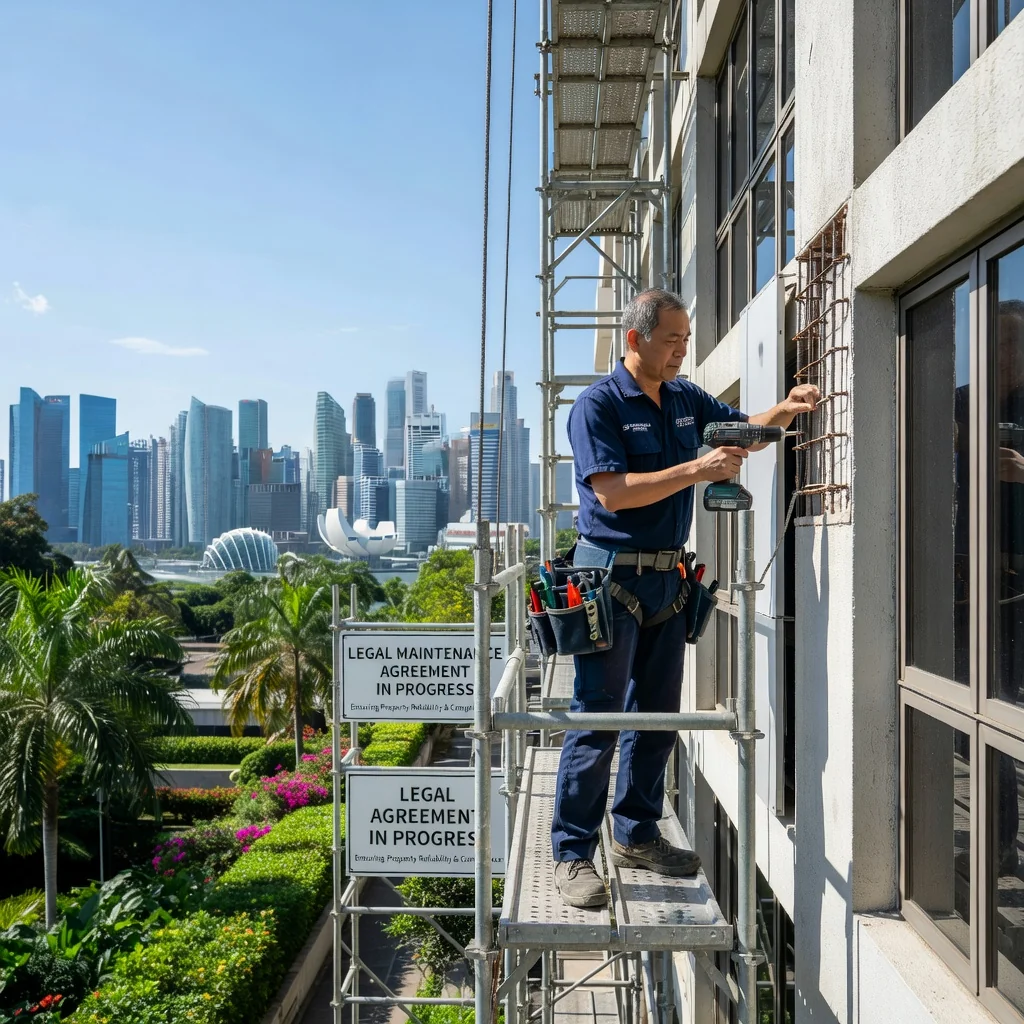
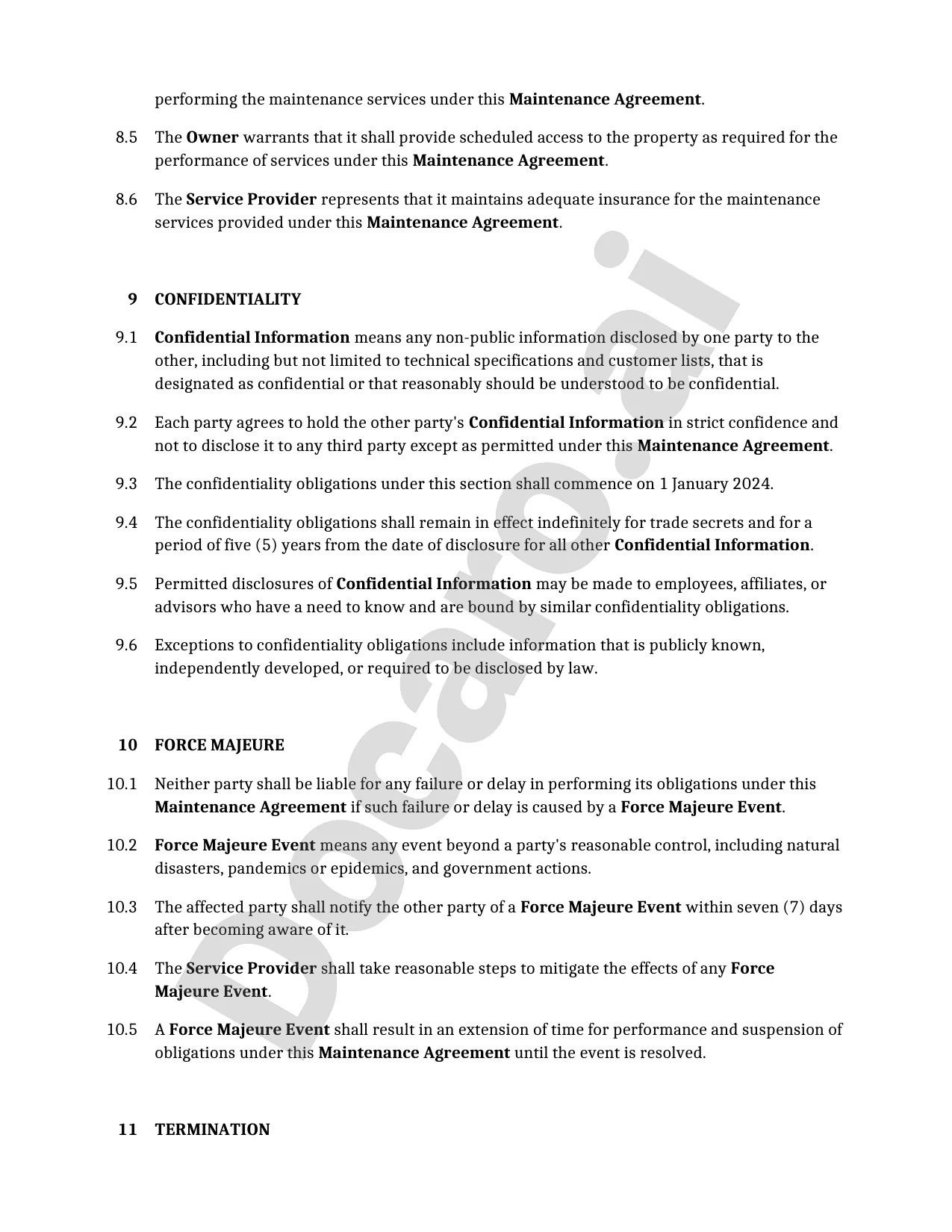
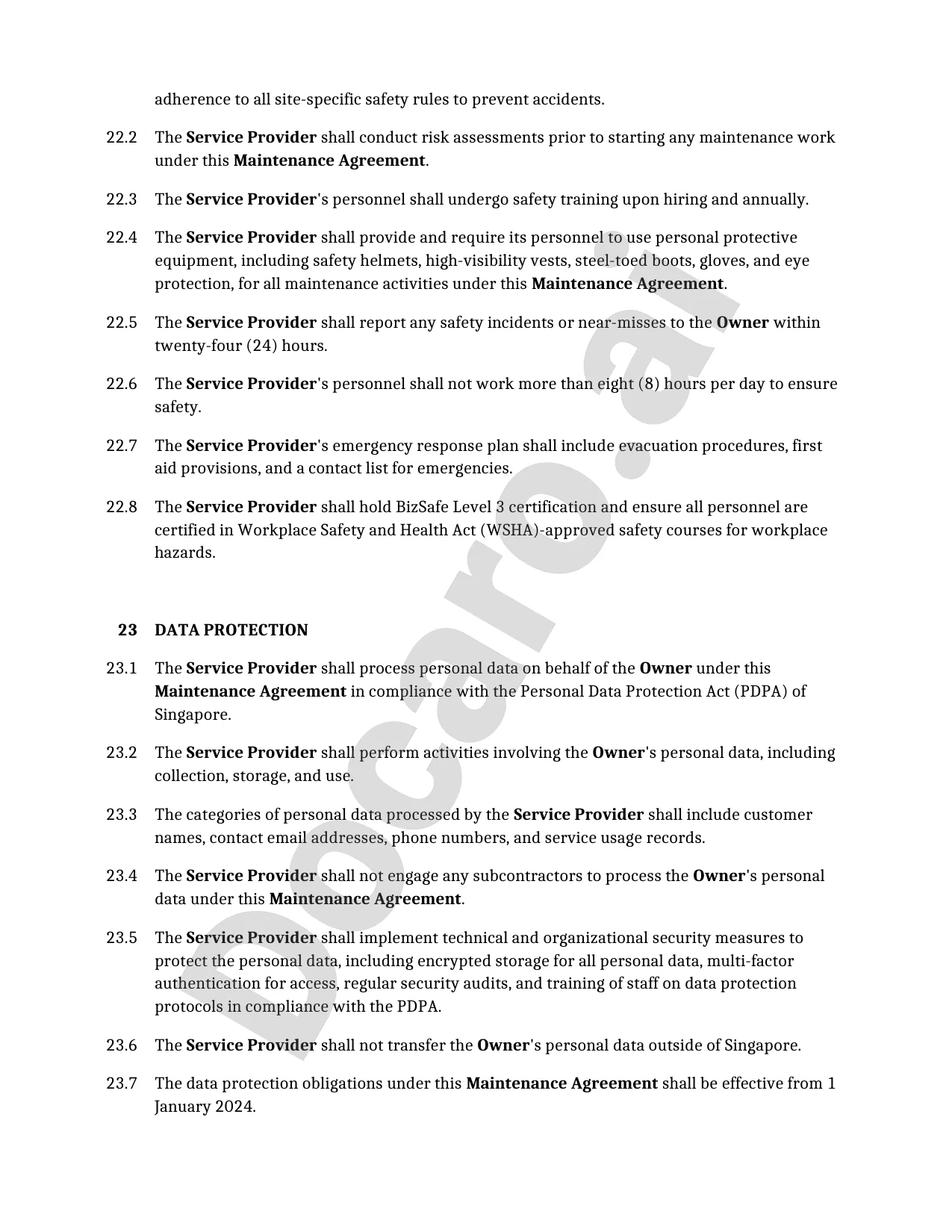
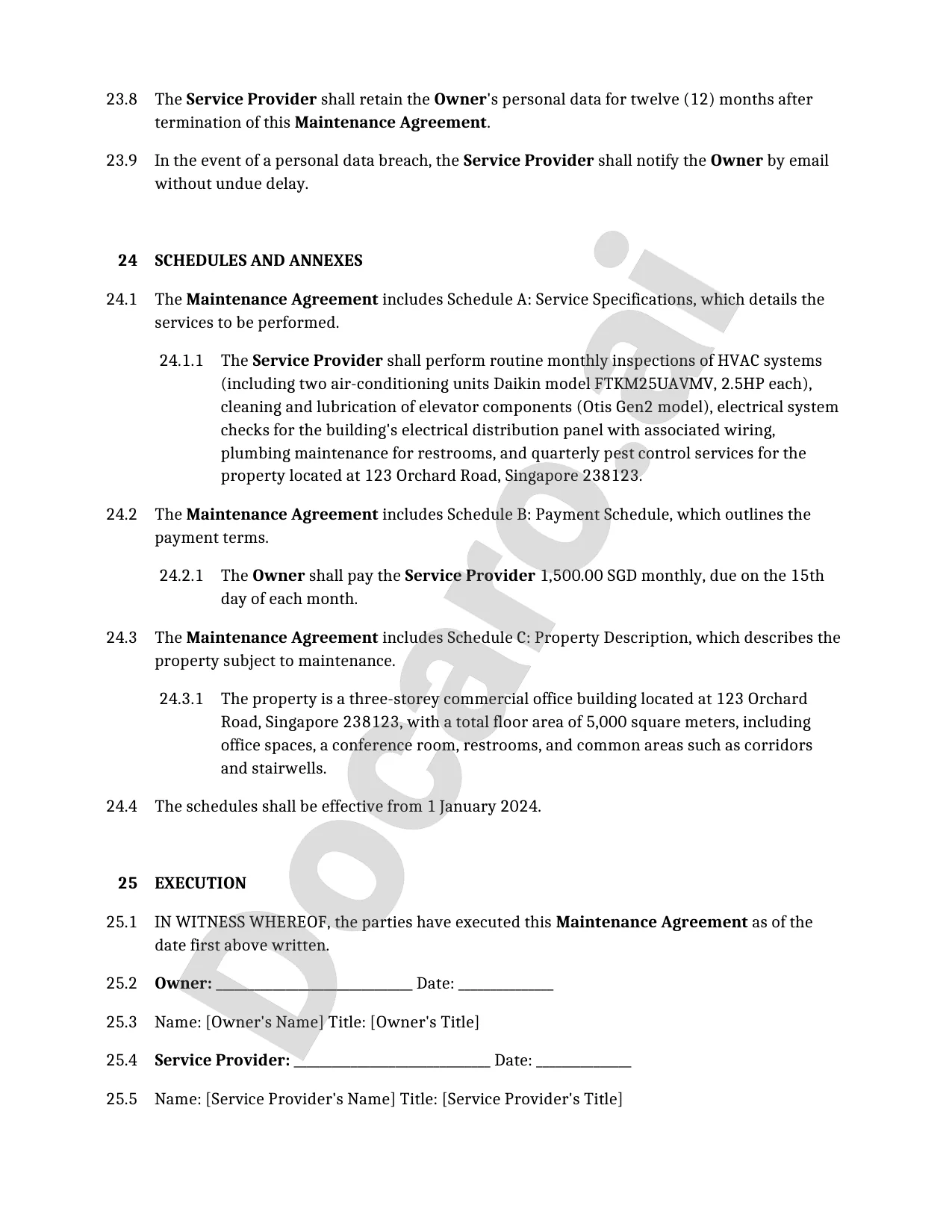
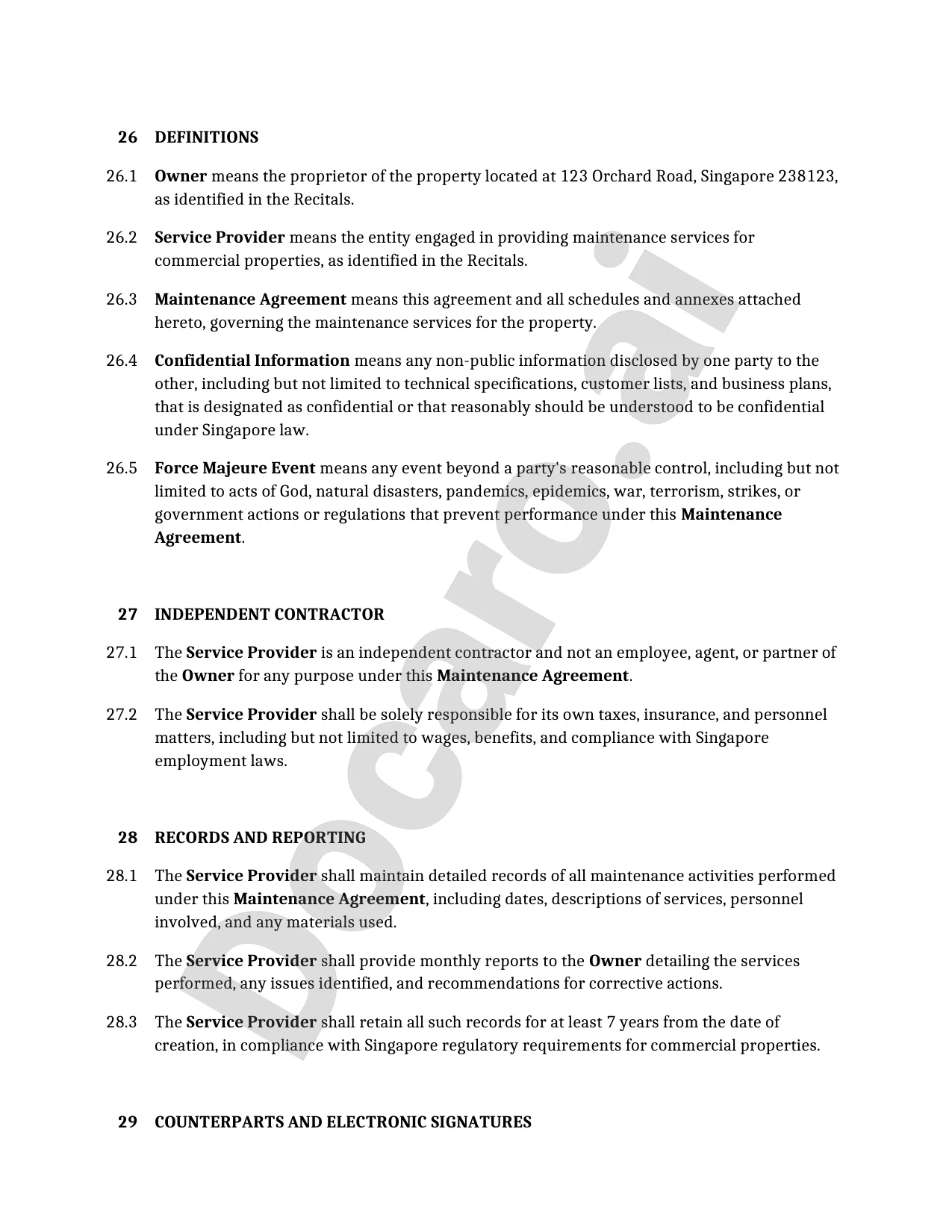
In the Singapore legal context, a maintenance agreement is a binding contract that outlines the terms for ongoing maintenance services provided to properties, equipment, or systems. This agreement ensures regular upkeep, inspections, and repairs to maintain functionality and compliance with local regulations such as those under the Building and Construction Authority (BCA).
The primary purpose of a maintenance agreement is to regulate long-term service obligations between the service provider and the client, promoting preventive care to avoid costly breakdowns. It typically includes schedules for routine checks, response times for emergencies, and clauses on liability, fostering reliability in property maintenance Singapore and beyond.
Unlike one-time service contracts, which cover isolated repairs or installations without recurring commitments, maintenance agreements emphasize continuous support over an extended period. This distinction helps property owners in Singapore plan budgets effectively for sustained asset management.
For tailored maintenance agreements, consider using Docaro to generate bespoke AI-generated legal documents that align precisely with your specific needs and Singapore's legal standards.
When should you use a Maintenance Agreement in Singapore?
A maintenance agreement is essential for long-term property upkeep in residential buildings, ensuring that common areas like roofs, plumbing, and exteriors remain in optimal condition through scheduled inspections and repairs. This approach prevents minor issues from escalating into costly emergencies, providing homeowners with peace of mind and sustained property value.
In commercial buildings, a maintenance agreement supports ongoing servicing of elevators, fire safety systems, and structural elements to meet high occupancy demands. It guarantees cost predictability by bundling services into fixed annual fees, allowing business owners to budget effectively without unexpected disruptions.
For industrial settings, maintenance agreements cover equipment servicing such as machinery lubrication, calibration, and part replacements to minimize downtime and enhance operational efficiency. These agreements often include performance guarantees, reducing the risk of production halts and supporting seamless business continuity.
Routine maintenance for HVAC systems benefits from dedicated agreements that schedule filter changes, duct cleaning, and efficiency checks, which are crucial for energy savings and indoor air quality. In Singapore, such agreements ensure compliance with building regulations under the Building Maintenance and Strata Management Act, avoiding fines and promoting safer environments; for tailored legal documents, consider using Docaro AI legal services.
When should you avoid using one?
Maintenance agreements are ideal for ongoing services but may not suit short-term or one-off repairs, where a single intervention suffices without the need for recurring commitments. In such cases, these agreements can impose unnecessary administrative burdens and fixed costs that exceed the value of limited work.
For projects with uncertain scopes, a maintenance agreement might lock parties into inflexible terms, complicating adjustments as requirements evolve. This rigidity can lead to disputes or inefficiencies, making it preferable to opt for flexible arrangements that accommodate changes.
Under Singapore law, if the service provider lacks proper licensing, a maintenance agreement becomes unsuitable and potentially invalid, exposing clients to legal risks and substandard work. Always verify credentials to ensure compliance before proceeding.
Alternatives to maintenance agreements include ad-hoc service quotes, which provide tailored pricing for specific tasks without long-term obligations. For customized legal support in these scenarios, consider bespoke AI-generated legal documents using Docaro to create precise agreements.
- Ad-hoc quotes offer transparency and cost control for isolated repairs.
- They allow negotiation based on exact project needs, enhancing flexibility.
What are the key clauses in a Singapore Maintenance Agreement?
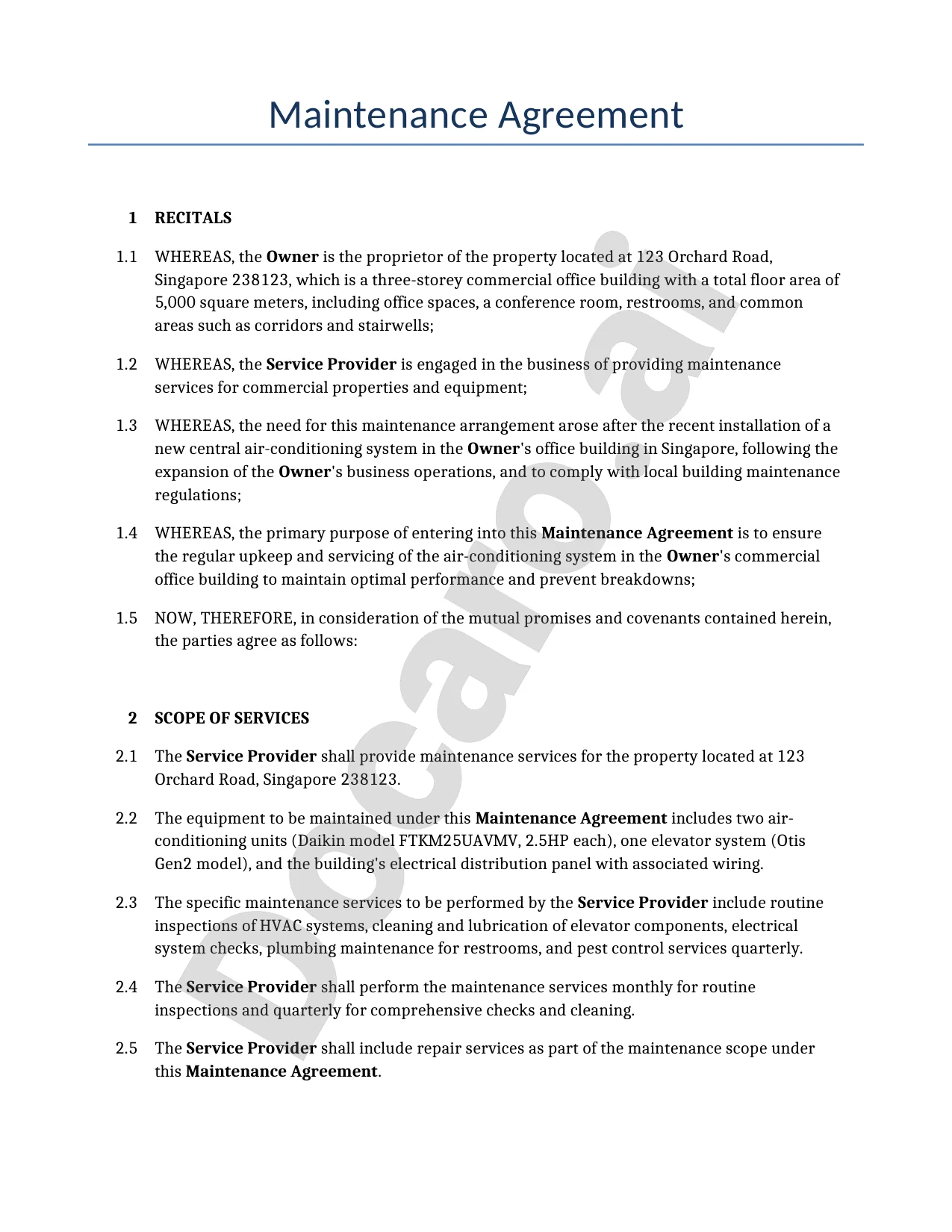
A maintenance agreement in Singapore must clearly define the scope of services, outlining specific tasks like routine inspections, repairs, and compliance with the Building Maintenance and Strata Management Act (BMSMA) to ensure building safety and strata title obligations. This clause should specify standards, frequency, and any exclusions, tailored to Singapore's Contract Law under the Contracts Act for enforceability and clarity.
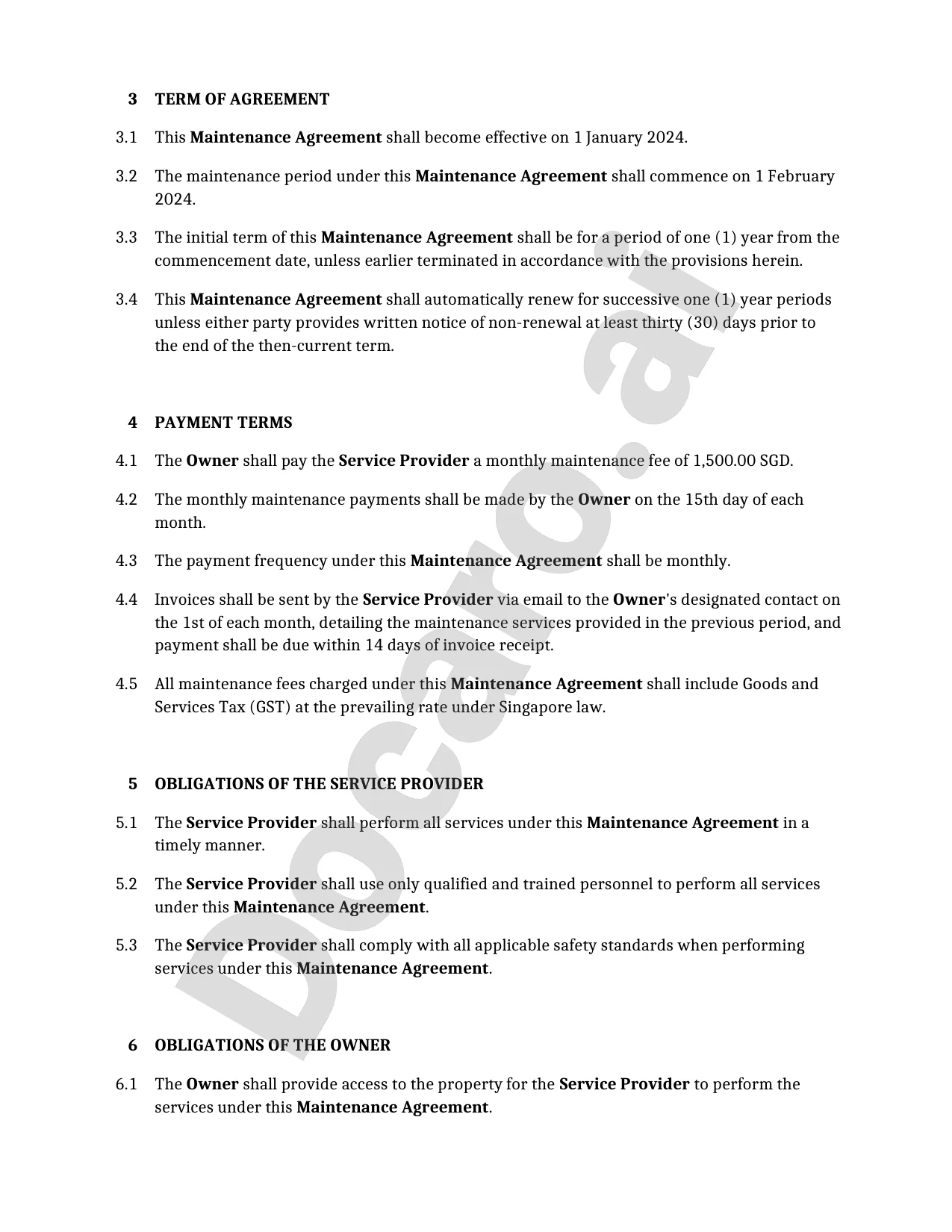
Payment terms are crucial, detailing amounts, schedules, invoicing procedures, and penalties for late payments, while incorporating GST as per Singapore's tax laws to avoid disputes. Include provisions for cost adjustments due to inflation or material changes, ensuring alignment with fair contract principles.
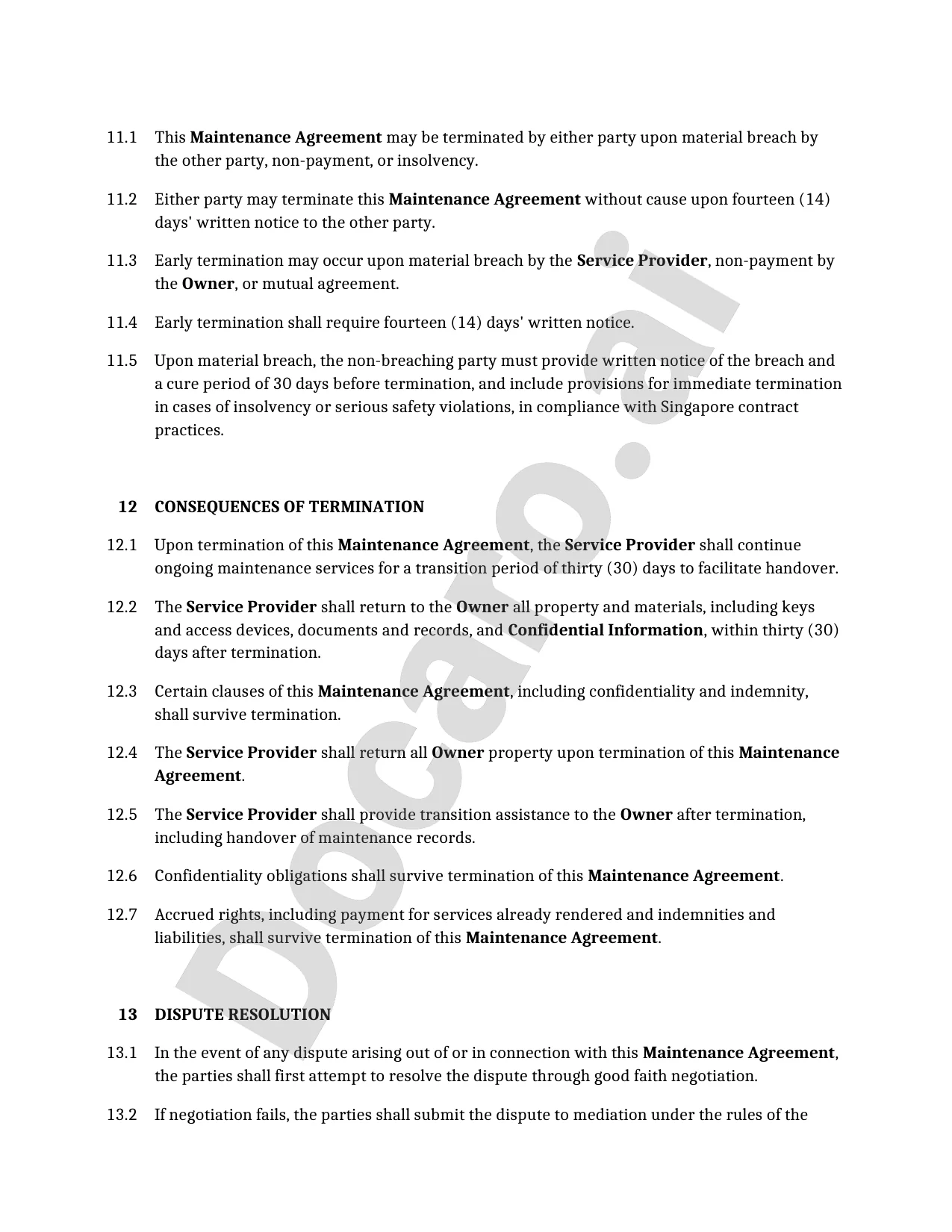
The duration clause should state the agreement's term, renewal options, and notice periods, complying with BMSMA requirements for ongoing strata maintenance. Termination conditions must cover grounds like breach, insolvency, or mutual consent, with post-termination obligations such as final payments or handover, all governed by Singapore's equitable remedies under common law.
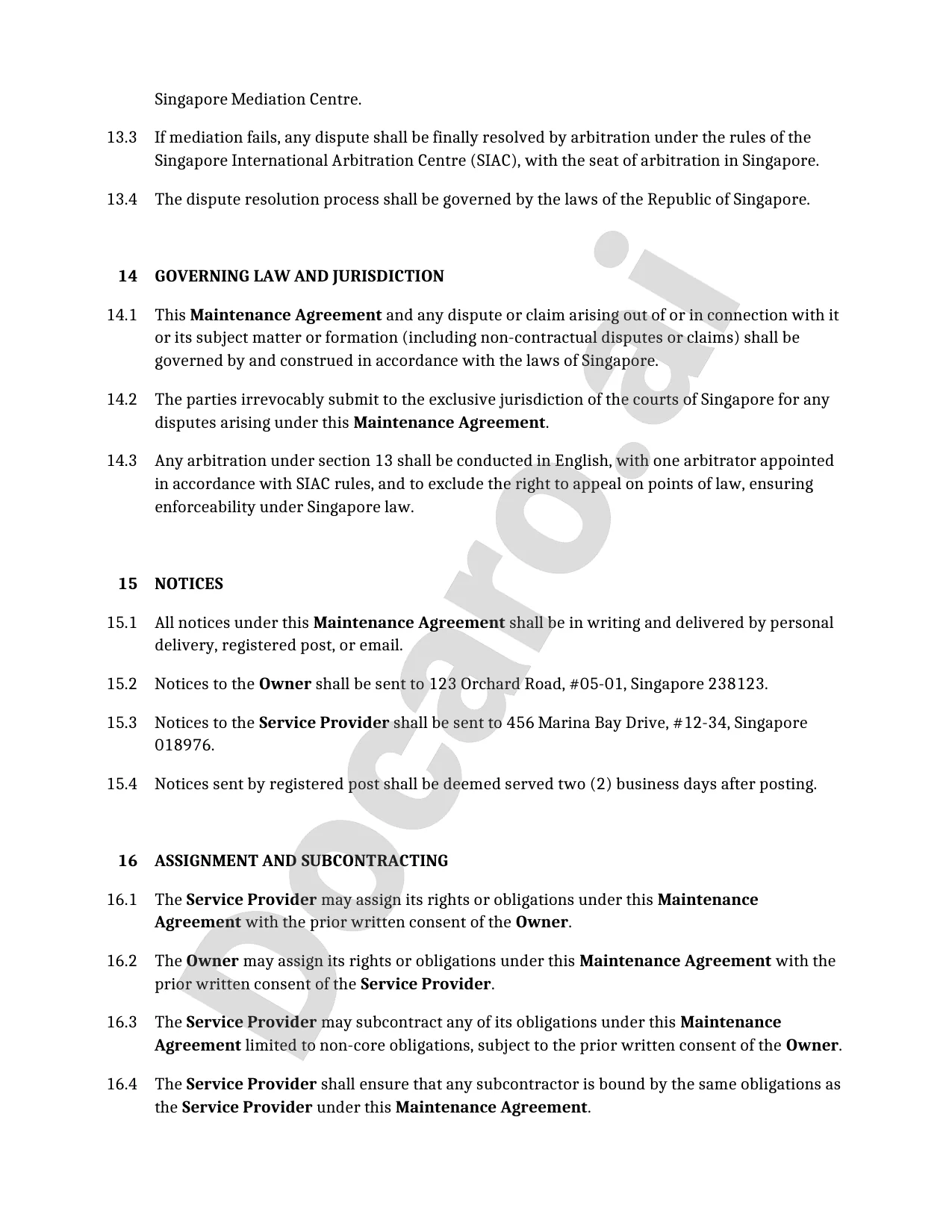
Dispute resolution mechanisms should prioritize negotiation, mediation, and arbitration under the Singapore International Arbitration Centre rules, or litigation in Singapore courts as a last resort. For bespoke AI-generated legal documents using Docaro, customize these clauses to fit unique needs, ensuring full compliance with local statutes like the BMSMA.
"In Singapore, clearly defining the scope of work in maintenance agreements is essential to avoid costly disputes, as ambiguities often lead to litigation under contract law principles," says Dr. Lim Wei, Senior Partner at a leading Singapore law firm. To ensure precision, I recommend commissioning bespoke AI-generated legal documents via Docaro, tailored to your specific needs for robust protection.
What key rights and obligations do parties have under these agreements?
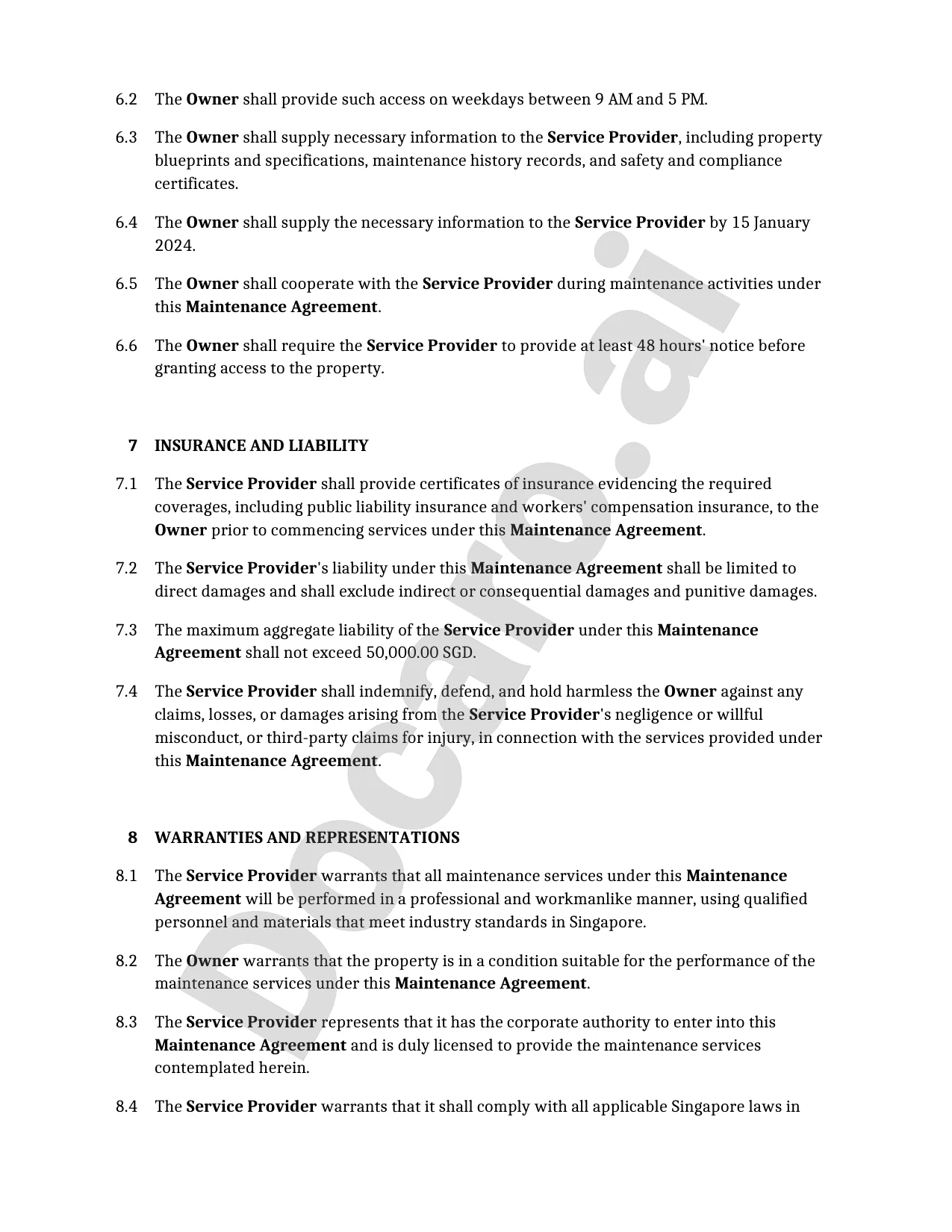
In Singapore maintenance agreements, service providers hold primary obligations such as timely performance of maintenance services and maintaining adequate insurance coverage to protect against liabilities. These duties ensure reliable upkeep of assets like buildings or equipment, aligning with contractual standards under Singapore law.
Clients, in turn, must provide access provision to the site and ensure payment timeliness for services rendered, fostering a smooth operational flow in the agreement. Failure to meet these can lead to disputes, emphasizing the need for clear terms in maintenance contracts.
Under the Unfair Contract Terms Act in Singapore, both parties' rights and obligations are scrutinized to prevent unfair exclusions, such as limiting liability disproportionately. This Act mandates that terms in maintenance agreements be reasonable, particularly for standard clauses on insurance or access, safeguarding against exploitative practices.
- Service providers: Ensure timely performance and insurance coverage to mitigate risks.
- Clients: Facilitate access provision and adhere to payment timeliness for compliance.
- Legal reference: Unfair Contract Terms Act promotes fairness in obligations.
For robust protection, opt for bespoke AI-generated legal documents via Docaro, tailored specifically to your Singapore maintenance agreement needs.

Are there any key exclusions to consider in these documents?
In maintenance agreements in Singapore, a key exclusion is liability for pre-existing defects, which prevents the service provider from being held accountable for issues that existed before the agreement's commencement. This clause is crucial under Singapore's legal framework, including the Contracts (Rights of Third Parties) Act, as it clearly delineates responsibility timelines, thereby limiting risks of unforeseen disputes and ensuring parties focus on ongoing maintenance obligations.
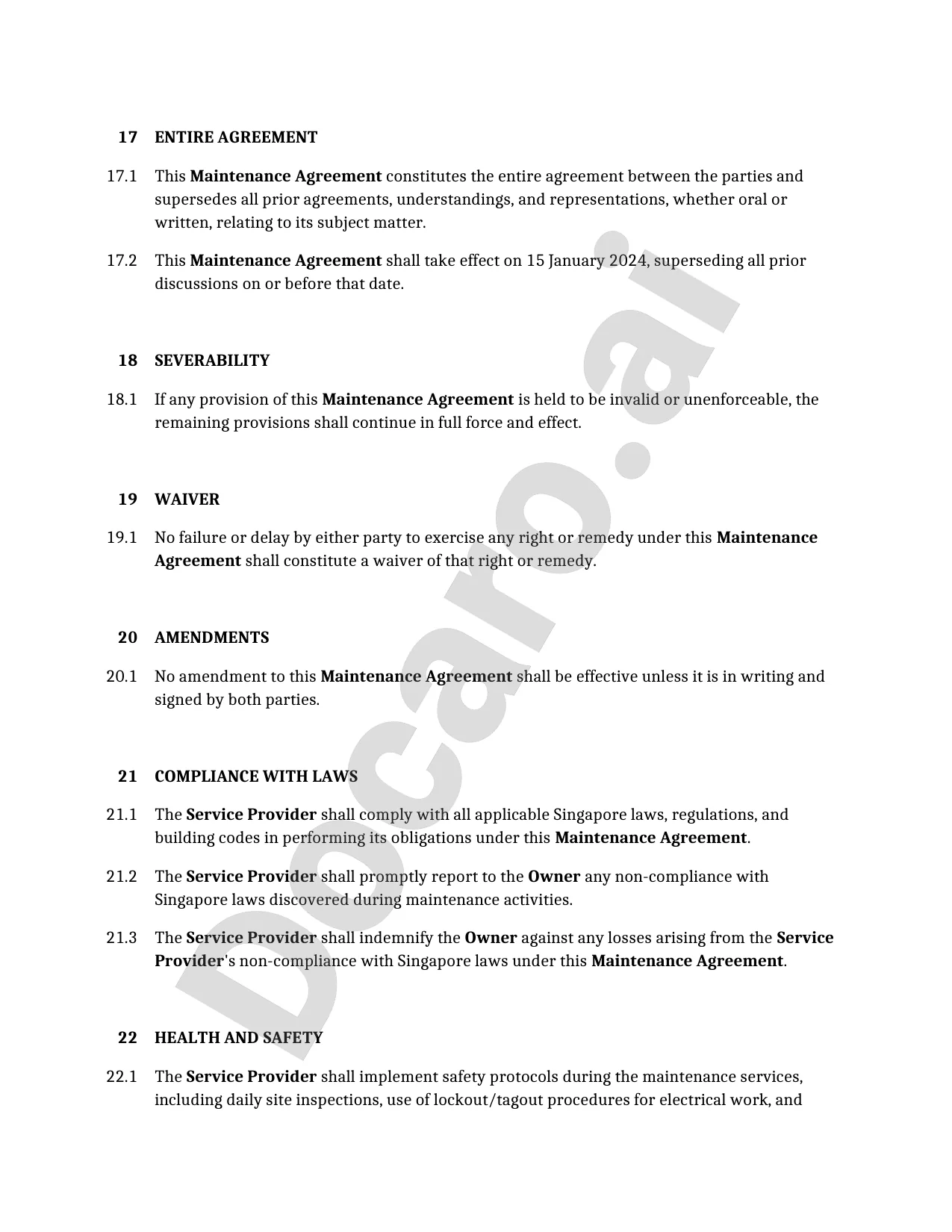
Another common exclusion involves force majeure events, such as natural disasters or pandemics, which absolve parties from performance failures beyond their control. In Singapore, governed by common law principles from cases like Channel Island Ferries Ltd v Sealink UK Ltd, this provision mitigates risks by protecting against uncontrollable circumstances, aligning with the Unfair Contract Terms Act to ensure fairness without imposing undue burdens.
Wear and tear not covered by the agreement is frequently excluded to specify that normal deterioration from regular use falls outside the provider's scope. This is relevant in Singapore's context under the Sale of Goods Act and implied warranties, helping to limit liability exposure by defining covered repairs as those from negligence or fault, thus promoting clear expectations and reducing litigation risks.
To effectively incorporate these exclusions, businesses in Singapore should opt for bespoke AI-generated legal documents using Docaro, tailored to specific needs rather than generic forms, ensuring compliance and risk minimization.

What recent or upcoming legal changes affect Maintenance Agreements in Singapore?
Recent amendments to the Building Control Act in Singapore, effective from October 2025, introduce the Building Control (Fixed Installations) Regulations 2025, which replace older rules for lifts, escalators, and mechanised parking systems. These updates mandate stricter design, installation, and maintenance protocols to enhance safety, directly impacting maintenance agreements by requiring detailed compliance clauses for periodic inspections and reporting.
Under the Consumer Protection (Fair Trading) Act, enforcement actions have surged from 2023 to 2025, with cases like Purexygen highlighting unfair practices in maintenance service packages for water systems, including misleading claims on terms and benefits. This heightened scrutiny implies that maintenance agreements must incorporate transparent disclosures on pricing, service scopes, and consumer remedies to avoid violations and potential injunctions.
For drafting maintenance agreements, these developments necessitate inclusion of energy efficiency measures from the Building Control Act's Part 3B and adherence to CPFTA guidelines against unfair trading. Professionals should opt for bespoke AI-generated legal documents using Docaro to ensure tailored compliance, reducing risks in building maintenance and consumer protection.
How can you get started with a Maintenance Agreement in Singapore?
1
Assess Your Needs
Evaluate your equipment, usage, and specific maintenance requirements to define the scope of the agreement.
2
Consult a Lawyer
Discuss your assessed needs with a qualified lawyer to ensure the agreement aligns with legal standards.
3
Select a Licensed Provider
Research and choose a reputable, licensed maintenance provider that meets your defined needs.
4
Generate and Review Draft
Use Docaro to create a bespoke AI-generated legal document, then review it for compliance with a lawyer.
Where can you learn more about Maintenance Agreements?
When navigating maintenance agreements in Singapore, it's essential to understand the key elements and benefits to ensure your property or equipment remains in optimal condition. For a detailed exploration, read our article on Understanding Maintenance Agreements in Singapore: Key Elements and Benefits.
Drafting a legally binding maintenance agreement requires precision to comply with Singaporean laws and protect all parties involved. Learn the step-by-step process in How to Draft a Legally Binding Maintenance Agreement in Singapore.
To safeguard your interests, be aware of common mistakes in Singapore maintenance contracts that could lead to disputes or financial losses. Our guide covers these pitfalls in Common Mistakes to Avoid in Singapore Maintenance Contracts.
While these resources provide valuable insights into Singapore maintenance contracts, always seek professional legal advice for your specific situation. Consider using Docaro for bespoke AI-generated legal documents tailored to your needs, ensuring compliance and customization without relying on generic templates.