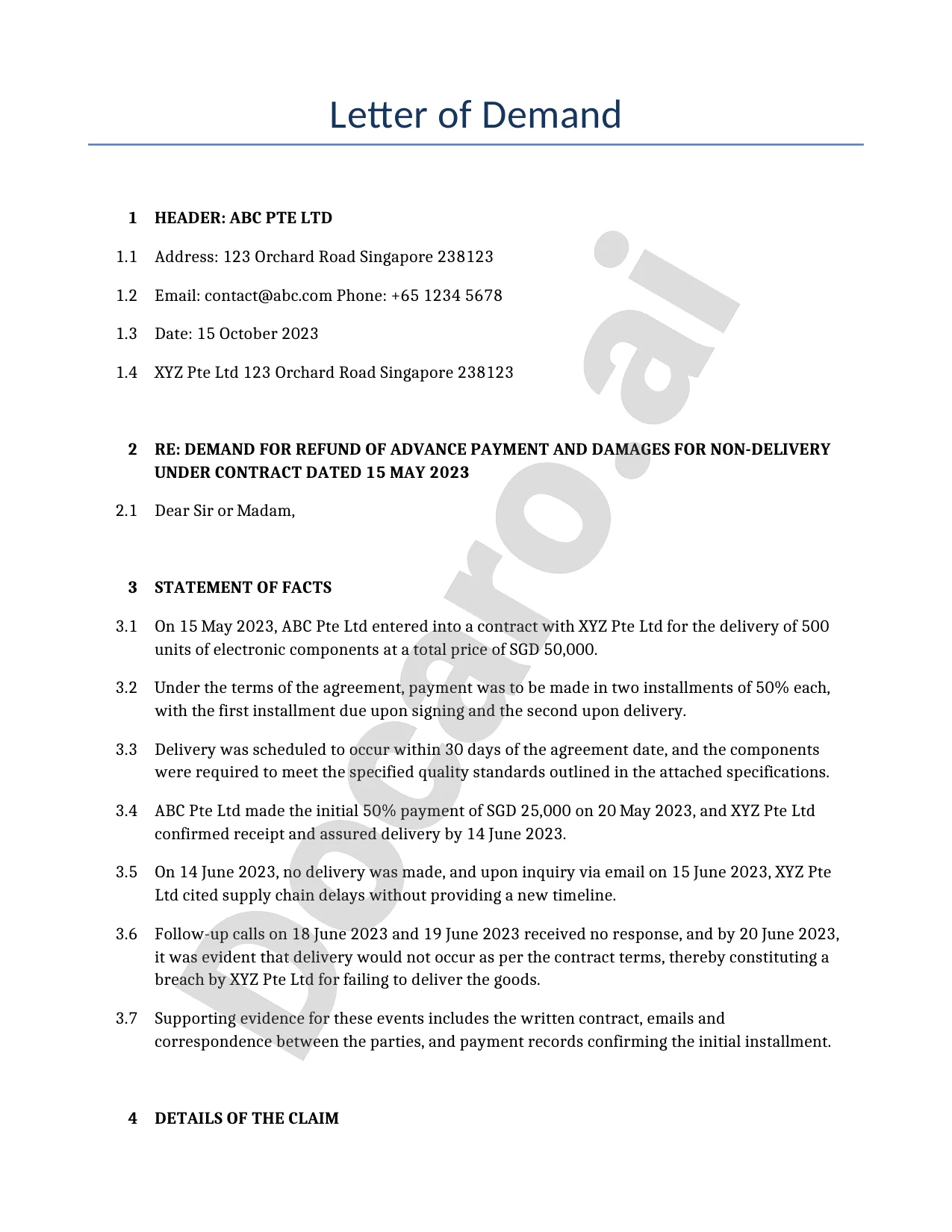
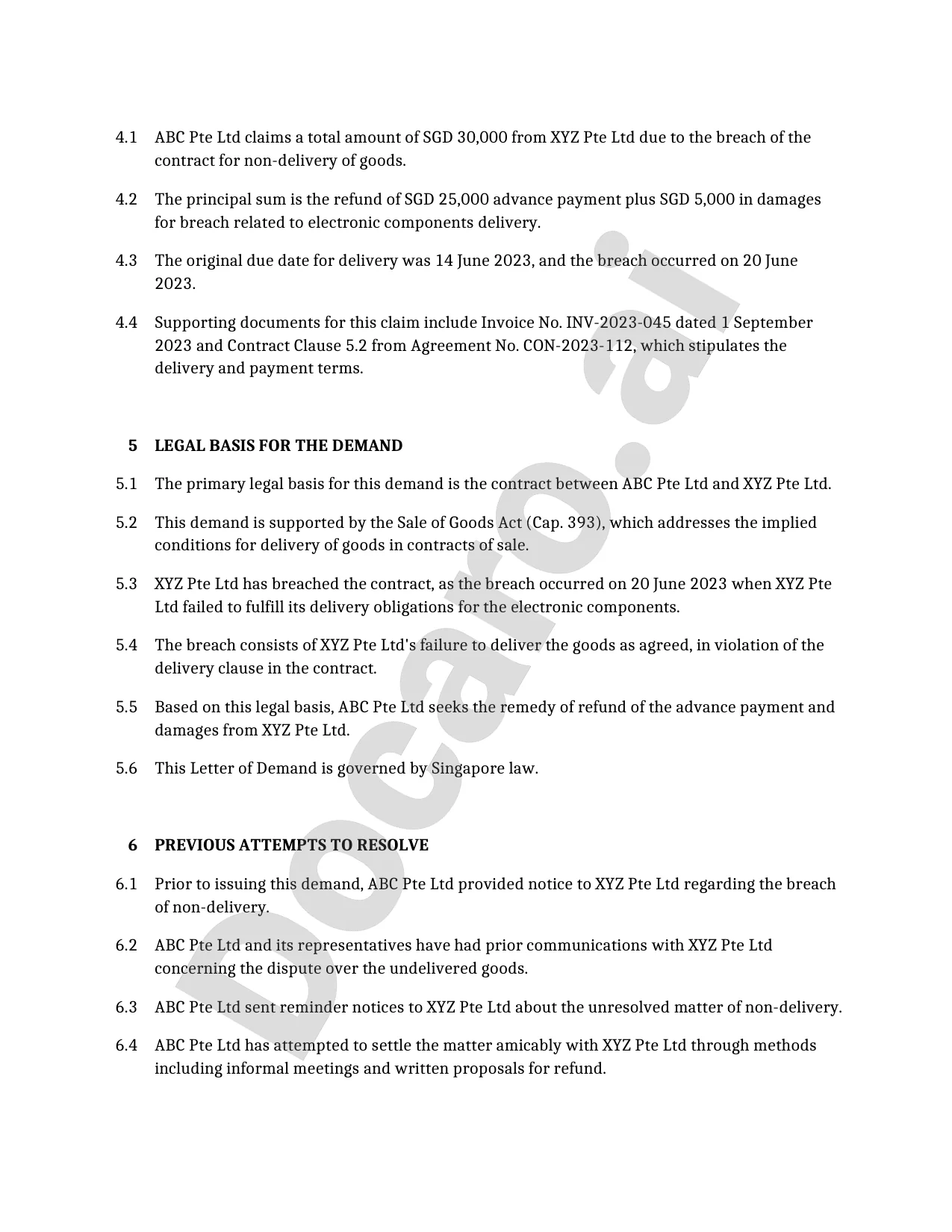
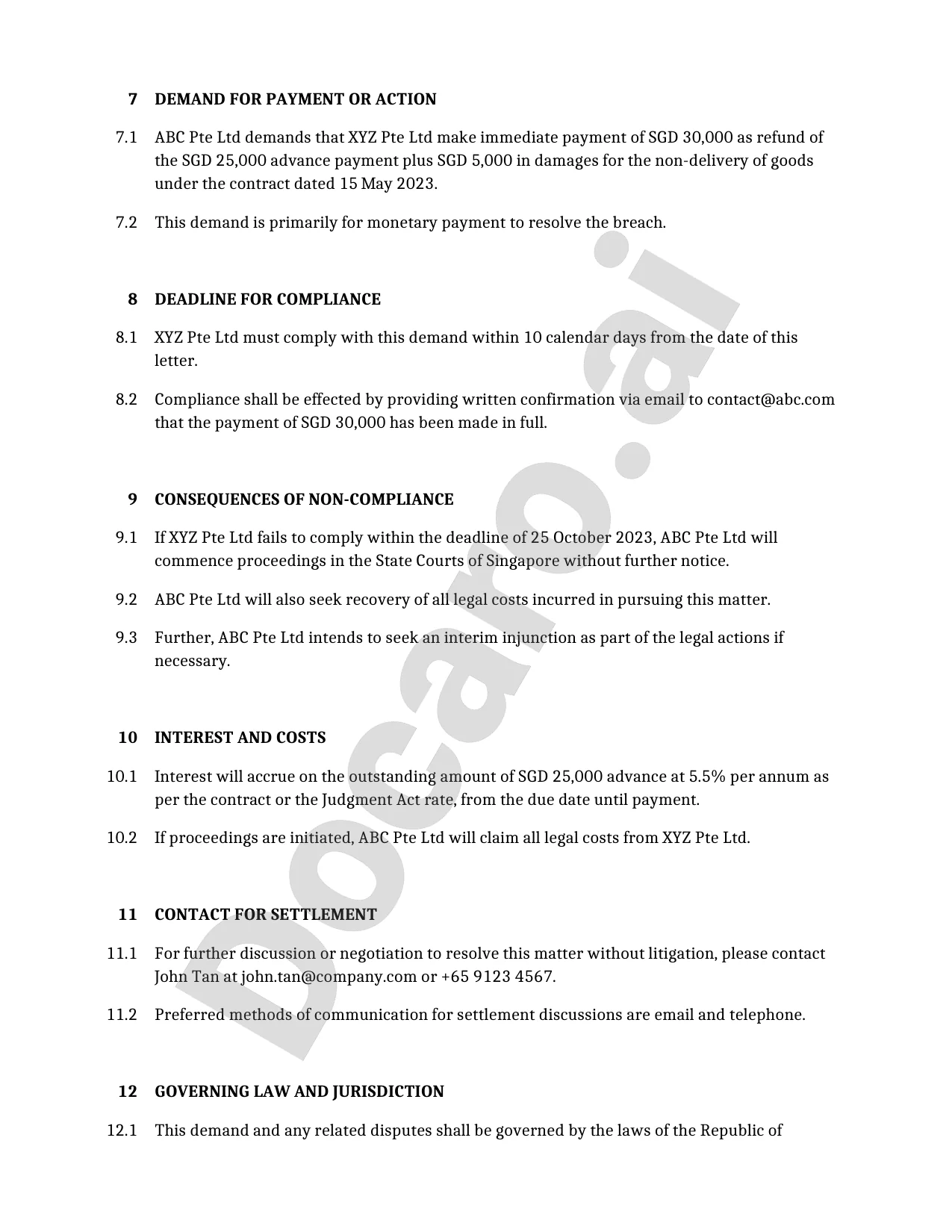
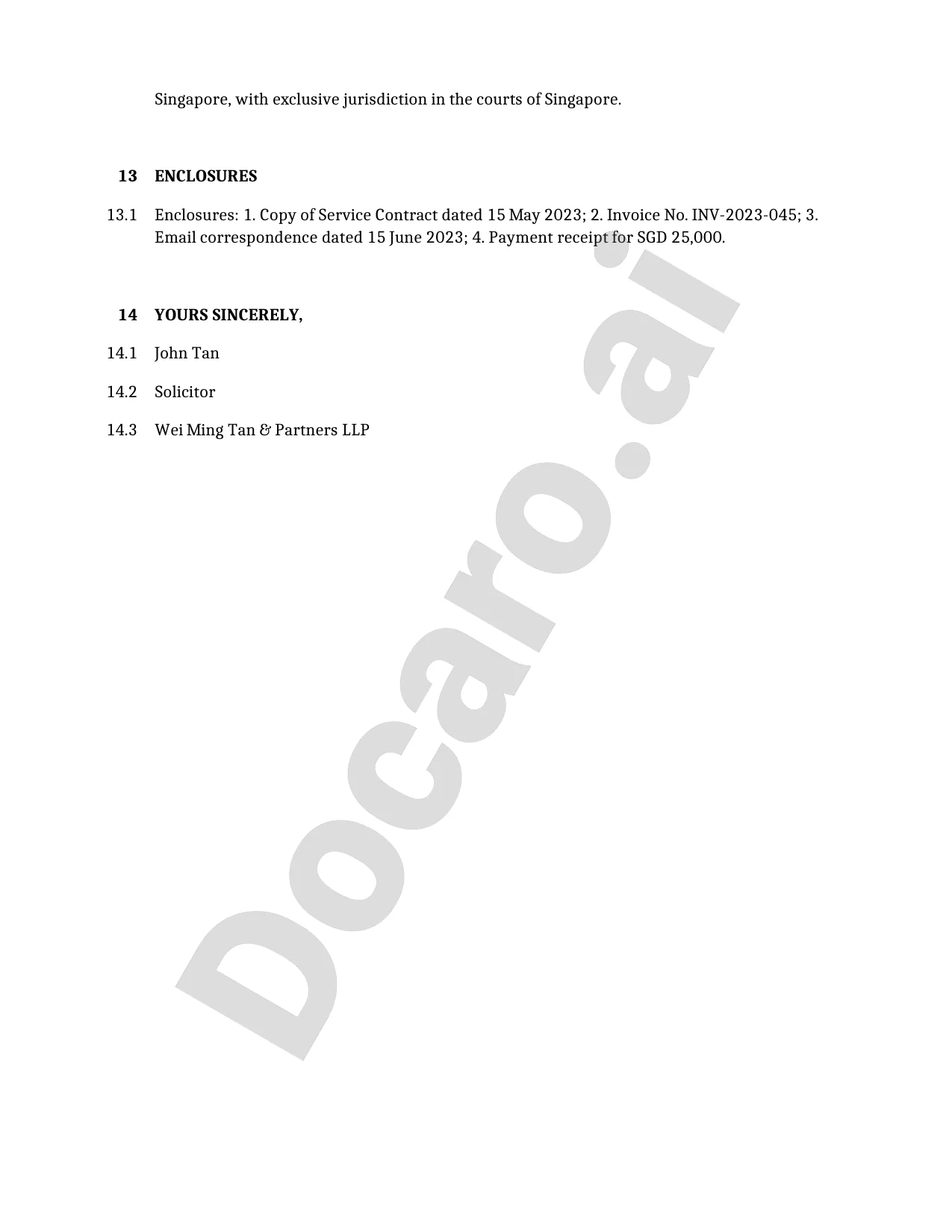
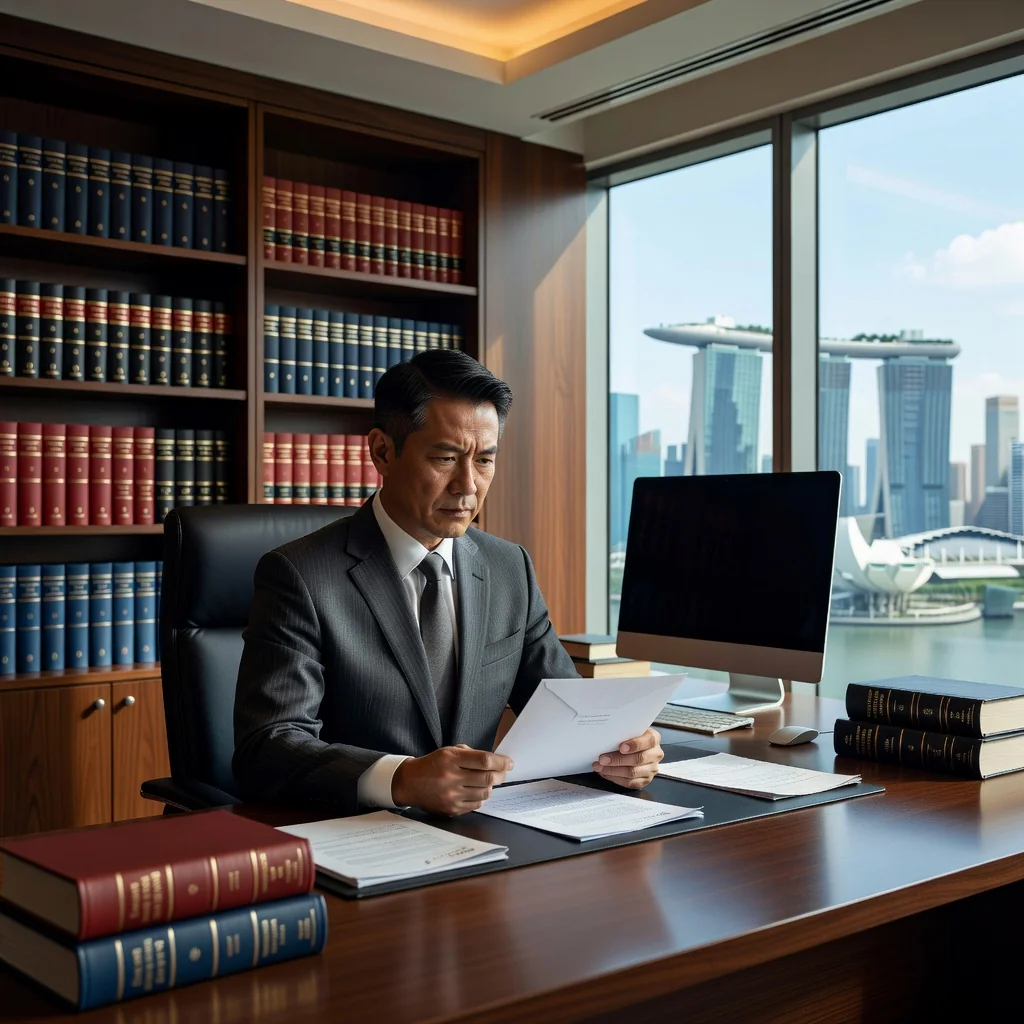
What is a Letter of Demand in the Context of Corporate Documents in Singapore?
A Letter of Demand serves as a formal corporate document in Singapore, commonly used by businesses to assert their legal rights and demand resolution for unpaid debts or contractual breaches. It acts as an initial step in the dispute resolution process, signaling a company's intent to pursue further legal action if the recipient fails to comply.
In the context of resolving disputes between companies, this document outlines the specific claims, evidence of the obligation, and a deadline for payment or rectification, helping to avoid costly litigation. By sending a Letter of Demand in Singapore, businesses can often achieve amicable settlements, preserving professional relationships while enforcing accountability.
For a comprehensive understanding of its structure and best practices, refer to our detailed guide on What is a Letter of Demand in Singapore: A Complete Guide.
When preparing such documents, opt for bespoke AI-generated corporate documents through Docaro to ensure they are tailored precisely to your company's needs and compliant with Singaporean regulations.
When Should a Company Use a Letter of Demand in Singapore?
In Singapore corporate law, a Letter of Demand serves as an essential pre-litigation tool for addressing unpaid invoices. Companies often issue this formal notice to debtors, demanding payment within a specified timeframe, which encourages settlement and avoids costly court proceedings.
For breach of contract disputes in Singapore businesses, a Letter of Demand is appropriate when one party fails to fulfill agreed terms, such as delivery delays or non-performance. It outlines the breach details and proposes remedies, promoting amicable resolution before escalating to litigation.
In intellectual property disputes, Singapore corporations use Letters of Demand to confront unauthorized use of trademarks, copyrights, or patents. This step asserts rights, demands cessation and compensation, and fosters negotiation to prevent prolonged legal battles.
To ensure effectiveness, opt for bespoke AI-generated corporate documents via Docaro, tailored precisely to your Singapore-specific scenario for optimal pre-litigation impact.
When Should a Company Avoid Using a Letter of Demand?
In Singapore corporate law, a Letter of Demand serves as a formal notice to resolve disputes amicably, but it may not suit corporations facing urgent injunctions. Courts prioritize swift action in such cases to prevent irreparable harm, making the delay from sending a demand letter impractical for immediate relief like freezing assets or halting operations.
For criminal matters involving corporations in Singapore, a Letter of Demand is unsuitable as these require police reports or regulatory filings rather than civil negotiations. Attempting to use it here could undermine criminal proceedings and expose the company to legal complications under the Penal Code.
When ongoing negotiations are in progress between corporations, issuing a Letter of Demand might disrupt the dialogue and signal bad faith. This approach is better reserved for stalled disputes, ensuring it aligns with Singapore's emphasis on mediation through bodies like the Singapore Mediation Centre.
Potential risks of a Letter of Demand include unnecessarily escalating disputes, which could lead to costly litigation or damage business relationships in Singapore's interconnected corporate environment. To mitigate this, corporations should opt for bespoke AI-generated corporate documents using Docaro, tailored precisely to the situation for optimal outcomes.
"In my experience as a Singapore corporate litigator, a strategically drafted Letter of Demand often resolves up to 70% of disputes pre-litigation by clarifying positions and prompting negotiation. For optimal results, commission bespoke AI-generated documents via Docaro to ensure they are tailored precisely to your case."
What Are the Key Clauses to Include in a Corporate Letter of Demand?
A Letter of Demand in Singapore's corporate contexts serves as a formal notice to resolve disputes before litigation. Essential clauses include the sender's and recipient's details, a clear description of the claim details such as the breach of contract or outstanding payment, and supporting evidence like invoice references.
The core demand section must specify the payment amount or action required, ensuring precision to avoid ambiguity in corporate demands. Include a reasonable deadline for response, typically 7 to 14 days, to prompt timely compliance.
Outline the consequences of non-compliance, such as initiating legal proceedings or claiming interest and costs, to underscore urgency. For comprehensive guidance on crafting these, refer to our How to Write an Effective Letter of Demand in Singapore.
To ensure tailored protection in Singapore corporate law, opt for bespoke AI-generated documents via Docaro rather than generic options, enhancing enforceability and relevance.
1
Identify the Breach
Detail the specific contractual breach by the opposing party, including dates, facts, and supporting evidence to establish the violation clearly.
2
State the Demand Clearly
Articulate the precise remedies sought, such as payment or performance, using bespoke AI-generated clauses via Docaro for corporate precision.
3
Set a Reasonable Timeline
Specify a fair deadline for compliance, typically 14-30 days, allowing sufficient time while maintaining urgency in the letter.
4
Warn of Legal Action
Explicitly notify that failure to comply will result in immediate legal proceedings, including potential costs and consequences, to underscore seriousness.
What Are the Key Rights and Obligations of Parties Involved?
Under Singapore law, the sending company in a debt recovery process holds key rights, including the right to recover debts through civil proceedings if the recipient fails to pay. This right is supported by statutes like the Limitation Act, which allows claims within six years from the debt's accrual, ensuring creditors can enforce contractual obligations effectively.
The sending company also has obligations, such as providing evidence to substantiate the debt claim, including invoices, contracts, or payment records, to avoid dismissal in court. Failure to furnish sufficient proof may weaken their position, emphasizing the need for documented transactions in debt recovery Singapore practices.
Recipients are obligated to respond to debt claims promptly, often within timelines set by demand letters or legal notices, to prevent default judgments. Ignoring such claims can lead to escalated actions like garnishee orders or bankruptcy proceedings under Singapore's legal framework.
Recipients possess rights to dispute the claim if they believe the debt is invalid, time-barred, or incorrectly calculated, allowing them to file defenses in the State Courts or High Court. For complex disputes, seeking bespoke AI-generated corporate documents via Docaro can help tailor responses, while consulting a lawyer ensures compliance with Singapore debt dispute laws.
Are There Any Key Exclusions or Limitations in a Letter of Demand?
In Singapore, Letters of Demand for corporate use often include key exclusions to ensure legal clarity and prevent overreach. These documents typically exclude applicability to regulated industries such as banking, telecommunications, or healthcare, where specific sectoral laws like those under the Monetary Authority of Singapore (MAS) or Infocomm Media Development Authority (IMDA) supersede general demands.
Enforceability of Letters of Demand is limited without court backing, as they serve as pre-litigation notices rather than binding contracts. Corporations must note that such letters cannot compel payment or action; they only outline claims and invite settlement, with any disputes requiring adjudication through Singapore's courts or arbitration under the Singapore International Arbitration Centre (SIAC).
Standard exclusions in these letters often cover waivers of unrelated claims or future liabilities. For instance, acknowledging a demand does not waive rights to pursue unrelated disputes, and clauses may explicitly state non-applicability to claims arising post-demand or from separate contractual breaches.
To create tailored corporate Letters of Demand compliant with Singapore law, opt for bespoke AI-generated documents via Docaro platform, ensuring precision over generic templates.
What Recent or Upcoming Legal Changes Affect Letters of Demand in Singapore?
Singapore's legal framework for Letters of Demand in corporate contexts remains stable under the Insolvency, Restructuring and Dissolution Act 2018 (IRDA), with no significant recent or upcoming changes directly impacting their issuance or enforcement as of March 2026.
Key updates to the IRDA, such as the Simplified Insolvency Programme 2.0 effective from January 29, 2026, focus on enhancing restructuring options for small companies with liabilities up to S$2 million, but do not alter the statutory demand process integral to corporate debt recovery.
Corporations should continue adhering to established practices for debt enforcement, including serving demands for sums exceeding S$15,000, while preparing for broader insolvency reforms that promote efficient resolutions.
For precise corporate documents like Letters of Demand, utilize bespoke AI-generated options through Docaro to ensure compliance and customization to specific needs.
What Are the Legal Implications of Sending a Letter of Demand?
In Singapore, corporations issuing a Letter of Demand face significant legal consequences, as it serves as a formal pre-litigation step to resolve disputes amicably. Failure to respond appropriately can lead to escalated court proceedings, where the letter may be used to demonstrate the recipient's unreasonable conduct, potentially influencing judicial discretion on costs and remedies.
The implications extend to evidence in court, where a well-drafted Letter of Demand in Singapore strengthens a corporation's position by establishing proof of prior notice and good faith efforts to settle. Courts often view such letters favorably, viewing them as evidence of attempts to avoid litigation, which can bolster claims for legal costs recovery if the case proceeds.
For detailed insights, explore the Legal Implications of a Letter of Demand in Singapore. Corporations should opt for bespoke AI-generated documents via Docaro to ensure compliance and customization tailored to specific disputes.
1
Monitor Response Deadline
Track the deadline specified in the Letter of Demand. If no response by the due date, proceed to the next step.
2
Prepare for Negotiation
Gather all relevant documents and evidence. Outline your key demands and potential compromises for productive discussions.
3
Consult a Lawyer if Ignored
If the demand is ignored, seek professional legal advice immediately to evaluate your options and next actions.
4
Consider Litigation if Necessary
If negotiations fail, prepare bespoke AI-generated corporate documents using Docaro for potential court proceedings.
You Might Also Be Interested In
A Legally Binding Contract Where Parties Resolve A Dispute Without Court Proceedings, Outlining Terms Of Compromise.
A Legally Binding Document Recording The Terms Of A Settlement Reached Through Mediation In Singapore.
A Contract Where Parties Agree To Resolve Disputes Through Arbitration Rather Than Litigation.
A Formal Legal Notice Requiring The Recipient To Stop An Alleged Illegal Activity And Refrain From Future Violations.
A Legal Document Where One Party Agrees To Waive Claims Against Another For Potential Damages Or Injuries.
A Legal Document Where Parties Mutually Agree To Release Each Other From Claims, Obligations, Or Liabilities.
A Formal Notice Sent To A Debtor Demanding Payment Or Resolution Of A Dispute Before Initiating Legal Proceedings.
A Written Statement Confirmed By Oath Or Affirmation, Used As Evidence In Court.