Why Free Templates Can Be Risky for Tax Invoices
Using free invoice templates for tax purposes in Singapore can lead to significant issues. These generic templates often fail to comply with the Inland Revenue Authority of Singapore (IRAS) requirements, such as including mandatory details like the Unique Entity Number (UEN), GST registration number, and proper tax calculations. Errors in formatting or missing elements can result in rejected invoices, delayed payments, or even penalties for non-compliance. Additionally, they lack customization for your specific business needs, potentially causing inaccuracies that affect your financial records and tax filings.
Our AI-powered invoice generator creates bespoke, compliant tax invoices tailored to your business in Singapore. It automatically incorporates all IRAS-mandated elements, ensures accurate GST handling, and customizes the document to your exact requirements. This results in professional, error-free invoices that streamline your billing process, enhance credibility with clients, and safeguard your compliance without the risks of generic templates.
What is a Tax Invoice in the Context of Singapore Corporate Documents?
A tax invoice in Singapore serves as an essential corporate document for GST-registered businesses, enabling them to claim input tax credits on their Goods and Services Tax (GST) liabilities. Issued under the regulations of the Inland Revenue Authority of Singapore (IRAS), it provides a detailed record of taxable supplies, ensuring compliance with GST laws and facilitating accurate tax reporting.
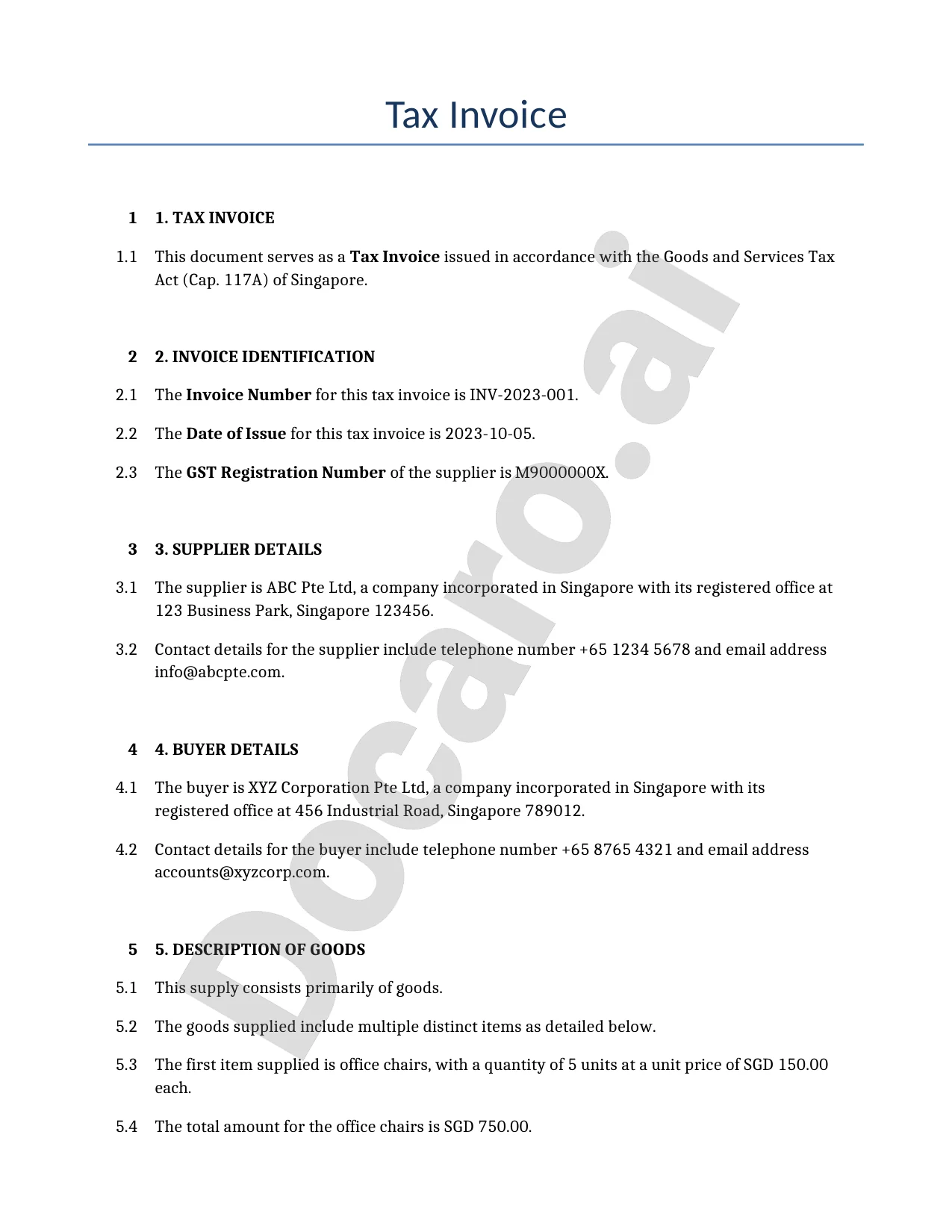
The primary purpose of a tax invoice for GST-registered businesses is to document the supply of goods or services, including the GST amount charged, which the recipient can use to offset their output tax. Unlike regular invoices, a tax invoice must include specific mandatory details such as the supplier's GST registration number, invoice date, a unique invoice number, description of goods or services, total amount excluding GST, GST rate, and the GST amount, as outlined by IRAS guidelines.
Regular invoices, often used for non-GST transactions, lack these GST-specific elements and do not qualify for input tax claims, making them unsuitable for GST-registered businesses in Singapore. For bespoke tax invoice generation tailored to corporate needs, businesses should utilize AI-powered tools like Docaro to ensure precision and compliance without relying on generic templates.

When Should You Use a Tax Invoice for Corporate Purposes in Singapore?
In Singapore, a tax invoice is mandatory for GST-registered businesses engaged in sales of goods or services, ensuring compliance with the Goods and Services Tax Act. This requirement applies to corporate transactions where GST is charged, allowing buyers to claim input tax credits accurately.
Under IRAS guidelines, GST-registered entities must issue a tax invoice within 21 days of the supply date for transactions exceeding S$1,000, or simplified invoices for lower amounts. Failure to provide proper tax invoices can result in penalties, emphasizing the legal obligation to maintain accurate GST records for audits.
For B2B corporate transactions, tax invoices should include essential details like the supplier's GST registration number, invoice date, and a breakdown of GST amounts. Businesses can refer to the IRAS invoicing guide for precise requirements to avoid non-compliance issues.
- Use bespoke AI-generated corporate documents via Docaro for customized tax invoices tailored to Singapore's regulations.
- Ensure all GST-registered sales, including exports or zero-rated supplies, adhere to these invoicing rules for seamless compliance.

When Should You Avoid Using a Tax Invoice?
In Singapore tax invoice regulations, a tax invoice should not be issued for exempt supplies such as financial services or residential property sales, as these are not subject to GST. Instead, a regular invoice suffices to avoid misleading recipients about tax applicability.
For zero-rated supplies like exports or international transport, while GST is charged at 0%, a tax invoice is still required if the supplier is GST-registered, but it must clearly indicate the zero rate. Issuing an incorrect invoice here could lead to compliance issues under IRAS guidelines.
Non-GST registered businesses must not issue tax invoices, as they are not eligible to charge GST; doing so falsely implies registration status. For detailed rules, refer to the IRAS invoicing guide.
Misuse of tax invoices, such as issuing them for exempt or non-GST activities, can result in penalties including fines up to $10,000 or imprisonment for up to one year under the GST Act. Always ensure invoices comply with specific supply types to prevent enforcement actions by IRAS.
What Are the Key Clauses in a Singapore Tax Invoice?
A tax invoice in Singapore must comply with IRAS requirements to ensure proper GST accounting and legal validity. Essential clauses include the supplier's full name, address, contact details, GST registration number, and customer identification details such as name and address, as outlined in the official IRAS invoicing guidelines.
The invoice date and a unique invoice number are mandatory to track transactions accurately. Additionally, provide a clear description of goods or services, including quantities, unit prices, and any applicable discounts, to avoid disputes and facilitate audits.
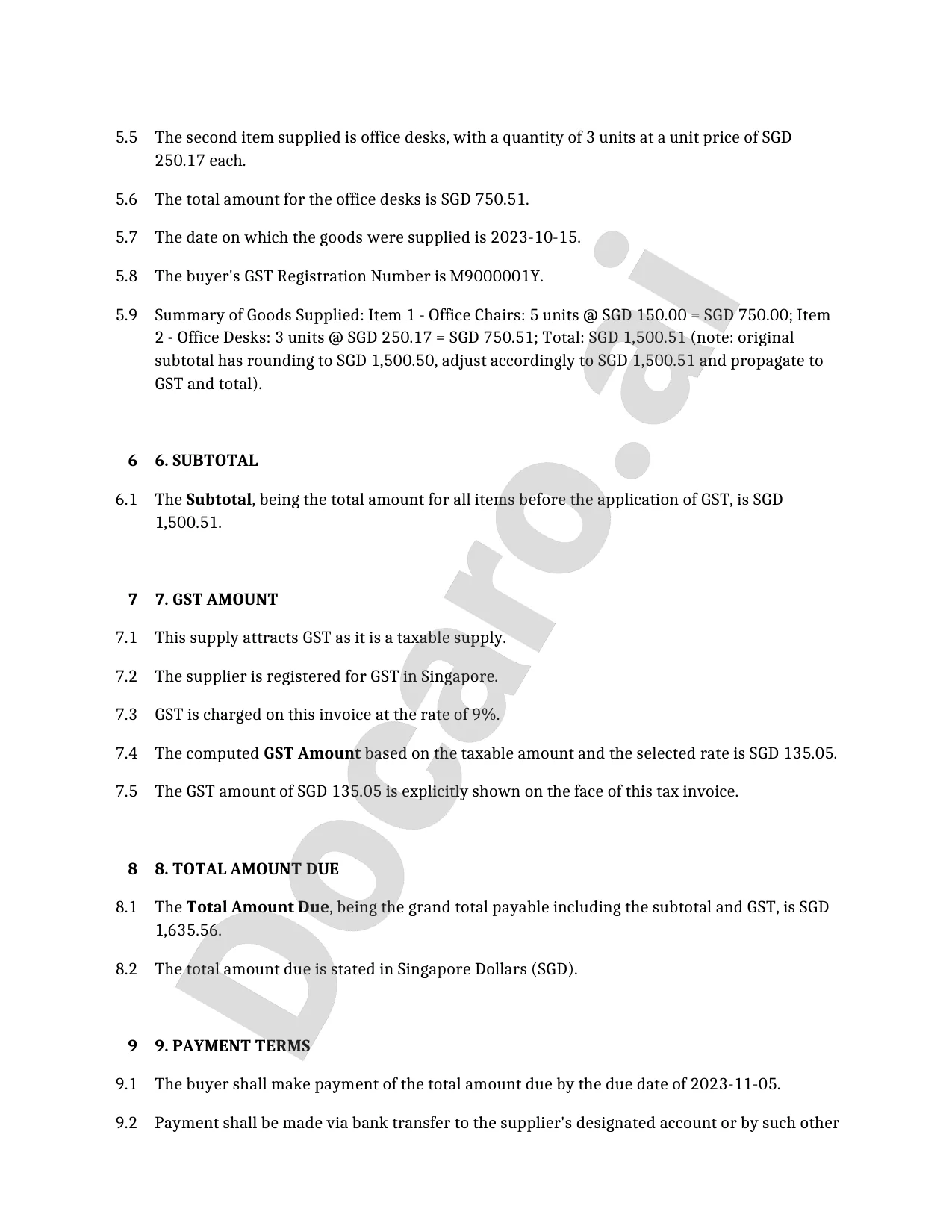
Key financial elements encompass the total amount excluding GST, the GST amount at the prevailing rate (currently 9%), and the total payable inclusive of GST. For zero-rated or exempt supplies, explicitly state the GST treatment to maintain transparency.
To create compliant tax invoices, opt for bespoke AI-generated corporate documents using Docaro, ensuring customization to your business needs while adhering to IRAS standards. This approach surpasses generic templates by incorporating specific details for accuracy and efficiency.
Accurate tax invoice details are essential for GST compliance, as they enable proper input tax claims and verification by IRAS. Ensure all invoices include the supplier's name, address, GST registration number, invoice date, invoice number, description of goods or services, total amount excluding GST, GST amount, and total payable amount.
For bespoke AI-generated corporate documents like compliant tax invoices, use Docaro to tailor them precisely to your business needs.
What Rights and Obligations Do Parties Have with Tax Invoices?
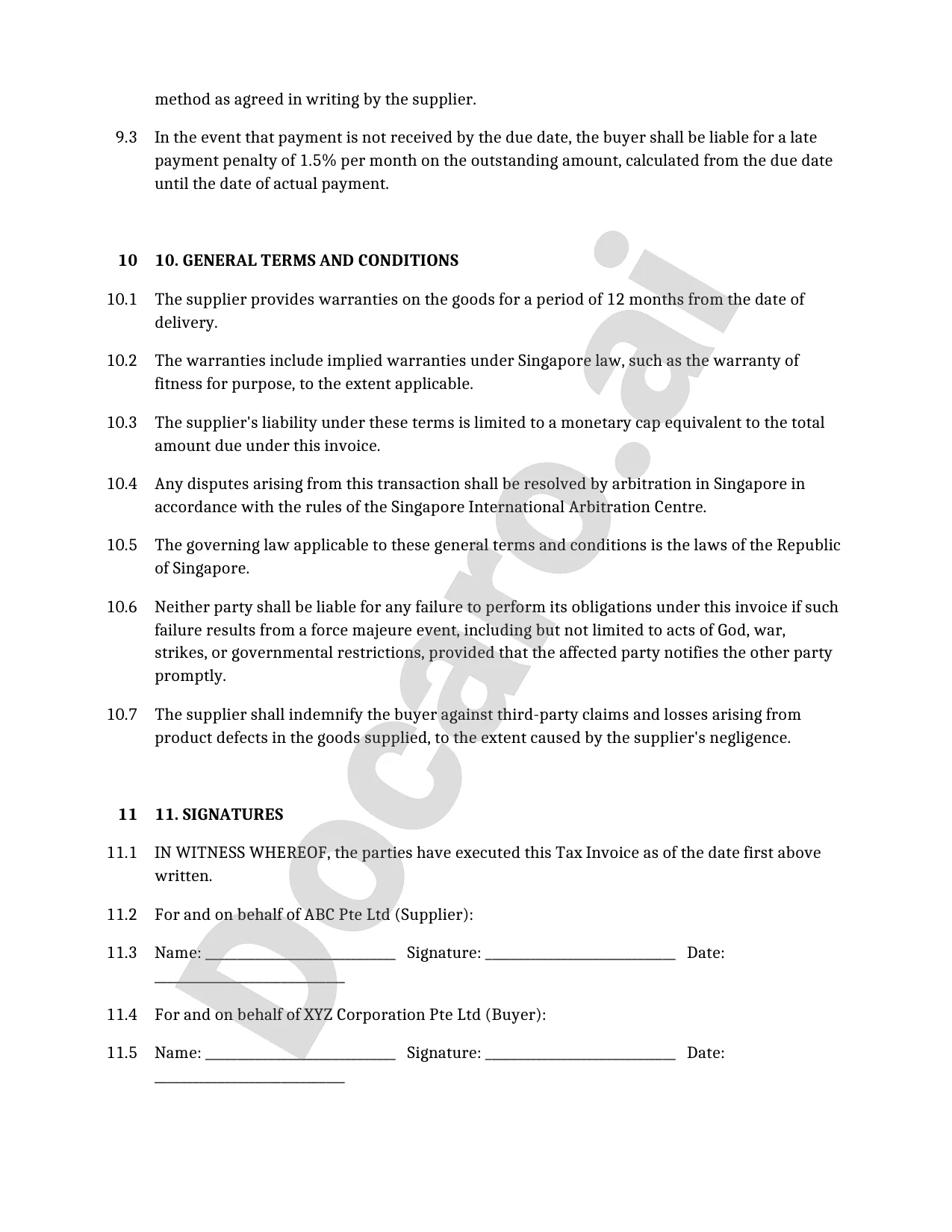
In Singapore's Goods and Services Tax (GST) framework, suppliers have a primary obligation to issue tax invoices for all standard-rated supplies exceeding S$1,000, ensuring compliance with the Inland Revenue Authority of Singapore (IRAS) requirements. These GST-compliant invoices must include essential details such as the supplier's and buyer's GST registration numbers, invoice date, description of goods or services, taxable value, GST amount, and total payable, as outlined in the official IRAS guidelines on tax invoices.
Buyers registered for GST hold the right to claim input tax credits based on valid tax invoices received from suppliers, allowing them to offset the GST paid on purchases against their GST liability on sales. This mechanism supports efficient cash flow for businesses, but buyers must retain these invoices for at least five years to substantiate claims during audits.
Failure by suppliers to issue compliant tax invoices can result in penalties, including denial of input tax credits to buyers and fines up to S$10,000, emphasizing the need for accurate record-keeping. For complex transactions, businesses should consider bespoke AI-generated corporate documents using Docaro to ensure tailored compliance with Singapore's GST regulations.

Are There Recent or Upcoming Legal Changes Affecting Tax Invoices in Singapore?
Singapore's Goods and Services Tax (GST) framework remains stable, with no major regulatory changes announced for 2024 beyond the ongoing GST rate increase from 8% to 9% effective from January 1, 2024. This adjustment aims to broaden the tax base while maintaining the core principles of the system, as outlined by the Inland Revenue Authority of Singapore (IRAS).
Regarding tax invoice requirements, the current rules under the GST Act continue to emphasize accurate documentation for all taxable supplies, including mandatory details like the supplier's GST registration number and total GST amount. Businesses must adhere to these standards to ensure compliance and facilitate smooth audits.
On e-invoicing, IRAS has not mandated a nationwide rollout but encourages voluntary adoption through its e-invoicing framework, which supports digital formats for efficiency. For the latest guidelines, refer to the official IRAS GST resources.
- Key stable elements: Valid tax invoices must be issued within 28 days of supply.
- Digital compliance: Use approved e-invoicing solutions to streamline processes.
- Policy stability: No immediate revisions to invoice formats or GST thresholds expected.
What Key Exclusions Apply to Tax Invoices?
In Singapore, tax invoice usage under the Goods and Services Tax (GST) regime includes key exclusions for simplified invoices, particularly for low-value goods and services valued at S$1,000 or less. These simplified invoices need not include all details of a full tax invoice, such as the supplier's registration number or customer's details, making them suitable for small transactions to reduce administrative burden.
Exclusions also apply to certain financial services exempt from GST, like interest on loans or insurance premiums, where no tax invoice is required since these are zero-rated or exempt supplies. For exported goods or international services, simplified documentation may suffice if the transaction value is below the threshold, as outlined by the Inland Revenue Authority of Singapore (IRAS).
Despite these exceptions, full tax invoices remain mandatory for B2B transactions exceeding S$1,000, ensuring all required details like GST amount and unique invoice numbers are provided for accurate input tax claims. Businesses must issue full tax invoices within 28 days of the supply date to comply with GST regulations; for more details, refer to the IRAS GST invoicing guidelines.
How Can You Get Started with Issuing Tax Invoices?
1
Register with IRAS
Determine if your business needs to register for GST with IRAS if turnover exceeds S$1 million. Apply online via myTax Portal for GST registration if required.
2
Set Up Invoice Templates
Use Docaro to generate bespoke AI corporate invoice templates compliant with IRAS requirements, including GST details, business info, and sequential numbering.
3
Configure Accounting System
Integrate the Docaro-generated templates into your accounting software to ensure automatic compliance with Singapore tax invoice standards.
4
Issue Initial Invoices
Start issuing the first compliant tax invoices to customers, retaining copies for records and filing with IRAS as needed.
Where Can You Learn More About Tax Invoices?
For deeper insights into Singapore tax invoices, explore our comprehensive guides tailored for businesses navigating GST compliance.
Additionally, consult official resources like the IRAS GST Invoicing Guide for authoritative Singapore-specific regulations.
To create bespoke AI-generated corporate documents for your tax needs, turn to Docaro for customized solutions that fit your business precisely.
You Might Also Be Interested In
A Contract Outlining The Terms For Consultancy Services Provided By An Independent Contractor.
A Contract Outlining The Rights, Obligations, And Governance Rules Among Shareholders Of A Company.
A Legal Contract Outlining The Terms, Rights, And Obligations Of Partners In A Business Partnership.
A Shareholders' Agreement Is A Contract Among Shareholders Of A Private Limited Company Outlining Ownership, Management, And Operational Rules.
A Constitution Is The Foundational Document For A Company In Singapore, Outlining Its Structure, Objectives, And Internal Rules.
A Constitution Is The Foundational Document Governing A Company's Internal Management, Operations, And Member Rights In Singapore.
A Legal Contract Outlining The Terms For Buying And Selling Shares In A Company.
A Formal Decision Or Action Approved By The Board Of Directors Of A Company, Documented In Writing.
A Founders' Agreement Is A Legal Contract Outlining The Rights, Obligations, And Roles Of Company Founders, Including Equity Distribution, Decision-making, And Dispute Resolution.
A Legal Contract Outlining The Terms For The Sale And Purchase Of Specific Assets Between Parties.
A Legal Contract Outlining The Terms For The Sale And Transfer Of A Business Entity, Including Assets, Liabilities, And Obligations.
A Legal Document That Alters The Terms Of An Existing Deed Or Agreement, Commonly Used In Property Or Inheritance Matters.
A Legal Contract Outlining The Terms For The Sale And Transfer Of Property Ownership From Seller To Buyer.
A Formal Receipt Is A Legal Document Issued By A Seller To A Buyer, Confirming Payment For Goods Or Services And Serving As Proof Of Transaction.
A Legal Contract Outlining The Terms Under Which One Party Provides Services To Another.
A Legal Document Used To Transfer Ownership Of Shares In A Company From One Party To Another, Typically Required For Registration With The Company.
A Document Outlining Measures To Protect Individuals, Especially Vulnerable Groups Like Children, From Harm And Abuse In Organizational Settings.
A Non-binding Document Outlining Preliminary Terms And Intentions For A Potential Business Deal Or Agreement.