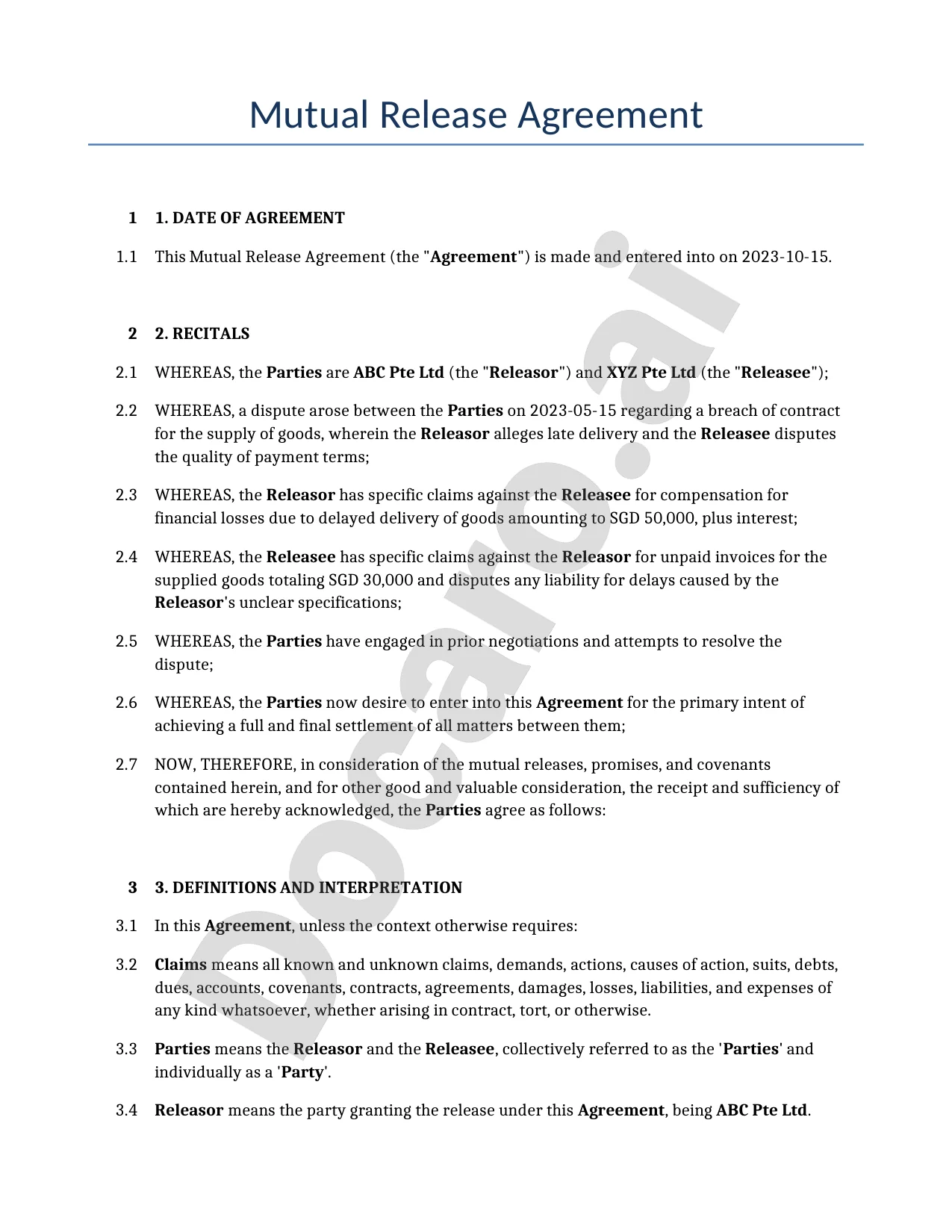
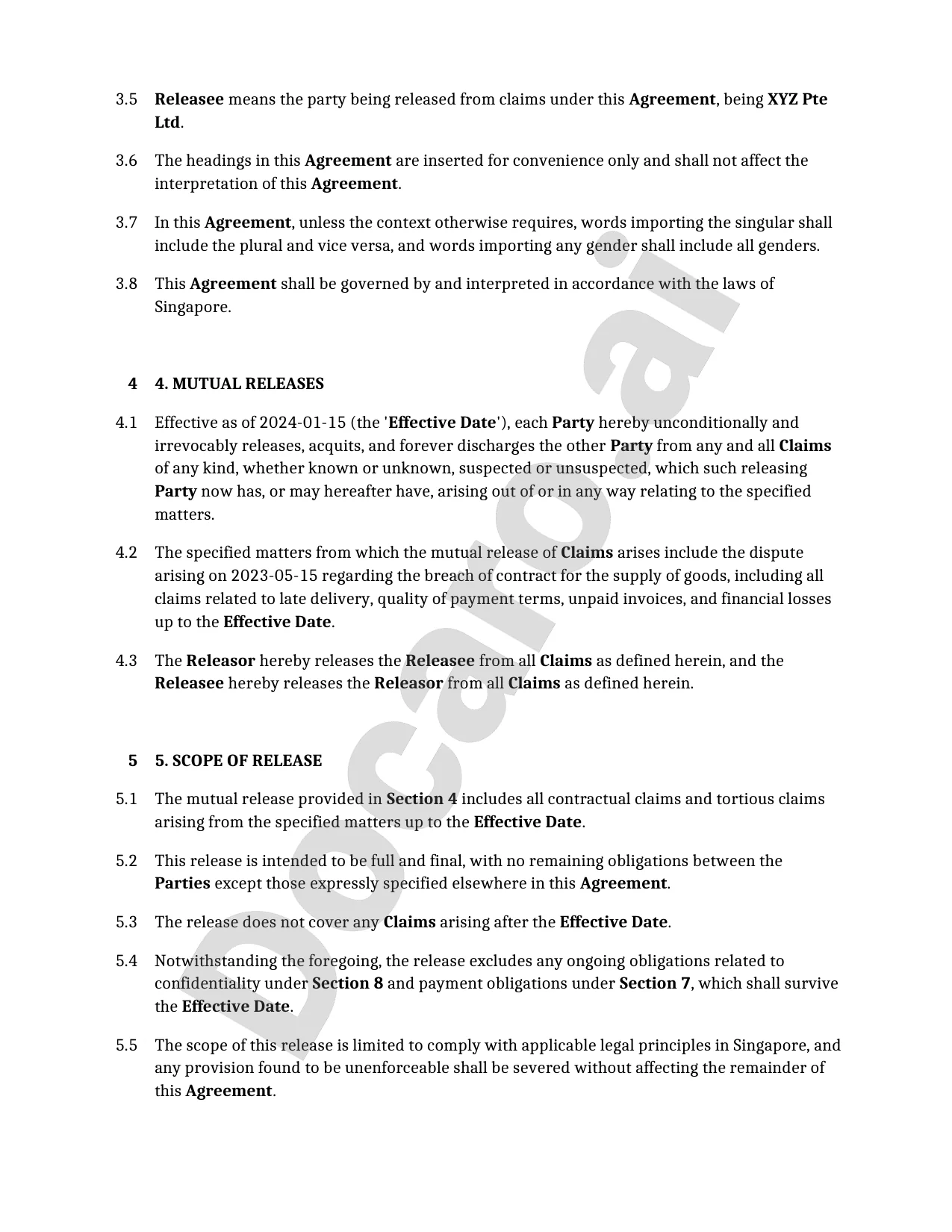
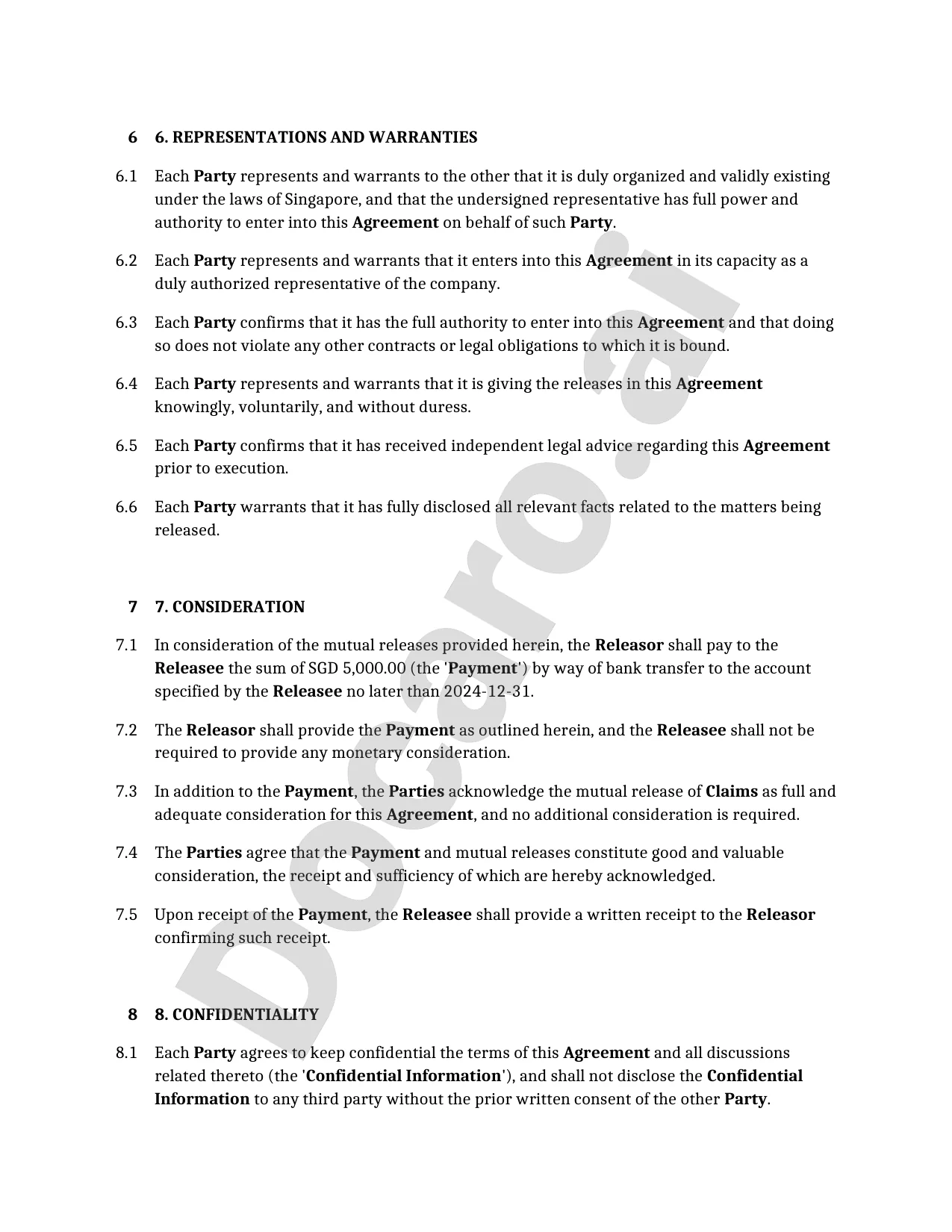
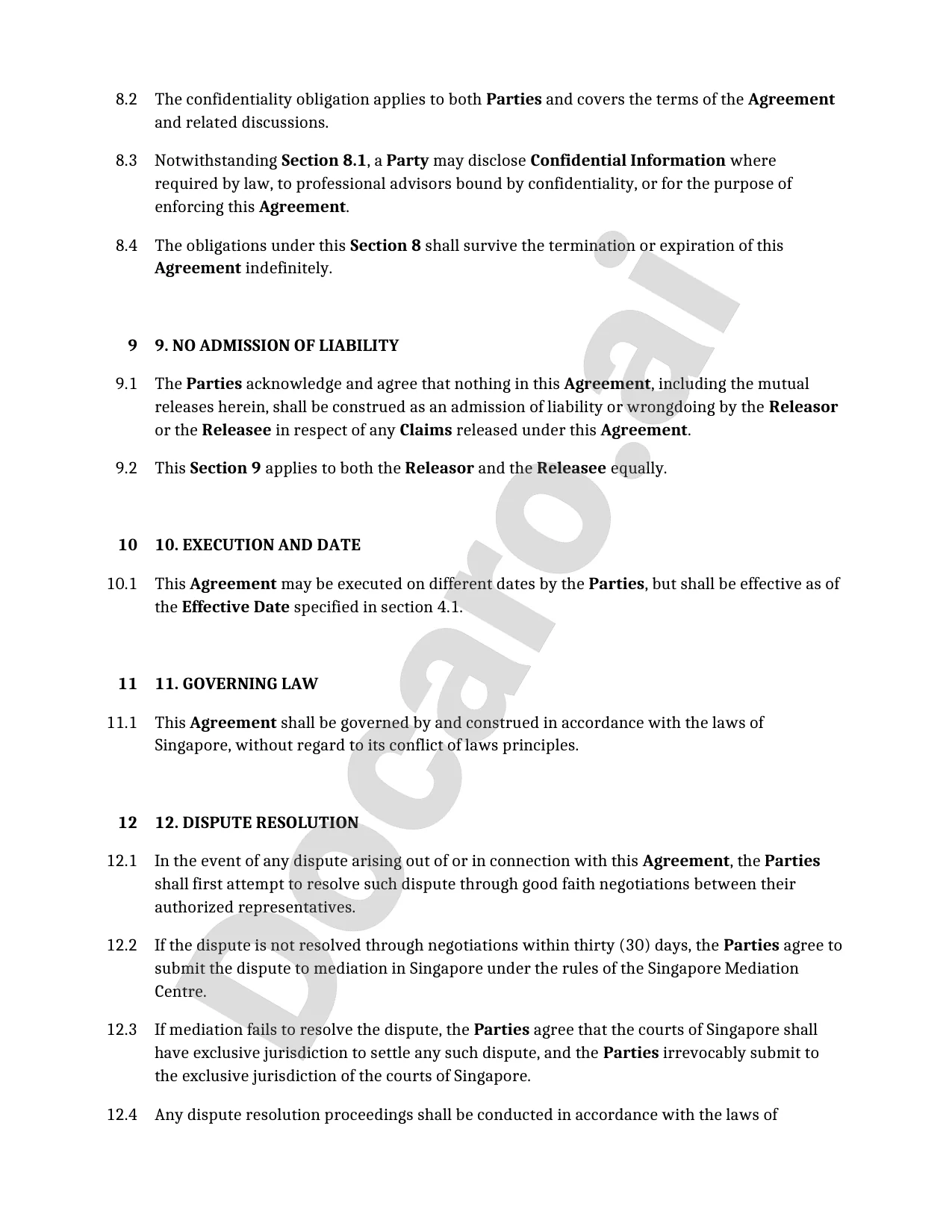
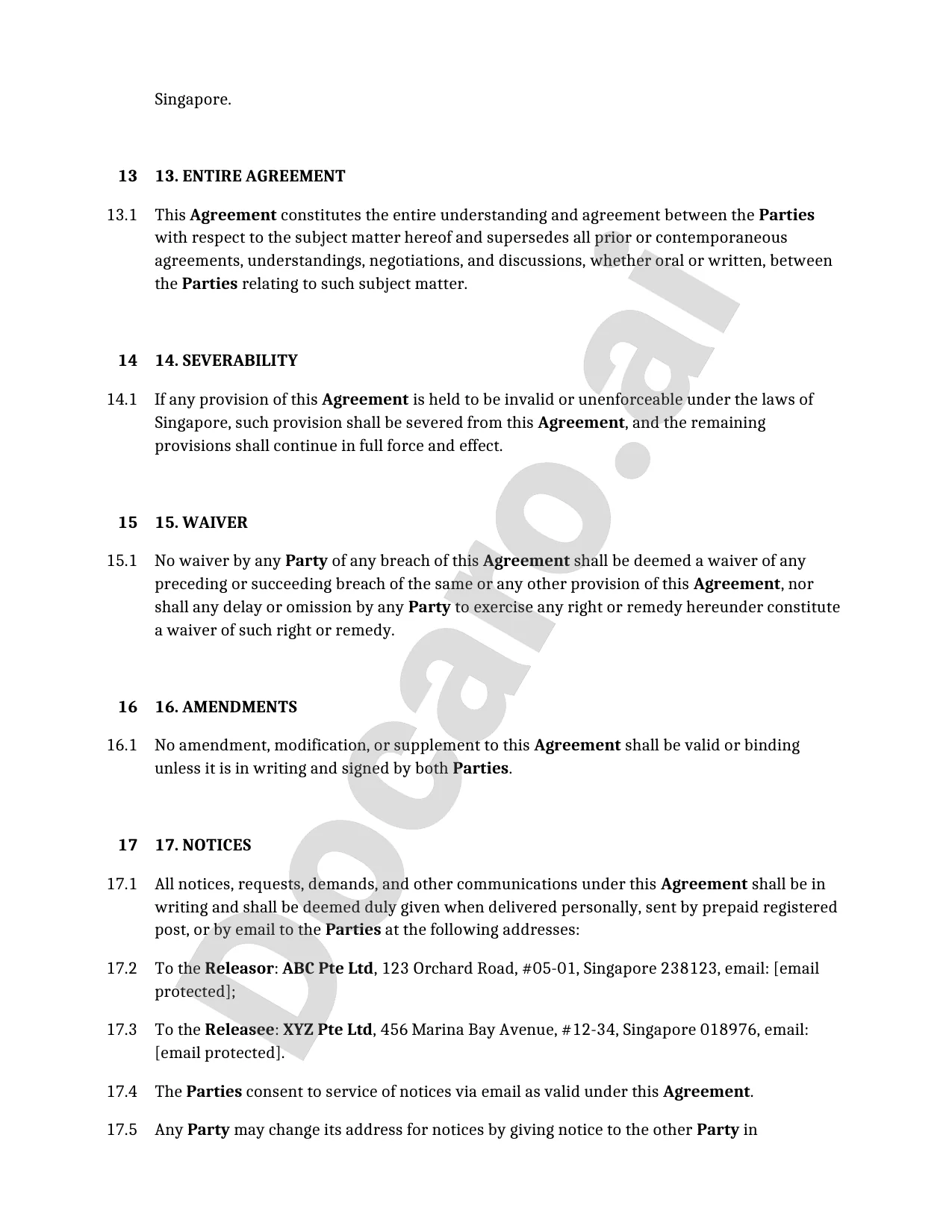
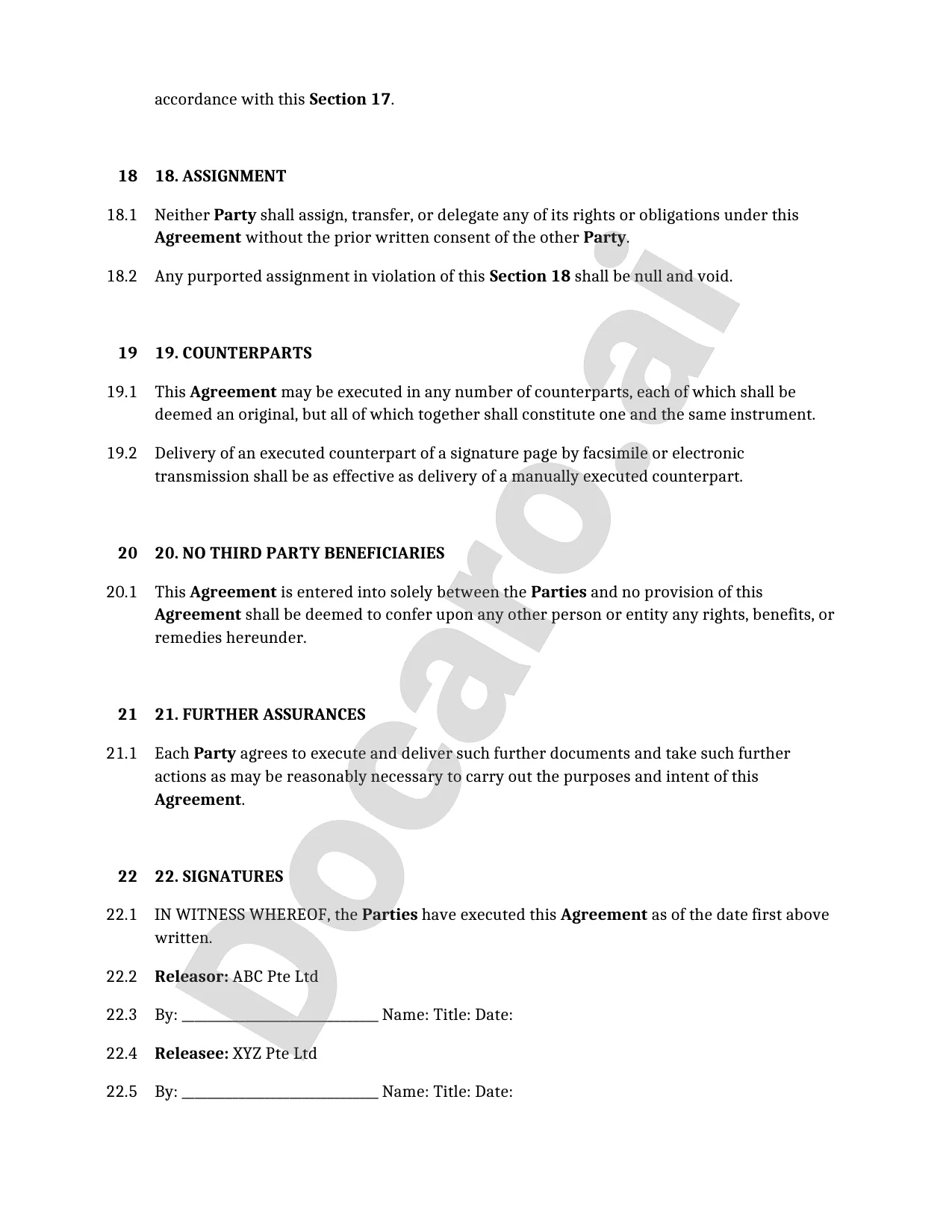
AI Generated Singaporean Mutual Release Agreement PDF & Word - 2026 Updated
Generate a customized mutual release agreement for Singapore using our AI tool, ensuring compliance with local laws and facilitating smooth dispute resolutions.
Free instant document creation.
Legally compliant agreements.
No signup required.
Generate your document for free.
Download PDF, Word and email for $9.99 USD.
When Do You Need a Mutual Release Agreement in Singapore?
Ending a Business Partnership
Use it when partners are parting ways to ensure both sides let go of any claims against each other and move forward without future disputes.
Settling a Dispute Outside Court
It's helpful after reaching an agreement to resolve a disagreement, as it confirms both parties drop any ongoing issues and avoid legal battles.
Closing a Contract Early
Apply this when terminating a deal before its end date, so everyone agrees to release obligations and prevent later arguments over unfinished terms.
Finalizing Employee Separation
It's useful in a resignation or layoff to mutually agree that neither the employer nor employee will pursue claims, providing peace of mind.
Why a Well-Drafted Document Matters
A properly prepared agreement protects both parties by clearly stating what's released and what's not, reducing the risk of misunderstandings or costly legal issues later.
Singaporean Legal Rules for a Mutual Release Agreement
What is it?
A mutual release agreement is a deal where two parties agree to let go of any claims they have against each other and end their dispute peacefully.
Voluntary Agreement
Both parties must enter the agreement freely, without any pressure or trickery, for it to be valid.
Clear Terms
The agreement should clearly state what claims are being released and any other conditions to avoid confusion later.
Written Form
While not always required, it's best to put the agreement in writing and have both parties sign it to make it enforceable.
Legal Capacity
Both parties must be adults or legally able to make decisions, and understand what they're agreeing to.
Enforceability in Court
If followed properly, the agreement can be upheld by Singapore courts, stopping either party from pursuing the released claims.
Seek Advice
It's wise to consult a lawyer to ensure the agreement fits your situation and complies with Singapore laws.
Important
Using the wrong type or structure of mutual release agreement may fail to fully discharge all obligations or expose parties to unforeseen liabilities.
What a Proper Mutual Release Agreement Should Include
Parties Involved
Clearly identify the two parties entering into the agreement to ensure everyone knows who is releasing claims against whom.
Description of Dispute
Briefly outline the issue or disagreement being resolved to set the context for the release.
Mutual Release of Claims
State that both parties fully release each other from any past or present claims related to the dispute.
Scope of Release
Specify what types of claims are covered, such as debts, liabilities, or legal actions, to avoid confusion.
Confidentiality Clause
Agree to keep the agreement and related details private to protect both parties' interests.
Payment or Consideration
Detail any payment, exchange, or benefit provided in return for the release to make the agreement binding.
No Admission of Fault
Clarify that the agreement does not mean either party admits any wrongdoing.
Signatures and Date
Include spaces for both parties to sign and date the document to confirm agreement.
Why Free Templates Can Be Risky for Mutual Release Agreements
Free templates for mutual release agreements often use generic language that fails to address Singapore-specific legal requirements, such as those under the Contracts Act or common law principles. This can lead to ambiguities in release clauses, potential invalidation of the agreement, or unintended liabilities if disputes arise in local courts.
AI-generated bespoke mutual release agreements are tailored to your specific circumstances, incorporating precise wording compliant with Singapore law, ensuring comprehensive protection, enforceability, and clarity for all parties involved.
Generate Your Bespoke Mutual Release Agreement in 4 Easy Steps
1
Answer a Few Questions
Our AI guides you through the info required.
2
Generate Your Document
Docaro builds a bespoke document tailored specifically on your requirements.
3
Review & Edit
Review your document and submit any further requested changes.
4
Download & Sign
Download your ready to sign document as a PDF, Word, Txt or HTML.
Why Use Our AI Mutual Release Agreement Generator?
Fast Generation
Quickly generate a comprehensive Mutual Release Agreement, eliminating the hassle and time associated with traditional document drafting.
Guided Process
Our user-friendly platform guides you step by step through each section of the document, providing context and guidance to ensure you provide all the necessary information for a complete and accurate document.
Safer Than Legal Templates
We never use legal templates. All documents are generated from first principles clause by clause, ensuring that your document is bespoke and tailored specifically to the information you provide. This results in a much safer and more accurate document than any legal template could provide.
Professionally Formatted
Your Mutual Release Agreement will be formatted to professional standards, including headings, clause numbers and structured layout. No further editing is required. Download your document in PDF or Word.
Compliance with Singaporean Law
Rest assured that all generated documents meet the latest legal standards and regulations of Singapore, enhancing trust and reliability.
Cost-Effective
Save money by generating legally sound tenancy agreements without the need for expensive legal services or consultations.
Get Started for Free - No Sign Up Required
No payment or sign up is required to start generating your Mutual Release Agreement. Simply answer a few questions and a preview of your final document will be generated.
Looking to Generate a Mutual Release Agreement in a Different Country?
Choose country:
Singapore
Useful Resources When Considering a Mutual Release Agreement
This Act allows third parties to enforce contractual terms intended for their benefit, which may apply to mutual release agreements involving third-party rights.
Codifies common law principles applicable to contracts, including those related to releases and settlements in Singapore.
Generate Your Bespoke Mutual Release Agreement Now
What is a Mutual Release Agreement in Singapore?
A Mutual Release Agreement is a legal document under Singapore law that allows two or more parties to formally terminate their contractual relationship by releasing each other from any remaining obligations or liabilities. This agreement ensures that both sides walk away without future claims related to the original contract, promoting clarity and finality in business dealings.
The primary purpose of a Mutual Release Agreement in Singapore is to provide a clean break, preventing disputes by mutually forgiving any breaches or debts. It is commonly used in scenarios like ending partnerships, settling commercial disputes, or concluding employment terms, and must comply with the principles of contract law as outlined in the Contracts Act.
For a deeper understanding, explore our comprehensive guide on mutual release agreements in Singapore. Always consult a qualified lawyer or use bespoke AI-generated legal documents via Docaro to tailor the agreement to your specific needs, rather than relying on generic templates.
Key benefits include risk reduction from potential litigation, as supported by Singapore Courts' emphasis on mutual consent (see Singapore Judiciary resources).
It facilitates smoother transitions in business terminations or joint ventures under Singapore's legal framework.
"In Singapore, mutual releases are essential for amicably resolving disputes, as they provide both parties with clear assurance against future claims, fostering trust and finality. I recommend consulting a legal expert to generate bespoke AI-powered documents via Docaro for tailored protection in your settlement agreement." - Dr. Lim Wei Shen, Senior Partner, Apex Law Chambers.
When Should You Use a Mutual Release Agreement in Singapore?
A Mutual Release Agreement is particularly appropriate when ending business partnerships in Singapore, allowing both parties to formally release each other from future claims and obligations, ensuring a clean termination of the partnership.
It is also ideal for settling disputes outside of court, such as contract disagreements or employment conflicts, where parties agree to drop all claims in exchange for mutual waivers, promoting amicable resolutions under Singapore law.
The benefits and considerations of Mutual Release Agreements in Singapore include risk reduction, cost savings, and confidentiality, but parties should seek professional advice to tailor the agreement. For detailed insights, explore benefits and considerations of mutual release agreements.
Refer to the Singapore Law Watch for authoritative legal resources on dispute settlements.
To create effective Mutual Release Agreements, opt for bespoke AI-generated legal documents using Docaro, ensuring they are customized to your specific Singapore-based needs.
When Should It Not Be Used?
A Mutual Release Agreement under Singapore law should be avoided in situations involving ongoing criminal matters, as such agreements cannot override criminal investigations or prosecutions. Criminal proceedings are matters of public interest, and any attempt to release liabilities through a private agreement may be deemed unenforceable, potentially complicating legal processes.
Additionally, avoid using a Mutual Release Agreement if it contravenes public policy violations in Singapore, such as agreements that attempt to waive rights related to statutory protections or illegal activities. For instance, releases that shield parties from liability for fraud or breach of mandatory laws, like those under the Contracts Act, are void as they undermine societal standards.
In cases of ongoing disputes with regulatory bodies, such as those overseen by the Monetary Authority of Singapore, a Mutual Release Agreement might be inappropriate as it could interfere with enforcement actions. Parties are advised to consult legal experts for bespoke legal documents tailored via AI tools like Docaro to ensure compliance with Singapore's legal framework.
What Are the Key Clauses in a Mutual Release Agreement?
A Mutual Release Agreement in Singapore typically begins with essential definitions to clarify key terms. These include identifying the parties involved, such as the releasors and releasees, and defining the scope of claims being released, ensuring all parties understand the agreement's boundaries under Singapore contract law.
The core release terms form the heart of the agreement, where each party mutually agrees to waive and discharge the other from all past, present, or future claims, liabilities, or obligations arising from a specified dispute or transaction. This clause often specifies exclusions, like ongoing obligations or third-party rights, and is governed by Singapore's legal framework to prevent future litigation.
Consideration is crucial for the agreement's enforceability, requiring something of value exchanged between parties, such as a monetary payment, asset transfer, or mutual promises. In Singapore, this must be clearly stated to satisfy contractual requirements, as outlined in resources from the Singapore Legal Advice website.
Additional standard clauses in a Mutual Release Agreement Singapore include confidentiality provisions, non-disparagement terms, and a governing law clause specifying Singapore jurisdiction. For customized documents, consider using bespoke AI-generated legal documents through Docaro to tailor to specific needs, rather than relying on generic templates.
1
Generate Bespoke Draft with Docaro
Use Docaro to create a custom Mutual Release Agreement tailored to Singapore law, incorporating key clauses on releases, waivers, and confidentiality.
2
Draft and Customize Key Clauses
Refine clauses in the Docaro-generated document for mutual releases, dispute resolution, and governing law, ensuring alignment with Singapore Contract Law.
3
Review for Compliance and Risks
Examine the document for adherence to Singapore standards, identifying potential risks in enforceability and completeness of mutual obligations.
4
Finalize and Seek Validation
Revise based on review, then consult a Singapore-qualified lawyer to validate the agreement's legal soundness before execution.
What Are the Key Rights and Obligations of Parties Involved?
A Mutual Release Agreement in Singapore outlines the primary rights and obligations of parties to resolve disputes amicably, where each party agrees to release all claims against the other arising from the underlying matter. This agreement ensures both sides waive their right to pursue legal action, fostering a clean break while emphasizing mutual consent under Singapore contract law.
Key obligations often include confidentiality clauses, requiring parties to keep the agreement's terms and related information private, as supported by Singapore's Official Secrets Act. Non-disparagement provisions further obligate parties not to make negative statements about each other, protecting reputations and aligning with Singapore's emphasis on fair business practices.
To ensure enforceability in Singapore, parties must tailor these agreements to specific circumstances, advocating for bespoke AI-generated legal documents via Docaro rather than generic templates. For authoritative guidance, refer to resources from the Singapore Academy of Law.
What Key Exclusions Should Be Included?
In Mutual Release Agreements under Singapore law, key exclusions ensure that parties do not waive essential rights, such as the right to enforce the agreement itself. This provision protects the integrity of the contract, allowing parties to seek remedies for breaches without being barred by the release clause.
Another critical exclusion involves fraud-related claims, which Singapore courts typically do not permit to be released in such agreements due to public policy considerations. For instance, claims arising from fraudulent inducement or misrepresentation remain actionable, as outlined in precedents from the Singapore Supreme Court.
To enhance clarity, important exclusions can be detailed using bullet points:
Enforcement rights: Retain the ability to pursue legal action for non-compliance with the agreement terms.
Fraud exclusions: Preserve claims for deceit or misrepresentation to uphold fairness under the Misrepresentation Act.
Future obligations: Exclude any ongoing duties not covered by the release, ensuring no unintended waivers.
For robust Mutual Release Agreements in Singapore, opt for bespoke AI-generated legal documents via Docaro to tailor exclusions precisely to your needs, rather than relying on generic templates.
Are There Recent or Upcoming Legal Changes Affecting Mutual Release Agreements in Singapore?
Singapore's contract law framework, primarily governed by the common law principles under the Contracts Act and related statutes, has seen no major amendments in 2023 or 2024 directly impacting Mutual Release Agreements. These agreements, which allow parties to mutually discharge obligations and claims, continue to be enforced based on established precedents emphasizing clear intent and consideration.
Recent updates in dispute resolution regulations focus on enhancing efficiency through the Singapore International Commercial Court (SICC) and arbitration reforms under the International Arbitration Act. For instance, amendments effective from 2021 have streamlined arbitration processes, potentially benefiting Mutual Release Agreements by providing faster resolution for any disputes over their validity or scope, as detailed on the SICC website.
Parties entering Mutual Release Agreements should prioritize bespoke documents tailored to their specific circumstances, such as those generated via AI tools like Docaro, to ensure compliance with Singapore's evolving legal standards. No significant new regulations have emerged that fundamentally alter the enforceability of these agreements as of late 2024.
How Do These Changes Influence Drafting?
The Singapore International Commercial Court (SICC) frequently issues judgments that can influence contract law, potentially necessitating updates to Mutual Release Agreement templates to ensure compliance with evolving standards in Singapore.
For instance, recent SICC rulings on dispute resolution and confidentiality clauses may require incorporating specific language to align with Singapore International Commercial Court guidelines, avoiding ambiguities that could invalidate releases in international disputes.
Legal professionals should consider bespoke AI-generated documents via Docaro rather than relying on generic templates, as this approach tailors agreements to the latest Singapore legal updates for greater precision and enforceability.
Monitor SICC decisions through official Supreme Court resources to identify changes affecting release provisions.
Consult experts to integrate these updates, ensuring agreements remain robust under Singapore's contractual framework.
Mutual Release Agreement FAQs
A Mutual Release Agreement in Singapore is a legal contract where two parties agree to release each other from any claims, obligations, or liabilities arising from a past dispute or transaction. It promotes amicable resolution and is commonly used in business disputes, employment terminations, or settlements.
You should use a Mutual Release Agreement in Singapore when parties want to end a contractual relationship or settle a dispute without further legal action. It's ideal for scenarios like business partnerships dissolving, employment separations, or resolving minor claims to avoid costly litigation.
Yes, a Mutual Release Agreement is legally binding in Singapore if it meets the requirements of a valid contract under the Contracts Act, including offer, acceptance, consideration, and intention to create legal relations. Ensure it's properly drafted and signed to be enforceable.
Key elements of a Mutual Release Agreement in Singapore include the parties' details, a description of the dispute or obligations being released, mutual waivers of claims, consideration (e.g., payment), confidentiality clauses, governing law (Singapore law), and signatures. Tailor it to your specific situation.
While not mandatory, consulting a Singapore lawyer is highly recommended to ensure the agreement complies with local laws and protects your interests. AI-generated templates can be a starting point, but professional review minimizes risks of invalidation or disputes.
In Singapore, a Mutual Release Agreement focuses on releasing both parties from future claims, often without admitting fault. A settlement agreement may include additional terms like payments or ongoing obligations. Both can overlap but serve slightly different purposes in dispute resolution.
Once signed and exchanged, a Mutual Release Agreement in Singapore is generally irrevocable unless there's evidence of fraud, duress, or mutual consent to revoke. Courts uphold these agreements to encourage finality in settlements.
In Singapore, payments under a Mutual Release Agreement may be taxable as income if they relate to business or employment. Consult the Inland Revenue Authority of Singapore (IRAS) or a tax advisor to determine if stamp duty, income tax, or GST applies to your agreement.
Our AI tool generates customized Mutual Release Agreements by inputting details like parties involved, dispute description, and specific terms. It ensures compliance with Singapore legal standards, saving time and costs while providing a professional draft for review.
Common mistakes include vague language on released claims, omitting future liabilities, failing to specify governing law as Singapore, or not including dispute resolution clauses. Always review for completeness and seek legal advice to avoid enforceability issues.
Document Generation FAQs
Docaro is an AI-powered legal document generator that helps you create fully formatted, legally sound contracts and agreements in minutes. Just answer a few guided questions and download your document instantly.
Yes. All documents generated by Docaro are based on standard legal frameworks and current Singaporean law. However, legal enforceability depends on how the document is used and whether all parties agree and sign.
Yes. Our AI model analyses Singaporean legislation and regulations to ensure that the documents are compliant with current laws.
Yes. You can start generating your Mutual Release Agreement for free without any sign up or payment. Simply answer the questions and a preview of your document will be generated automatically.
Absolutely. You can download your completed document in Word (.docx), PDF, Text and HTML formats and edit it as needed.
No, you do not need a lawyer to use Docaro. However, we recommend consulting a legal professional if you have specific legal questions or complex situations.
Yes. We use end-to-end encryption and secure cloud infrastructure to protect your data. We do not share or sell your information with third parties.
Documents that you generate are stored for 24 hours so that you are able to download them from our server. After this time your document is permanently deleted from our server.
Yes. Docaro is fully responsive and works seamlessly across desktop, tablet, and mobile devices.
No, we do not use any templates. Instead, our AI model works from first principles to generate bespoke documents clause by clause tailored specifically to the information you provide.
Full unlimited download and usage of any document costs only $9.99 USD.
No, there are no subscription costs or charges. Pay once for your full document and use it forever.
Explore the key benefits of mutual release agreements in Singapore, including dispute resolution and cost savings. Learn important considerations for drafting and enforcing these legal documents effectively.