Why Free Templates Can Be Risky for Letter of Demand
Generic free templates for letters of demand often overlook Singapore-specific legal requirements, such as precise statutory references under the Civil Law Act or proper notice periods. Using them can result in unenforceable demands, procedural errors that weaken your case in court, or failure to comply with local dispute resolution protocols, potentially leading to dismissed claims or escalated costs.
Our AI-generated bespoke letters of demand are tailored to your unique situation and Singapore's legal framework, incorporating accurate language, relevant statutes, and customized details to ensure enforceability, strengthen your position, and streamline the recovery process efficiently.
What is a Letter of Demand in Singapore?
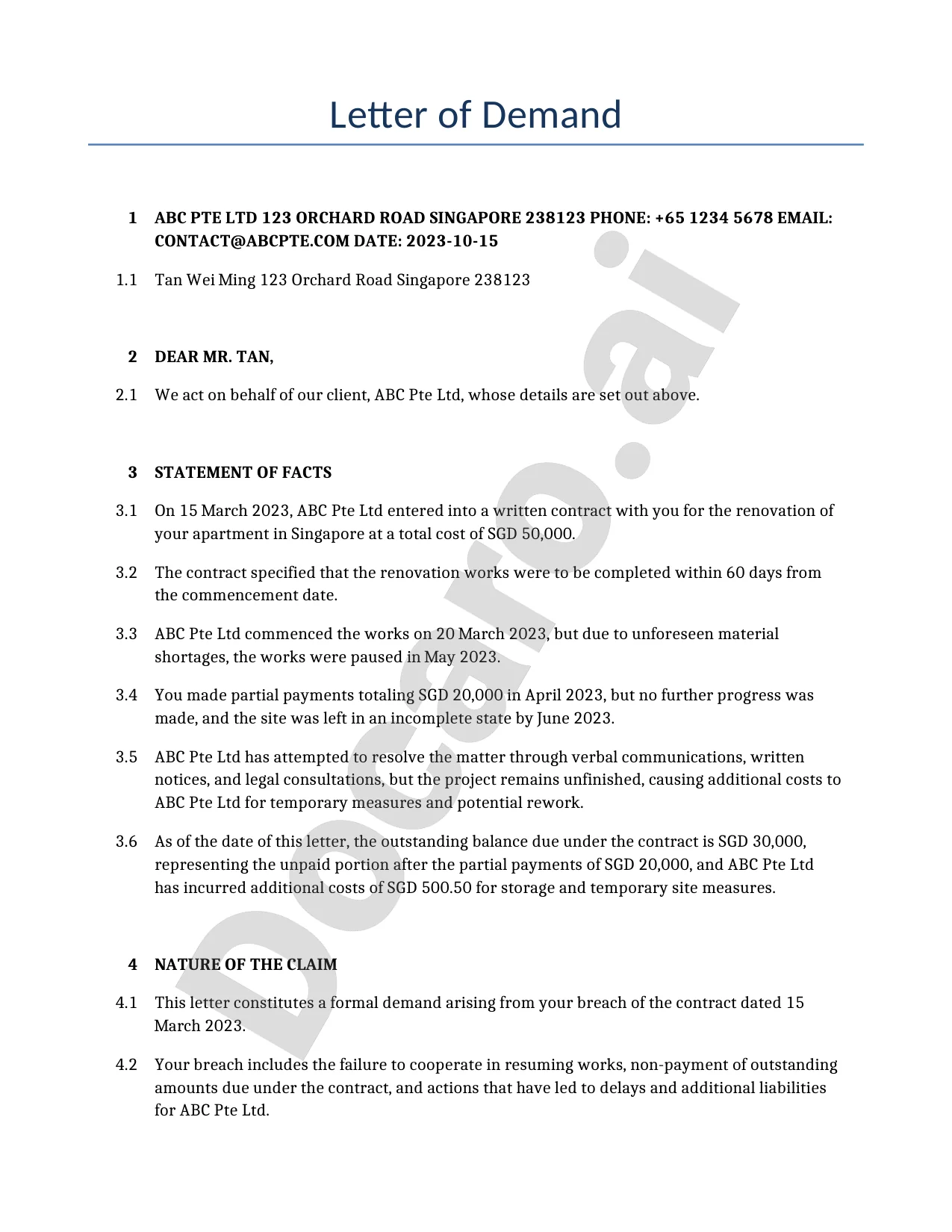
A Letter of Demand in Singapore law serves as a formal written notice sent by one party to another, demanding payment of a debt, performance of an obligation, or cessation of an unlawful act. It acts as the initial step in resolving disputes amicably, giving the recipient a clear deadline—often 7 to 14 days—to comply and avoid escalation to court proceedings.
The primary purpose of a Letter of Demand is to demonstrate the sender's serious intent to pursue legal remedies if ignored, while also providing evidence of prior notice in potential litigation under Singapore's civil procedure rules. For more in-depth details on crafting an effective Letter of Demand in Singapore, refer to our guide What is a Letter of Demand in Singapore?.
To ensure compliance with Singapore's legal standards, such as those outlined in the State Courts Act or High Court rules, it's essential to use bespoke AI-generated legal documents via Docaro rather than generic templates. This approach allows for customization to your specific circumstances, enhancing enforceability and reducing risks in debt recovery or contractual disputes.
In Singapore, issue a Letter of Demand as the essential first step in debt recovery to formally notify the debtor and lay the groundwork for legal action if needed. For a tailored document that fits your specific situation, generate it using Docaro's AI-powered service.
When should you use a Letter of Demand in Singapore?
A Letter of Demand in Singapore is an essential first step for resolving unpaid debts, where a creditor notifies the debtor of the outstanding amount and demands payment within a specified timeframe to avoid escalation.
It is also appropriate for breach of contract scenarios, such as when one party fails to fulfill agreed terms, allowing the aggrieved party to outline the violation and seek remedies like compensation or performance.
In property disputes, a Letter of Demand can address issues like unauthorized use of leased space or non-payment of rent, urging the recipient to rectify the matter promptly.
The benefits of issuing a Letter of Demand include encouraging settlement without court involvement by demonstrating seriousness, often prompting negotiation or compliance to save time and costs; for tailored documents, consider bespoke AI-generated legal documents using Docaro.
When should you avoid using a Letter of Demand?
In Singapore legal practice, a Letter of Demand should not be used when the claim is time-barred under the Limitation Act, as pursuing it could waste resources and potentially expose the sender to counterclaims for frivolous actions. This Act sets strict deadlines for filing claims, such as six years for contract disputes, making any demand futile if the period has lapsed.
Similarly, avoid issuing a Letter of Demand in criminal matters, where issues like theft or fraud require police involvement rather than civil negotiation. Attempting a demand here might interfere with criminal proceedings or dilute the severity of the offense under Singapore's Criminal Procedure Code.
When immediate injunctions are needed to prevent irreparable harm, such as stopping a breach of contract or asset dissipation, a Letter of Demand is inappropriate due to its delays. Instead, seek urgent court orders through the High Court for swift protection in time-sensitive Singapore disputes.
Using a Letter of Demand unnecessarily risks escalating disputes in Singapore, turning amicable resolutions into adversarial battles that increase legal costs and strain relationships. To mitigate this, opt for bespoke AI-generated legal documents via Docaro, tailored precisely to avoid overreach and promote efficient outcomes.

What are the key clauses to include in a Letter of Demand?
A Singapore Letter of Demand begins with the sender's details, including their full name, address, contact information, and date of the letter. This is followed by the recipient's details, such as their name, address, and any relevant identifiers, ensuring clear identification of both parties involved in the demand letter Singapore process.
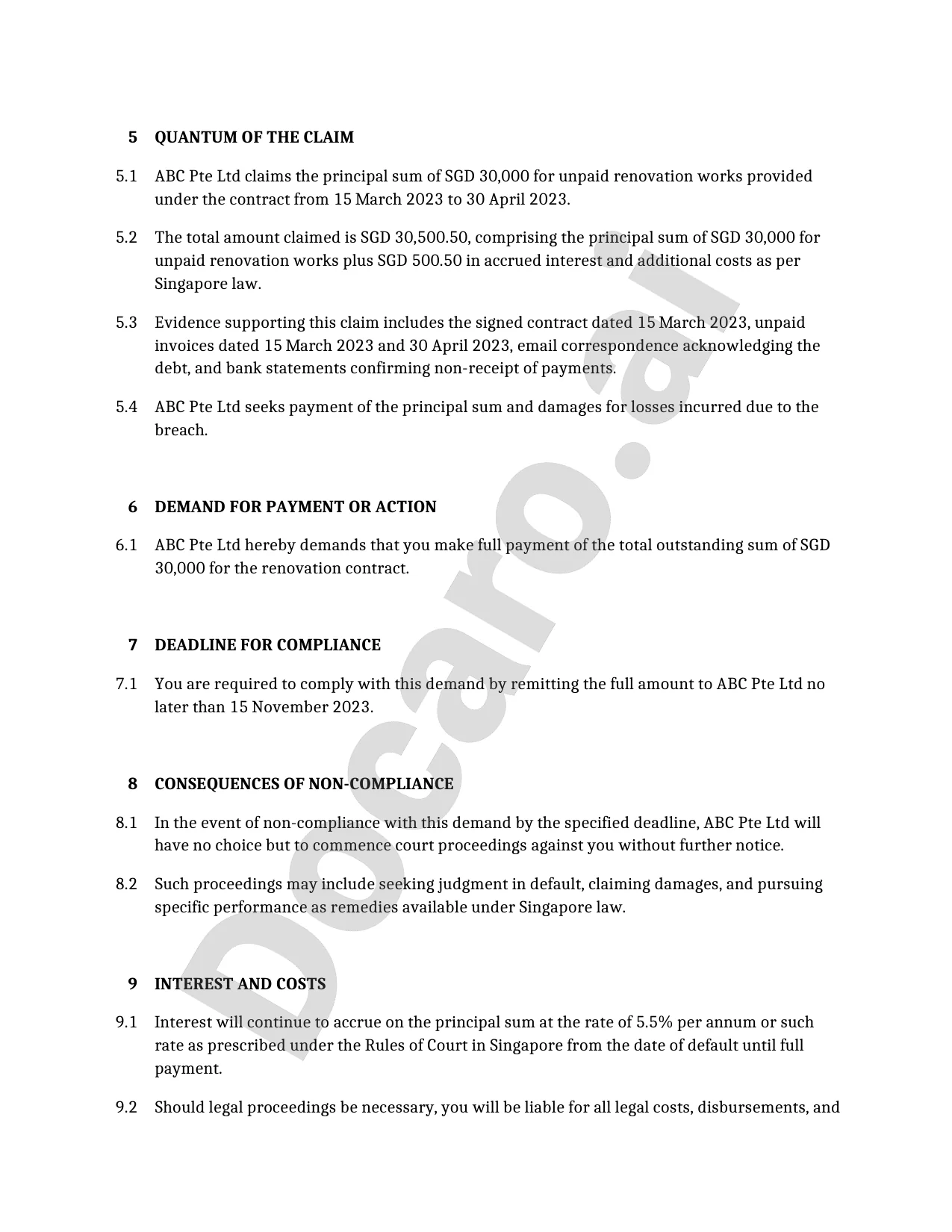
The core of the letter includes a detailed description of the claim, outlining the facts, events, and legal basis for the dispute, such as breach of contract or unpaid debts. It then specifies the amount demanded, breaking down any calculations for clarity and referencing supporting evidence where applicable.
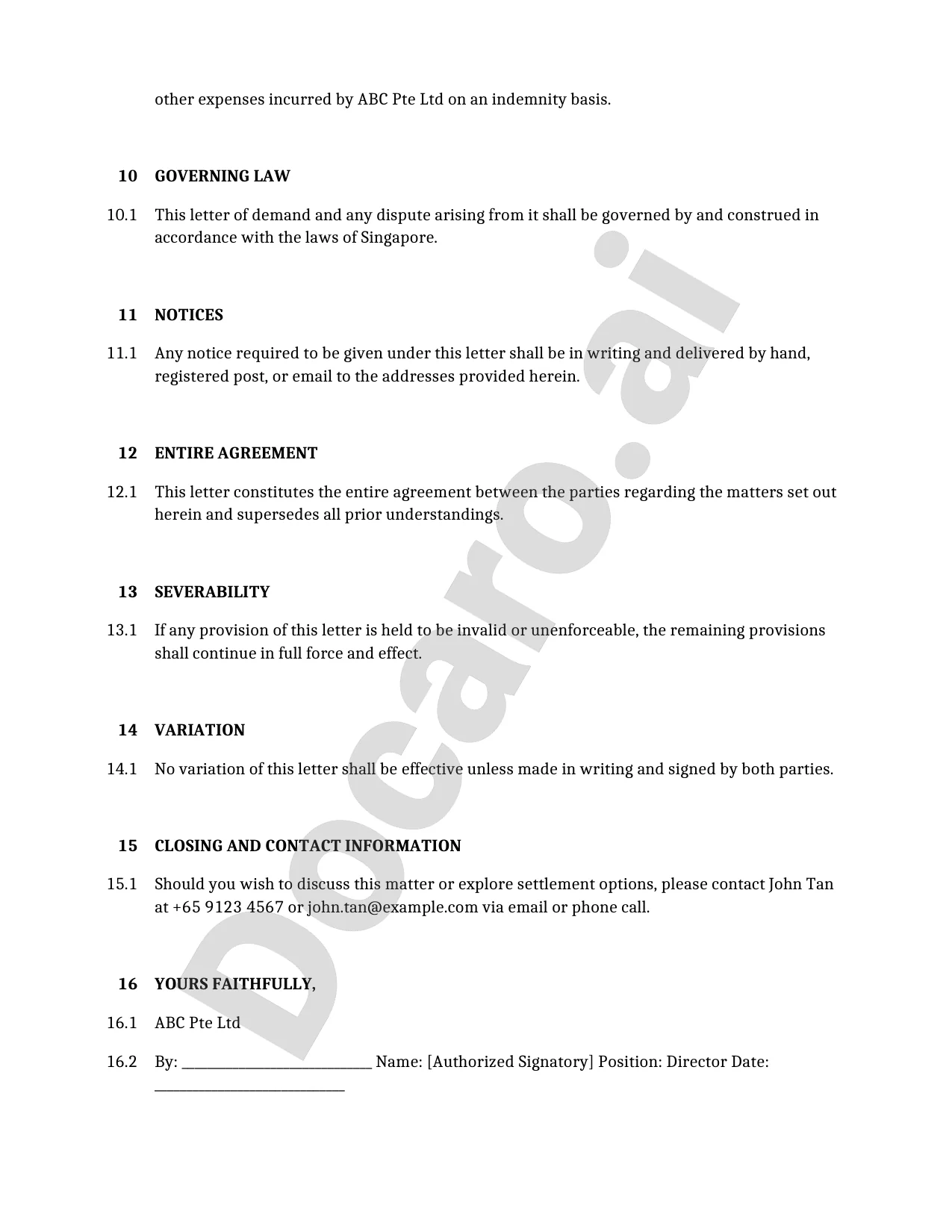
Next, the letter sets a deadline for compliance, typically 7 to 14 days, giving the recipient a reasonable timeframe to respond or settle the matter. It concludes with the consequences of non-compliance, warning of potential legal action like court proceedings or further claims for costs.
For comprehensive guidance on crafting such documents, explore our article on writing an effective Letter of Demand in Singapore. Opt for bespoke AI-generated legal documents via Docaro to ensure they are tailored precisely to your needs.
1
Identify Key Parties and Dispute
Outline the sender, recipient, and core facts of the dispute with precise details to establish context in the demand letter.
2
Draft Demand Clause Precisely
Specify the exact relief sought, including amounts and deadlines, using clear Singapore legal terminology for enforceability.
3
Include Consequences and Legal Basis
Detail repercussions for non-compliance and cite relevant Singapore statutes to strengthen the demand's authority.
4
Generate Bespoke Document via Docaro
Use Docaro to create a customized AI-generated letter of demand, ensuring tailored structure and legal precision.
What are the key rights and obligations in a Letter of Demand?
In Singapore law, the sender of a formal demand letter holds the right to demand payment for any valid claim, such as unpaid debts or contractual breaches, ensuring they can enforce their entitlements through legal channels.
Senders also have key obligations to provide accurate information, including clear details of the claim, supporting evidence, and a reasonable deadline for response, to avoid claims of misrepresentation under the Misrepresentation Act.
Recipients in Singapore must acknowledge and respond to demand letters promptly, often within the stipulated timeframe, to prevent escalation to court proceedings and potential default judgments.
Recipients possess rights to dispute the claim if the demand is unfounded, by gathering counter-evidence and seeking legal advice, potentially through mediation under the State Courts Act or filing a defense in civil litigation.
Are there any recent legal changes affecting Letters of Demand in Singapore?
In Singapore, the Insolvency, Restructuring and Dissolution Act 2018 (IRDA) has seen recent amendments that indirectly affect Letters of Demand by updating statutory demand thresholds and insolvency processes. As of November 2024, the Ministry of Law introduced the Simplified Insolvency Programme (SIP) revamp, making it a permanent feature with simplified eligibility for companies with liabilities up to $2 million, potentially influencing demand enforcement in restructuring scenarios.
COVID-19 related extensions to filing deadlines under the IRDA, such as those for the temporary SIP, expired on 28 January 2024, with no further pandemic-specific prolongations noted in 2024 or 2025. Current practices for Letters of Demand remain stable, adhering to the IRDA's core provisions on debt recovery and winding-up petitions.
For handling Letters of Demand amid these stable regulations, businesses should opt for bespoke AI-generated legal documents using Docaro to ensure tailored compliance and efficiency in Singapore's insolvency landscape.
What are common mistakes to avoid when issuing a Letter of Demand?
Preparing a Letter of Demand in Singapore requires precision to ensure it effectively prompts payment or action without escalating disputes unnecessarily. Common pitfalls include issuing vague demands that fail to specify exact amounts, timelines, or remedies, which can weaken your position and invite legal challenges.
Another frequent error is setting incorrect deadlines, such as overly aggressive timelines that disregard Singapore's legal norms under the Contracts Act or Limitation Act, potentially rendering the letter ineffective or prompting counterclaims. Always align deadlines with reasonable notice periods to maintain enforceability.
To navigate these challenges, consult resources on common mistakes to avoid in a Singapore Letter of Demand for detailed guidance: Common Mistakes to Avoid.
Opt for bespoke AI-generated legal documents via Docaro to craft tailored Letters of Demand that sidestep these pitfalls and comply with Singapore's regulatory framework.
1
Research Legal Requirements
Study Singapore's specific laws on demands, like the Limitation Act, to ensure your claim is valid and timely.
2
Gather Supporting Evidence
Collect all relevant documents, contracts, and proof of loss to strengthen your letter's credibility.
3
Generate Bespoke Document with Docaro
Use Docaro to create a customized Letter of Demand tailored to your unique situation and Singapore regulations.
4
Review and Send Professionally
Proofread for clarity and accuracy, then deliver via registered mail or email for proper record-keeping.
You Might Also Be Interested In
A Legally Binding Contract Where Parties Resolve A Dispute Without Court Proceedings, Outlining Terms Of Compromise.
A Legally Binding Document Recording The Terms Of A Settlement Reached Through Mediation In Singapore.
A Contract Where Parties Agree To Resolve Disputes Through Arbitration Rather Than Litigation.
A Formal Legal Notice Requiring The Recipient To Stop An Alleged Illegal Activity And Refrain From Future Violations.
A Formal Letter Sent To Demand Payment, Compliance, Or Resolution Of A Dispute Before Pursuing Legal Action.
A Legal Document Where One Party Agrees To Waive Claims Against Another For Potential Damages Or Injuries.
A Legal Document Where Parties Mutually Agree To Release Each Other From Claims, Obligations, Or Liabilities.
A Written Statement Confirmed By Oath Or Affirmation, Used As Evidence In Court.